Introduction
Birds are not well adapted to high ambient temperatures because they lack sweat glands. Climate changes, especially temperature variation, greatly impact chicken productivity and disease resistance. Introducing major genes of tropical interest, including Na, dw and F, to overcome heat stress in hot climates and to improve production is highly recommended. The two genes for naked neck (Na) and frizzle feathering (F) are marker genes identified by qualitative criteria (visual, biochemical and serological) that may have association with quantitative traits, due to pleiotropy or linkage with other genes (Mérat, Reference MÉRAT1990). The Na gene has received greater attention in broiler production because of its association with heat stress tolerance (Mérat, Reference MÉRAT1986; Cahaner et al., Reference CAHANER, DEEB and GUTMAN1993), which inhibits poultry productivity and immunity in hot tropical climates (Dorny et al., Reference DORNY, BAELMANS, PARMENTIER, NIEUWLAND, DEMEY and BERKVENS2005; Rajkumar et al., Reference RAJKUMAR, REDDY, RAMA RAO, RADHIKA and SHANMUGAM2011).
Information regarding haematological parameters and blood biochemical indices are essential in diagnosing various pathological and metabolic disorders in chickens. Haematological changes are routinely used to determine health status and stresses due to environmental, nutritional and pathological factors (Peters et al., Reference PETERS, GUNN, IMUMORIN, AGAVIEZOR and IKEOBI2011). Accordingly, the utilisation of naked neck and frizzle genes in high-ambient temperatures is encouraged, and, in future, are expected to play an important role in immunocompetence of layer lines suitable for overcoming such genotype-environment interaction (Thiruvenkadan et al., Reference THIRUVENKADAN, PANNEERSELVAM and PRABAKARAN2010; Rajkumar et al., Reference RAJKUMAR, REDDY, RAMA RAO, RADHIKA and SHANMUGAM2011; Mahrous and El-Dlebshany, Reference MAHROUS and EL-DLEBSHANY2011).
Blood constituents and H/L ratio
Heterophils (H) recognise pathogens by specialised receptors (pattern recognition receptors), but their principal role appears to be as scavenger cells. An additional feature of heterophils is that they increase in blood when chickens are exposed to stressors, whereas lymphocytes (L) decrease, hence the H/L ratio has been used as an index of stress response (Siegel, Reference SIEGEL1995; Fathi et al., Reference FATHI, EL-ATTAR, ALI and NAZMI2008). There is a genetic component to heterophil and lymphocyte responses to stressors (Gross and Siegel, Reference GROSS and SIEGEL1983), and their ratio has been used as a selection criterion for heat resistance in chickens (Al-Murrani et al., Reference AL-MURRANI, KASSAB, AL-SAM and AL-ATHARI1997). Under winter conditions, El-Safty et al. (Reference EL-SAFTY, ALI and FATHI2006) showed that there was no significant difference between naked neck and normal plumage hens in H/L ratio, although an increased H/L ratio was found in the normally feathered genotype. In this context, there was a significant difference between genotypes for heterophil level, where the nana hens had a higher percentage compared to Nana. Accordingly, it could be stated that the nana birds were more stressed than their Nana counterparts, and consequently the heterozygous naked neck hens had a better state of health comparatively to nana. Conversely, Nazmi (Reference NAZMI2006) found that the Nana genotype had significantly higher heterophils and lower lymphocytes percentages compared to NaNa and nana genotypes.
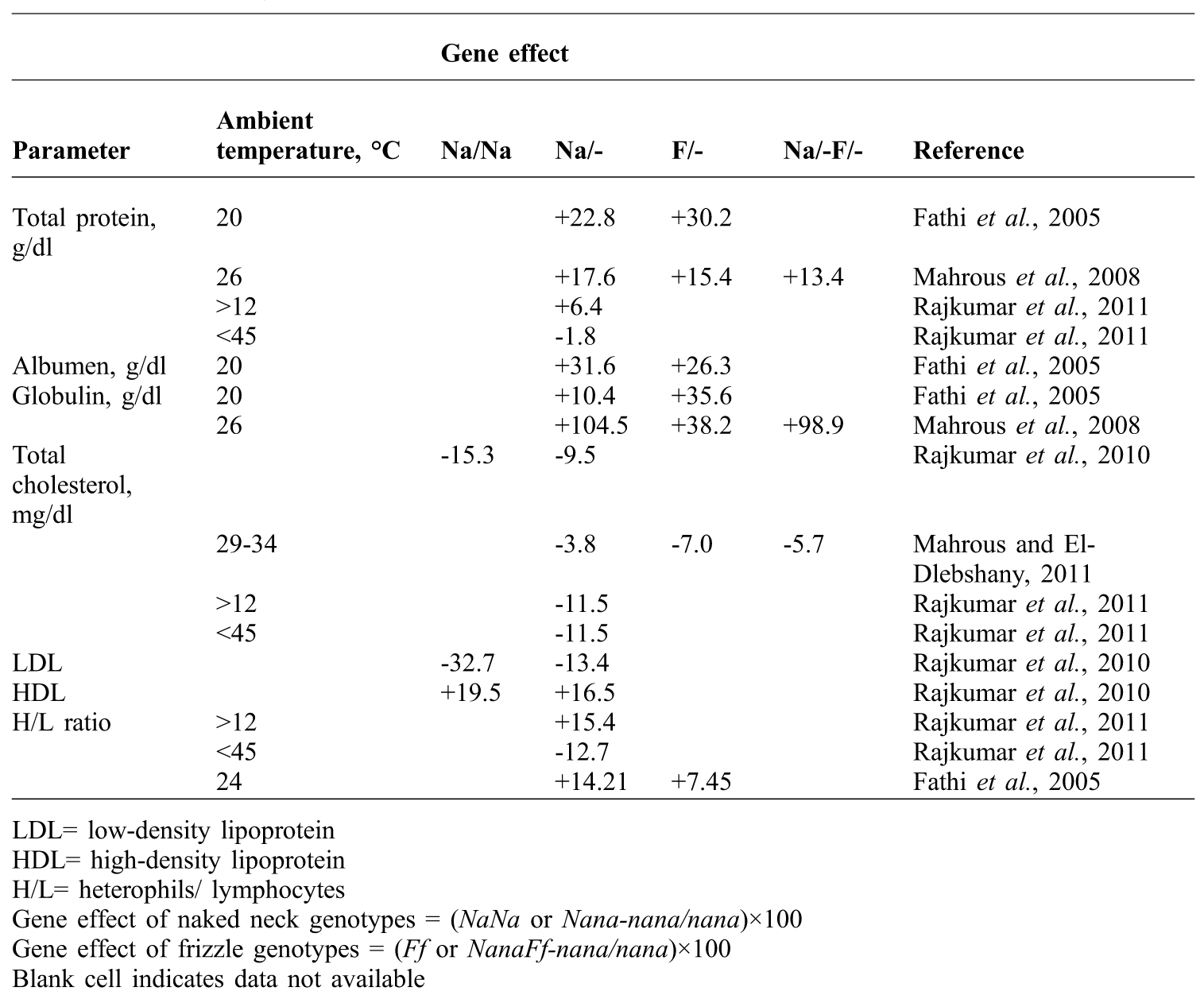
Under moderate temperatures (27ºC), Mahrous et al. (Reference MAHROUS, GALAL, FATHI and ZEIN EL-DEIN2008) revealed that the presence of the Na or F gene, either singly or interacted, significantly increased plasma total protein measured at seven days post primary SRBC injection compared to nanaff sibs. At 14 days post primary SRBC injection, both Nanaff and NanaFf genotypes had significantly higher plasma total protein compared to nanaff birds, with the nanaFf genotype being intermediate. For plasma albumen, the nanaff and nanaFf genotypes had significantly higher levels measured at all times during both primary and secondary SRBC injection compared to Nanaff and NanaFf counterparts. Conversely, the Nanaff, nanaFf and NanaFf genotypes had significantly higher plasma globulin compared to other genotypes. In accordance with Rajkumar et al. (Reference RAJKUMAR, REDDY, RAJARAVINDRA, NIRANJAN, BHATTACHARYA, CHATTERJEE, PANDA, REDDY and SHARMA2010) and Patra et al. (Reference PATRA, BAIS, PRASAD and SINGH2002), cholesterol levels were significantly lower in naked neck chicken indicating the lower proportion of fat associated with this breed compared to the normally feathered birds.
In a study by Peters et al. (Reference PETERS, GUNN, IMUMORIN, AGAVIEZOR and IKEOBI2011) on the haematological parameters of Nigerian native chickens (normal frizzle-feathered, naked-neck, and normally feathered breeds), normally feathered birds had a higher (p<0.05) packed cell volume, corpuscular volume, corpuscular haemoglobin concentration, serum glucose, urea, cholesterol, globulin and creatinine levels compared to frizzled and naked neck genotypes. Furthermore, males generally had higher values than their female counterparts across all genotypes. However, a higher haematocrit value with naked neck gene was observed (Yahav et al., Reference YAHAV, LUGER, CAHANER, DOTAN, RUSAL and HURWITZ1998; Galal, Reference GALAL2008; El-Safty, et al., 2006). Records of blood parameters according to several authors are shown in Table 1.
Summarised gene effect for Na, F and their combination for blood parameters.

LDL= low-density lipoprotein
HDL= high-density lipoprotein
H/L= heterophils/ lymphocytes
Gene effect of naked neck genotypes = (NaNa or Nana-nana/nana)×100
Gene effect of frizzle genotypes = (Ff or NanaFf-nana/nana)×100
Blank cell indicates data not available
Immunocompetence
Selection for good immune response is an important aspect in poultry breeding programs. An animal's protection from disease is based, in part, on phagocytic, cell-mediated, and humoral immunity. In birds, the heterophils are phagocytic cells whose main role is protection against invading micro-organisms, whereas the primary functions of lymphocytes involve cell-mediated and humoral immunity. Some major marker genes are believed to confer not only adaptability to the tropical climate, but also resistance to disease. Slow feathering and dwarfism genes have been evaluated for their possible influence on immunocompetence in chickens (Klingensmith et al., Reference KLINGENSMITH, DONAHOE and STREPHENS1983; Bacon et al., Reference BACON, FADLY and CRITENDEN1986) and showed no adverse effect. Other marker genes, such as Na and F have been considered during the last decade. Several studies have shown that birds bearing these genes have a better immune system and higher resistance to diseases. The findings of numerous experiments suggest that immunocompetence traits can be used in selection programs, using Na birds for improving general disease resistance as naked neck genotypes have better immunity than the normal genotypes.
lymphoid organs
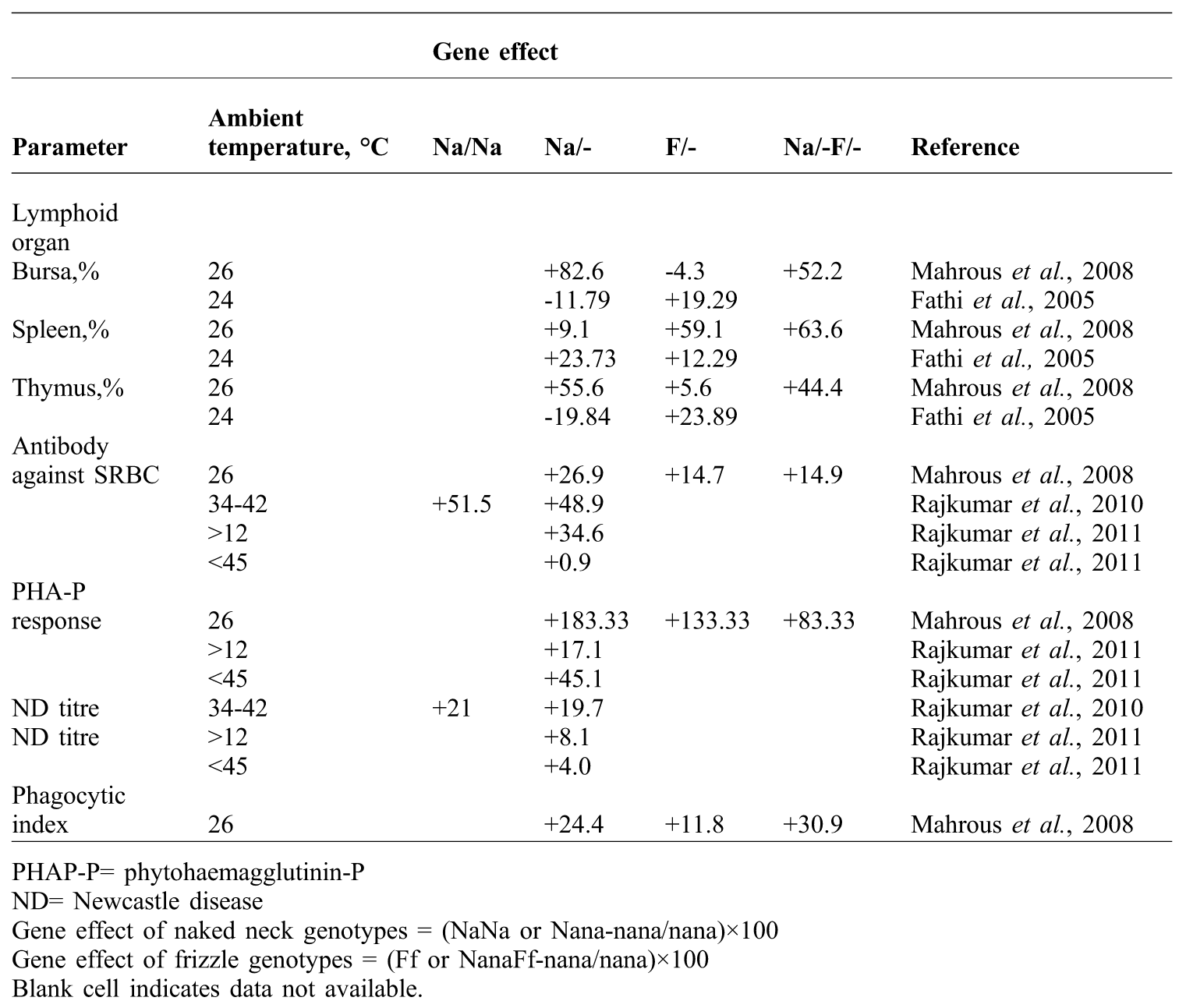
Lymphoid organs weights are easily measured and reflect the body's ability to provide lymphoid cells during an immune response. Primary and secondary lymphoid organs provide the site for the maturation of lymphocytes, and for the interaction between lymphocytes and antigens. Spleen and bursa are key organs involved in the development and differentiation of T or B lymphocytes (Eerola et al., Reference EEROLA, VEROMAA and TOIVANEN1987; Toivanen et al., Reference TOIVANEN, NAUKKARINEN and VAINIO1987), and the presence of the naked neck gene significantly decreased the relative weight of both thymus and bursa by 19.8% and 11.8% respectively, compared to normally feathered birds organs. On the contrary, the presence of the F gene significantly increased the relative weight of both thymus and bursa by 23.9% and 19.3% respectively, compared to normal type. With respect to relative spleen weight, the relative spleen weight in Na and F genotypes, was significantly higher than that of normally feathered strains by 23.7% and 12.3%, respectively compared to normally feathered birds (Fathi et al., Reference FATHI, GALAL, EL-SAFTY and ABDEL-FATTAH2005). However, Nazmi (Reference NAZMI2006) reported that there was no significant difference among NaNa, Nana and nana genotypes for relative weight of the spleen. The opposite trend was seen for relative bursa weight, whereby the presence of the Na gene in a single state significantly increased relative bursa weight compared to both homozygous dominant (NaNa) and recessive (nana) genotypes.
cell mediated immunity
The introduction of major genes is used to overcome heat stress in hot climates and to improve production, which has an impact on innate immunity, thereby affecting the immunocompetence in chickens (Dorny et al., Reference DORNY, BAELMANS, PARMENTIER, NIEUWLAND, DEMEY and BERKVENS2005). There have been indications that cell-mediated immunity (CMI) plays an important role in controlling and clearing intracellular bacterium (Kogut et al., Reference KOGUT, MCGRUDE, HARGIS, CORRIER and DELOACH1994; Reference KOGUT, MCGRUDE, HARGIS, CORRIER and DELOACH1995). Selection for cellular responsiveness could enhance resistance to coccidiosis (Parmentier et al., Reference PARMENTIER, YOUSIF-ABUZEID, VRIES-REILINGH, NIEUWLAND and GRAAT2001).
In general, many reports state that the presence of Na gene increased cell mediated responses. Nazmi (Reference NAZMI2006) and Galal (Reference GALAL2008) showed that homozygous naked neck birds had a higher responder to phytohaemagglutinin-P (PHA-P) challenges compared with both heterozygous and normally feathered genotypes. These differences were statistically significant (p<0.05) at 48 and 72 hr post PHA-P-injection. Similarly, El-Safty et al. (Reference EL-SAFTY, ALI and FATHI2006) observed that Nana laying hens had a significantly greater dermal swelling response to PHA-P compared to normally feathered hens. Alvarez et al. (Reference ALVAREZ, CARRASCO, TATO and TÉLLEZ2002) considered Nana birds to have better cellular and humoral responses than their normally feathered (nana) and homozygous NaNa genotypes. Likewise, Alvarez et al. (Reference ALVAREZ, LEDESMA, TELLEZ, MOLINARI and TATO2003) showed that Nana chickens are the most resistant to Salmonella gallinarum (SG) infection and are better responders to vaccination with SG antigens compared to NaNa and nana sibs. In broiler breeds, Patra et al. (Reference PATRA, BAIS, SHARMA, SINGH, PRASAD and BHUSHAN2004) reported significantly higher CMI estimates in Nana and NaNa genotypes compared to nana. However, contradictory information is available with respect to the influence of the Na gene on immunity (Haunshi et al., Reference HAUNSHI, SHARMA, NAYAL, SINGH and SINGH2002; Kaufman, Reference KAUFMAN2008).
In an experiment conducted to study the effect of Na and F interaction, Fathi et al. (Reference FATHI, GALAL, EL-SAFTY and ABDEL-FATTAH2005) reported that CMI response was found to be significantly higher in naked neck (Nanaff) and frizzled (nanaFf) genotypes at all interval times as compared to normally feathered (nanaff) birds. On the other hand, Martin et al. (Reference MARTIN, GROSS and SIEGEL1989) and Haunshi (Reference HAUNSHI1999) reported that the naked neck and frizzle genes did not significantly affect CMI response to concanavalin A.
antibody response against sheep red blood cells
Immunological memory is an important mechanism for long-term maintenance of protective immunity against formerly encountered pathogens. The response against sheep red blood cells (SRBC) immunisation is considered a T-dependent antigen. The majority of relevant reports have shown that naked neck and frizzle genotypes have higher antibody production against SRBC. Under Egyptian conditions, Fathi et al. (Reference FATHI, GALAL, EL-SAFTY and ABDEL-FATTAH2005), and Galal and Mahrous (Reference GALAL and MAHROUS2011) showed that the heterozygous naked neck genotype had significantly (P<0.05) higher total antibody titres to SRBC compared to normally feathered counterparts. Likewise, Rajkumar et al. (Reference RAJKUMAR, REDDY, RAJARAVINDRA, NIRANJAN, BHATTACHARYA, CHATTERJEE, PANDA, REDDY and SHARMA2010) reported that the humoral response, as measured by antibody titre to SRBC, was significantly higher in NaNa compared to Nana and nana genotypes. Amongst the Indian native breeds, Kundu et al. (Reference KUNDU, SINGH, MOHAPATRA, DASH, MOUDGAL and BISHT1999) found that naked neck birds had the highest titre to sheep erythrocytes on day five post-immunisation. Conversely, humoral assays have indicated that there were no significant differences for antibody response to a multi-determinant antigen, such as SRBC, in heterozygous naked neck and frizzled birds when compared with normally feathered counterparts. However, the titres were lower in heterozygous naked neck birds (Haunshi et al., Reference HAUNSHI, SHARMA, NAYAL, SINGH and SINGH2002(.
phagocytic activity
Many reports have indicated that the birds carrying the Na gene had more resistance against bacterial, viral and parasitic infections. Qureshi et al. (Reference QURESHI, YU and SAIF2000) reported that birds with higher macrophage phagocytotic potential and nitrite production had better protection against internal organisms infections. Cheng and Lamont (Reference CHENG and LAMONT1988) suggested that phagocytosis may be under the influence of the B complex. Under high environmental summer conditions in Egypt, Fathi et al. (Reference FATHI, GALAL, EL-SAFTY and ABDEL-FATTAH2005), Nazmi (Reference NAZMI2006) and Galal and Mahrous (Reference GALAL and MAHROUS2011) found that the Nana genotype had significantly lower levels of carbon in their circulation as compared to nana birds. These results indicated that the mononuclear phagocytic index for naked neck birds was more efficient than those for normally feathered genotypes. However, Haunshi et al. (Reference HAUNSHI, SHARMA, NAYAL, SINGH and SINGH2002) did not detect a difference between naked neck and normally feathered genotypes for phagocytotic ability. Records of immune response according to several authors are shown in Table 2.
Summarised gene effects for Na, F and their combination for lymphoid organs and immune response.
PHAP-P= phytohaemagglutinin-P
ND= Newcastle disease
Gene effect of naked neck genotypes = (NaNa or Nana-nana/nana)×100
Gene effect of frizzle genotypes = (Ff or NanaFf-nana/nana)×100
Blank cell indicates data not available.
Conclusions
Although benefits in immunocompetence have been reported in the last twenty years for birds carrying the Na and F genes, especially those reared under sub-tropical or tropical conditions, some areas remain to be clarified - as reports vary on levels of effectiveness. However, the beneficial results obtained indicate that including naked neck and frizzle genes in birds destined for production in such climates is to be encouraged, as they are expected to play an important role in immunocompetence both in layer and broiler chickens.
Acknowledgements
This paper would not have been possible without all faculty staff of poultry breeding and genetics at Ain Shams University, Cairo, Egypt. The authors are grateful to farm workers for their effort, patience and love during the long time of extensive experimental work.