Introduction
Leafhoppers (Homoptera: Cicadellidae) are abundant and widespread phytophagous insects that chiefly inhabit paddy plants and grasses (Krishnankutty and Viraktamath, Reference Krishnankutty and Viraktamath2008) and cause serious injury to several host plants of Gramineae (e.g. sugarcane, barley, wheat, sorghum; Young, Reference Young1979; Heinrichs and Barrion, Reference Heinrichs, Barrion and Hettel2004). They are abundant in rice-growing areas across the Oriental, Afrotropical and Australian regions (Kamitani et al., Reference Kamitani, Kahono, Ubaidillah, Herwint and Partomihardjo2004). Cofana spp. are abundant in different regions of India such as West Bengal, Northeast and southern states (CAB International, 2007). Two species, Cofana spectra (Distant) and Cofana unimaculata (Signoret), are considered as minor pests of rice in West Bengal (Reynolds et al., Reference Reynolds, Mukhopadhyay, Riley, Das, Nath and Mandal1999). The plant systems undergo damage as a result of extensive feeding and oviposition by C. spectra followed by secondary fungal and bacterial attacks on the affected area. Cofana spectra is also a vector of pathogenic viruses such as Rice yellow mottle virus (RYMV) in West Africa (Nwilene et al., Reference Nwilene, Traore, Asidi, Sere, Onasanya and Abo2009). The RYMV pathogen belongs to the genus Sobemovirus and is transmitted mechanically through rice plant injuries and by insect vectors (Abo et al., Reference Abo, Sy and Alegbejo1997). Low white leafhopper (WLH) infestation results in reduced tillering, moderate infestation causes loss of ear production and browning of leaves, and severe infestation results in the death of the paddy plants (Sam and Chelliah, Reference Sam and Chelliah1984). In Africa, WLHs (Cofana spp.) are more abundant than green leafhoppers (Nephotettix spp.), and some are important paddy pests (Heinrichs and Barrion, Reference Heinrichs, Barrion and Hettel2004). Among them, C. spectra and C. unimaculata are major pests in West Africa (Oyediran et al., Reference Oyediran, Ndongidila and Heinrichs2000). In the warm and humid tropics, leafhopper and planthopper species remain active throughout the year, and the proportion of populations fluctuates according to the availability of the food plant, the presence of natural enemies and environmental conditions (Pathak and Khan, Reference Pathak and Khan1994).
Among the natural enemies of leafhoppers, members of the genus Halictophagus Curtis, belonging to the cosmopolitan obligate endoparasitoid Strepsiptera, may be considered as important ones. The genus Halictophagus is represented by eight species from India, of which Halictophagus australensis Perkins is distributed in the regions of Southeast Asia, Japan, Australia and India. The host of this endoparasitoid has now been established as C. spectra. The host species is also widely distributed over the same area as the parasitoid (Kathirithamby, Reference Kathirithamby1992; Mazumdar and Chaudhuri, Reference Mazumdar and Chaudhuri2004). The percentage of stylopization of leafhoppers varies from 1 to 63% according to season (Miura et al., Reference Miura, Hirashima and Wongsiri1978; Peña and Shepard, Reference Peña and Shepard1986). Hirashima and Kifune (Reference Hirashima and Kifune1978) first reported the parasitization of C. spectra by Halictophagus spectrus Yang in the regions of Sarawak, Malaysia. Barrion and Litsinger (Reference Barrion and Litsinger1983) listed several natural enemies that attacked the hopper, showing a 11–50% variation in stylopization depending on different biological and environmental factors such as host population, weather, rice cultivar, the age of the paddy plants and the time of occurrence.
The aim of this study was to estimate the number of C. spectra in a field and the relative number of this species infected by the strepsipteran parasitoid. The temporal variation in the abundance of C. spectra would help to elucidate its relative importance as a paddy pest. Furthermore, an estimate of the ratio of infected and normal C. spectra would help in understanding the dynamics of the host (C. spectra) and the parasitoid (Strepsiptera) under natural conditions. Environmental parameters such as temperature, relative humidity and rainfall were also recorded to evaluate the correlation between pest and parasitoid abundance.
Materials and methods
Study area
The study was conducted in a lowland area (23°15′09.8″N and 87°50′40.5″E) at the Crop Research and Seed Multiplication Farm, University of Burdwan, Golapbag, Burdwan District, West Bengal.
Rice paddy cultivation
Rice paddy is mainly cultivated during the monsoon season (aman crop). The subsequent paddy crop is sown during winter (boro crop). The area experiences a monsoon rainfall pattern; during erratic rainfall periods, fields are irrigated by an underground water source. The boro crop is cultivated from the last week of January to mid May, whereas the aman crop is cultivated from the third week of July to mid December. Generally, rice varieties grown during the monsoon season are IR 36 and IE8-4786. The rice variety MTU-7029 is sown during the winter season.
Insect sampling
Sampling was conducted between January 2004 and December 2007 to record the seasonal variation in the relative abundance of C. spectra and its status of infection by the strepsipteran parasitoid (number of cropping seasons: two per year, i.e. total 8 in 4 years). For each month, sampling was conducted for a total of 16 days. A pilot study was conducted to initially detect the insect orders affected by the Strepsiptera and thereafter the sampling continued for C. spectra.
The insects were collected through sweep nets (mesh size 200 μm) in the rice fields under study. The collected insects were brought to the laboratory for observing the parasitized conditions. The parasitized hopper hosts (male/female) could be easily detected by the presence of extruded pupal cases of male Strepsiptera and extruded adult larviform female cephalothoraxes in the host cuticle. Furthermore, C. spectra were dissected randomly to record the juvenile stages of the Strepsiptera residing within the haemocoel to ascertain the infected hosts.
Data analysis
Data on the temperature and relative humidity of the study sites were recorded during the sampling events. The monthly data on rainfall were obtained from the meteorological office at the University's Crop Research and Seed Multiplication Farm.
The correlation between the environmental variables and the relative abundance of C. spectra was evaluated. Regression equations were constructed following the method of Zar (Reference Zar1999) to investigate the observed variations due to the environmental factors and parasitization by H. australensis.
Data on seasonal abundance were subjected to the regression analysis using the software Addinsoft (XLSTAT, version 2009; Addinsoft, France) to justify the variation in the relative abundance of normal and infected C. spectra following the method of Krebs (Reference Krebs1999).
Results
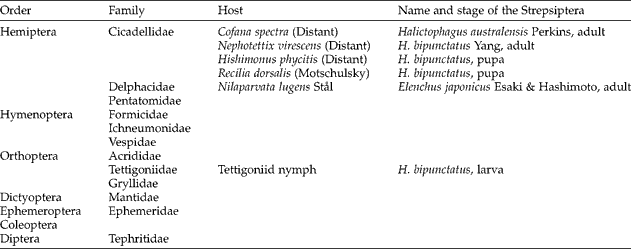
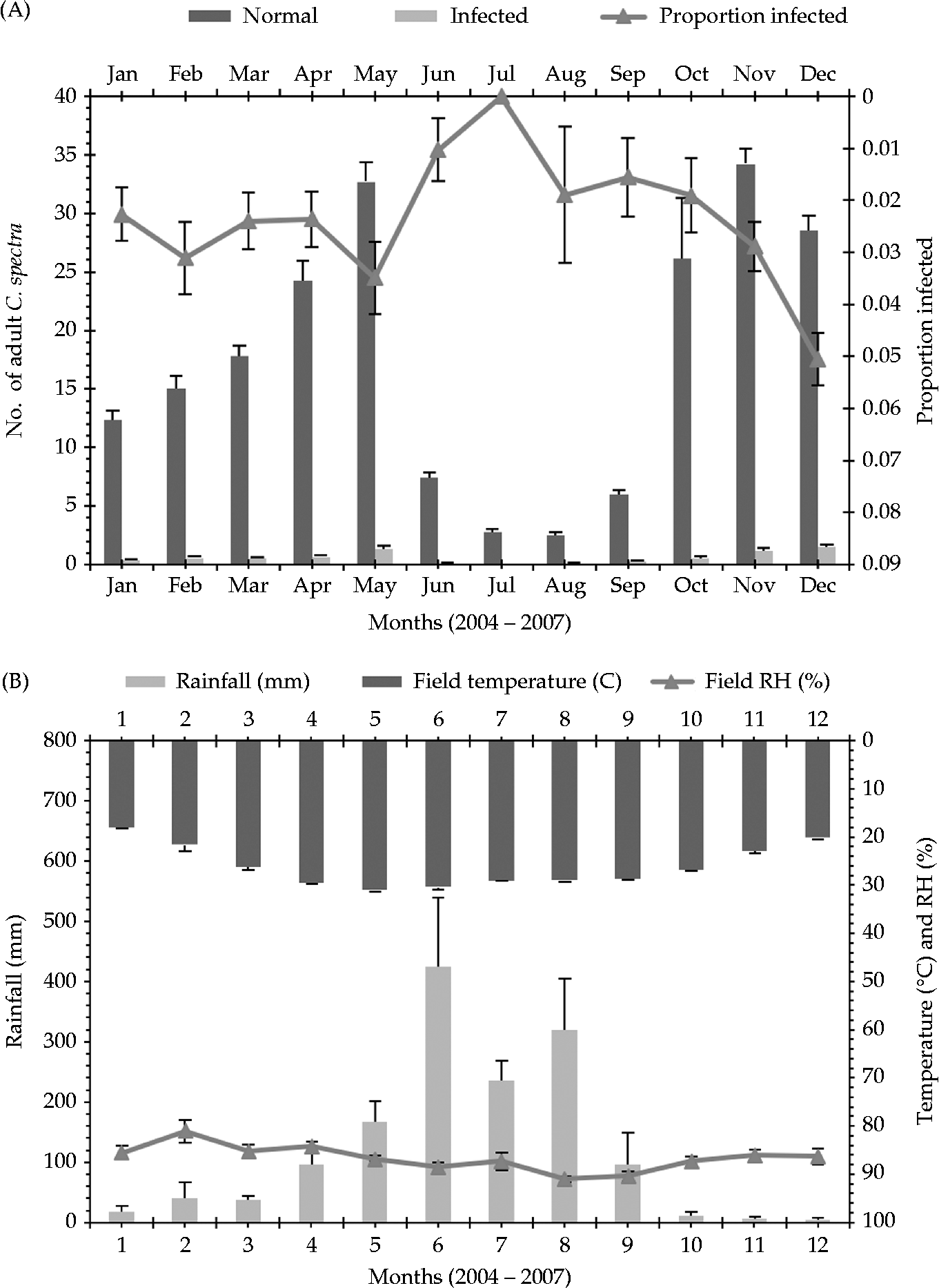
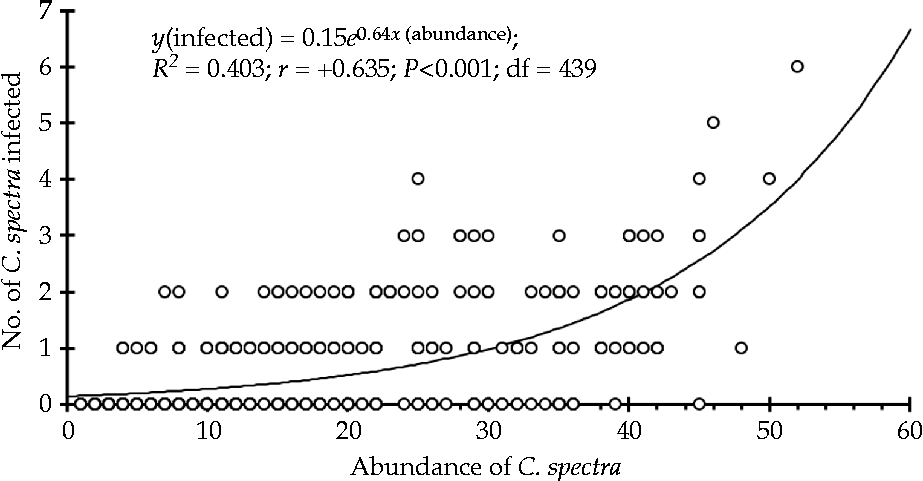
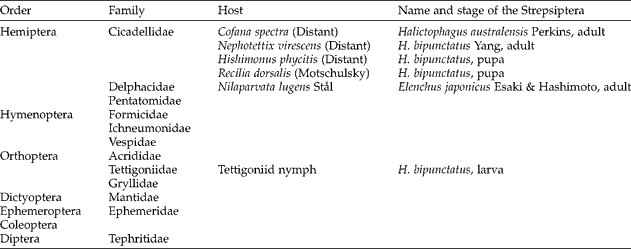
During the study, besides the host C. spectra, other homopteran rice pests such as Nephotettix virescens (Distant), Recilia dorsalis (Motschulsky), Nilaparvata lugens Stål and members of several insect families were screened for stylopization (Table 1). It was observed that C. spectra was parasitized by H. australensis Perkins, N. virescens by H. bipunctatus Yang and N. lugens by Elenchus japonicus Esaki & Hashimoto. The number of normal adult C. spectra collected from the field ranged between 2.82 ± 0.17 in July and 34.18 ± 1.29 in November (N= 38,400, 16 days/month and 50 sweeps per day, 48 months, 2004–2007). The number of infected adult C. spectra ranged from 0 in July to 1.57 ± 0.18 in December (Fig. 1A). The number of infected individuals seemed to be low since the first–fifth larval instars of the strepsipteran parasitoids remained in the haemocoel of adult C. spectra and thus the hosts were considered asymptomatic. The seasonal variation in the relative abundance of the normal and infected C. spectra is shown in Fig. 1B. It is evident that the relative abundance of C. spectra varied between months per year, with two peaks coinciding with the general paddy cultivation system. The relationship between the number of the normal and infected C. spectra can be presented through the regression equation (Fig. 2) as:
 $$\begin{eqnarray} Y \ (infected) = 0.15\, e ^{0.64 x \,\,(abundance)};\ R ^{2} = 0.403;\ r = + 0.635;\ P < 0.001;\ df = 439, \end{eqnarray}$$
 $$\begin{eqnarray} Infected\ ( Y ) = 0.05\times normal\ ( X ) - 0.17;\ r ^{2} = 0.367;\ df = 1441;\ F = 256.22;\ P < 0.001. \end{eqnarray}$$
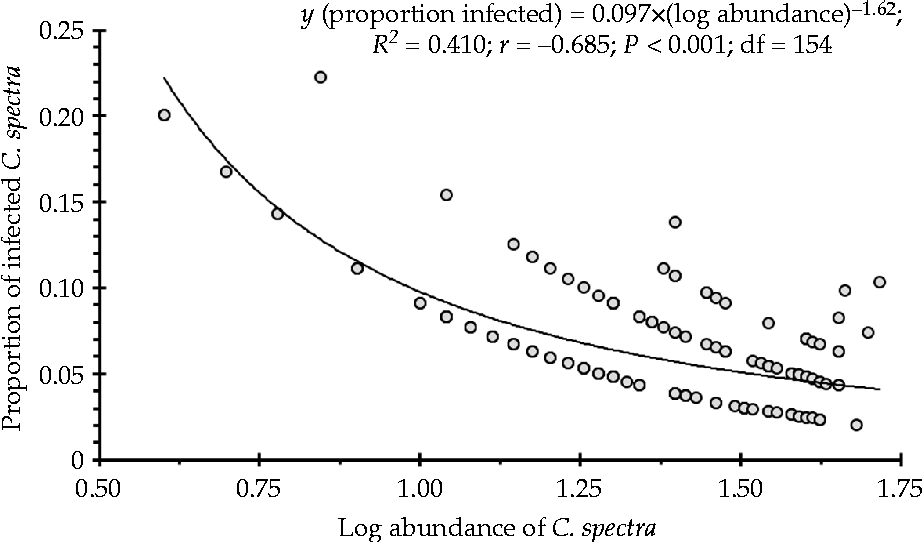
The two variables are positively correlated (r= +0.606; P< 0.001), suggesting that the abundance of C. spectra increases the probability of parasitized WLHs. The relationship between the normal C. spectra and the proportion of infected C. spectra (Fig. 3) is represented as:
 $$\begin{eqnarray} Y \,(proportion\ infected) = 0.097\times (normal)\, X ^{ - 1.62};\ R ^{2} = 0.410;\ r = - 0.685;\ P < 0.001;\ df = 154, \end{eqnarray}$$
 $$\begin{eqnarray} Proportion\ infected\ ( Y ) = 0.001\times \,normal\,( X ) + 0.01;\ r ^{2} = 0.075;\ F = 35.7;\ P < 0.001. \end{eqnarray}$$
These two variables are positively correlated (r= +0.274; P< 0.001).
Insect orders examined for strepsipteran parasitoids
(A) Monthly (mean ± SE) variation in the number of normal and infected Cofana spectra. The line represents the proportion of individuals that were infected by Strepsiptera. (B) Variation (mean ± SE) in air temperature, relative humidity (RH) and rainfall during the same period.

Relationship between the normal and infected C. spectra collected from the field during 2004–2007. The infected individuals are expressed as a function of normal C. spectra collected from the study site.
Relationship between the normal C. spectra and the proportion of infected C. spectra collected from the field during 2004–2007. The proportion of infected individuals is expressed as a function of normal C. spectra collected from the study site.
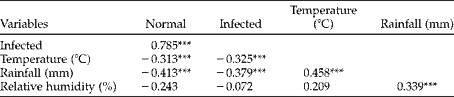
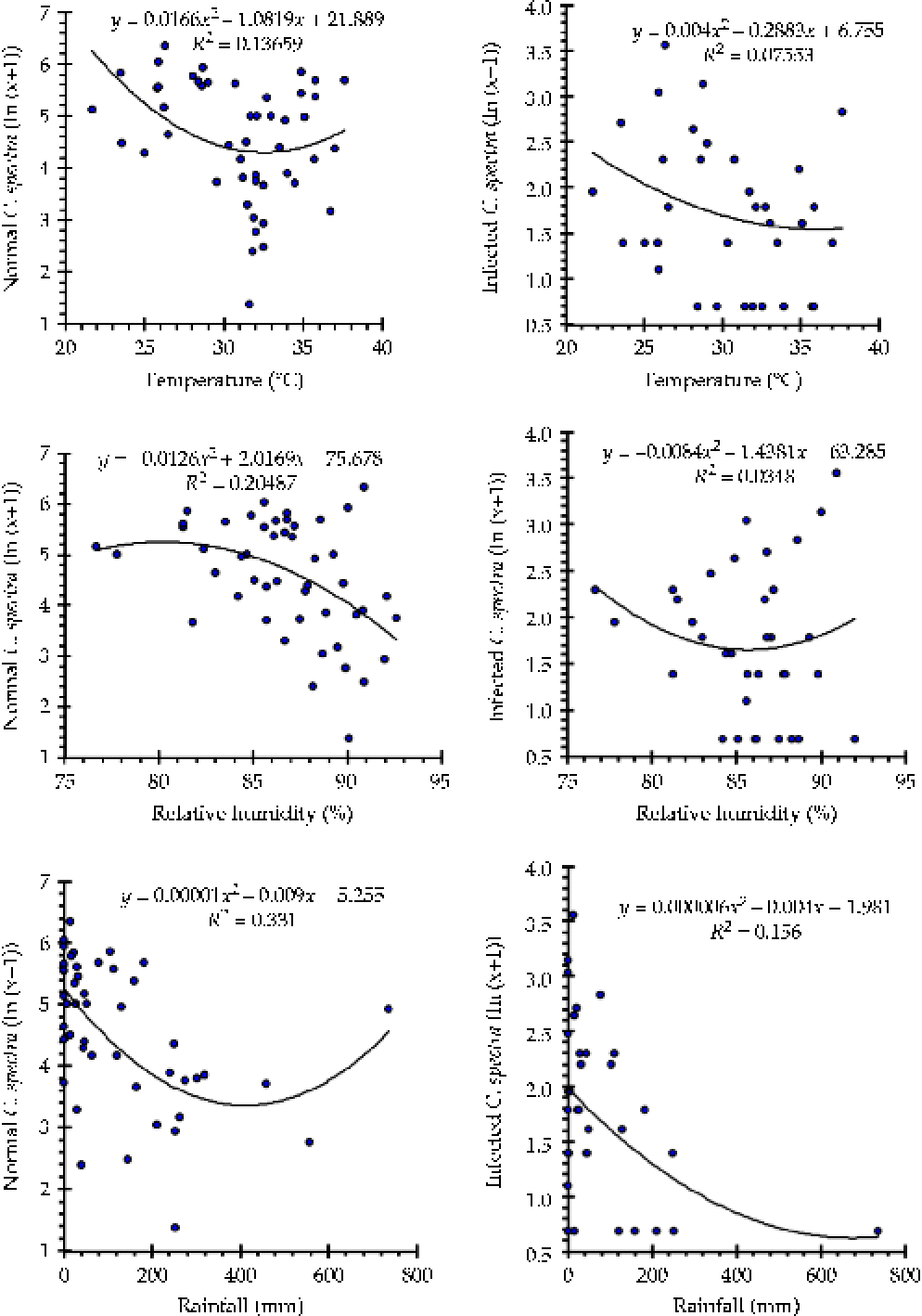
The relationship between the environmental variables and the relative abundance of C. spectra and the correlations between these variables are presented in Tables 2 and 3 and Fig. 4. It can be concluded that the impact of parasitization by the strepsipteran parasitoid is also confirmed by the multiple regression equations, where relative humidity seems to be an important factor for differentiating the abundance of the normal and infected C. spectra. It was observed that, although the number of collected C. spectra remained high, the percentage of parasitized WLHs did not increase proportionately, reflected by the low r 2 value (coefficient of determination; Zar, Reference Zar1999). The reason being that external manifestation of C. spectra was considered as an indication of parasitization by the strepsipteran parasitoid. From a sample of 274 (155 male, 119 female) infected C. spectra, 221 exhibited monostylopism, 41 double stylopism, 9 triple stylopism, 2 tetrastylopism and 1 nonastylopism. The larval stage of the parasitoid resides in the haemocoel of the host, whereas adult female cephalothoraxes and male pupal cases extrude through the arthroidial membrane. The laboratory analysis revealed that the female H. australensis always made its exit ventrally and the male dorsally, with no exception in the case of polystylopism. Among the 345 parasitoids of adult C. spectra, 17 were larval, 176 were male and 152 were female H. australensis.
Correlation coefficients between the different variables considered in the regression analysis
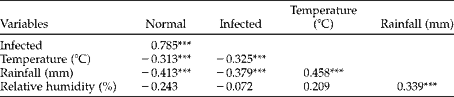
*** Values were significant at P< 0.001 (df = 47).
Multiple linear regression equation between the environmental variables and the abundance of Cofana spectra

RH, relative humidity.
(colour online) Scatter plot representation of the relationship between the abundance of C. spectra (normal and infected) with the environmental variables.
Discussion
The density of normal and strepsipteran-infected WLHs varied between months, which is in agreement with the observations reported by Peña and Shepard (Reference Peña and Shepard1986), Litsinger et al. (Reference Litsinger, Canapi, Bandong, Lumaban, Raymundo and Barrion2009) and Oyediran et al. (Reference Oyediran, Ndongidila and Heinrichs2000) in different geographical locations. The abundance of C. spectra varied throughout the seasons, i.e. the decrease was significant during June to September while the maximum increase occurred in May and November. The observations on the abundance of C. spectra and the pattern of parasitization suggest that the strepsipteran parasitoid partly bears an impact on the population level of WLHs. A similar effect of the strepsipteran parasitoid on N. lugens was observed in the regions of Malaysia by Kathirithamby (Reference Kathirithamby1985), and on N. lugens and Sogatella furcifera Horváth in the regions of Sri Lanka by Otake et al. (Reference Otake, Somasundaram and Abeykoon1976). Besides the parasitoids, environmental factors probably affected the availability of WLHs in the field. Rainfall has a direct effect on the increase in vegetation cover and the moisture content of the habitat, and may be a key feature in determining the abundance and community composition of WLHs. It is evident that in summer (drought), vegetation decreases significantly and the winter season has an effect on the egg-hatching and nymphal development (Masters et al., Reference Masters, Brown, Clarke, Whittaker and Hollier1998) of homopteran insects. The parameters, namely air temperature, relative humidity and rainfall, exhibited negative correlations (Fig. 3) with the abundance of C. spectra in the rice field. It has been reported that Strepsiptera has a very close relationship with their host and their reproductive rates exhibit a density-dependent relationship with the host (Greathead, Reference Greathead1970). Several aspects of biology and the incidence of parasitization by H. australensis have been studied in C. spectra (Chaudhuri and Mazumdar, Reference Chaudhuri and Mazumdar2000). A positive correlation has been observed in the relative abundance pattern of the parasitoid (H. australensis)-infected host and the normal host, but the differential effects of environmental factors on these two forms remain obscure. However, the multiple regression equation provides a preliminary clue that the infected C. spectra can tolerate higher relative humidity compared with the normal one. Host availability is expected to vary depending on the spatial and structural aspects of the host's environment, and these aspects affect the foraging efficiency of the parasitoid. Foraging efficiency of the parasitoid, and hence reproductive success, is likely to be less in complex and heterogeneous environments than in more simple and homogeneous environments (Jervis et al., Reference Jervis, Ellers and Harvey2008). In addition, strepsipterans do not exhibit a high percentage of parasitism due to their low searching ability (Buschbeck et al., Reference Buschbeck, Ehmer and Hoy2003) and the short lifespan of triungulins (Chandra, Reference Chandra1980). Finally, it may be concluded that the effect of parasitization by the Strepsiptera may be one of the factors responsible for suppressing the population levels of C. spectra in the field.
Acknowledgements
The authors are indebted to Professor P. K. Chaudhuri, former Professor of the Department of Zoology, University of Burdwan, for identifying the parasitoid species and for rendering valuable suggestions, and to the Head of the Department of Zoology, University of Burdwan for providing laboratory facility sponsored by the DST-FIST. The authors also thank Dr G. Aditya, faculty member of the Department of Zoology, University of Burdwan for statistical work.