Introduction
The provision of medical care in the wake of major disasters is challenging. Loss of infrastructure, population displacement, inter-agency coordination, variable record keeping, and unstable staffing patterns are some of the hurdles to providing adequate health care in crisis zones.Reference Chan, Alagappan and Gandhi1 The earthquake in Haiti on January 12, 2010 was no exception.
The World Health Organization (WHO) estimated that there were >200,000 immediate quake-related deaths and >300,000 injured survivors.2 Thousands of those injured underwent amputations or complex orthopedic surgery, in a setting with little preexisting medical infrastructure. The number of children orphaned by the earthquake still is unknown, and at the time of this writing, >1 million people remained in temporary shelters.3 Thousands of medical and relief volunteers worked in hundreds of sites across the island. Significant coordination and accountability challenges accompanied this response.
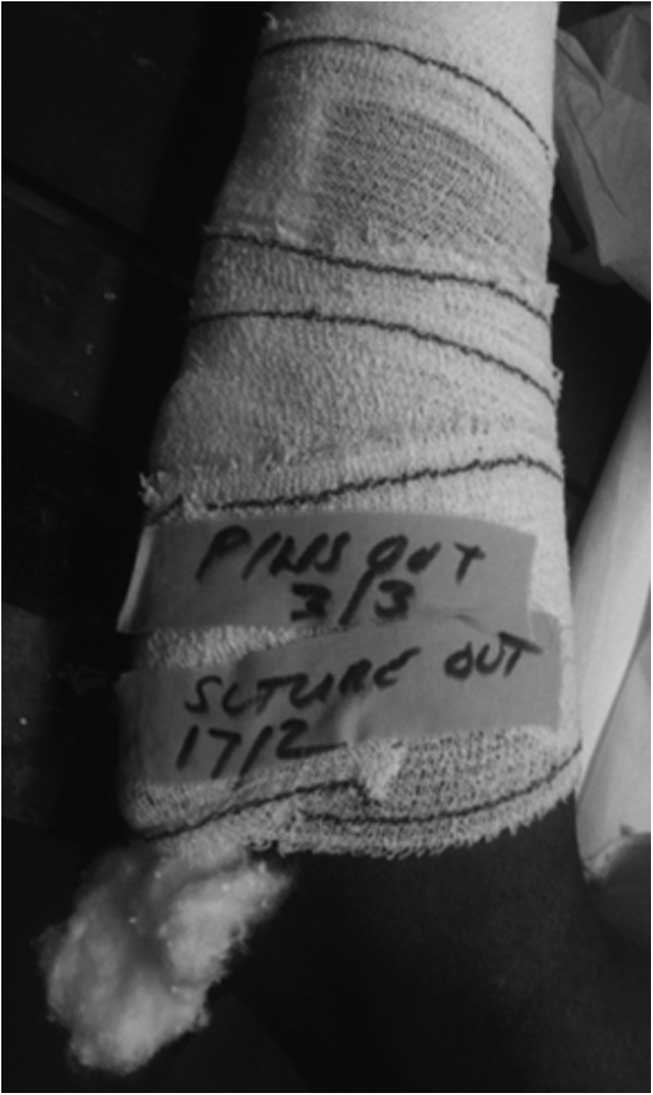
Advances in mobile technology may provide a platform to organize medical resources and improve patient care in the disaster setting.Reference Nudell4 Current mobile technology platforms can assist with rapid triage, patient tracking, and medical record maintenance.Reference Killeen, Chan and Buono5, Reference Crawford, Gao and White6 The technology exists to better integrate the delivery of care after disasters like the earthquake in Haiti. However, patients continue to transfer among field hospitals with little more than a short medical summary written on their casts (Figure 1). Recent consensus statements call for an interoperable patient tracking system that can function in the absence of local infrastructure and focus on children separated from their parents.Reference Blake and Stevenson7, Reference Maltz, Ng and Li8
Example of medical recordkeeping in post-earthquake Haiti

In the acute relief phase of disaster response (the first days to weeks post-event), the loss of infrastructure and massive influx of volunteers creates a complex management environment. Mobile health (mHealth) information technology platforms can create a common operational framework that improves disaster response by standardizing data acquisition, organizing information storage, and facilitating medical communication. Specifically, mHealth technology systems can improve post-operative care and patient handoffs between volunteer providers. In addition, they provide field hospital administrators with real-time census information essential for planning, resource allocation, inter-facility patient transfers, and inter-agency collaboration. Above all, mHealth can harness the power of information to improve patient outcomes.
It was hypothesized that mobile health information technology could improve the provision of care in the immediate post-event setting. The goal of this study was to simultaneously develop, deploy and evaluate a novel electronic patient medical record and tracking system. The immediate mission was to improve patient care, with the secondary purpose of evaluating the advantages and limitations of mobile technology in a disaster setting.
Methods
Setting
The role of mHealth technology was tested at a large field hospital in Fond Parisien (FDP), Haiti. The effects of the mHealth application on provider triage, post-operative care, patient handoffs, patient tracking, protection of unaccompanied minors, and field hospital administration were evaluated.
The FDP Disaster Rescue Camp was established seven days after the earthquake. The site was located at Love a Child Orphanage, which provided storage space, a security wall, and well water. Mobile gas-powered generators provided electricity, and a satellite antenna from AVL Technologies provided a local wireless network. The Harvard Humanitarian Initiative assumed administrative control of the camp. The Operational Medicine Institute at Harvard Medical Faculty Physicians (OMI) was responsible for health information technology and patient tracking. The OMI is a non-profit organization comprised of Harvard-affiliated professionals who provide critical mission support and training to medical personnel, humanitarians, and disaster response teams. The authors and other affiliates of the OMI completed all phases of the trial.
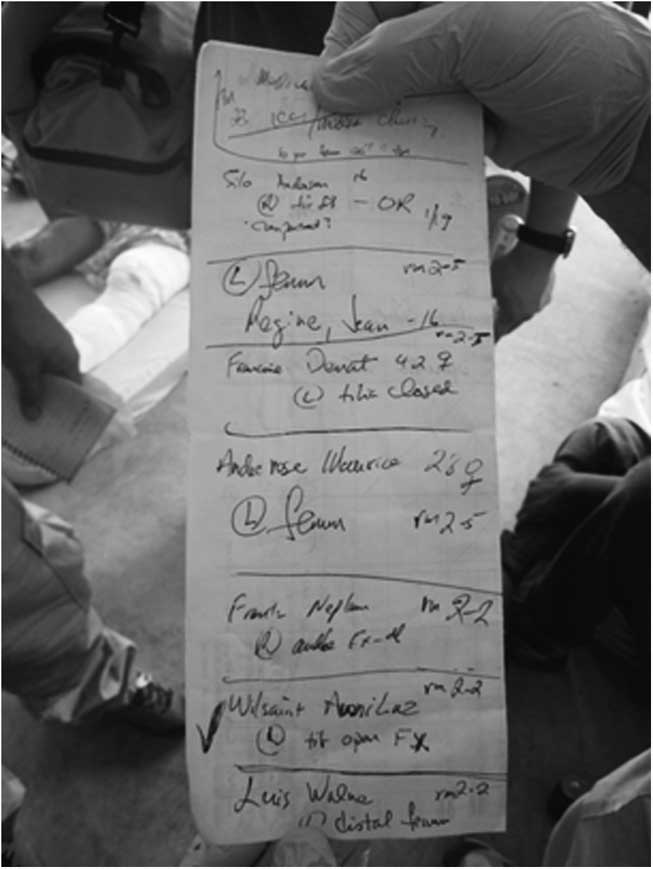
International volunteers formed five patient care teams. Approximately 90% of volunteers possessed personal cellular phones; 75% of these were iPhones. Patients were housed in large eight-person tents arranged in a grid pattern. There was an average of 240 patients in the field hospital during the time of this study. The total camp population, including family and staff, was approximately 800. Initially, there was no formal census or patient tracking system. Rather, individual medical teams kept hard copy lists on paper (Figure 2).
Sample patient census list prior to implementation of electronic tracking system

The FDP field hospital was selected as the trial site for several reasons. First, the Harvard Humanitarian Initiative (HHI) had established a unified command structure, allowing for the development of relatively consistent standard operating procedures. Second, the location of the facility in Eastern Haiti allowed for more convenient logistics and supply chain from the Dominican Republic. Finally, close relations with the Government of the Dominican Republic provided a strong local technology support network and repatriation capabilities for Haitians treated there.
Study Design
An iPhone-based mobile technology platform for patient tracking was implemented at the FDP Disaster Rescue Camp from January 20, 2010 through March 11, 2010 in three distinct, but overlapping phases: (1) initial needs assessment and product selection; (2) feasibility testing with a focus on high-risk patients such as children and amputees; and (3) trial expansion to include all patients in the field hospital. All patients who registered at the FDP Disaster Rescue Camp from January 20, 2010 through March 11, 2010 were included in this study.
During Phase 1, the response team interviewed volunteer providers to identify operational gaps in the existing care delivery structure immediately after the FDP field hospital was established. Interviews consisted of two members of the OMI team asking a series of open-ended questions to medical providers to establish major barriers to patient care. Answers were documented in field notebooks, and were discussed each evening during team meetings. The team simultaneously conducted a literature review using MeSH terms: mobile health, health information technology, disaster, disaster medicine, patient tracking, and earthquakes. The team examined pre-existing health information technology solutions, and selected the commercially available iPhone application iChart version 1.39 (Caretools Inc, Burlington, Massachusetts USA) for this trial.
The iChart application was not designed for the disaster setting, but was selected for several reasons. First, iChart functions with or without Internet connectivity (with so-called “thick” and “thin” client capabilities). Second, at FDP, approximately 75% of medical volunteers had personal iPhones, reducing training requirements and allowing for broad deployment of the tool. Third, the iChart system allowed for bidirectional information flow between providers and the database. Finally, the parent company, Caretools, was willing to offer 150 free licenses.
Upon completion of the rapid initial needs assessment trial, control transitioned to implementation teams comprised of physicians and Haitian Creole interpreters. During Phase 2, the implementation teams conducted feasibility testing and product evaluation. Testing began with the deployment of the iChart electronic medical record on day seven post-earthquake. Teams collected patient data in a staggered fashion. High-risk patients (e.g., unaccompanied minors and amputees) were prioritized, given these were the priorities of the Field Hospital Administration and medical care providers. Then, the Implementation teams split up to collect data on existing patients (i.e., previously in the camp) and new patients (i.e., presenting after initiation of the trial). Concurrently, the iPhone application was deployed at Triage and in the operating theater to collect all new high-risk patient data. All information was entered into a unified database. Initially, surveys were conducted daily, and then every three days once the patient backlog was cleared and all new patients had been registered at Triage. By the third week of implementation, the iChart database was the primary census of the field hospital, and was used by administration, on daily medical rounds, and by the operating theater staff.
OMI teams continually evaluated and improved upon the data collection process with structured morning and evening meetings based on rapid Plan-Do-Study-Act (PDSA) cycles.9 Specifically, OMI staff prioritized goals for the next day based on verbal feedback given by providers about the functionality of the iChart program. As necessary, OMI staff contacted Caretools support staff to modify the program to fit the needs of providers on the ground. OMI staff then implemented the programmatic change the next day. Verbal feedback on these changes was monitored, and qualitatively recorded in field laptops and notebooks throughout the day, and consolidated during a formal evening meeting. After these evening meetings, the OMI field team provided daily reports to a United States-based technology support group comprised of academics, industry experts, and government officials. Requests for modification were submitted at 6 PM each day to allow the technology teams in the United States to review the information and generate responses by the next morning. The compressed PDSA cycle allowed for the rapid evolution of a tailored disaster-response tool based on the off-the-shelf iChart application.
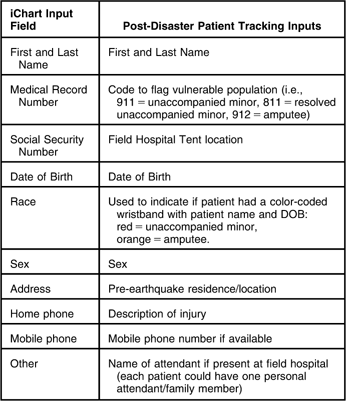
The iChart application permitted collection of fixed demographic information such as name, social security number, medical record number, date of birth, sex, race, address, and home and mobile phone numbers. The application also allowed for providers to enter customized “encounter notes.” Implementation teams modified iChart's fixed data fields, developing “workarounds” to create relevant data fields from the existing program. For example, the social security number field became a location field that indicated the patient's tent number (Table 1). Caretools later modified those demographic fields in response to provider feedback. Subsequent application versions added a crude medical record based on when the patient arrived at the camp.
Adapting iChart to a disaster setting

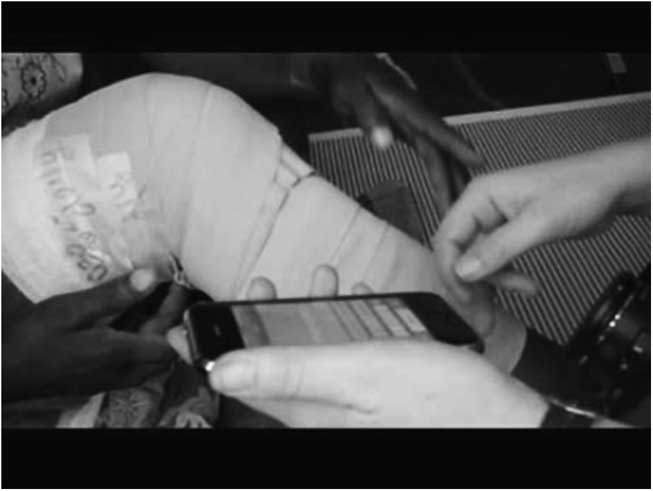
During Phase 3, implementation teams expanded the electronic patient tracking system to incorporate all patients in the FDP field hospital (Figure 3). The information was validated with the same three-tiered data verification process: comparison to paper records, spot checks, and discussion with providers during morning and evening rounds. All information on iChart was synced using 128-bit SSL and authentication, including individual PIN numbers. The system included dual password protection for data security.
Registration of patients using the iChart mHealth system

Outcome Measures
Real-time provider feedback was obtained throughout the study during PDSA cycles (described in detail above) with a focus on provider triage, patient tracking, reunification of unaccompanied minors, post-operative care tracking, provider handoffs, and aggregated census information. Providers were asked to rate the application's utility and limitations. They also were asked to provide specific weighted suggestions for improvements. These data were compiled to create a tiered request list for application modification.
Results
Characteristics of Study Subjects
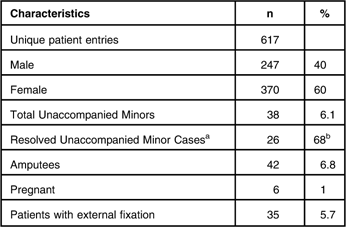
The vast majority of patients at FDP Disaster Rescue Camp only spoke Creole. Few had government-issued identification, and most were displaced from their primary provinces. There were 617 unique patient entries into the patient tracker during the study period. Three hundred seventy (60%) were female, and the mean age was 28.45 (SD ± 24.15). Sixty-four percent of the primary injuries were orthopedic in nature (defined as requiring an orthopedic intervention). On March 11, 2010, 15% of the remaining patients were amputees, and 5% were unaccompanied minors (Table 2).
Summary of patient data for the FDP Disaster Rescue Camp gathered with iChart from January 20, 2010 through March 11, 2010

aCases were considered resolved when the patient's parents were found or when placement was obtained via collaboration with UN sanctioned agencies.
bAs a percent of total unaccompanied minors
Main Results
Prior to the implementation of the iChart mHealth system, there was no patient log for operations, and no longitudinal patient record. This resulted in many directly observed and anecdotal adverse outcomes. For example, unaccompanied minors initially were not identified and monitored. Patients missed scheduled surgeries because they could not be located, prosthetic care was suboptimal because dates of surgery were not recorded, and care plans were fragmented as medical teams frequently transitioned.
Provider Triage—The iChart application resulted in an adequate ability to triage patients as they arrived as new encounters or transfers. Patient information was entered in real-time during the initial provider evaluation, and was easily searchable. Average time (self-reported) for each single patient input depended on each provider and ranged from two minutes to five minutes 30 seconds. The majority of providers felt that a handheld, electronic patient tracking system and medical record could reduce work load, improve patient care and prove valuable in the post-disaster care setting. Most felt the current version of iChart was too cumbersome to immediately fulfill that need.
Patient Handoffs and Post-Operative Care—The iChart improved provider handoffs and continuity of care at this single facility. Patient information was standardized (i.e., spelling of patient's name), was in one language (English), and information complemented verbal sign-outs. The surgical staff appreciated the application's patient tracking capabilities (e.g., the ability to locate the tent numbers of patients for pre-operation planning). Volunteer physicians stayed in Haiti an average of 10 days. Frequently, surgeons who conducted the initial operation provided much of the post-operative care.Reference Ginzburg, O'Neill and Goldschmidt-Clermont10 Given the chaotic nature of volunteer physicians’ arrivals and departures, the mobile application accommodated fluctuating provider schedules by keeping a centralized repository of basic patient information. The iChart program was able to flag patients who required complicated post-surgical care (e.g., amputees, external fixation devices, and complex debridement).
Patient Tracking—The ability to search for patient information instantaneously with a handheld device, rather than having to access data at one fixed location (either a non-networked computer or handwritten system) proved to be one of iChart's most useful features. Providers were able to easily track vulnerable populations, such as unaccompanied minors and amputees, in order to coordinate appropriate care plans. For example, a Child Protection Team consisting of a member of the patient tracking team, a pediatric nurse, and a field hospital administrator, was formed to reunite children with their families. Twenty-six children were reunited during this study period. Information on amputation patients was provided to UN-sponsored registries, and utilized to facilitate immediate post-operative treatment, short-term wound care requirements, rehabilitation, and prosthetic planning.
Field Hospital Administration—Camp administrators used iChart's online database every evening to generate aggregate census information for logistics, operations, and staffing requirements. The program had limited ability to generate summary data in real-time for analysis and reporting. Providers manually extracted data from iChart, and exported it to an Excel spreadsheet (Version 7.0.25, Microsoft Corporation, Redmond, Washington USA) for the evening report. Provider feedback summaries indicated a low satisfaction rating for this limitation.
Discussion
Mobile health technology is beneficial and feasible in the early disaster setting. Some proprietary disaster software exists, but is limited by cost, connectivity requirements, or facility of use. Currently, there is no suitable mobile technology platform that provides cost-effective, integrated operational triage, treatment, and tracking capabilities for disaster responders.
Some of the mobile platform needs are simple. For example, any system must allow rapid data entry, provide a clear information organization framework, and be able to “flag” or track high-risk patients. This capability allows for appropriate allocation of resources and targeting of high-impact interventions. Additionally, users must be able to quickly generate a patient census, and to export those data to a variety of software programs (e.g., for data mining or identification bracelets). Finally, given the large volumes of “non-affiliated” volunteers in disaster settings, the application must be inexpensive, with few training requirements. Utilizing handheld devices owned by volunteer staff helps to minimize program costs and improve scalability.
Other mHealth system requirements are more complex. The most obvious challenge arises with data management and security. Collected data must be easily searchable, and hospital census reports readily generated. Bidirectional data flow and the ability to collect information without Internet connectivity also are critical capabilities in any disaster mHealth solution. Syncing technology is sufficiently advanced today to allow handheld devices to share data locally or transmit to a cloud-based system. The challenge becomes reconciling conflicting data. For example, if two users enter complimentary information on one patient, but spell the patient's name differently, how does the program accurately incorporate both data entries? Informatics specialists have solved this problem in United States-based hospital electronic medical records. To date, no one has applied such a solution to disaster settings.
Finally, data security is critical. The system must include adequate patient privacy and data security, modeled on HIPAA compliance regulations. Given the transient nature of volunteer activity and different levels of service provision, the platform should have the option for tiered access and permissions.
Despite these challenges, the authors believe that mobile technology is both feasible and beneficial in the disaster setting, and should be the standard of care for disaster medicine. Ideally, the mHealth application would be easily scalable, with an interoperable platform for easy integration into different sites throughout a disaster area. This mobile platform either should integrate into existing electronic medical record systems, or set the stage for the development of a novel mHealth infrastructure.
Limitations
Ethical research in a post disaster setting is challenging, and has inherent limitations. In this case, the team's priorities were insuring protection of high-risk populations and improving the quality of patient care. As a result, the trial of the iChart system began in an ad hoc fashion. End user feedback was collected and quickly relayed to technical teams in the United States. One limitation is that this study design was created rapidly and evolved to reflect the changing situation on the ground. In addition, although providers gave structured feedback for application modification, there was no formal numerical scale rating system for questions such as device utility, ease of use, ease of training, and relevance. Future studies should include a numerical rating system for component analysis in order to prioritize end user analysis. Additionally, future trials should more thoroughly examine patient-oriented outcomes such as safety, morbidity and mortality.
Conclusion
Disaster mobile health technology is feasible in a resource-poor, chaotic setting. However, the ideal program has yet to be developed. Mobile health technology has the potential to improve patient care in disaster settings. Despite the limitations of iChart, study authors were able to demonstrate improvements in patient tracking, patient care (especially in orthopedics and pediatrics), facilities management (through accurate census data) and inter-facility transfers. Patient tracking, especially of resource-intensive vulnerable populations, was facilitated by providers carrying handheld devices. During an eight-week trial, iChart also demonstrated a capacity to improve provider triage by enabling a real-time, standardized and searchable registration process.
Abbreviations
- FDP:
Fond Parisien
- HHI:
Harvard Humanitarian Initiative
- mHealth:
mobile health
- OMI:
Operational Medicine Institute
- PDSA:
Plan-Do-Study-Act
- WHO:
World Health Organization