1. Introduction
Pycnogonids or sea spiders are arthropods with a quite unusual morphology. They seem to consist only of legs and indeed, in some pycnogonids, organs extend into the legs, because of lack of space in the reduced trunk region. More than 1300 species of extant pycnogonids have been described, showing a worldwide distribution from marine abyssal depths to the intertidal zone (Arango & Wheeler, Reference Arango and Wheeler2007). The morphology of sea spiders is quite well known, in contrast to their lifestyles. An overview of the most relevant facts in pycnogonid biology is given in Arnaud & Bamber (Reference Arnaud and Bamber1987).
Though today quite common, there is only a sparse fossil record for sea spiders. The earliest record is a larval specimen that is found in Upper Cambrian deposits (Waloszek & Dunlop, Reference Waloszek and Dunlop2002). Doubts concerning the pycnogonid nature of these fossils (Bamber, Reference Bamber2007) were partly unsubstantiated (Edgecombe, Reference Edgecombe2010). An Upper Ordovician sea spider has been recorded from a Lagerstätte deposit in central Manitoba, Canada (Rudkin et al. Reference Rudkin, Cuggy, Young and Thompson2009), but no detailed information on this discovery has been published yet. A remarkably well-preserved fossil of an adult sea spider is Haliestes dasos Siveter, Sutton, Briggs & Siveter, Reference Siveter, Sutton, Briggs and Siveter2004 from the Silurian Herefordshire Lagerstätte (Siveter et al. Reference Siveter, Sutton, Briggs and Siveter2004). The Lower Devonian Hunsrück Slate is another Lagerstätte yielding fossil pycnogonids. Four species in the same number of genera have previously been described (Bergström, Stürmer & Winter, Reference Bergström, Stürmer and Winter1980; Poschmann & Dunlop, Reference Poschmann and Dunlop2006) and here we add a further new taxon. After the Lower Devonian there is a gap in the fossil record of pycnogonids, which extends to the Middle Jurassic with three species known from the La Voulte-sur-Rhône Lagerstätte in France (Charbonnier, Vannier & Riou, Reference Charbonnier, Vannier and Riou2007).
The Lower Devonian Hunsrück Slate is exceptional in providing us with a glimpse of Palaeozoic pycnogonid diversity, yielding by far the highest number of fossil specimens. Palaeoisopus problematicus Broili, Reference Broili1928 is most common with more than 60 specimens. Palaeopantopus maucheri Broili, Reference Broili1929 is known from four specimens and Palaeothea devonica Bergström, Stürmer & Winter, Reference Bergström, Stürmer and Winter1980 and Flagellopantopus blocki Poschmann & Dunlop, Reference Poschmann and Dunlop2006 are each known from single finds. Some of the Hunsrück Slate species (excluding P. devonica and the species described herein) differ from all other extant and extinct pycnogonids in having an abdomen (including the telson) with three (P. maucheri and F. blocki) or even five (P. problematicus) segments. This might be phylogenetically relevant as it is interpreted as a plesiomorphic condition in pycnogonids (Hedgpeth, Reference Hedgpeth and Moore1955; Waloszek & Dunlop, Reference Waloszek and Dunlop2002; Siveter et al. Reference Siveter, Sutton, Briggs and Siveter2004; Poschmann & Dunlop, Reference Poschmann and Dunlop2006). This view has recently been challenged by combined analysis of molecular and morphological data (Arango & Wheeler, Reference Arango and Wheeler2007). Here the fossil pycnogonids P. devonica, P. maucheri, H. dasos and P. problematicus grouped within the paraphyletic grown group Ammotheidae.
2. Geological setting
The fossil association described here originates from the Obereschenbach Quarry, an open-cast mine southwest of Bundenbach, and was found between 1996 and 1997 (Peter Hohenstein, pers. comm. 2011) not long before roof slate production ceased in 1999. The precise stratigraphic horizon is given as the Wingertshell member (sensu Schindler et al. Reference Schindler, Sutcliffe, Bartels, Poschmann and Wuttke2002). The sequence of roof slates exposed in the Eschenbach-Bocksberg and the adjacent Obereschenbach quarries is about 140 m thick and thus represents only a part of the entire Hunsrück Slate sediment sequence (Schindler et al. Reference Schindler, Sutcliffe, Bartels, Poschmann and Wuttke2002; Sutcliffe, Tibbs & Briggs, Reference Sutcliffe, Tibbs and Briggs2002). This unit has been assigned to the middle Kaub Formation of Early Emsian age, as evidenced by biostratigraphic data (e.g. Mittmeyer, Reference Mittmeyer, Stürmer, Schaarschmidt and Mittmeyer1980; Schindler et al. Reference Schindler, Sutcliffe, Bartels, Poschmann and Wuttke2002; De Baets et al. in press). It is famous for the occurrence of a well-preserved, pyritized and highly diverse fauna comprising more than 270 taxa (see Bartels, Briggs & Brassel, Reference Bartels, Briggs and Brassel1998 and Kühl et al. Reference Kühl, Bartels, Briggs and Rust2011 for overviews). The dark grey clay to silt-sized sediments containing these exceptionally preserved fossils were interpreted as having been deposited within the intrashelf central Hunsrück Basin (e.g. Dittmar, Reference Dittmar1996) at the distal edge of a submarine fan by low-density turbidity currents, at or just below storm-wave base (Sutcliffe, Briggs & Bartels, Reference Sutcliffe, Briggs and Bartels1999; Sutcliffe, Tibbs & Briggs, Reference Sutcliffe, Tibbs and Briggs2002). Although anoxia within the sediment favoured pyritization, the water column was well oxygenated and allowed a diverse epifauna to be established (Briggs et al. Reference Briggs, Raiswell, Bottrell, Hatfield and Bartels1996; Bartels et al. Reference Bartels, Poschmann, Schindler and Wuttke2002; Sutcliffe, Tibbs & Briggs, Reference Sutcliffe, Tibbs and Briggs2002). Obrution events periodically overwhelmed parts of this fauna and led to their autochthonous to parautochthonous burial (e.g. Bartels, Briggs & Brassel, Reference Bartels, Briggs and Brassel1998; Sutcliffe, Briggs & Bartels, Reference Sutcliffe, Briggs and Bartels1999; Sutcliffe, Tibbs & Briggs, Reference Sutcliffe, Tibbs and Briggs2002; Bartels & Poschmann, Reference Bartels and Poschmann2002).
3. Material and methods
This investigation is based on two incomplete specimens, associated with a crinoid and two further undeterminable pycnogonid specimens. The fossil bearing slab with the collection number MNHM PWL 2010/5-LS is stored in the Natural History Museum Mainz; State Collection of Natural History, Rhineland-Palatinate. It was prepared by Peter Hohenstein, Lautertal.
The specimens were photographed using a D100 and a JVC Camera KY-F70B through a Leica MZ16 microscope. Radiographs were obtained with a Phoenix v|tome|x s Micro Tomograph using 120 kV and 130 μA, but yielded no additional information. Drawings were either made using a Leica MZ75 stereomicroscope with a camera lucida attachment or using Adobe Illustrator® CS3. Adobe Photoshop® CS3 and Adobe Illustrator® CS3 were used for editing pictures. ImageJ was used for measurements.
4. Preservation
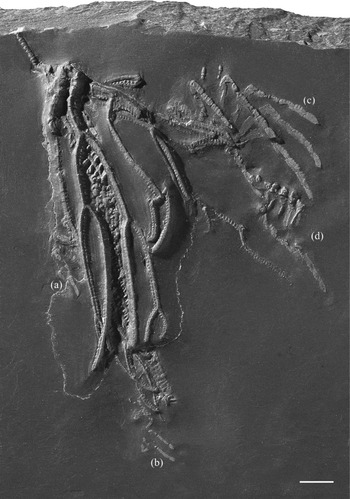
Four pycnogonid specimens and one crinoid Parisangulocrinus zeaeformis (Follmann, Reference Follmann1887) are associated on one slab of Hunsrück Slate. One very small pycnogonid specimen (Fig. 1a) is attached to the arms of the crinoid on the left hand side of the slab. Only the remains of one chelifore, lateral parts of the trunk and parts of three legs are preserved. A second small pycnogonid specimen (Fig. 1b) is visible near the distal part of the crinoid anal tube. Again only the remains of one chelifore, lateral parts of the trunk and parts of three legs are preserved. On the right side of the crinoid two additional specimens are preserved (Fig. 1c, d). In the following, the terms left and right refer to the left and right side of a living animal seen from the dorsal surface. The most completely preserved specimen (Fig. 1c) is situated beneath the distal part of one crinoid arm. It is ventrally exposed, but lacks most parts of the right half of the body. Only the remains of the proximal two podomeres of the left chelifore are preserved. The right chelifore lacks the chela. Ovigers are either not preserved or were not developed. The left palp lacks the distal part and the right palp is not preserved. The body is largely covered by crinoid arms (or brachia) and the four anterior walking legs on the right side are not preserved. The next pycnogonid specimen (Fig. 1d) is laterally embedded adjacent to the last mentioned pycnogonid specimen. It is not in contact with the crinoid. This specimen lacks parts of both chelifores, including most parts of the chelae, the distal parts of the palps, the distal parts of the first four walking legs on the left side and most distal parts of the right walking legs. From the fifth pair of walking legs no remains are preserved.
MNHM PWL2010/5-LS. Hunsrück Slate slab with crown of the crinoid Parisangulocrinus zeaeformis and four pycnogonid specimens. (a, b) Two specimens of undetermined pycnogonids; (c, d) two specimens of Pentapantopus vogteli gen. et sp. nov. Scale bar represents 3 mm.

5. Systematic palaeontology
Class PYCNOGONIDA Latreille, Reference Latreille1810
Genus Pentapantopus gen. nov
Etymology. From penta (five) and the name Pantopoda.
Type species. Pentapantopus vogteli sp. nov., by monotypy.
Diagnosis. Pycnogonid with elongate body and five pairs of walking legs consisting of eight podomeres plus a terminal main claw; distal leg podomeres (femur to propodus) flattened and setose; chelifores large; palps present; abdomen short.
Pentapantopus vogteli sp. nov
Etymology. From Hans Vogtel (Rhaunen), a former slate worker, recognizing his detection of many important fossils during the process of roof-slate production.
Diagnosis. As for the genus.
Holotype. Slab MNHM PWL2010/5-LS; Figs 1c, 2 (specimen 1).
Paratype. Slab MNHM PWL2010/5-LS; Figs 1d, 2 (specimen 2).
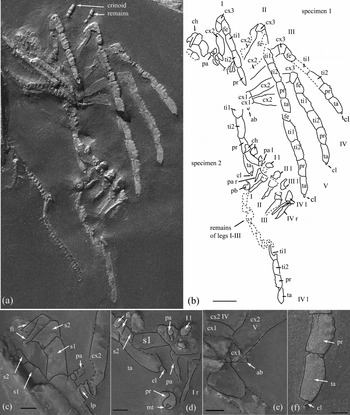
Description. The cephalosoma of Pentapantopus vogteli gen. et sp. nov. bears a pair of large chelifores consisting of a long proximal segment, a second segment that is only half the length of the first one, and the terminal chela (Fig. 2a–c). The proboscis is long, probably reaching the third pair of walking legs when tucked underneath the body and directed backwards. The terminal part of it has a roundish shape and the mouth opening is triangular (Fig. 2a, b, d). The position of the proboscis in specimen 2 (Fig. 2d) indicates that it was ventrally directed in the living pycnogonid. The second pair of prosomal appendages are palps, which insert at the lateral margin of the cephalosoma posterior to the chelifores. The number of palp segments is unknown (Fig. 2a–d). The next pair of prosomal appendages is the first pair of walking legs. It is morphologically similar to the following four pairs of trunk appendages. All leg pairs are inserted at a lateral process of the body wall. This process is ornamented with up to four rings. The legs consist of eight podomeres, which can be divided into coxae I to III, femur, tibia I and II, tarsus and propodus, plus a terminal main claw (Fig. 2a, b). At least the distal podomeres (femur to propodus) were slightly flattened. Short marginal setae are situated on the dorsal margin of tibia I and II and the proximal part of the tarsus. The abdomen may be partly preserved in specimen 1 (Fig. 2a, b, e). It is a short remnant located on the expected position of an abdomen. Judging from the available evidence, it is concluded that the abdomen of P. vogteli gen. et sp. nov. is short and unsegmented.
MNHM PWL2010/5-LS. Specimens 1 and 2 of Pentapantopus vogteli gen. et sp. nov. (a) Photograph; (b) interpretative drawing; (c) detail of the anterior region of specimen 1 showing the chelifore and the palp; (d) detail of the anterior region of specimen 2 showing the chelifore, palps and remains of the proboscis; (e) remains of the abdomen in specimen 1; (f) propodus, tarsus and terminal claw of the third walking leg of specimen 1. Scale bar represents 3 mm (a, b); 1 mm (c–f). Note that in (c–f) our interpretation (drawing) is superimposed on the photograph. Abbreviations: ab – abdomen; ch – chelifore; cl – claw; cx – coxa; fe – femur; fi – finger; l – left; mt – mouth; pa – palp; pb – proboscis; lp – lateral process; pr – propodus; r – right; s – segment; ta – tarsus; ti – tibia.

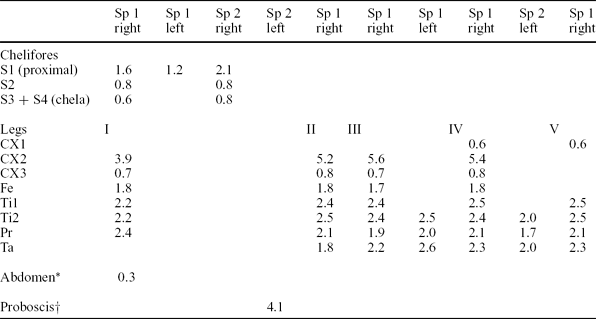
Measurements. In comparison to other Hunsrück Slate pycnogonids, Pentapantopus vogteli gen. et sp. nov. is small, with a total length (chelifore to abdomen) of approximately 12 mm. In the chelifores the most proximal segment is 1.6 mm in specimen 1 and 2.1 mm in specimen 2, and it is at least twice as long as the following segment. Referring to the walking legs of specimen 1 (specimen 2 is too incomplete) coxa 1 seems to be the shortest leg podomere and is about 0.6 mm in length. Coxa 2 is the longest podomere with 3.9 mm length in the first walking leg and 5.2 to 5.6 mm length for the walking legs II to IV. The length of coxa 2 for walking leg V is unknown. Coxa 3, which seems to function as the knee bend is again only between 0.7 and 0.8 mm in length. Tibia 1, tibia 2, and the propodus are comparable in their lengths; they vary between 1.8 and 2.5 mm. Leg I seems to be the shortest walking leg, based on the relatively short coxa 2. However, legs II to V are more or less of the same length (Table 1).
Measurements of the appendages of Pentapantopus vogteli gen. et sp. nov.

All measurements are length specifications and are given in mm
Sp – specimen; S – segment; CX – coxa; Fe – femur; Ti – tibia; Pr – propodus; Ta – tarsus
* abdomen may be incomplete
† length of proboscis is interpolated as the middle part is not preserved
6. Phylogeny
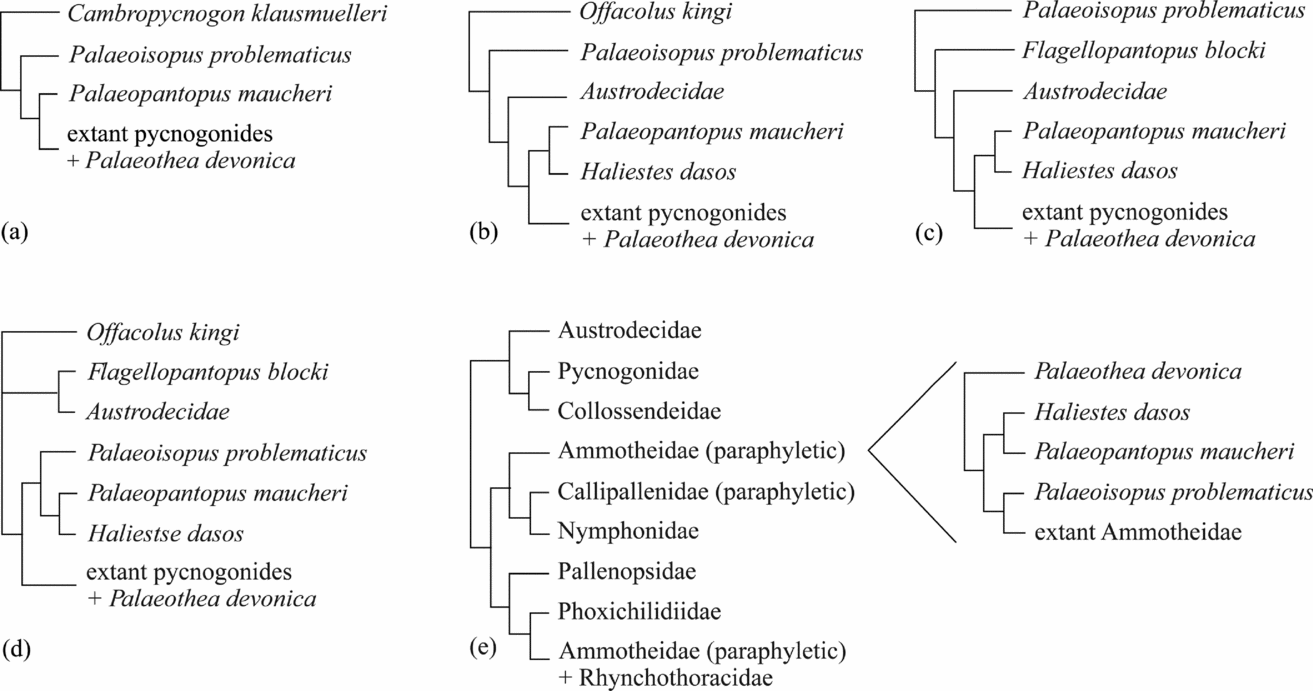
Only a few attempts to resolve the internal phylogenetic relationships of the Pycnogonida including fossil species are available (for a review see Dunlop & Arango, Reference Dunlop and Arango2005) and the results are quite contradictory (for criticism see Bamber Reference Bamber2007). Morphology-based investigations carried out by Waloszek & Dunlop (Reference Waloszek and Dunlop2002), Siveter et al. (Reference Siveter, Sutton, Briggs and Siveter2004), and Poschmann & Dunlop (Reference Poschmann and Dunlop2006) favour a concept with Palaeoisopus problematicus as a stem lineage representative of the Pycnogonida, and Palaeopantopus maucheri as sister taxon to Recent pycnogonids including Palaeothea devonica (Fig. 3 a–c).
Published pycnogonid cladograms. (a) Waloszek & Dunlop (Reference Waloszek and Dunlop2002); (b) Siveter et al. (Reference Siveter, Sutton, Briggs and Siveter2004); (c) Poschmann & Dunlop (Reference Poschmann and Dunlop2006); (d) Charbonnier (Reference Charbonnier2009); and (e) Arango & Wheeler (Reference Arango and Wheeler2007).

This concept follows Hedgpeth (Reference Hedgpeth and Moore1955) who supposed a stem lineage position of P. problematicus and P. maucheri with respect to the remaining Pycnogonida, with P. problematicus as the most basal taxon. This author suggested an evolutionary trend of the reduction of appendages, such as chelifores, palps or ovigers for more derived pycnogonids. The presence of a five and three segmented abdomen in P. problematicus and P. maucheri respectively was generally regarded as a plesiomorphic character state (Hedgpeth, Reference Hedgpeth and Moore1955; Bergström, Stürmer & Winter, Reference Bergström, Stürmer and Winter1980). Arango & Wheeler (Reference Arango and Wheeler2007) tested the concept of appendage reduction with a cladistic analysis based on molecular and morphological data and showed that there seems to be no such evolutionary trend within the Pycnogonida. Additionally, all fossil taxa were grouped within the extant, paraphyletic Ammotheidae with P. problematicus as direct sister taxon to the extant Ammotheidae, and Palaeothea devonica as most basal taxon of Ammotheidae (Fig. 3e). In contrast to these results, Charbonnier (Reference Charbonnier2009; Fig. 3d) excluded most fossil pycnogonids from having a close relationship with the extant taxa. He proposed a sister group relationship of Flagellopantopus blocki and the Austrodecidae in an unresolved relationship with Offacolus kingi Orr et al. Reference Orr, Siveter, Briggs, Siveter and Sutton2000 (usually taken as the outgroup, e.g. Sutton et al. Reference Sutton, Briggs, Siveter, Siveter and Orr2002) at the base of pycnogonids. The remaining fossil taxa P. problematicus, P. maucheri and Haliestes dasos are thus the sister taxa to the extant pycnogonids, including P. devonica.
Determining the phylogenetic position of Pentapantopus vogteli gen. et sp. nov. is difficult because of incomplete preservation and because the ontogenetic stage of the specimens is unclear (see discussion below). Nevertheless, three character states strongly support a position within the crown group. First, there is the presence of five pairs of walking legs. Although the full set of walking legs is preserved only on one side of the holotype specimen, we interpret the number of walking legs (5 pairs) as a true morphological trait of this new taxon, and not as a morphological abnormality. Five pairs of walking legs occur in the extant pycnogonid genera Pentanymphon (Nymphonidae), Pentapycnon (Pycnogonidae), Pentacolossendeis (Colossendeidae) and Decolopoda (Colossendeidae), but the phylogenetic significance of their polymery is unclear (Arango & Wheeler, Reference Arango and Wheeler2007). However, as this character is unknown from any pycnogonid hitherto considered as basal, polymery might indicate a more derived phylogenetic position. This is also indicated by the reduction of the abdomen and telson in P. vogteli nov. gen. et sp., because a segmented abdomen (plus telson, if applicable) seems to be the strongest argument for the inclusion of Palaeoisopus problematicus, Flagellopantopus blocki and Haliestes dasos in the pycnogonid stem lineage (Hedgpeth, Reference Hedgpeth and Moore1955; Bergström, Stürmer & Winter, Reference Bergström, Stürmer and Winter1980; Waloszek & Dunlop, Reference Waloszek and Dunlop2002; Siveter et al. Reference Siveter, Sutton, Briggs and Siveter2004; Poschmann & Dunlop, Reference Poschmann and Dunlop2006). On the other hand, the chelifores with a two-segmented scape, the flattened and setose distal leg podomeres, and the reduced trunk end may indicate a closer relationship of P. vogteli gen. et sp. nov., and the Silurian H. dasos (i.e. Nectopantopoda of Bamber, Reference Bamber2007), although the morphology of the trunk end is somewhat obscure in H. dasos (composed of three ‘elements’, but with no segment boundaries visible; Siveter et al. Reference Siveter, Sutton, Briggs and Siveter2004).
7. Discussion
7.a. Larva or adult?
Because live observations of Recent pycnogonids are difficult to obtain, knowledge of their post-embryonic development is still limited, but the situation has been improved considerably in the last two decades (e.g. Nakamura, Reference Nakamura1981; Bain, Reference Bain2003a ; Bogomolova, Reference Bogomolova2007; Bogomolava & Malakhov, Reference Bogomolova and Malakhov2004; Brenneis, Arango & Scholtz, Reference Brenneis, Arango and Scholtz2011; Cano & López-González, Reference Cano and López-González2009; Cano Sánchez & López-González, Reference Cano Sánchez and López-González2010; Vilpoux & Waloszek, Reference Vilpoux and Waloszek2003). These studies showed that larval development is not consistent within pycnogonids, which complicates the determination of the ontogenetic stage of isolated fossil material. Postembryonic development in some pycnogonids (e.g. in Austropallene cornigera; Möbius, Reference Möbius and Chun1902), shows that the development of the walking legs is sequential, i.e. with each subsequent moult a further (more posterior) leg is added and the number of leg podomeres of the previous one increases until the full (adult) number of podomeres has been acquired (Bain, Reference Bain2003b ). In Propallene longiceps (Böhm, Reference Böhm1879) the sixth instar larva already has four pair of legs, and the chelifores. Up to the ninth instar, the larva develops the sexual organs and shows the complete sexual differentiation at this stage (Nakamura, Reference Nakamura1981). Observations on postembryonic larval development in Tanystylum orbiculare Wilson, Reference Wilson1878 and Achelia alaskensis Cole, Reference Cole1904 showed that the sixth or seventh instars can be distinguished from the eighth by an incomplete number of podomeres in their legs (Bain, Reference Bain2003a ). The new Hunsrück Slate pycnogonid has the complete set of appendages (assuming it is a decapodous form) with the full number of podomeres developed. Sexual differentiation cannot be determined. However, we are inclined to assume that the specimens are at least subadults. Based on the presence of five pairs of appendages in Pentapantopus vogteli gen. et sp. nov., it can be discounted that the pycnogonid is a juvenile form of one of the previously described Hunsrück Slate pycnogonids.
7.b. Palp or oviger?
Pentapantopus vogteli gen. et sp. nov. is missing one pair of head appendages. The chelifores and the first pair of walking legs are easy to identify due to their morphology. The distinction between ovigers and palps is more difficult, because these appendages can be morphologically very similar. Usually, ovigers insert on the ventral side of the cephalosoma and are directed posteriorly. Palps insert laterally succeeding the chelifores. In P. vogteli gen. et sp. nov. the second pair of appendages seems to insert laterally, as the appendage base does not proceed to the ventral part of the cephalosoma. Hence, we conclude that the second pair of appendages in the cephalosoma of P. vogteli gen. et sp. nov. are palps. In the absence of further evidence for an additional pair of appendages in the cephalosoma, we conclude that the ovigers are not present. Whether their absence indicates sexual dimorphism, a subadult stage or a morphological character of this species cannot be determined.
7.c. Life habits
A conspicuous morphological trait of Pentapantopus gen. nov. is the flattened distal leg podomeres not unlike those found in Haliestes or Palaeoisopus. These flattened podomeres might indicate that Pentapantopus gen. nov. was a fairly good swimmer, as has been assumed for Palaeoisopus by Bergström, Stürmer & Winter (Reference Bergström, Stürmer and Winter1980). An occasional co-occurrence with crinoids is another feature that is shared by these two pycnogonid taxa (cf. Broili, Reference Broili1933; Bergström, Stürmer & Winter, Reference Bergström, Stürmer and Winter1980). Pycnogonid feeding on echinoderms, such as ophiuroids, echinoids and holothuroids has been reported several times (Helfer & Schlottke, Reference Helfer and Schlottke1935; Sloan, Reference Sloan1979; Arnaud & Bamber, Reference Arnaud and Bamber1987 and references therein). Furthermore, a co-occurrence of extant pycnogonids with crinoids has been reported by Carpenter (Reference Carpenter1908), but information concerning the nature of this interaction is lacking. Although the association of Pentapantopus gen. nov. with the crinoid Parisangulocrinus could be accidental, the association of Hunsrück Slate pycnogonids with crinoids is not uncommon and might possibly be related to the pycnogonids’ mode of feeding, suggesting that both Palaeoisopus and Pentapantopus gen. nov. preyed upon crinoids. Recent re-investigation of fossil pycnogonid material showed, that predominantly smaller forms are associated with crinoids. Therefore the crinoid may also have provided shelter for smaller individuals.
7.d. Two additional pycnogonids
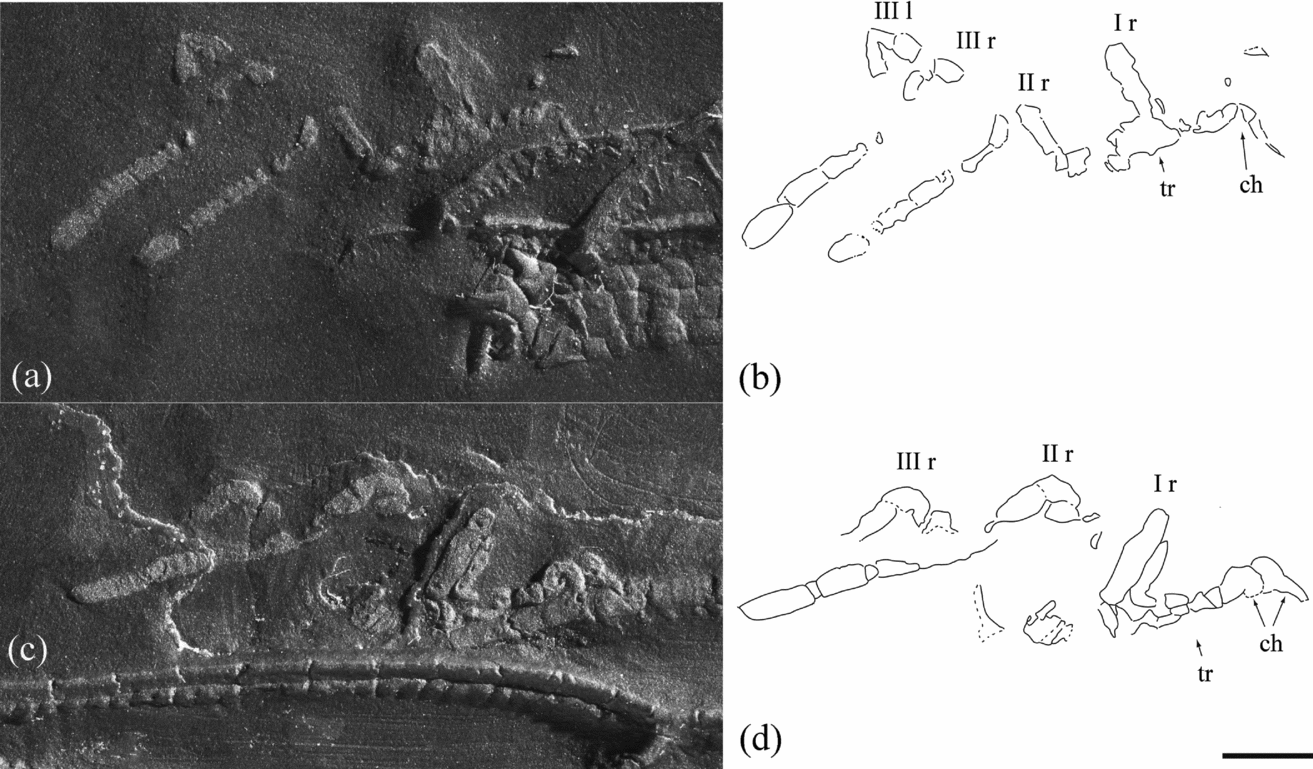
The two specimens of Pentapantopus vogteli gen. et sp. nov. are associated with a crinoid and two additional pycnogonids, much smaller than the ones described above (Figs 1a, b; 4a, c). These two specimens are very poorly preserved, but the observable chelifores and their general habitus clearly identify these arthropods as pycnogonids. In both cases only three pairs of walking legs are preserved in addition to the chelifores, corresponding to the situation in the fifth instar larva of Propallene longiceps (Nakamura, Reference Nakamura1981). But owing to their poor preservation, it is impossible to determine, whether the two additional specimens are juvenile stages of P. vogteli gen. et sp. nov., or of one of the earlier described Hunsrück Slate pycnogonids, or even represent a further new taxon. In the absence of any distinguishing characters there is some probability that they are younger individuals of our new species.
MNHM PWL2010/5-LS. (a, b) Undetermined pycnogonid near the anal tube of the crinoid Parisangulocrinus zeaeformis; (c, d) undetermined pycnogonid attached to one arm of the crinoid P. zeaeformis. Abbreviations: ch – chelifore; tr – trunk. Scale bar represents 1 mm.

8. Conclusions
The association of a crinoid with four specimens of pycnogonids is described from the Lower Devonian Hunsrück Slate. Two specimens can be assigned to a new genus and species, Pentapantopus vogteli. The new taxon is morphologically quite different from previously described Hunsrück Slate pycnogonids and bears some resemblance to both modern representatives and the Silurian Haliestes dasos. It thus widens the known range of diversity for Devonian pycnogonids. Furthermore, the fossil association indicates that these Devonian pycnogonids possibly preyed upon crinoids. The putative phylogenetic position of P. vogteli gen. et sp. nov. among other crown group pycnogonids shows that the evolution of pycnogonid body plans must have taken place early in the Palaeozoic and that subsequent evolution of pycnogonid morphology was much more conservative.
Acknowledgments
The specimens studied were kindly lent to us by the Naturhistorisches Museum Mainz/Landessammlung für Naturkunde Rheinland-Pfalz (Dr Herbert Lutz). We thank Georg Oleschinski (Steinmann Institute, Bonn) for photographs. Thanks also to Peter Hohenstein (Lautertal) for information on the fossil slab. Funding was provided by the Deutsche Forschungsgemeinschaft (DFG, No. RU 665/5-1).