INTRODUCTION
Head and neck cancer (HNC) is a collective term describing malignancy located around the oral, larynx, pharynx, and maxillofacial areas. Common treatments for HNC—including surgical operations, chemotherapy, and radiation therapy—have developed at a rapid pace. As a result, the five-year survival rate among patients with HNC has improved moderately (American Society of Clinical Oncology, 2014; Pulte & Brenner, Reference Pulte and Brenner2010). However, most HNC patients suffer from dysfunction and disfigurement caused by these medical treatments and have difficulty breathing, eating, and communicating (Danker et al., Reference Danker, Wollbrück and Singer2010; Semple et al., Reference Semple, Dunwoody and George Kernohan2008). The suicide rate among HNC patients is more than four times greater than that of the general population (Zeller, Reference Zeller2006), and 15–44% of patients experience psychological distress (depression and anxiety) at some point during the course of their illness (Joseph et al., Reference Joseph, Routledge and Burns2013; Neilson et al., Reference Neilson, Pollard and Boonzaier2013).
In particular, depression has a highly negative impact on patients' lives. Depression can lead to lowered quality of life, poor treatment adherence, poor mental adjustment to cancer, high pain sensitivity, severe physical symptoms, long length of hospital stays, and a decreased survival rate (Aarstad et al., Reference Aarstad, Osthus and Olofsson2014; de Leeuw et al., Reference de Leeuw, de Graeff and Ros2000; Haisfield-Wolfe et al., Reference Haisfield-Wolfe, McGuire and Soeken2012; Johansson et al., Reference Johansson, Rydén and Finizia2011; Satin et al., Reference Satin, Linden and Phillips2009). Therefore, identification and treatment of depression is crucial in HNC patients.
Not all HNC patients with depressive symptoms experience depressive disorder. Indeed, one study reported that only 6.5% of HNC patients are diagnosed with major depressive disorder (MDD) (Singer et al., Reference Singer, Danker and Dietz2008). Although this percentage is higher than that of the general population, this statistic indicates that HNC patients with MDD may comprise an important subgroup of all patients who experience depressive symptoms. Depression is considered to be a continuous phenomenon that ranges from minor mood swings to major depressive disorder in individuals with head and neck cancer (Haisfield-Wolfe et al., Reference Haisfield-Wolfe, McGuire and Soeken2009), and persistent depressive symptoms may lead to depressive disorders. Therefore, addressing the persistence of psychological distress among HNC patients is critical to preventing MDD.
To the best of our knowledge, however, no studies have examined the factors affecting persistence or change in psychological distress in HNC patients. Understanding the different functional problems faced by patients with persistent distress versus those with reduced distress could be useful for improving psychosocial care in the HNC patient population. The primary aim of this study was thus to evaluate the ratio of patients with persistence of psychological distress in HNC patients during a period of hospital treatment, and to identify the correlated factors affecting persistence of psychological distress.
Pretreatment distress is a strong risk factor for posttreatment distress among patients who have undergone surgery or radiation therapy (Adachi et al., Reference Adachi, Kimura and Sato2014; Badr et al., Reference Badr, Gupta and Sikora2014). One study suggested that psychological distress resulting from a diagnosis of HNC persisted, on average, for three years (Joseph et al., Reference Joseph, Routledge and Burns2013). Therefore, reducing pretreatment distress may contribute to prevention of persistent distress. Our secondary aim was to examine the effect of pretreatment factors on psychological distress at the time of hospital admission. Our results could help create a care system for HNC patients prior to receiving treatment.
METHODS
Study Design and Participants
We used a single-center longitudinal design in which patients self-completed questionnaires. From our research database of patients admitted to the Department of Otorhinolaryngology or the Department of Head and Neck Surgery at the Medical Hospital of Tokyo Medical and Dental University (TMDU) between October of 2011 and August of 2013, we selected patients with laryngeal, pharyngeal, oral, maxillary sinus, paranasal sinus, or nasal cavity cancer. The following patients were excluded from the study: those with severe physical or mental problems, those with insufficient literacy skills, and patients older than 90 years of age.
Study Procedures
We collected continuous data from all patients admitted to the TMDU. At the time of hospital admission, two researchers (IK and YA), who were not engaged in medical treatments, informed the patients about the purpose of our study and gained their consent for participation. All consenting participants were then approached to complete the questionnaires prior to initiating treatment. The researchers assisted those patients who were unable to independently write their answers because of physical problems. Data were collected at the time of hospital admission (time 1) and at hospital discharge (time 2).
Ethics
All procedures were in accordance with the ethical standards of the responsible committee on human experimentation (institutional and national) and with the Helsinki Declaration of 1975, as revised in 2000. Informed consent was obtained from all patients in writing. This study assured anonymity and was approved by the ethics committee of the TMDU (1057).
Measures
Demographic and Clinical Characteristics
We collected demographic and clinical information from the patient medical records to identify potential confounders for psychological distress. We included the following data: age, gender, history of alcohol intake, history of smoking, frequency of going out, original cancer, TNM classification, time since diagnosis, whether they were receiving initial treatment or not, treatment type, length of hospital stay, whether they continued therapy after discharge, outcome at the time of hospital discharge, and outcome one year after hospital discharge.
Functional Level (Well-Being)
We used the Functional Assessment of Cancer Therapy–Head and Neck Scale (FACT–H&N) to measure patient function in terms of predictors of psychological distress (List et al., Reference List, D'Antonio and Cella1996). The FACT–H&N is a 38-item self-related scale used to measure function and well-being in cancer patients. The scale has five factors: physical well-being (7 items), social/family well-being (7 items), emotional well-being (6 items), functional well-being (7 items), and a head and neck cancer subscale (11 items).
Psychological Distress (Anxiety and Depression)
We evaluated psychological distress using the Hospital Anxiety and Depression Scale (HADS) (Zigmond & Snaith, Reference Zigmond and Snaith1983), which is a 14-item self-related scale used to measure psychological distress. The scale has two factors: anxiety and depression. It is a 4-point Likert-type scale ranging from 0 to 3 (overall score 0–42). We used an optimal cutoff point of 10/11 to screen for adjustment or major depressive disorder (Carroll et al., Reference Carroll, Kathol and Noyes1993; Kugaya et al., Reference Kugaya, Akechi and Okuyama1998).
Statistical Analysis
We first examined the frequency of psychological distress (HADS–total ≥ 11) at time 1 and time 2 and categorized the participants into four groups based on their status at these timepoints: (1) a no-distress group (without distress to without distress); (2) a reduced-distress group (with distress to without distress); (3) an increased-distress group (without distress to with distress); and (4) a continued-distress group (with distress to with distress). We then summarized the demographic and clinical characteristics of these four groups using standard descriptive statistics. We next used an ANOVA to evaluate the differences between the four groups in terms of functional level (FACT score). We employed logistic regression modeling to examine the association between functional level and psychological distress at time 2. We then calculated the odds ratios (ORs) and 95% confidence intervals (95% CI) after controlling simultaneously for potential confounders. The following variables were considered in the models: age (nominal), frequency of going out (nominal), T classification (continuous), presence of surgery treatment (nominal), and whether the patient was receiving initial treatment or not (nominal). The independent variables included in this model were chosen based on a-priori clinical judgment and the existing literature. We utilized the likelihood ratio test to determine the statistical significance of the interaction terms in the logistic regression models. We assessed multicollinearity using the variance inflation factor (VIF) (Katz, Reference Katz2003). A VIF exceeding 10 is regarded as indicating serious multicollinearity, and values greater than 4.0 may be a cause for concern (Katz, Reference Katz2003). We conducted all analyses using R version 2.15.1., with the R packages “rpsychi” and “car” (R Development Core Team, 2011). All tables and figures were created using Microsoft Office 2013.
RESULTS
Participant Characteristics
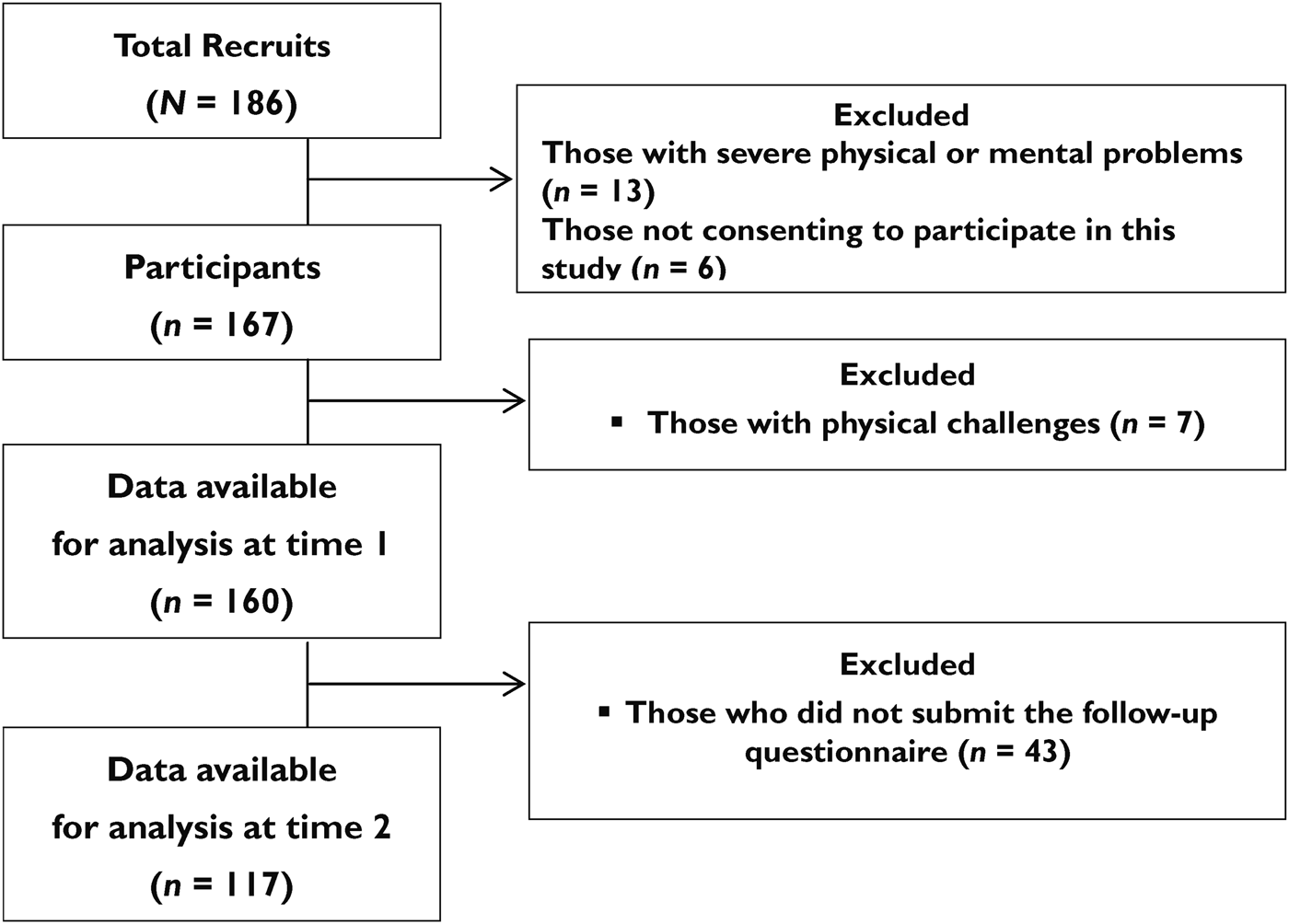
Of 186 patients with head and neck cancer, data from 167 participants were considered potentially suitable for our study (Figure 1). A total of 7 patients were excluded because they had physical difficulty at the time of hospital admission, leaving 160 participants. Some 43 patients dropped out of the study because they were discharged from the hospital and left without returning their questionnaires, leaving a total of 117 participants for whom we analyzed data.
Patient recruitment flowchart.

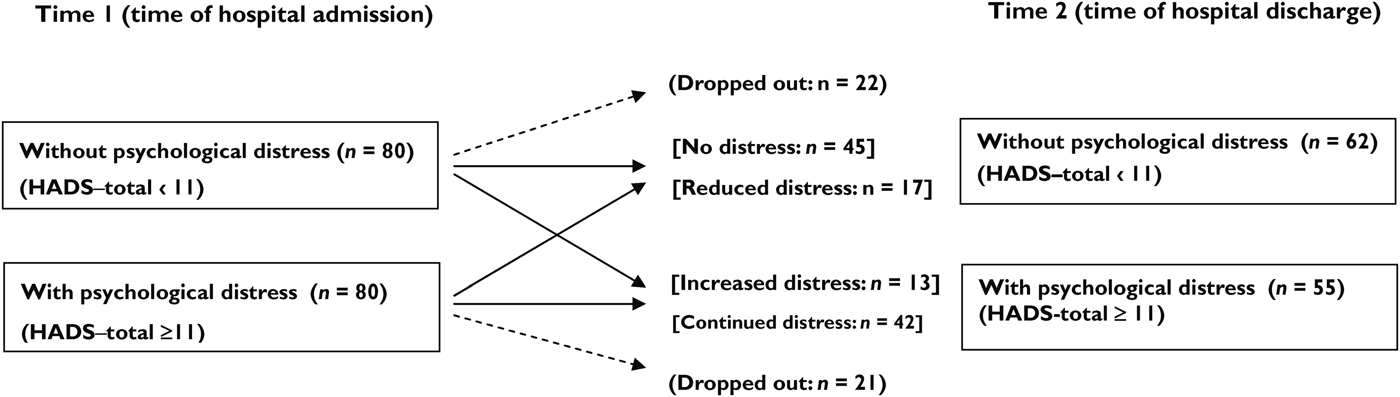
As mentioned above, we created four participant groups: the no-distress group (n = 45), the reduced-distress group (n = 17), the increased-distress group (n = 13), and the continued-distress group (n = 42). These groups were created according to psychological distress scores (HADS–total) at times 1 and 2 (Figure 2). Some 42 (52.5%) participants reported continued psychological distress from the time of hospital admission through to hospital discharge.
Change in psychological distress from the time of admission until discharge.
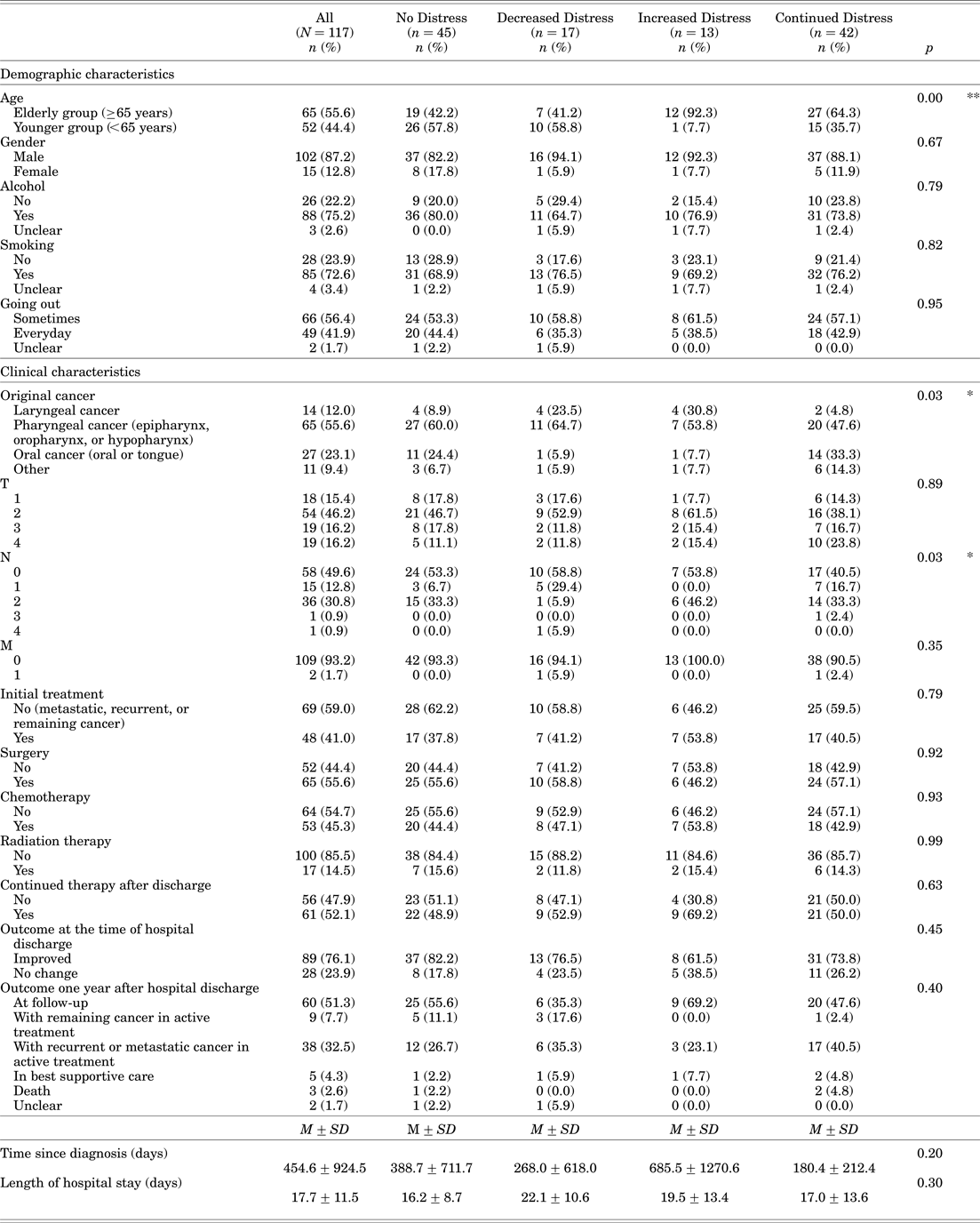
Participant characteristics are presented in Table 1. Some 65 (55.6%) participants were over 65 years of age, 102 (87.2%) were male, and 85 (72.6%) had a history of smoking. The underlying diseases and received therapeutic treatments during hospitalization are also given in Table 1. The frequency of elderly (≥65 years old) patients was significantly higher in the increased-distress (n = 12, 92.3%) and continued-distress groups (n = 27, 64.3%). Additionally, the frequency of patients with pharyngeal cancer was significantly higher in the reduced-distress group (n = 11, 64.7%), and the frequency of patients with oral cancer was significantly higher in the continued-distress group (n = 14, 33.3%).
Demographic and clinical characteristics of the study participants (N = 117)
M = mean, SD = standard deviation. *p < 0.05, **p < 0.01.
Differences in Functional Level Between the Four Groups
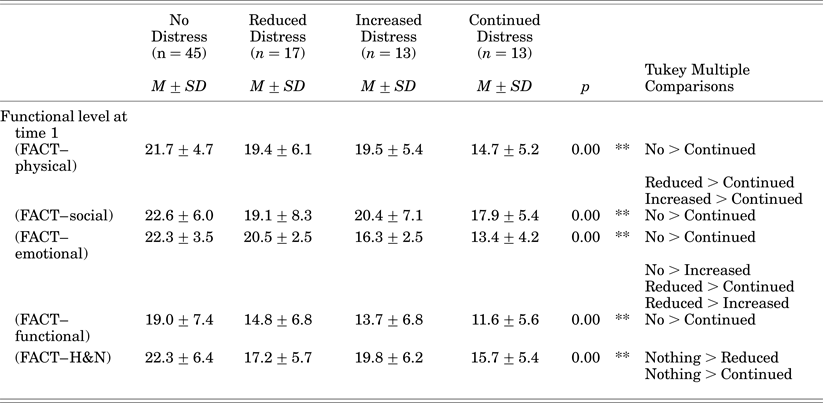
Table 2 presents the differences in functional level between the four groups for each of the five FACT factors, including the means (M) and standard deviations (SD). The ANOVA revealed significant differences between the four groups for all five FACT factors. Tukey multiple comparisons indicated that the patient physical well-being scores were significantly lower in the continued-distress group (14.7 ± 5.2) compared with the other groups (21.7 ± 4.7, 19.4 ± 6.1, 19.5 ± 5.4; p < 0.01), and that the emotional well-being scores were significantly lower in patients in the continued-distress group (13.4 ± 4.2) compared with the no-distress group and the reduced-distress group (22.3 ± 3.5, 20.5 ± 2.5; p < 0.01).
Differences in functional level based on changes in psychological distress following hospitalization
M = mean, SD = standard deviation. *p < 0. 05, **p < 0.01.
Factors Influencing Psychological Distress at the Time of Hospital Admission
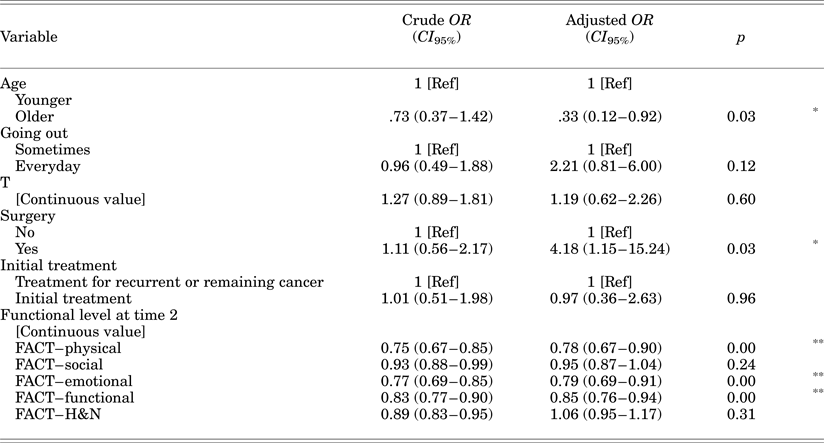
Table 3 presents the factors influencing psychological distress (HADS–total ≥ 11) at time 1, with each OR and 95% CI. A logistic regression analysis revealed that younger age (≤65 years old), scheduled surgery, and poor physical, emotional, and functional well-being were risk factors for psychological distress at the time of hospital admission (Table 3), with adjusted OR of 0.33 (95% CI = 0.12–0.92), 4.18 (95% CI = 1.15–15.24), 0.78 (CI 95% = 0.67–0.90), 0.79 (95% CI = 0.69–0.91), and 0.85 (95% CI = 0.76–0.94). The likelihood ratio test indicated that none of the interactions between independent variables were significant. We found no evidence for multicollinearity because the VIF for the independent variables in this model was less than 4.0.
Logistic regression modeling of factors influencing psychological distress at the time of hospital admission (n = 160)
OR = odds ratio, CI = confidence interval, [Ref] = reference level. *p < 0.05.
DISCUSSION
The primary aim of our study was to evaluate the ratio of patients with persistence of psychological distress over a period of hospital treatment in HNC patients. Our data revealed that half of our HNC patients experienced psychological distress and 70% reported continuous symptoms over the entire duration of their hospital stay. Additionally, physical and emotional well-being in patients with reduced distress was higher than that in patients with continued distress.
Previous studies have suggested that 15 to 30% of HNC patients experience psychological distress at the time of diagnosis and during pretreatment (Joseph et al., Reference Joseph, Routledge and Burns2013; Neilson et al., Reference Neilson, Pollard and Boonzaier2010). Additionally, pretreatment levels of psychological distress have been found to predict levels of psychological distress during posttreatment and follow-up (Adachi et al., Reference Adachi, Kimura and Sato2014; Joseph et al., Reference Joseph, Routledge and Burns2013). Our results, which are consistent with previous findings, indicate that we should prevent the persistence of psychological distress beginning at initiation of pretreatment and on through to posttreatment.
We found physical function to be associated with the persistence of psychological distress in our study population. Indeed, several previous cross-sectional studies have demonstrated a relationship between psychological distress and physical function among patients with HNC (Chiou et al., Reference Chiou, Lee and Ho2013; Koizumi et al., Reference Koizumi, Matsushima and Mochizuki2013; Shiraz et al., Reference Shiraz, Rahtz and Bhui2014). We suggest that there are two possible explanations for this relationship. First, psychological distress may occur as a secondary phenomenon in patients with HNC, resulting from the experience of physical disability, especially when swallowing function is affected (Lin et al., Reference Lin, Starmer and Gourin2012). This common reaction can be described as learned helplessness in a psychological setting, which has a negative impact on psychological adjustment among cancer patients (Eskelinen et al., Reference Eskelinen, Korhonen and Selander2014; Pérez et al., Reference Pérez, Galdón and Andreu2014). Psychosocial approaches that act directly to reduce dysfunction may enhance a patient's willingness to live, and dysphagia or vocal rehabilitation may have a beneficial effect on diminishing psychological distress (Cousins et al., Reference Cousins, MacAulay and Lang2013; Tuomi et al., Reference Tuomi, Andréll and Finizia2014). Second, pain or fatigue sensitivity may be an intermediate variable in the relationship between psychiatric weakness and psychological distress. HNC patients with poor subjective physical function are more likely to experience psychological distress (Chiou et al., Reference Chiou, Lee and Ho2013; Koizumi et al., Reference Koizumi, Matsushima and Mochizuki2013). Accordingly, relaxation therapies have been shown to have a significant impact on psychological adjustment in HNC patients (Allison et al., Reference Allison, Nicolau and Edgar2004; Hammerlid et al., Reference Hammerlid, Persson and Sullivan1999). This may be because such therapies work to increase the amount of attention directed toward body sensations other than pain.
We also found that emotional function was associated with persistence of psychological distress in our study population. Some previous cross-sectional studies have shown a relationship between psychological distress and emotional function, as well as between psychological distress and physical function (Chiou et al., Reference Chiou, Lee and Ho2013; Koizumi et al., Reference Koizumi, Matsushima and Mochizuki2013; Shiraz et al., Reference Shiraz, Rahtz and Bhui2014). Patients with poor emotional function exhibit negative thinking about their disease or about death, and thus often experience persistent psychological distress, even when their physical status improves. In one metaanalysis, psychological interventions, including psychoeducation and supportive psychotherapy, had no effect on individuals with high levels of psychological distress (Semple et al., Reference Semple, Parahoo and Norman2913). Perhaps traditional psychotherapy is not the most efficacious strategy for changing negative thinking about one's disease or death. Recent studies have suggested a strong relationship between attention bias and fear of cancer recurrence (Butow et al., Reference Butow, Kelly and Thewes2014; Park et al., Reference Park, Cho and Blank2013). This indicates a potential for developing an alternative psychotherapeutic technique that includes elements of attention training.
Our secondary research aim was to examine the effect of pretreatment factors on psychological distress at the time of hospital admission. In accordance with other studies, our results suggest that younger age (less than 65 years old) and scheduled surgery are demographic predictors of psychological distress at the time of hospital admission (Adachi et al., Reference Adachi, Kimura and Sato2014; Duffy et al., Reference Duffy, Ronis and Valenstein2007; Mochizuki et al., Reference Mochizuki, Matsushima and Omura2009; Rogers et al., Reference Rogers, Courneya and Robbins2006). Along with the previous literature, our results provide support for a relationship between physical, emotional, and functional well-being and pretreatment for psychological distress. Specifically, our results mirror those of another study that implicated emotional and functional well-being as a predictor of psychological distress at the time of pretreatment (Koizumi et al., Reference Koizumi, Matsushima and Mochizuki2013). Therefore, methods for reducing psychological distress in HNC patients should focus on interventions to improve emotional and functional well-being. Patients who have high levels of functional well-being are able to enjoy daily life, including their job, household responsibilities, and leisure time. Therefore, pretreatment interventions that help patients direct their attention toward the activities of daily life (and away from the details of their illness) are likely to be beneficial.
Our study has two important limitations associated with systematic error. First, our methods may not have excluded selection bias. Our study participants were selected from only one hospital in Japan, and there were many laryngeal cancer patients in the group. However, we believe the participants in this study to be representative of those currently being treated in Japanese hospitals, so that our results are generalizable. Second, the sample size was insufficient when comparing the four groups using an ANOVA because of a high dropout rate in the follow-up questionnaire. In future research, we may be able to develop strategies to improve the response rate. However, we found no differences between dropout rates for patients with and without psychological distress at admission; therefore, dropout status may have a minimal effect on the background characteristics of the HNC patients in our four groups. As this was an exploratory study with a small sample size, we are planning to conduct a future large-scale observational study to test our hypothesis.
CONCLUSION
To the best of our knowledge, this is the first study to focus on the persistence of psychological distress among patients with HNC. Our results indicate that persistence of psychological distress is more common among HNC patients during periods of hospitalization and that their distress is affected by physical and emotional function. New therapeutic approaches are necessary to address psychological distress in HNC patients. Such alternative psychological interventions may focus on helping patients to control their physical or emotional attention. This is certainly a topic for future study.
ACKNOWLEDGMENTS
This study was supported by a grant-in-aid for JSPS Fellows (Social Science: 24-1085) from the Japan Society for the Promotion of Science between April of 2012 and March of 2015. We are grateful to all collaborators for supporting our research program: the participants, the health providers at TMDU hospitals, and laboratory members at the Department of Liaison Psychiatry and Palliative Medicine at TMDU.
CONFLICTS OF INTEREST
The authors state that they have no conflicts of interest to declare.