INTRODUCTION
Hermit crabs are curious and conspicuous organisms that inhabit mostly intertidal environments of the world. These crustaceans use gastropod shells as a shelter to protect themselves against predators and desiccation (Reese, Reference Reese1969; Bertness, Reference Bertness1981; Hazlett, Reference Hazlett1981). The main factors that affect shell occupation in the field are related to availability and shell attributes such as weight, shape, architecture and internal volume (Hazlett, Reference Hazlett1981). Adaptation to a particular shell species may differ among hermit crab species, reflecting numerous selective pressures, which may be associated with different habitats (Bertness, Reference Bertness1981; Garcia & Mantelatto, Reference Garcia and Mantelatto2000). Furthermore, gastropod shells occupied by hermit crabs are an important substrate for settlement of ectosymbionts (epizoans and epiphytes) (Brooks & Mariscal, Reference Brooks and Mariscal1986; Wahl, Reference Wahl1989; Williams & McDermott, Reference Williams and McDermott2004). Ectosymbiont presence can influence many aspects of shell occupation, including shell selection and shell exchange (Grant & Pontier, Reference Grant and Pontier1973; Hazlett, Reference Hazlett1981, Reference Hazlett1984).
Most studies of ecological aspects of hermit crabs are restricted to certain localities. In Brazil, knowledge of shell occupation by hermit crabs in the field has accumulated in the last 15 years, and several studies have been conducted particularly on species/populations from the southern region (Mantelatto & Garcia, Reference Mantelatto and Garcia2000; Mantelatto & Dominciano, Reference Mantelatto and Dominciano2002; Mantelatto & Meireles, Reference Mantelatto and Meireles2004; Biagi et al., Reference Biagi, Meireles, Scelzo and Mantelatto2006; Fantucci et al., Reference Fantucci, Biagi and Mantelatto2008). Considering that Brazil has an extensive coastline and a high diversity of habitats (Dominguez, Reference Dominguez2006), in addition to a high richness and wide distribution of hermit crabs species, comparative studies could be useful for understanding intraspecific adaptations to different environmental conditions (Stearns, Reference Stearns1992; Wehrtmann et al., Reference Wehrtmann, Miranda, Lizana-Moreno, Hernáez, Barrantes-Echandi and Mantelatto2012).
Here we present a comparative study in two regions of the Brazilian coast to evaluate the patterns of shell occupation in the field and the occurrence of ectosymbiotic organisms on the shells of two hermit crab species, comparing two different populations of each species, in order to further investigate the adaptation of species in different habitats. We chose to study Clibanarius antillensis Stimpson, 1859 and Calcinus tibicen (Herbst, 1791) (Melo, Reference Melo1999), which are abundant in rocky beaches, especially in the mesolittoral portion, and have a wide geographic distribution, occurring from the Atlantic coast of the United States to southern Brazil (Melo, Reference Melo1999).
MATERIALS AND METHODS
Site description and sampling methods
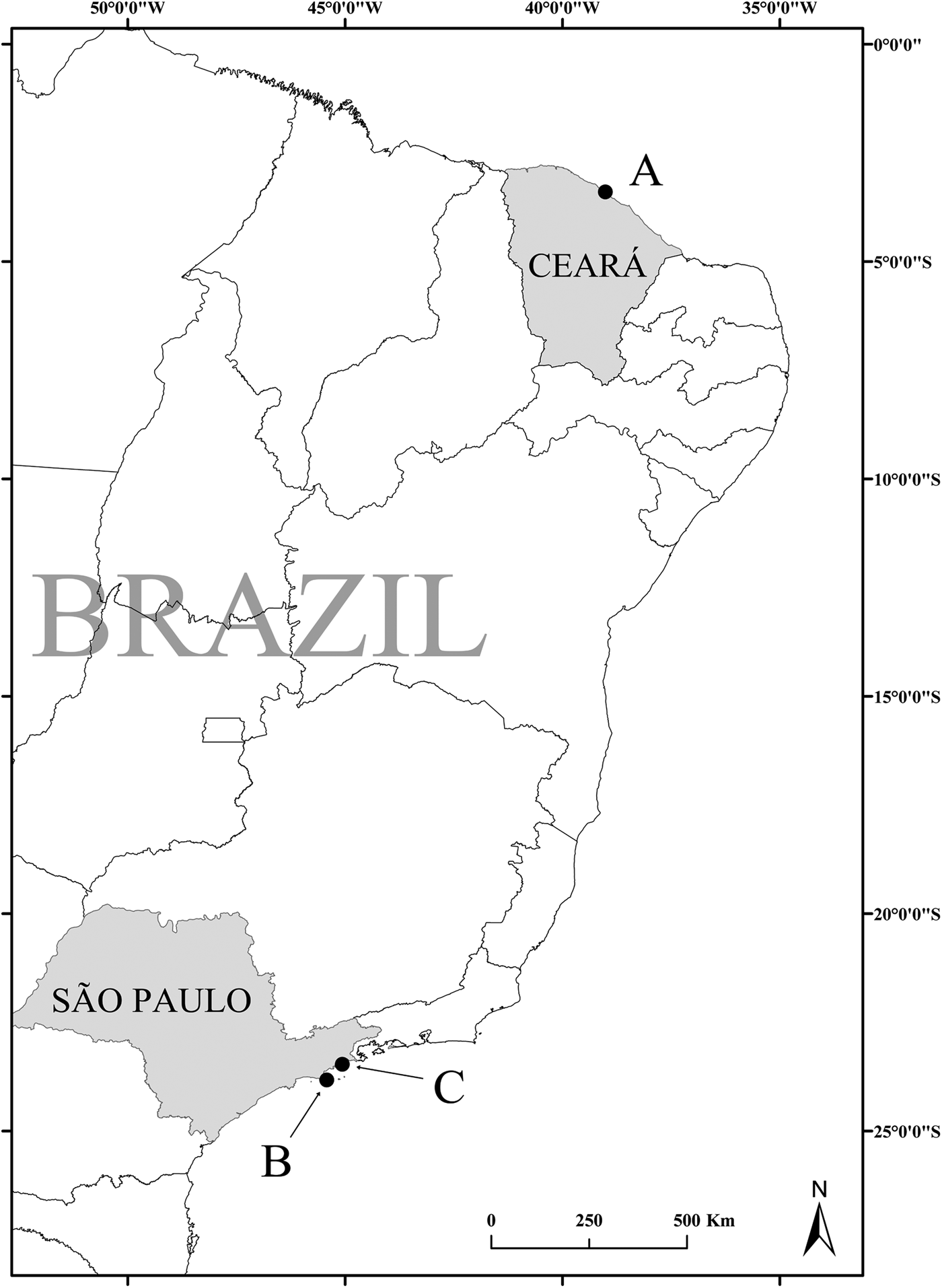
Two diogenid species of hermit crabs were selected for the study, Clibanarius antillensis Stimpson, 1859 and Calcinus tibicen (Herbst, 1791). Specimens were randomly captured manually during about 1 h by one person in low-tide periods in order to obtain specimens of different sizes, every 2 months from February 2011 to January 2012. Sampling was carried out in three different intertidal areas, in two geographic regions (Figure 1).
Study areas: (A) Pedra Rachada Beach, Paracuru, Ceará, north-eastern region; (B) Araçá Beach, São Sebastião, São Paulo, south-eastern region; (C) Grande Beach, Ubatuba, São Paulo, south-eastern region.

The first area, in north-eastern Brazil, is Pedra Rachada Beach, Paracuru, state of Ceará (03°23′52″S 39°00′47″W), where both species were collected. This beach has a sandstone reef about 3 km long, interrupted by sandbanks, with many species of algae and a wide diversity of marine invertebrates (Matthews-Cascon & Lotufo, Reference Matthews-Cascon and Lotufo2006). The second area is Araçá Beach, São Sebastião, São Paulo state in south-eastern Brazil (23°49′41″S 45°25′22″W), where only individuals of C. antillensis were collected. This area is protected lowland in a bay, which contains one of the last remaining mangrove stands along the São Sebastião Channel. The environment is formed by sandy-mud sediments, gravels and mangrove roots, and is entirely uncovered at low tide (Amaral et al., Reference Amaral, Migotto, Turra and Schaeffer-Novelli2010). The third area is Grande Beach, Ubatuba, São Paulo (23°27′98″S and 45°03′49″W), where only individuals of C. tibicen were collected. This area has a sloping rocky profile with cracks and irregular surfaces, exposed to strong wave action (Mantelatto & Fransozo, Reference Mantelatto and Fransozo1998).
Laboratory analysis
After collection, the hermit crabs were placed in plastic bags and taken to the laboratory, where they were immediately frozen. There, they were carefully removed from their shells.
The gastropod shells were identified according to Rios (Reference Rios2009), counted, and measured for aperture length (SAL) and width (SAW). The sex of hermit crabs was checked by the gonopore position (on the basis of the third pereopods in females and the fifth in males) and measured for the shield length (SL), i.e. the distance from the edge of the rostrum to the V-shaped groove in the posterior margin. The measurements were made with a vernier caliper (±0.01 mm accuracy).
The species of ectosymbionts that composed the fouling community were separated and identified to the lowest possible taxonomic level. Where this identification was not possible, ectosymbionts were classified in greater taxonomic groups and their frequency of occurrence was evaluated. We used a qualitative classification adopted from Ayres-Peres & Mantelatto (Reference Ayres-Peres and Mantelatto2010), which consisted of recording the presence or absence, and when possible, the position of these organisms on the surface of the shell. Most of the surfaces were completely covered, so it was not possible to describe the exact boundaries of many fouling organisms. In addition, we analysed the prevalence of ectosymbionts in occupied shells according to the terminology of Overstreet (Reference Overstreet1978) and Margolis et al. (Reference Margolis, Esch, Holmes, Kuris and Schad1982) and checked the range of the number of ectosymbiont groups in colonized shells. We established the prevalence of fouling, consisting of the proportion of infested hosts, as the percentage of colonized shells by each ectosymbiont group. The abundance, i.e. the number of symbionts per host, and the intensity, i.e. the number of symbionts per infested host were not evaluated.
For damaged shells, the frequency and location of the damage were recorded. Damage location was characterized according to the position on the shells: aperture (including the siphon channel and internal/external lips), body whorl, spire and protoconch. Damage included mainly cracks, breaks and perforations.
Voucher specimens of hermit crabs were deposited in the carcinological collection of the Departamento de Zoologia, Universidade Federal do Rio Grande do Sul (UFRGS catalogue numbers 5744–5747).
Statistical procedures
The Pearson correlation was employed to determine the relationships among the SL, SAL and SAW. The G-Test was utilized to determine possible differences in shell occupation among males, non-ovigerous and ovigerous females. The Chi-square test was used to assess the crabs’ occupancy of damaged and undamaged shells. All analyses were performed with a significance level (α) of 95% (Zar, Reference Zar2010).
RESULTS
Shell occupation
Clibanarius antillensis
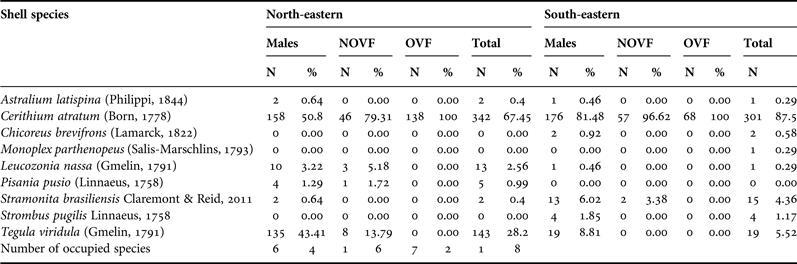
In total, 851 hermit crabs were sampled: 507 (59.6%) in the north-eastern region, occupying five species of gastropod shells, with Cerithium atratum and Tegula viridula being the shell species most occupied; and 344 (40.4%) in the south-eastern region, occupying eight species of gastropod shells, C. atratum being the most occupied (Table 1). Ovigerous females occupied the shell species C. atratum in both areas. Males occupied six species in the north-east and eight species in the south-east, while non-ovigerous females occupied respectively four and two species in the two areas (Table 1).
Gastropod shell species occupied by the hermit crab Clibanarius antillensis in the two study areas in north-eastern and south-eastern Brazil.

N, number of occupied shells; NOVF, non-ovigerous females; OVF, ovigerous females.
There were significant differences in the proportion of shells occupied by males and females (non-ovigerous and ovigerous) in the north-east (G = 154.8244, df = 10, P < 0.0001) and south-east (G = 35.7942, df = 14, P < 0.001).
The relationships between the shell dimensions (SAL and SAW) and shield length (SL) were positive, and most were significant for the shells that were most occupied (Table 2).
Clibanarius antillensis. Correlation analysis between SL × SAL and SAW for shells most occupied in north-eastern and south-eastern Brazil.

-SL, shield length; SAL, shell aperture length; SAW, shell aperture width; R, correlation coefficient; t, value of Student's t test.
ns, not statistically significant.
Calcinus tibicen
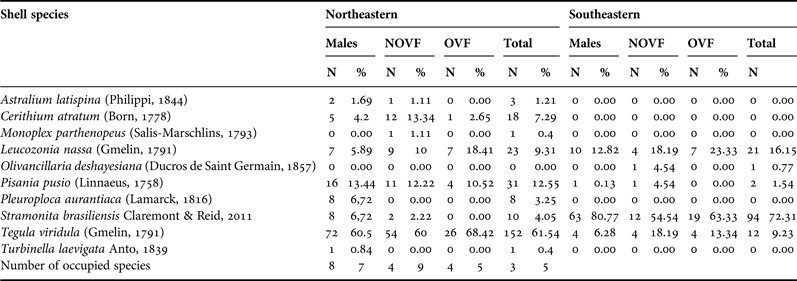
In total, 377 hermit crabs were sampled: 247 (65.5%) in the north-eastern region, occupying nine species of gastropod shells, with T. viridula being the shell most occupied; and 130 (34.5%) in the south-eastern region, occupying five species of gastropod shells, with Stramonita brasiliensis being the shell most occupied (Table 3). Ovigerous females occupied four species of gastropod shells in the northeast, most frequently T. viridula. In the south-east, only three species of gastropod shells were occupied by ovigerous females, of which S. brasiliensis was the most frequent. Males occupied nine shell species in the north-east and four in the south-east. Non-ovigerous females occupied seven and five species in the north-east and south-east respectively (Table 3).
Gastropod shell species occupied by the hermit crab Calcinus tibicen in the two study areas in north-eastern and south-eastern Brazil.
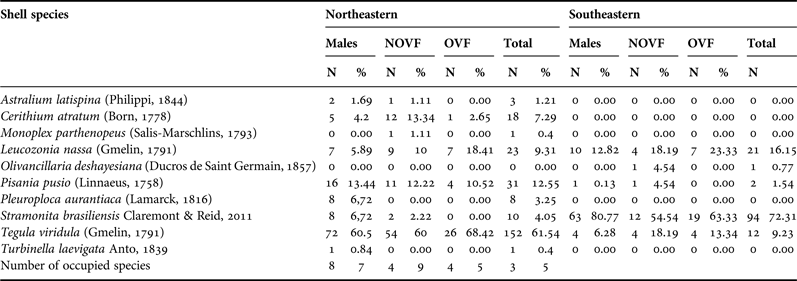
N, number of occupied shells; NOVF, non-ovigerous females; OVF, ovigerous females.
The proportions of shells occupied by males and females (non-ovigerous and ovigerous) differed significantly in the north-east (G = 33.9098; df = 16; P < 0.005), but not in the south-east (G = 12.6322; df = 8; P = 0.1251).
The relationships between the shell dimensions (SAL and SAW) and shield length (SL) were positive, and most were significant for the most-occupied shell species (Table 4).
Calcinus tibicen. Correlation between SL × SAL and SAW for the most-occupied shell species in north-eastern and south-eastern Brazil.

N, number of individuals; SL, shield length; SAL, shell aperture length; SAW, shell aperture width; R, correlation coefficient; t, value of Student's t test.
Shell damage
Clibanarius antillensis
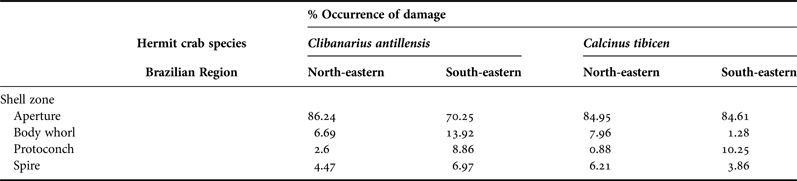
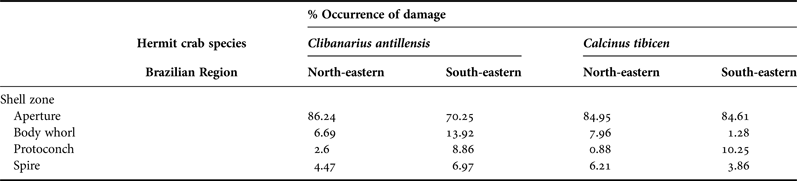
The percentage of damaged shells occupied was not significant in the north-east (N = 283; 55.82%; χ2 = 2.899, P = 0.1058) and the south-east (N = 344; 49.42%; χ2 = 0.8715, P = 0.8715). Most of the damage was to the shell aperture; damage to the body whorl, protoconch and spire was less frequent (Table 5).
Relative frequencies of shell damage in different areas of shells occupied by the hermit crabs Clibanarius antillensis and Calcinus tibicen in the two study areas in north-eastern and south-eastern Brazil.
Calcinus tibicen
In this species, the percentage of damaged shells was not significant in the north-east (N = 247; 45.35%; χ2 = 2.142; P = 0.1616), while in the south-east the percentage was significantly high (N = 130; 70%; χ2 = 20.80; P < 0.0001). Damage to the shell aperture was the most common in both areas (Table 5).
Characterization of ectosymbionts
Clibanarius antillensis
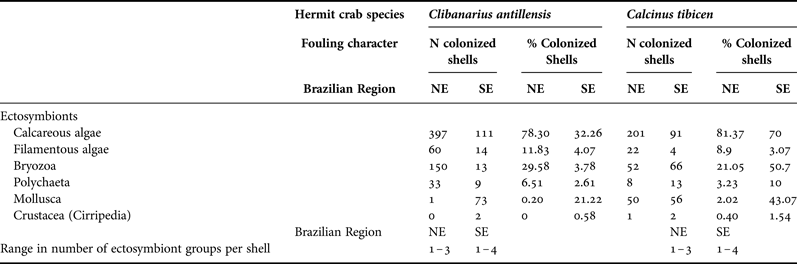
In the north-east, 91.91% (N = 466) of the shells were incrusted by ectosymbionts, while in the south-east, the percentage was 52.27% (N = 197). In both regions, some shells bore one or more groups of ectosymbiont organisms, but in the south-east the number of ectosymbionts found per shell was higher (Table 6). Fouling organisms most frequently found and with higher prevalence on shells in the north-east were calcareous algae (order Corallinales) and bryozoans (Figure 2A; Table 6). Other organisms occasionally found were tubes of spirorbid and serpulid polychaetes, filamentous algae of the genus Ulva Linnaeus, 1753 and the exotic invader bivalve Isognomon bicolor C. B. Adams, 1845, which was always located cryptically in the umbilical region of shells of T. viridula. Calcareous algae and bryozoans were the most common fouling organisms found on the two shell species that were most occupied (Figure 2B). In the south-east, the most frequent ectosymbionts and with higher prevalence were coralline algae and the oyster Crassostrea brasiliana (Lamarck, 1819) (Figure 2A; Table 6). Although less frequently, the following ectosymbionts were also observed: the bivalve genus Chama Linnaeus, 1758; egg capsules of gastropods of the family Neritidae; the slipper snail Crepidula plana Say, 1822; and the barnacle Amphibalanus amphitrite (Darwin, 1854). For the most occupied shells, calcareous algae and ostreid bivalves were the most frequent ectosymbionts (Figure 2B, C).
Clibanarius antillensis ectosymbiont groups: (A) found on gastropod shells occupied in the north-eastern and south-eastern regions; (B) found on gastropod shells most often occupied in the two study areas in the north-eastern region and (C) south-eastern region.

Prevalence and range in number of ectosymbionts on shells occupied by the hermit crabs Clibanarius antillensis and Calcinus tibicen in the two study areas in north-eastern and south-eastern Brazil.
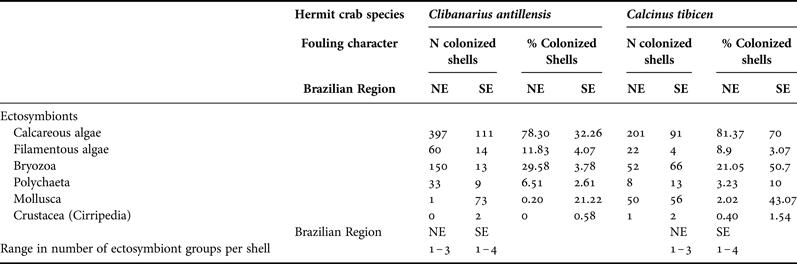
N, number of shells; NE, north-east region; SE, south-east region.
Calcinus tibicen
In the north-east, 89.47% (N = 247) of shells were incrusted by ectosymbionts, while in the south-east, the percentage was 94.31% (N = 130). In both regions, some shells bore one or more groups of ectosymbiont organisms, but in the south-east, the number of ectosymbionts found per shell was higher (Table 6). In the north-east, calcareous algae, bryozoans and polychaete worm tubes were the most frequently found and with higher prevalence on shells (Figure 3; Table 6). Occasionally, the slipper snail Crepidula plana Say, 1822, was observed in the umbilical region of T. viridula shells and inside a shell of P. aurantiaca. In the south-east, the occurrence of ectosymbionts was similar, and the bivalve Sphenia antillensis Dall & Stimpson, 1901 was occasionally found associated with S. brasiliensis shells.
Calcinus tibicen ectosymbiont groups: (A) found on gastropod shells occupied in the north-eastern and south-eastern regions; (B) found on gastropod shells most often occupied in the two study areas in the north-eastern region and (C) south-eastern region.

Calcareous algae and bryozoans were the most frequent ectosymbionts on the four most-occupied shell species in the north-east. In the south-east, this pattern was the same for the two most-occupied shell species, followed by polychaete worm tubes (Figure 3B, C).
DISCUSSION
Shell occupation
The two sympatric hermit crab species showed different patterns of shell occupation. In both areas, C. antillensis occupied mainly C. atratum, and Calcinus tibicen occupied mainly T. viridula in the north-eastern area and S. brasiliensis in the south-east. These shell species are widely distributed along the Brazilian coast (Rios, Reference Rios2009). The shell of O. deshayesiana was occupied only in the south-east, but this species has only been recorded in the south and south-east of Brazil (Rios, Reference Rios2009). The observed differences in shell occupation between the two species of hermit crabs may be directly influenced by the diversity of gastropod populations in the two areas and to the geographic distributions of these molluscs (Mantelatto et al., Reference Mantelatto, Fernandes-Góes, Fantucci, Biagi, Pardo and Góes2010). However, studies concerning the diversity of gastropod molluscs in rocky beaches are scarce in Brazil (Veras et al., Reference Veras, Martins and Matthews-Cascon2013); such studies could help to characterize the potential source of shells used as shelters by hermit crabs. In addition, according to Martinelli & Mantelatto (Reference Martinelli, Mantelatto, Schram and Vanpel Klein1999), hermit crabs do not necessarily occupy the shells of all existent gastropod species in a given area, due to shell characteristics and conditions.
Shell utilization in the field by hermit crabs changes according to each species, but it is limited by shell availability (Reese, Reference Reese1969). As hermit crabs are attracted by chemoreceptors to sites where gastropods are predated (McLean, Reference McLean1974; Rittschof et al., Reference Rittschof, Sarrica and Rubenstein1995), these crustaceans can obtain the shells quickly after their death, before they are damaged or destroyed (Hazlett, Reference Hazlett1981). Shells may also be obtained directly from another hermit crab, by moving between adjacent zones where these crabs may share shells (Spight, Reference Spight1977).
Other factors influencing shell occupation by hermit crabs are sex and reproductive status (Neil & Elwood, Reference Neil and Elwood1985). Male and female hermit crabs exhibit different behaviours in shell occupation. Because of their larger size, males are able to outcompete females when in agonistic conflicts for shell occupation (Hazlett, Reference Hazlett1966; Bertness, Reference Bertness1981; Neil & Elwood, Reference Neil and Elwood1985). In this study, the sexes showed significant differences in patterns of shell occupation for C. antillensis in both areas and only in the north-east for C. tibicen. Other hermit crab species such as the pagurid Pagurus brevidactylus (Stimpson, 1859) in the sublittoral area of Anchieta Island (Ubatuba, São Paulo) also showed differences in shell occupation between the sexes, with males occupying predominantly shells of C. atratum and ovigerous females occupying Morula nodulosa (C. B. Adams, 1845) (Mantelatto & Meireles, Reference Mantelatto and Meireles2004). In the diogenid Isocheles sawayai Forest & Saint Laurent, 1968, a study on Margarita Island (Venezuela) also found differences in shell occupation, with males occupying mainly shells of L. nassa and females occupying Engoniophos unicinctus (Say, 1826) (Galindo et al., Reference Galindo, Bolaños and Mantelatto2008). In the present study, for C. antillensis, shells of C. atratum were more occupied in both areas, while for C. tibicen three species of shells were mainly occupied, two of which are found in both areas. In the present study, ovigerous females showed a specific pattern of shell occupation: C. antillensis occupied only C. atratum shells in both areas, while C. tibicen ovigerous females occupied three species of shells, two of which are found in both areas. The high frequency of ovigerous females in a specific gastropod shell species is well documented (Bach et al., Reference Bach, Hazlett and Rittschof1976; Fotheringham, Reference Fotheringham1976). The limited occupation of shell species by ovigerous females suggests that the choice is restricted by the need for space to accommodate the egg mass (Mantelatto & Garcia, Reference Mantelatto and Garcia2000) and therefore shell features such as internal volume and aperture width are very important (Mantelatto & Garcia, Reference Mantelatto and Garcia2000; Frameschi et al., Reference Frameschi, Andrade, Alencar, Fransozo, Teixeira and Fernandes-Góes2013).
In addition, taking into account that these species are located in different types of environments according to the region, the spatial heterogeneity and physical and biological properties of these habitats can influence the occupation of different shells by each population (Dominciano et al., Reference Dominciano, Sant'Anna and Turra2009; Teoh et al., Reference Teoh, Hussein and Chong2014). In this study, we observed that the north-eastern locality is spatially more heterogeneous than the south-eastern localities. Although, we observed that only for non-ovigerous females of C. antillensis and for both sexes of C. tibicen there was a greater number of species of occupied shells in the north-east. A more heterogeneous habitat can provide a wider choice of shells, minimizing interspecific competition for the available shells (Teoh et al., Reference Teoh, Hussein and Chong2014). Some studies have shown differences in the shell occupation by hermit crabs between populations of the same species in different habitats (Leite et al., Reference Leite, Turra and Gandolfi1998; Garcia & Mantelatto, Reference Garcia and Mantelatto2000; Mantelatto et al., Reference Mantelatto, Biagi, Meireles and Scelzo2007, Reference Mantelatto, Fernandes-Góes, Fantucci, Biagi, Pardo and Góes2010; Ayres-Peres et al., Reference Ayres-Peres, Quadros and Mantelatto2012).
The positive relationships observed between hermit crabs and shell sizes indicates that larger individuals occupy larger shells, as observed by Turra & Leite (Reference Turra and Leite2001) for sympatric species of the genus Clibanarius in an intertidal zone. The coexistence of hermit crab species is closely related to shell occupation, and it is influenced by differences in the shell species presence and on a finer scale associated with shell selection and shell occupation patterns (Turra & Leite, Reference Turra and Leite2001). Habitat segregation by hermit crabs in the intertidal zone is related to differences in the supply of shells (Spight, Reference Spight1977), and can generate a sharing of resources, reducing interspecific competition.
Shell damage
Shells occupied by hermit crabs can be damaged by physical factors such as wave hydrodynamics, chemical degradation and biological action caused by ectosymbionts and even predators (Turra et al., Reference Turra, Denadai and Leite2005). In this study, we suggest that predation and wave hydrodynamics could be important factors causing damage to the shells.
The damage to the shells was mostly located at or near the shell aperture. According to Bertness & Cunningham (Reference Bertness and Cunningham1981), this type of damage can indicate high gastropod predation rates by brachyuran crabs (Turra et al., Reference Turra, Denadai and Leite2005). These crustaceans are very common in Brazilian rock shores (Melo, Reference Melo1996), especially the families Eriphiidae and Menippidae, represented respectively by two abundant species, Eriphia gonagra (Fabricius, 1781) and Menippe nodifrons Stimpson, 1859. These crabs are important predators of gastropods and hermit crabs in the intertidal zone (Rossi & Parisi, Reference Rossi and Parisi1973) and frequently found in the study area in the north-east (Coelho et al., Reference Coelho, Almeida and Bezerra2008) and south-east regions (Bertini et al., Reference Bertini, Braga, Fransozo, Corrêa and Freire2007; Amaral et al., Reference Amaral, Migotto, Turra and Schaeffer-Novelli2010). Claws of the crab M. nodifrons are well designed for breaking mollusc shells (Vermeij, Reference Vermeij1977; Santana et al., Reference Santana, Fonteles-Filho, Bezerra and Matthews-Cascon2009). Turra (Reference Turra2003) reported similar damage for shells occupied by sympatric species of the genus Clibanarius, including C. antillensis, at Pernambuco Island, São Sebastião, São Paulo. Damaged shells could make hermit crabs more susceptible to predation by brachyuran crabs and increase exposure to the parasites (Reese, Reference Reese1969) and osmotic stress (Shumway, Reference Shumway1978). In addition to predation by crabs, the high frequency of damage found in hermit crabs collected on Grande Beach (especially around the shell aperture) may be due to the strong waves and currents in this area (Fransozo & Mantelatto, Reference Fransozo and Mantelatto1998).
Other types of damage such as perforations along the spire or cracks in the protoconch were found in low percentages. Shells with this type of damage may be unfavourable for use, because damage to the upper shell prevents water retention during low tide, making the hermit crabs more susceptible to desiccation (Reese, Reference Reese1969), especially in intertidal species.
In this study, we did not assess the presence of damage in unoccupied shells. Empty shells normally used by hermit crabs are rare in the rocky intertidal zone (Childress, Reference Childress1972; Vance, Reference Vance1972) and availability is directly related to environmental characteristics and the presence of live gastropods (Bollay, Reference Bollay1964; Mantelatto & Garcia, Reference Mantelatto and Garcia2000). Shells in good condition (with no cracks or perforations) are ideal for hermit crabs and can be the result of non-destructive gastropod death due to desiccation, parasitism or diseases (Bertness, Reference Bertness1980). Pechenik & Lewis (Reference Pechenik and Lewis2000) found that in Pagurus longicarpus Say, 1817, damage was more common in empty gastropod shells than in occupied shells, suggesting that individuals of this species avoid damaged shells. Hermit crabs seem to be able to discriminate between intact and damaged shells based on tactile cues, once broken shelters can increase the vulnerability of crabs under osmotic stress, predation and eviction by conspecifics (Pechenik & Lewis, Reference Pechenik and Lewis2000).
Characterization of ectosymbionts
Marine animals, especially crustaceans, are commonly associated with ectosymbiont organisms. In hermit crabs, these organisms are mainly associated on the surface of occupied gastropod shells. The few studies on the occurrence of ectosymbiont organisms on shells occupied by hermit crabs include those of Turra & Leite (Reference Turra and Leite2001) and Turra (Reference Turra2003), who investigated the ectosymbionts and adequacy of shells used by sympatric hermit crabs of the genus Clibanarius Dana, 1852 on the Island of Pernambuco, São Sebastião, São Paulo; and Ayres-Peres & Mantelatto (Reference Ayres-Peres and Mantelatto2010), who analysed the occurrence of ectosymbionts on shells used by Loxopagurus loxochelis Moreira, 1901 in two areas of the north-east coast of São Paulo. These studies were restricted to the southern region of Brazil. In the two hermit crab species studied in both areas, most of the shells were covered by ectosymbionts, mainly incrusting calcareous algae, bryozoans, polychaete worm tubes and ostreid bivalves.
Organisms that compose the macrophytobenthos, such as filamentous and coralline algae, are often found covering the shells, providing substrates for other species (Hazlett, Reference Hazlett1984). Filamentous algae were found in shells of all populations. Hermit crabs can eventually decorate shells with algae to provide a food resource or camouflage. Some crustaceans such as spider crabs exhibit a curious behaviour in which they decorate themselves with materials from their environment, including algae, to provide camouflage against predators (Wicksten, Reference Wicksten1993). Calcareous algae were the most frequent ectosymbionts and with higher prevalence, found on all parts of the shells and usually entirely covering them, leaving no space for the settlement of other organisms. The paucity of studies of epiphytes on shells occupied by hermit crabs does not allow comparisons, but the shells are important substrates for calcareous algae in the marine environment (Tendal & Dinesen, Reference Tendal and Dinesen2005).
Bryozoans were present in high percentages and prevalences, as also found by Ayres-Peres & Mantelatto (Reference Ayres-Peres and Mantelatto2010) for L. loxochelis. The high rate of occurrence of these organisms may stem from their high abundance in the surrounding environment and to the susceptibility of shells for settlement. Bryozoans produce calcareous colonies that can grow large enough to alter the morphology of the shells and may provide greater protection for the hermit crabs against predators, by strengthening the shell or by providing camouflage (Taylor, Reference Taylor1994; Sandford, Reference Sandford2003; Ayres-Peres & Mantelatto, Reference Ayres-Peres and Mantelatto2010). The high incidence of bryozoan species indicates that these organisms may depend extensively on these crustaceans for settlement substrate (Taylor, Reference Taylor1994). In this contribution, bryozoan colonies were found mainly near the shell aperture, the inner lip or the siphonal canal. Taylor (Reference Taylor1994) suggests that bryozoans settle near the shell aperture, often in grooves among the whorls. Some colonies can develop at the apex of the shells, as also observed in this study. In addition, bryozoan colonies may also be found on the surface of other marine organisms such as horse-shoe crabs and sea snakes (Key et al., Reference Key, Jeffries, Voris, Yang, Gordon, Smith and Grant-Mackie1996) and even on other crustaceans such as the giant isopod Glyptonotus antarticus Eights, 1852 (Key & Barnes, Reference Key and Barnes1999).
Polychaete worms of the families Spirorbidae and Serpulidae were also frequent on the shells. Bick (Reference Bick2006) studying populations of Clibanarius erythropus (Latreille, 1818) and Calcinus tubularis (Linnaeus, 1767) in Ibiza, Mediterranean Sea, found that shells occupied by hermit crabs supported polychaete communities dominated by Spirorbidae in the case of C. erythropus and by small Sabellidae in C. tubularis. These annelids produce calcareous tubes of variable morphology, are prevalent on occupied shells (Williams & McDermott, Reference Williams and McDermott2004), and may attach to the outer or inner surface of the shells. Their occurrence is usually facultative or accidental, and only a few species are obligate associates (Al-Ogily & Knight-Jones, Reference Al-Ogily and Knight-Jones1981).
With respect to molluscs, the occurrence of ostreid bivalves on the shells is mostly accidental. The oysters attach to the outer surface by the left valve (Williams & McDermott, Reference Williams and McDermott2004). The high prevalence of oyster Crassostrea brasiliana in shells of C. antillensis in the Araçá beach can be related to the extensive cultivation of these molluscs in the southern region. The gastropod Crepidula plana is a commensal and shows a preference for occupied shells, mainly in the lumen region (McDermott, Reference McDermott2001). The occurrence of egg capsules of gastropods of the family Neritidae is common on the surface of live gastropods (Kano & Fukumori, Reference Kano and Fukumori2010), but can be eventually found in shells utilized by hermit crabs.
Barnacles can attach to a variety of live substrates, including gastropod shells (McDermott, Reference McDermott2001), shrimp and crab carapaces (Key et al., Reference Key, Volpe, Jeffries and Voris1997; Farrapeira & Calado, Reference Farrapeira and Calado2010) and vertebrate skin (Caine, Reference Caine1986; Ribeiro et al., Reference Ribeiro, Carvalho, Bevilaqua and Bezerra2010) among others. In the present study, barnacles occurred sporadically, differing somewhat from observations by Ayres-Peres & Mantelatto (Reference Ayres-Peres and Mantelatto2010), who found larger numbers of barnacles attached to shells occupied by L. loxochelis.
The presence of ectosymbionts can influence shell selection and also provide advantages and disadvantages for hermit crabs. Incrusted shells can provide camouflage, protecting the crabs against predation. On the other hand, fouling organisms can reduce the resistance and the internal volume of shells, as well as increase shell weight (Partridge, Reference Partridge1980; Gherardi, Reference Gherardi1990, Reference Gherardi1991). Ectosymbionts receive some benefits beyond just the availability of substrates for colonization. For example, sessile filter-feeding organisms can be transported to locations with better feeding conditions and higher concentrations of dissolved oxygen (Wahl, Reference Wahl1989).
Final considerations
The differences in shell occupation, shell damage and ectosymbiont coverage in shelters between populations of the hermit crabs C. antillensis and C. tibicen in this study are probably attributed to habitat characteristics of each area and shell availability in the environment, as well as reproductive condition and sex of hermit crabs. This can reflect the adaptive capability of these crustaceans to exploit different shelter resources and niches in different areas. These factors interact together and should be considered in biological studies of hermit crabs in the field. The results of this contribution should encourage future comparative studies in order to comprehend the plasticity of biological traits of hermit crabs in different environments.
ACKNOWLEDGEMENTS
This study was completed by F.B. Ribeiro in order to partially fulfil the requirements for a Master's degree in Tropical Marine Science at the Federal University of Ceará. The authors would like to thank Dr Alexandre Oliveira de Almeida for comments on the thesis, Dr Janet W. Reid for correcting the English text and to the anonymous reviewers for their suggestions.
FINANCIAL SUPPORT
Coordenação de Aperfeiçoamento de Pessoal de Nível Superior (CAPES) supplied a Master's of Science Scholarship to FBR (Ciências do Mar – Processo 0532/2010) and additional support to sampling in the southern region (Ciências do Mar II – Processo 2005/2014 – 23038.004308/2014-14); Conselho Nacional de Desenvolvimento Científico e Tecnológico (CNPq) supplied a Productivity Research Scholarship to FLM (PQ 302748/2010-5; 304968/2014-5); Fundação de Amparo à Pesquisa do Estado de São Paulo (FAPESP Processo 2010/50188-8) provided additional support to sampling in the southern region.