Despite Chosŏn Korea (1392–1910) being a rigid, hierarchical society, the right to litigate was open to everyone regardless of social status or gender. The openness of the Chosŏn legal system is richly documented in numerous litigation records and petitions submitted to local magistrates’ offices and to the state. Existing studies refer to people's use of this legal resource to resolve various disputes in Chosŏn Korea (Cho Yun-sŏn Reference Yun-sŏn2002; Han Sang-gwŏn Reference Sang-gwŏn1996; Im Sang-hyŏk Reference Sang-hyŏk2003; Kim Kyŏng-suk Reference Kim2005, Reference Kyŏng-suk2008, Reference Kyŏng-suk2012; Jisoo Kim Reference Kim2015; Kim and Kim Reference Kim and Kim2014; Pak Pyŏng-ho Reference Pyŏng-ho1972, Reference Pyŏng-ho1993; Sim Chae-u Reference Sim2013). Yet people also made use of alternative ways of voicing their grievances rather than going directly to the local court. Although we do not know how often those alternative attempts were settled before or without reaching the local court, legal cases reveal that such ad hoc methods were a compelling way of addressing one's resentment to the local community.
The question of whether to use the court was indeed complex. A simple assumption would be that those elites with more political power and economic means preferred the official method (filing at the court), whereas nonelites with limited resources used unofficial methods. However, legal cases do not always reinforce such a supposition. On the one hand, evidence shows that many elites wanted to resolve conflicts through private settlement because involvement in legal matters could damage the moral reputation and image of their families. On the other hand, a number of cases note nonelite people's vigorous litigation activity, even challenging members of the elite group through the local court (Kim and Kim Reference Kim and Kim2014, 55–61). In the litigation case that this article examines in detail, the complainant, Son Sun-mun, though he was a nonelite commoner, preferred not to go through a formal litigation process but instead to appeal his resentment of the accused—another commoner, Kim T'ae-hoe—to their community.
In the dark night of the ninth day of the fifth month in 1745,Footnote 1 Son Sun-mun, residing in Sangju County of Kyŏngsang Province, threw a stone toward the house of Pak Un-ch’ŏl, a clerk to the village association (soim 少任).Footnote 2 Discovered by Pak early the next morning, the stone was carefully wrapped in a paper with writing that described the source of Son's resentment. Pak, even though he was in charge of some aspects of village administration, could not read what was written on the paper, although it was in Korean script (ŏnmun 諺文).Footnote 3 Pak thus immediately called for a meeting with several village people to decipher the contents of the paper, which turned out to be a letter prepared by Son Sun-mun against Kim T'ae-hoe, who, ironically, was the father-in-law of Son's married daughter living in the same village as Pak (“Son Akchi Ogan” 1746, 324–28).Footnote 4
Why did Son choose to throw a letter wrapped around a stone into Pak's yard to air his resentment when he had an official way to initiate litigation through the local court?Footnote 5 And how did Son, an illiterate commoner, prepare the letter to inscribe his grievance? Could Son still have expected the method of a letter-wrapped stone to accomplish justice? What was the community's reaction to Son's action? Son's letter accused Kim T'ae-hoe of the attempted rape of Son's daughter, who was Kim's daughter-in-law. By throwing his letter where the village clerk Pak would be sure to find it, Son ultimately wanted to make Kim's immoral behavior public and get him expelled from the village without having to go directly to the local court. Nevertheless, about twenty days after Son's letter was found, the matter reached the local magistrate's office through a formal petition submitted by Kim T'ae-hoe, who confronted Son's accusation in the letter (“Son Akchi Ogan” 1746, 289–91). In using different approaches, each man selected the method he deemed most effective for presenting his case to the public.
Although scholarship on Chosŏn legal history has investigated the evolution of the law, legal enforcement, Confucian justice, and the petition system and activity, the interactions between local courts and their ordinary users remain largely unexplored. Moreover, while existing studies have focused on the various aspects of legal actions, none has seriously questioned the nature of the legal documents concerned, especially how they were produced and by whom—topics critically related to the circulation of legal information and to the decision to use the legal channel (or not). In other words, though scholars agree about the “fictive” elements embedded in legal documents with respect to how people “formed, shaped and molded” their narratives (Davis Reference Davis1987, 3–4), no careful inquiry has yet been made into the textual complexity of document production in examining Korean legal archives.
Legal documents are, without doubt, a critical resource for accessing the voices of marginalized people at the time, such as women and nonelites. Given the very high illiteracy rates among these people, however, we know that their legal documents were written either by officials or by the scriveners whom illiterate ordinary users of the law employed when preparing to present their cases.Footnote 6 For instance, even oral petitions, despite their immediate impression of being oral testimony spoken in front of the authorities, were actually drafted by officials of the Ministry of Penal Affairs (Hyŏngjo 刑曺) after the interrogation procedure (often involving torture) that took place before presenting the summary of a petitioner's appeal to the king. And the documents written by scriveners simply cannot be presumed to deliver petitioners’ actual rhetorical tone or narrative strategies, because they were crafted by and filtered through the scriveners’ hands. Furthermore, as exhibited by the fact that Pak Un-ch’ŏl—who held a local administrative position in which he took care of various financial and report-writing tasks—was not able to read Korean script, illiteracy may have been far higher than we generally assume. Nor can we presuppose that all legal documents presented in Korean script, rather than in literary Chinese or in scribe's script (idu 吏讀), were drafted either by women or solely by ordinary petitioners.
For a deeper understanding of the dynamics of local society through legal documents, therefore, it is crucial to investigate the nature of and motivation behind the documents being produced, whether individually or collectively, at the specific time concerned. It is necessary to ask how people prepared their own documents, what resources ordinary people had in navigating legal conflicts, how they strategized over the choices they had, and why they finally exercised particular options when trying to win their cases. Taking a micro-historical approach, this article sheds light on these questions by examining Son Sun-mun's litigation case. Doing so illuminates an amazingly rich and complex picture of ordinary people's strategies as they navigated the shifting sociolegal constraints and opportunities offered by eighteenth-century Korean society.
Dealing with Litigation at the Local Courts
Abundant scholarship has pointed out that the Chosŏn state institutionalized the legal system for people in the early fifteenth century. It specified the steps for people to submit their resentful matters to the state, whether through written (sangŏn 上言) or oral petitions (kyŏkchaeng 擊錚), including the use of the sinmun'go (申聞鼓) system, the drum installed outside the palace that anyone could beat to address his or her grievance directly to the king—an example of the Chosŏn state's commitment to listening to people's voices and making legal recourse relatively open to anyone in the society.Footnote 7
Founded upon the Confucian principles of benevolence and rule by virtue, the Chosŏn state, in theory, aimed to function “without litigation” (musong 無訟), which Confucius had accentuated as a condition for a harmonious society.Footnote 8 While the government therefore discouraged the overuse of litigation (often referred to as “favoring litigation,” hosong 好訟), it was also keen to provide its subjects with legitimate ways to litigate if needed or demanded, as well as with the proper operating of local courts in handling litigation. In other words, a balance between rule by virtue and the effective management of lawsuits remained the basis of governing the judicial system throughout the Chosŏn dynasty.
The “seven fundamental affairs of a local magistrate” (suryŏng ch'ilsa 守令七事), formally prescribed in Chosŏn law, echo the seriousness of the state's attitude toward litigation at the local level. “Handling litigation” (sasonggan 詞訟簡) was one of these seven fundamentals, along with agriculture, population, the school system, the military, taxation, and corruption. These “seven affairs” were built upon the “five affairs” originally implemented in the late Koryŏ dynasty (918–1392), in which the lucid management of litigation was also underlined (Koryŏsa 1451, vol. 75, sŏngŏ 3, chŏnju). After the establishment of the Chosŏn dynasty in 1392, Koryŏ's “five affairs” continued to be observed. Adding two more items—promotion of schools and ordering of the military system—the Chosŏn state further articulated the duties of a local magistrate,Footnote 9 and eventually legislated the seven affairs in The Great Code of Administration (Kyŏngguk taejŏn 經國大典 1485), under the section concerning “evaluation of merits” (kogwa 考課). These duties became the core principles that a magistrate would diligently carry out during his tenure in local office.
The burden of handling litigation through the local courts increased as Chosŏn society witnessed a growing number of legal disputes in the second part of the dynasty. Among the various cases, conflicts over gravesites accounted for the greatest number of litigations. The term “gravesite litigation” (sansong 山訟) first appeared in a collection of royal edicts in 1686, under the “funeral” (sangjang 喪葬) section of Ritual Codes (yejŏn 禮典) in the Collection of Received Edicts (Sugyo chimnok 受敎輯錄 1686). The fact that gravesite litigation was placed in the Ritual Codes rather than in the Penal Codes (hyŏngjŏn 刑典), as were other types of litigation, indicates that the state still considered gravesite disputes to be conflicts arising from ritual procedures rather than property rights (Kim Kyŏng-suk Reference Kyŏng-suk2012). However, the escalating numbers of gravesite litigations (along with two other major issues, over land and slaves) soon brought another important change in Chosŏn law. Some decades later, in 1743, “gravesite litigation” became an independent section under the Ritual Codes in the Revised and Supplemented Collection of Received Edicts (Sinbo sugyo chimnok 新補受敎輯錄 1743). The Chosŏn state then created a new section of “hearing cases” (ch’ŏngli 聽理) under the Penal Codes in the Amended Great Code (Sok taejŏn 續大典 1744), and eventually moved the “gravesite litigation” category to the Penal Codes.
Such changes in legal statutes not only reflected the state's response to new and chronic disputes in local areas, but also coincided with the active production of administrative handbooks, which local officials consulted. Individual scholars who had experience in local administration as magistrates or officers were particularly aware of the need for these guidebooks. Kim Paek-kan (1516–82), who served as a local magistrate three times, compiled the Classification of Legal Proceedings (Sasong yuch'wi 詞訟類聚) to help equip local officers with essential knowledge for overseeing legal matters in a fair and timely manner (Kim Paek-kan, Sasong yuch'wi, “Preface”).Footnote 10 In 1656, the Chosŏn government ordered that A Compendium to Enlighten the People (Kyŏngminp'yŏn 警民扁), drafted in 1519 by the scholar-official Kim Chŏng-guk 金正國 (1485–1541), be printed and disseminated throughout the country as a primary reference for both local governance and edification of the people. Magistrates continued to refer to this handbook through the eighteenth century.Footnote 11 A series of legal handbooks, covering everything from the general duties of a local magistrate to specific subjects on handling legal cases, began to appear in large quantities toward the later part of the Chosŏn dynasty (Chŏng and Im Reference Kŭng-sik and Sang-hyŏk1999). Several handbooks for local officers published in the eighteenth and nineteenth centuries even sort out different types of conflicts and then provide exemplary judicial decisions according to specific topics that a magistrate could turn to when presiding over litigation cases (Sim Reference Sim2013).
The surge in the production of such handbooks both by the state and by scholar-officials in the second half of the dynasty shows that handling litigation was a major task of the local courts, whose magistrates felt a pressing need to respond to the various problems that were brought before them. Since Chosŏn law underscored that those with a genuine grievance must go through “the offices and local courts in charge of the jurisdiction” (Kyŏngguk taejŏn 1485, 5:8a), it also confirmed the people's tendency to resolve their problems by accessing the relatively open local courts in Chosŏn Korea.
Inscribing Grievance and Preparing Documents
If late Chosŏn society experienced a notable increase in people's legal activity, how easily could people then prepare their documents? As discussed earlier, with the mounting numbers of petitions and litigations being submitted to local courts, the judicial aspect of the magistrate's responsibilities became heavier. In his Admonitions on Governing the People (Mongmin simsŏ 牧民心書), the late-Chosŏn scholar Chŏng Yag-yong 丁若鏞 (1762–1836) devotes two sections to a discussion of the local magistrate's role in dealing with legal cases. He particularly emphasizes the need for a magistrate to carefully read petitions himself, rather than having his assistants summarize them and make reports. Chŏng writes,
When people make petitions, they borrow the brushes of others and have them draft [words] about their grievous state. Then [petitions] are read by a clerk who usually takes out the gist of the petition and reports [only] the last section of it. How can the magistrate, even if he is as brilliant as a god, judge [the case] correctly by only hearing the ending part? (Chŏng Yag-yong Reference Yag-yong1821, Mongmin simsŏ 11:54–55; emphasis added)
While Chŏng's criticism discloses magistrates’ negligence and local clerks’ bowdlerization in handling legal cases, it also highlights illiterate ordinary people's preparation of their petitions. In the legal realm, the Chosŏn state was based on document-oriented administrative practices that required both parties directly involved in litigation to present relevant materials on their own. In addition to literacy, considerable knowledge was necessary to submit materials using the proper formats, terms, and languages prescribed by the government. The difficulties of document preparation led to the production of compiled casebooks that provided a wide range of petition examples and other litigation-related materials (Chŏn et al. Reference Kyŏng-mok2006).
Essential Knowledge for Scholar-Officials and Clerks (Yusŏ p'ilchi 儒胥必知 1872),Footnote 12 for example, introduces the formats for different types of written and oral petitions that could be referred to by anyone—from local officials and clerks to yangban and ordinary people—who wished to file a complaint or petition. Listing actual cases most commonly filed by people, it offers a definition of each petition form, documental format, and the specific terminology to be used when petitioning. In the “rules concerning the application of the law” (pŏmnye 法例) section of the preface, the Essential Knowledge outlines,
A petition submitted directly by ruling aristocrats is called a tanja (單子). For instance, a yangban residing in the capital and submitting a petition to the Five Districts (obu 五部), the Board of Punishments (hyŏngbu 形部), and the Capital District Office (hansŏngbu 漢城府) on the matter of a gravesite conflict first [needs to] write, “A petition by a resident of . . . district and . . . village, the scholar . . . ” on the front page. It [i.e., the petition] must then start with “Bowing down, I respectfully wish [you] to investigate” (恐鑑伏以) and end with “I could not wish this more ardently” (無任祈懇之至). In case of an extremely grievous and critical matter, [the closing] could be written, “Weeping, I could not wish this more fervidly” (無任泣祝). . . . When commoners submit petitions, “A petition (palgwal 白活) by a man, resident of . . . ” is to be written on the first page, followed by “I respectfully submit a petition as above” (右謹陳所志矣段) or “I address this enormously resentful matter as above” 右謹陳志寃情由事段). To conclude [the petition], [a commoner then] states, “Bowing down, after thorough investigation, I hope ten million times that you will carefully examine [the case] (伏乞參商校是後云云 千萬望良爲白只爲).” (Yusŏ p'ilchi 1872, “Preface”)
As specific document formats were required according to one's social status, it was not easy for people to equip themselves with the precise prerequisites and make documents acceptable to the offices.Footnote 13 This intricacy is also noted by Chŏng Yag-yong, who, distinguishing between the language used by scholars and that used by local clerks, laments that “for those in the countryside who are illiterate or ignorant of the rules of law, the instructors of the village schools often draft petitions on their behalf. Yet their writings are generally plain; how can they know about the [specific] writing styles [used] by the clerks?” (Chŏng Yag-yong Reference Yag-yong1821, Mongmin simsŏ 11:52). Moreover, the casebooks could not cover every individual issue brought by people (Chŏn Reference Kyŏng-mok2006).
In her scrupulous study of gravesite litigations in the late Chosŏn, Kim Kyŏng-suk traces a series of petitions (both written and oral) made by two yangban families—the No family and the Pak family—over a prolonged gravesite conflict (Kim Kyŏng-suk Reference Kyŏng-suk2008; Reference Kyŏng-suk2012, 73–96). In particular, a diary kept by a No family member, No Sang-ch'u (1746–1829), informs us of the No family's painstaking petitioning strategies after their first written petition was rejected by the office for not having the appropriate content and form. In the first two months of 1810, for instance, the No family put tremendous time and effort into drafting what was by then a fifth petition, asking a couple of people with literary talent to write the petition on their behalf and then having the draft undergo revision after revision by other scholars, including No Sang-ch'u himself.Footnote 14 In the meantime, No also gathered information about the king's trip to the royal tombs, planned where along the king's journey to submit the prepared petition to him, and contacted relevant officials to ensure that the petition would indeed be presented to the monarch (Kim Kyŏng-suk Reference Kyŏng-suk2012, 92).
The case of the No family illustrates how litigation activities could entail calling on sources of considerable knowledge, marshalling one's personal connections, and otherwise devoting extensive time to preparing the most appealing document possible to present to the authorities. As a relatively renowned yangban family with links to both the local and central governments, the No family was able to afford the resources necessary to meet all the requirements. But what about ordinary people with far fewer connections and with quite limited financial and literary means? As copious textual evidence of all status groups’ active participation in the litigation system shows, they too tried to protect their interests by whatever methods available to them. At the same time, the complexity of document preparation forced ordinary people to seek assistance from people who possessed the skills that they lacked.
Scholars have wondered about the identities of those who helped draft petitions and litigation documents at others’ request. Historical records of the early to mid-Chosŏn tell of the existence of some people who were well versed in legal details. Collectively referred to in official histories as oejibu (外知部), they were regarded as “unofficial men with legal knowledge.” Paid to draft various legal documents, they worked mostly around the capital area, functioning something like Korean counterparts of the Chinese songshi (訟師), or legal masters (Fuma Reference Fuma2007; Chen Reference Chen2012, Reference Chen, Chen and Zelin2015; Macauley Reference Macauley1998; Wu Reference Wu, Chen and Zelin2015). However, the Chosŏn government considered these men “litigation hooligans” who encouraged unnecessary lawsuits, protected the guilty, used tricky methods to secure success, embellished litigation documents, and even bribed local clerks and messengers. As early as 1475, the state imposed a heavy criminal penalty on these people's activities (Sŏngjong sillok 1475/8/15), and by the seventeenth century, they no longer appear in any historical records. After the last explicit reference to them, made in 1603 (Sŏnjo sillok 1603/11/25), it is quite challenging to locate traces of their activities in the later part of the Chosŏn dynasty.
Historians of Chosŏn Korea only assume that men engaging in such unofficial legal activity continued to ply their trade until the end of the dynasty, meeting the high demand for people with legal knowledge amid the ever-increasing numbers of litigations, petitions, and other legal actions in later Chosŏn society.Footnote 15 In carefully examining the use of language and rhetoric in various legal documents, some scholars have noted the presence of a somewhat professional level of scribes who could shape their stylistic writings to impress readers while getting to the kernel of the issue (Chŏn Reference Kyŏng-mok2013, 21–22; Han Reference Sang-gwŏn2008; Pak Chun-ho Reference Chun-ho2018, 418–19). Moreover, law books published in the nineteenth century still included the statute on punishing the crime of “enticing one to litigate” with 100 rounds of heavy flogging and exile to a distance of 3,000 li (Yullye yoram 1837, 263),Footnote 16 implying the continued existence of these people's activities.
Given the dearth of references to such men in historical materials, it remains difficult to paint a comprehensive picture of how ordinary people, including women, actually prepared the various legal documents they needed. However, delving into questions of how the documents were produced, by whom (whether through individual or collective efforts), and by means of what procedures is as important as scrutinizing what the documents contained after they were eventually written. Examining these issues can offer insight into what resources ordinary people in the late Chosŏn had in navigating legal conflicts and how they strategized over the choices they had for winning their cases. By pursuing these questions, we can thus move a step beyond the existing picture of ordinary people's engagement in the late Chosŏn legal sphere.
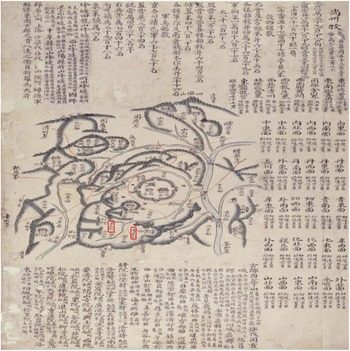
Son Sun-mun's case reveals how, as an illiterate ordinary man, he managed to prepare his letter before wrapping it around a stone and throwing it into the clerk's yard, whence it would reach his local community. When Son decided to make public Kim T'ae-hoe's attempted rape of Son's daughter, he traveled about 10 li to visit a literate man residing in a different district and asked him to draft his letter (figure 1). Son later testified, “Because I am not literate, I borrowed writing (ch'asŏ 借書) from Im Ch'ang-i, a post station clerk (yŏngni 驛吏) living in Ch’ŏng district. But he did not write what I told [him to write], neglectfully drafting that [Kim T'ae-hoe] attempted to rape his daughter-in-law, then kicked her out of the house because she resisted” (“Son Akchi Ogan” 1746, 302). To investigate Son's claim, Im was called to the court and gave his version as follows:
I do not have much knowledge and am not good at writing. . . . In the fourth month of this year, when Son asked me for writing because he cannot do it himself, I wanted to decline Son's request. However, thinking of this old man, Son Sun-mun, who traveled all the way to my house more than twice to seek [my help], I could not refuse and asked him about the story. . . . I wrote [exactly] what I heard from Son, told him that I did not care whether or not he submitted this petition, then sent him off. That Son testified I did not write according to what he spoke [to me] is totally groundless. Please consider this and handle [it rightfully]. (“Son Akchi Ogan” 1746, 314–16)
According to Son, he only asked Im to write the following: “Kim T'ae-hoe entered a room where my daughter was alone sewing jackets, urinated in her bedpan, then grabbed her wrist. Being surprised, she shook his hands off, then ran away.” But the letter that Im drafted expressed Son's complaint in the following terms: “Kim T'ae-hoe tried to rape (kŏpkan 劫奸) his daughter-in-law [my daughter] in broad daylight, yet was refused (pujong 不從). Therefore, he kicked her out of the house and took five or six pieces of her clothing” (“Son Akchi Ogan” 1746, 290). Certainly, there is a big disparity between simply “grabbed her wrist” and “tried to rape her,” a difference that could not only complicate the course of litigation but influence the final verdict on punishment.
A map of Sangju (mid-eighteenth century) from Haedong chido 海東地圖 (Map of Korea). The local court is shown at the center, along with the surrounding subvillages where the two families of Son Sun-mun and Kim T'ae-hoe resided. Son traveled from Ch’o˘ngnam 靑南 district to Ch’o˘ngdong 靑東 district to ask Im Ch'ang-i to draft his letter. This map also includes comprehensive information about each subdistrict, including size, population, taxable land, agriculture, and number of soldiers. Kyujanggak Archive, Seoul National University (古大4709-41).

Aside from the two contrasting accounts of what Son asked Im to write and what Im actually wrote, Son and Im's testimonies raise more intriguing questions: Was the document written in front of Son, directly recording Son's statement, or did Im, after listening to Son's story, perhaps promise to draft it later and then have Son revisit him to pick it up? Being illiterate, Son could not check whether the document exactly reproduced what he had said. Also, if Im drafted the letter later, he could have forgotten some details of Son's story, hinting at a possible gap between the spoken and the written accounts. Indeed, Son's and Im's clashing claims over what Son had told Im to write would have been difficult for the court to sort out without further evidence or witnesses.
How, then, do we understand Im's position within the broader legal practice of eighteenth-century Chosŏn Korea? The original text mentions neither whether Im was paid by Son nor whether he was eventually punished for his writing. As stated earlier, Chosŏn law strictly prohibited any unofficial use of legal knowledge, whether by a scrivener or someone else. In addition to the penalty imposed for using blasphemous language or an unacceptable format in drafting a petition, the state punished anyone composing a petition on behalf of someone elseFootnote 17 with 100 strokes of the heavy stick (Taejŏn hoe'tong 1865, 5:25b), even though it might be onerous for the officer to determine the original drafter of the document. It is speculative to see Im's work as something professional, especially since we do not know how often Im may have been engaged to do such writing or to what extent he was known for his skill among illiterate people such as Son. Situated in between the court and ordinary people, the identity of men such as Im was quite complicated in the eyes of the state, local court, and ordinary users of their skills, and in their own eyes as well.
Although people such as Im are scarcely visible in most legal archives, fragmentary records reveal that from the moment people throughout late Chosŏn society began trying to document their grievances, they employed a much wider variety of strategies than we have imagined to date. It is important to consider the extent to which men and women of all social strata relied on scribes or on others with legal information in preparing documents, by drawing upon whatever resources they possessed. As shown in the case of the yangban No family, the production of a petition required a tremendous collaborative effort by family members and their acquaintances alike, including rigorous revisions of the draft petition. For illiterate commoners such as Son Sun-mun, checking what someone else had written for them was difficult at best, and they were, of course, completely dependent on a scrivener such as Im if all their family members were illiterate, too. After all, choosing literary Chinese over Korean script, say, or employing narrative strategies reflecting the petitioner's gender and social status was far more complex than the simplistic binary practice represented by the two factors might suggest. Son's case urges us to reconsider the specific circumstances and intentions of an individual litigant when inscribing his or her grievance in documents crafted to present the matter as persuasively and effectively as possible.
Connected Community and Local Power
Regardless of whether the letter that Im Ch'ang-i wrote for Son Sun-mun accurately reflected Son's words, Son's aim in wrapping the letter around a stone and throwing it toward the house of the village clerk went beyond merely informing people of Kim T'ae-hoe's misdeed: it also gave him the opportunity to present his complaint at a local meeting, where he could elaborate on his position in oral form. Like people in any premodern society, the residents of small communities in Chosŏn Korea were closely connected to one another through familial, neighborly, and economic relations. As a village man called into court for Kim T'ae-hoe's litigation testified, “There was nothing we did not know about [even] a single matter of Kim T'ae-hoe's household since our houses completely surrounded his” (“Son Akchi Ogan” 1746, 320), implying that it was almost impossible for a villager to live free of the social webs of community. An open, well-connected community meant the active circulation of information that people shared, accumulated, and used for their own ends. Besides learning details large and small about each person and family in the immediate vicinity, people picked up facts and rumors alike with which to form public opinion, and they acquired familiarity with the necessary procedures for filing lawsuits at the court to resolve their conflicts.
This interconnected local community also influenced what it signified when people violated the community's codes or regulations. The preface to Kim Chŏng-guk's previously mentioned 1519 Compendium to Enlighten the People opens with an eloquent juxtaposition of moral indoctrination and lawful punishment in governing people, while stressing the need for moral conduct:
Being in charge of inspecting areas and checking customs, there was no time [that I, as a local governor,] did not lament whenever presiding over legal cases. Those ignorant people, like worms, neither know the gravity of morals nor understand the details of the law . . . only chasing after clothing and food, they do not realize [that they are] trespassing on the law, and then resort to crimes. (Kim Chŏng-guk Reference Chŏng-guk1519, 1–2)
Categorizing the thirteen most compelling immoral acts of that time, including murder, each section of this book starts with a short moral edification, followed by the actual law codes that applied to misconduct or crimes committed by people. Kim Chŏng-guk's writing of this book coincided with a period when the moralizing project by the Chosŏn state was spurred by the enthusiasm of neo-Confucian scholars such as Chu Se-bung (周世鵬 1495–1554), who proposed the community compact (hyangyak 鄕約) as a way to inspire people to follow moral precepts in local society.Footnote 18
On the list of self-governing regulations in A Compendium to Enlighten the People, the most severe punishment for a misdeed is permanent expulsion from the community to which one belongs and with which one has long-established economic and cultural ties, often going back generation after generation. Rich references to “demolishing the home and expelling the family from the village” (hwega ch'ulhyang 毁家出鄕) are found in Chosŏn local documents, indicating this to be a pivotal practice in punishing evil deeds so as to uphold the local order (Kim Reference Kim, Strange, Cribb and Forth2014, 175). Though not officially legislated in The Great Code, the enforcement of expulsion held tremendous power over a local community as part of “local punishment” (hyangbŏl 鄕罰) (Chŏng Reference Chin-yŏng1998, 221; Deuchler Reference Deuchler2015, 305).Footnote 19 For example, a community compact drafted for the Haeju region of Hwanghae Province in the late sixteenth century records that:
Those who fail to perform filial piety to their parents, to maintain harmonious brotherly relations, and who engage in licentious behavior against [Confucian] norms should all be forced to leave [the village]. Villagers must abandon them and sever any [further] connection. Villagers will temporarily lose their membership in the community if it is discovered that they have continued to contact or talk to those who have been expelled. (Yi I 1924, 16.3:51a)Footnote 20
Once a meeting of the community made the collective decision to permanently expel someone from the village, this generated a semilegal authority that even extended to punishing anyone who continued to be in contact with the person(s) who had been kicked out. It may have been this communal power that Son Sun-mun was hoping to employ in his attack on Kim T'ae-hoe. In the letter Son wrapped around a stone and threw toward the clerk's house, he made his goal clear:
One day in the tenth month of 1743, Kim T'ae-hoe tried to rape his daughter-in-law [my daughter] in broad daylight, yet was refused by the daughter-in-law. Therefore, he kicked her out of the house and took five or six pieces of her clothing. How can we not expel such [an evil] man from our village by destroying his house? (“Son Akchi Ogan” 1746, 290)
The practice of “demolishing the home and expelling the family from the village” has conventionally been understood in conjunction with maintaining the autonomous authority of local elites as they endeavored to enlighten local people, limiting its nature to the local elites’ exclusive right to self-regulation of the village. Existing scholarship notes the practice as a crucial aspect of the local yangban's right to mete out punishment—something that was accepted by the state and equivalent to a magistrate's judicial authority (Han'guk yŏksa yŏn'guhoe Reference Han'guk yŏksa yŏn'guhoe2003, 132–35). Because of the extreme severity of permanent expulsion and its being abused by local people, the Chosŏn state began prohibiting the punishment, first by royal edict in 1624, and then by formal codification in the 1746 Amended Great Code (Deuchler Reference Deuchler2015, 351).Footnote 21 As Son's letter reveals, however, the state's legal prohibition did not completely root out the practice, since nonelite ordinary people such as Son also understood the power of expulsion and employed it within the community it to resolve their grievances, as an alternative to using the local court.
How did the local community react to Son's act of “throwing a letter” to air his resentment of Kim? From the beginning of the Chosŏn dynasty, the state had regarded the practice of throwing an (anonymous) letter as a malicious deed that instigated groundless rumor, and doing so was therefore subject to strict punishment. Stating that “those throwing a letter will be beheaded; those arresting the thrower will be awarded ten silver coins,” The Great Code prescribes that people passing on the words of an unidentified letter—or keeping the letter for several days rather than burning it immediately—shall be punished by the law (Kyŏngguk taejŏn 1485, 5:2a). Despite its illegal nature, the practice of throwing such a letter seems to have persisted. In his Admonitions on Governing the People, Chŏng Yag-yong still advises that thrown letters expressing personal animosity and spreading false accusations among local people and clerks be burned without delay to prevent their further circulation. He also alerts magistrates to conduct deliberate investigations to determine the truth about the contents of the letters (Chŏng Yag-yong Reference Yag-yong1821, 10:115).
Notwithstanding the fact that throwing a letter was a violation of the law, Son's local community took his grievance seriously, maintaining that any resentful matter should not be overlooked by, or left out of, public attention. Indeed, even though Son Sun-mun threw his letter toward the house of Pak Un-ch’ŏl, the clerk to the local association, this action was viewed as having been aimed at a much wider audience. The original text of Son's case uses the term tongjung (洞中) in referring to where Son's letter was thrown, rather than specifying that he threw it toward Pak's house. Tongjung could mean the entire population of the village, but more specifically, it indicated a village organization voluntarily formed in the local area.Footnote 22 Moreover, in referring to Son's letter, the terms “thrown letter” (t'usŏ 投書) and “thrown petition” (t'udan 投單) appear in the original text interchangeably, implying that the community regarded the letter as a public appeal or even as a petition (albeit not the petition that was taking the official path of being filed directly at the court). Son must have thought that his letter would prompt a village meeting and discussions, and prove powerful enough to lead to justice on behalf of his daughter. What he ultimately sought was not a simple compromise with Kim T'ae-hoe negotiated by village middlemen but Kim's eventual punishment, arrived at by the power of public consensus.
After Pak Un-ch’ŏl's discovery of Son's letter, Son and his daughter were summoned to the tongjung, which called for a ward assembly (tonghoe 洞會). It brought together “about one hundred people from among yangban and commoners, and [Son's letter] was unfolded and seen by everyone there” (“Son Akchi Ogan” 1746, 320). All attending the meeting thus understood the gist of the case, as well the direction of the ensuing public discussions. The discussions were detailed and concrete, and involved the participation of all concerned, such as Son himself and his daughter, who were questioned about the truth of what was written in the letter (“Son Akchi Ogan” 1746, 320–21). According to the testimonies of a village elder who presided at the village meeting, those in attendance reached a public agreement (kongŭi 公議) that what Son and his daughter were asserting did not make sense. Some neighbors testified that ever since Son's daughter had married, she had complained about the poverty of her husband's family and had not obeyed, but instead had insulted her parents-in-law. In the nearly five years that she had been married, she had stayed at her husband's house no longer than five months in all, because she often returned to her natal home (“Son Akchi Ogan” 1746, 308). Other neighbors added that she even had a plan to remarry after expelling the in-law family from the village by accusing Kim T'ae-hoe of attempted rape (“Son Akchi Ogan” 1746, 292).
After the meeting, Son's case reached the next step—being submitted to the bureau of local yangban (hyangch’ŏng 鄕廳), members of which were typically elected by the local yangban association (hyangan 鄕案) and appointed by the magistrate as his advisors. The bureau's conclusion again turned out to be the opposite of Son's wish that Kim T'ae-hoe be punished, taking Son's claim to be illogical and finally burning his letter (“Son Akchi Ogan” 1746, 325). Son's effort backfired. Even so, the conclusions reached at the village meeting and reviewed by the bureau of local yangban disclose the community's sense of right and wrong, which worked critically for the realm of justice in Chosŏn local society. Anyone who wished to bring his or her conflict to the attention of the public could take advantage of access to the justice system—whether formally or informally, depending on personal resources and strategy.Footnote 23 Moreover, disputes could reach the local court by a number of different paths: by a decision of the public consensus after reviewing the case; by a complaint whose appeal was not heard through the meeting, thus turning to a higher, more formal arena; or by litigants’ direct filing of complaints with the local court, as Kim T'ae-hoe did.
According to the investigation report, Son Sun-mun insisted that Kim T'ae-hoe had attempted to rape Son's daughter (Kim's daughter-in-law) in the tenth month of 1743. Yet Son did not throw the letter toward the local clerk's house until the fifth month of 1745, after verbally humiliating Kim over the crime for more than a year. Kim submitted his own formal petition to the local court only after being publicly accused by Son's thrown letter. When the magistrate asked Kim why he had taken so long to file his complaint with the court, Kim excused it on the basis of there being no local magistrate in the county in the interim. Indeed, the Yŏngjo sillok confirms that no magistrate was in charge of Sangju during the time in question. A new magistrate, Yi Sŏk-p'yo (1704–?), was appointed on the first day of the fourth month of 1745. He bid farewell to King Yŏngjo at the palace in Seoul on the twelfth day of the fifth month, then headed to his new post (Yŏngjo sillok, 1745/4/1 and 1745/5/12). It would have been around the twentieth day of the fifth month that the new magistrate arrived in Sangju, and he started to hold the legal testimony on Son's case on the twenty-eighth.
Although both Son and Kim were commoners, they were calculating the best approach and best timing in dealing with their conflict, given their resources and the scope of their interactions with the community. Kim considered the proper steps to take to file a formal litigation at the local court while gaining support from the community. In the meantime, Son intentionally selected a letter drafter from a community other than his own, hinting at Kim's stronger position and connections within the community that Son and Kim shared. Moreover, the punishment that Son suggested for Kim and the way that Son's thrown letter was treated by the village people further indicate how closely people were in touch with communal understandings within the local community that involved various groups. An autonomous sphere of community norms and practices continued to shape both the choices people had in dealing with their conflicts and the functioning of the local judicial system.
Conclusion
Scholars have pointed out the value of legal archives as a window on premodern society, because they disclose people's use of the law as well as “the power of governing authorities to negotiate their lives” (McSheffrey Reference McSheffrey2008, 65). As this article demonstrates, a close analysis of a case such as Son's offers a far more complex prism through which to view the spatial and the legal territory of litigation practice. It reveals the power of the local community in directing both people's lives and the course of judicial procedure, even prior to litigation being filed at the local court.Footnote 24 It also yields a multilayered picture of local community in which each person deployed a strategy in his or her choice of lawful action in a most sophisticated way. As illustrated in Son Sun-mun's case, people in local areas were far from passive recipients of the will of the Chosŏn state, regardless of their social status or resources. Since expulsion of Kim T'ae-hoe from the village was Son's eventual objective, he reckoned that it was something to be achieved through communal power, not the local court. Son's decision to throw a letter toward the village clerk's house reflects the close interactions among people in the community, their individual deliberations and collective needs, and also local interests and the power of local authorities.
Although the Chosŏn government had institutionalized an official and legal conduit through which people could litigate to seek justice, unofficial methods such as “throwing a letter” of complaint out to the local community at large were employed to express people's grievances. Such actions were not ignored by village people but quickly generated larger “public discussions” within the community. This implies that as long as some residents (such as Son Sun-mun) preferred such a way of resolving conflict, it had the potential to achieve their goals, resulting in a “semi-official” method of gaining the community's public recognition. At the same time, such a method could eventually lead to formal litigation (as Kim T'ae-hoe's reaction to Son's letter reveals), shifting the boundary between the authority of the community that helped shape the direction of public consensus and the judicial realm officially empowered by the state.
As this article has reinforced, the late Chosŏn was far from the litigation-free society of which Confucius had dreamed; rather, it was a vivacious site where people eagerly engaged with legal channels to secure their interests. At the same time, Son and Kim's case urges us to consider the complex motivations behind the different decisions they each made over the use of the local court, so as to draw a fuller picture of Chosŏn legal practice in a more dynamic way. In addition, the fact that people had multiple choices in dispute resolution leads to reconsideration of the role and the power of the village meeting within the community. Certainly, there was a hierarchical division at the meetings between those with yangban authority and the non-yangban, commoner-status residents. But community meetings were not always a top-down, exclusive yangban preserve. People's use of village resources in an attempt to gain their own ends elucidates the vibrant and broad participation in—and interrelations among—different groups within the local community, illuminating people's active engagement with the communities to which they belonged while carving out solutions to their problems.
Acknowledgments
I am deeply grateful to Dr. Sunhui Yi, who introduced me to the Sangsan nok (Record of Sangsan) during her years as a visiting scholar at Columbia, and to Sun Joo Kim for her invaluable suggestions on an earlier draft of this work. My thanks also to those who offered generous comments on the initial stage of this work: Masato Hasegawa, Ho Kim, Matthew Lauer, Sohyun Park, and Jaewoo Shim. The anonymous reviewers’ critical readings, insightful questions, and detailed feedback helped improve this manuscript far beyond its original version—I truly appreciate them all. Finally, I thank the editors of The Journal of Asian Studies for their patience during the prolonged revision process.
Author Bio
Jungwon Kim is King Sejong Associate Professor of Korean Studies in the Department of East Asian Languages and Cultures at Columbia University.