


The privatization of social service provision in the United States is a defining feature of the modern American welfare state, but most studies of this phenomenon focus on the private delivery of traditional public benefits. However, one of the most significant forms of privatized social support (both in absolute economic value and effect), is government’s increasing preference for promoting private consumer credit in lieu of public spending. Beginning in the 1930s and escalating in the 1970s, policy makers actively pursued the so-called democratization of credit. By adopting consumer financial regulations that loosened restrictions on consumer loan terms, policy makers boosted lenders’ potential profit margins, encouraging them to extend credit to people who might otherwise require public assistance (Krippner Reference Krippner2011; Prasad Reference Prasad2012; Quinn Reference Quinn2019; SoRelle Reference SoRelle2020; Thurston Reference Chloe2018). This trade-off established what scholars dub a US “credit-welfare state.” In the process, it expedited the growth of high-cost, predatory lendingFootnote 1, generating serious financial consequences for American families—especially those at the economic margins.Footnote 2
Despite the centrality of credit to the average American’s finances and the mounting risk borrowers assume when forced to rely on it, most borrowers don’t treat consumer financial protection as a political issue. Although they are willing, as this paper will show, to take action within the market to express their grievances—for example, by complaining to creditors or participating in mass protests of banks and trade associations—borrowers have largely ignored parallel action within the political sphere—for example, submitting complaints to federal agencies or participating in organized efforts to contact legislators to support policy reform. Policy makers and advocates alike have lamented the lack of borrower political mobilization to support federal efforts to curtail predatory lending. For example, during the heated partisan battle to enact financial reform after the 2008 crisis, Representative Barney Frank, chair of the House Financial Services Committee, expressed his frustration in a town hall with consumer leaders, chastising them for being “horseless headmen”—experts who lobbied policy makers while failing to foment necessary grassroots political mobilization to reinforce their efforts (Byrnes Reference Byrnes2008).
Advocates from the two most prominent organizations created to mobilize consumers during the fight over the Dodd-Frank reform acknowledged Frank’s critique. In a 2008 internal memo, the director of Americans for Fairness in Lending evaluated the group’s efforts to activate borrowers politically as “a disappointing record of progress” (Campen Reference Campen2008). Similarly, leadership at Americans for Financial Reform (2010) described their campaign to secure a strong financial reform bill as having a “super-sophisticated inside game” while “strategically, at the grassroots level, we failed.” Scholarly observers described this inability to channel borrower’s anger over predatory financial practices toward demands for policy reform one of the most striking puzzles of the 2008 financial crisis (Kirsch and Mayer Reference Kirsch and Mayer2013; McCarty, Poole, and Rosenthal Reference McCarty, Poole and Rosenthal2013).Footnote 3
Borrowers’ political ambivalence toward federal consumer financial protection efforts is perplexing for a number of reasons. First, Americans have demonstrated their willingness to engage politically on other issues that affect their financial security, like taxes and social program spending (e.g., Campbell Reference Campbell2002). Even more puzzling, however, is that political inaction to address consumer financial protection is not indicative of a general aversion to doing something about predatory financial practices. Distressed borrowers, as this paper will demonstrate, continue to voice their significant displeasure directly to market-based actors like banks, lenders, and trade associations, even when those actions fail to resolve individual or systemic problems with financing. For example, while consumer groups struggled to get citizens to take political action in the aftermath of the 2008 financial crisis, they mobilized more than 5,000 people to protest the 2009 annual meeting of the American Bankers Association at the Showdown in Chicago. Additional well-attended showdowns were held outside of bank headquarters across 10 states and Washington, DC, the largest of which drew 8,000 protesters to Wall Street more than a year before Occupy Wall Street materialized (Kirsch and Mayer Reference Kirsch and Mayer2013). Why have borrowers been reluctant to act through political channels to secure greater federal consumer financial protection within the credit-welfare state?
I offer a policy-centered explanation: borrowers’ strategies for demanding financial protection have been influenced by their experiences with US consumer financial regulations. In order to sustain broad access to financing necessary for a credit-welfare state, US policy makers rely on information disclosures as the primary form of consumer financial protection (SoRelle Reference SoRelle2020). I contend that the design and implementation of these disclosures produce regulatory feedback effects that diminish borrower political engagement by privatizing the issue of consumer financial protection. Because federal consumer protections are implemented through private financial transactions, most borrowers never see the state’s significant role in the expansion and regulation of consumer credit. Furthermore, the reliance on information disclosures as the primary form of financial “protection” teaches borrowers that they are responsible for their own financial (mis)fortunes, augmenting the effects of a growing personal responsibility narrative in American political economy. I argue that these policy-induced lessons encourage people to think of consumer financial protection not as a political issue but as a market matter to be addressed between borrowers and lenders. I employ an original survey of borrower behavior and survey experiments to demonstrate how these attitudes encourage people to engage with private financial institutions instead of public officials to address both individual problems with credit and systemic grievances about predatory lending, thus limiting the opportunities for policy reform.
Consequences of the Credit-Welfare State
Consumer credit and its associated debt have become the “lifeblood” of the American economy over the last 50 years (Manning Reference Manning2000, 6). Americans rely on credit to pay for everything from their morning coffee to their monthly rent, racking up considerable debts along the way. According to the Federal Reserve Board, the total outstanding debt from nonmortgage consumer credit rose dramatically over the last four decades; it has grown from two and a half trillion dollars at the onset of the 2008 financial crisis to more than 3.8 trillion dollars by 2017. In 2016, credit cards surpassed mortgages to become the most widely held type of consumer debt, and the average American household with credit card debt owed more than US$16,000 (Bricker et al. Reference Bricker, Dettling, Henriques, Hsu, Jacobs, Moore, Pack, Sabelhaus, Thompson and Windle2017). When compared with the Census estimate for the median household income that same year—just over $51,000—it’s no wonder that US household debt outstripped annual income (Dynan and Kohn Reference Dynan and Kohn2007).
This deleveraging was partly fueled by the necessity of borrowing in the absence of higher wages or more generous social welfare. About 40% of Americans report regularly using credit cards to cover basic expenses (Traub and Ruetschlin Reference Traub and Ruetschlin2012), and 45% say that they are most likely to rely on credit cards when they experience an income shortfall (Durante et al. Reference Durante, Larrimore, Park and Tranfaglia2017). Nearly half of American families depend on credit to secure daily necessities and navigate financial emergencies—both core functions of traditional welfare policy.
Americans’ growing reliance on consumer financing didn’t happen by accident. Scholars have detailed the choice of twentieth-century policy makers to promote private credit as an ersatz form of welfare support (e.g., Krippner Reference Krippner2011; Prasad Reference Prasad2012). The result, as Gretta Krippner describes, is that “the citizen-debtor” supplanted “the citizen-worker” as the iconic figure of late 20th-century capitalism” (Reference Krippner2017, 3). Expanding this private form of financial support required policy makers to avoid credit regulations like interest rate caps and prohibitions on risky loan products that might limit lenders’ incentives to expand access to new borrower populations (SoRelle Reference SoRelle2020), laying the foundation for the proliferation of high-risk loans that take a significant toll on the financial well-being of American families.
On the eve of the financial crisis in 2007, total outstanding debt represented 115% of the average household’s annual income. On a monthly basis, debt payments amounted to about 19% of the average debtor’s income, and one in 10 households devoted more than 40% of their monthly paycheck to debt. Unsurprisingly, 21% of households had fallen behind on their credit card payments, accruing sizeable late fees on top of their already-inflated interest charges (Bricker et al. Reference Bricker, Dettling, Henriques, Hsu, Jacobs, Moore, Pack, Sabelhaus, Thompson and Windle2017). Altogether, these patterns suggest that policy makers’ privatization of welfare through expanded consumer credit presents a paradox for the average American family: credit has become an essential fiscal support, but relying on it generates costly debt for American borrowers. So, why haven’t borrowers turned to politics to demand better consumer financial protections?
Explaining Borrower Inaction
There are several reasons why someone might eschew political activism to address consumer financial protection, even in the aftermath of a major financial crisis. The most obvious is that Americans may be satisfied with their own borrowing experiences. But problems with financial products and services, including debt collection, banks, and credit cards, regularly top the ranking of consumer complaints filed in the United States (Federal Trade Commission 2018). And according to the Federal Reserve Board’s triennial Survey of Consumer Finances, Americans are dissatisfied with their own lending situations. For example, more than 90% of respondents in both 2000 and 2012 strongly agreed that credit card interest rates were unreasonable, and a majority strongly agreed that credit card companies made it difficult for people to get out of debt. Perhaps most telling, however, is that about half of respondents felt strongly that their own credit card companies failed to treat them fairly (Board of Governors 2016).
If borrowers have grievances with the financial products and services they use, then perhaps their lack of political activism stems from other factors. One common refrain suggests that borrowers who bear the brunt of predatory lending and consumer debt must be lower income and, therefore, lack the resources that have proven to be an integral part of political engagement (e.g., Brady, Verba, and Schlozman Reference Brady, Verba and Schlozman1995). This argument, however, misunderstands the range of American borrowers who are subject to risky lending terms. Although low-income borrowers may be least able to weather the burdens imposed by predatory loans, and we should certainly be concerned with the disproportionately harmful effects of such lending on those borrowers, less-affluent borrowers are neither the largest cohort of people who rely on conventional credit nor the exclusive targets of high-cost, risky lending practices.
The least affluent Americans are considerably less likely to have access to conventional sources of credit or bank accounts (Baradaran Reference Baradaran2015; Bolton and Rosenthal Reference Bolton and Rosenthal2005). For example, a majority of Americans in every income quintile except for the lowest use credit cards. Furthermore, consumer debt increases with income (see Durkin et al. Reference Durkin, Elliehausen, Staten and Zywicki2014). These trends suggest that middle-income Americans have a vested interest in protecting against risky lending practices—especially because these practices affect them in large numbers.
About four in 10 nonmortgage consumer loans originated on the eve of the 2008 crisis were subprime—lent to borrowers with credit scores below 640 on a scale from one to 850 (Zibel and Andriotis Reference Zibel and Andriotis2015). In terms of raw numbers, subprime consumer loans affect all socioeconomic groups—especially middle-income borrowers. In 2007, middle-income borrowers represented the largest portion of people in each credit score decile, outstripping the number of low-income Americans with even the lowest credit scores (Board of Governors 2007).Footnote 4 Thus, middle- and even high-income borrowers—groups predisposed toward greater political engagement—held a substantial portion of those subprime loans. And although debt may represent a smaller portion of overall wealth for the most affluent families, wage stagnation and relatively low rates of personal savings make costly credit and high fees dangerous for the vast majority of American borrowers. Most Americans are only one economic shock—perhaps in the form of a lost job or a serious illness—away from finding themselves in an inescapable cycle of debt.
Another problem with blaming resources for political inaction is that it would likely predict a general absence of borrower engagement—whether public or private. This simply doesn’t reflect the reality of people’s behavior. Although political activity to address consumer financial protection is limited, it is fairly common for borrowers to engage in market action, both to deal with their own credit grievances and, occasionally, to make collective demands of firms and trade associations for increased consumer financial protection. So, why are people unwilling to take political action to support stronger financial protection?
Another possibility is that Americans simply don’t trust government to fix the problem (Kirsch and Mayer Reference Kirsch and Mayer2013). It is, of course, true that federal policy makers are frequently maligned by the public. Congressional approval ratings hovered in the teens and twenties for most of the period surrounding the 2008 financial crisis (Gallup 2016). But there are several reasons to question the idea that government distrust is to blame for the dearth of political mobilization. First, the lack of political engagement on this issue, as I will demonstrate, is a trend that dates back at least to the 1970s, spanning times of both higher and lower trust in government. Second, the government’s recent struggle with low approval ratings has not quashed political engagement for all issues. Nor, even, has it entirely done so for other financial issues generated in the wake of the crisis. In 2009, for example, when it was discovered that bonuses were paid to insurance executives using federal bailout funds, the public outcry aimed directly at political leaders was so great that it led to swift congressional hearings and a vote to tax those bonuses at 90% (McCarty, Poole, and Rosenthal Reference McCarty, Poole and Rosenthal2013).
Another indication that low trust in government is not pushing borrowers to the marketplace is that the public placed relatively low trust in the banking and finance industry as well. Polls conducted by Harris Interactive between 2003 and 2009 found the percentage of respondents who agreed that banks were “honest and trustworthy” dropped by 28 percentage points—from 40% to a low of 12%. This drop was equally if not more precipitous than the decline in public approval of Congress for the same period, putting public trust in financial institutions on par with or lower than trust in federal policy makers. During the same period, the percentage of respondents supporting greater government regulation of banks actually doubled from 20% to 40%. Despite these trends, people either failed to act or turned to market, not political actors to protest risky, high-cost consumer credit. Why?
How Financial Regulations Shape Borrower Politics
I offer an alternative, policy-centered explanation for the lack of political action to support consumer financial protection: borrowers’ strategies for addressing lending issues are influenced by their experiences with the regulations at the heart of the credit-welfare state. Once enacted, public policies, particularly those that become durable features of the political landscape, have the capacity to shape future politics in a variety of ways (Lowi Reference Lowi1972; Mettler and Soss Reference Mettler and Soss2004; Pierson Reference Pierson1993). The existing corpus of policy feedback scholarship—a term used to describe work that examines how policy shapes politics—focuses primarily on effects generated from what Theodore Lowi (Reference Lowi1972) would classify as redistributive policies, particularly social welfare programs (e.g., Campbell Reference Campbell2002; Soss Reference Soss1999). Scholars have largely overlooked how these feedback dynamics might map onto regulatory policies—a significant oversight given that regulatory policy making “has become the most common and instrumental form of lawmaking” in the United States (Kerwin and Furlong Reference Kerwin and Furlong1992, 114).
I adapt the logic of policy feedback to the regulatory context. Despite the welfare function consumer credit fulfills, consumer financial protections fall squarely into the category of protective regulations, which “are designed to protect the public by setting the conditions under which various private activities can be undertaken” (Ripley and Franklin Reference Ripley and Franklin1987, 24). Protective regulatory policies differ fundamentally from redistributive polices in their design and implementation with implications for existing conceptions of policy feedback. Although most redistributive policies provide benefits directly to recipients, protective regulatory policies promulgate rules that initially affect businesses. The public is the ultimate beneficiary of protective regulation, but borrowers only experience policy remedies once regulations have been filtered through private transactions. As a result, protective regulations introduce unique complications for the feedback process.
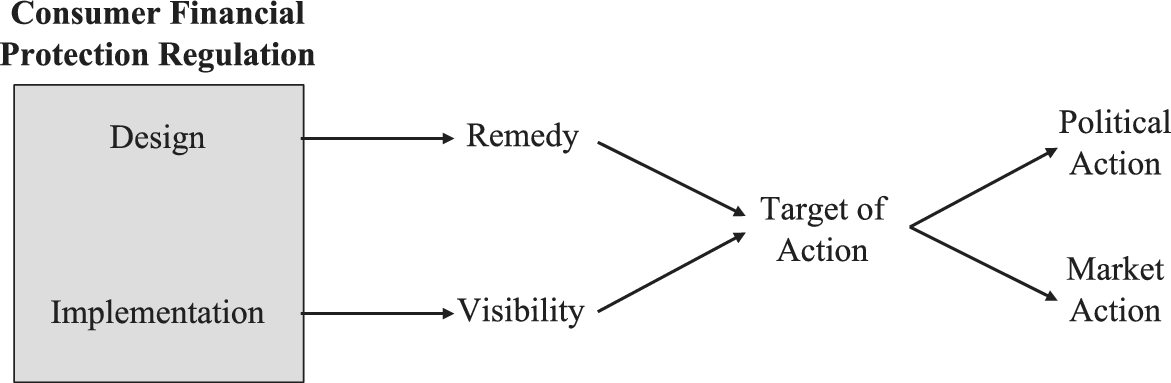
I argue that people’s strategies for engagement with consumer financial protection have been shaped by their experiences with the regulatory policies at the heart of the credit-welfare state. The following section develops an explicit theory of regulatory feedback effects, applying it to consumer financial protection. Figure 1 illustrates the specific pathways along which I contend the features of policy design and implementation generate regulatory feedbacks that influence the type of action borrowers take. I then present a systematic analysis of the features of every significant federal, nonmortgage consumer financial protection law enacted from 1934 to 2010 to demonstrate what effects are at work for federal consumer credit protections.Footnote 5
Consumer Financial Protection Regulatory Feedback Effects for Individuals

First, the design of protective regulations, like other policies (Mettler and Soss Reference Mettler and Soss2004), can transmit norms about the relationship between citizens and the state for a particular issue. For example, if regulations primarily focus on providing remedies that maintain fair market competition—rather than intervening in supply and demand by outlawing the sale of certain credit products or the use of specific finance charges—people may learn that, as long as transactions are “fair,” borrowers are accountable for their own financial affairs as responsible players in an increasingly complex financial market.
Second, people’s experiences with policy implementation have also been shown to influence their attitudes about government efficacy and their resulting political engagement (Campbell Reference Campbell2002; Mettler Reference Mettler2005; Soss Reference Soss1999). Of particular relevance are findings that the inability to identify a remedy as precipitating from government action can encourage citizens to underestimate government’s role in that policy area, thus disincentivizing political action for that issue (Mettler Reference Mettler2011). As Douglas Arnold (Reference Arnold1990) argues, the electorate must be able to link policy making to a political actor to engage politically on that policy.
This is especially important for understanding the feedback effects of regulatory policies because the direct recipients of government regulations are not consumers themselves but businesses. Ordinary Americans are not responsible for knowing or complying with most regulatory policy mandates, so borrowers, despite being the ultimate beneficiary of protective regulations, experience them only indirectly once they have been mediated through a private company. When the policy doesn’t make visible government’s regulatory power—for example, through descriptive information on a label or inspection notice—people may not be aware that government played a role in regulating the transaction at all. This dynamic may be exacerbated when the relevant regulator is less well known to the public, minimizing the chance that people will have a preexisting frame of reference for the regulator’s relationship to the issue.
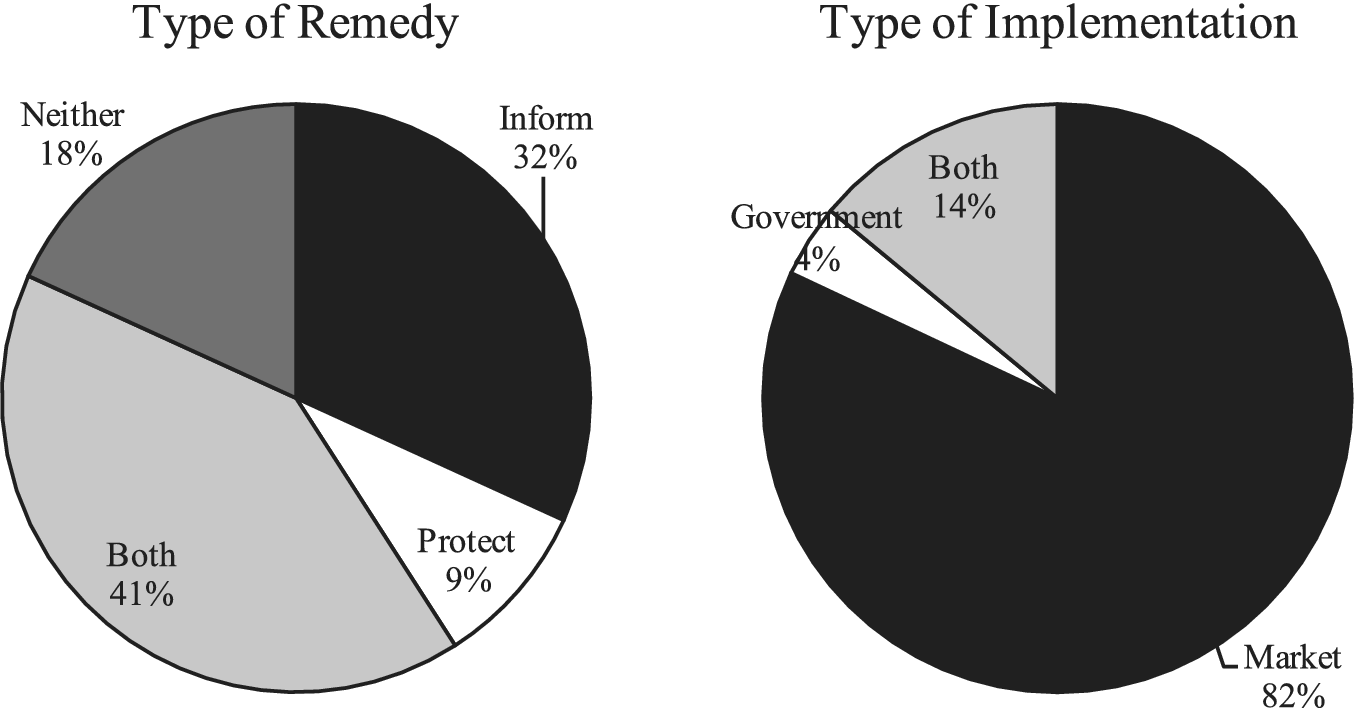
Figure 2 describes the extent to which US consumer credit protections adopt each of these design and implementation approaches. First, I employ two dummy variables to capture the remedies for each consumer financial regulation. Information disclosures are the most prominent remedy used to bolster fair market competition across all types of consumer products (Beales, Craswell, and Salop Reference Beales, Craswell and Salop1981; Hadfield, Howse, and Trebilcock Reference Hadfield, Howse and Trebilcock1998), so a dummy variable is included to measure whether a policy establishes new information disclosures. An additional dummy is constructed to measure whether a policy provides a more explicit protective remedy—for example, by outlawing certain fees for a transaction.Footnote 6 Second, a dummy variable is included for each policy to identify whether the remedy is implemented in a way that highlights government at all—a conservative measure of visibility. Policies that are implemented entirely through market transactions with no indication of government oversight are coded as zero, whereas those that illuminate government’s role through the implementation of a particular remedy are coded as one. For example, a policy requiring the disclosure of specific fees for a credit card might be implemented by including the information on the application a consumer receives directly from the credit card company, with no indication that government has regulatory oversight for those provisions. Alternately, a policy might require that each credit card application also include specific information that makes explicit the terms that creditors are required by federal law to disclose and provides information for a federal agency that consumers can contact if the lender violates those terms.
Privatizing Attributes of Consumer Financial Protection, 1934-2010

As Figure 2 illustrates, when it comes to policy remedies, approximately one-third of all consumer financial protections require only information disclosure. In total, almost three-quarters of the policies rely on information disclosure as at least one type of remedy. In contrast, only one of every 10 financial regulations exclusively relies on a protective remedy, with only half of all policies including any protective remedies at all. Many of these protective measures are minor, ancillary provisions to the overall disclosure mission of the law. For example, one such protection prohibits credit reporting agencies from including certain information in their reports. This evidence clearly suggests that the majority of consumer financial protections are designed with a preference for market remedies.
Perhaps even more important than the type of remedy adopted by these policies, however, is the way in which the remedy is implemented. Only four policies (18%) give consumers an obvious indication that government is involved in credit regulation. Of those, just two—the Home Equity Loan Consumer Protection Act of 1988 and the Credit Repair Organizations Act of 1996—mandate that lenders provide consumers with specific information about their rights that includes contact information for federal government agencies. In each case, the allusion to government is still minimal. Only one of the consumer protections enacted since 1934 provides a truly visible indication to borrowers that government is involved with the regulation of their financial affairs: the Consumer Financial Protection Act of 2010, which established the Consumer Financial Protection Bureau (CFPB).
The result of these two dimensions of consumer financial protection regulation is that although some policies provide limited remedies that extend beyond disclosure requirements designed to promote fair market competition, the tendency to bury these protective remedies within ordinary market transactions may well render them powerless to convince citizens that government is responsible for protecting borrowers’ interests. Instead, most policies obfuscate the role of government in consumer credit regulation, thus privatizing the use of credit for borrowers. I hypothesize that these attributes of regulatory policy design and implementation produce feedback effects that shape borrowers’ perceptions of government responsibility and thus their preferences for distinct types of engagement.
When credit (or other) regulations are designed to promote market fairness and implemented in ways that obscure the role of government, consumer preferences will align with market-based action to address financial protection (e.g., complaining directly to lenders, moving business to another provider, participating in protests or boycotts directed at trade associations or financial institutions). Nearly three-quarters (72%) of federal consumer credit protections combine elements of policy design and implementation that I anticipate will privatize the issue of financial protection. I expect policies such as these to encourage people to address both specific and systemic issues with consumer financing in the marketplace. Conversely, when policies proactively protect consumers and highlight government’s regulatory role, I expect consumers might be more likely to engage in political action like filing a complaint to a regulatory agency or participating in a campaign to contact legislators to support a bill. Only one federal policy—the Consumer Financial Protection Act of 2010—relies primarily on nonmarket design and implementation measures, potentially generating political engagement. Consumers are, of course, exposed to multiple policies at any particular time, so the resulting lessons may be derived from the cumulative policy regime governing consumer financial protection rather than from each individual policy. About one in five policies (23%) includes a mix of provisions, typically a combination of both information and minor safety disclosures that nonetheless obscure government’s regulatory role. Therefore, this evidence suggests that federal consumer financial protections are more likely to privatize the use of finance as I hypothesize, with potentially significant consequences for the landscape of borrower mobilization in the United States.
Measuring Borrower Behavior
I argue that federal consumer financial protection regulations teach American borrowers to think of credit as a market matter and to blame market actors—both themselves and their lenders—for problems they encounter with consumer finance. I expect that this will encourage people who choose to respond—either to specific problems with their own accounts or to broader concerns about predatory lending—to target market, and not political, figures. To explore patterns of blame and corresponding action for these issues, I conducted an original survey of 1,500 American adults representing all fifty states and the District of Columbia, hereafter referred to as the 2017 Survey of Consumer Credit.Footnote 7 The survey included questions about individuals’ experiences with and opinions about consumer banking and credit. It also asked how they respond, or might respond, to specific and systemic problems with credit.Footnote 8
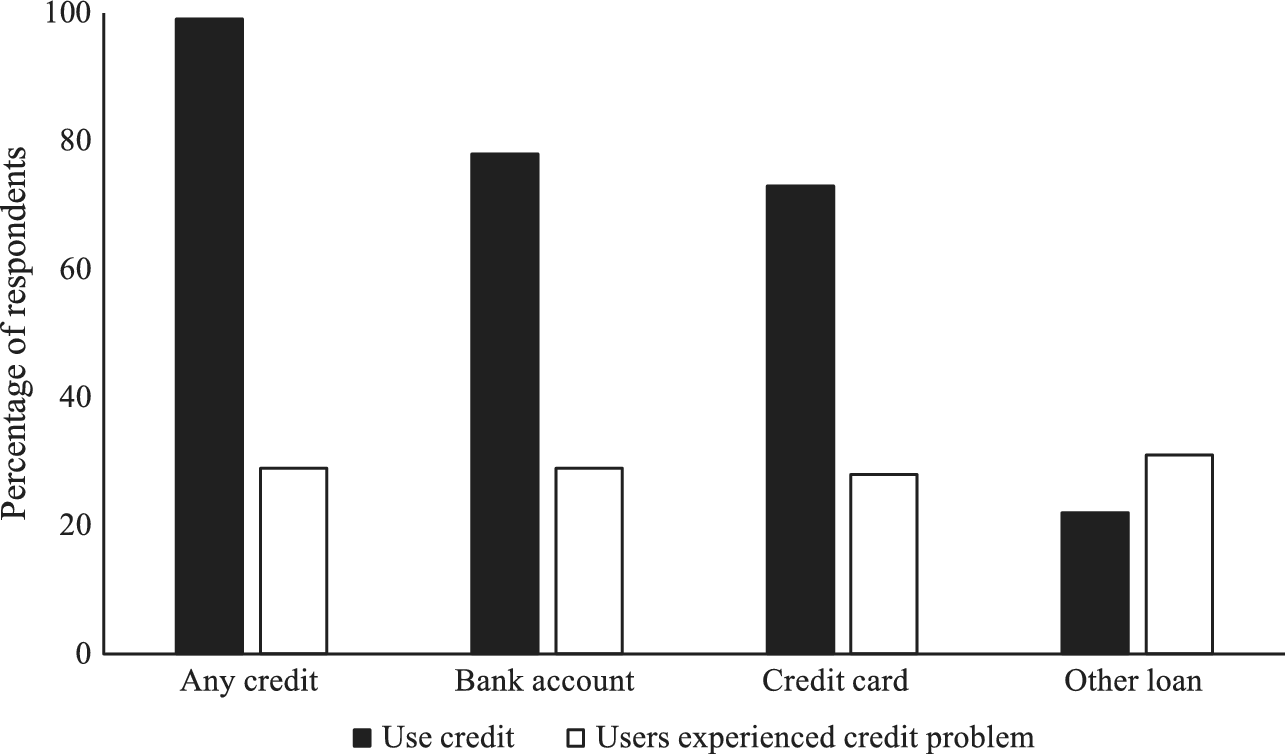
Survey respondents were asked to report what, if any, types of financial products and services they had used or made payments toward in the past year. They were then asked if they had been treated unfairly or experienced problems with any of these financial transactions. People who reported a negative experience were also asked to detail what type of problem they encountered.Footnote 9 Figure 3 presents the distribution of credit use for survey respondents, including the percentage of borrowers who experienced problems for each type of financing.
Use of and Experience with Consumer Finance in the Past Year, 2017

Almost all respondents reported using at least one financial product or service in the past year, highlighting the importance of credit to the livelihood of American consumers. The most commonly cited financial service (80% of respondents) was, perhaps unsurprisingly, a bank account, which includes exposure to associated finance charges, like overdraft fees, and use of debit cards. Credit card usage was similarly high, with roughly three-quarters of respondents saying they had at least one. Finally, just under a quarter of survey respondents reported using a personal loan in the previous year. Twenty-nine percent of borrowers said they experienced at least one problem with their financing, and those rates were fairly consistent across different types of credit.
Borrower Blame
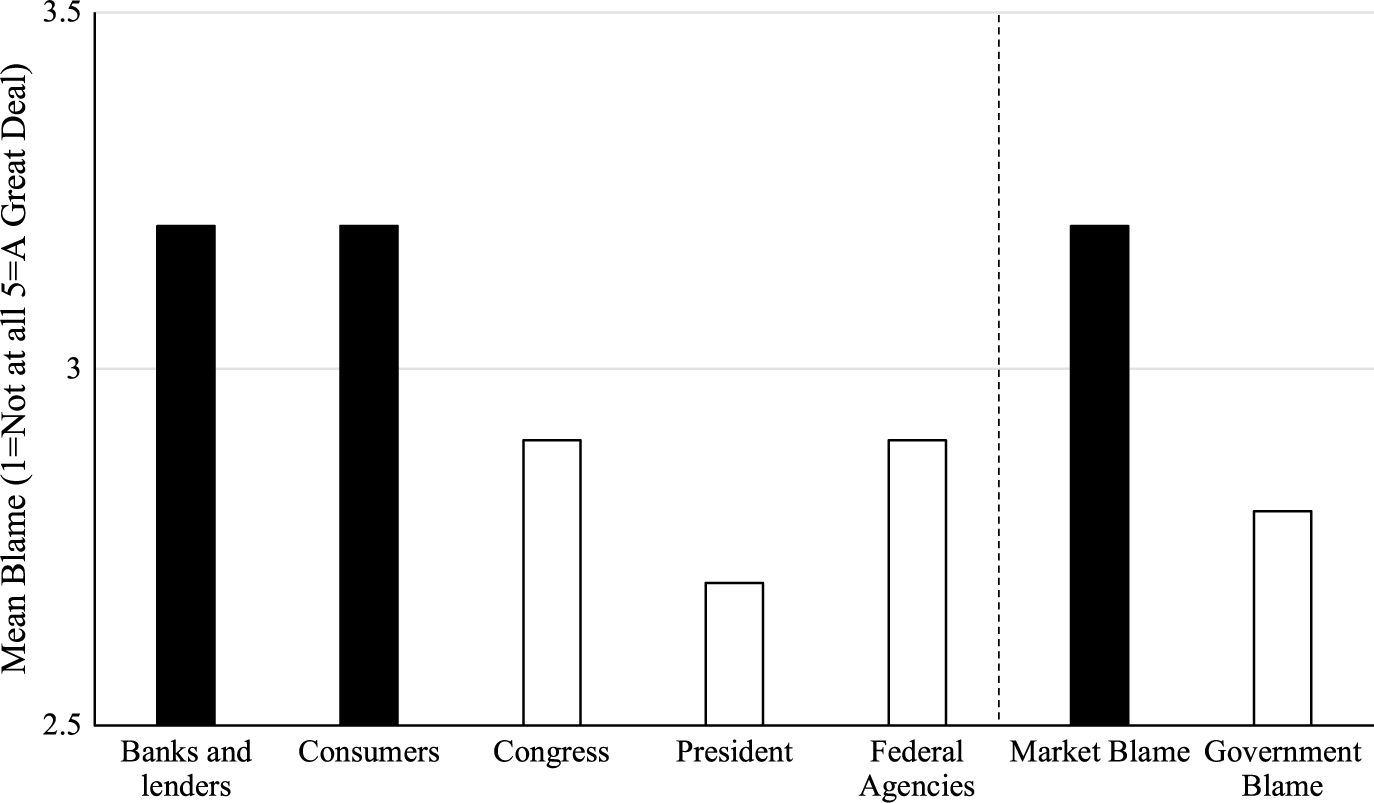
Who do borrowers blame for these problems with consumer financing? I argue that most, seeing little indication of government’s role in protecting their credit transactions, instead focus their ire on market actors—both borrowers and lenders. Figure 4 presents an analysis of respondents’ answers to a series of questions asking them to identify the degree to which different actors should be blamed for the “problems people experience with financial products and services like bank accounts, credit cards, and loans.” The scores reflect the average (mean) blame assigned to each actor on a scale from one to five, where one equals no blame and five equals all of the blame.
Blame for Problems with Consumer Finance

“Banks and lenders” and “consumers” received the greatest amount of blame from respondents at 3.2, falling between a moderate amount and a lot of blame. It is noteworthy that survey respondents placed equal blame on both lenders and consumers for problems with credit. This is consistent with the idea that information disclosures teach borrowers to hold themselves and their banks responsible for their financial experiences. In contrast, government actors were deemed less culpable. “The president” was accorded the least blame (2.7), with Congress and federal agencies receiving slightly more (2.9 each). Of particular interest is the gap that exists between the average blame borrowers assigned to market versus political actors. As Figure 4 illustrates, the average blame people placed on market actors was about half a point higher than the blame they assigned to political actors, providing support for the notion that people are focused on the market, not the government, as the responsible party for financial grievances.
This blame gapFootnote 10—the extent to which respondents assign more blame to market actors than to political actors—is not driven by a small group of respondents who are unusually likely to point the finger at financial institutions or borrowers. Just over half of all respondents (53%) place more blame for problems with credit on market actors than on political actors. Only 27% of respondents were likely to hold political actors more culpable, and about one in five respondents allocated equal blame to both groups. Notably, the blame gap is greater among those who use credit, and thus directly experience financial regulations, than among those who do not. Across all types of credit (bank accounts, credit cards, and other loans), respondents who used a specific financial product placed about 20% more blame on market actors relative to political actors than did people who did not use the type of credit. And this isn’t simply an artifact of demographic differences between credit users and nonusers; the differences in blame gap remain significant when controlling for income, education, race, gender, and age.Footnote 11
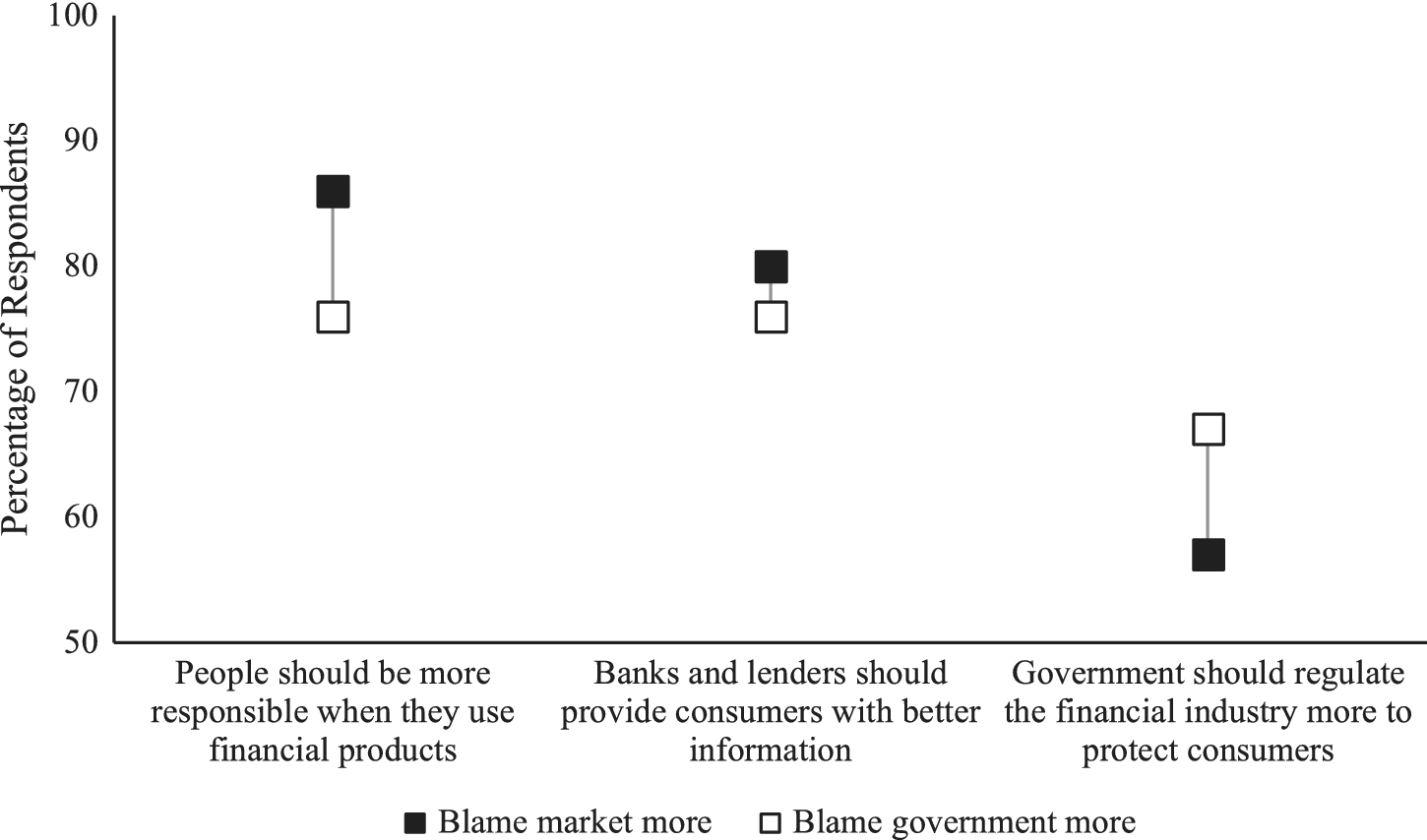
We might expect that people who place more blame for the negative consequences of consumer borrowing on one type of actor relative to another will have corresponding attitudes about what should be done to protect against those consequences in the future. To see whether people’s opinions about addressing problems with borrowing reflect where they locate blame, respondents were asked whether they agreed with each of three statements about possible solutions: (1) people should be more responsible credit users, (2) banks and lenders should provide better information, and (3) government should more strictly regulate the financial industry. Figure 5 reports the results, separating respondents by whom they blame more for problems with consumer credit. If the general measures of blame discussed previously correspond to people’s opinions about concrete solutions, we should expect those who focus their ire on market actors to agree more with market-based solutions, whereas those who point the finger at government actors should be more supportive of political solutions.
Attitudes toward Financial Protection by Blame

Two noteworthy trends are illuminated in Figure 5. First, each solution garnered support from a majority of respondents. Second, support for more government regulation was lower among all borrowers than was support for either of the two market-based remedies, although the gap for people who placed greater blame on government was smaller. However, there are notable differences between the two groups of respondents. People who place greater blame on market actors for problems with credit are, unsurprisingly, about 10 percentage points more supportive of the idea that consumers should be more responsible in their financial dealings and 5 percentage points more supportive of banks and lenders providing better information to their customers when compared with people who place greater blame on government. In contrast, those who assign greater blame to government actors are about 10 percentage points more supportive of increasing government regulation of the financial industry than their market-focused peers are.
Taken together, these results indicate that Americans—especially those who use financial products and services—are more likely to blame market actors for problems with consumer credit. They further suggest that questions of blame may translate to meaningful attitudes and preferences about how to solve systemic consumer financial problems. The pattern of blame is consistent with the hypothesis that people’s experiences with consumer financial regulations encourage them to view financial transactions, and their consequences, as influenced primarily by financial players rather than political forces. However, blaming market actors is only one piece of the puzzle.
Borrower Action
To whom do borrowers turn when they experience problems with consumer financing? I argue that, once again, with little evidence of government intervention in the regulation of consumer banking and lending, people are more likely to seek market solutions. Because consumer financial regulations have consistently employed privatizing remedies and implementation strategies, I anticipate that people’s incentives to target market actors will be as strong today as when policy makers first enacted consumer financial protections, even though the amount of federal financial regulation has grown considerably during the intervening decades.
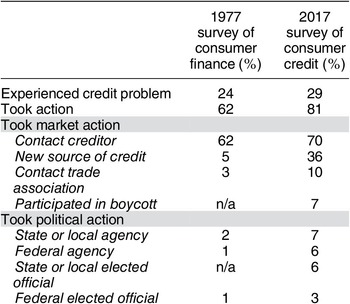
Table 1 offers evidence consistent with this contention. It presents responses to an identical set of questions about how Americans address credit problems that were administered in two different surveys 40 years apart. The 1977 Survey of Consumer Finances included a battery of questions designed to test the efficacy of the 1968 Truth in Lending Act’s regulations one decade after their implementation. Borrowers were asked to detail any credit problems they encountered and what, if anything, they did in response. I replicated these questions in the 2017 Survey of Consumer Credit to see how today’s borrowers respond to their problems with consumer financial products and services.Footnote 12
Borrower Action in Response to Problems with Consumer Finance, 1977 and 2017

As the results illustrate, a significant and growing majority of people who have adverse credit experiences do something to address them: about two in three borrowers in 1977 and four in five borrowers in 2017. This confirms that people are not simply failing to engage when faced with the negative side effects of borrowing. It also suggests that borrowers today are not suffering from greater apathy than did their counterparts from the late seventies; if anything, the reverse is true. These responses further demonstrate that consumers are far more likely to engage with market actors to address their grievances than to contact political actors. None of the political responses garnered even 10% of borrowers in either survey.
Of those who reported doing something about an adverse financial experience, nearly all (97%) took at least one form of market action. Only 13% reported even a single political response, and only 3% exclusively took political action. This pattern fits with the predictions generated from the evaluation of federal credit protections: most people solely target market actors with complaints, whereas a small number of consumers target a mix of market and political actors.
Of course, complaining to a creditor or seeking a better lending situation both seem like reasonable short-term methods for resolving specific problems with a financial product or service. But requesting intervention from a government agency is equally, if not more, likely to yield a resolution to the same type of problem, yet American borrowers virtually ignore these alternatives. When people do submit complaints to someone other than their own lender, they are more likely to contact a trade association than to contact a government agency.Footnote 13 Once again, the growing penchant for contacting a trade association (from 3% to 10% of borrowers between 1977 and 2017) rather than a comparable political agency is consistent with the prediction that borrowers, whether seeking a specific solution to a problem or voicing general concern about a lending practice, are more likely to look toward the market.
Perhaps these responses reflect something unique about people who are reacting to a specific negative experience. To what extent do these patterns carry over to the broader universe of borrowers? To gauge people’s more general preferences for taking market versus political action to address issues of consumer financial protection, respondents were asked a series of questions about how likely they would be to engage in each specific action from Table 1 in response to a hypothetical future problem with consumer financing. Their answers were then aggregated to create mean scores for the likelihood of taking future market action and future political action respectively, where one equals “very unlikely” and five equals “very likely.”
These responses suggest that people’s willingness to take market versus political action in response to future problems with credit mirrors the real-world decisions of those who have already reacted to adverse borrowing experiences. Seven of ten respondents (70%) reported that they were more willing to engage within the market than with the political sphere if they experienced a future problem. A further 15% were equally interested in market and political avenues for pursuing grievances. Only 15% expressed greater willingness to take political action to address credit problems. All told, these responses provide further confirmation of the idea that borrowers are more likely to turn to the market when they are unhappy with consumer credit.Footnote 14 They also suggest that people who have experienced problems with financing are not somehow distinctive from other borrowers in their actions and preferences.
These survey trends mirror the real-world behavior of disgruntled borrowers during the aftermath of the 2008 financial crisis. Although political elites lamented the lack of mass political mobilization to support Dodd-Frank’s passage in 2010, borrowers took to the market to express their displeasure with consumer financial protection. Thousands of consumers signed an online petition and threatened a boycott to oppose new debit card fees levied by Bank of America (Mayer Reference Mayer2012). Similarly, around 650,000 people opened accounts at credit unions as part of a widespread social media campaign encouraging people to transfer their funds out of big banks (Mincer Reference Mincer2011). And, as described previously, thousands turned out to protest the American Bankers Association and other financial institutions around the country (AFR 2009).
Does Market Blame Generate Market Action?
The previous two sections provide evidence that most Americans have learned to attribute more blame for their financial problems to market actors and are more likely to target banks, lenders, and trade associations when seeking redress for those problems. But are these two outcomes related? Does market blame actually correspond with market action, as suggested by the theory of regulatory feedback effects outlined in this article?
If blame for the market is driving, in part, the decision to address lending problems with financial actors, then we should expect to find an increased likelihood of pursuing market action as a person places increasing blame for consumer financial problems on banks, lenders, and consumers. The same should be true of political action for borrowers who place greater blame on government actors. The following section tests the effect of blame on both the actions of respondents who reported actual problems with credit and a borrower’s likelihood of taking future action on financial protection. The degree to which a respondent blames market actors, in aggregate, for problems with credit serves as the measure of market blame;Footnote 15 likewise for government actors and political blame. Additional measures are included to control for the individual characteristics of the respondent, including household income, education, age, gender, race, and partisan identification.Footnote 16
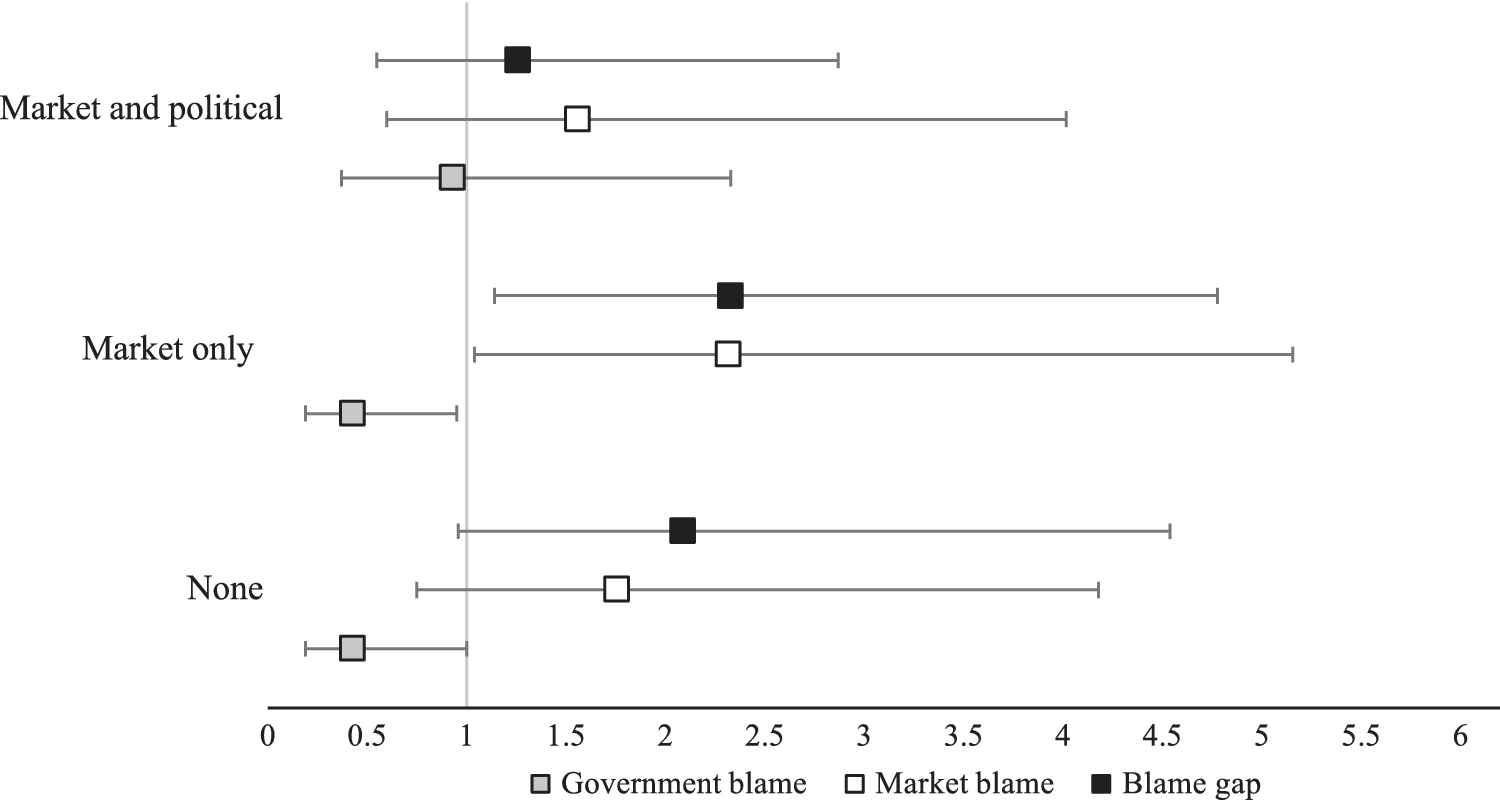
Figure 6 explores the link between blame and action for the subset of respondents who reported actual adverse credit experiences. It reports results from a multinomial logit model to capture the predicted effect of market and government blame respectively on four different responses to real-world problems with credit: no action, market action only, political action only, and both types of action. It also includes a model using a relative measure (“blame gap”) to show how the increasing gap between market and government blame relates to a person’s behavior. Political action serves as the reference category because it allows for a comparison of the effect of blame on action both between types of action—market versus political—and between the absence of action versus the choice to act politically.
Predicted Effect of Blame on Action by Type of Blame and Action
Note: Points represent relative risk ratios from multinomial logistic regression, with 95% confidence interval bars (n = 413). Full results are available in appendix Table A.4

As the theory of regulatory feedback effects predicts, different forms of blame appear to correspond with the type of action—whether market or political—a person takes in response to an adverse credit experience. For example, as respondents place more blame for problems with credit on government actors, they appear increasingly less willing to engage in market action relative to political action. In contrast, placing greater blame on market actors corresponds with an increased likelihood of taking market action relative to political action. Similarly, as the blame gap favoring market actors grows, the average respondent’s likelihood of seeking a solution in the market sphere was predicted to increase relative to political action.Footnote 17
These results also suggest that as a person places greater blame on political actors, the likelihood that they take no action to respond to an adverse credit experience decreases. Put another way, there appears to be a significant positive correlation between political blame and political action. Perhaps unsurprisingly, the only outcome for which blame and action do not appear to correlate in a clear pattern is when a person takes both types of action in response to a credit problem.
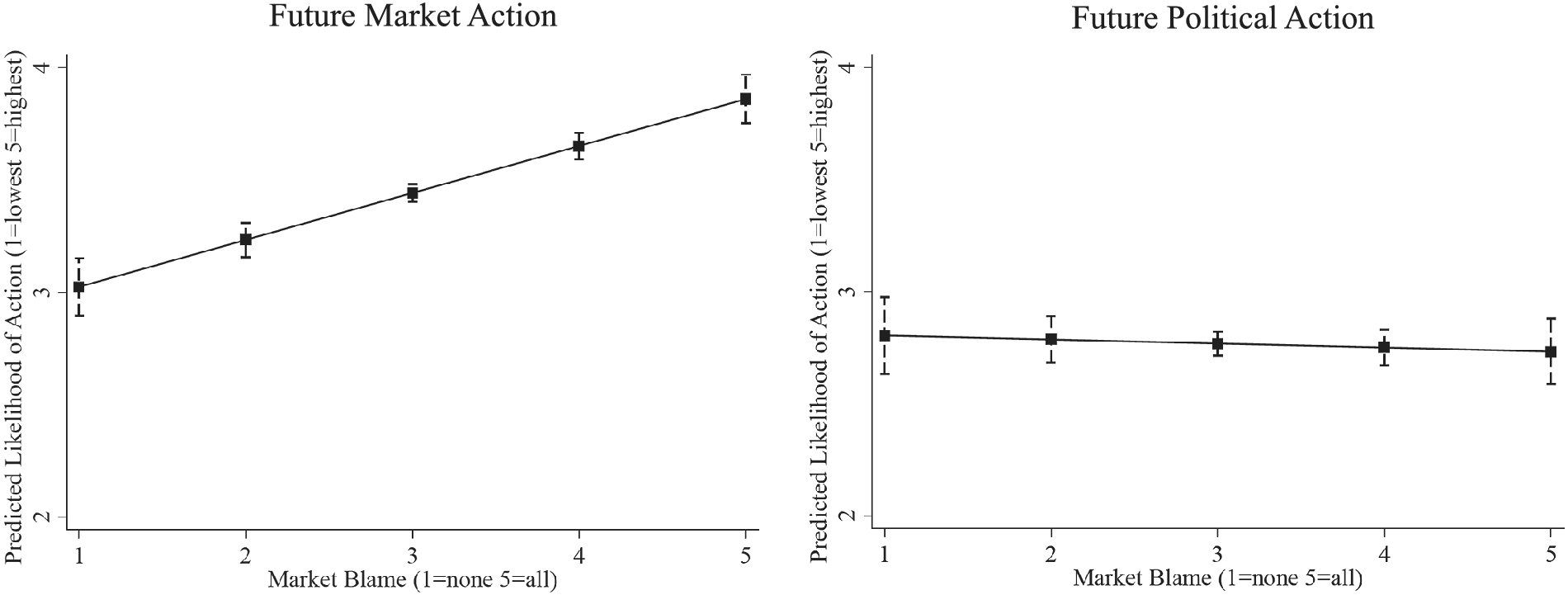
Although these relationships are consistent with the proposed hypothesis, the relatively small number of respondents who reported taking each type of action in response to a real adverse experience means we should be cautious in our interpretation of these findings. What, then, if we can examine the relationship between blame and action for the full sample of respondents instead of only those who reported real world problems? To accomplish this, Figure 7 presents evidence from the full sample about the relationship between blame and action when it comes to hypothetical future problems one might experience with credit.
Predicted Effect of Market Blame on Future Action
Note: Points represent marginal effects from OLS regression coefficients, with 95% confidence intervals in dotted lines (n = 1,495). Full results are available in appendix Table A.5 columns 1–2.

The predicted relationship between blame for market actors and willingness to take future action within the market is positive. For the average respondent, placing a great deal of blame on market actors versus not placing much blame on them at all corresponds with an increased willingness to take future market action of about three-quarters of a point on a five-point scale. In practical terms, this is the difference between being ambivalent versus being likely to respond within the market. Once again, however, blaming banks and borrowers does not produce the same incentive to take political action. As Figure 7 demonstrates, increasing blame for market actors does not correspond with a change in the average respondent’s willingness to take political action for a future problem with credit.
These results focus on how people respond to real or hypothetical problems they encounter with their own banks and lenders. But perhaps the motivations for addressing a concrete experience with financing differ from those that shape borrowers’ reactions to a systemic policy proposal to improve consumer financial protection. To see whether people behave differently when considering a proposal to protect consumer finances and whether their blame attribution maps onto those behaviors in different ways, the survey asked respondents to read a “press release describing a new proposal about overdraft fees.” The press release, which is depicted in the appendix and reflects real legislation, describes the problem of overdraft fees and outlines a solution.
After reading the proposal, respondents were asked whether they supported or opposed the reform on a scale from one to five, where one equals “strongly oppose” and five equals “strongly support.” Seven in 10 respondents (70%) signaled at least moderate support for the measure. This is consistent with generally favorable opinions Americans voice for many lending reforms that have been introduced in recent years. It also offers further evidence that the lack of political engagement on behalf of consumer financial protection is not due to a lack of support for actual reforms.
Favoring a reform, however, does not mean a person is willing to do something to bring it to fruition. So, respondents who said they supported the proposal were asked how likely they would be to take different types of action to voice their support. Each respondent rated how likely they would be on a scale from one to five, where one equals “very unlikely” and five equals “very likely,” to contact their member of Congress, to contact a federal agency “like the Federal Trade Commission,” or to contact their bank to express support. The average respondent reported being somewhat willing to contact their bank, but they expressed ambivalence toward contacting either their member of Congress or an agency like the FTC.Footnote 18 This outcome suggests that even proponents of a popular reform are reluctant to engage politically to see the proposal enacted. It also mirrors the patterns of behavior people reported with respect to specific financial experiences (either real or hypothetical). The prospects for political engagement look even dimmer when considering that people typically overreport their willingness to act on a survey.
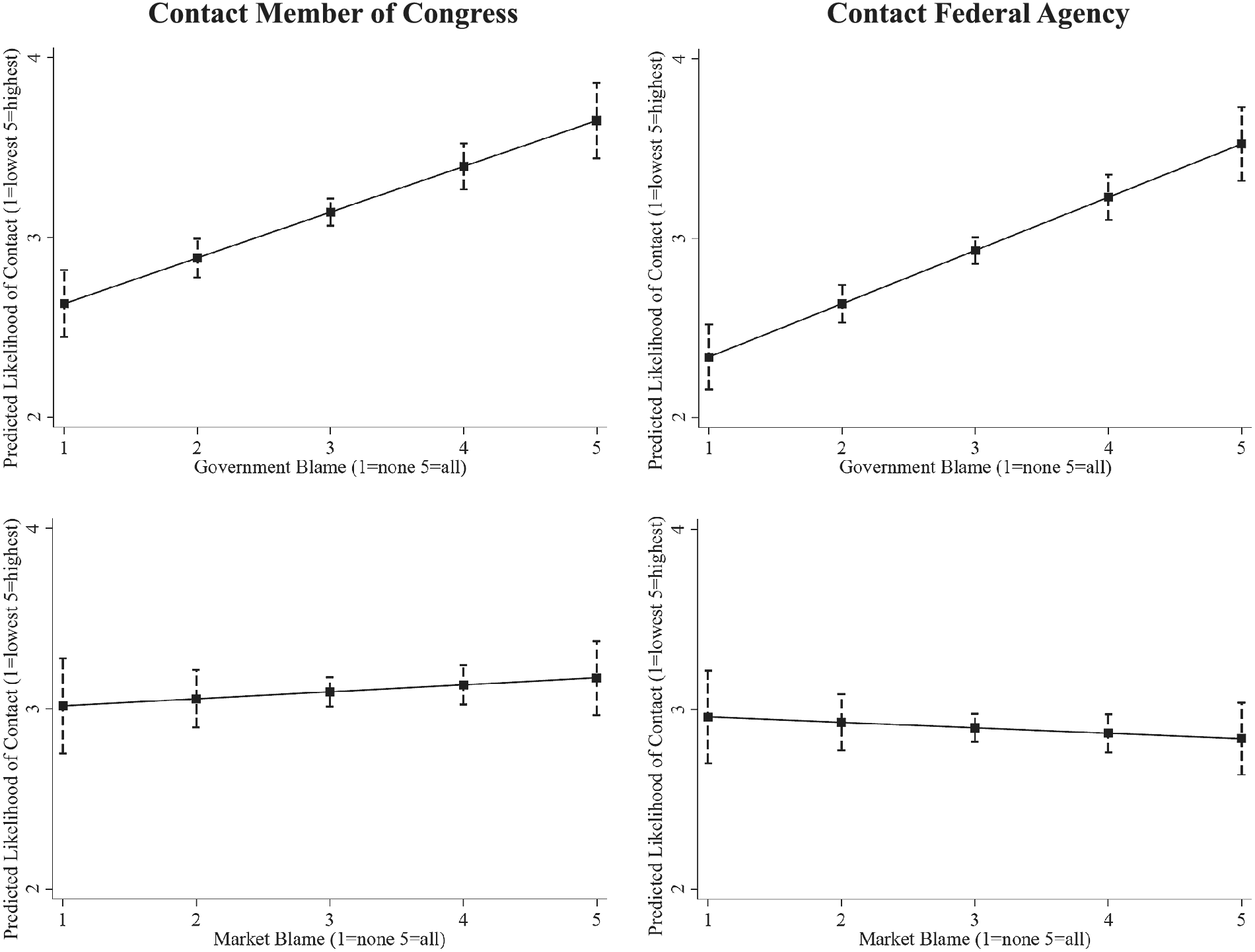
Do these results correspond with borrowers’ attribution of blame? Figure 8 illustrates the relationship between both market and government blame for respondents’ willingness to contact their member of Congress or a federal agency in response to this overdraft proposal. The analysis excludes those who oppose the reform, as we wouldn’t expect them to act on its behalf.
Predicted Effect of Blame on Political Action for Overdraft Proposal
Note: Points represent marginal effects from OLS regression coefficients, with 95% confidence intervals in dotted lines (n = 1,063). Full results are available in appendix Table A.5 columns 3–4.

As the results show, there is a correlation between how much blame a respondent places on government for perceived problems with credit and that person’s willingness to either contact their member of Congress or a federal agency in response to the overdraft proposal. As blame for government increases, so too does that person’s inclination to take these specific political actions. In fact, for the average proposal supporter, placing a moderate to a significant amount of blame for problems with banking and lending on government actors correlates with willingness to voice their support to both political figures. In contrast, market blame produces no such result, even when a respondent supports the reform.Footnote 19 The problem for political reform, as we uncovered earlier, is that most Americans blame market, and not political, actors for their problems with consumer finance.
Taken together, each piece of evidence helps to paint an increasingly clear picture of how borrowers think about consumer credit problems and how that thinking influences their decisions to act to protect their finances. Americans consistently attribute greater blame to market actors for problems with consumer financial products and services than they do to government actors. And that blame is reflected in a wide range of activity surrounding consumer finances—from responses to individual problems with credit to action in support of systemic reform. These trends indicate that government’s responsibility for financial protection has been effectively hidden from the millions of American borrowers.
Linking Policy Experience and Political Behavior
I argue that such a feat would not have been possible if credit regulations did not actively privatize consumer financial protection, but can these patterns be linked more directly to borrowers’ experiences with financial regulation? One indication that they can has already been noted: the tendency to place more relative blame on market actors is greatest for those who actually use consumer financing and, thus, who experience firsthand these regulatory policies. A more direct test would see how borrowers respond when exposed to financial regulations that allow people to identify government’s role in the protection of their finances.
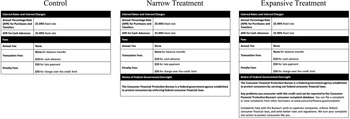
I conducted two online survey experiments to explore this possibility.Footnote 20 In one, participants were randomly assigned to receive one of three credit card information disclosures depicted in Figure 9.
Control and Treatment Disclosures

The control includes standard text about interest rate charges and fees adapted from a major lender. The two treatment disclosures are designed to help people link government’s regulatory role to the protection of participants’ finances in realistic ways. Existing scholarship lacks a clear roadmap for what it means to make government visible in the policy process. In the redistributive context, some studies cite the direct interaction with government in the receipt of benefits as an example of visibility (e.g., Mettler Reference Mettler2011), but the waters are murky. For example, benefits distributed through tax mechanisms rather than cash transfers are considered “hidden” despite the fact that the act of filing taxes and receiving a refund requires interacting with government (e.g., Faricy and Ellis Reference Faricy and Ellis2021). Thus, visibility refers in some cases to the clear presence of a government actor and in other cases to the clear presence of a government remedy.
In the regulatory context, then, we might imagine that it is necessary for borrowers not only to be able to identify a particular agency active in the regulatory process but also to understand something about how that agency provides a remedy to protect borrowers. The first treatment reflects the former. Adopting a narrow conception of visibility, it simply identifies the CFPB as the federal agency responsible for consumer financial protection. The CFPB is a useful choice not only for its role enacting and enforcing credit card regulations but also because its relative youth means it is not well known among the public, magnifying its visibility problem.Footnote 21
The second treatment includes additional information to make visible a specific government remedy. Adapted from the Bureau’s own language, this treatment contains a description of the CFPB complaint process (explained previously in Footnote footnote 13). By illuminating an actual protective remedy provided by the CFPB—the ability to mediate complaints with lendersFootnote 22—this treatment is also more reflective of the full theory of regulatory feedback presented here, which links the privatization of financial protection to the visibility of both a government actor and protective remedy.
Participants were asked to “review the following information disclosure for a credit card from a major credit card company and answer some questions.” They were then asked how likely they would be, on a scale from one to five where one equals “very unlikely” and five equals “very likely,” to complain to different actors, including “the credit card company” and “a government agency like the Consumer Financial Protection Bureau,” if they “had this credit card and [they] experienced a problem with the card or felt [they] were treated unfairly by the credit card company while using it.” Filing a complaint serves as an appropriate outcome of interest because, as described previously, it is an action with analogous forms in both the market and the public realm, yet consumers have generally eschewed the latter despite its better prospects for relief.
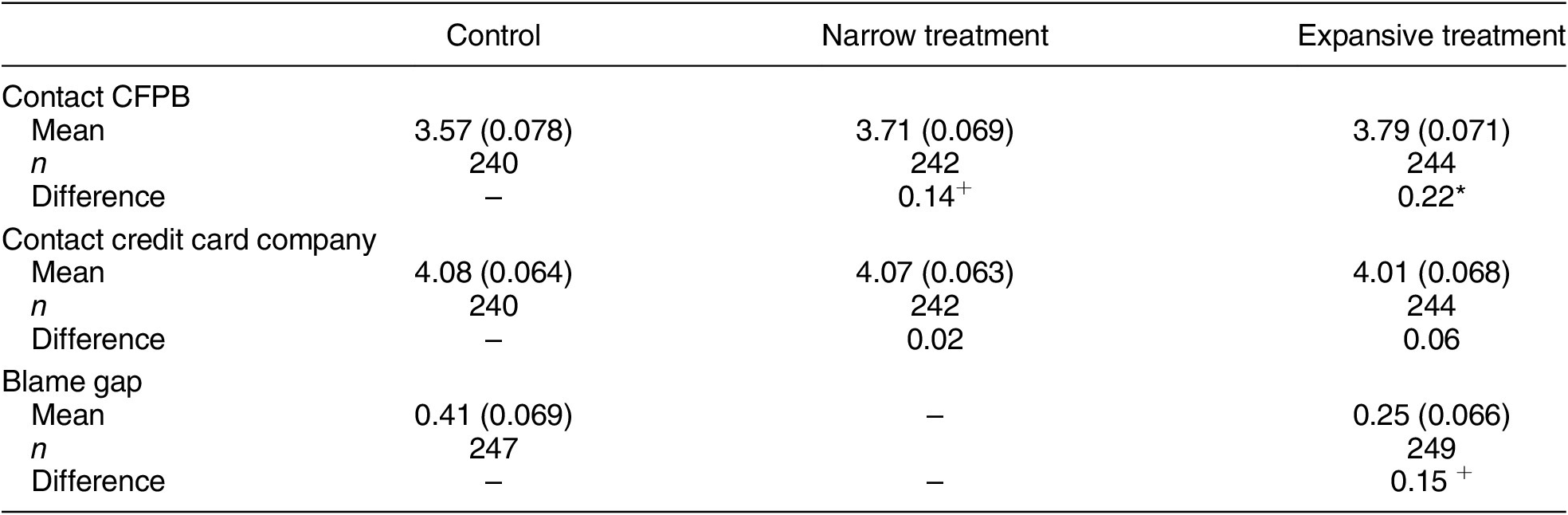
Table 2 presents the results of each treatment on participants’ willingness to say they would contact the CFPB versus the lender with complaints about the credit card described in the disclosure. Those who received the expansive treatment experienced a significant increase of nearly a quarter point in their likelihood of contacting the CFPB. This is a substantively meaningful shift along a five-point scale. Participants who received the narrow treatment experienced a smaller, marginally significant increase in their willingness to file a complaint with the CFPB. Notably, neither treatment corresponded with a greater interest in contacting their credit card company, which suggests that highlighting government’s role in regulatory oversight is having a targeted effect on political outcomes. These results are consistent with the prediction that financial regulations that help individuals link a specific government actor with consumer financial protection can boost people’s propensity to consider government-oriented action to address problems with consumer financing.
Effect of Treatments on Borrower Action

Note: For one-tailed test; standard errors in parentheses; p < 0.05, +p < 0.10.
The second experiment probes the underlying mechanisms behind this result. For this experiment, participants were randomly assigned to receive either the control or the expansive treatment from Figure 9.Footnote 23 Replicating the general blame question from the 2017 survey, participants were asked how much they blame different actors for the “problems people experience with financial products and services like bank accounts, credit cards, and loans.”Footnote 24 If the theory of regulatory feedback effects holds, participants who received the treatment highlighting the CFPB’s complaint process should place greater blame for problems with consumer financing on government actors and should be more willing to contact the CFPB to address those problems.
Consistent with the survey findings in this paper, participants in the control group placed on average about a third of a point more blame on market (3.64) versus political (3.25) actors for problems with consumer credit—a gap of nearly four-tenths of a point. Receiving the treatment, however, corresponds with an increase in average blame assigned to political actors (from 3.25 to 3.4). As Table 2 reports, the blame gap thus shrinks from four-tenths of a point for participants in the control group to only a quarter of a point for participants in the treatment group—a statistically significant shift driven primarily by the increase in government blame.Footnote 25 By making the CFPB and its complaint process visible, these experiments suggest that policy designs highlighting specific government actors and regulatory tools have the potential to influence people’s perceptions of government responsibility for consumer financial protection and their subsequent choices about how to act.
Consumer Credit Regulation and the Submerged Credit-Welfare State
These trends illuminate an interesting facet of federal consumer financial protections in the United States. They bear many hallmarks of “submerged” policies (Mettler Reference Mettler2011). That is to say, despite government’s role in protecting borrowers’ finances, the implementation of federal credit regulations occurs largely within the bounds of existing market transactions. This dynamic has been shown for other policies to make it difficult for citizens to form and express relevant preferences. Governmental authority for submerged policies is often only identifiable to elite interests with the political knowledge and connections to interpret them. The result is that borrowers are left unaware of the existence of relevant policies or policy makers, thus removing incentives to pursue government redress. Such is clearly the case for consumer financial protection, where battles over financial reform have played out largely among policy makers, financial institutions, and advocacy organizations (Jacobs and King Reference Jacobs and King2016).
The process of regulatory feedback described here is also consistent with—and likely reinforced by—a larger turn in American social policy making. Scholars have illuminated lawmakers’ increasing fondness since the 1970s for policies that are characterized by market logic and that channel benefits and protections through market structures (Hacker Reference Hacker2006; Howard Reference Howard1997; Mettler Reference Mettler2011). Although these scholars have written largely in the context of public welfare retrenchment, it is an apt description for how exposure to consumer financial protections teaches citizens to look to Wall Street, not Washington.
Of course, the inability to recognize government’s role in regulation is not an inevitable consequence of regulatory policy making. Government is visible in several arenas of protective regulation—for example, food and drug regulation where labeling requirements highlight the relevant federal agencies. Invisibility is not even consistent across all types of financing. For example, government’s protective role in mortgage financing has long been more obvious, from notices of Federal Housing Administration oversight to newer requirements that CFPB educational materials be provided with mortgage paperwork (12 CFR 1024.6).Footnote 26 However, as the theory of regulatory feedback suggests, the very nature of protective regulation—wherein the government-citizen link is mediated by business—makes it harder to identify government’s role. But it is not impossible, as the experimental design suggests. There are also, undoubtedly, other mechanisms for increasing the visibility of government regulation that are not specific to policy design. For example, media coverage of regulatory agencies and their accomplishments may also help members of the public to better identify government’s regulatory role. In the case of consumer financial protection, there is some evidence that as the public becomes more familiar with the CFPB, people’s complaint-making behavior has increased (SoRelle Reference SoRelle2020), but future research could explore this more fully.
The Problem of Political (In)Action
Does it ultimately matter if borrowers blame, and subsequently target, banks and lenders for individual and systemic problems they perceive with consumer credit? During the last two decades, a growing cohort of scholars—primarily historians and sociologists—has developed a narrative of consumption as an explicit form of politics (e.g., Cohen Reference Cohen2003; Jacobs Reference Jacobs2005). Countering the existing wisdom that consumption and politics exist in separate realms and with opposite motivations, scholars of “socially conscious” consumption (e.g., Micheletti Reference Micheletti2003; Stolle, Hooghe, and Micheletti Reference Stolle, Hooghe and Micheletti2005) have built on this foundation to argue that market-based consumer action is another expression of political will. But classifying consumer behavior as political action overlooks important ways in which market-based action is fundamentally different from expressing consumer concerns through traditional political channels. First, market and government actors face different pressures and incentives—profit and electoral motivations, respectively. Second, they possess different tools—both in form and scope—with which to address consumer demands. As a result, the likelihood that borrower mobilization will be successful in securing specific remedies and broader reforms, the form that each will take, and the magnitude of each will be shaped by the target of borrower action—irrespective of whether people’s underlying motivations are economic or political.
For millions of American borrowers who are potentially at risk from predatory lending, especially as the financial wake of COVID-19 leaves vulnerable borrowers reliant on credit to cover medical expenses and lost income,Footnote 27 eschewing political action as a pathway to better consumer financial protection has serious consequences. Without the political muscle provided by constituent support, federal lawmakers—even those who back stronger consumer financial protections—are limited in their ability to enact policy changes.
The theory of regulatory feedback effects laid out in this article offers some hope to reverse this trend. Although the US political economy’s reliance on widespread access to credit presents challenges for pro-reform policy makers to change the substantive landscape of federal financial protection, lawmakers may be able to implement those remedies—as in other regulatory arenas—in ways that highlight government, helping to build a foundation for borrower political engagement. More broadly, with protective regulatory policy making growing dramatically since the 1970s, touching on health and safety issues that extend from the food we eat to the air we breathe, the theory of regulatory feedback effects developed here can help us disentangle the political dynamics for these critical domains affecting people’s everyday well-being.
SUPPLEMENTARY MATERIALS
To view supplementary material for this article, please visit http://doi.org/10.1017/S0003055422001071.
DATA AVAILABILITY STATEMENT
Replication materials can be found at the American Political Science Review Dataverse: https://doi.org/10.7910/DVN/RKUZT3.
ACKNOWLEDGMENTS
The author extends her thanks to many colleagues who have provided valuable feedback on this project at various stages of development, including Suzanne Mettler, Adam Seth Levine, Peter Enns, Jamila Michener, Chloe Thurston, Jacob Hacker, Larry Jacobs, Tamar Malloy, Delphia Shanks, Sarah Maxey, and the anonymous reviewers.
FUNDING STATEMENT
The Center for the Study of Inequality at Cornell University and the Academic Research Council at Lafayette College provided critical funding to support this project.
CONFLICT OF INTEREST
The author declares no ethical issues or conflicts of interest in this research.
ETHICAL STANDARDS
The author declares the human subjects research in this article was deemed exempt from review by the Lafayette College and Duke University Institutional Review Boards.




Comments
No Comments have been published for this article.