Implications
Morbidity and mortality in beef calves continue to impact beef operations around the world and can be associated with significant economic losses. Improving health management including calving intervention, colostrum administration and other common practices could increase calf health and survival, thus improving animal welfare and performance. However, there is limited current research investigating specific management practices in the field and their influence on beef calf health and survival. Expanding knowledge of risk factors associated with calf morbidity and mortality will assist in the development of evidence-based management recommendation and could have substantial implications for improving efficiencies of beef production.
Introduction
Beef production in Canada is largely split into two sectors: extensively managed cow-calf operations and intensively managed feedlots. Pre-weaning morbidity and mortality continue to be major issues of concern for cow-calf operations, resulting in economic losses for the beef industry. Calf mortality may be up to 13%, of which the majority are stillbirths (Patterson et al., Reference Robison, Stott and DeNise1987; Waldner, Reference Waldner, Jelinski and McIntyre-Zimmer2001). A study by Sanderson and Dargatz (Reference Sanderson and Dargatz2000) estimated a mean morbidity of 5.8% before weaning on US beef herds. Pre-weaning calf diarrhea (PCD) may affect between 2.4% and 36% of beef calves, and bovine respiratory disease (BRD) may affect between 3% and 11% (Acres et al., Reference Acres, Saunders and Rodostits1977; Snowder et al., Reference Snowder, Dale Van Vleck, Cundiff and Bennett2005; Hanzlicek et al., Reference Hanzlicek, Renter, White, Wagner, Dargatz, Sanderson, Scott and Larson2013; Waldner et al., Reference Waltner-Toews, Martin and Meek2013). Morbidity in calves has significant impacts on average daily gain and production efficiencies of the animal (Smith, Reference Smith1998).
In Canada, the average beef herd size increased by almost 50% from 105 cows and calves in 1996 to 149 in 2011, whereas the number of cow-calf operations dropped from 142 157 to 85 890 within the same time period (Statistics Canada, 2012). As beef operations consolidate and become larger, management practices on a given operation have the capacity to impact greater numbers of animals. Management practices in Canada follow a typical seasonal pattern: calves are generally born in late winter or early spring, cow-calf pairs are turned out onto large grasslands for the summer and cows are bred naturally by bulls during that time, and calves are weaned from the cow in the fall and sold either to a backgrounding operation (fed at moderate planes of nutrition) or to a feedlot (fed at high planes of nutrition).
With the shift in herd size and number, research that can inform this management system becomes more important to ensure best practices guidelines are developed appropriately. However, there is little current data about on-farm management practices on cow-calf operations in western Canada and their effects on calf health and survival. Previous published studies either are outdated (Radostits and Acres, Reference Quigley, Fike, Egerton, Drewry and Arthington1980; Schumann et al., Reference Schumann, Townsend and Naylor1990), focused on specific diseases (Hanzlicek et al., Reference Hanzlicek, Renter, White, Wagner, Dargatz, Sanderson, Scott and Larson2013) or were conducted in areas that use different management systems (Dutil et al., Reference Dutil, Fecteau, Bouchard, DuTremblay and Pare1999). Thus, the objectives of this study were to investigate current calf management practices on cow-calf operations in western Canada and to determine their association with herd-level morbidity and mortality.
Material and methods
Recruitment and questionnaire
A 40-question survey about health management practices, morbidity and mortality was distributed to cow-calf producers across the Canadian province of Alberta between May and December 2013. The survey was developed in consultation with experienced veterinarians and industry leaders. Initially, a pilot survey (n=17) was sent to the regional delegates of the provincial beef producer association. The survey was then revised for wider circulation. A multi-pronged approach was used, involving producer meetings, veterinary practices and online venues for recruiting participants. Paper copies of the survey were distributed to cow-calf producers attending several producer meetings and a conference. To assist with survey distribution, the provincial veterinary clinic directory was used to contact veterinary clinics that service cow-calf producers. Eight practices mailed surveys to their clients. A link to an online version of the survey was also circulated through postcards, online social media and websites, and articles in producer-focused magazines.
Survey questions focused on topics suspected of being relevant as risk factors for morbidity and mortality because of their association with pain and stress, or because they are known to impact calf health or survival. Efforts were made to keep the survey short to maximize response rate. The survey inquired about the following perinatal management practices: the start and end dates of the calving season; frequency and timing of calving intervention; care of the newborn calf, including resuscitation techniques and pain management; and colostrum management practices. It also included questions regarding pre-weaning management, such as methods and timing of castration, deworming and preconditioning of calves. As outcome parameters, producers were asked to estimate the herd-level treatment risk for PCD and BRD during the previous calving season (expressed as the fraction of the number of calves treated by the number of calves), as well as the proportion of calves that were born dead, born alive that died in the first 24 h, died between 1 and 7 days after birth, and died between 7 days and weaning during the 2013 calving season (expressed as a fraction of the number of calves dead by the number of cows due to calve). The survey was approved by the University of Calgary’s Conjoint Faculties Research Ethics Board (REB13-0263) and is available upon request.
Statistical analyses
Data were entered in Microsoft Excel (Microsoft, Redmond, WA, USA) and exported into Stata-SE 13.0 (StataCorp, College Station, TX, USA) for statistical analysis. All variables were examined with descriptive statistics for data cleaning and to determine their distributions. For each categorical variable, a referent category was chosen based on biological interpretation and sample size. The association between management practices and outcome variables was determined using multivariable linear regression models. Herd-level outcomes included herd-level treatment risk for PCD and BRD, stillbirth (death at birth or within the first 24 h of life), calves born alive that died 1 to 7 days after birth and calves that lived to 7 days but died before weaning. All outcome variables were rounded to the nearest 0.5 and log (natural) transformed to approximate a normal distribution.
All explanatory variables were screened for unconditional associations with the outcome variable in univariable linear regression analyses. Any explanatory variables that were associated with the outcome using a liberal cut-off (P<0.20) were considered for inclusion in the multivariable model. Spearman’s correlation coefficients were calculated for all explanatory variables considered for inclusion. If the correlation coefficient was >0.8, only the variable that made the most biological sense or had the fewest missing observations was included in the multivariable model-building process. Linearity was assessed graphically between continuous explanatory variables and the outcome using locally weighted regression. If the relationship was non-linear then the quadratic, log and square root transformations of the explanatory variable were tested. If none improved linearity, the variable was categorized. Models were built and confounding was assessed through backward elimination. Confounding was defined as a >25% change in the coefficients of remaining significant variables. Biologically appropriate interaction terms were tested. Significant (P<0.05) interaction effects were assessed graphically. Explanatory variables were included in the final model if P<0.05, or if they were a confounding variable or part of a significant interaction term.
Final multivariable models were assessed using a Cook–Weisberg test and by plotting the standardized residuals against the predicted value to evaluate homoscedasticity. A Shapiro–Wilk’s test was performed on the standardized residuals with a non-significant test (P⩾0.05) to evaluate normality. Standardized residuals were examined graphically to look for outliers and observations with high leverage. Influential observations were identified by examining Cook’s distance, DFITS and DFBETAS graphically. Outliers and influential observations were examined for recording errors and to see if their removal resulted in a change in interpretation of the model(s).
Results
Descriptive results
Description of herds
Survey respondents included 267 cow-calf producers. However, not all producers completed the survey entirely, limiting the actual sample size in the multivariable models. A total of 20 respondents did not indicate a postal code so geographical location could not be determined. Of the 247 producers that indicated a postal code, 237 (96%) were from Alberta, with the remaining 10 from other provinces in central and western Canada (4%). Geographical distribution of respondents is shown in Supplementary Figure S1. The median herd size was 135 cows, ranging from three to 1700 cows.
Calving management
Just 10% of producers began calving in January, whereas 19.5% began in February, 36.7% in March, 26.3% in April, 7.2% in May and 0.4% in June. Across all operations, the average length of the calving season was 79 days (median: 70; 95% CI: 73.8 to 83.8). Over half of producers (52%) rarely intervened during calving and called a veterinarian for assistance only if they could not correct a problem on their own (65%). Almost 60% of producers reported suspending newborns by their hind limbs for fluid drainage. Only 13% of producers administered pain medication to the calf after calving and 15% gave it to the cow. Just over half (53%) gave vitamin and/or mineral injections to the calf. Calving management practices are described in Supplementary Table S1.
Colostrum management
The majority of producers reported verifying if a calf received colostrum by observing if it sucked (87%) and intervened when they perceived that it failed to suck enough (86%). Most (69%) producers chose the dam’s fresh colostrum as their first choice to feed the calf if intervention was necessary. However, nearly 13% chose colostrum replacer. Colostrum management practices are summarized in Supplementary Table S2.
Other management
Almost all (99%) producers castrated their bull calves. However, only 4% of producers reported using pain medication at castration. The median age at castration with each method was 1.3 days of age (95% CI: 4.8 to 9.3) for small elastrator band, 2 months (95% CI: 2.0 to 2.7) for surgical castration knife, 2.8 months (95% CI: 2.3 to 4.5) for Burdizzo clamp and 4 months (95% CI: 2.6 to 11.4) for large Callicrate™ band.
A large percentage (91%) of respondents used anti-parasiticides on cows, whereas only 69% used them on calves. For both cows and calves, anti-parasiticides were most commonly used in the fall (59% and 52%, respectively).
Over 65% of producers reported preconditioning their calves before sale. However, the majority (90%) of these were herds that pre-vaccinated at spring turn-out. Of respondents that indicated not preconditioning, 45% would consider it in the future if there were certain incentives or changes to their operation. The management practices other than calving and colostrum are described in Supplementary Table S3.
Pre-weaning morbidity and mortality
PCD
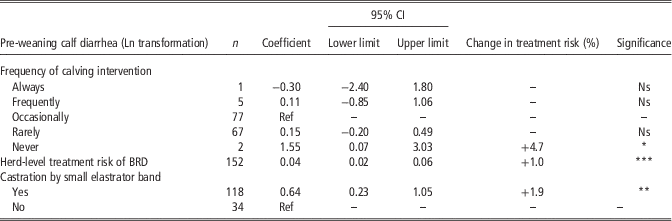
Mean herd-level treatment risk for pre-weaning calf diarrhea was 4.9% (95% CI: 3.9 to 6.0). Operations that never intervened at parturition (n=2) had 4.7% higher herd-level treatment risk of PCD than those that occasionally did (P=0.04). On operations using small elastrator bands for castration, herd-level treatment risk of PCD was 1.9% higher than those using other methods (P=0.002). For every 1% increase in herd-level treatment risk of BRD, the herd-level treatment risk of PCD increased by 1.0% (P=0.001) (Table 1).
Final multivariable linear regression model assessing explanatory variables for the herd-level treatment risk of pre-weaning calf diarrhea in beef calves on cow-calf operations (n=152)

CI=confidence interval; BRD=bovine respiratory disease; Ref=referent category; Ns = non-significant.
*P<0.05, **P<0.01, ***P<0.001.
BRD
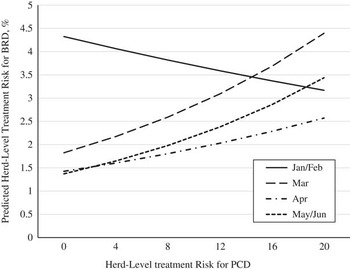
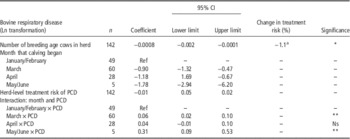
The mean herd-level treatment risk for bovine respiratory disease was 3.0% (95% CI: 2.1 to 3.8). For every increase of 100 cows in herd size, herd-level treatment risk of BRD decreased by 1.1% (P=0.02). Herd-level treatment risk of BRD was influenced by an interaction between the month calving season began and herd-level treatment risk of PCD (Table 2). There was a significant, positive non-linear association between the herd-level treatment risk of BRD with herd-level treatment risk of PCD in operations that began calving in March (P=0.004), and May or June (P=0.006), compared with herds beginning their calving season in January or February (Figure 1). The interaction was not significant (P=0.1) for the month of April compared with January or February (Table 2).
Predicted values for the herd-level treatment risk for bovine respiratory disease (BRD) as calving start month interacts with herd-level treatment risk for pre-weaning calf diarrhea (PCD). Predicted values for BRD have been back transformed from the log outcome. All explanatory variables in the model were set to median values.

Final multivariable linear regression model for the herd-level treatment risk of bovine respiratory disease in pre-weaned beef calves on cow-calf operations (n=142)

CI=confidence interval; PCD=pre-weaning calf diarrhea; Ref=referent category; Ns = non-significant.
a For every additional 100 cows.
*P<0.05, **P<0.01.
Stillbirth
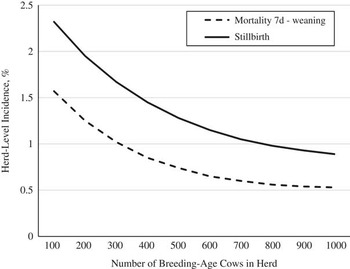
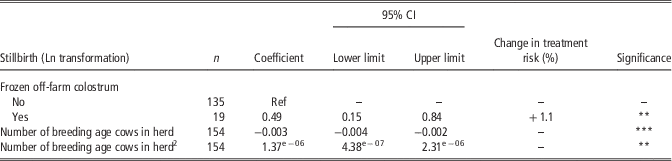
The mean herd-level incidence of stillbirth was 2.3% (95% CI: 2.0 to 2.6). Herds that fed their calves frozen colostrum from a source other than their cows, such as a friend’s or neighbour’s cows, had 1.1% higher herd-level incidence of stillbirth (P=0.005) compared with those that did not (Table 3). The herd-level incidence of stillbirth decreased as the number of cows increased in a non-linear fashion (P=0.004) (Figure 2).
Association between the number of breeding age cows and the herd-level incidence of stillbirth and mortality from d 7 to weaning. Data are based on the respective multivariable linear regression models, while controlling for all explanatory variables. Values for stillbirth and mortality from d 7 to weaning have been back transformed from the log transformed outcome.

Final multivariable linear regression model for the herd-level incidence of stillbirthFootnote a on cow-calf operations (n=154)

CI=confidence interval; Ref=referent category.
a Calves dead at birth or in the first 24 h of life.
**P<0.01, ***P<0.001.
Mortality from 1 to 7 days
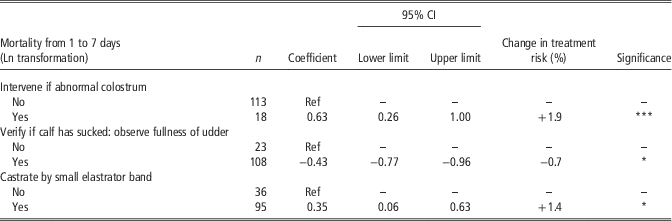
From 1 to 7 days of age, the mean herd-level incidence of mortality was 1.1% (95% CI: 0.9 to 1.3). Operations that verified a calf had suckled by observing the fullness of cows’ udders had 0.7% lower mortality from 1 to 7 days of age (P=0.01) compared with those that did not. Those that intervened when it was noticed that colostrum was abnormal (P=0.001), or that used small elastrator bands for castration (P=0.02) had 1.9% and 1.4% higher mortality during the 1st week of life, respectively, compared with other operations (Table 4).
Final multivariable linear regression model for the herd-level incidence of calf mortality from 1 to 7 days of age on cow-calf operations (n=131)

CI=confidence interval; Ref=referent category.
*P<0.05, ***P<0.001.
Mortality from 7 days to weaning
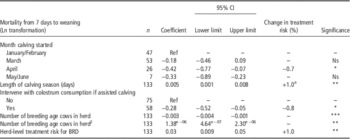
The mean herd-level incidence of death from d 7 to weaning was 1.4% (95% CI: 1.2 to 1.7). Mortality from 7 days to weaning was lower by 0.7% when calving season started in April compared with January or February (P=0.02), and was higher by 1.4% for each additional week of calving season (P=0.007). Operations that routinely intervened with colostrum consumption for calves that were assisted at parturition had lower mortality from 7 days to weaning by 0.8% compared with those that did not (P=0.02). For every 1% increase in herd-level treatment risk for BRD, mortality from 7 days to weaning increased by 1.0% (P=0.004) (Table 5). The herd-level incidence of mortality between 7 days and weaning decreased as the number of cows increased in a non-linear fashion (P=0.003) (Figure 2).
Final multivariable linear regression model for the herd-level incidence of calf mortality from 7 days to weaning on cow-calf operations (n=133)

CI=confidence interval; BRD=bovine respiratory disease; Ref=referent category; Ns = non-significant.
a For every additional week
*P<0.05, **P<0.01, ***P<0.001.
Discussion
This survey has identified a wide range of on-farm calf management practices used on cow-calf operations and their associations with morbidity and mortality in calves. Important factors identified included calving season, herd size, calving intervention, colostrum management, castration method and herd-level treatment risks for BRD and PCD. Although other studies have previously demonstrated the association of herd size and calving season with treatment risk and mortality, the present study identifies several other risk factors not previously described. Furthermore, this work provides insights into the frequency of implementation of various management practices, which is important for identifying opportunities for improvement and disconnects with recommended best practices.
Calving season
The timing of the calving season influenced both morbidity and mortality. Herds that began their calving season in January or February had a greater incidence of calf mortality from d 7 to weaning, compared with those that began calving in the warmer conditions of April. In agreement, Waldner et al. (Reference Waltner-Toews, Martin and Meek2013) found that delaying the start of calving resulted in significantly reduced odds of treatment for both diarrhea and pneumonia. A similar association has also been found in dairy calves, as calves born in the winter have an increased risk of experiencing BRD, diarrhea or death compared with calves born in the summer or fall (Lombard et al., Reference Lombard, Garry, Tomlinson and Garber2007; Windeyer et al., Reference Waldner2014). This association may be due to the effect of cold weather on calf vigour and the transfer of passive immunity (Olson et al., Reference Olson, Papasian and Ritter1980; Robison et al., Reference Robertson, Kent and Molony1988). Calves with lower levels of passive immunity are at increased risk of morbidity and mortality events (Godden, Reference Godden2008).
The association of herd-level treatment risk of PCD with herd-level treatment risk of BRD varied by the month that calving season started. Operations that calve later in the spring are more likely to run into issues with fluctuating temperatures, wet weather and muddy conditions than those that calve during January and February. Therefore, it may be that common risk factors associated with environmental conditions exist for both diseases. Alternatively, this association may reflect a confounding association between management decisions regarding the timing of calving season, ability to detect disease and treatment protocols.
In the current study, the length of the calving season was associated with pre-weaning calf mortality, which is in agreement with Dutil et al. (Reference Dutil, Fecteau, Bouchard, DuTremblay and Pare1999). This may be because longer calving seasons are associated with biological amplification of pathogens on pasture (Larson and Tyler, Reference Larson and Tyler2005). Furthermore, the pathogen load on pasture may be greater in warmer months, increasing the risk of exposure and disease (Rhoades et al., Reference Radostits and Acres2009; Boyer and Kuczynska, Reference Boyer and Kuczynska2010). Alternatively, producers with longer calving seasons may lack management skills including hygiene, colostrum management, and timely vaccination or treatment for disease.
Herd size
Another factor that may influence the density of pathogens in the environment is herd size if pasture area is limited. If there is a high density of livestock, the risk of developing disease and subsequent death increases (Larson and Tyler, Reference Larson and Tyler2005). However, in the current study, the opposite relationship was found. A greater herd size was associated with reduced morbidity and mortality. Larger herds may have more labor and oversight, and be more effectively managed to prevent disease. Conversely, because respondents were asked to estimate the morbidity and mortality of their herd, it is possible that larger herds are less likely to observe sick animals or remember individual calf treatments or death, resulting in an underestimation of these incidences.
Interventions at calving
Dystocia has also been previously associated with an increased risk of morbidity (Sanderson and Dargatz, Reference Sanderson and Dargatz2000) and mortality in calves (Patterson et al., Reference Robison, Stott and DeNise1987; Lombard et al., Reference Lombard, Garry, Tomlinson and Garber2007), which are likely a result of the detrimental effects for the calf such as reduced vitality and increased failure of transfer of passive immunity (Mee, Reference Molony, Kent and Robertson2004; Gundelach et al., Reference Gundelach, Essmeyer, Teltscher and Hoedemaker2009; Murray and Leslie, 2013). However, dystocia includes both protracted-unassisted or difficult-assisted deliveries, and timely intervention is encouraged to minimize the negative effects (Mee, Reference Molony, Kent and Robertson2004). In the current study, the association of never intervening at calving with herd-level treatment risk of PCD may indicate that assistance at calving was not provided when needed. This could result in a larger proportion of calves compromised at birth that might not have otherwise been at risk for PCD had they received assistance at calving. However, given this is a herd-level study, it is prudent not to make conclusions at the individual animal level. In addition, the small sample size of operations that fell into this category means this finding should be interpreted with caution.
Although studies have shown that dystocia is one of the most painful conditions in adult cattle (Huxley and Whay, Reference Huxley and Whay2006; Laven et al., Reference Laven, Huxley, Whay and Stafford2009), few survey respondents reported administering pain medication to the cow at calving. Even fewer reported giving non-steroidal anti-inflammatory drugs (NSAIDs) to the calf. This may be because the effects of dystocia on the cow are perceived as being more painful than in the calf (Huxley and Whay, Reference Huxley and Whay2006; Laven et al., Reference Laven, Huxley, Whay and Stafford2009). Despite this perception, it is common for calves to endure severe injury, inflammation or bruising, which can impact calf vitality, health and performance (Murray and Leslie, 2013). However, this practice of administering an NSAID at calving to either the cow or the calf was not associated with any herd-level morbidity or mortality outcomes in this study. Cost and availability of NSAIDs are also a major limiting factors influencing usage in both cows and newborn calves. More research is needed on the health, welfare and economic benefits of administering NSAIDs for pain management after dystocia in beef cattle. The frequency of NSAID use at calving in beef cattle has not previously been described.
With most calf losses occurring in the first 24 h of life (Patterson et al., Reference Robison, Stott and DeNise1987), good resuscitation techniques are critical to ensure survival of the newborn. Although there are many methods and tools that have been suggested to aid in resuscitation, there is very little data on the most effective and appropriate techniques. The practice of suspending newborn calves by their hind legs was historically suggested as a method to drain fluid from the calf’s lungs to help establish breathing and remains prevalent today. Current evidence has concluded that most of this fluid comes from the stomach and that pressure from the internal organs on the diaphragm actually makes it more difficult for the calf to expand its lungs and breathe (Nagy, Reference Nagy2009). However, there was no association between this practice and the herd-level outcomes of morbidity and mortality in this study. The findings of this study can be interpreted to suggest that while the veterinary profession has long been discouraged from this practice, transfer of this knowledge to producers has been lacking. Education programs are needed so producers can be informed of the detrimental effects of this practice.
Colostrum management
The practice of assessing the udder for fullness as a means of verifying colostrum consumption was associated with a reduced incidence of mortality in the first 7 days of life. This is likely because most producers reported intervening to assist with colostrum intake if they believed the calf did not suck adequately. Assisting with colostrum intake has been associated with reducing the risk of failed transfer of passive immunity (Filteau et al., Reference Filteau, Bouchard, Fecteau, Dutil and DuTremblay2003). Alternatively, the practice of verifying udder fullness may be an indicator for other management practice or an overall high level of attention to detail during calving that might also influence the herd-level mortality during early life.
Intervening with colostrum intake if the calving was assisted reduced the incidence of death from d 7 to weaning. Ensuring calves consume adequate colostrum after a difficult birth reduces the risk of failed transfer of passive immunity (Dutil et al., Reference Dutil, Fecteau, Bouchard, DuTremblay and Pare1999). In contrast, if producers intervened if abnormal colostrum was noticed, the incidence of death in the first 7 days was increased. This may be because alternative products such as dairy colostrum or colostrum supplement were fed instead. Dairy colostrum has been shown to have a much lower IgG concentration than beef colostrum (Guy et al., Reference Guy, McFadden, Cockrell and Besser1994). In addition, calves fed colostrum replacer or supplements may have lower serum IgG concentrations than calves fed fresh colostrum, which may be due to lower IgG concentrations per dose of product or insufficient amounts being fed (Quigley et al., Reference Patterson, Bellows, Burfening and Carr1998; Swan et al., Reference Swan, Godden, Bey, Wells, Fetrow and Chester-Jones2007). Furthermore, if these alternatives were not readily available, the resulting time delay may have affected IgG absorption (Godden, Reference Godden2008).
Feeding frozen colostrum from an off-farm source was associated with increased herd-level incidence of stillbirths. As stillbirth occurs within 24 h of birth, it is unlikely this association is due to inadequate transfer of passive immunity. Colostrum also serves as a means to warm a calf from the inside at a time when they thermoregulate poorly. Thus, when no colostrum is available at the farm of origin, producers need to find alternative sources, which may result in delayed warning and risk of hypothermia, leading to early death. Alternatively, it may be that operations that feed colostrum from an off-farm source are generally less prepared to provide intervention to compromised newborn calves when needed.
Other management practices
Castration of bull calves is a common management practice in North America. However, the methods of castration varied widely across herds, with the most common being small elastrator bands (Coetzee et al., Reference Coetzee, Nutsch, Barbur and Bradburn2010). Castration by rubber ring caused significant increases in painful behaviors compared with Burdizzo or surgical techniques (Robertson et al., Reference Rhoades, Duffy and Koutsoumanis1994), have more prolonged effects including greater scrotal temperatures (Moya et al., Reference Murray and Leslie2014), and cause acute and chronic pain lasting for >42 days (Molony et al., Reference Moya, González, Janzen, Caulkett, Fierheller and Schwartzkopf-Genswein1995). In the current study, the prolonged stress associated with small band castration at an early age may be why herds that used this technique had a greater incidence of PCD and mortality in the first 7 days of life compared with those that did not. Currently, there are no other published studies investigating the effects of castration in the 1st week of life on morbidity and mortality.
Although using anti-parasiticides on cows is a standard practice on most herds, it is interesting that almost one out of three herds in the current study did not use them for calves. This is a similar finding to a survey of dairy and beef producers in the northeastern United States, which found that 10% to 30% of producers do not use parasite control (Gasbarre et al., Reference Gasbarre, Stout and Leighton2001). This is despite evidence suggesting that anthelmintic treatment results in increased growth and performance in young animals (Hawkins, Reference Hawkins1993). Anti-parasiticide use was not associated with morbidity or mortality.
Preconditioning programs are applied before weaning to better prepare calves before exposure to stressors and pathogens during and after shipment from the farm of origin. Examples of such programs include pre-vaccination, pre-weaning and training to use bunk feeders or artificial water sources. In the current survey, many producers indicated they preconditioned their calves. However, most of these were pre-vaccinating a spring turn-out. This was not associated with a reduction in herd-level treatment risk of disease or death in this study. In the past, the adoption of preconditioning programs has been slow (Dhuyvetter et al., Reference Dhuyvetter, Bryant and Blasi2005). This may be because some producers who do not precondition are unaware of the premiums that may be generated on preconditioned cattle (Carlberg and Hogan, Reference Carlberg and Hogan2013). This is in agreement with the current study as less than half of respondents who do not precondition would consider doing it in the future.
Pre-weaning calf diarrhea and bovine respiratory disease
Many other studies have also shown that diseases such as PCD may predispose calves to BRD, which often occurs later in the pre-weaning period (Waltner-Toews et al., Reference Windeyer, Leslie, Godden, Hodgins, Lissemore and Leblanc1986; Van Donkersgoed et al., Reference Van Donkersgoed, Ribble, Boyer and Townsend1993). As this was a cross-sectional, herd-level study, the timing of individual treatment events was not collected. Therefore, it cannot be determined which disease proceeded the other and it can only be stated that an association existed. Herd-level treatment risk for BRD was a significant variable in the model for herd-level treatment risk for PCD, and vice versa, although that association depended on when the calving season began. This suggests that common, unmeasured herd management factors increased the herd-level treatment risks for both diseases, rather than one predisposing the population to the other.
Study limitations
As this was a cross-sectional, herd-level study, causation at the individual animal level could not be determined and these findings should not be interpreted as such. However, herd-level survey data does provide useful insights into associations of management practices with herd-level treatment risks and mortality. It is important to note that herd-level treatment risk of disease and incidence of mortality was estimated by respondents. Results are based on producer perception and recollection of events, possibly leading to response and recall bias, in that, respondents may either intentionally misrepresent or unintentionally lack accuracy in their responses. This is indicative of two major challenges faced when conducting research in the cow-calf industry: a lack of standardized case definitions for disease and difficulties in obtaining accurate records to estimate the incidence of morbidity both at the individual animal and herd level. The benefits of accurate records may be realized through a more intensive and controlled study in which individual animals can be closely monitored; however, such work required much greater resources.
A response rate could not be calculated for this study because a set number of surveys were not distributed. One of the methods of distribution was an online link through social media. As such, any cow-calf producer who found this link could complete the survey. Response rate is important as it provides insight into non-response bias, which can be a major issue when interpreting survey results. However, the lack of calculable response rate is likely outweighed by the benefit of broadening the source population in this study. Other recent work in this area recruited producers only through veterinary clinics (Waldner et al., Reference Waltner-Toews, Martin and Meek2013), and while the intent of that study was to investigate veterinary-related interventions, it does limit extrapolation solely to producers that have close ties to a veterinarian. Using a multi-pronged approach widens the source population. However, a selection bias may still exist in that producers not recruited through a veterinary clinic were either attending a producer meeting, reading a producer magazine, or using an online resource (i.e. had internet access) and were willing to participate. Producers willing to respond to a survey are potentially more interested in research and more likely to have implemented recommended practices. Thus, it is likely these findings are most applicable to a target population of progressive cow-calf producers using extensive management systems who engage in extension efforts, use veterinary services, or both.
Conclusions
This survey has identified several key management practices, which are associated with an increased herd-level incidence of pre-weaning morbidity and mortality. These practices include timing and length of calving season, frequency of calving intervention, colostrum management practices and method of castration. However, effect size was relatively small and causation cannot be determined by a cross-sectional study such as this. Practices such as suspending calves by their hind end after birth and not using anti-parasiticides on calves were found to be highly prevalent on herds, despite evidence of their negative impacts. Identifying these issues and providing continuing education opportunities for producers is an important step toward the implementation of evidence-based management to improve the health and survival of beef calves.
Acknowledgments
The authors would like to thank the Alberta Beef Producers, participating veterinary practices and the Western Producer magazine for their assistance circulating the surveys; all of the participating cow-calf producers who responded to the survey; and the University of Calgary and the Canadian Institutes of Health Research for financial support.
Supplementary Material
For supplementary material/s referred to in this article, please visit http://dx.doi.org/10.1017/S1751731115002062