Introduction
Somatoform disorders and functional somatic symptoms are characterized by bodily complaints that cannot be satisfactorily explained by known pathophysiology and result in significant disability of the individual. Functional somatic symptoms are very prevalent in primary care (Toft et al. Reference Toft, Fink, Oernboel, Christensen, Frostholm and Olesen2005) and are common in high utilizers of medical care (Fink et al. Reference Fink, Ewald, Jensen, Sorensen, Engberg, Holm and Munk-Jorgensen1999; Hansen et al. Reference Hansen, Fink, Frydenberg and Oxhoj2002; Reid et al. Reference Reid, Wessely, Crayford and Hotopf2002; Creed & Barsky, Reference Creed and Barsky2004).
Cognitive factors, such as catastrophizing, have been found to play a role in somatoform disorders and to predict disability (Rief & Broadbent, Reference Rief and Broadbent2007; Martin & Rief, Reference Martin and Rief2011). There is some evidence that patients with somatoform and related disorders have more negative beliefs about their symptoms than patients with physical disease. For example, one study comparing patients with rheumatoid arthritis and chronic fatigue syndrome (CFS) found that CFS patients had more negative views of their illness but similar levels of physical disability (Moss-Morris & Chalder, Reference Moss-Morris and Chalder2003). Another study found that patients with CFS had more concerns about their illness compared with patients with autoimmune thyroid disease who, on the other hand, considered their illness to be more chronic (Dickson et al. Reference Dickson, Toft and O'Carroll2009).
The present study employed the Illness Perception Questionnaire (IPQ) (Moss-Morris et al. Reference Moss-Morris, Weinman, Petrie, Horne, Cameron and Buick2002), which is based on the common-sense model of illness (Leventhal et al. Reference Leventhal, Brissette, Leventhal, Cameron and Leventhal2003). According to this model, a person encountering a health threat will develop perceptions of that health threat, which determine how they cope in response. Patients' illness perceptions can be grouped into components consisting of the label and symptoms that the individual ascribes to the condition (illness identity), the causes, the duration (timeline perspective) of the condition, whether the condition is thought to be curable or controllable (control beliefs), and expectations about the physical, social and psychological impact of the illness (consequences). According to the common-sense model, patients also develop parallel emotional representations, that is, how they emotionally respond to the health threat. Patients with similar disease profiles can have quite different patterns of illness perceptions and this has been shown to make a difference in relation to their illness trajectories (Petrie & Weinman, Reference Petrie and Weinman2012).
In a previous study, we found illness perceptions to predict higher healthcare expenditure in primary care patients (Frostholm et al. Reference Frostholm, Fink, Christensen, Toft, Oernboel, Olesen and Weinman2005a ). However, the evidence is more scarce regarding whether specific cognitions may predict healthcare expenditure in patients with somatoform disorders. In one cross-sectional study of patients with musculoskeletal pain, catastrophizing was associated with more self-reported previous healthcare use (Severeijns et al. Reference Severeijns, Vlaeyen, van den Hout and Picavet2004). Another study examining associations between previous healthcare use and patient characteristics in somatoform disorders found that high utilizers had higher rates of staff-rated overt illness behaviour and more self-reported bodily weakness (Hiller & Fichter, Reference Hiller and Fichter2004).
In this longitudinal study, we wished to investigate whether primary care patients presenting well-defined physical disease had more negative perceptions of that complaint if they were diagnosed with a somatoform disorder, and, second, whether illness perceptions predicted greater healthcare expenditure in patients with somatoform disorders. According to previous studies, we expected that having a strong illness identity, perceiving negative consequences and having strong emotional representations would predict greater healthcare expenditure at follow-up.
Method
Participants
The present study is a secondary analysis of a large randomized controlled trial on the effect of educating primary care physicians about the treatment of patients with functional somatic symptoms (see Toft et al. Reference Toft, Rosendal, Ornbol, Olesen, Frostholm and Fink2010). The study included 1785 consecutive patients of Scandinavian origin (aged 18–65 years) who consulted one of 38 primary care physicians during a 3-week period between 3 March 2000 to 1 May 2000 for new medical problems. Patients not speaking or reading Danish, and administrative consultations (e.g. driver's licenses and vaccinations) were excluded. After being given a description of the study, written informed consent was obtained from all patients.
Selection of patients for diagnostic psychiatric interview
A two-phase design was used. First, a screening questionnaire was distributed to all patients in the waiting room. This questionnaire included, among others, the eight-item version of the Symptom Check List (SCL-8d) (Fink et al. Reference Fink, Ørnbøl, Huyse, de Jonge, Lobo, Herzog, Slaets, Arolt, Cardoso, Rigatelli and Hansen2004) to assess emotional distress, the seven-item Whiteley index (Fink et al. Reference Fink, Ewald, Jensen, Sorensen, Engberg, Holm and Munk-Jorgensen1999) measuring worrying and conviction of illness, the somatization subscale of the SCL-92 (SCL-SOM), including 12 common physical symptoms (Derogatis & Cleary, Reference Derogatis and Cleary1977), and the CAGE which consists of four questions screening for alcohol abuse (Ewing, Reference Ewing1984). Patients with a total score of 2 or more on the SCL-8d, or the Whiteley-7, or the CAGE, or 4 or more on the SCL somatization subscale were selected for the second phase – a diagnostic psychiatric interview. A further random sample of one-ninth of the remaining patients was selected for interview to produce a stratified subsample consisting of all high-scores and one-ninth of the patients who scored below the cut-offs.
Schedules for Clinical Assessment in Neuropsychiatry (SCAN) – the psychiatric research interview
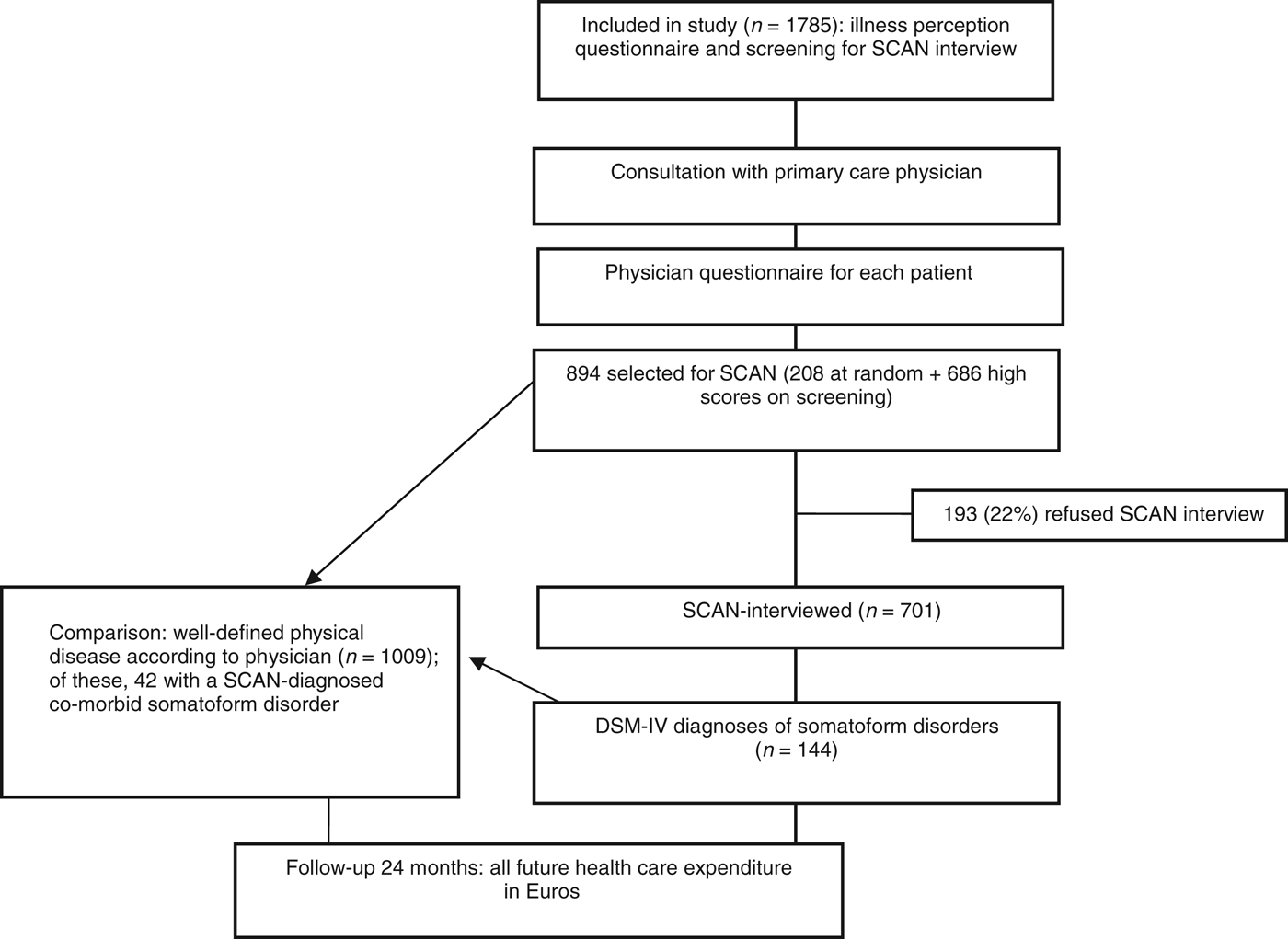
The psychiatric interviews were conducted as soon as possible after the index contact, either at a primary care physician's surgery, in the research unit's office or in the patients' own homes by six qualified physician interviewers. The diagnostic interviews were made by means of SCAN, version 2.1 (World Health Organization, 1998), which is a standardized comprehensive interview endorsed by the World Health Organization, covering all mental disorders. Of the 1785 patients, 894 were selected for interview, of which 193 (21.6%) declined, leaving 701 patients (Fig. 1). Decliners were younger and more likely to be men (Toft et al. Reference Toft, Rosendal, Ornbol, Olesen, Frostholm and Fink2010). We, therefore, present the data on 144 patients with current somatization disorders (n = 26) and undifferentiated somatoform disorders (n = 118).
Flow chart. SCAN, Schedules for Clinical Assessment in Neuropsychiatry; DSM-IV, Diagnostic and Statistical Manual of Mental Disorders, fourth edition.

Primary care physician questionnaires
Immediately after the consultation the physicians completed a questionnaire for each of the 1785 patients. One item from this questionnaire required the physician to classify the patient's current health problem as either: (1) a well-defined physical disease (n = 1009); (2) probably well-defined physical disease (n = 395); (3) medically unexplained symptoms (n = 229); (4) mental disorder (n = 95); or (5) no somatic disorders (n = 39) or missing (n = 18). Out of the 1009 patients presenting well-defined physical disease, 42 had co-morbid somatoform disorders. We further combined category 4 and 5 to take into account the nature of the current health problem in regression modelling of future healthcare expenditure.
Healthcare expenditure
All participants were covered by the National Health Care Programme that requires individuals to be registered with one primary care physician. Denmark has a public healthcare system, which is tax-financed by Danish public health insurance. Within this system, 98% of the population is registered with a specific physician, who acts as a gatekeeper to the secondary healthcare system. Each person has a personal registration number used for all contacts with the healthcare system. Data were obtained from the Danish public health registers by using this registration number (Hansen et al. Reference Hansen, Rosendal, Oernboel and Fink2011). Data were obtained for 2 years after the consultation and 3 years prior to the consultation, respectively. Decreased use of healthcare services due to time spent abroad or death was taken into account by subtracting those periods from the maximum time at risk.
Illness perceptions
The measure of illness perceptions was based on the Revised IPQ (IPQ-R) (Moss-Morris et al. Reference Moss-Morris, Weinman, Petrie, Horne, Cameron and Buick2002). Each patient answered questions regarding their perception of the most important health problem, which they presented to their physician on the day of inclusion in the study. The IPQ-R was adapted and condensed for use in primary care (see Frostholm et al. Reference Frostholm, Fink, Christensen, Toft, Oernboel, Olesen and Weinman2005a , Reference Frostholm, Fink, Oernboel, Christensen, Toft, Olesen and Weinman b ). The emotional representation items were extended to include helplessness and hopelessness. The following components were included: emotional representations, consequences, timeline perspective and personal control. The response format was true/mainly correct/mainly false/false, and, moreover, patients were given the option to endorse a ‘cannot answer’ category. Sum scores of the different IPQ dimensions were calculated. To increase the power of the analyses, we made imputations to replace missing values of the illness perception sum scores based on best subsets regression with the other illness perceptions, emotional distress scores, and sociodemographics of the patients as covariates (see Frostholm et al. Reference Frostholm, Fink, Christensen, Toft, Oernboel, Olesen and Weinman2005a ). The Symptom Check List-somatization subscale (SCL-SOM) (Derogatis & Cleary, Reference Derogatis and Cleary1977) was used as a measure of illness identity according to the self-regulatory model (Cameron et al. Reference Cameron, Leventhal and Leventhal1993).
Data analysis
We identified illness perceptions of patients presenting well-defined physical disease according to the physician, and examined whether the presence of a Diagnostic and Statistical Manual of Mental Disorders, fourth edition (DSM-IV) diagnosis made a significant difference in their illness perceptions. Due to the skewed distribution of illness perception and healthcare use variables we reported means with bias-corrected and accelerated 95% confidence intervals (CIs). Tests of equality of means in two groups were performed by computing the bootstrap test statistic achieved significance level (ASL) (Efron & Tibshirani, Reference Efron and Tibshirani2003).
To examine whether illness perceptions predicted healthcare expenditure in somatoform disorders, we performed five linear regression models (one for each illness perception component included) with log-transformed use of healthcare as the dependent variable. All analyses were controlled for age and gender of the patient, the physician's diagnoses of the current health problem to take into account possible differences in illness perceptions explained by differences in the nature of the current health problem, emotional distress using the SCL-8d to take into account the possible impact of symptoms of anxiety and distress, the intervention at physician level (Toft et al. Reference Toft, Rosendal, Ornbol, Olesen, Frostholm and Fink2010), and for the effect of clustering at physician level to account for interdependence between patients consulting the same physician.
Furthermore, to examine whether illness perceptions predicted prospective healthcare expenditure even when taking into account previous healthcare expenditure, we performed the same five linear regression models including use of log-transformed healthcare expenditure per year for a period of 3 years before the consultation. We conducted all linear models both with and without imputed illness perception scores, except illness identity, which did not have missing values, to examine if there were major variations in results. All models were checked by diagnostic plots of the residuals.
To illustrate differences in healthcare expenditure explained by differences in illness perceptions, we compared median healthcare expenditure in Euros for two patients (40 years old, women, no symptoms of emotional distress, presenting well-defined physical disease according to the physician), one with the 25th percentile of illness identity and perceived consequences and the other with the 75th percentile, respectively. All data analysis was carried out in Stata v. 12.1 for Windows (StataCorp LP, USA).
Results
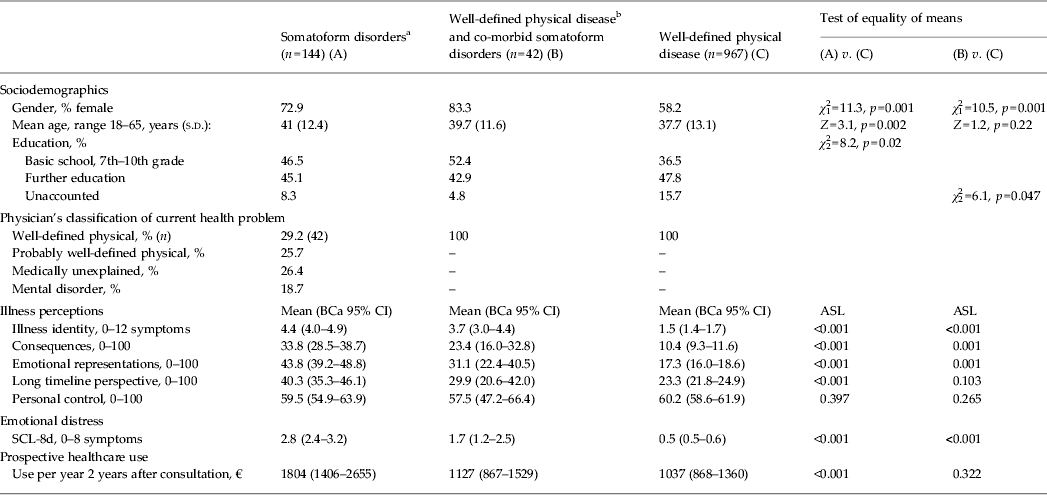
Table 1 shows demographic characteristics and illness perceptions of all patients with somatoform disorders (n = 144), patients presenting with well-defined physical disease (n = 967) and the subgroup of patients with well-defined physical disease and a co-morbid somatoform disorder (n = 42). Patients with somatoform disorders were significantly older, more likely to be female, and had a lower educational level than patients presenting well-defined physical disease (Table 1). They also had higher levels of self-reported emotional distress. Furthermore, patients with somatoform disorders had more negative illness perceptions on all components, except for personal control, as well as significantly greater healthcare expenditure (Table 1).
Characteristics of patients with well-defined physical disease and somatoform disorders

s.d., Standard deviation; BCa 95% CI, bias-corrected and accelerated CI based on bootstrap with 1000 repetitions; ACL, achieved significance level based on the bootstrap with 1000 repetitions; SCL-8d, eight-item version of the Symptom Check List.
a According to diagnostic interview (Schedules for Clinical Assessment in Neuropsychiatry).
b According to physician's classification.
Illness perceptions in physical disease with or without a co-morbid somatoform diagnosis
To take into account the nature of the presenting health problem, we examined whether patients with somatoform disorders had more negative illness perceptions when they presented well-defined physical disease. Patients who had a co-morbid somatoform disorder compared with those presenting with a physical disease only were more likely to be female (83.3% v. 58.2% women, χ 2 = 10.5, p = 0.001), and more likely to have a lower educational level; however, this variable had a high percentage of missing data, which warrants caution (see Table 1). Patients with co-morbid somatoform disorders had a stronger illness identity (3.7 v. 1.5 symptoms, ASL <0.001), perceived their health problem to have more negative consequences (23.4 v. 10.4, ASL = 0.001) and had a stronger emotional representation of their illness (31.1 v. 17.3, ASL = 0.001). There was no significant difference in timeline or personal control between the two groups and no significant difference in healthcare expenditure (Table 1).
Healthcare expenditure in somatoform disorders
We performed 10 linear regression models, five without previous healthcare expenditure and five including previous healthcare expenditure, to examine whether illness perceptions predicted prospective use of healthcare in patients with a somatoform disorder. Of the 144 patient with somatoform disorders included in the analyses, 29.2% presented well-defined physical disease according to the general practitioner, 25.7% presented probably well-defined physical disease, 26.4% a medically unexplained problem, and 18.7% a mental disorder or no physical health problem (Table 1).
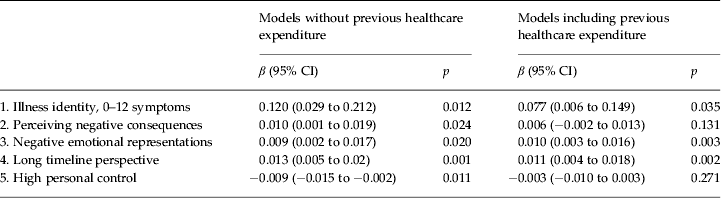
All five imputed illness perception components predicted higher future healthcare use in the models without previous health car expenditure (Table 2): strong illness identity (reporting more physical symptoms; β = 0.120, 95% CI 0.029–0.212, p = 0.012), negative consequences (β = 0.010, 95% CI 0.001–0.019, p = 0.024), strong emotional representations (β = 0.009, 95% CI 0.002–0.017, p = 0.020), a long timeline perspective (β = 0.013, 95% CI 0.005–0.021, p = 0.001) and less perceived control (β = − 0.009, 95% CI −0.015 to −0.002, p = 0.011) (Table 2).
Illness perceptions predicting healthcare expenditure in patients with somatoform disorders (n = 144) a

CI, Confidence interval.
a Multiple linear regression models with log-transformed future healthcare use as the dependent variable. All analyses adjusted for gender, age, physician's diagnosis of current health problem, self-reported emotional distress, intervention, and adjusted for clustering at physician level.
No covariates apart from self-reported emotional distress were significantly associated with prospective healthcare use in any of the analyses. Emotional distress was associated with future healthcare expenditure in the linear regression models of a long timeline perspective (β = 0.122, 95% CI 0.022–0.222, p = 0.019) and less perceived control (β = 0.133, 95% CI 0.043–0.223, p = 0.005). When repeating the analyses with non-imputed illness perceptions, the same components predicted healthcare use: negative consequences (β = 0.080, 95% CI 0.014–0.146, p = 0.020, n = 128), strong emotional representations (β = 0.073, 95% CI 0.021–0.125, p = 0.007, n = 130), a long timeline perspective (β = 0.146, 95% CI 0.055–0.237, p = 0.003, n = 98) and less perceived control (β = − 0.102, 95% CI −0.192 to −0.011, p = 0.029).
In the regression models including previous healthcare expenditure, three of the five illness perception components still predicted future healthcare expenditure, namely, strong illness identity (reporting more physical symptoms; β = 0.077, 95% CI 0.006–0.149, p = 0.035), strong emotional representations (β = 0.010, 95% CI 0.003–0.016, p = 0.003) and a long timeline perspective (β = 0.011, 95% CI 0.004–0.018, p = 0.002) (Table 2). Self-reported emotional distress only predicted future healthcare expenditure in the model on less perceived control (β = 0.086, 95% CI 0.006–0.167, p = 0.037). Previous healthcare expenditure predicted future healthcare expenditure in all regression models. When repeating the analyses with non-imputed illness perceptions, the same components predicted healthcare use: strong emotional representations (β = 0.073, 95% CI 0.032–0.114, p = 0.001, n = 130) and a long timeline perspective (β = 0.126, 95% CI 0.040–0.213, p = 0.006, n = 98).
A 40-year-old woman with no symptoms of emotional distress presenting well-defined physical disease according to the physician would, according to the regression model not including previous use, have a median future healthcare expenditure per year of €270 on the 25th percentile of illness identity versus €387 per year for a similar woman on the 75th percentile of illness identity. This amounts to an increase in healthcare expenditure of 43% (ratio of medians = 1.43, 95% CI 1.09–1.89, p = 0.012). Applying perceived consequences to the same example, the 25th percentile equals a median of €356 and the 75th percentile a median of €472 in healthcare expenditure per year, which amounts to an increase in healthcare expenditure of 32% (ratio of medians = 1.32, 95% CI 1.04–1.69, p = 0.024).
Discussion
In this prospective primary care study we found that primary care patients had more negative perceptions of a current health complaint and a greater healthcare expenditure if they had a somatoform disorder. Furthermore, in patients with somatoform disorders, we found that these negative perceptions predicted greater healthcare expenditure, even when taking into account symptoms of anxiety and depression. Expecting that the current health problem would last longer and have more negative consequences, experiencing lower personal control over the health complaints and reporting more negative emotional reactions to the health problem predicted higher future healthcare expenditure. As expected, a stronger illness identity (reporting more common symptoms) and reporting more perceived consequences of the health problem predicted greater expenditure in somatoform disorders, and may account for additional healthcare expenditure of at least €100 per year. It is difficult to evaluate the clinical significance of this amount; however, it is equivalent to five basic fees for daytime general practice consultations. Current healthcare expenditure is known to be one of the strongest predictors of prospective healthcare expenditure, but when we included previous healthcare expenditure to the analyses, a strong illness identity, strong emotional representations and a long timeline perspective still predicted prospective healthcare expenditure.
The questionnaire on illness perceptions was aimed at the presenting health complaint on the day of inclusion in the study. Therefore, in examining possible differences in perceptions of patients with and without somatoform disorders, we chose to compare the perceptions of patients presenting well-defined physical disease according to the physician to avoid the possibility that differences in perceptions could be explained by differences in the nature of the presenting health problem. Still, we cannot exclude that differences in the nature of the presenting symptoms may have had an impact on the findings. For example, some patients may have presented more than one health problem to their physician, which we have not been able to account for in our analyses. A weakness of this study was missing values in illness perception variables. We made imputations of missing values based on responses on the other illness perception items (Frostholm et al. Reference Frostholm, Fink, Christensen, Toft, Oernboel, Olesen and Weinman2005a ). However, results from multiple regressions using non-imputed data revealed similar interpretations, although bias seems to be present, providing larger coefficients compared with those of imputed data. Missing data may to some extent reflect that patients were asked about perceptions of a possibly new health complaint for which they might not have had very clear-cut cognitive representation.
To our knowledge, no previous study has examined the associations between illness perceptions and healthcare expenditure in somatoform disorders in a prospective design including several data sources such as patient and physician questionnaires, diagnostic interviews by professional interviewers, as well as register data. Our results are strengthened by the inclusion of all prospective healthcare expenditure from a range of Danish health registers, including hospitalization and use of medication, not subject to self-report bias. Furthermore, we used structured diagnostic interviews in which inter-rater reliability was established to obtain the diagnoses of somatoform disorders rather than the physician's diagnosis of medically unexplained symptoms, as it has been shown that physicians vary considerably in how likely they are to provide this diagnosis (Rosendal et al. Reference Rosendal, Bro, Fink, Christensen and Olesen2003). We did use the physician's diagnosis of well-defined physical disease for which no inter-rater reliability was established. To partly respond to this problem we excluded the group of patients presenting ‘probably well-defined physical disease’ according to the physician and furthermore controlled for clustering in the regression analyses to account for possible interdependence between patients consulting the same physician.
The results are in line with previous findings from a broader general practice population (Frostholm et al. Reference Frostholm, Fink, Christensen, Toft, Oernboel, Olesen and Weinman2005a ) suggesting that a stronger illness identity, negative beliefs with respect to timeline and future consequences of the symptoms, and stronger emotional representations are associated with higher healthcare expenditure not only in patients with somatoform disorders. In connection with the revision of the somatoform section of the DSM-IV into the somatic symptom disorder of the Diagnostic and Statistical Manual of Mental Disorders, fifth edition (DSM-5) there has been a discussion of whether to include psychological and behavioural symptoms in the diagnostic criteria. The fact that negative illness perceptions predict worse outcome in somatoform patients in this study seems to support the fact that they are included as was decided for the DSM-5. However, as negative illness perceptions also predict worse outcome in patients with well-defined medical conditions this may not be specific for somatoform disorders as such. We did find that patients with somatoform disorders had more negative illness perceptions than patients with medical conditions, suggesting that illness perceptions may be one of the mechanisms involved in the perpetuation of somatoform disorders (Rief & Broadbent, Reference Rief and Broadbent2007; Martin & Rief, Reference Martin and Rief2011). Even when presenting well-defined physical disease, patients with somatoform disorders have more negative illness perceptions supporting the notion of a general tendency to interpret and react negatively to bodily sensations and symptoms. These negative perceptions may increase the likelihood of consulting when faced with new or recurrent symptoms, as primary care consulters have been found to have more negative perceptions of their symptoms than non-consulters (Kettell et al. Reference Kettell, Jones and Lydeard1992; Cheng, Reference Cheng2000). Our findings more specifically propose, in line with a study by Hiller & Fichter (Reference Hiller and Fichter2004), that negative cognitions might be involved in driving higher use of healthcare in a subgroup of patients with somatoform disorders.
Our results suggest that illness perceptions should be addressed in primary care interventions for somatoform disorders, for example in educational programmes aimed at primary physicians (Toft et al. Reference Toft, Rosendal, Ornbol, Olesen, Frostholm and Fink2010) in accord with the strong evidence for cognitive–behavioural interventions for these conditions (Schroder & Fink, Reference Schroder and Fink2011). A few studies actually suggest that such interventions may lead to reductions in consulting behaviour (Morriss et al. Reference Morriss, Gask, Ronalds, Downes-Grainger, Thompson, Leese and Goldberg1998; Martin et al. Reference Martin, Rauh, Fichter and Rief2007). To further examine the impact of illness perceptions in somatoform disorders, it would be of importance to examine whether illness perceptions might mediate the effect of psychological interventions in these disorders.
Acknowledgements
The study has been supported by grants from The Danish Medical Research Council (grant no. 2028-00-0007) and the Health Service of Aarhus County (project no. 0871). The funding sources had no role in the study design, data collection, data analysis, data interpretation, writing of the paper or the decision to submit the paper for publication.
Declaration of Interest
None.