


INTRODUCTION
The trajectory of the Indonesian Prosperous Justice Party (Partai Keadilan Sejahtera, PKS) is a notable example of Islamists’ moderation in Muslim-majority countries with competitive electoral systems. Born from a Muslim student movement called Tarbiyah (Education), PKS was originally a “radical” or “conservative” Islamist party that endorsed sharia law and promoted Islam as the sole ideology in Indonesia (van Bruinessen Reference van Bruinessen2002). However, after disappointing results in its first national election in 1999, PKS adopted inclusive and pluralist attitudes toward a broader range of constituencies, including non-Muslims. This change has been articulated by expressing the party's interests in practical issues in political and socioeconomic realms, including forming electoral coalitions with mainstream nationalist parties, nominating non-Muslim candidates, and providing social services. As PKS has taken root in Indonesian politics by securing sufficient numbers of votes and legislative seats, scholars have paid it increasing attention in line with broader contexts of the electoral rise of religious parties that moderate to mobilize voters (Buehler Reference Buehler2012; Tanuwidjaja Reference Tanuwidjaja2012; Tomsa Reference Tomsa2012; Hamayotsu Reference Hamayotsu2011).
However, less is known about how and to what extent PKS's moderation has affected the party's electoral performance, particularly its short-term progress followed by a decade-long stagnation of its vote shares. After experiencing a surprising jump in electoral support from 1.3 percent in 1999 to 7.5 percent in 2004, its national vote tallies levelled off until the 2019 legislative election. The trajectory of PKS in the electoral arena thus presents several questions. Why have PKS's efforts to capture median voters not been fully translated into the party's electoral growth? Did the stagnant electoral performance originate from the party's coherent electoral base or an approximate equilibrium between an influx and a loss of voters? Last, how would the political mainstreaming of conservative and anti-pluralist Muslims, which is a prominent trend in contemporary Indonesian politics (Mietzner and Muhtadi Reference Mietzner and Muhtadi2018), affect the overall political mobilization of PKS?
The party's case compels a more nuanced understanding of the impact of moderation on the electoral performance of Islamist parties in Indonesia and beyond. The literature on moderation assumes that the core constituencies of an Islamist party, mostly conservative Muslims yearning for a sharia-based social and political restructuring, remain loyal to their party regardless of the degrees of moderation. Such an assumption, however, seems to run counter to the broader party literature, which emphasizes that core voter loyalty is not permanent but is subject to decline if a party signals a clear deviation from its founding policy platforms and ideological commitments (Toka Reference Toka1998; Thachil Reference Thachil2011). Thus, a more finely grained picture of the relationship between moderation and electoral outcomes of an Islamist party is needed to examine whether there was not only an influx of voters from broader segments of society but also an outflow of initial party stalwarts. In this article, following Mecham and Hwang (Reference Hwang, Mecham and Hwang2014), I posit that several behavioral changes among Islamist elites that occurred during the course of moderation are conceptually different from moderation because these kinds of changes are caused not by their willingness to accommodate democratic values and pluralism—the impetus for moderation—but by opportunistic and unprincipled political learning through contact with diverse actors outside their party. Such behavioral changes, or what I call normalization, are thus expected to increase the risk of losing support from the party's original constituencies and to offset the positive impact of moderation on convincing new supporters. In this light, using the case of PKS, the goal in this article is thus to explore how moderation and normalization differently affected the mobilization of electoral support for Islamist parties.
I divide this analysis of the electoral performance and voter profile of PKS into two parts. Deploying survey data of multiple opinion polls, I first seek to examine whether there was a change in the profiles of party supporters over the last decade. The statistical findings show that the party's voter base became significantly more amorphous because of a rapid decrease in the likelihood of receiving support from segments of the electorate with specific socioeconomic characteristics. Specifically, an influx of more pluralist Muslims from diverse backgrounds into the party's constituencies was offset by the defection of educated Islamists who were behaviorally more pious, as opposed to Westernized interpretations of Islam, and expressed anti-American sentiments. Despite its recent efforts to bring radical and intransigent Muslim groups into the political mainstream, PKS could not fully restore its electoral appeal to Islamist voters.
In the second part, I argue that regardless of the drive for moderation, which was crucial in allowing PKS to make inroads into various elements of Indonesian society, it was normalization that sparked discontent among the party's original constituencies enthusiastic about Islam-oriented political reform and clean governance. Concretely, I demonstrate that PKS elites have behaviorally become inseparable from the two trends in contemporary Indonesian party politics—that is, “moral overstepping” and “clientelistic maneuvering.” As a result, PKS has gradually lost its capacity to take up the mantle of reformist agendas in accordance with religious aspirations, hence experiencing a withdrawal of reform-minded educated Islamist voters from its voter base. As normalization prevails, PKS has suffered a lack of recovery from such voter defection, even though it has recently attempted to combine Islamic piety with its moderated mobilization strategy and display an oppositional stance to the nationalist government. In contrast to previous studies, my analysis thus suggests that, apart from moderation, the negative and independent effect of PKS's accommodation to Indonesian political realities on its electoral support should be considered for sharper understanding of the party's political mobilization.
This paper proceeds as follows. The next section introduces the concept of normalization and how it affects electoral mobilization in ways different from moderation. The third section assesses the literature on PKS and the impact of the party's moderation had on voter choice and discusses some remaining empirical puzzles. The fourth section statistically examines the transformation of PKS's electoral base from the defection of Islamist voters to an influx of more socioeconomically heterogeneous Muslims. The fifth section provides a range of anecdotal evidence on the party's normalization and specifies how this affected the drastic change in its constituencies. The final section comments on wider implications for understanding the political mobilization of Islamist parties and future research.
MODERATION, NORMALIZATION, AND ELECTORAL MOBILIZATION OF ISLAMIST PARTIES
Recent decades have witnessed an active accommodation with democratic and pluralist political systems by Islamist political groups and individuals in predominantly Muslim countries (Schwedler Reference Schwedler2006; Driessen Reference Driessen2012; Tomsa Reference Tomsa2012; Somer Reference Somer2014). With reference to earlier experiences of socialists (Przeworski Reference Przeworski1985, chap. 1) and Christian elites (Kalyvas Reference Kalyvas1996) in European democracies, a related literature defines such change in political Islam as moderation, which generally refers to a behavioral or ideological shift from radical ideals toward liberal and democratic norms and practices. Electoral participation through the formation of political parties is the most visible sign of Islamist moderation. Once Islamists have taken the path toward electoral politics, they are exposed to incentives for additional moderation, which is conducive not only to capturing votes from broader constituencies than radical Muslims but also to their organizational survival (Tezcur Reference Tezcur2010).
However, not all Islamists’ ideological and behavioral changes can be conceptually categorized as moderation. In addition to an acquiescence to democratic practices, the formation of political parties gives Islamists more opportunities to interact with others from more diverse political and religious backgrounds. While such interaction contributes to diluting an initial exclusivist and uncooperative image (Wickham Reference Wickham2004), it also diminishes that which distinguishes the position of Islamist elites. More concretely, their original anti-status-quo stance expressed in verbal intransigence, indifference to political engineering, and reliance on militant style of activism is assimilated into established patterns of thinking and practicing in the party system through political learning and bargains with fellow politicians of other parties (Taydas, Akbaba, and Morrison Reference Taydas, Akbaba and Morrison2012; Boubekeur Reference Boubekeur2016). Compared with a purely ideological aspect, this centripetal trend is particularly conspicuous in the Islamists’ political behaviors, including ways they mobilize voters, access power and state resources, and bargain with actors from diverse backgrounds. Considering that behavioral inertia is an important authoritarian legacy that obstructs the process of democratic consolidation in developing countries (Berenschot and Aspinall Reference Berenschot and Aspinall2020; Davidson Reference Davidson2009), a large part of Islamists’ centripetal tendencies following their electoral participation should extend beyond moderation. Regarding this, Mecham and Hwang suggested the term normalization, which they defined as
a process by which Islamist parties increasingly accommodate themselves to the rules of the political regimes in which they operate; in other words, they become less unique and more normal political actors when compared with other parties in the competitive systems (Mecham and Hwang Reference Mecham and Hwang2014, 6–7).
Yet, notwithstanding the conceptual difference, almost no attempt has been made to assess how normalization might affect Islamist electoral mobilization differently from moderation, which has been widely understood as a momentum behind the electoral gains of Islamist parties in the Muslim world.
In Indonesia, the world's largest Muslim democracy, three prevalent elite-level trends in political behaviors can function as reference points for assessing the extent of normalization. First, like their predecessors under the authoritarian rule of Suharto, political parties have functioned as corrupt electoral vehicles relying on clientelistic networks and illicit funding (Mietzner Reference Mietzner2007; Allen Reference Allen2015). Second, in most cases, electoral coalitions among parties at both national and local levels are formed not by longstanding ideological solidarities or common social milieus but by opportunistic motives for winning elections and power-sharing (Slater and Simmons Reference Slater and Simmons2013). Third, growing factionalism within Indonesian party apparatuses has caused frequent infighting and splits, hence undermining organizational cohesion (Fionna and Tomsa Reference Fionna and Tomsa2020). Thus, in the context of contemporary Indonesian politics, an Islamist party becomes more normalized as its behaviors assimilate these opportunistic strategies.
Normalization affects Islamist electoral mobilization differently from moderation. Supposing that an Islamist party is a vote-seeking actor whose primary goal is to exert a greater influence of Islam on the state by winning elections, then moderating its policies and ideological positions toward the center (or broader constituencies) is more desirable than other strategies (Schofield Reference Schofield2003). Despite varying degrees, Islamist parties in the Muslim world, such as the Turkish Adalet ve Kalkınma Partisi (AKP), the Moroccan Justice and Development Party (PJD), and the Tunisian Ennahda, initially made large electoral gains by compromising their religious commitments with democratic credentials (Somer Reference Somer2014; Daadaoui Reference Daadaoui2017; McCarthy Reference McCarthy2018). In contrast, the electoral appeal of Islamist parties likely declines when normalization arises. In most cases, Islamists form parties to translate Islam into ideological solutions to the ongoing social and political problems in their countries (Collins Reference Collins2003; Driessen Reference Driessen2012). Thus, as a new competitor with pre-existing parties, the Islamist party's initial source of voter mobilization comes primarily from its commitment to change or prophesy (Lucardie Reference Lucardie2000). In this sense, normalization may electorally backfire on an Islamist party because some of its supporters could be less satisfied with the party's dubious religious credentials. Yet, less is known about the extent to which normalization impairs the party's electoral outcomes and which component of the electorate is more likely to renounce their support for a normalized Islamist party.
In the next sections, I present an empirical analysis that rests upon both statistical and historical data covering the electoral mobilization of PKS since its formation. This party is appropriate for measuring the impact of normalization (and moderation) on voting patterns for an Islamist party over multiple elections for two reasons. First, as discussed below, both proponents and sceptics of the moderation thesis on PKS voter choice cannot fully explain the party's decade-long electoral stagnation followed by a slight increase in the vote share during the period when no clear signs of the party's de-moderation were observed. Second, compared to other Muslim democracies, the Indonesian political system arguably has remained stable since the democratic opening in 1998; hence, the effects of exogenous factors on the voters’ decisions may be limited.
VOTER PROFILE AND THE MODERATION OF PKS: A PUZZLING RELATIONSHIP
PKS was born from a political diversification within Indonesian Islamist movements. Despite sharing the same organizational roots in the Saudi-backed dakwah (Islamic proselytization) movement that emerged in the late 1960s, Islamists gradually diverged along differences about the roles of democratic systems, particularly party politics, in building an Islamic community (ummah) and on implementing sharia law (Hasan Reference Hasan2006, 143–148). Unlike hardliners who favored revolutionary action to topple Suharto's New Order regime, Tarbiyah members supported a gradual and pragmatic approach that minimized any confrontation with the existing state system (Machmudi Reference Machmudi2006, 92–100). When the political opening in 1998 facilitated the participation of Muslim mass organizations in politics, the moderate wing of Tarbiyah formed the Justice Party (PK) and contested the 1999 legislative election to promote the Islamization of parliament.Footnote 1
However, PK fared poorly, receiving only 1.31 percent of the national vote. It failed to reach the 2.5 percent threshold for running in the 2004 election (see Table 1). PK fell flat because, even among conservative Muslim or Islamist groups, it was less electorally appealing than other Islamist parties with deeper historical roots, such as the United Development Party (Partai Pembangunan Persatuan, PPP) or the Crescent and Star Party (Partai Bulan Bintang, PBB).Footnote 2 In particular, except among highly educated voters, PK was rather isolated from Javanese Muslim communities (Ananta, Arifin, and Suryadinata Reference Ananta, Arifin and Suryadinata2004, 399–400). Thus, the party's radical ideas resonated only with a small segment of Muslims (Permata Reference Permata2008, 211).
PKS in the Recent Legislative Elections

Data from: Indonesian Election Commission (Komisi Pemilihan Umum, KPU), www. kpu.go.id/.
Observers agree that PKS's underwhelming electoral underperformance accelerated the party's strategic shift toward more moderate positions. After reformulating itself as PKS in 2002, the party began promoting the aspiration of building a “clean and caring” government to downplay its Islamic and devotional image. It also showed its inclusivity by nominating non-Muslim candidates and by forming electoral coalitions with non-Islamic parties. In addition, it provided a range of social welfare services, such as free healthcare, disaster relief, and donations of essential goods, regardless of the recipients’ religious affiliations (Hamayotsu Reference Hamayotsu2011; Permata Reference Permata2008, 116–117). Again, while such moderation is a common strategy of Islamist parties in the Muslim world to secure support from swing voters (Kurzman and Naqvi Reference Kurzman and Naqvi2010), PKS's case seems to differ from the normal and expected effects of moderation on voter mobilization. As Table 1 shows, after making significant inroads in 2004, neither significant progress nor a decline in recent vote shares has been observed as of the time of writing. This stagnant electoral performance is in marked contrast to many Islamist parties, most notably AKP and PJD, which gained sufficient momentum toward winning election or at least becoming major parties.
A number of explanations have been advanced to account for PKS's mixed electoral outcomes. The impact of moderation on the electorates’ choices can be classified into two types. The first highlights moderation's positive influence on PKS's performance, meaning that progress toward becoming a mid-size party was mainly because of an expanded voter base beyond Islamists. Notably, Liddle and Mujani (Reference Liddle and Mujani2005) claim that the improvement in its performance in the 2004 election resulted from its enhanced capacity to embrace Islamist and secularist voters by replacing its Islamist tone with aspirations for political and social reform. Proponents of the moderation thesis also highlight the positive role of the party's greater pragmatism and democratic credentials in broadening its constituencies toward diverse Muslim groups (Hamayotsu Reference Hamayotsu2011; Hwang Reference Hwang, Mecham and Hwang2014); meanwhile, the loyalties of the party's core membership remained intact (Arifianto Reference Arifianto2018). In short, these studies generally assumed that moderation has benefited PKS by building a stable voter base, which is an essential component of being free from the chronically high volatility of party loyalties and support in Indonesia.
Others, however, have claimed that the electoral rise of PKS is not a consequence of diversifying the party's voter base but a conjoining of conservative and pious Muslim voters, who originally supported other Islamist parties. For example, based on the finding that there was no noticeable change in the party's provincial-level performance between the 2004 and 2009 legislative elections, Tanuwidjaja (Reference Tanuwidjaja2012, 539) argues that “PKS had not been able to convince any voters beyond those who traditionally voted for Islamic parties.” Similarly, in analyses of public opinion polls, Choi (Reference Choi2017) and Mietzner (Reference Mietzner2008) note that an emphasis on non-Islamic issues, particularly economic policies, had not significantly affected the original electoral base of PKS and of other Islamist parties. The limited effects of PKS's moderation on mobilizing its voters were also found in the party's organizational reliance on anti-pluralist cell groups (Hairgrove and Mcleod Reference Hairgrove and Mcleod2008) and the strong intraparty ideological congruence between voters and cadres that preferred Islamism over secularism (Fossati et al. Reference Fossati, Aspinall, Muhtadi and Warburton2020). According to these sceptics, regardless of its moderation, PKS's electoral performance stemmed from stable and coherent mobilization of voters who sympathized with the party's ultimate goal—to build an Islamic society without the use of violence.
However, both perspectives oversimplify the intricacies of PKS's ideological and behavioral changes and their ramifications for elections. On the one hand, while associating moderation with its electoral growth, scholars have been less able to explain why the party has not achieved a further increase in its vote share as witnessed in the 2004 election. As Sánchez-Cuenca (Reference Sánchez-Cuenca2004) suggests, the moderation of ideologically oriented parties can be traumatic or at least produce mixed electoral outcomes when it provokes discontent and defections by hardline cadres and supporters who are unwilling to sacrifice the party's basic messages and principles for electoral gain. Similarly, Kalyvas (Reference Kalyvas1996, 234–241) shows that specific strategies for downplaying confessionalism by European Christian democratic parties, including cross-class coalitions and curtailing the Church's influence on the party's decision making, triggered internal backlashes. Yet, it cannot be simply argued that the party has successfully secured a certain number of votes from a stable electoral base without empirically investigating whether significant vote switching by original supporters occurred regardless of the party's changes.
On the other hand, understanding moderation as PKS's cosmetic strategy cannot satisfactorily explain why burgeoning Islamism in Indonesia has not boosted the party's electoral strength. Scholars have reported a rapid growth of Islamic piety in private and public spheres, not only in personal interactions or through peer pressure but also in the implementation of sharia regulations, particularly at the local level (Brown Reference Brown2019; Buehler Reference Buehler2016; Hasan Reference Hasan2013). Public surveys also find that the proportion of Indonesian Muslims who promote Islamist agendas has risen rapidly, reaching approximately 40 percent (Fossati Reference Fossati2019, 125). Furthermore, since the lead-up to the 2017 Jakarta gubernatorial election, which featured great controversy and turmoil over a Chinese Christian candidate, Islamists and conservative Muslims have transformed into an unmistakable political force (Mietzner and Muhtadi Reference Mietzner and Muhtadi2018). However, concerning PKS's recent electoral stalemate, no specific relationship can be found between the broader Islamization fused into social and political realms and the mobilization of Islamist parties. If PKS's core constituencies largely comprise Muslims influenced by Islamism, then why have the party's vote totals not been reflected in the rise of Islamist sentiments?
Recent studies, nonetheless, have addressed that PKS has an “electoral dilemma,” that is, the moderation acts as both an electoral incentive and a deterrent. For example, Hwang and Mecham (Reference Hwang and Mecham2010) indicate that the impact of its moderation has, at best, modestly contributed to the party's electoral gains, even given the large discrepancies between the targets set by party elites and actual outcomes. Tomsa (Reference Tomsa2012) also claims that an internal inconsistency between its inclusive leadership and Islamist grassroots activists has hindered the party's voter mobilization. However, because these studies analytically relied on anecdotal evidence over a relatively short time period, they lacked rigorous examination of the association between PKS's moderation and its electoral performance. This methodological shortcoming is also applicable to the two perspectives introduced above.Footnote 3
Below I seek to examine longitudinally and systematically how multiple aspects of moderation affected PKS's electoral mobilization. First, by measuring the Islamist electorate's likelihood of voting for PKS, I assess whether there has been a change in the party's voter base in the last decade. I then analyze whether and to what extent normalization has affected the party's voter profile and past election performance.
STATISTICAL ANALYSIS
MODEL SPECIFICATION, DATA, AND METHOD
Before proceeding to statistical testing, it is necessary to develop several essential concepts and assumptions to form a hypothesis. We begin with Islamists. They can broadly be defined as those who are behaviorally pious, oppose Western (especially Americanized) values and norms, and support a holistic application of Islamic principles to worldly issues. This conceptualization is broader and more inclusive than that in the literature on political Islam, which usually differentiates Islamists from non-Islamists based on whether the person desires the implementation of sharia law as means of political, economic, and social reform (Schwedler Reference Schwedler2011, 349, Tomsa Reference Tomsa2012, 487, Choi Reference Choi2017, 230). As Mozaffari (Reference Mozaffari2007, 23) indicates, the introduction of sharia is a part of the ultimate goal of Islamist ideology or Islamism, that is, to build a global and holistic polity based on religion (dîn), way of life (dunya), and government (dawla). Furthermore, the recent rise of Islamism around the Muslim world is closely associated with the growing hostility toward Western (or Americanized) models and values, particularly secular democracy (van Bruinessen Reference van Bruinessen2002). Finally, since Geertz's (Reference Geertz1960) seminal work on Javanese Islam, there has been a consensus that a clear difference in religious piety can be observed among Indonesian Muslims about the fulfilment of Islamic practice, including pilgrimages, fasting, and five daily prayers. I thus assume that some Islamists, especially those influenced by Tarbiyah, comprised the original PKS voter base.
I also assume that the pace of PKS's moderation has been maintained at least a certain level. Since it is beyond the scope of this article to measure the intensity of the party's moderation over time, I posit that there was no substantial retrogression within PKS to its commitment to democratic practices and institutions during the period under study. This assumption is indirectly supported not only by recent literatureFootnote 4 but also by my interviews with many PKS cadres.Footnote 5 Lastly, given the fluctuations of the other Indonesian parties’ performances, notably continuous entries of newcomers with large numbers of votes and the extinction of existing parties, I assume that PKS experienced neither significant gains nor losses—referred to as an ‘electoral stalemate’— after the legislative ballot in 2004, when it achieved 7.5 percent of the vote.
The hypothesis tested here is as follows: A vote shift of educated Islamist voters dissatisfied with the party's growing normalization caused PKS's electoral stalemate. Because of the infeasibility of collecting actual electoral outcome data at the voter level, I indirectly measured the vote shift based on responses to questions about party support in multiple surveys. I used eight datasets from two cross-national surveys: the World Value Survey (WVS) in 2006 and the Global Attitude Project (GAP) from 2009 to 2018.Footnote 6 To test the hypothesis, I used a multinomial logit (MNL) model. This method is applicable when the dependent variable is nominal and has multiple categories. Studies on voting behavior in multiparty political systems also have used this analytical tool (Whitten and Palmer Reference Whitten and Palmer1996).
The dependent variable has multiple discrete categories, including respondents’ choices of parties that were active at the time when the survey was conducted. In addition to PKS, I included the following political parties that had sufficiently cleared the electoral thresholds for winning seats in the national parliament (DPR) since the 2004 election: the Indonesian Democratic Party of Struggle (Partai Demokarasi Indonesia Parjuangan, PDI-P), the Golkar Party (Golkar), the National Awakening Party (Partai Kebangkitan Bangsa, PKB), the National Mandate Party (Partai Amanat Nasional, PAN), the United Development Party (PPP), the Democrat Party (Partai Demokrat, PD), and the Great Indonesia Movement (Gerakan Indonesia Raya, Gerindra). These eight parties comprise nearly the entire ideological spectrum in the Indonesian party system, namely nationalist (PDI-P, Golkar, PD, and Gerindra), Muslim traditionalist (PKB), Muslim modernist (PAN), and Islamist (PKS and PPP).Footnote 7
There are two key independent variables in the model. The first is Islamist, which refers to the degree of the respondent's commitment to an Islamist agenda. As noted above, this variable comprises three subcomponents, meaning that that an additional procedure is required to create it. I thus used confirmatory factor analysis to examine the empirical relationships among the related items in each questionnaire. After applying the Varimax rotation method, I found that several factors identified with eigen-values greater than 1 (one) can be generally grouped into three categories: personal Islamic piety, application of Islamic principles to the Indonesian state, and anti-American sentiments.Footnote 8 This categorization supports the multifaceted definition of Islamism introduced above. Subsequently, the values of each factor are summed and standardized to create a single variable with a mean of 0 (zero) and a standard deviation of 1 (one). Thus, having higher values on Islamist indicates being more supportive of Islamist agendas.
Level of education is the second main independent variable. Considering that PKS was formed to realize the political goals of the campus-based Tarbiyah, it can be assumed that its original voter base was better-educated than those who supported other parties. In other words, the likelihood of voting for PKS relative to other parties was initially higher as the voter's level of education increased. Alongside the Islamist variable, the statistical analysis primarily focuses on whether the initially strong impact of education on voting for PKS remained unchanged. Here, education is measured on a five-level scale ranging from the incompletion of elementary schooling through post-secondary degree.
I also use a range of control variables, some of which have been discussed in the literature as causal factors that might affect voter choice in the Indonesian party system. Income level is a prime example. Some scholars, such as Hadiz (Reference Hadiz2014) and Choi (Reference Choi2017), emphasize the role of the increasing class divisions in the Indonesian Muslim community on reshaping Indonesian political Islam. Accordingly, the electoral rise of PKS resulted from a mobilization of urban (upper-) middle-class Muslims eager to sharpen their own political identity by promoting an Islamic consciousness. To control for the effects of income level on voting for PKS, my statistical model includes a measure that indicates respondents’ gross household income reproduced on a scale of 1 to 5, ranging from the lowest to the highest level. In addition, the model includes two economic variables: (a) an evaluation of their economic conditions, ranging from 1 (very good) to 4 (very bad), and (b) a dichotomous variable coded from the respondents’ job conditions, where 1 (one) represents unemployment and 0 (zero) represents other employment status. I included this variable to control for a voter's grievance against the economic status quo, which was discussed by other studies on Muslims’ electoral decision in the Muslim world (for Indonesia, Hadiz Reference Hadiz2014, for other countries, García-Rivero and Kotzé Reference García-Rivero and Kotzé2007).
FINDINGS
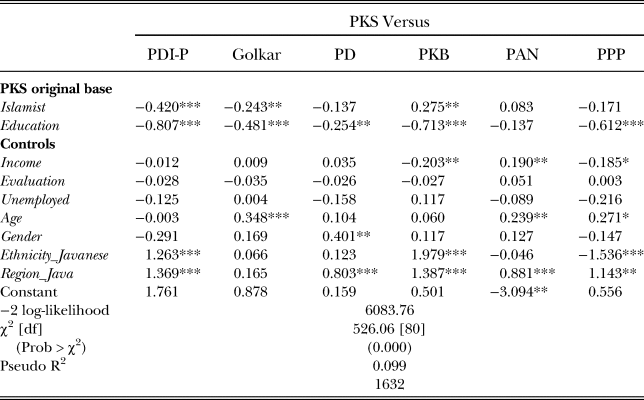
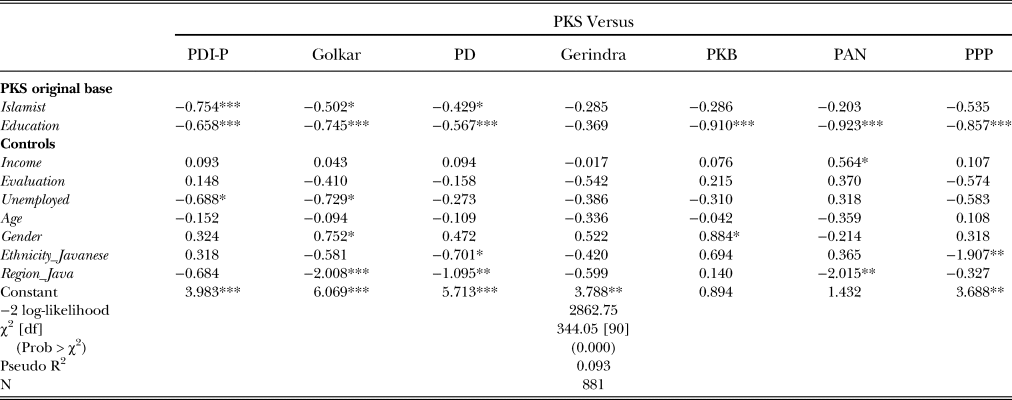
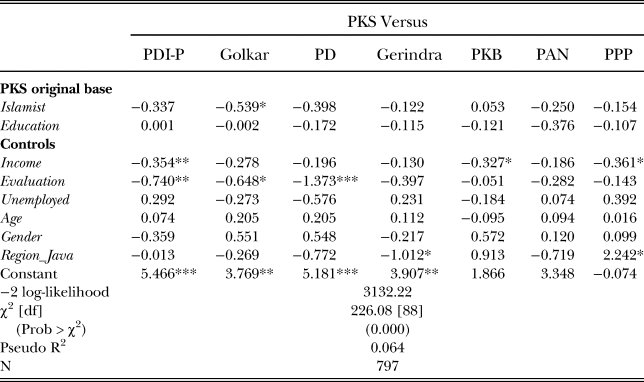
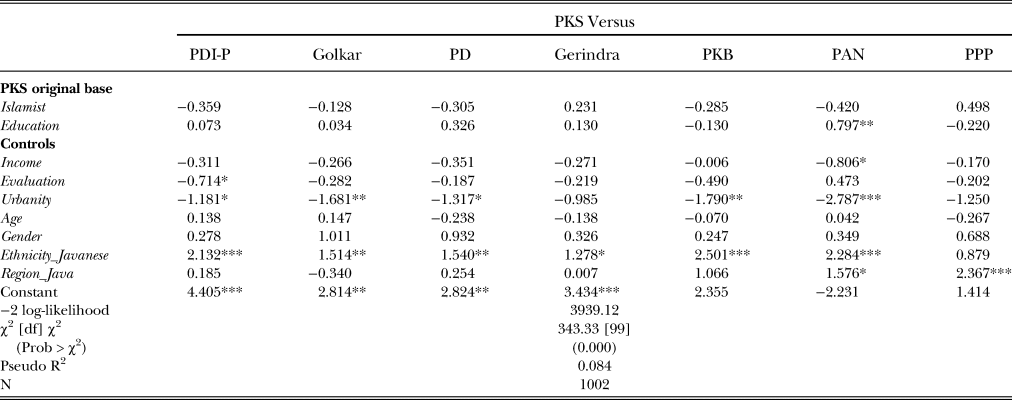
Tables 2–5 present the results of multinomial logistic analyses using the four datasets—the WVS in 2006 and three GAP surveys in 2009, 2014, and 2018. Significantly, these four surveys a reproduce the actual voting patterns of the Indonesian electorate in the national legislative elections of 2004, 2009, 2014, and 2019.
Party Support for PKS Relative to Other Parties in 2006

Note: p* < .10, p** < .05, p*** < .01.
Party Support for PKS Relative to Other Parties in 2009

Note: p* < .10, p** < .05, p*** < .01.
As the tables show, noticeable changes in the signs and significance of the variables’ coefficients are present, indicating a major transformation in PKS's support base. First, the unidirectional effects of Islamism and education on voting for PKS relative to other parties, notably nationalist parties, declined gradually during the time of the survey. Table 2 and 3 show that PKS supporters were more likely to be better educated and inclined to an Islamist agenda than others until 2009.
As indicated in Tables 4 and 5, however, this clear voting pattern based on education and Islamism became significantly blurred in the following elections. In particular, since the 2014 election, the strongly positive association between the level of education and electoral choice for PKS over other parties had not only lost its statistical significance but also changed its direction in some pairs. The findings thus show that present-day PKS has relied less on educated Islamist voters in elections.
Party Support for PKS Relative to Other Parties in 2014

Note: p* < .10, p** < .05, p*** < .01.
Party Support for PKS Relative to Other Parties in 2018

Note: p* < .10, p** < .05, p*** < .01.
Second, regarding the economic and demographic factors discussed in previous studies, my statistical analysis shows mixed results. Save for some pairs with PKB, which is primarily rooted in rural East Java, income did not have a significant impact on voting for PKS relative to other parties. Similarly, economic grievances, which are assumed to be a result of a voter's negative economic evaluation of national economy and unemployment, only had an influence on vote choice for PKS vis-à-vis certain nationalist parties, such as Golkar and PDI-P. Put differently, there is no clear difference between the electoral base of PKS and those of other Islamic parties in class identity or socioeconomic status. The only exception is the urbanity variable's negative effects on voting for other parties relative to PKS in 2018, meaning that potential PKS voters in the 2019 election appeared to be significantly more likely to live in urban areas than those affiliated with other parties. Indeed, these findings seemingly conflict with prior research that posits economic motives for Islamist political mobilization in Indonesia (Pepinsky, Liddle, and Mujani Reference Pepinsky, Liddle and Mujani2018). In contrast, my analysis finds that PKS voters cannot be characterized by specific socioeconomic conditions, except that they have been consistently urban relative to rural.
The heterogeneity of PKS voter profile can also be found by examining the effects of demographic factors on voter choice in each election. In 2006, for example, living on the island of Java significantly decreased the probability of voting for PKS relative to other parties. However, PKS's initial reliance on support from the outer islands declined gradually and even reversed over the decade. Indeed, in 2018, only PKB and PAN, rooted in East and Central Java, respectively, were more likely to be preferred by voters over PKS in Java. Similar patterns can be observed in the case of the voter's age. Compared with 2006, when younger voters were more likely to report a preference for PKS over other parties, I found no statistically significant association between the variable of age and support for PKS in 2009, 2014, and 2018. By contrast, the impact of ethnicity on PKS voting was more dynamic. In 2006, relative to PKS, Javanese voters were more likely to choose PDI-P and PKB but for PPP less likely. Such mixed effects of ethnic affiliation on the likelihood of voting for PKS became unidirectional, meaning being a Javanese significantly decreased the probability of voting for PKS relative to other parties (Table 5). The results thus show that PKS's voter base became demographically heterogeneous, except for the likelihood of being ethnically non-Javanese.
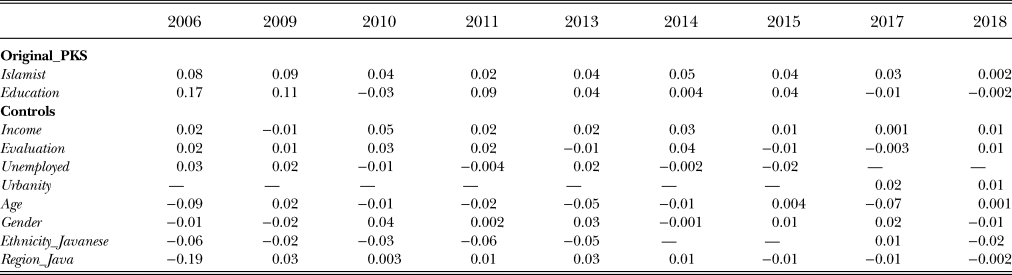
Table 6 shows a clearer picture of the growing heterogeneity in PKS's voter base, which was caused by the decrease in electoral reliance on specific groups in Indonesian Muslim society. The entries in this Table represent the predicted probabilities of voting for PKS, which were calculated based on variation from the minimum to the maximum value of each explanatory variable. To track the impact of key explanatory variables more specifically, I added the results of the statistical analyses by using datasets of the GAP survey in 2010, 2011, 2013, 2015, and 2017 (See Appendix A for full details of the statistical tests). The Table demonstrates that in 2006, all else being equal, Muslims who favored Islamism most strongly were eight percentage points more likely to vote for PKS than those who were least supportive of it. Education also exerted a large effect. Compared with college students or graduates, the least-educated voters (those who did not graduate from elementary school) were 17 percentage points less likely to vote for PKS. However, the strong and positive effects of Islamism and education on support for the party decreased and disappeared, dropping to 0.2 and minus 0.2 percentage points in 2018, respectively. Conversely, the party had gradually detached from disproportionate support from specific groups of age and region. For example, the additional likelihoods of voting for PKS from voters in outer islands compared with voters in Java decreased from 19 percent in 2006 to 0.2 percent in 2018.
Discrete Changes in the Predicted Probability of Support for PKS (observed min → max values)

Empirical evidence drawn from the statistical analysis thus suggests that the effects of PKS's ideological and behavioral changes, usually defined as moderation, on its voter mobilization were not linearly positive but ambivalent. Over the decade, PKS's emphasis on democratic commitment and pragmatism had made inroads into broader segments of society, particularly Javanese Muslims from diverse socioeconomic backgrounds. However, since the 2009 legislative election, the party also had gradually lost votes from educated Islamist voters, the party's original constituency. In the next section, I argue that it was PKS's growing normalization that caused not only a countervailing response of preexisting party supporters to the party but also the eventual electoral stalemate.
THE GROWING NORMALIZATION AND THE CHANGING NATURE OF VOTER SUPPORT FOR PKS
Although the aforementioned statistical test confirms the recent transformation of PKS's core constituency during the years of the party's moderation process, it is not sufficient to account for why the original electoral base withdrew its support instead of maintaining party loyalties. It is also difficult to understand why educated Islamist voters did not support PKS again, despite the party's recent participation in bringing conservative Islamic groups into the political arena. In this section, based on the three criteria for measuring normalization—factionalism, joining a coalition government led by non-Islamic parties, and moral overstepping caused by the rise of clientelistic maneuvering, I describe how PKS's growing normalization has changed and impinged the party's support patterns and overall electoral performance.
As recalled by a senior PKS politician, PKS's disappointing electoral result in 1999 was crucial to its cadres who “finally realized that realpolitik is quite different from what they expected previously.”Footnote 9 Concretely, they knew that PKS's campaign strategy, which reflected a demand for Islamic awakening and moral reform, could only resonate with the small number of voters who sympathized with Tarbiyah. Indeed, in preparation for the 2004 election, the leaders of the newly established PKS sought to underline that the party's Islamic credentials were compatible with the pre-existing religious diversity and could bring practical benefits to broader segments of the electorate. For example, in 2002, instead of demanding a recognition of sharia, PKS proposed the so-called Medina Charter that stipulates religious pluralism and harmony under a supremacy of Islam as a core principle of legal interpretation.Footnote 10 The party also started offering social services, from free health care and emergency relief to education assistance, by using Tarbiyah's dense organizational networks and the skills of professionals in their membership (Aspinall Reference Aspinall2005, 128–131; Hamayotsu Reference Hamayotsu2011).
During the inter-election period between 1999 and 2004, PKS also gained public recognition for its intransigency and incorruptibility. Prior to the 1999 presidential election by the parliament,Footnote 11 the party formed a coalition with other Islamic-oriented parties called the Central Axis, which played a key role in electing Abdurrahman Wahid, the late leader of Indonesia's largest Muslim mass organization Nahdlatul Ulama (NU) and the founder of PKB, over Megawati Sukarnoputri, the chairwoman of the secular-nationalist PDI-P. However, as Wahid's presidency faltered because of corruption scandals and controversies over his personal issues, PKS participated in his impeachment and endorsed Megawati to be the new president in 2001. Nevertheless, the party did not join Megawati's cabinet and remained an opposition party, mainly because of an incompatibility with female political leadership and Megawati's allegedly antagonistic attitude toward political Islam (Permata Reference Permata2008, 245). PKS's behavior was unconventional, considering that its coalition partners, especially PPP and PAN, made backroom deals with Megawati in exchange for cabinet posts. Furthermore, PKS's elites who were elected as legislators or participated in national coalition governments showed far more upright behavior, including refusing to accept kickbacks and bribes and filing corruption cases that involved business moguls (Rahmat Reference Rahmat2008, 46–49). Overall, during this period PKS “was seen as uncompromising and incorruptible” (Aspinall Reference Aspinall2005, 131).
PKS also distinguished itself from other parties by its organizational coherence and immunity from factionalism. Like Tarbiyah, PK(S) was heavily influenced by the Egyptian Muslim Brotherhood's way of building a top-down hierarchical organization and a multi-level membership structure. In particular, its rank-and-file members were obliged to be loyal to party leaders, who were also recognized as “religious teachers” (ustadz) (Permata Reference Permata2008, 173). Because of this organizational strength, the party successfully made adequate preparations for the 2004 legislative election by gaining a reputation for being different from the political mainstream (Mietzner 2008, 448). By contrast, almost all major parties suffered factional infighting over party leadership posts and the spoils of office. Some of these conflicts ended up splitting the parties: for example, in late 2001, several breakaway PPP cadres formed the Reform Star Party after they failed to win the party chairmanship (Fealy and Platzdasch Reference Fealy and Platzdasch2005, 87). PKS's behavioral distinctiveness was thus effective because it appealed to a significant portion of the voters, especially young, educated, and devout Muslims in urban areas longing for a political solution to the crisis of Indonesian society caused by rampant corruption and moral hazard problems (Liddle and Mujani Reference Liddle and Mujani2005, 121).Footnote 12
As the sixth-largest party in the parliament, PKS gained political leverage over subsequent interparty decision-making, most notably the candidate selection for the first-ever direct presidential election in July 2004. The party initially maintained its previously uncooperative approach, declaring that it would not endorse any candidates and advising members not to assist a specific candidate's campaign (Permata 2008, 118). However, as the election neared, PKS changed direction by supporting PAN's founder Amien Rais and retired army general Susilo Bambang Yudhoyono in the first and second round of the election, respectively. The shift, however, did not originate from unanimous consent within the party cadres. Some conservatives, who prioritized Islamic unity over interparty cooperation, were especially discontented with the endorsement of Yudhoyono, whose Islamic credentials were veiled and questionable. Although PKS eventually partook in the spoils of Yudhoyono's victory by securing three ministerial posts, the tension within the party's leading cadres caused subsequent factional infighting, explained below (Tomsa Reference Tomsa2012, 492).Footnote 13
As a member of the coalition government, PKS's behavior became accommodating toward the status quo by downplaying its original aspiration for Islamic social reform. In March 2005, a few days after a meeting between President Yudhoyono and then-PKS chairman Tifatul Sembiring, the party withdrew its opposition to the government's plan to increase oil prices by 30 percent.Footnote 14 Furthermore, alongside the introduction of the direct election of regional heads, PKS's practice of accessing power using ‘un-Islamic’ electoral coalitions had strengthened; so by 2008, they formed approximately 40 percent of the total number of its electoral coalitions (86 cases) with secular-nationalist parties, and also formed one with the Christian Prosperous Peace Party (Permata 2008, 265). Furthermore, in preparation for the 2009 legislative election, PKS openly initiated efforts to broaden its support base by portraying itself as open, inclusive, and capable of embracing all Indonesians (Hwang Reference Hwang, Mecham and Hwang2014). A prime example of this strategic shift was the party's advertisement that eulogized Suharto as one of the “national heroes” to attract the secular electorate who had nostalgia for the economic development and security under the New Order. This was striking considering that not only the main source of Tarbiyah's politicization was to struggle against Suharto but also the party's initial indifference to reliance on personal appeal or track record of public figures (Baswedan Reference Baswedan2004, 686). For young and educated Muslim voters who constituted PKS's key constituency and were previously mobilized by the party's appeal for the Islamic reform of society and state, such inclusivism was a crucial reason why the party lost these voters’ loyalties (Hidayat Reference Hidayat2012, 208–227). Indeed, some of them voted for other parties, particularly Yudhoyono's PD, which sought to intensify an Islamic tone in the 2009 legislative election (Hasan Reference Hasan2013, 119–224).
Within PKS, another unfortunate signpost of normalization in Indonesian politics—engagement in corruption—became obvious as the party was rocked by corruption scandals and immoral lifestyle disclosures implicating some of its major cadres during the inter-election period between 2009 and 2014. The first case concerned Misbahkun, a PKS legislator accused of money laundering and bank fraud in collusion with Bank Century in early 2010. Mishahkun became a target of public criticism because he was one of nine legislators who initially demanded police investigations into the bank owners’ alleged misuse of the government's liquidity assistance (Tanuwidjaja Reference Tanuwidjaja2012, 540–541). Another scandal erupted a few months later when Yusuf Supendi, one of the founders of Tarbiyah and PKS, filed a lawsuit over the party leadership's embezzlement of millions of dollars that were donated by Middle Eastern benefactors. The legal dispute soon damaged the party's puritanical reputation because Supendi revealed the extravagance and unregistered polygamies of several party cadres, who were the pupils at his Islamic school.Footnote 15 Following these corruption cases, concern among PKS loyal voters, especially urban-educated Muslims, grew over the party's future prospects (Woodward et al. Reference Woodward, Amin, Rohmaniyah and Lundry2013, 188). While all Indonesian parties have been likewise plagued by corruption issues since their formations, the corruption problem was particularly acute for these original PKS constituencies who resonated with the party's self-identification as an Islamically minded alternative to the political status quo with a popular theme of “clean and caring government.”
In this crisis situation, the so-called “Beef-gate” in 2013, which concerned allegations that party chairman, Luthfi Hasan Ishaaq, and his assistants received bribes in exchange for an illegal increase in the allocation of beef import quotas, damaged the party's moral standing. Beef-gate exposed not only the corruption, but also the suspects’ immoral sexual relationships (as revealed by the media and prosecutors). Following Beef-gate, PKS's support dwindled. A poll following the scandal showed that less than 3 percent of respondents would vote for PKS in the upcoming 2014 election.Footnote 16 The shrinkage of the PKS voter base was sharply contrasted with the party's previous experience in preparation for the 2009 election, in which almost the same share of the vote (7 percent) had been secured for nearly a year by promising clean and effective governance (Lembaga Survei Indonesia Reference Indonesia2008; Hwang Reference Hwang, Mecham and Hwang2014, 78–80). Although the party performed relatively well with a slight decline in its overall number of votes from 7.9 percent to 6.8 percent in 2014, such a performance was mainly caused not by a recovery of its traditional constituencies, particularly young and educated Muslims, but by an influx of socioeconomically heterogeneous Muslims mobilized by the party's social services provisions at the grassroots level and by active penetration into established mass Muslim organizations (Kramer Reference Kramer2014; Fuad Reference Fuad2020; Wahid Reference Wahid2019). Such a shifting patterns of PKS support empirically supports the findings of my statistical analysis, indicating a decrease in the positive impact of education in this period (see Table 6).
To be sure, PKS's recent reinforcement of antagonism against non-Islamic elements in Indonesian politics in tandem with (ultra-) conservative Muslim groups, can be interpreted as an opposite trend of normalization. Soon after the 2014 legislative election, political parties ardently engaged in negotiations over presidential coalitions led by two political figures—former Jakarta Governor Joko “Jokowi” Widodo and retired General Prabowo Subianto. Rather than Jokowi, who had become renowned for his commitment to religious pluralism, PKS backed Prabowo who promised cabinet seats and significant resources. Interestingly, although Jokowi won the 2014 presidential election, PKS opted to remain allies in opposition led by Prabowo and his Gerindra Party. Furthermore, unlike other pro-Prabowo Islamic parties, such as PAN, PPP, and PBB, which gradually became opportunistic (again) and joined Jokowi's ruling coalition, PKS played a key role in transforming the strong anti-status-quo sentiment of Islamists into stable support for Prabowo by mobilizing both mass protests and an on-line campaign.Footnote 17 For example, the party closely aligned with the so-called 212 movement, referring to a political bloc of radical and scripturalist Muslim elites that emerged during the 2017 Jakarta gubernatorial race. By organizing tumultuous mass protests against Basuki Tjahaja Purnama (Ahok), an ethnic Chinese candidate and Jokowi's close ally, the 212 movement had a decisive impact on turning the election around and contributing to the triumph of Gerindra's candidate, Anies Baswedan (Nastiti and Ratri Reference Nastiti and Ratri2018). In mid-2018, PKS reformulated the Islamists’ anti-Ahok sentiment as broader opposition to the Jokowi presidency by launching #Ganti Presiden (Change The President), a social media-based political campaign that tacitly endorsed Prabowo as the next president.
PKS's recent, increasingly conservative turn and its partnership with Prabowo was closely associated with the takeover of party leadership in 2015 by idealists, known as the justice faction. These members were more inclined to recapture Islamist support than their moderate predecessors in the prosperous faction (Priamarizki and Dinarto Reference Priamarizki and Dinarto2019).Footnote 18 At first glance, the new leadership's strategy was seemingly successful as PKS increased its share slightly by garnering 8.2 percent of the popular vote in the 2019 election. The party's rebound, however, should be understood as electoral dividends from being loyal to Prabowo's coalition. As we saw in the previous section, until recently, educated Islamist voters had continued to remain detached from PKS. Instead, like PD in 2009, a large portion of them have chosen Gerindra as a preferred alternative since the 2014 election (Mietzner and Muhtadi Reference Mietzner and Muhtadi2018; Charta Politika Indonesia 2018). Meanwhile, although a Muslim electorate from various backgrounds became PKS's new support base, as indicated by pre-election polls for the 2019 election, their intention to vote for the party was not attributable to the party's ideological appeal. Rather, they chose maintaining the coalition with Prabowo as the chief reason behind their support for PKS (Charta Politika Indonesia 2019).
The declining electoral appeal of PKS to its original constituency implies, as Fealy (Reference Fealy2011, 346) predicted, that the party appeared already “too similar to other run-of-the-mill Islamic parties.” Concretely, in terms of moral overstepping caused by corruption, clientelism and factional infighting, two of the three criteria for measuring normalization, PKS has become hardly different from other parties. Plaguing the party's hardline stance against money politics and moral hazard actions was the high-profile corruption cases brought against party politicians, such as Nur Mahmudi Ismail (PKS's first president and former minister of Agriculture and Forestry) and Gatot Pujo Nugroho (former governor of North Sumatra province). In the Malang municipality of East Java, all PKS members of the local parliament were suspected of receiving bribes and gifts from the mayor in 2018.Footnote 19 Furthermore, the marginalization of the moderate justice faction led by former party Secretary General Anis Matta aggravated factional rivalries among party leaders. Having failed to win the party candidacy for the presidency because of the new leadership's ties with Prabowo, Anis and his followers eventually defected from PKS; they established the New Direction Movement of Indonesia (Garbi) in late 2018. Because Anis was one of a few nationally well-known PKS politicians, the formation of Garbi was expected to dent PKS's electability by informing its loyal supporters that the party's solidarity was not as strong as previously believed.Footnote 20
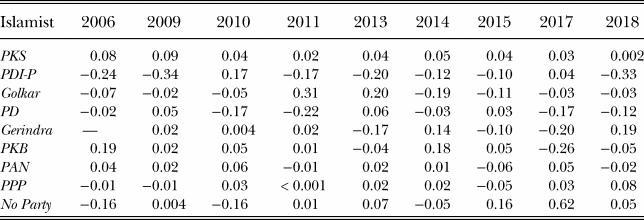
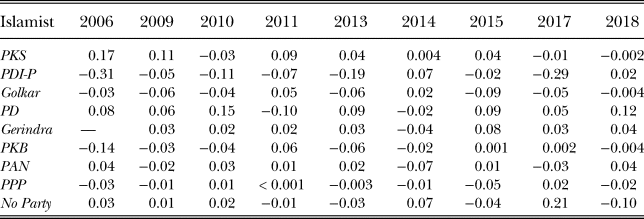
Tables 7 and 8 present the more precise trend of the shift in party preferences of Indonesian Muslims in accordance with their Islamist orientation and educational attainment during PKS's normalization period. Table 7 shows that Islamist electorates, who previously dispersed attachments toward Islamic parties and certain nationalist parties like PD, had become increasingly willing to choose Gerindra. Yet, the converging voting patterns seem fluid, meaning that Islamists’ intention to vote for Gerindra has only existed during periods of national electioneering. Otherwise, they tended to abstain from attaching themselves to parties in the existing system. This finding resonates with Mietzner and Muhtadi's (Reference Mietzner and Muhtadi2018, 488–489) analysis on the fluidity in the voting behavior of the supporters for the Indonesian Defenders’ Front (FPI), the largest Islamist organization recently banned by the government. Interestingly, contrary to PKS, a segment of Islamist voters started supporting PPP. This seems to be mainly attributed to the party's reassertion of Islam alongside the waning factional conflict under the chairmanship of Muhammad Romahurmuziy, a great-grandson of the NU founder and backed by conservative and senior figures of NU.Footnote 21 Similarly, as indicated in Table 8, educated Muslims, the original component of PKS's voter base, have begun supporting other such parties as PD and Gerindra since 2009. It is worth noting that their eroding support for PKS became evident in the five-year period between 2009 and 2014, when the party suffered a series of major corruption scandals.
Discrete Changes in the Predicted Probability of Party Support (observed min → max values of the Islamist variable)

Discrete Changes in the Predicted Probability of Party Support (observed min → max values of the Education variable)

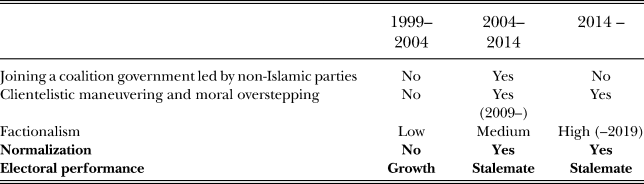
In all, as summarized in Table 9, PKS's electoral stalemate is associated not with moderation per se but with the party's increasing normalization. The party's grassroots activism that downplays Islamic idioms has successfully built its own support base that cuts across socioeconomic divisions. As a result, the size of the party membership has grown threefold within the last fifteen years, from approximately 500,000 in the mid-2000s to 1.5 million presently.Footnote 22 Furthermore, as shown in the 2019 elections, PKS also benefited from riding on Prabowo's coattails. However, as PKS cadres have become accustomed to their leadership's lowered ethical standards, office-seeking motives, and factionalism of much of Indonesia's political elite, the party's reformist and puritanical image started being tarnished. In particular, a series of major corruptions and moral overstepping disclosed in the period spanned from the elections in 2009, notably the Beef-gate in 2013, generated a public outcry against PKS, and eventually triggered a vote shift of educated Islamists from PKS to party alternatives in subsequent elections (Umam et al. Reference Umam, Whitehouse, Head and Khan2020, 134; Hadiz and Robison Reference Hadiz and Robison2013, 35–36). Its normalization, in turn, has diminished the positive effects of its moderation and the broadening of its range of supporters, because the party's original constituency switched to party alternatives. Despite its recent conservative turn and participation in an opposition coalition, PKS has not been able to regain the confidence of educated Islamist voters.
Trends of PKS Normalization and Electoral Performance

CONCLUSION
PKS's political trajectory in the Indonesian electoral arena implies that using a single framework of moderation may produce deficiencies in terms of understanding more complicated electoral challenges that Islamist parties face. Islamists form political parties to realize their goals in the electoral arena, but their initial ideological positions are often distant from those of median voters. For this reason, moderation seems to be a sensible, superior strategy. This Downsian logic also seems appropriate for implementation in Indonesia, where an absolute majority of Indonesian Muslims have embraced a pluralistic understanding of Islam under highly syncretized cultural underpinnings. After experiencing a poor showing in the first election in 1999, PKS deemphasized its Islamist aspiration to appeal to a broader constituency in Indonesian Muslim society. As the surprising result in the 2004 legislative election suggests, the party's ideological shift was successful. Nevertheless, PKS's electoral results then stagnated, calling into question the reliability of moderation as a sole factor for determining electoral support for the party.
In this article, I thus have sought to conceptually separate notable changes in Islamists participating in formal politics, particularly the adaptation to extant practices and behavioral orientations among political elites, from other forms of moderation by collectively describing them as normalization. Based on individual-level survey data collected across multiple years up until most recently, I later delineated and differentiated the impact of normalization from that of moderation on the electoral support for PKS. The statistical analysis reveals that while more socioeconomically heterogeneous Muslims with more tolerant views on Islam increasingly started voting for the party, its original electoral base of educated Muslim voters influenced by Islamism gradually withdrew its support. By exploring the sequence of events in PKS's recent past, I found that normalization rendered PKS electorally less successful in securing political support from reform-minded educated Islamist voters than its alternatives, notably PD and Gerindra. My statistical analysis also shows that PKS has been unable to reclaim these voters, despite its recent rapprochement with conservative and radical Muslim organizations. Rather, I concluded that the positive impact of moderation on increasing the electoral clout of Islamist parties seems to have been offset by normalization.
Empirical findings from this study are applicable to understanding other Islamist parties in the Muslim world, which have experienced a decline in electoral appeals to Islamist voters. Consider the Tunisian Ennahda. After winning a plurality of votes in the country's first-ever democratic general election in 2011, Ennahda has continuously formed a coalition government with such secular parties as the Congress for the Republic to appease non-Islamist voters’ growing suspicion of Ennahda's hidden radical agenda (Boubekeur Reference Boubekeur2016, 113–114). Party leadership also displayed considerable behavioral inclusivism and accommodation toward the political elite of the former authoritarian regime, as manifested in its tacit support for Béji Caïd Essebsi, the former House speaker and the leader of the reactionary Nidaa Tounes party, in the 2014 presidential election (McCarthy Reference McCarthy2018, 380). In turn, Ennahda's normalization drive evoked widespread discontent among dakwah activists and Islamist voters who defended the party's original revolutionary cause. Their dissatisfaction developed into a factional conflict in 2016, when the Ennahda chairman Rached Ghannouchi, officially proclaimed the party's transformation from an Islamist to a Muslim democrat party. Subsequently, many hard-liners defected and joined the Dignity Coalition formed in early 2019 by Seifeddine Makhlouf, who is allegedly associated with radical Islamist groups that have denounced Western-style liberal democracy.Footnote 23 The effects of Ennahda's normalization on shifting preferences of Islamist voters were profound: its vote share continuously decreased from 34.8 percent in 2011 and 26.5 percent in 2015 to 19.6 percent in 2019. In contrast, notwithstanding its shortage of time and resources for campaigning, the Dignity Coalition performed relatively well and became the fourth largest party in 2019.
This study also implies that it is necessary for PKS and other Islamist parties that pursue moderation to make greater efforts to secure support from their original party base. This is what the PKS leadership failed to do. Voters abandoned PKS not only because of its normalization but also because of the decline in the party's reform-oriented image of religious piety and doggedness to change Indonesian society. Because corruption scandals and opportunistic political maneuvering have been regular features of Indonesian political parties, one can argue that the withdrawal of the original PKS base was also caused by the party's loss in maintaining its own distinctiveness. The arguments in this article are thus in line with those in previous studies on moderation of Islamist parties that show that pragmatism, opportunism, and shifts in positions toward that of centrist parties diminish the parties’ electoral incentives (Tomsa Reference Tomsa2012, Hwang Reference Hwang, Mecham and Hwang2014).
Finally, this study's findings suggest that future research could lead to a sharper understanding of voter discontent vis-à-vis the electoral rise and stagnation of new parties in young democracies. Previous research has indicated that disappointment with existing parties and the political system is a main factor that contributes to a new party's formation and development (Tavits Reference Tavits2008). It was also Indonesian Islamists’ discontent with the social and political status quo that mobilized them as supporters of PKS and drove the party's meaningful electoral progress in the early 2000s. However, as the subsequent withdrawal of the original PKS base demonstrates, new party voters can be capricious, and swiftly can find alternatives if their disappointment cannot be appeased by available political choices. Based on the experience of PKS, one can assume that generalized voter discontent is not always advantageous for the electoral performance of new parties. What seems to matter more is whether and how the party can transform disappointment into sustainable party loyalty.
SUPPLEMENTARY MATERIAL
The supplementary material for this article can be found at https://doi.org/10.1017/jea.2021.21.
ACKNOWLEDGEMENTS
I would first like to thank Jamie S. Davidson for his insights and invaluable academic guidance. I am also grateful to Subhasish Ray, Risa J. Toha, Stephan Haggard, and anonymous reviewers for their helpful suggestions and comments. All errors are mine alone.
CONFLICTS OF INTEREST
The author declares none.