1. Introduction
The human rights treaty bodies (HRTBs or treaty bodies) stand as professional organs, in contrast to the political organs of the United Nations (UN), which include the General Assembly, the Security Council and the Human Rights Council. They consist of independent experts who are nominated by their own countries, and are directly elected for fixed renewable terms of four years by the states parties to the ten core international human rights conventions. Nomination is based on their recognised competence in human rights in general and in the particular area of the relevant convention. Their main task is to monitor the core international human rights conventions and oversee their implementation, by considering the periodic reports submitted by states parties, considering individual complaints, conducting country inquiries (by those Committees entrusted with this power) and the adoption of general comments on the interpretation of treaty provisions.Footnote 1
A key element in the operation of the HRTBs is their unbiased and neutral treatment of all states parties to the relevant convention. This can be achieved only by ensuring the independence and impartiality of the treaty body members, as was recently emphasised in the ‘Guidelines on the Independence and Impartiality of Members of the Human Rights Treaty Bodies' (the Addis Ababa Guidelines), adopted by the Chairs of the HRTBs at their annual meeting in June 2012 and endorsed by the General Assembly in April 2014.Footnote 2 The Guidelines state,Footnote 3 inter alia, that
[t]he independence and impartiality of members of the human rights treaty bodies is essential for the performance of their duties and responsibilities and require that they serve in their personal capacity. Treaty body members shall not only be independent and impartial, but shall also be seen by a reasonable observer to be so.
We would like to take this as a brief background to a question that seems to intrigue anybody who is familiar with the treaty bodies system as well as with the ‘special treatment’ that Israel is allegedly accorded by the political UN entities:Footnote 4 can this ‘special treatment’ also be discerned within the treaty bodies system? Is there any basis for claiming that politics overcome professionalism when it comes to Israel's encounter with the HRTBs? Within the UN's general functions, especially at the level of the Security Council or the Human Rights Council, the alleged ‘special treatment’ is reflected in the disproportionality in dealing with Israel compared with other countries that carry out human rights violations.Footnote 5 What would be a possible equivalent treatment within the realm of the HRTBs' work?
To examine this question, we must first address the functions of the HRTBs and identify potential avenues for political treatment. One such area could be in the considerations of individual complaints, which some of the treaty bodies are empowered to do. Under this mechanism, any individual who claims a violation of rights under the relevant treaty by a state party to that treaty may bring a communication before the relevant Committee, provided that the state recognises the competence of the Committee to receive such complaints and domestic remedies have been exhausted.Footnote 6 Israel, however, did not join any of the optional protocols to the conventions that established the individual complaints mechanism, so there is nothing to examine here.Footnote 7
So we then come to the examination of the main function of the HRTBs: consideration of the states parties' reports.Footnote 8 On becoming a party to a human rights treaty, a state assumes the obligation to report periodically to the treaty body on the implementation of the treaty in its territory. The treaty body, as the monitoring mechanism on implementation, assesses the situation in the reporting state, and issues concluding observations, which are basically a set of recommendations that the state party is asked to instigate in order to improve its compliance with the treaty's provisions.
The reporting process is a cycle that begins with the state's submission of a formal report, to which the treaty body responds with a list of questions for the purposes of refinement and clarification, and schedules a date for conducting a dialogue with the state party. The state supplies its answers to the list of questions before this dialogue and, together with the report, they form the basis for the constructive dialogue between the treaty body and the state party. The dialogues are conducted with the state's representatives, usually in the form of high-level delegations, with the aim of discussing all aspects of implementing the treaty in the state. Obviously, not all of the state's official reports or answers are fully exhaustive or reliable, and treaty bodies seek information from other sources, such as UN institutions and international organisations. Within this realm, civil society plays a primary role. Domestic non-governmental organisations (NGOs) and civil society organisations (CSOs) submit what are known as ‘alternative’ or ‘shadow’ reports to those submitted by the governments. The information provided in these reports is usually perceived as independent and unbiased. HRTBs regularly rely on these reports in their attempt to formulate an accurate and complete appraisal of the situation. NGOs are involved in the reporting process throughout the cycle, and often meet with the treaty body members in correspondence to the dialogue. The concluding observations that result from the reporting process present a summary of the review, and serve as a reference point for the next reporting cycle.Footnote 9
In determining whether bias can be ascertained in the Committee's handling of Israel under this exercise, we suggest that the concluding observations at the end of the consideration of each state party's report should be examined. Bias could be implied if, for instance, conflict-related issues carry what seems to be a disproportional weight in the concluding observations. We are aware that the proportionality criterion is subjective, and what might constitute disproportionality to some could be entirely acceptable to others based, inter alia, on the severity of the alleged human rights violations. Moreover, the significant weight given to Israel's policies in the occupied territories could be a mirror reflection of Israel's lack of reporting on treaty implementation in those territories, in light of its formal position that the treaties do not apply extraterritorially.Footnote 10 Nevertheless, a critical view of the HRTBs based on perceived disproportionality is still occasionally expressed in closed circles,Footnote 11 and is taken as another expression of the notorious ‘special treatment’ referred to above. Our aim in this article is twofold. We first wish to see whether the significant weight given to conflict-related issues is factually grounded. If that is the case, we suggest another explanation for this phenomenon – one that is more technically oriented in building upon the formal elements of the reporting exercise.
Thus, we suggest that the concluding observations should be taken as the ‘output’. This output should be quantitatively and qualitatively analysed. Furthermore, the output should be viewed in light of the ‘input’ of this exercise to see whether there is a link between the two. The input comprises many sources. First and foremost, it includes the state parties' official reports and their replies to the list of questions and issues.Footnote 12 Reports by UN agencies and by national human rights institutions are then added. For the purpose of this study, more significant is the information received from civil society organisations, international and local, referred to as ‘alternative’ or ‘shadow’ reports. As civil society generally has a large role in the outcome of the reporting exercise, these alternative reports considerably influence the concluding observations. In another ongoing research exercise conducted by the authors, a clear link was found between the concluding observations of the Committee on the Elimination of Discrimination against Women (CEDAW) and the information provided to it by civil society organisations.Footnote 13
2. Research Methodology
To pursue this research avenue, we studied consideration by the HRTB Committees of Israel's six most recent periodic reports:
• Human Rights Committee (HRC);
• CEDAW;
• Committee on Economic, Social and Cultural Rights (CESCR);
• Committee on the Elimination of Racial Discrimination (CERD);
• Committee on the Rights of the Child (CRC); and
• International Covenant on Civil and Political Rights (ICCPR).Footnote 14
As is the case with most states, Israel is not a monolithic political entity, and any examination of its human rights policy and reality must take into consideration the different segments of its society. In the reporting framework of the HRTBs this is often reflected in separate alternative reports which specifically represent the experience of the various groups. In the case of Israel, an additional factor weighs in – namely, the unresolved conflict and Israel's ongoing control over the occupied territories. Thus, we identified four distinct population groups, each of which is situated differently both within Israel's human rights framework, and in relation to the treaty bodies' reporting mechanism. These are:
• the general Israeli population (both Jewish and non-Jewish);
• the non-Jewish Israeli population;
• refugees and asylum seekers; and
• the Palestinian population in the occupied territories.Footnote 15
For each group we identified those alternative reports that addressed its particular situations and concerns, and quantified them (with respect both to the number of reports and their volume, which may also be seen as implicating their breadth and depth). Having examined the input side of the process, we turned to the output, namely the concluding observations (COBs). For each of these reports, we distinguished between the four target population groups which the COBs addressed. We also graded the COBs according to the severity of the language used, and distinguished between ‘soft’ and ‘strong’ language. Soft language includes such terms as ‘calls upon’, ‘recommends’, ‘encourages’, ‘draws attention’, and similar. Strong language refers to where the Committee ‘urges’ the state party to act or to refrain from acting, or to ‘immediately’ do or refrain from doing something.Footnote 16 The purpose of this exercise was to learn whether, as is often argued, disproportional attention is accorded to the Palestinian population in the occupied territories, and also whether the Palestinian–Israeli conflict overshadows all other matters within the work of the treaty bodies. However, the full picture can be ascertained only following an analysis of a possible correlation between the input and the output sides of the process.
3. Findings and Discussion
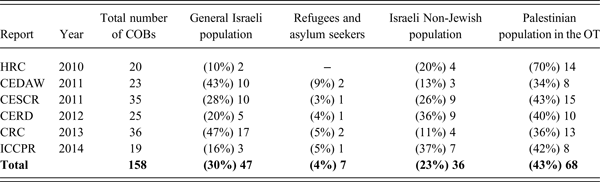
Since this research set out to investigate whether a form of ‘special treatment’ can be claimed within the treaty bodies system with respect to Israel, in the form of heightened or even disproportionate weight given to conflict-related issues, we will start with presenting the end result of the reporting exercise, namely the concluding observations. Tables 3.1 and 3.2 appear to show a clear pattern of the HRTBs' main focus regarding Israel.
Distribution of Concluding Observations by Target Groups

Note: The numbers have been rounded.
Distribution of Concluding Observations by Target Groups and Language
Table 3.1 merely shows the distribution of the concluding observations (COBs) among the four population groups and, even from this simple counting exercise, the focus on the Palestinian population in the occupied territories is evident: a total of 43 per cent of the COBs addresses them, compared with a total of only 30 per cent for the general Israeli population (Jews and non-Jews) generally. There could be many reasons for this uneven distribution, clearly unrelated to the respective sizes of the population groups. Palestinians in the occupied territories are disenfranchised persons who are not represented in the political branches of the reporting state. It could be expected that they would receive more attention. However, if that were the only reason, we may not have witnessed such significant variations between the treaty bodies themselves. While the average rate of COBs addressing Palestinians in the occupied territories is 44 per cent, and out of the total number of all COBs given to Israel since 2011 they comprised 43 per cent, the Human Rights Committee clearly stands out: in 2010 it targeted 70 per cent of its COBs at the Palestinian population in the occupied territories.
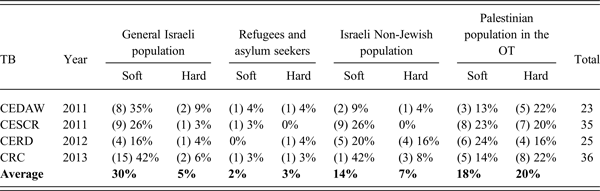
However, what Table 3.2 shows is even more notable. In this table we distinguished between two types of COB, according to the strength of the language used (CCPR COBs were not categorised since the Human Rights Committee uses the same language throughout its COBs).
This table shows a clear distinction between the nature of the concluding observations directed at the general Israeli population, and those directed at the Palestinian population in the occupied territories. The former use mostly soft language, such as when the Committee ‘encourages’ or ‘recommends’, while the latter use equally soft and strong language (such as ‘urges’ and ‘immediately requests’). Even more interesting is Figure 3.1, which suggests a correlation between soft language used for the general population and strong language used for the Palestinian population: it seems that a high rate of soft COBs towards the general population correlates with a relatively high rate of strong COBs addressing the Palestinian population.
Relationship between Types of Concluding Observation and Target Groups
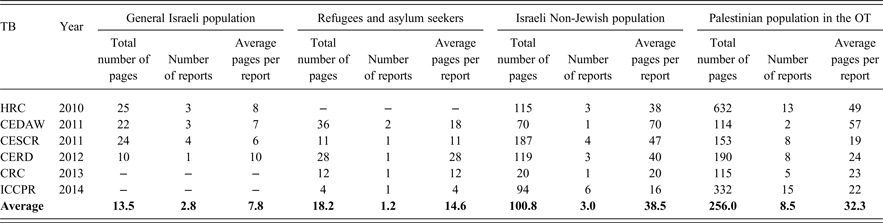
Once again, one could think of a number of reasons to explain these findings, including the severity of violations leading to the varying strength of the concluding observations. However, as explained above, examination of the output (the COBs) alone is misleading. A serious study of the HRTBs' work must take into consideration the input (the alternative reports) as well as the output. When this is done, the picture changes. Table 3.3 presents several attributes of the alternative reports that were available to the treaty bodies in their consideration of Israel's reports, both in terms of quantity (number of reports and overall number of pages addressing each population group) and quality (volume of each report as a partial indication of its breadth and depthFootnote 17).
Distribution of Alternative Reports by Target Groups
The differences in the volume and nature of the information that was available to the treaty bodies with respect to the four population groups are striking. The total number of pages dealing with the Palestinian population in the occupied territories was almost 20 times higher than those addressing the general Israeli population. Furthermore, while the volume of information relating to the non-Jewish population was approximately one-third of that concerning the Palestinians, it was still 7.5 times more than that in respect of the general Israeli population. This pattern remains consistent when examining the actual number of reports addressing each of the groups that were available to the Committees, and when reflecting upon the quality of those reports as partially indicated by the average number of pages in each report.
This, we believe, puts the first impression obtained from the concluding observations in a completely different light. Notwithstanding the limits of this study in terms of the lack of feasible statistical analysis, a tentative explanation for Israel's experience with the HRTBs can be offered. The correlation between the relatively heavier weight accorded to the Palestinian population in the occupied territories on the input side of the exercise (the alternative reports) and the output side (the concluding observations) can hardly be disputed. The same pattern can be discerned with respect to the two other specific population groups, and the same applies when examining the differences in the severity of the concluding observations. Thus, what might at first sight be perceived as support for the alleged bias in the HRTBs' treatment of Israel, in light of the seemingly disproportional weight they accord to the conflict, eventually turns out to be at least partially influenced by the information and materials provided to the Committees. Even if it does not explain all aspects of the treaty bodies' differential focuses, we believe that the correlation that we found between the input and the output sides of the process seriously questions the alleged ‘special treatment’ the HRTBs accord Israel. At the very least, it offers another explanation of the treaty bodies' choice of focus and approach – one that is rather devoid of value judgments, political considerations and alleged bias.