The uncommon Jervell and Lange-Nielsen SyndromeReference Jervell and Lange-Nielsen 1 is characterised by congenital hearing loss, prolongation of the QT interval, and a high risk of developing life-threatening ventricular tachyarrhythmia.Reference Schwartz, Spazzolini and Crotti 2 , Reference Goldenberg, Moss and Zareba 3
The Jervell and Lange-Nielsen Syndrome is caused by homozygosity or compound heterozygosity for mutations in the KCNQ1 or KCNE1 genes, coding for subunits that co-assemble into a voltage-gated potassium ion channel.Reference Splawski, Timothy, Vincent, Atkinson and Keating 4 , Reference Tyson, Tranebjaerg and Bellman 5 The majority of the causative mutations affect the KCNQ1 gene.Reference Schwartz, Spazzolini and Crotti 2
Clinical description of the Jervell and Lange-Nielsen Syndrome has historically focused mainly on the effects on hearing and heart rhythm; however, several cases of unexplained iron-deficiency anaemia have been reported.Reference Fraser, Froggatt and Murphy 6 – Reference Tranebjaerg, Bathen, Tyson and Bitner-Glindzicz 9 Taking into account the fact that the potassium ion channel encoded by the KCNQ1 gene in addition to regulating the electrical signalling in the heart and the endolymph flow in the cochlea of the inner ear also uphold electrolyte homeostasis in several epithelial tissues in organs such as the kidneys, lungs, placenta, and gastrointestinal tract,Reference Jespersen, Grunnet and Olesen 10 it is plausible that further symptoms could be associated with the disorder.
There has been increasing evidence regarding the importance of KCNQ1 function for normal gastric acid secretion,Reference Song, Groos and Riederer 11 – Reference Grahammer, Herling and Lang 14 and recently data on three Jervell and Lange-Nielsen cases with elevated gastrin levels, a marker of impaired gastric acid secretion, were presented.Reference Rice, Dickson and Lane 15
We present data exploring the possible relationship between congenital impaired KCNQ1 function, iron-deficiency anaemia, gastrointestinal symptoms, and signs in Swedish patients with genotype-ascertained Jervell and Lange-Nielsen Syndrome.
Materials and methods
All genotype-ascertained Jervell and Lange-Nielsen cases with KCNQ1 mutations of Swedish descent were included in the study. Cases were identified via a national inventory of clinical Jervell and Lange-Nielsen cases – inclusion criteria were congenital hearing loss and QT prolongation – and genotypes were ascertained at the Laboratory of Clinical Genetics, Umeå University Hospital, Umeå, Sweden. 16 The mutation spectrum consisted of eight KCNQ1 mutations, all previously reported,Reference Tyson, Tranebjaerg and Bellman 5 , Reference Tranebjaerg, Bathen, Tyson and Bitner-Glindzicz 9 , Reference Chouabe, Neyroud and Richard 17 – Reference Wei, Fish, Myerburg, Roden and George 23 the identification of which in the Swedish families constituted the first reported association with the Jervell and Lange-Nielsen Syndrome for four of the mutations. 16
Clinical data, including results of previous medical investigations regarding gastrointestinal symptoms and/or iron-deficiency anaemia, were collected from full medical records. An extensive semi-structured interview was performed in all Jervell and Lange-Nielsen families. 16
All participants were offered laboratory-based blood tests screening for anaemia, gastric mucosal function, and unspecific inflammatory reaction in the gastrointestinal tract. Blood samples were collected and analysed locally according to standard laboratory protocols. Standard age-stratified clinical cut-offs for normal values were used. Analysis of levels of haemoglobin (gram per litre, age- and gender-specific normal values), mean corpuscular volume (femtolitre, normal 76–100), and levels of vitamin B12, iron, and ferritin in blood serum was performed. Gastrointestinal markers included gastrin, pepsinogen, and calprotectin. Fasting levels of gastrin (picomole per litre, normal below 60) and pepsinogen (microgram per litre, normal 30–130) in blood serum were analysed as a proxy for gastric mucosal function. A faecal sample was collected and analysed for amounts of calprotectin, an unspecific marker for gastrointestinal tract inflammation (milligram per kilogram, normal below 50, borderline 50–100).
Biopsy specimens received from endoscopic examinations were stained and examined in clinical routine pathology at the local clinical pathology department.
Statistical analysis was performed using the Mann–Whitney U-test for comparison between numerical and nominal variables and the Chi-square test for comparison between nominal variables. Correlations were explored using Fisher's exact test. A p-value below 0.05 was considered statistically significant.
A signed informed consent to participate in the study, and to publish prints of endoscopic images/biopsy material, was obtained from cases or their legal guardian. The study was approved by the Regional Ethical Review Board, Umeå University, Umeå, Sweden.
Results
A total of 14 Jervell and Lange-Nielsen cases from 12 Swedish index families were included in the study, seven of the homozygous genotype and seven of the compound heterozygous genotype. In all, 11 cases had the p.R518X mutation on at least one allele, and documented geographic clustering of alleles suggests that the common occurrence of the p.R518X allele is secondary to a founder effect. 16 Among the 14 cases, there were nine female and five male patients. The mean age in all cases was 31 years and the standard deviation 24 years – the median 31 years and the range 5–88 years, including six paediatric cases.
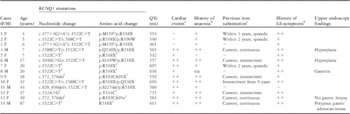
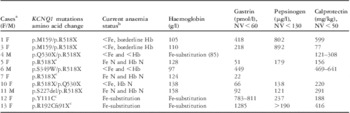
The clinical characteristics, genotype, and the main findings are summarised in Tables 1 and 2.
Clinical characteristics, including cardiac phenotype, history of anaemia, iron substitution, gastrointestinal symptoms, and findings, in 14 Jervell and Lange-Nielsen cases.

F = female; GI = gastrointestinal; M = male; n/a = not available; NV = normal values; QTc = QT interval corrected for heart rate (QT/√RR); yrs = years
aCardiac events: –, no cardiac events; +, syncope only; and ++, verified fast ventricular tachycardia, ventricular fibrillation or aborted cardiac arrest
bAnaemia defined as a low haemoglobin concentration for age ± low plasma levels of iron: +, sporadic; ++, recurrent or therapy-resistant; and –, no anaemia
cSubscribed iron substitution before current testing
dReported GI symptoms: ++, recurrent or severe; +, mild to moderate; and –, no GI symptoms
eResulting in a splice error
fHomozygous mutation carrier
Relationship between genotype, current anaemia status, and gastrointestinal markers in 10 JLNS cases.
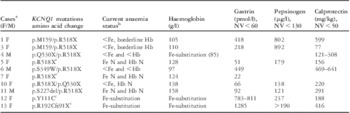
F = female; JLNS = Jervell and Lange-Nielsen Syndrome; M = male; NV = normal values
aCases are numbered in accordance with Table 1
bAnaemia defined as a low haemoglobin concentration for age (<Hb) ± low plasma levels of iron (<Fe) or continuous prescribed iron substitution
cHomozygous mutation carrier
Anaemia – symptoms/signs and treatment
There were 12 cases with a previous history of anaemia (Table 1). In two cases, that is, Cases 3 and 11, a low haemoglobin count was noted in childhood, although no therapy was prescribed. Among the other 10 cases, three, four, and three cases, respectively, had a history of sporadically, intermittently, or continuously prescribed oral iron substitution on the basis of iron-deficiency anaemia. Case 8 had no record of anaemia testing, but his parents reported marked pallor since childhood and less energy than his peers.
Gastrointestinal symptoms and investigations
Subjective symptoms localised to the gastrointestinal tract were reported in 13 of 14 cases (Table 1). Perceived symptoms ranged from relatively mild – gases, loose or hard stools, frequent defecation, abdominal pains – to severe – persistent diarrhoea, recurrent abdominal pains). A previous positive faecal haemoglobin test was found in four cases, that is, Cases 1, 4, 13, and 14. Among the clinical gastrointestinal investigations that the cases had participated in, three cases had undergone upper and lower endoscopy and two cases had undergone upper endoscopy only. There was one case of gastritis, that is, Case 8, two cases of hyperplasia of the duodenal or gastric mucosa, that is, Cases 4 and 6, and one ventricular tumour, that is, polypous adenocarcinoma in Case 14. No case of gastrointestinal bleeding, inflammatory bowel disease, or coeliac disease was identified. Coeliac disease was investigated and excluded in two cases by use of disease-specific antibodies only, that is, Cases 1 and 12, and in three cases lactose intolerance was suspected but not verified, that is, Cases 1, 8, and 12.
Current laboratory test results
At current testing, signs of iron-deficiency anaemia – overt iron-deficiency and/or low haemoglobin count for age or current prescribed iron substitution – were present in 9 of 12 tested cases. One or more of the gastrointestinal markers were elevated in 9 of 10 tested cases (Table 2). Fasting levels of gastrin were elevated in seven of nine tested cases (mean 379 picomols per litre, standard deviation 426, median 218, normal below 60) and pepsinogen levels were elevated in six of seven tested cases (mean 366 micrograms per litre, standard deviation 332, median 190, normal below 130). Faecal calprotectin was elevated in all nine tested cases (mean 322 milligrams per kilogram, standard deviation 195, median 291, normal below 50, Table 2).
There was no significant difference in the levels of gastrin, pepsinogen, or calprotectin between the sexes or between homozygous and compound heterozygous cases; however, gastrin levels were lower in cases with the R518X mutation on at least one allele (188 picomols per litre, standard deviation 179 versus 1048 picomols per litre, standard deviation 335, p-value 0.04). Gastrin levels were significantly higher in cases with concurrent anaemia (541 picomols per litre, standard deviation 442 versus 55 picomols per litre, standard deviation 35, p-value 0.039, and correlation coefficient 0.756). All cases with current signs of anaemia and available test results presented with elevated gastrointestinal markers (Table 2).
Case reports
Below we present a selection of case reports. Cases are numbered according to age, from the youngest to the oldest case, and in accordance with Tables 1 and 2.
Case 1
Presented with a history of diarrhoea and loose stools, and severe iron-deficiency anaemia (haemoglobin count 73 grams per litre, mean corpuscular volume 64 femtolitres) in relation to cochlear implantation at 2 years of age. Investigations revealed positive faecal haemoglobin and absence of coeliac disease-specific antibodies. Current testing revealed haemoglobin levels bordering on low, depleted iron reserves (haemoglobin count 105 grams per litre and plasma iron 7 micromols per litre), and elevated gastrointestinal markers.
Case 4
Presented with a history of frequent diarrhoeas and severe iron-deficiency anaemia (haemoglobin count 72 grams per litre, mean corpuscular volume 59 femtolitres) in relation to cochlear implantation at 6 years of age. The anaemia remained persistent in spite of continuous oral iron substitution and later intermittent iron infusions and a blood transfusion. Tests for faecal haemoglobin were positive at anaemia diagnosis. Repeated faecal calprotectin tests have shown elevated levels (121–308 milligrams per kilogram). Upper endoscopy was performed at 7 years of age and revealed no signs of coeliac disease but found nodular hyperplasia of the duodenal bulb mucosa. No biopsy was collected from the ventricular mucosa.
Case 6
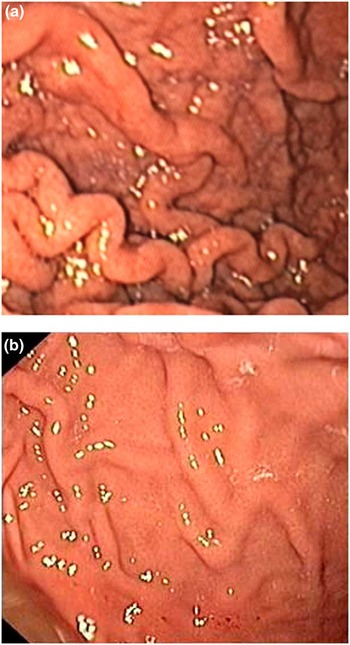
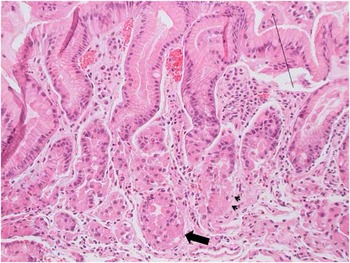
Presented with recurrent, diffuse abdominal pains and iron-deficiency anaemia at 17 years of age (haemoglobin count 97 grams per litre, mean corpuscular volume 64 femtolitres). Investigations revealed no faecal haemoglobin, but elevated faecal calprotectin levels at repeated testing (641, 469, and 367 milligrams per kilogram) and elevated gastrin levels (449 picomols per litre). Lower endoscopy including distal ileum with multiple biopsies revealed normal macro- and microscopic findings excluding inflammatory bowel disease. Gastroduodenoscopy revealed a macroscopic hypertrophy of the antral and fundic mucosa and a mild gastritis (Fig. 1). Microscopically, the fundic mucosa showed a general derangement of parietal cell morphology, including hyperplasia, but also degeneration of parietal cells. Moreover, a somewhat increased number of immune cells were present (Fig. 2).
Endoscopic photographic images from Case 6 (above) revealing hypertrophic rugal folds in the corporal and antral part of the stomach, and from a healthy control (below).

Biopsy tissue material derived from the fundic mucosa of Case 6 is shown (20 times objective magnification). A deranged parietal cell histology is evident including hyperplasia (bold arrow), but also degeneration of parietal cells (arrow heads). In addition, a slight increase in chronic inflammatory cells is noted in the lamina propria. An increased amount of exfoliated parietal cells is seen at the luminal border (thin arrow).

Case 13
Presented with iron-deficiency anaemia at 2.5 years of age. The anaemia remained therapy resistant during childhood and the case remains on continuous iron substitution. Investigations in adulthood revealed positive faecal haemoglobin at repeated testing, iron depletion on bone marrow assessment, absence of coeliac disease-specific antibodies, and concomitant vitamin B12 deficiency – non-dependent on intrinsic factor deficiency, according to the Shilling test. Upper endoscopic investigation, including biopsies from the duodenum only, revealed no signs of overt gastrointestinal bleeding or coeliac disease. Lower endoscopy including the distal part of the ileum revealed no signs of inflammatory bowel disease, polyps, or malignancy. Gastrointestinal markers were grossly elevated at current testing.
Case 14
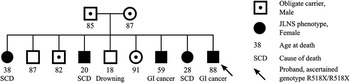
Presented with iron-deficiency anaemia at 78 years of age and remained on continuous iron substitution and iron infusions for the rest of his life. Investigations revealed positive faecal haemoglobin, iron depletion on bone marrow assessment, and absence of vitamin B deficiency. An upper endoscopy excluded coeliac disease diagnosis but detected a polypus ventricular tumour, an adenocarcinoma. After 10 years, he died from metastasised cancer, at 88 years of age. Furthermore, Case 14 had a congenitally deaf brother, with recurrent syncopal attacks during childhood and clinical Jervell and Lange-Nielsen diagnosis; his arrhythmia tendencies ameliorated with age, but he died from a gastric carcinoma at 59 years of age (Fig. 3).
Pedigree illustrating nine siblings, of whom five had clinical Jervell and Lange-Nielsen Syndrome, and their parents, including age and cause of (untimely) death. Obligate carriers have offspring with ascertained carrier-ship of the R518X mutation. The proband is Case 14, homozygous for the R518X mutation. JLNS = Jervell and Lange-Nielsen Syndrome; GI = gastrointestinal; SCD = sudden cardiac death.

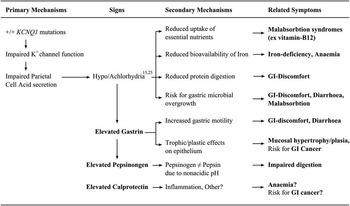
A hypothesis of the association between the Jervell and Lange-Nielsen genotype and the found phenotype, including iron-deficiency anaemia and gastrointestinal symptoms and signs, is presented in Figure 4.
Proposed hypothesis of how the Jervell and Lange-Nielsen genotype could result in gastrointestinal signs and symptoms, including iron-deficiency anaemia. Related symptoms or signs reported/verified in this study are depicted in bold. GI = gastrointestinal.

Discussion
In Swedish Jervell and Lange-Nielsen cases with KCNQ1 mutations, we found a high frequency of previous and current iron-deficiency anaemia, gastrointestinal symptoms, and elevated levels of gastrin, pepsinogen, and calprotectin. Endoscopic findings included hypertrophy and hyperplasia of the gastrointestinal mucosa, and a polypous gastric tumour. A significant correlation between concurrent iron-deficiency anaemia and elevated gastrin levels was seen, and in no case was anaemia present without elevated gastrointestinal markers.
We propose that our findings can be explained by a primary loss of normal gastric acid secretion caused by homozygous or compound heterozygous mutations in the KCNQ1 gene (Fig. 4). KCNQ1-encoded potassium channel function has been shown to be essential for gastric acid secretion, through maintaining an adequate luminal potassium ion concentration for the gastric hydrogen potassium proton pumps found in the apical parietal cells of the gastric mucosa.Reference Song, Groos and Riederer 11 The loss of functional KCNQ1-encoded potassium channels in the Jervell and Lange-Nielsen Syndrome could cause gastric hypo/achlorhydria,Reference Takagi, Nishio and Yagi 12 , Reference Rice, Dickson and Lane 15 , Reference Lee, Ravenel and Hu 24 secondary iron-deficiency anaemia, and elevated levels of gastrin.
Hypo/achlorhydria, hypergastrinaemia, and secondary effects
An acidic gastric pH is required for normal uptake of basic electrolytes and vitamins – such as vitamin B12 – and achlorhydria in itself may cause malabsorption syndromes. The association between gastric acidity and iron-deficiency anaemia has been long known.Reference Baird and Wilson 25 , Reference Baird, Blackburn and Wilson 26 Specifically, the bioavailability of non-heme iron is dependent on gastric acidity both for liberating iron ions from ingested foods and to keep iron ions in the soluble and thereby absorbable ferrous form.Reference Schade, Cohen and Conrad 27 , Reference Conrad and Schade 28 Furthermore, protein digestion is inhibited by hypo/achlorhydria through reduced cleavage of the precursor protein pepsinogen into to the active form (pepsin A), which could result in gas and abdominal pains. 29 Low gastric acid levels are also associated with bacterial overgrowth that can manifest as diarrhoea, sometimes with concomitant malabsorption of essential nutrients and vitamins.
The hormone gastrin is produced by G cells in the antrum and duodenum. Gastrin release is stimulated by undigested foods in the stomach, whereas its production is primarily regulated by negative feedback via acidification of the gastric lumen. 30 In the case of hypo/achlorhydria, hypergastrinaemia ensues because of a lack of inhibitory feedback.
The hypergastrinaemia found in seven of nine tested cases could be of clinical significance by at least two different mechanisms. First, the stimulating effect of gastrin on gastrointestinal motility could be associated with gastrointestinal discomfort and diarrhoea. Second, gastrin precursors act as growth factors that regulate proliferation of epithelial cells in the stomach and other parts of the gastrointestinal tract.Reference Aly, Shulkes and Baldwin 31 – Reference Hansen, Pedersen, Larsen and Rehfeld 33 We propose that the trophic effects of gastrin cause the gastric and duodenal mucosal hyperplasia/dysplasia that was found in three Jervell and Lange-Nielsen patients.
Gross morphological abnormalities in affected tissues
There is previous evidence of the association between impaired KCNQ1-encoded potassium channel function and gross morphological abnormalities in affected tissues. Histopathological evidence of a marked structural degeneration and atrophy of the inner ear has been found in temporal bone from deceased Jervell and Lange-Nielsen patients and KCNQ1 knock-out mice.Reference Rivas and Francis 34 , Reference Friedmann, Fraser and Froggatt 35 Gastric mucosal hypertrophy, elongated glands, degeneration of parietal cell morphology, hypo/achlorhydria, and hypergastrinaemia, that is, complete loss of normal gastric mucosa morphology and function, were seen in adult KCNQ1 knock-out mice, and similar findings were observed in an adult with the Jervell and Lange-Nielsen Syndrome.Reference Rice, Dickson and Lane 15 , Reference Lee, Ravenel and Hu 24 , Reference Vallon, Grahammer and Volkl 36
In our study, evidence of hyperplasia and/or dysplasia was identified in three of five cases who had undergone endoscopic investigations, and might have been present but overlooked in the other cases where the clinical indication for endoscopy was suspicion of gastrointestinal bleeding/inflammatory bowel disease, in Case 13, and gastritis, in Case 8. A morphologically abnormal gastric mucosa, as seen in Case 6, with low-grade gastritis could be related to the elevated levels of calprotectin found in all tested cases and might also cause a leakage of red blood cells into the gastric lumen. The apparent chronic inflammation and loss of haemoglobin in stools found in seven cases could also be related to the therapy resistance of the anaemia frequently seen in the Jervell and Lange-Nielsen Syndrome.
Gastrin, inflammation, and gastrointestinal cancer risk
The role of the trophic hormone gastrin in the growth and development of different types of gastrointestinal cancer has been of increasing interest, and in vitro studies have linked gastrin to pathways affecting proliferation, cell-adhesion, and anti-apoptotic effects.Reference Ferrand and Wang 32
A gastrin level above 190 picomols per litre is associated with risk for developing enterochromaffin-like carcinoid tumours.Reference Modlin, Lawton and Miu 37 A synergistic association between hypergastrinaemia and Helicobacter pylori infections in increasing risk for developing gastric carcinomas was seen in a mouse model.Reference Wang, Dangler and Chen 38 Specifically, in a KCNQ1 knock-out mouse model, gastric hyperplasia, metaplasia, dysplasia, and pre-malignant adenomatous hyperplasia were observed independent of infection.Reference Elso, Lu and Culiat 39 Elevated levels of faecal calprotectin are associated with gastric cancer, and calprotectin has been identified as an amplifier of inflammation in cancer development.Reference Ehrchen, Sunderkotter, Foell, Vogl and Roth 40 , Reference Roseth, Kristinsson and Fagerhol 41
In our study, both ascertained KCNQ1 dysfunction, hypergastrinaemia (above 190 picomols per litre in five of nine tested cases), signs of chronic inflammation (elevated calprotectin in cases of all ages) and two cases of adenomatous ventricular tumours/cancer (two siblings) were present.
In a report by Rice et al in 2010, a homozygous Jervell and Lange-Nielsen female patient in her early 30s presented with iron-deficiency anaemia, achlorhydria, and gastrinaemia, and was diagnosed with multiple enterochromaffin-like carcinoid tumours. Histology revealed grossly hyperplastic parietal cells and a single nodal metastasis was identified. The condition was interpreted as secondary to chronic hypergastrinaemia on the basis of a primary acid secretion pump defect related to the patients’ KCNQ1 mutation.Reference Rice, Dickson and Lane 15
Clinical importance of gastrointestinal involvement
In this study, we found a high frequency of clinical symptoms related to gastrointestinal involvement, and also a high frequency of previously performed medical investigations including blood tests and endoscopy, indicating that the symptoms were not negligible. Endoscopy was more common in men, that is, four of five men versus one of nine women, and could possibly reflect that male gender is a risk factor for a more severe phenotype, as is the case regarding cardiac phenotype.
A significant correlation between concurrent iron-deficiency anaemia and elevated gastrin levels was found, and we propose the novel concept of a gastrointestinal cause of the iron-deficiency associated with the Jervell and Lange-Nielsen Syndrome.
In the Swedish cases, one mutation (p.R518X) accounted for 54% of the genotype, that is, 15 of 28 alleles; however, the p.R518X allele was associated with lower gastrin levels, suggesting that our gastrointestinal findings are not secondary to the high frequency of p.R518X alleles in the Swedish population.
Rice et alReference Rice, Dickson and Lane 15 hypothesised that elevated gastrin levels might correlate with arrhythmia severity in Jervell and Lange-Nielsen patients. This theory is particularly interesting since findings from knock-out mice suggest that impaired KCNQ1-encoded potassium channel function is associated with loss of electrolytes in the intestine, possibly affecting potassium ion homeostasis,Reference Vallon, Grahammer and Volkl 36 which in turn might affect arrhythmia susceptibility. We saw no correlation between gastrin levels and arrhythmia severity, symptomatic versus asymptomatic cases, p-value 0.77; however, the sample size is small. Although the majority of Jervell and Lange-Nielsen cases present with a severe cardiac phenotype, it could be hypothesised that periods of gastrointestinal aggravation could be related to an increased arrhythmia risk via the above mechanisms.
Rice et alReference Rice, Dickson and Lane 15 reported normal gastrin levels in 10 heterozygous KCNQ1 mutation carriers and suggested that the level of KCNQ1 function loss might influence gastrin levels and thereby cancer risk. In our study, a hyperplastic gastrointestinal mucosa was found already before 20 years of age in Case 6, a compound heterozygote with documented residual KCNQ1 function, that is, residual hearing. Analogous to that, it is possible that the gastrointestinal phenotype described here could be present in individuals with compound KCNQ1 mutations without hearing loss, a condition reported at least twice at least in compound heterozygous carriers of the R518X mutation.Reference Larsen, Fosdal and Andersen 19 , Reference Wei, Fish, Myerburg, Roden and George 23 Compound heterozygosity has been reported to be as common as 9% of Long QT Syndrome probands,Reference Kapplinger, Tester and Salisbury 42 indicating that the group of individuals possibly at risk for gastrointestinal manifestations might be considerably larger than the Jervell and Lange-Nielsen population.
In the included cases, a variability regarding occurrence and severity of extra-cardiac symptoms was evident in spite of all cases having the Jervell and Lange-Nielsen phenotype and ascertained KCNQ1 genotype. In the Long QT Syndrome type 1, typically caused by heterozygous carrier-ship of KCNQ1 mutations, it is well established that disease penetrance is incomplete and disease expression associated with a marked phenotypic variability, beyond that which is explainable by gender or specific causative mutations.Reference Dipple and McCabe 43 The specific mechanisms underlying this heterogeneity in the Long QT Syndrome largely remains to be elucidated, but it is likely that the same mechanisms explain the variability regarding extra-cardiac manifestations seen in the Swedish Jervell and Lange-Nielsen cases. The proposed correlation between KCNQ1 dysfunction, gastrointestinal phenotype and iron-deficiency anaemia needs to be evaluated further in larger and more genetically diverse study populations.
With the improved survival in the Jervell and Lange-Nielsen Syndrome, owing to successful antiarrhythmic treatment and management, potential extra-cardiac long-term complications need to be addressed. Owing to the apparent elevated risk of developing anaemia and possibly gastrointestinal cancer, we propose monitoring of anaemia and gastrin levels throughout life. Endoscopic investigation should be considered in adults with elevated gastrointestinal markers, in order to enable early detection of possible mucosal transformation. The possibility of pharmacologically preventing the trophic and/or plastic effects of hypergastrinaemia on the mucosa, by, for example, supplementation with betaine hydrochloride, gastrin receptor blockade, or the G-cell inhibitor somatostatin, needs to be studied further.
Conclusion
We propose that the Jervell and Lange-Nielsen Syndrome phenotypically includes iron-deficiency anaemia and gastrointestinal symptoms/signs, secondary to hypochlorhydria on the basis of KCNQ1 mutations. We flag for the possibility of an increased risk for gastrointestinal cancer in Jervell and Lange-Nielsen patients, and the need for further studies. Clinical monitoring of anaemia and gastrointestinal markers should be considered in the Jervell and Lange-Nielsen Syndrome.
Acknowledgements
The authors would like to thank all the participating cases and families. They would also like to acknowledge their colleagues in the Long QT Syndrome Research Group, Centre for Cardiovascular Genetics, Umeå University Hospital, Umeå, Sweden, who participated in the preceding national inventory of JLNS cases. The authors also thank Medical Gastroenterologist Professor Ole Suhr, Umeå University Hospital, Umeå, Sweden, for his support. Funding sources: This work was supported by the Swedish Heart-Lung Foundation and the Northern County Councils Cooperation Committee.