Introduction
There is a large body of evidence showing that attention deficit hyperactivity disorder (ADHD) is associated with deficits in both basic information processing (BIP; Sergeant & Scholten, Reference Sergeant and Scholten1985a , Reference Sergeant and Scholten b ; Sergeant et al. Reference Sergeant, Geurts and Oosterlaan2002; Willcutt et al. Reference Willcutt, Doyle, Nigg, Faraone and Pennington2005a ; Rommelse et al. Reference Rommelse, Altink, de Sonneville, Buschgens, Buitelaar, Oosterlaan and Sergeant2007; Bitsakou et al. Reference Bitsakou, Psychogiou, Thompson and Sonuga-Barke2008; Mulder et al. Reference Mulder, Bos, Weusten, van Belle, van Dijk, Simen, van Engeland and Durston2010; Kuntsi & Klein, Reference Kuntsi and Klein2012) and inhibitory-based executive functioning (IB-EF; Barkley, Reference Barkley1997; Quay, Reference Quay1997; Willcutt et al. Reference Willcutt, Pennington, Olson, Chhabildas and Hulslander2005b ; Wood et al. Reference Wood, Buitelaar, Rijsdijk, Asherson and Kuntsi2010). BIP encompasses lower-order bottom-up cognitive processes, such as encoding, search, decision and response organization and forms necessary components for higher-order cognitive operations (Parisi, Reference Parisi1997; Sergeant, Reference Sergeant2000). IB-EF comprises top-down cognitive processes (from a higher order) linked to the ability to inhibit an inappropriate prepotent or dominant response in favor of a more appropriate alternative (Barkley, Reference Barkley1997).
The literature on this is limited in several important ways. First, nearly all relevant studies are restricted to clinical samples and are therefore likely to be affected by referral bias (Cohen & Cohen, Reference Cohen and Cohen1984). In particular, referred patients may be different from non-referred cases in terms of demographic and clinical characteristics (Gillberg et al. Reference Gillberg, Gillberg, Rasmussen, Kadesjo, Soderstrom, Rastam, Johnson, Rothenberger and Niklasson2004; Biederman et al. Reference Biederman, Kwon, Aleardi, Chouinard, Marino, Cole, Mick and Faraone2005; Maniadaki et al. Reference Maniadaki, Sonuga-Barke and Kakouros2006), and are likely to have high levels of exposure to medication (Polanczyk et al. Reference Polanczyk, Rohde, Szobot, Schmitz, Montiel-Nava and Bauermeister2008; Stein et al. Reference Stein, Horwitz, Storfer-Isser, Heneghan, Hoagwood, Kelleher, O'Connor and Olson2009). These factors could affect cognitive function in ways not specifically linked to ADHD. Indeed, in previous studies medication and co-morbidity have been reported to affect both BIP and IB-EF (Oosterlaan et al. Reference Oosterlaan, Logan and Sergeant1998, Reference Oosterlaan, Scheres and Sergeant2005; Rhodes et al. Reference Rhodes, Coghill and Matthews2006, Reference Rhodes, Park, Seth and Coghill2012; Coghill et al. Reference Coghill, Rhodes and Matthews2007; Chamberlain et al. Reference Chamberlain, Robbins, Winder-Rhodes, Muller, Sahakian, Blackwell and Barnett2011; Swanson et al. Reference Swanson, Baler and Volkow2011).
Second, studies have often not addressed the issue of diagnostic specificity of neurocognitive deficits (Oosterlaan et al. Reference Oosterlaan, Logan and Sergeant1998; Geurts et al. Reference Geurts, Verte, Oosterlaan, Roeyers and Sergeant2004; Sonuga-Barke, Reference Sonuga-Barke2010). Thus, certain features of the deficits in BIP and IB-EF found in ADHD studies might be general markers of childhood psychopathology (Oosterlaan et al. Reference Oosterlaan, Logan and Sergeant1998; Geurts et al. Reference Geurts, Verte, Oosterlaan, Roeyers and Sergeant2004; Sonuga-Barke, Reference Sonuga-Barke2010). For instance, IB-EF and BIP are also deficient in children with other disorders such as oppositional defiant disorder/conduct disorder (ODD/CD; Oosterlaan et al. Reference Oosterlaan, Logan and Sergeant1998; Pajer et al. Reference Pajer, Chung, Leininger, Wang, Gardner and Yeates2008; Hobson et al. Reference Hobson, Scott and Rubia2011) and autism (Geurts et al. Reference Geurts, Verte, Oosterlaan, Roeyers and Sergeant2004; Geurts et al. Reference Geurts, Grasman, Verte, Oosterlaan, Roeyers, van Kammen and Sergeant2008). Additionally, BIP and IB-EF are rarely studied in relation to anxiety and depressive disorders, despite evidence suggesting dysfunctional executive processes in emotional disorders (Toren et al. Reference Toren, Sadeh, Wolmer, Eldar, Koren, Weizman and Laor2000; Korenblum et al. Reference Korenblum, Chen, Manassis and Schachar2007; Matthews et al. Reference Matthews, Coghill and Rhodes2008; Favre et al. Reference Favre, Hughes, Emslie, Stavinoha, Kennard and Carmody2009).
Third, the impact of ADHD co-morbid with ODD/CD on processing deficits needs to be studied more extensively (Rommelse et al. Reference Rommelse, Altink, Fliers, Martin, Buschgens, Hartman, Buitelaar, Faraone, Sergeant and Oosterlaan2009). This co-morbidity is extremely prevalent and represents a more severe clinical disorder with poorer long-term prognosis (Connor et al. Reference Connor, Edwards, Fletcher, Baird, Barkley and Steingard2003; Biederman, Reference Biederman2004; Gillberg et al. Reference Gillberg, Gillberg, Rasmussen, Kadesjo, Soderstrom, Rastam, Johnson, Rothenberger and Niklasson2004; Bauermeister et al. Reference Bauermeister, Shrout, Ramirez, Bravo, Alegria, Martinez-Taboas, Chavez, Rubio-Stipec, Garcia, Ribera and Canino2007; Vitola et al. Reference Vitola, Salgado, Silva, Karam, Victor, Mota, Contini, Picon, Guimaraes-da-Silva, Giordani, Rohde, Belmonte-de-Abreu, Bau and Grevet2012). The available evidence regarding IB-EF in co-morbid and non-co-morbid ADHD groups is mixed: some studies suggest that the neurocognitive profile of co-morbid ADHD and ODD/CD represents a substantially different entity than either ADHD or ODD/CD alone (Fischer et al. Reference Fischer, Barkley, Smallish and Fletcher2005; Luman et al. Reference Luman, van Noesel, Papanikolau, Van Oostenbruggen-Scheffer, Veugelers, Sergeant and Oosterlaan2009; Lipszyc & Schachar, Reference Lipszyc and Schachar2010; Qian et al. Reference Qian, Shuai, Cao, Chan and Wang2010; Hummer et al. Reference Hummer, Kronenberger, Wang, Dunn, Mosier, Kalnin and Mathews2011) whereas others report only additive effects (Oosterlaan et al. Reference Oosterlaan, Logan and Sergeant1998; Clark et al. Reference Clark, Prior and Kinsella2000; Geurts et al. Reference Geurts, Verte, Oosterlaan, Roeyers and Sergeant2004; Rommelse et al. Reference Rommelse, Altink, Fliers, Martin, Buschgens, Hartman, Buitelaar, Faraone, Sergeant and Oosterlaan2009; Rhodes et al. Reference Rhodes, Park, Seth and Coghill2012). However, interactive effects are rarely formally tested (Rommelse et al. Reference Rommelse, Altink, Fliers, Martin, Buschgens, Hartman, Buitelaar, Faraone, Sergeant and Oosterlaan2009).
Fourth, the relationship between BIP and IB-EF in ADHD needs further study. Studies of IB-EF in ADHD often assume that BIP activities such as encoding, decision making and motor executions are intact. Thus, they rarely take into account of possible between-group differences in BIP (Rommelse et al. Reference Rommelse, Altink, de Sonneville, Buschgens, Buitelaar, Oosterlaan and Sergeant2007; Mulder et al. Reference Mulder, Bos, Weusten, van Belle, van Dijk, Simen, van Engeland and Durston2010). Nevertheless, previous evidence emphasizes the importance of taking bottom-up processes into consideration when investigating executive functions (Logan et al. Reference Logan, Cowan and Davis1984; Trommer et al. Reference Trommer, Hoeppner, Lorber and Armstrong1988; Lijffijt et al. Reference Lijffijt, Kenemans, Verbaten and van Engeland2005; Alderson et al. Reference Alderson, Rapport and Kofler2007; Rommelse et al. Reference Rommelse, Altink, de Sonneville, Buschgens, Buitelaar, Oosterlaan and Sergeant2007; Bitsakou et al. Reference Bitsakou, Psychogiou, Thompson and Sonuga-Barke2008; Kuntsi et al. Reference Kuntsi, Wood, Van Der Meere and Asherson2009; Mulder et al. Reference Mulder, Bos, Weusten, van Belle, van Dijk, Simen, van Engeland and Durston2010). Most of the literature analyzing both BIP and IB-EF does so with summary measures such as mean reaction time (RT) and indexes of RT variability, with some exceptions (Castellanos et al. Reference Castellanos, Sonuga-Barke, Scheres, Di Martino, Hyde and Walters2005; Geurts et al. Reference Geurts, Grasman, Verte, Oosterlaan, Roeyers, van Kammen and Sergeant2008; Kuntsi & Klein, Reference Kuntsi and Klein2012). However, the distribution of RTs can be decomposed to provide information on different basic processing components. This decomposition also allows the specific nature of BIP deficits underlying ADHD to be tested more directly. For instance, problems could be due to a general inefficiency in processing or reflect reduced willingness to spend time accumulating information before responding, leading to a trade-off of accuracy for speed. Such process decomposition is also important as it allows high-order functioning to be measured in the context of BIP deficits.
We report here a study using a large community sample of never-medicated children with a variety of non-co-morbid psychiatric disorders using classical IB-EF measures and diffusion models (DMs) to disentangle various BIP processes (Ratcliff, Reference Ratcliff1979; Ratcliff & McKoon, Reference Ratcliff and McKoon1988). DMs are sequential sampling statistical techniques that allow us to differentiate between these different elements of basic processing involved in two-choice reaction time tasks by simultaneously analyzing RTs and accuracy over time. The models provide parameter estimates of processing efficiency, encoding/motor function and speed–accuracy trade-off. Studies using DM analyses have found that subjects with ADHD are less efficient in basic processing (Karalunas et al. Reference Karalunas, Huang-Pollock and Nigg2012; Karalunas & Huang-Pollock, Reference Karalunas and Huang-Pollock2013; Metin et al. Reference Metin, Roeyers, Wiersema, van der Meere, Thompson and Sonuga-Barkein press), and also suggest that executive deficits in ADHD may be totally attributable to underlying BIP deficits (Karalunas & Huang-Pollock, Reference Karalunas and Huang-Pollock2013).
Our objectives were fourfold: (1) to investigate differences in BIP and IB-EF between typical developing controls (TDC) and participants with ADHD detected in the community; (2) to investigate whether potential differences in ADHD neurocognitive performance are specific to ADHD; (3) to test whether ADHD and ODD/CD affect information processing additively or interactively; and (4) to test whether IB-EF deficits as measured by the classical inhibitory parameters could be fully mediated by deficits in BIP.
Given previous empirical evidence, our hypotheses were: (1) ADHD will be related to inefficient information processing; (2) this will be specific to ADHD and not found in other psychiatric disorders; (3) the co-morbidity between ADHD and ODD/CD will impact additively in these neurocognitive functions; and (4) any associations between ADHD and classical IB-EF measures (as assessed by classical variables) will be fully accounted for by BIP deficits.
Method
Participants
The sample was drawn from a large community school-based study. The ethics committee of the University of São Paulo approved the study. Written consent was obtained from parents of all participants, and verbal assent was obtained from all children.
The screening phase of the study included children from public schools situated close to the research centers in two Brazilian cities, Porto Alegre and São Paulo. We screened 9937 parents using the Family History Survey (FHS; Weissman et al. Reference Weissman, Wickramaratne, Adams, Wolk, Verdeli and Olfson2000). From this pool, we recruited two subgroups: one selected randomly (n = 958) and one high-risk sample (n = 1524). Selection for the high-risk sample involved a risk prioritization procedure to identify individuals with current symptoms and/or a family history of specific disorders (for further details, see Salum et al. Reference Salum, Mogg, Bradley, Gadelha, Pan, Tamanaha, Moriyama, Graeff-Martins, Jarros, Polanczyk, Rosário, Leibenluff, Rohde, Manfro and Pine2012). Data for the main tasks used in this study were available for 1993 of these 2512 participants (79.3%). A total of 119 participants (4.7%) were excluded for representing outliers in the DM analysis. There were no differences in the percentage of outliers among groups (χ 2 = 2.61, df = 5, p = 0.759). Six non-overlapping groups were selected from the remaining sample (n = 1881) based on current proposals for DSM-5. These groupings considered independent evidence from twin studies (Kendler et al. Reference Kendler, Prescott, Myers and Neale2003; Lahey et al. Reference Lahey, Van Hulle, Singh, Waldman and Rathouz2011), and also from studies of symptom structure (Krueger, Reference Krueger1999; Vollebergh et al. Reference Vollebergh, Iedema, Bijl, de Graaf, Smit and Ormel2001; Watson, Reference Watson2005; Watson et al. Reference Watson, O'Hara and Stuart2008; Trosper et al. Reference Trosper, Whitton, Brown and Pincus2012): (1) the TDC group comprised subjects without any psychiatric disorder and without any history of ADHD in any family member; (2) the ADHD group consisted of individuals with any ADHD subtype; (3) the Fear disorder group comprised those with separation and social anxiety disorder, specific phobia or agoraphobia; (4) the Distress disorder group suffered from generalized anxiety disorder, depression (major or not otherwise specified) or post-traumatic stress disorder; (5) the fifth group had ODD and/or CD; and (6) the sixth group had ADHD co-morbid with ODD/CD.
Exclusion criteria were lifetime use of any psychiatric medication (n = 75; 4%), IQ < 70 (n = 38; 2%), mania (n = 3; 0.2%), pervasive developmental disorder (n = 11; 0.6%), tics (n = 15; 0.8%), eating disorder (n = 8; 0.5%), obsessive–compulsive disorder (n = 5; 0.3%) or psychotic disorder (n = 1; 0.1%).
Psychiatric diagnoses
Psychiatric diagnoses were made with the Development and Well-Being Assessment (DAWBA; Goodman et al. Reference Goodman, Ford, Richards, Gatward and Meltzer2000). The DAWBA is a structured interview applied by trained lay interviewers, who also record verbatim responses about specific symptoms and related impairment. Verbatim responses and structured questions are then evaluated carefully for psychiatrists, who confirm or refute the diagnosis. All questions are closely related to DSM-IV diagnostic criteria and were rated in accordance with previously reported procedures (Goodman et al. Reference Goodman, Ford, Richards, Gatward and Meltzer2000). Nine psychiatrists performed the rating procedures. All were trained and supervised by a senior child psychiatrist. Psychiatric training consisted in lectures about the rating system (approximately 12 h of training) and weekly supervision of difficult cases. A second child psychiatrist rated a total of 200 interviews and the between-rater κ value for ADHD was high (κ = 0.72).
The DAWBA is a reliable and clinically valid tool for assessing childhood psychiatric disorders (Foreman et al. Reference Foreman, Morton and Ford2009). A comparison of levels of agreement for ADHD between the DAWBA and the Child and Adolescent Psychiatric Assessment (CAPA) and between the DAWBA and the Diagnostic Interview Schedule for Children (DISC) resulted in moderate agreement (0.49 and 0.57 respectively; similar to a κ value of 0.52 comparing CAPA and DISC; Angold et al. Reference Angold, Erkanli, Copeland, Goodman, Fisher and Costello2012).
Family history of ADHD
Family history of ADHD was assessed using the ADHD module of the Mini International Psychiatric Interview (MINI-Plus; Amorim et al. Reference Amorim, Lecrubier, Weiller, Hergueta and Sheehan1998; Sheehan et al. Reference Sheehan, Lecrubier, Sheehan, Amorim, Janavs, Weiller, Hergueta, Baker and Dunbar1998) and the Family History Screen (FHS; Weissman et al. Reference Weissman, Wickramaratne, Adams, Wolk, Verdeli and Olfson2000).
Neurocognitive tasks
Three tasks were used to assess BIP and IB-EF: a Two-Choice Reaction Time Task (2C-RT), a Conflict Control Task (CCT; Hogan et al. Reference Hogan, Vargha-Khadem, Kirkham and Baldeweg2005) and a Go/No-Go task (GNG) (Bitsakou et al. Reference Bitsakou, Psychogiou, Thompson and Sonuga-Barke2008).
The 2C-RT measures the ability of the participant to perform extremely basic perceptual decisions about the direction an arrow on the screen is pointing with no or little executive component. A total of 100 arrow stimuli were presented, half requiring a left and half requiring a right button press.
The CCT builds on the 2C-RT and includes a second inhibitory executive component requiring participants to occasionally suppress a dominant tendency to respond to the actual direction of an arrow and to initiate a response indicating the opposite direction. This requirement was indicated by a change in the color of the arrow (a ‘conflict’ effect). There were 75 congruent trials with green arrows, when participants had to press the button indicating the actual direction of the arrow, and 25 incongruent trials (n = 25), when red arrows were presented and participants had to respond in the opposite direction to that indicated by the arrows presented.
The GNG also builds on the 2C-RT but includes a different IB-EF component that requires participants to completely suppress and withhold a dominant tendency to press the buttons indicating the direction of the green arrows (Go stimuli; n = 75) when a double-headed green arrow (No-Go stimuli; n = 25) appears on the screen. This task consisted of 100 trials.
The inter-trial interval was 1500 ms and the stimulus duration was 100 ms for all three tasks and no incentives were offered. Accuracy and speed were equally emphasized in task instructions. These three tasks were used to derive BIP variables using DMs (2C-RT and CCT), IB-EF measured in the context of BIP deficits (i.e. above and beyond deficits in BIP or measured independently from BIP) and classical IB-EF measures (CCT and GNG).
BIP derived from DMs
BIP variables were derived from DMs (Ratcliff & McKoon, Reference Ratcliff and McKoon1988; White et al. Reference White, Ratcliff, Vasey and McKoon2010) in both the 2C-RT and congruent trials of CCT. DM parameters decompose accuracy and RT data into the following information processing parameters: processing efficiency (determined by the drift rate, v, the neural signal-to-noise ratio; that is the rate at which an individual is able to acquire information to make a forced choice response), speed–accuracy trade-off (measured as boundary separation, a, response caution or impulsive response style), and encoding/motor function (measured as a non-decision time, T er, which encompasses encoding, motor preparation and execution; that is the time it takes to complete all other information processes not involved in stimulus discrimination). Both processing efficiency and encoding/motor function fluctuate from trial to trial in the course of the experiment, also providing parameters of BIP variability (Q and e). More information about the mathematical formulations of DMs and their implementation can be found elsewhere (Ratcliff & McKoon, Reference Ratcliff and McKoon1988; Vandekerckhove & Tuerlinckx, Reference Vandekerckhove and Tuerlinckx2007; Vandekerckhove et al. Reference Vandekerckhove, Tuerlinckx and Lee2011). The correlations between DM parameters in both tasks and between congruent and incongruent conditions of the CCT are given in the online Supplementary Table S1.
IB-EF
IB-EF measured using DMs
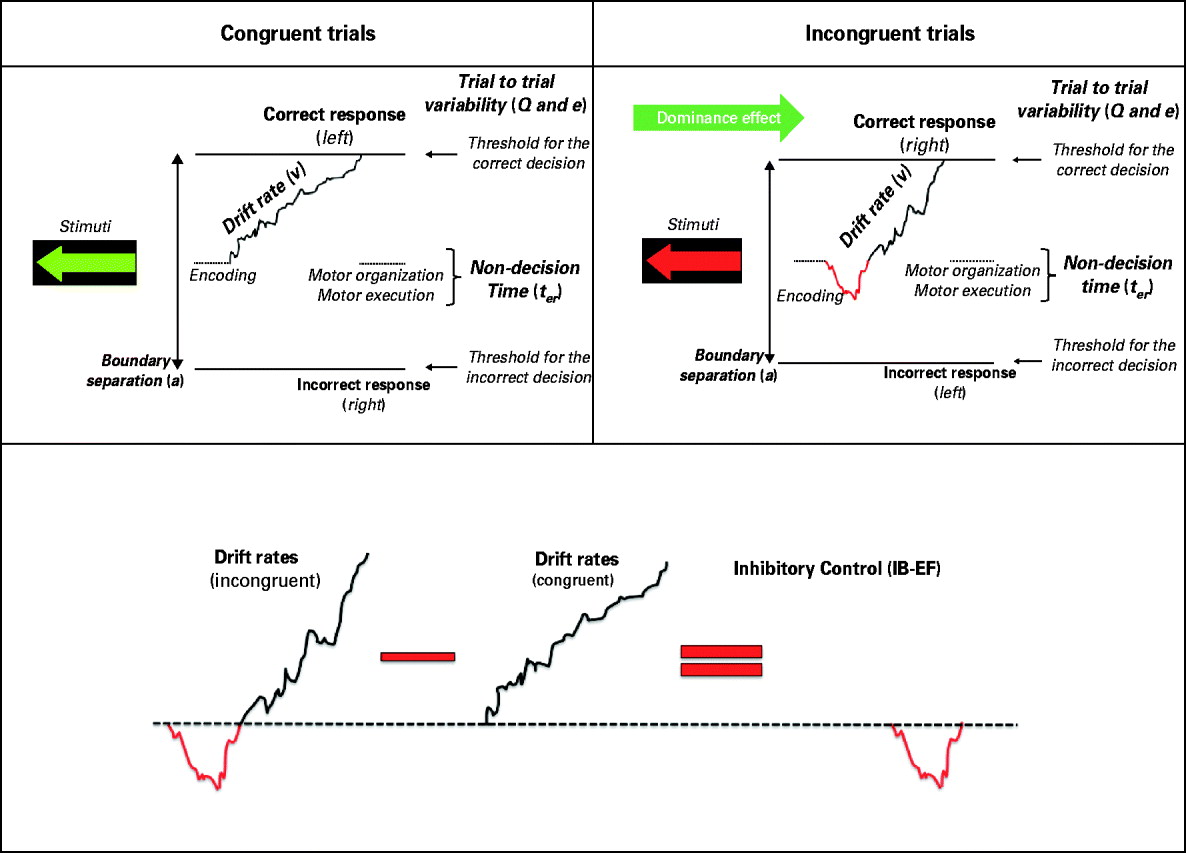
As classical parameters of IB-EF assume an intact BIP (a controversial assumption), we used DMs to investigate IB-EF in a way that is above and beyond potential pre-existing deficits in BIP. The IB-EF can be measured as the difference in mean drift rates from congruent and incongruent trials (v incongruent − v congruent) (White et al. Reference White, Ratcliff, Vasey and McKoon2010). Fig. 1 illustrates the way IB-EF was conceptualized using DMs.
Schematic representation of the diffusion model (DM) for the Conflict Control Task (CCT).

Classical parameters
For the CCT we used the percentage of correct responses in incongruent trials and the percentage of correct inhibitions in No-Go trials in the GNG (Bitsakou et al. Reference Bitsakou, Psychogiou, Thompson and Sonuga-Barke2008).
Intelligence
Intelligence quotient (IQ) was estimated using the vocabulary and block design subtests of the Weschler Intelligence Scale for Children, 3rd edition (WISC-III; Wechsler, Reference Wechsler2002) using the method of Tellegen & Briggs (Reference Tellegen and Briggs1967) and Brazilian norms (Figueiredo, Reference Figueiredo2001).
Statistical analysis
Multivariate analyses of covariance (MANCOVAs; Pillai's Trace) were used to test overall group differences in BIP across all variables. The source of differences on specific dependent variables for BIP and differences in IB-EF were explored using ANCOVAs. These analyses tested the effects of group, site and gender, controlling for estimated IQ and age as covariates. Significant differences between groups were further examined using two simple contrasts to avoid multiple testing: (1) differences between TDC and other groups; and (2) differences between ADHD and other groups of psychopathology. Our first hypothesis (ADHD versus TDC differences) was tested using the first of these contrasts. For our second hypothesis (ADHD specificity), we predicted that (1) ADHD participants would differ significantly from TDC (contrast 1); (2) ADHD would differ from the other psychopathological groups (contrast 2); and (3) other psychopathological groups would not differ from TDC in the same direction as ADHD (contrast 1).
To investigate our third hypothesis (effects of the co-morbidity between ADHD and ODD/CD), a similar analytic strategy was followed with one difference. Instead of using non-overlapping diagnostic groups (as in the first and second hypotheses), we used ‘any ADHD’ and ‘any ODD/CD’ as dummy variables to test their interaction in the linear model (any ADHD × any ODD/CD).
To test our fourth hypothesis, point biserial correlations were calculated for classical indexes of the inhibitory tasks (CCT: percentage of inhibitions on the incongruent trials; GNG: percentage of correct inhibitions). Following this, partial correlations were calculated controlling for age, IQ, site and gender and for baseline BIP parameters.
Effect sizes were defined in terms of percentage of explained variance and 1, 9 and 25% were defined as small, medium and large effects corresponding to 0.01, 0.06 and 0.14 partial eta square (η p 2) values respectively (Cohen, Reference Cohen1988). DM analysis was performed using computer codes from hierarchical DMs for two-choice response times (Vandekerckhove et al. Reference Vandekerckhove, Tuerlinckx and Lee2011). All scores were z transformed before analysis using the van der Waerden transformation (Lehmann, Reference Lehmann1975). All tests were two-tailed.
Results
Differences in demographics, psychopathology and classical task measures among groups are listed in Table 1. The Distress group had a higher percentage of females (χ 5 2 = 14.2, p = 0.014; adjusted residuals = 2.8) than the TDC group. The ADHD group had lower IQ than the TDC (F 5,698 = 3.8, p = 0.002). The groups did not differ in age (F 5,698 = 2.20, p = 0.053).
Sample description of clinical assessment, age, IQ, SES, gender and site

IQ, Intelligence quotient; SES, socio-economic status; POA, Porto Alegre site; TDC, typically developing controls; PTSD, post-traumatic stress disorder; GAD, generalized anxiety disorder; ADHD, attention deficit hyperactivity disorder; C, combined; I, inattentive; H, hyperactive; NOS, not otherwise specified; ODD, oppositional defiant disorder; CD, conduct disorder; s.d., standard deviation.
Hypothesis 1: Do non-referred community cases of ADHD differ from TDC in BIP components and IB-EF?
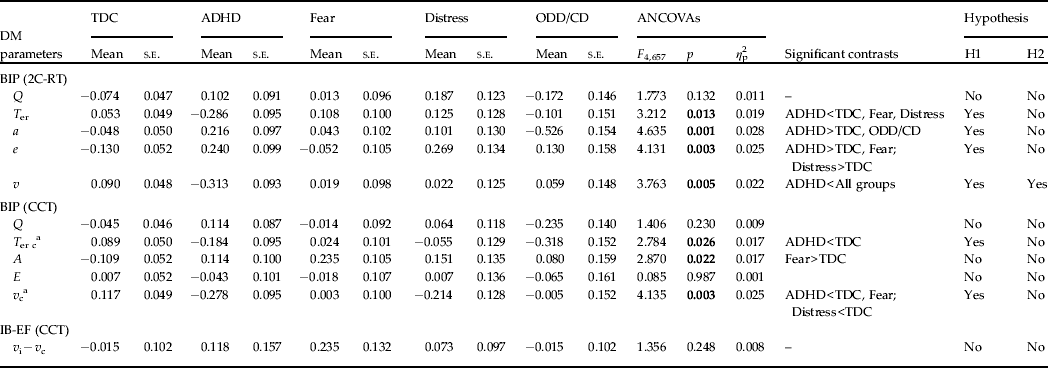
The results from all MANCOVAs and post-hoc ANCOVAs related to hypothesis 1 are shown in Table 2.
BIP
ADHD subjects had faster encoding/motor function, poorer processing efficiency, higher variability in processing efficiency from trial to trial and a more cautious response style (Table 2, Fig. 2) in the 2C-RT. ADHD groups differed significantly from controls in also having poorer processing efficiency and faster encoding/motor function in the CCT.
Primary differences between attention deficit hyperactivity disorder (ADHD) subjects and typically developing controls (TDC) in basic information processing (BIP) according to the Two-Choice Reaction Time Task (2C-RT) and the Conflict Control Task (CCT). Ratcliff diffusion model (DM) parameters: Q, trial-to-trial variability in non-decision time; T er, mean non-decision time (encoding/motor function); a, boundary separation (speed–accuracy trade-off); e, trial-to-trial variability in drift rates; v, mean drift rate (processing efficiency). T er and v in the CCT were generated only with congruent trials.

Post-hoc ANCOVAs showing between-group differences in diffusion model (DM) parameters for the Two-Choice Reaction Time Task (2C-RT) and the Conflict Control Task (CCT)

TDC, Typical developing controls; ADHD, attention deficit hyperactivity disorder; ODD, oppositional defiant disorder; CD, conduct disorder; BIP, basic information processing; IB-EF, inhibitory-based executive functioning; s.e., standard error; Q, trial-to-trial variability in non-decision time; T er, mean non-decision time (encoding/motor function); a, boundary separation (speed–trade-off); e, trial-to-trial variability in drift rates; v, mean drift rates (processing efficiency); v i, mean drift rates in incongruent trials; v c, mean drift rates in congruent trials; H1, hypothesis 1 (deficits in ADHD if compared to controls); H2, hypothesis 2 (deficits are specific to ADHD).
MANCOVAs: BIP (2C-RT), F 20,2612 = 2.69, p < 0.001, η p 2 = 0.02; BIP (CCT), F 20,2612 = 2.03, p = 0.002, η p 2 = 0.015.
Estimated marginal means for z scores (corrected for age and IQ). IB-EF represents differences between raw scores of both trial conditions.
a Calculated only for congruent trials.
IB-EF
ANCOVAs with IB-EF estimates measured above and beyond BIP in the CCT revealed no statistically significant group effects (Table 2).
Thus, in both 2C-RT and CCT, children with ADHD exhibited poorer processing efficiency and faster encoding/motor function (Table 2, Fig. 2). A more cautious response style and greater variability in deciding from trial to trial were significant in the 2C-RT but not in the CCT (Table 2, Fig. 2). No clinically meaningful findings for inhibitory function were found.
Hypothesis 2: Are BIP deficits specific to ADHD?
The results from all MANCOVAs and post-hoc ANCOVAs related to hypothesis 2 are presented in Table 2.
BIP
Poorer processing efficiency in the 2C-RT differentiated the ADHD group from all other groups, indicating that this deficit was specific for ADHD. A faster encoding/motor function differentiated ADHD from both the Fear and Distress groups but not from the ODD/CD group. In addition, ADHD subjects had a more cautious response style whereas ODD/CD subjects were less cautious or ‘impulsive’ (Table 2, Fig. 3). For the CCT, poorer processing efficiency differentiated the ADHD from the Fear group (Table 2, Fig. 3).
Specific processing deficits in attention deficit hyperactivity disorder (ADHD) compared to Fear and Distress and oppositional defiant disorder/conduct disorder (ODD/CD) groups. (a) ADHD is different from Fear and Distress disorders in the Two-Choice Reaction Time Task (2C-RT). (b) ADHD is different from ODD/CD in the 2C-RT. (c) ADHD is different from all groups in the 2C-RT, and from Fear in the Conflict Control Task (CCT). a Different from typical developing controls (TDC). b Different from ADHD.

IB-EF
ANCOVAs with IB-EF estimates measured above and beyond deficits in BIP in the CCT revealed no statistically significant group effects (Table 2). Thus, processing efficiency was found to be specifically associated with ADHD in the 2C-RT.
Hypothesis 3: Does co-morbidity between ADHD and ODD/CD represent a qualitatively different clinical entity with respect to deficits in BIP and IB-EF?
BIP
MANCOVAs testing the interaction term between ADHD and ODD/CD as dummy variables for all BIP parameters in the 2C-RT and the CCT gave non-significant results (all p's > 0.05).
IB-EF
No significant interaction effect was found for IB-EF (all p's > 0.05). Thus, co-morbidity produced only additive effects and is not a distinct category in terms of BIP and IB-EF.
Hypothesis 4: Do classical parameters of IB-EF remain significant after controlling for deficits in BIP?
In the three above-mentioned hypotheses, we measured IB-EF using diffusion analysis, a way of measuring IB-EF above and beyond potentially pre-existing BIP deficits. With this rigorous analysis no evidence of IB-EF deficits was found in ADHD. Nevertheless, deficits in IB-EF measured with classical parameters such as the percentage of correct responses in incongruent trials in the CCT and the percentage of correct inhibitions in No-Go trials in GNG have frequently been reported in the ADHD literature. Therefore, this fourth hypothesis aimed to investigate: (1) whether we could find the same classical findings in our sample; and (2) whether the potential differences in these parameters just reflected the dysfunctional underlying BIP already reported here.
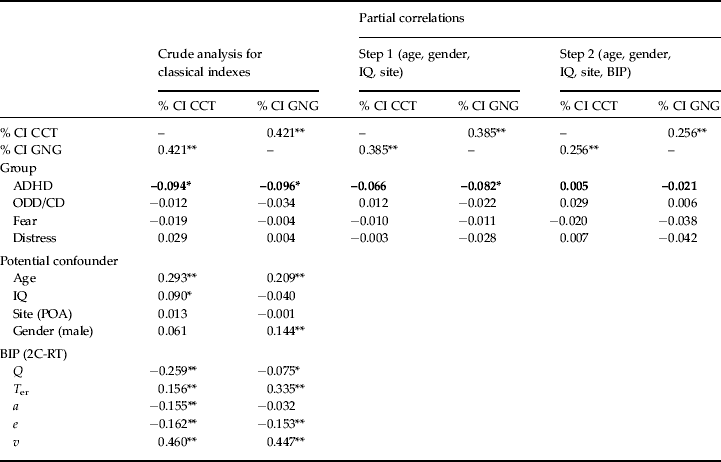
First, we found that classical IB-EF measures were associated significantly with ADHD in both tasks, corroborating previous findings in this field (Table 3). Second, we conducted partial correlations to control for baseline BIP deficits (as measured by the 2C-RT) and to investigate whether the associations found for classical IB-EF variables could be fully accounted for by the lower-order deficits in baseline BIP. After controlling for baseline BIP parameters, the association between ADHD and classical parameters of IB-EF in both tasks was no longer significant (Table 3). Moreover, mediation tests (Sobel–Goodman) showed that approximately 50% of classical IB-EF Go/No-Go variables and 76% of the classical IB-EF CCT were mediated by processing efficiency (a BIP component) and that only the mediated effects were significant. No evidence for direct effects was found in this analysis.
Partial correlations between inhibitory-based executive functioning (IB-EF) classical indexes controlled for potential confounders and baseline basic information processing (BIP)

CCT, Conflict Control Task; GNG, Go/No-Go task; 2C-RT, Two-Choice Reaction Time Task; CI, confidence interval; ADHD, attention deficit hyperactivity disorder; ODD, oppositional defiant disorder; CD, conduct disorder; IQ, intelligence quotient; POA, ; Q, trial-to-trial variability in non-decision time; T er, mean non-decision time; a, boundary separation; e, trial-to-trial variability in drift rates; v, mean drift rate.
Classical indexes: for GNG, percentage of correct inhibitions, and for CCT, percentage of correct responses in the incongruent trials. Values represent Pearson and point biserial correlation coefficients.
Correlations for ADHD shown in bold.
* p < 0.05, ** p < 0.01.
Discussion
In this study we have demonstrated that some BIP components are impaired in ADHD subjects. Children with ADHD differ from controls by having faster encoding and/or motor preparation/execution times and poorer processing efficiency in both the 2C-RT and the CCT. Furthermore, poorer processing efficiency in the 2C-RT was the only parameter that met the criteria for being specific to ADHD and differentiated ADHD from all the other psychopathological groups. Overall evidence supports a correlated risk factors model for the co-morbid group (ADHD+ODD/CD). All deficits frequently seen in ADHD subjects measured with classical IB-EF variables were fully accounted for by pre-existing BIP deficits.
Our results challenge theories that propose inhibitory deficits as unique to ADHD (Barkley, Reference Barkley1997; Quay, Reference Quay1997; Wood et al. Reference Wood, Buitelaar, Rijsdijk, Asherson and Kuntsi2010) but are consonant with studies indicating that all between-group differences in inhibitory findings become non-significant after controlling for baseline measures in BIP (Rommelse et al. Reference Rommelse, Altink, de Sonneville, Buschgens, Buitelaar, Oosterlaan and Sergeant2007) or following the introduction of incentives (Konrad et al. Reference Konrad, Gauggel, Manz and Scholl2000; Slusarek et al. Reference Slusarek, Velling, Bunk and Eggers2001; Kuntsi et al. Reference Kuntsi, Wood, Van Der Meere and Asherson2009). They are also consistent with electrophysiological studies indicating that inhibitory control difficulties in ADHD are accompanied by altered response preparation and motor execution processes, which may indicate dysfunctional processes in some BIP components during these tasks (Brandeis et al. Reference Brandeis, van Leeuwen, Rubia, Vitacco, Steger, Pascual-Marqui and Steinhausen1998; Pliszka et al. Reference Pliszka, Liotti and Woldorff2000; Banaschewski et al. Reference Banaschewski, Brandeis, Heinrich, Albrecht, Brunner and Rothenberger2004). These findings provide further evidence in support of the thesis that non-executive deficits are primary in ADHD.
Our findings regarding the relevance of processing efficiency are in agreement with a recent meta-analysis (Huang-Pollock et al. Reference Huang-Pollock, Karalunas, Tam and Moore2012) reporting that poorer rate of accumulating information in DM is a crucial parameter in explaining individual differences related to ADHD. Children with ADHD are impaired in accumulating information required to perform a very simple decision with respect to the direction that a given arrow is pointing to. An inefficient accumulation of information to reach very simple decisions may explain a variety of ADHD symptoms, because children are continually required to contrast information accumulated in their given environment with a series of instructions about how to process that information. Our study extends previous findings demonstrating that poorer processing efficiency is not shared with other forms of psychopathology.
Faster encoding/motor function differentiated the ADHD group the from Distress and Fear groups in the 2C-RT. Evidence for deficits in both encoding (August & Garfinkel, Reference August and Garfinkel1989) and motor preparation/execution does exist for ADHD (Sergeant & van der Meere, Reference Sergeant and van der Meere1990). We hypothesized that a lower encoding/motor function time may represent three distinct conditions: (1) an advantage in information processing that may further explain motivational deficits in activities that are not ‘fast enough’ and therefore ‘not interesting enough for engaging effort’; (2) a faster but dysfunctional/inefficient encoding and/or motor function process (explaining a higher number of errors in all tasks in addition to the errors due to inefficient processing); and (3) a compensatory mechanism secondary to the inefficient information accumulation.
It is important to note that our results were more consistent for the 2C-RT than the CCT. Differences between ADHD and TDC emerged for encoding/motor function and processing efficiency in both tasks but only in the 2C-RT did deficits in processing efficiency differentiate ADHD from other psychopathological groups. Thus, we assessed task effects for these parameters (see online Supplementary Material), exploring a potential role for cognitive load in determining these two deficits. No group by task interaction effects were found for the main parameters, suggesting that a potential type II error is a suitable reason for our CCT negative findings in drift rates when other child mental disorders were compared to ADHD.
The results concerning the speed–accuracy trade-off are of particular interest because response style in the 2C-RT clearly differentiated ADHD from ODD/CD patients, with the ODD/CD group trading accuracy for speed and the ADHD subjects having a more cautious response style. Here, speed and accuracy were equally emphasized, suggesting that strategy rather than pure structural deficits in cognitive processing contributed to attentional function in externalizing disorders (Sergeant & Scholten, Reference Sergeant and Scholten1985b ; Scheres et al. Reference Scheres, Oosterlaan and Sergeant2001; Schoemaker et al. Reference Schoemaker, Bunte, Wiebe, Espy, Dekovic and Matthys2012). ODD/CD, but notably not ADHD, showed a more impulsive response style. However, none of these results were evident in the CCT and a task by group effect was found (see Supplementary Material), suggesting that this finding is highly dependent on task manipulations consistent with previous evidence (Mulder et al. Reference Mulder, Bos, Weusten, van Belle, van Dijk, Simen, van Engeland and Durston2010). These results may also reflect the community nature of our sample. Given the fact that clinical samples are highly co-morbid, assessing a non-referred community sample allowed us to investigate the distinct contributions of various clinical presentations. This specific characteristic may have revealed that an impulsive response style is more closely associated with ODD/CD and that non-co-morbid ADHD subjects in the community may be more cautious in responding to 2C-RT than ODD/CD subjects.
The co-morbid group with both ADHD and ODD/CD did not show any distinctive pattern to characterize them as a distinct entity from single diagnostic groups. This evidence supports the ‘correlated risk factors model’, which predicts additive or synergistic effects of co-morbidity, in contrast to the ‘independent disorders model’, which predicts unique neuropsychological profiles (Faraone et al. Reference Faraone, Biederman, Keenan and Tsuang1991; Waldman & Slutske, Reference Waldman and Slutske2000). Our findings are in agreement with studies that formally tested the interaction between these two clinical domains and failed to find significant differences (Rommelse et al. Reference Rommelse, Altink, Fliers, Martin, Buschgens, Hartman, Buitelaar, Faraone, Sergeant and Oosterlaan2009).
The current study has some limitations. First, we were only able to investigate a restricted range of psychiatric disorders and important forms of psychopathology such as autism and reading disorders were not evaluated. However, we used an empirically and theoretically derived taxonomy investigating differences between Fear, Distress, ADHD, ODD/CD and co-morbid groups. Second, although our sample size is one of the largest in this area of investigation, it might not have had enough power to confirm some of the findings on BIP in both tasks. Third, DMs are not capable of detecting periodic oscillations in performance that have been suggested to be characteristic of ADHD by some researchers (Castellanos et al. Reference Castellanos, Sonuga-Barke, Scheres, Di Martino, Hyde and Walters2005; Sonuga-Barke & Castellanos, Reference Sonuga-Barke and Castellanos2007; Di Martino et al. Reference Di Martino, Ghaffari, Curchack, Reiss, Hyde, Vannucci, Petkova, Klein and Castellanos2008; Helps et al. Reference Helps, Broyd, Bitsakou and Sonuga-Barke2011).
Our study also has some notable strengths. To our knowledge, this is the largest community-based study combining psychopathological and task-based data to study specificities and communalities in the neuropsychopathology of ADHD. All the groups came from the same community of never-medicated subjects, providing a strong design against population stratification due to selection methods. All the results are independent of age, site, gender and IQ effects. In addition, we used sophisticated analytic methods of performance, allowing us to decompose cognitive data into distinct processing components.
In conclusion, we were able to demonstrate that ADHD is distinctly affected in some BIP components, which also explains the deficits in IB-EF if measured with classical variables in the literature. Our results have important implications for research into the pathophysiology of ADHD because they point to the involvement of both lower-order processing and strategy differences among clinical groups. Future studies are needed to reveal the neural networks underlying these BIP components and strategies and to advance our understanding of such deficits from a clinical and neurobiological perspective.
Supplementary material
For supplementary material accompanying this paper, please visit http://dx.doi.org/10.1017/S0033291713000639.
Acknowledgments
We thank the children and families for their participation, which made this research possible; the other members of the high-risk cohort research team (Drs A. Carina Tamanaha, E. C. Miguel, R. Affonseca-Bressan and H. Brentani); the collaborators for the neuropsychological evaluation (B. S. Scarpato, S. L. Ribeiro do Valle and C. Araújo); Dr R. Goodman for his research support regarding the DAWBA instrument procedures; and Dr B. Fleitlich-Bilyk for her clinical supervision.
This work received funding from the following Brazilian government agencies: the National Council for Scientific and Technological Development (CNPq), the Brazilian Federal Agency for Support and Evaluation of Postgraduate Education (CAPES) and the Foundation for Research Support of the State of São Paulo (FAPESP).
Declaration of Interest
G. A. Salum is in receipt of a post-doctoral CAPES/FAPERGS scholarship. J. Sergeant is a member of an advisory board to Lilly and Shire, and has received research funding from Lilly and speaker fees from Lilly, Janssen-Cilag, Novartis and Shire. E. Sonuga-Barke is a member of an advisory board to Shire, Flynn Pharma, UCB Pharma and AstraZeneca, has served as speaker and consultant for Shire and UCB Pharma, receives current/recent research support from Janssen Cilag, Shire, Qbtech and Flynn Pharma, and has received conference support from Shire. A. Gadelha receives continuous medical education support from Astra Zeneca, Eli-Lilly and Janssen-Cilag. P. M. Pan receives research support from CNPq and CAPES and continuous medical education support from Astra Zeneca, Eli-Lilly and Janssen-Cilag. T. S. Moriyama is in receipt of a CNPq doctoral scholarship and has received continuous medical education support from Astra Zeneca, Eli-Lilly and Janssen-Cilag. A. S. Graeff-Martins is in receipt of a CNPq post-doctoral fellowship. P. Gomes de Alvarenga is in receipt of a CNPq doctoral fellowship. M. C. do Rosário receives research support from CNPq and has worked in the past 5 years as a speaker for Novartis and Shire. G. G. Manfro receives research support from the Brazilian government institutions CNPq, FAPERGS and FIPE-HCPA. G. V. Polanczyk has served as a speaker and/or consultant for Eli-Lilly, Novartis and Shire Pharmaceuticals, has developed educational material for Janssen-Cilag, and receives unrestricted research support from Novartis and from CNPq, Brazil. L. A. Rohde was on the speakers' bureau and/or acted as consultant for Eli-Lilly, Janssen-Cilag, Novartis and Shire in the past 3 years, and has received travel costs from Novartis and Janssen-Cilag in 2010 for taking part of two child psychiatric meetings. He chaired the ADHD and Juvenile Bipolar Disorder Outpatient Programs, which received unrestricted educational and research support from the pharmaceutical companies Abbott, Eli-Lilly, Janssen-Cilag, Novartis and Shire in the past 3 years. He also receives authorship royalties from Oxford University Press and ArtMed.