


Societies adopt institutions—rules and laws—to shape behavior in order to produce desirable political, economic, or social outcomes. Institutions are the means to an end; they are the mechanisms that channel independent human energy toward goals desired by those who possess the power to design them. Although informed by theory, data, and natural experiments, institutional designers often find that outcomes don’t align with the designers’ intent. Resource management programs miss sustainability targets, or anticorruption measures are futile, or democracies fail to prevent the rise of incompetent or authoritarian leaders. Decades of effort to improve the economy through development projects have fallen short of aspirations, sometimes wildly so (Easterly Reference Easterly2006). Part of these institutional failures can be attributed to the fact that context affects performance. Nearly identical institutions succeed in one location and fail in another. Empiricists have observed context dependence countless times and at all scales, from community-based cooperative lending institutions (Guinnane Reference Guinnane1994) to country-level political and economic institutions (Roland Reference Roland2004).
In the literature, one finds two renderings of context: as culture and as the institutional environment. Culture—the shared history, expectations, beliefs, meanings, and artifacts that characterize a community—can be empirically linked to institutional performance; Alesina and Giuliano’s (Reference Alesina and Giuliano2015) review is replete with examples. Separately, some argue that the broader set of institutions in a society influence a society’s ability to respond to a new institution efficiently, such as Acemoglu, Johnson, and Robinson’s (Reference Acemoglu, Johnson and Robinson2001) explanation of the divergent developmental paths of national economies or regime types. In both scholarly streams, rich empirical evidence supports the claim that context affects performance but the theoretical development—an explanation for how—remains scant.
North offers one of the most influential arguments to connect context and institutional performance (Reference North, Knight and Sened1995, Reference North2005). An “institutional matrix” describes the incentive environment for agents who respond by acquiring skills that they perceive to be useful given their understanding of the environment. Culture, treated exogenously, helps the agents’ diverse mental models to converge, facilitating coordinated behavior. North posits that “the economies of scope, complementarities, and network externalities of an institutional matrix make institutional change overwhelmingly incremental and path dependent” (Reference North, Knight and Sened1995, 59). North makes a strong assertion that gradual institutional change is natural, that is, gradualism would have the best hope of success.
North’s conception is intuition-generating and raises significant questions. If change is “overwhelmingly incremental,” is it necessarily incremental? If not, what about extraordinary cases—the interesting ones? Is it necessarily path dependent, and does it depend only on history, or also on the sequence? And must transitions be gradual, or are there ways to overcome the incrementalism? Formal models can function as useful analytical tools to help answer questions like these. Working with a formal model we can derive conditions when one would expect culture and institutional environment to affect institutional performance.
We argue that culture and institutional environment are interlinked and jointly affect institutional performance. We focus on the human contribution to institutional failure: when people do not behave as anticipated. Institutions produce different outcomes because people in one place respond differently to the institution’s incentives and information than in another place. These behaviors may spill over to other institutions, affecting the way agents respond to otherwise unrelated rules or laws. We model two behavioral phenomena: behavioral repertoires and behavioral spillovers. Behavioral repertoires refer to the accumulated set of behaviors used in preexisting institutions. A behavioral spillover is the influence of a person’s behavior—be it trusting, cooperative, risk-taking, or altruistic—on her response to another institution.
In focusing on behavior, we develop a model of multiple institutions that provides a causal mechanism for how culture might affect institutional performance. The causal logic requires two steps. Diverse sequences of institutional choices produce distinct behavioral repertoires. The repertoires, in turn, produce distinct spillovers. A society that supports multiple forms of altruistic or trusting behavior will be more likely to see that behavior spill over into a new context than a society that lacks those behaviors. Culture, as patterns of behavior and expectations of how others will behave, is generated in response to existing institutions and, in turn, affects response to new institutions.Footnote 1 Institutional choices and their ordering are primary contributors to context; the optimal institution can depend on the other institutions in play. The indirect interaction between institutions creates institutional path dependence where culture is both spawned by the institutional path and is the path’s architect.Footnote 2
We derive eight main results, five concerning institutional performance and three addressing sequencing. First, as a baseline, we establish that cultural sway can result in suboptimal outcomes. Second, we demonstrate that any set of institutions will be susceptible to behavioral path dependence unless all institutions have unique equilibria. Third, we show how early institutions that create clear incentives increase potential future path dependence. Fourth, contrary to what might be expected, we show that the relationship between cultural sway and path dependence is nonlinear. As cultural sway increases, path dependence decreases; the influence of institutional sequencing—path dependence—is swamped by the influence of the initial institution. This insight aligns with the literature on founder effects in organizational strategy (Boeker Reference Boeker1989). Fifth, in a general class of games we show how optimal institutional design requires more carrot than stick. In other words, the best institutions create strong incentives to choose the efficient equilibrium and impose only weak punishments for deviating from it.
The first of our three results on optimal sequencing states that the most efficient paths—when agents maximize their payoffs—include games that induce different behaviors early in the sequence and then rely on incrementalism. Second, these optimal sequences paradoxically avoid path dependence by enabling its possibility. Early diversity builds the dimensionality of behavioral repertoires, resulting in greater capacity to respond optimally to incentive structures. That initial diversity also maximizes the potential for future path dependence. Third, negatively reinforced institutional drift leads to institutional change at the most inefficient moment, an overlooked consequence of gradualist theories, including the quasiparameter model of Greif and Laitin (Reference Greif and Laitin2004).
We have organized the article into five parts. We first situate our project within the literature on how context influences institutional design and performance. Next, we present our modeling framework and apply it to two familiar and canonical families of games that can be parameterized by a single variable.Footnote 3 We also include a sketch of how one might apply the model to sequencing in democratic transitions. We follow the model’s exposition with a presentation of our first set of main results, parsing path dependence from initial game dependence, conditions for optimal sequencing, and modeling endogenous institutional change. We then extend the model to cover a broad array of cooperation problems: in formal modeling terms, we present a model of a general class of all two-by-two symmetric games as well as arbitrary game forms. We conclude by discussing possible extensions.
INSTITUTIONAL PERFORMANCE WITHIN CONTEXT
Evidence of the importance of context on institutional performance spans centuries and continents. Putnam’s (Reference Putnam, Leonardi and Nanetti1993) analysis of divergence in the economic performance of northern and southern Italy provides a well-known example. In 1970, Italians decentralized their government, implementing identical institutions at the regional level. In subsequent decades, the northern regional governments outperformed those in the south. Putnam and his colleagues traced the cause of the divergence to culture: the north and south had differing patterns of behavior that Putnam labeled “trust.” In the north, trust was fostered through cooperative, mutually rewarding social relations and economic transactions. In the south, patterns of social and economic interaction where characterized more by mutual suspicion and exploitation. In Putnam’s analysis, these differing habits of behavior—1000 years old—created distinct reactions to identical governmental reforms.
The failed Irish loan cooperatives provide a second brief illustration. In 1894, Horace Plunkett encouraged the Irish to copy rural Germany’s Raiffeisen credit cooperatives. Among the reasons these cooperatives failed were that the Irish, unlike the Germans, refused to force their neighbors to repay loans. Guinnane (Reference Guinnane1994) cites a 1902 report by the Irish Agricultural Organization Society: “It is difficult in a country with no business traditions, and where the natural kindliness of the people renders them easy-going with regard to mutual obligations, to make them realize the necessity of adhering resolutely to the rules.” The Irish culture lacked the behaviors that would cause them to be willing to punish deviations, leading to a suboptimal outcome.
These examples illustrate our framework of behavioral repertoires and behavioral spillovers. In Italy, the same institution produced different results because behavior varied by place; spillovers from southern Italian Mafia organizations dampened the trust that could have made regional governance more effective. In Ireland, the institution allowed for multiple outcomes, or equilibria. People adopted a familiar behavior resulting in a suboptimal outcome. In each case, existing behaviors influenced how institutions performed.
It should come as no surprise that scholars concerned with institutional performance have paid attention to institutional context. In Long’s (Reference Long1958) conception of an “ecology of games” or North’s “institutional matrix” institutions create a behavioral or belief environment, and through that, affect the performance of other institutions. Similarly, Aoki’s (Reference Aoki1994, Reference Aoki2001) theory of complementary institutions assumes that the presence of one institution in an environment makes another more effective, and his approach to institutional change also allows for interdependence between institutions (Aoki Reference Aoki2007). Relatedly, Mahoney and Thelen (Reference Mahoney, Thelen, Mahoney and Thelen2010) show how individual agency produces incremental institutional change. What the literature has not done is to introduce a framework for analyzing context.
There are case-specific applied analyses of the effect of institutional sequencing, which requires situating an institution within an institutional and behavioral context. Lubell (Reference Lubell2013) invokes Long’s ecology of games as well as Ostrom’s (Reference Ostrom2009) lexicon of institutional complexity to construct a schema representing the set of agents, the scope of their decisions, and the feedback within the system. Scholars of historical institutionalism consider how accumulated experience shapes responses at particular moments by using the methodology of process tracing to identify explanatory variables and the corresponding causal mechanisms in historical cases (Thelen Reference Thelen1999; Mahoney Reference Mahoney2001; Brady and Collier Reference Brady and Collier2004; Falleti and Lynch Reference Falleti and Lynch2009). For example, Luebbert (Reference Luebbert1991) describes the necessity of the creation of a coalition between the working class and the landed peasantry for social democracy in Europe. These focused studies are enlightening within their cases of interest, but are not intended to derive testable claims that might hold across a variety of contexts.
Theories of democratization and economic development commonly include recommendations for the sequencing of institutional reform. Those sequencing prescriptions often conflict. Consider the competing approaches to timing, characterized as gradualism (e.g., Dewatripont and Roland Reference Dewatripont and Roland1992; Carothers Reference Carothers2007; Roland Reference Roland2000, Reference Roland2002) vs. big bang (Lipton and Sachs Reference Lipton and Sachs1990). Big bang, or shock therapy, advocates radical and comprehensive (multi-institutional) departures from existing institutions for quick improvement while, with gradualism, steps are taken toward the social goal that begins from the baseline of existing conditions, working with the positive aspects of a political economy, rather than strictly against the undesirable aspects. New institutions are introduced slowly and start with reforms considered most likely to be popular or successful (Roland Reference Roland2000) as public acceptance for reform builds.
Democratization and growth theories suggest a variety of starting points. Some say that the first step should be to establish democratic institutions (Sen Reference Sen1999; Carothers Reference Carothers2007; Berman Reference Berman2007; Knight and Johnson Reference Knight and Johnson2011), or to foster economic growth and its enabling institutions (Lipset Reference Lipset1959; North and Thomas Reference North and Thomas1973), to establish civil society with high levels of trust (Huntington Reference Huntington1968; Putnam Reference Putnam, Leonardi and Nanetti1993), or to reduce economic inequality (Boix Reference Boix2003), or to create a strong, independent government (Acemoglu and Robinson Reference Acemoglu and Robinson2005). Still others recommend establishing security and order prior to all other objectives (Mansfield and Snyder Reference Mansfield and Snyder2005; Lake Reference Lake2010). All of these works share two features: they are empirically grounded, and they claim that institutional order affects outcomes. They also largely agree on an ideal end state: a democratic country with strong economic and political institutions, high levels of trust and security, and relative equality, yet they disagree about the appropriate first step on the path to that common end.
Historical narratives situate institutions’ contextual effects in beliefs, behaviors, norms, rituals, habits, and organizations (Greif Reference Greif2006), but any formal model must reduce the dimensionality of causes. Greif, for example, relies on beliefs as the cultural attribute that transmits the weight of past institutions and constrains the set of equilibria as well as determining public acceptance of institutions. Although behavior depends on beliefs, no one-to-one mapping exists between the two. Common beliefs need not induce identical behaviors and behavioral heterogeneity can have implications for outcomes (Bednar, Jones-Rooy, and Page Reference Bednar, Jones-Rooy and Page2015). Alternatively, identical behaviors can emerge despite disparate beliefs. While both beliefs and behavior can be used to identify conditions for institutional path dependence, they rely on different assumptions. Belief-based models require constraints on priors, while our model requires minimal bounds on the extent of the cultural sway. A behavioral approach complements belief-based models by providing an opportunity to explore a different set of causal forces and to draw distinct insights.
For example, Greif (Reference Greif2006) highlights a fundamental asymmetry between institutions that build from existing structures and those that are created de novo. He derives a strong preference for the former because the latter lack sufficient context for similarities in beliefs. As a result, learning will be a “lengthy, costly, uncertain endeavor” (Reference Greif2006, 191). Greif concludes that human nature advantages traveling familiar paths. A society’s historical experience with an institution, or components of it, should cause that society to implement familiar institutional components rather than ones that might appear to be more efficient, from a mechanism design perspective. There exists efficiency in familiarity.
Our approach complements historical institutionalism by building a model based upon individual decision-making. It shares the intuitions of North (Reference North, Knight and Sened1995) that culture helps the diverse mental models held by agents to converge, and together with the “institutional matrix” interacts with beliefs to affect institutional change. We diverge in our assessment of the necessity of incrementalism. Given that our formalization enables us to evaluate gradualism theoretically, we can derive conditions when gradualism would and would not lead to optimal outcomes.Footnote 4 We find that, generically, gradualism leads to inefficient outcomes by locking in on a particular behavior.
THE MODEL
In this section, we describe our theoretical framework, detailing our working assumptions, definitions, and the general structure of our model. We then build intuition, first with illustrations of sequences of two foundational families of games—coordination and a risk-dominant refinement—and then we suggest an application drawn from electoral sequencing.
The Formal Framework
Our framework relies on three assumptions: (1) institutions arrive sequentially; (2) individuals’ initial behaviors differ: some draw on past behaviors and others do not; and (3) in subsequent periods, individuals learn to play an equilibrium in the new institution. Each assumption requires some elaboration.
First, to model institutions, we adopt the convention of representing an institution as a game form, capturing the incentives and information available to agents as they interact with one another. We assume an infinite population of individuals who play a sequence of games. As agents play more games, they develop repertoires of behaviors that they acquire in response to institutions. We divide time into two components: epochs and periods, where each epoch is divided into a large number of periods. In each epoch, we introduce a new game. Each game is chosen from a family of symmetric games, G, and (in our initial analyses) related by a common payoff parameter, θ, which creates a distance measure between games. We denote the game selected in epoch t by g t and the payof-maximizing repeated game equilibrium strategy by s* t .Footnote 5 That game is played some large finite number of periods within the epoch. We remain agnostic as to whether that same game is played in subsequent epochs. If so, we assume that individuals continue to play the same strategies.
Second, we assume that agents are one of two behavioral types: those subject to cultural sway and those who are not. The behavioral type affects only the initial response to a new game.Footnote 6 We define the cultural sway to be the probability that an individual’s initial response draws on a preexisting behavior. Formally, we denote cultural sway as the proportion γ of the individuals who compare the new institution with all existing institutions (games), identify the game in the sequence that most closely resembles game g t , and initially play that strategy in the new game.Footnote 7 The remaining fraction (1 − γ) of the individuals interpret the game devoid of any context, in the same way that someone trained in game theory might look at a payoff matrix in an experimental setting. Following convention, we assume that the context-free choice is the payoff maximizing equilibrium strategy, s* t . Note that the context-free response is an implicit assumption in many, if not most, formal models of institutions. The agents who draw their initial responses from their behavioral repertoires create behavioral spillovers, the core assumption of our model.Footnote 8
Third, agents’ initial actions need not be the long-run equilibria. They provide the starting point, the initial conditions, from which people learn. Our last assumption therefore addresses how agents learn. These two types of individuals—those whose behavior is culturally embedded and those whose initial behavior is context-free—interact within the institution, applying a rational learning rule. They best respond to the diverse behaviors in the population. Given the families of games we consider, these best responses will be Nash equilibria.Footnote 9 Crucial to the subsequent analysis will be that the equilibrium attained depends on the extent of the cultural sway as well as the payoff structure to the game; it could be the culturally influenced behavior, or it could be the payoff-maximizing one. Once established, the equilibrium behavior gets added to the repertoire, becoming a part of the larger culture.
To summarize game play: In the first epoch, all individuals choose s*1, the payoff-maximizing equilibrium strategy. In all subsequent epochs, as new institutions are added, individuals choose initial strategies according to their types as described above. After the initial period, the population best responds producing an equilibrium as in Nash’s original formulation of the concept (Nash Reference Nash1951).
A central part of our analysis will be the extent to which a sequence of games together with a spillover parameter (to capture the effect of culture) enable path dependence. To simplify the presentation, we define a historical context to be an initial history of games together with a spillover parameter: Ω = {γ, (g 1, g 2, . . ., g k )}. Without loss of generality, assume a game g that, when played given a historical context, produces an efficient outcome. Next, imagine inserting a sequence of games between the history of games and game g. The outcome in g exhibits path dependence (relative to the context) if there exist sequence insertions that can change the outcome in game g. In this case, that would mean making the outcome in g inefficient.
We can compare relative degrees of path dependence in the following way. Historical context Ω is more path dependent than
 $\hat{\Omega }$
if: (1) both produce the same outcome in game g, and (2) the set of sequence insertions that change the outcome in context Ω strictly contains the set of sequence insertions that change the outcome in context
 $\hat{\Omega }$
. Put another way, outcomes in the context Ω are less robust to the insertion of sequences than in context
 $\hat{\Omega }$
.Footnote
10
In the next section, we show that the performance of some institutions, represented as conventional game forms, depends on the institutions that were introduced prior to its appearance. We refer to these institutions as susceptible: behavioral outcomes depend upon the particular sequence of games that precede it. If a game’s outcome is not a function of the historical context, we refer to it as immune. As we will see, immunity is harder to achieve in contexts with substantial cultural sway. In addition, the initial game in the sequence can have a large effect on future outcomes. We define the extent of initial game dependence for a context Ω to be the probability that the outcome of a game in the susceptible region is the same as that of the initial game in the context.
Two Foundational Families of Games: Coordination and Efficiency
In our model, we consider families of games indexed by a parameter or set of parameters. Any two-by-two game—the prisoners’ dilemma, chicken, stag hunt, pure coordination, or the battle of the sexes—can be embedded within the family of games we consider. We focus here on games with multiple one-shot equilibria. The multiplicity of equilibria is necessary for behavioral spillovers to matter. Otherwise, the players would choose the unique equilibrium.
To build intuition before our main analysis, we first derive results for two familiar classes of games. We first analyze coordination games. In these games, highest payoffs are achieved when players manage to play the same action as their opponent. These games can capture technological choice as well as coordination on social norms or language (Cooper Reference Cooper1999), or situations in which societies fail to adopt an innovation for cultural reasons, such as the United States’ continued use of the English system of weights and measures. We use these games to show how behavioral spillovers can produce inefficient outcomes when games are introduced sequentially.
We then consider a second class of games with the property that the inefficient equilibrium is risk dominant. Achieving the efficient outcome requires a level of trust. These games can provide insight into how a market institution might fail from lack of trust. In these games, learning often produces the inefficient equilibrium (Kandori, Mailath, and Rob Reference Kandori, Mailath and Rob1993; Ellison Reference Ellison1993). We show how some sequences of early games can produce behavioral patterns that spill over into subsequent games and enable the efficient equilibrium to emerge.
Coordination Games: Tradition or Innovate
In the first class of games, we consider a classic coordination game. In our setting, individuals choose one of two actions: to follow tradition or to innovate (the actions are labeled for convenience; they could be generic “A” and “B”). The payoffs to each action are determined by a parameter θ ∈ [0, 16]. If both players stick to tradition, each gets a payoff of (16 − θ). If both play an innovative new action, each gets a payoff of θ. If the two players choose opposite actions, then each receives a payoff of four. For θ less than four or greater than twelve, the game has a unique equilibrium. For θ ∈ [4, 12], both sticking to tradition (T) and innovating (I) are pure strategy equilibria. Note that sticking to tradition is efficient if θ ≤ 8 and innovating is efficient if θ ≥ 8. To facilitate the comparison of games, we refer to games by their θ value.
To demonstrate the logic of the model, we let the amount of cultural sway, γ, equal
 $\frac{3}{4}$
, so that three-fourths of the population plays the equilibrium action from the closest game. First, assume that the first game in a sequence of games has θ1 = 7. By assumption, the outcome in the first game will be efficient, so individuals will choose to follow tradition. Assume that, in the second game, θ2 = 9. By construction, three-fourths of the population will initially follow tradition and one-fourth will innovate. The payoffs for the two strategies in the population are as follows:
 $$\begin{eqnarray*}
&&{Tradition (T):} {\frac{3}{4}} (7) + {\frac{1}{4}} (4) \: = {\frac{25}{4}}\nonumber\\
&& {Innovate (I):} {\frac{3}{4}} (4) + {\frac{1}{4}} (9) \: = \frac{21}{4}\\
\end{eqnarray*}$$
For θ = 9, if everyone were to innovate, they would earn higher payoffs, but the payoff from sticking to tradition is higher given the amount of culture sway. If in subsequent periods people learn to play the strategy with the higher payoff, then the traditional strategy will come to dominate. Thus, in the learned equilibrium, everyone chooses to follow tradition.
Alternatively, if the first game in the sequence had produced innovative strategies, that is, θ1 > 8, the outcome in the second game with θ2 = 9 would also have been to innovate. Given that the outcome in the game θ2 = 9 depends on the games that precede it, it is susceptible, a condition that is required for a game to have a path-dependent outcome. In this example, the sequence of games (θ1 = 9, θ2 = 7) produces innovative outcomes in both games where, as we just showed, the sequence (θ1 = 7, θ2 = 9) produces traditional outcomes in both games. Hence, outcomes exhibit true path dependence: they depend not just on the set of games, that is, set dependence, but also on the order in which those games are played (Page Reference Page2006).
Not all games will be susceptible. If θ is sufficiently high (resp. low) then the outcome will be to innovate (resp. follow tradition) regardless of the previous games, as depicted in Figure 2. To see why, suppose that the first game in a sequence produces an efficient, traditional outcome, for example, θ1 < 8. If the second game has θ2 > 10, then both players choose innovative actions despite cultural sway.Footnote 11 A similar calculation shows that, for θ t < 6, the strategy chosen will follow tradition regardless of the previous games played. Therefore, the values θ = 6 and θ = 10 partition the parameters into the immune and susceptible regions. Games with parameter values in the immune region are not affected by the sequencing of the games’ introduction to the society.
Payoffs for the Tradition/Innovation Game

Susceptible and Immune Regions in the Tradition/Innovative Game as a Function of θ

Payoffs in the Trust Game

Risk-Dominant Games: Trust or Safety
We next characterize a class of games with a risk-dominant action. Players have a choice between a trusting action or a safe action; to trust implies risk but can lead to a higher payoff. This family generalizes the Stag Hunt game, where hunters could choose to rely on one another in pursuit of a stag or to hunt alone for a rabbit. Given the payoffs, if θ ≤ 8, then safe is the efficient equilibrium, otherwise trusting is efficient.
The initial susceptible regions are as shown in Figure 4.Footnote 12 Notice how the the immune regions favor the safe action. This happens because choosing safe is risk dominant.Footnote 13 Learning advantages risk-dominant strategies (Samuelson Reference Samuelson1997). Trust, therefore, will be harder to create or maintain. Consider the following set of games {7, 9, 10, 11, 14}. If game θ = 7 occurs first, then the only sequence that obtains the efficient outcomes in all remaining games is (7, 14, 11, 10, 9). This sequence front-loads games in which trusting is the efficient outcome, and then builds trust in the susceptible region.
Susceptible and Immune Regions in Safe/Trusting Game as a Function of θ

N Player Games: Sequencing Electoral Institutions
Our framework also applies to games with arbitrary numbers of players. Consider an N person coordination model in which voters coordinate on either regional or national parties in a series of two elections: one regional and one national. If regional elections are held first, voters would be more likely to coordinate on regional parties. When national elections are held, voters may continue to support regional parties. In contrast, if the national elections were held first, national parties may be more likely to emerge. Later, when subsequent regional elections are held, those nationalist party associations would spill over into the regional election. Relevant behaviors in this game could include gathering information, developing policy platforms, and forming relationships with people outside the region. These behaviors might transfer to the other elections.Footnote 14
Linz and Stepan (Reference Linz and Stepan1992, Reference Linz and Stepan1996) make similar arguments to prescribe that new democracies hold national elections first. This prescription breaks with the Tocquevillian logic that voters gain experience with local elections before trying their hand at the more significant national election, as well as with Ordeshook and Shvetsova’s (Reference Ordeshook and Shvetsova1997) recommendation that the party system be driven from below, to help constrain the national government. Spain, where national parties won a majority of the vote in early elections despite strong Basque and Catalan regional identities provides a supporting example. In contrast, Yugoslavia first held regional elections leading to the rise of ethnic parties and the dissolution of the country.
Our framework reveals the conditionality of any sequencing claims. If the payoffs from coordinating on regional interests in, say, Moldavia, Georgia, and Ukraine were sufficiently strong, regionalist behavior could have existed within the immune region. If so, even if voters had voted for national parties in the national elections, voters would have coordinated on regional parties later. Linz and Stepan’s argument that holding national elections first would have solved the problem assumes a limited attachment to regional identities. Our model implies a testable hyphothesis that electoral order matters more for low levels of attachment and would not matter when regional attachment is high.
RESULTS: ONE-DIMENSIONAL FAMILY OF GAMES
We now state general results for a family of games that includes coordination and risk-dominant games. We make the following formal assumptions:
Assumption 1: There exists a family of symmetric two-by-two games indexed by a one-dimensional real-valued parameter, G(θ), with θ ∈ [θ L , θ U ] with two pure strategies denoted by A and B. Payoffs are maximized if both players choose the same strategy for all θ. Payoffs for A are maximized at θ L and payoffs for B are maximized at θ U .
Assumption 2: The payoff to playing B increases in θ and the payoff to playing A decreases in θ. These marginal effects increase in magnitude when the other individual chooses the same action.Footnote 15
Assumptions 1 and 2 imply that there exists an efficiency cutpoint, θ=, such that for any game θ ≤ θ=, A is payoff maximizing, and for any θ > θ=, B is payoff maximizing. To simplify the presentation, we define θ A (γ) and θ B (γ) to denote the boundaries of the initial susceptible region. Thus, strategy A is immune for any game with θ < θ A (γ) and strategy B is immune for any game with θ > θ B (γ). If there exists no immune region for strategy A (resp. B) then we set θ A = θ L (resp. θ B = θ U ).
Our first claim states that the size of the initial susceptible region increases in the size of the spillover: the stronger the spillover, the more likely inefficient equilibria emerge in later games. The proofs of all claims are in the Appendix.
Claim 1: Increasing the amount of cultural sway makes more games susceptible to sequencing: θ A (γ) (resp. θ B (γ)) weakly decreases (increases) in γ.
Next, we state a lemma that clarifies the logic. The lemma states that at the end of any sequence of games, there exists a threshold T such that in the next game, the strategy A will be played if θ < T and B will be played if θ > T. Note that the lemma implies that two historical contexts are outcome equivalent if and only if they have the same threshold.
Lemma 1: The outcome in a game is determined by a threshold in the space of payoffs that depends on the historical context and the amount of cultural sway. [Given a historical context Γ of length t − 1, in epoch t there exists a threshold T t (Γ) such that if θ t < T t , A will be the outcome and if θ t > T t , B will be the outcome.]
The threshold will equal the average of the largest θ that produces an outcome of A and the smallest θ that produces an outcome of B, provided that the average lies in the susceptible region. Therefore, it depends on both the spillover parameter and the payoffs in the first game.
We now state a corollary that makes two points: first, the closer the first game is to the efficiency cutpoint, the more it will affect later paths, and second, the greater the amount of cultural sway, the larger the effect of the initial game.
Corollary 1: If the initial game produces outcome A, then for any subsequent games, the threshold increases in the amount of cultural sway and in the payoff parameter of the initial game. [Given Ω = {γ, (θ1)}, where θ1 < θ=, for any sequence of future games (θ2, θ3, . . ., θ k ), the threshold at time k, T k , weakly increases in both γ and θ1.]
Path Dependence and Initial Game Dependence
We now demonstrate how the extent of institutional path dependence depends on historical context. We first state a sufficient condition for the existence of institutional path dependence.
Claim 2. (Existence of Path Dependence):
Any set of games that contains at least one susceptible game and two games with distinct efficient equilibrium outcomes exhibits path dependence.
The claim has a straightforward corollary.
Corollary 2. (Existence of Susceptible Games):
For any set of games that contains at least one susceptible game and two games with distinct efficient outcomes, there exists an ordering of the games such that all susceptible games produce outcome A and another ordering in which all produce outcome B.
The existence of a susceptible region enables path dependence. However, a larger susceptible region does not necessarily imply greater path dependence; the size of the susceptible region depends both on the amount of cultural sway and the historical context. One historical context could have a larger susceptible region but include more previous games. These previous games can restrict path dependence. We make that intuition formal in the next claim.
Claim 3. (Greater Susceptibility Need Not Imply Greater Path Dependence):
There exist contexts Ω and
 $\hat{\Omega }$
with the same threshold such that the susceptible region for Ω contains the susceptible region for
 $\hat{\Omega }$
, but that context Ω does not exhibit greater path dependence.
It does not follow that a larger susceptible region implies greater path dependence if there has existed at least one outcome of each type in both contexts.
Claim 4. (Distinct Outcomes and Path Dependence):
If two historical contexts with the same threshold each include one outcome of each type, then a larger susceptible region implies greater path dependence.
A straightforward corollary of this claim is that choosing an institution with clearer incentives—that is, a θ further from the threshold—produces greater future path dependence because it makes the susceptible region larger.
Corollary 3: Given any game in a historical context, clearer incentives, that is, payoffs further from the threshold, increase subsequent path dependence.
We have shown how the degree of path dependence is captured by cultural sway provided that both outcomes have occurred. As cultural sway becomes dominant (formally, in the limit as γ approaches one), the susceptible region can converge to the entire space. It follows that the strategy played in the first game will be played in all subsequent games. This implies sensitivity to the initial game, and not path dependence.
We can measure initial game dependence as the probability that a given future game has the same outcome as the first game, given a random sequence of subsequent games. The next claim states that the extent of initial game dependence strictly increases in the amount of cultural sway.
Claim 5. (Large Cultural Sway Produces Initial Game Dependence):
The extent of initial game dependence strictly increases in cultural sway (γ) and approaches one as cultural γ approaches one.
The previous claim describes outcomes for γ near one. The same effect holds for less cultural sway as well. In Figure 5, we show results from 1000 simulations of our tradition/innovation game. We plot the number of times that the final threshold lies on the same side of the efficiency cutpoint as the initial game against the number of times that it was not. This is the odds ratio that the initial game determines all subsequent outcomes. If the initial game had no effect, then the odds ratio would equal one. For low amounts of cultural sway, the ratio is around two, which suggests path dependence. For large amounts of cultural sway, the odds ratio approaches seven; the initial game determines a substantial majority of subsequent outcomes. We might more accurately describe those cases as initial game dependent.
Odds Ratio of Threshold in Direction of Initial Game in Tradition Game after 1000 Epochs.

These calculations demonstrate that if the outcome depends on the path, then both outcomes must remain possible. This insight is a key factor in understanding how to construct optimal sequences. When cultural sway is large, the initial game determines behavior in nearly all future games.
Efficient Sequences
We now derive necessary and sufficient conditions for an efficient sequence of games to exist, and show how to construct such sequences. We restrict attention to sets of games that include at least one game in which outcome A is efficient and one game in which outcome B is efficient. We also require that at least one game lies in the immune region for one outcome (without loss of generality, we use B). Without that assumption, all games produce the same outcome.
We first show that placing games with stronger incentives earlier in the sequence weakly increases the number of games with efficient outcomes. In the statement and proof of the claim, we relabel games by their efficient outcome and their distance from the efficiency cutpoint, θ=, as follows: Given games {θ1, θ2, . . ., θ k }, we assign α labels to those games where A is efficient (θ < θ=) and β labels to games where outcome B is efficient. We assign index one to the α (resp. β) furthest from the cutpoint, index two to the α (resp. β) that is second furthest, and so on until all games have indices. This indexing implies that the α’s increase in value (α j < α j + 1) and the β’s decrease in value (β i > β i + 1).
Two principles underlie the construction of efficient sequences. First, games with lower indices, that is, those with stronger incentives, should be introduced earlier. Second, outcomes of both types should be alternated to some extent. The benefit of alternation can be seen through an example in which we alter the sequencing of a common set of games. Assume that payoffs and cultural sway are such that the efficiency cutpoint equals eight (θ= = 8) and the susceptible region is bounded by two and eleven (θ A = 2, and θ B = 11) as shown in Figure 6. Finally let the set of games be {4, 7, 9, 10, 12}.
An Efficient Sequence of Games

We first sequence the games according to the strength of their incentives, alternating between games that have A as the efficient outcome and games that have B as the efficient outcome. This produces the sequence (4, 12, 7, 10, 9). Refer again to Figure 6. As each game is introduced, the threshold (denoted by T t ) moves in the direction of the game just introduced. By construction, each subsequent game has sufficiently strong incentives that it lies on the appropriate side of the threshold. For example, game α2 which has a payoff parameter of seven lies to the left of the threshold T 3, which equals eight.
We next consider an alternative sequence (4, 12, 10, 9, 7) that does arrange the games by strength of incentives but includes all of the games with B as the efficient outcome before the second game that has A as the efficient outcome. This sequence violates the second principle. As can be seen in Figure 7, by the time that the game α2 is introduced in epoch five, the threshold T 5 has fallen below seven, so the game now produces an inefficient outcome. Had the game been placed earlier in the sequence, the outcome would have been efficient.
An Inefficient Sequence of Games

To make these intuitions more formal, we first state a claim establishing the benefits of ordering games by strength of incentives, a method of sequencing we call incentive-based incrementalism. The claim states that, given any sequence of games that produces efficient outcomes in every game, switching the order of the games so that those with stronger incentives (lower indices) are introduced earlier will maintain efficiency in at least as many future games.
Claim 6. Incentive-Based Incrementalism : Given any set of games labeled α1 < α2. . . < α k α < θ = < β k β < . . .β2 < β1, any game sequence in which there exists integers j and j′ such that j > j′ and α j (resp. β j ) appears prior to α j′ (resp. β j′), produces inefficient outcomes in at least as many games as an alternative sequence in which game α j appears before α j′ (resp. β j appears before β j′).
In light of this claim, we hereafter assume games are introduced by increasing indices and that α1 is the first game introduced so that the game αi produces an outcome A. Assume next an outcome of A in game α j − 1. We can then define the immunity score of game α j to be the number of type β games that can be introduced (starting from the most extreme) yet still obtain an efficient outcome in game α j . To state this formally, the immunity score equals the largest number of β games that can be introduced prior to α j such that those games all produce outcome B, yet game α j still produces outcome A.
Given a game α j (resp. β i ), and a set of games {α1, ..kα, kβ...β1}, the immunity score for α j (resp. β j ) is defined as follows:

From this definition, games with large immunity scores will be less susceptible to the sequence of games. At one extreme, a game in the immunity region of outcome A (resp. B) has an immunity score equal to k β (resp. k α). At the other extreme, a game with an immunity score of zero must be introduced prior to any game that produces the other outcome.Footnote 16
Our next claim relates the immunity scores to the possibility of an efficient sequence of games. Assume that k α = k β; that is, there are equal numbers of games with A and B as efficient outcomes. The claim gives a sufficient condition for the alternating sequence of games (α1, β1, α2, β2, . . ..α k α , β k β ) to be an efficient sequence.
Claim 7. (Efficient Alternation):
Given a set of games with an equal number of efficient A outcomes and B outcomes, if I(α j ) ≥ j for all j and I(β i ) > i for all i, then the alternating sequence of games produces efficient outcomes in every game.
The proof of the claim is straightforward. If the games are introduced in the order α1, β1, α2, β2, and so on, then by the construction of the immunity score, each game produces the efficient outcome. The alternating sequence will fail to be efficient if any game has an immunity score less than its index. For example, suppose that game α5, which has an index equal to five, has an immunity score of three. This low immunity score means that only β1, β2, and β3 can be introduced prior to α5 yet still have game α5 produce outcome A.Footnote 17 This implies that if the games are introduced using the alternating sequence, the outcome in game α5 would be B.
Violation of the inequality in the previous claim does not imply that an efficient sequence cannot exist. If game β4 has an immunity score larger than five, then game α5 could be introduced prior to game β4, and each game would still produce an efficient outcome. The following claim gives necessary and sufficient conditions for the existence of an efficient sequence. We refer to the procedure of incrementally weakening incentives from each direction as multidirectional incrementalism.
Claim 8. (Efficiency and Multidirectional Incrementalism):
Given a set of games {α1, α2, . . ., αkα , βkβ , kβ − 1, . . ., β1}, there exists a sequencing of the games that produces efficient outcomes in every game if and only if the following two conditions hold:
-
(i) If j > I(α j ), then for any β i s.t. i > I(α j ), I(β i ) ≥ j.
-
(ii) If i > I(β i ), then for any α j s..t. j > I(β i ), I(α j ) ≥ i.
As stated in the next corollary, if a set of games does not permit an efficient sequencing, then an efficient sequence can be created by introducing new, more extreme games early.
Corollary 4: Given a set of games for which no efficient sequence of games exist, an efficient sequence can be created by adding games to the set that have more extreme payoffs than the games that do not produce efficient outcomes.
The theoretical results reveal a benefit to placing games with higher immunity earlier in a sequence. Societies that early in their history introduce institutions that produce diverse behaviors better sustain that diversity. They can leverage that diversity to produce efficient outcomes in future games. The corollary suggests a lesson for reform: if you cannot attain an efficient outcome in the game you wish to introduce, construct a new game with stronger incentives first.
Endogenous Institutional Change
We now interpret the quasiparameter framework introduced by Greif and Laitin (Reference Greif and Laitin2004) within our framework. Grief and Laitin describe a process of endogenous institutional change where game play produces feedback that changes the payoff structure within an existing game. They refer to the changing payoff values as quasiparameters.
To translate their quasiparameter to our model, consider incremental adjustments to the θ’s of an existing game as the equivalent of new games being introduced. As the θ of an existing game changes, equilibrium behavior can be reinforced or become more fragile, depending on the change in payoffs. A change in payoffs could degrade an equilibrium behavior if it makes that behavior inefficient.
Institutional drift—the method of change in a quasiparameter framework—implies costly transitions. A reinforcing quasiparameter has no effect on efficiency. The equilibrium outcome was efficient and remains so. Degrading quasiparameters are another matter. Initially, an institution might have an efficient outcome A; however, as θ increases and crosses the efficiency cutpoint, outcome B becomes efficient.
Our framework provides a method for analyzing the size of the efficiency loss from a degrading quasiparameter. Behavior would not change—remaining inefficient—until the quasiparemeter enters the immune region. This implies inefficient outcomes for any games lying between the efficiency cutpoint and the immune region.
Claim 9: A degrading quasiparameter produces behavioral change only when entering the immune region for the alternative strategy.
The proof of the claim follows directly. Assume that all games produce outcome A. As θ increases, all outcomes will remain A until θ enters B’s immune region. In other words, A is played in the entire susceptible region, beyond the efficiency cutpoint of θ=. A degrading quasiparameter exemplifies one-directional incrementalism: a single behavior is reinforced with each change in θ.
The contrast between the two models merits emphasis. Greif and Laitin assume an exogenous rate of change in the quasiparameter (although they interpret this change as endogenous to the continued reliance on the institution). In Greif and Laitin, behavior changes within the same institution. In our model, behavior is chosen in a new, similar institution. The behavior and outcomes that will result when that institution is introduced depends on the set of existing institutions. Those institutions could either reinforce or degrade the desired behavior.
One might expect that cultural sway, that is, behavioral stickiness, would be larger for endogenous changes to an existing institution than for a new and similar institution. That may or may not be so. Regardless of what assumption one makes with regard to behavioral stickiness, our model shows that, for any level cultural sway, behavior only changes once the quasiparameter (or the payoffs in our case) lies in the immune region. Our model also offers a solution to redress this problem: speed up the degradation through a large change in the quasiparameter. Accelerating the transition moves the game into the immune region for the efficient behavior, or, if appropriate, introduces a new, more extreme institution to germinate the more efficient behavior.
RESULTS FOR GENERAL CLASSES OF GAMES
We now extend our framework to cover all two-by-two symmetric games. Within this more general class of games, we show that, when cultural sway is large, institutions that weakly punish for deviation are more likely to produce efficient outcomes. Increasing rewards for choosing the correct strategy also improves the likelihood of efficient outcomes but not as effectively as weakening the punishment for failing to coordinate on the efficient equilibrium. Our analysis relies on the parameterization of two-by-two symmetric games in Figure 8, with up to three distinct parameters to define a wide array of payoffs. The parameters ω, ν, and ρ can take any real value. This class of games admits three types of efficient equilibria: A and B as before, and a third in which players alternate between A and B that we denote by S. The efficient regions for each of the three strategies are shown in Figure 9.
A General Game Form

Efficient Regions for the Three Strategies in Two-by-Two Games

To analyze this more general class of games, we must modify our previous construction in two ways. First, we need to define a distance or similarity measure between games. We could use Euclidean distance over payoffs or a lexicographic measure in which a game is closer to games that have the same efficient equilibrium, and then base distance on the Euclidean metric. The results that follow do not depend on the distance metric used, only that it is well-defined.
Second, we must characterize off-the-equilibrium play, that is, punishment strategies. Following convention, we assume punishment relies on the minmax strategy. Consider the prisoner’s dilemma game where A is the analog of cooperation. To support cooperation A, an individual must punish with B in subsequent rounds of the game. To avoid complications, we assume that, within an epoch, a game is repeated infinitely and that discounting is sufficiently low so that we can rely on average payoffs. To see how path dependence arises in this setting, suppose that B is the efficient outcome in the first game and that the second game has the following payoffs:

Assume ρ + ν < 4, so that A is the efficient outcome in this second game. Let M denote the minmax payoff. Assuming infinitely repeated play we can approximate the payoffs from playing A, denoted as π A , and the payoffs from playing strategy B, denoted as π B , as follows:
 $$\begin{equation*}
\pi _A = \gamma M + (1-\gamma ) \omega \:\:\:\:\:\:\: \pi _B = \gamma 0 + (1-\gamma ) M
\end{equation*}$$
The efficient outcome will be achieved in the second game if and only if (1 − γ)ω > (1 − 2γ)M. This will be satisfied if M equals zero or if
 $\gamma < \frac{1}{2}$
(given that M ≤ 0). But suppose that the off-diagonal payoffs sum to a large negative number so that M < 0. Now, A may no longer be the equilibrium outcome in the second game. Thus, lowering the minmax payoff decreases the probability of getting the efficient strategy for the new game. To state the result simply: Stronger punishment is counterproductive.
This intuition holds more generally. Given an arbitrary family of games G = {G ψ}ψ ∈ Ψ with a well-defined distance measure, d : G × G → [0, ∞), consider the introduction of game G T in the Tth epoch. We can state the following claim:
Claim 10. (Stronger Punishment Impedes Efficiency):
Let G τ denote the previous game in the sequence of games closest to G T given distance measure d. Denote the payoff in the efficient infinitely repeated game equilibrium in G T by A T , let A τ denote the payoff in G T from playing the equilibrium strategy used in G τ, and let M denote the minmax payoff in G T . Assuming minmax punishment strategies, the efficient equilibrium will be chosen in G T if and only if the following holds:
 $$\begin{equation*}
A_T > A_\tau + (A_\tau -M)\frac{(2\gamma -1)}{(1-\gamma )}
\end{equation*}$$
The claim implies three routes to efficient outcomes: (1) choose a game so that the nearest game has the same efficient equilibrium, (2) increase payoffs to the efficient equilibrium, or (3) increase the minmax payoff, M. The third route is the most powerful. If a new institution creates large punishments (a small minmax payoff) then the cost of overcoming cultural sway will be high. Punishment works against experimentation; mild punishments enable the efficient behavior to take hold.
DISCUSSION
Whether implementing a new law, managing a transition—possible on a grand scale such as in a transition to democracy—or introducing policies to achieve more targeted goals like promoting a new industry, the order that laws and institutions are introduced can matter, as scholars of development have long noted. Conflicting interpretations of the empirical evidence create an opportunity for foundational models of institutional sequencing to unpack the logic of when and how institutional context and, more generally, culture matter.
This need for models is reinforced by North’s (Reference North1994, Reference North, Knight and Sened1995) influential intuition of the significance of the “institutional matrix” as well as recent studies that establish a correlation between culture and institutional performance (Greif Reference Greif1994; Guiso, Sapienza, and Zingales Reference Guiso, Sapienza and Zingales2006; Tabellini Reference Tabellini2010; Gorodnichenko and Roland Reference Gorodnichenko and Roland2016; Alesina and Giuliano Reference Alesina and Giuliano2015). In these studies, culturally circumscribed attitudes are measurable proxies for equilibrium beliefs. Most scholars have zeroed in on cultural differences such as the degree of trust, or whether the society is individualistic or collectivist, to explain differences in performance.Footnote 18 Analytically, culture has been treated as a primitive, at best “slow-moving” (Roland Reference Roland2004). However, it is also the product of institutions (Putnam Reference Putnam, Leonardi and Nanetti1993; Tabellini Reference Tabellini2010). In our framework, we capture culture as a behavioral consistency across institutional domains, and generate results about how culture modeled in this way can affect institutional performance.
A model should explicate conditions for common intuitions to hold and fail, it should produce more subtle, and sometimes unexpected results, and it should enable one to ask new questions. Our model does all three. First, we’ve shown that if some individuals choose initial strategies based on their past experiences, then we should expect to see path dependence in the performance of a sequence of institutions. In our model, path dependence arises even when spillovers are mild, and the level of inefficiency caused by this path dependence correlates with the extent of cultural sway. Neither of these results should be especially surprising. If the model failed to produce these results, we would have reason to question the core assumptions.
Second, the model reveals less intuitive comparative statics. As cultural sway increases, the susceptible regions increase until path dependence gives way to initial game dependence. If cultural sway is substantial, and if nearly all institutions have plausible behavioral analogues in the cultural repertoire, then the ultimate threshold will favor the behavior produced by the initial institution with high probability. Under these conditions, the first institution has an enormous effect on the agents’ responses to subsequent institutions.
Finally, we derive rules for the optimal sequencing and design of institutions. We find that the key to efficiency is diversity of institutions and behaviors. Optimal sequences start from diverse extremes, creating incentives to generate distinct behaviors, and eventually introduce institutions where outcomes are more contingent on the past. Thus, the way to reduce realized path dependence is to keep its potential alive for as long as possible, by creating incentives for diverse behaviors early.
The implications of gradualism—a common policy recommendation to ease economic or political transitions—are that it reduces the ways in which people can respond. When institutions evolve incrementally, existing behaviors become reinforced, preventing new behaviors from emerging. Gradualism may lock in undesirable behavior.Footnote 19
Our results also suggest that breaking from tradition requires strong carrots and weak sticks. Ang’s (Reference Ang2016) account of the introduction of bureau franchises in China provides a wonderful example of how this can be accomplished. The bureau franchises created strong incentives to create new businesses. Every agency, even the post office, could earn bonuses through entrepreneurship. At the same time, few punishments were put in place for inefficient choices. This combination of big carrots and little sticks allowed individualistic behavior to gain a foothold.
Regarding optimal design, we find that strong negative consequences are counterproductive: they reduce the likelihood of efficient outcomes by raising the cost of experimenting. This result runs counter to standard mechanism design logic that one should choose institutions with dominant strategies (Page Reference Page2012).
To conclude, our framework enables us to explore the implications of cultural sway and behavioral spillovers for optimal sequencing and the design of institutions. Our framework makes possible a class of rich models of institutions that attaches primacy to behavior and therefore can include cultural effects. We advocate proceeding in this new direction with vigor and caution. Immediate theoretical extensions include building social complexity by assigning roles that control the flow of information, centralize punishment, or limit the strategy space of some agents. One might also test the robustness of the results to noise or other interruptions.Footnote 20 We also encourage efforts to bring these models to data. Models of microprocesses used to explain macrophenomenon inevitably fail to capture important aspects of the environment. These gaps limit our ability to draw inferences about the real world, to construct accurate hypotheses, and to design effective institutions. By filling those theoretical gaps with micro-level data, formal institutional analysis can begin to bridge two literatures that rarely communicate: the stark theoretical models that isolate and identify informational structures and incentive effects, and the rich, comparative case studies that elucidate context.
APPENDIX
Proof of Claim 1: Let π i (θ) denote the payoff if both individuals choose strategy i and π iD (θ) denote the payoff to an individual who plays strategy i when the other player chooses the opposite. A game is immune for A if the payoff from A exceeds the payoff from B. If the immune region is empty, the result follows immediately. Assume an immune region for strategy A. The boundary of the immune region θ A (γ) satisfies the following equation:
 $$\begin{eqnarray}
&&(1-\gamma ) \pi _A(\theta ^A(\gamma )) + \gamma \pi _{AD}(\theta ^A(\gamma ))\nonumber\\
&& = (1-\gamma ) \pi _{BD}(\theta ^A(\gamma )) + \gamma \pi _{B}(\theta ^A(\gamma )).
\end{eqnarray}$$
Simplifying gives:
 $$\begin{equation}
\pi _A(\theta ^A(\gamma ))- \pi _{BD}(\theta ^A(\gamma )) = \frac{\gamma }{(1-\gamma )}\left[ \pi _{B}(\theta ^A(\gamma ))- \pi _{AD}(\theta ^A(\gamma )) \right].
\end{equation}$$
By construction, both individuals choosing strategy A is an equilibrium at θ A (γ). Therefore, π A (θ A (γ) > π BD (θ A (γ)), which implies that π B (θ A (γ)) > π AD (θ A (γ)). Increasing γ to γ + ε increases the coefficient on the right-hand side of the equation. By Equation (A2), decreasing θ A increases the left-hand side of the equation and decreases the right-hand side. Therefore, θ A (γ + ε) < θ A (γ). A similar argument holds for θ B (γ) strictly increasing in γ.
Proof of Lemma 1: It suffices to consider the case where θ1 < θ=. It follows that T
2 will equal θ
B
as any susceptible game produces outcome A. Until there exists a k such that θ
k
≥ θ
B
, the threshold remains at θ
B
. Therefore, if θ2 < θ
B
, T
3 = θ
B
. If θ2 ≥ θ
B
, then
 $T_3 = \frac{1}{2} (\theta _1 + \theta _2)$
, provided that
 $\frac{1}{2} (\theta _1 + \theta _2)$
lies in the interval (θ
A
, θ
B
). If
 $\frac{1}{2} (\theta _1 + \theta _2) \le \theta ^A$
, then T
3 = θ
A
, and if
 $\frac{1}{2} (\theta _1 + \theta _2) \ge \theta ^B$
, then T
3 = θ
B
. To determine the threshold for all subsequent periods, let θ
a
equal the largest θ
k
for k < t that produces outcome A and let θ
b
be the smallest θ
k
for k < t that produces outcome B. The threshold equals the average of θ
a
and θ
b
provided it lies in the susceptible region. Otherwise, the threshold equals whichever of θ
A
or θ
B
is closest to that average.
Proof of Corollary 1: Assume
 $\gamma < \hat{\gamma }$
. It suffices to show that
 $T_t(\gamma ) \le T_t(\hat{\gamma })$
for all t. Let ψ
A
t
(γ) denote the largest θ
i
for i = 1 to t that produces the outcome A given γ, and ψ
B
t
(γ) denote the smallest θ
i
for i = 1 to t that produces the outcome B given γ. If there exists no θ
i
that produces outcome B, set ψ
B
t
(γ) = ∞. The proof relies on induction. By assumption,
 $\gamma < \hat{\gamma }$
. Therefore by Claim 1, following period 1, three inequalities hold:
-
(i)
 $T_1(\gamma ) < T_1(\hat{\gamma }),$
-
(ii)
$\psi\,\ ^A_1(\gamma ) \le \psi\,\ ^A_1(\hat{\gamma }),$
-
(iii)
$\psi\,\ ^B_1(\gamma )\le \psi\,\ ^B_1(\hat{\gamma })$
.


We assume that all three inequalities hold through time t and show that they then hold for time t + 1. We consider three cases:
Case 1: θ
t + 1 < ψ
A
t
(γ) or
 $\theta _{t+1} > \psi\,\ ^B_t(\hat{\gamma })$
: By construction, T
t + 1(γ) = T
t
(γ) and
 $T_{t+1}(\hat{\gamma })= T_t(\hat{\gamma })$
, so inequality (i) holds. Inequalities (ii) and (iii) hold because ψ
j
t + 1(γ) = ψ
j
t
(γ) and
 $\psi\,\ ^j_{t+1}( \hat{\gamma }) = \psi\,\ ^j_{t}(\hat{\gamma })$
for j = A, B.
Case 2: ψ
A
t
(γ) < θ
t + 1 < Tt
(γ): First, consider the case where
 $\psi\,\ ^B_t(\hat{\gamma }) = \infty$
. In this case,
 $T_{t+1}(\hat{\gamma })= T_t(\hat{\gamma }) = \theta ^B(\hat{\gamma })$
(recall that
 $\theta ^B(\hat{\gamma })$
denotes the boundary for the immune region for B.) Therefore, by construction,
 $T_{t+1}(\gamma ) \le \theta ^B(\gamma ) \le T_{t+1}(\hat{\gamma })$
. The other two inequalities hold trivially. We can therefore restrict attention to the case where
 $\psi\,\ ^B_t(\hat{\gamma }) < \infty$
. By induction,
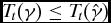 $T_t({\gamma }) \le T_t(\hat{\gamma })$
; therefore, the outcome in the game θ
t
is A for both spillover rates. Furthermore, ψ
B
t
(γ) = ψ
B
t + 1(γ) and
 $\psi\,\ ^B_t(\hat{\gamma }) = \psi\,\ ^B_{t+1}(\hat{\gamma }),$
so (iii) holds. To prove (ii) holds, by assumption, ψ
A
t + 1(γ) = θ
t + 1. There exist two possibilities: First, if
 $\theta _{t+1} < \psi\,\ ^A_t{\hat{\gamma }}$
, then (ii) holds strictly. Otherwise,
 $\theta _{t+1} = \psi\,\ ^A_t(\hat{\gamma })$
and
 $\psi\,\ ^A_t(\gamma ) = \psi\,\ ^A_t(\hat{\gamma })$
, so (ii) holds weakly.
To prove (i) holds, we first solve for T t + 1(γ):
 $$\begin{equation}
T_{t+1}(\gamma ) = \frac{\theta _{t+1} + \psi\,\ ^B_t({\gamma })}{2}
\end{equation}$$
To solve for
 $T_{t+1}(\hat{\gamma })$
, let θ* = max
 $\lbrace \theta _{t+1}, \psi\,\ ^A_t(\hat{\gamma })\rbrace :$
 $$\begin{equation}
T_{t+1}(\hat{\gamma }) = \frac{\theta ^*+ \psi\,\ ^B_t(\hat{\gamma })}{2}.
\end{equation}$$
By induction,
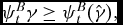 $\psi\,\ ^B_t{\gamma } \ge \psi\,\ ^B_t(\hat{\gamma }),$
and by construction, θ* ≥ θ
t + 1, which completes this case.
Case 3:
 $T_t(\gamma ) < \theta _{t+1} < \psi\,\ ^B_t(\hat{\gamma })$
: First, consider the case where
 $\theta _{t+1} < T_t(\hat{\gamma })$
. The outcome is B for γ and A for
 $\hat{\gamma }$
. All three inequalities hold trivially. If
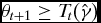 $\theta _{t+1} \ge T_t(\hat{\gamma })$
, then the outcome is B for both γ and
 $\hat{\gamma }$
. By assumption, ψ
B
t + 1 = θ
t + 1 and
 $$\begin{equation}
T_{t+1}(\hat{\gamma }) = \frac{\psi\,\ ^A_t(\hat{\gamma }) + \theta _{t+1}}{2}.
\end{equation}$$
To solve for T t + 1(γ), let θ* = min {θ t + 1, ψ B t (γ)}:
 $$\begin{equation}
T_{t+1}(\gamma ) = \frac{\psi\,\ ^A_t(\gamma ) + \theta ^* }{2}.
\end{equation}$$
By induction,
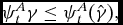 $\psi\,\ ^A_t{\gamma } \le \psi\,\ ^A_t(\hat{\gamma }),$
and by construction, θ* ≤ θ
t + 1, which completes the proof.
Proof of Claim 2: Let θ S denote a susceptible game. Without loss of generality assume that A is payoff maximizing in the susceptible game. Let θ o denote a game in which B is payoff maximizing. The sequence θ o followed by θ S produces outcome B in both games. The sequence θ S followed by θ o produces outcome A in the first game. The outcome in the second game will be A if θ o < θ B and B otherwise.
Proof of Corollary 2: To simplify notation, we write θ B (γ) as θ B and define θ A similarly. By assumption there exists games θ a and θ b such that θ a < θ A , θ b > θ B . Choose any susceptible game θ, i.e. a game θ in the interval (θ A , θ B ). The outcome in game θ will be A if the sequence of games begins with game θ a followed by θ. Similarly, the outcome in game θ will be B if the sequence of games begins with game θ b followed by θ. Additional susceptible games can be place in the sequence immediately after θ and they will have the same outcome as game θ.
Proof of Claim 3: This claim and several subsequent claims rely on the following formal definition of path dependence.
Path Dependence (Formal Def’n): Define Ω = {γ, (g
1, g
2, g
3, ..g
k
)} and
 $\hat{\Omega } = \lbrace \hat{\gamma },(\hat{g}_1,\hat{g}_2,\hat{g}_3,.. \hat{g}_{k^{\prime }})\rbrace$
to be outcome equivalent if and only if for any game played next, the same outcome is produced in both contexts, g ∈ G,
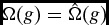 $\Omega (g) = \hat{\Omega }(g)$
.
Given Ω and
 $\hat{\Omega }$
that are outcome equivalent, we say that Ω exhibits greater path dependence if and only if for any game, the set of sequences of future games that changes the outcome in game g in context Ω strictly contains the set of sequences of future games that change the outcome in context
 $\hat{\Omega }$
.
 $$\begin{eqnarray}
&&\left\lbrace C_m \in \Psi _m : \hat{\Omega }(g) \ne (\hat{\Omega },C_m)(g) \right\rbrace \nonumber\\
&& \subset \left\lbrace C_m \in \Psi _m : \Omega (g) \ne (\Omega ,C_m)(g) \right\rbrace \:\: \forall g \in G \; \forall m \ge 1 \nonumber\\
\end{eqnarray}$$
We now proceed to the proof of claim 3: The proof uses payoffs from the traditional and innovative strategies game and relies on a counterexample. Assume context Ω = {0.8, (1, 15)} and context
 $\hat{\Omega } = \lbrace 0.75,( \emptyset )\rbrace$
, where ∅ denotes the empty set. Initially,
 $T = \skew5\hat{T} = 8$
. The susceptible region in context Ω contains the susceptible region for context
 $\hat{\Omega }$
. Now, consider the game θ = 1. In Ω, the threshold does not change. However, in context
 $\hat{\Omega }$
,
 $\skew5\hat{T}$
moves to 10. This means that the sequence (1, 9) would produce an inefficient outcome in
 $\hat{\Omega }$
but not in Ω. Therefore, Ω cannot exhibit greater path dependence.
Proof of Claim 4: Let
 $T = \skew5\hat{T}$
equal the common threshold in both contexts. Let θ
a
equal the largest θ
k
in context Ω that produces outcome A and θ
b
equal the smallest θ
k
in context Ω that produces outcome B. Define
 $\hat{\theta }^a$
and
 $\hat{\theta }^b$
similarly for context
 $\hat{\Omega }$
. The interval [θ
L
, θ
U
] can be partitioned into six intervals:
 $$\begin{equation}
[\theta_L,\theta^a) , [\theta^a,\hat{\theta}^a), [\hat{\theta}^a,T), [T,\hat{\theta}^b), [\hat{\theta}^b,\theta^b), {\rm and} [\theta^b),\theta_U].
\end{equation}$$
Without loss of generality, assume that, for the next game, θ < T, so the outcome equals A. We first state a lemma.
Lemma 2.
The introduction of the first new game moves T, the threshold in context Ω, at least as far as it moves
 $\skew5\hat{T}$
, the threshold in context
 $\hat{\Omega }$
.
First, note that if context Ω has produced a B outcome, then so has
 $\hat{\Omega }$
. If θ ∈ [θ
L
, θ
a
), then neither threshold moves and the result holds. If
 $\theta \in [\theta ^a,\hat{\theta }^a)$
, then only T moves, so the result holds. Finally, if
 $\theta \in [\hat{\theta }^a,T)$
, then the thresholds move to
 $\frac{\theta + \theta ^b}{2}$
and
 $\frac{\theta + \hat{\theta }^b}{2}$
in contexts Ω and
 $\hat{\Omega }$
respectively. Given that
 $\theta ^b \le \hat{\theta }^b$
, the result follows.
Given the lemma, it follows that after the introduction of the game θ, the set of games that produce different outcomes is larger in context Ω than in context
 $\hat{\Omega }$
. Therefore, after one game has been added, context Ω produces more path dependence than context
 $\hat{\Omega }$
. Note that, given any sequence of future games, the susceptible region of Ω is at least as large as the susceptible region of
 $\hat{\Omega }$
. We now state another lemma:
Lemma 3.
If contexts Ω and
 $\hat{\Omega }$
have both produced both types of outcomes and if Ω has a larger susceptible region, then any new game will move T at least as far as it moves
 $\hat{T.}$
We can assume that the new game produces outcome A, that is, θ < T. Suppose first that
 $T \le \skew5\hat{T}$
. If θ ∈ [θ
L
, ), then
 $\skew5\hat{T}$
does not change, so the result holds. If the interval
 $[\hat{\theta }^a,T)$
is not empty and contains θ, then the thresholds become
 $\frac{\theta + \theta ^b}{2}$
and
 $\frac{\theta + \hat{\theta }^b}{2}$
in contexts Ω and
 $\hat{\Omega ,}$
respectively. Given that
 $\theta ^b \le \hat{\theta }^b$
, the result follows.
Next suppose that
 $T \ge \skew5\hat{T}$
. As before, if
 $\theta \in [\theta _L,\hat{\theta }^a)$
, then
 $\skew5\hat{T}$
does not change, so the result again holds. If
 $\theta \in [\hat{\theta }^a, \skew5\hat{T})$
then the thresholds move to
 $\frac{\theta + \theta ^b}{2}$
and
 $\frac{\theta + \hat{\theta }^b}{2}$
in contexts Ω and
 $\hat{\Omega ,}$
respectively. Given that
 $\theta ^b \le \hat{\theta }^b$
, the result follows. Finally, suppose that
 $\theta \in [\skew5\hat{T},T)$
. Now the outcomes in the two contexts differ. The outcome in context Ω is A but the outcome in context
 $\hat{\Omega }$
is B. The thresholds therefore move to
 $\frac{\theta + \theta ^b}{2}$
and
 $\frac{\theta + \hat{\theta }^a}{2}$
in contexts Ω and
 $\hat{\Omega ,}$
respectively. In context Ω, the threshold moves a distance
 $\frac{1}{2}(\theta - \theta ^a)$
. In context
 $\hat{\Omega }$
, the threshold moves a distance
 $\frac{1}{2}(\theta - \hat{\theta }^b)$
. Given that
 $\skew5\hat{T}$
is the midpoint of
 $\hat{\theta ^a}$
and
 $\hat{\theta ^b}$
, the result follows from the fact that
 $\mid \theta - \hat{\theta ^b}\mid < \mid \theta - \hat{\theta ^a}\mid$
and that
 $\theta ^a < \hat{\theta ^a}$
.
Proof of Corollary 3: Follows directly from Claim 4.
Proof of Claim 5: By Claim 1, the size of the initial susceptible region weakly increases in γ. To show that initial path dependence strictly increases, we must show first that for any sequence of future games (θ1, θ2, ...θ
k
), that if all outcomes are the same given γ, then they must also all be the same for
 $\hat{\gamma } > \gamma$
, and second, that there exists a sequence of future games that produces a different outcome given γ but not given
 $\hat{\gamma }$
. It suffices to consider cases where the first outcome is A. In any sequence of future games, all outcomes will be A if and only if θ
i
< θ
B
(γ), the boundary of the immune region for B given γ. The result follows from the fact that
 $\theta ^B(\hat{\gamma }) > \theta ^B(\gamma )$
. To show that there exists a sequence of future games that produces an outcome of B for some game under γ but not under
 $\hat{\gamma }$
, consider the single game sequence of future games,
 $\theta _2 \in (\theta ^B(\hat{\gamma }), \theta ^B(\gamma ))$
. It has outcome B in the context defined by γ and outcome A in the context defined by
 $\hat{\gamma }$
. The proof that in the limit as γ approaches one, that the extent of initial game dependence converges to one, follows directly from Eqs. (A1) and (A2).
Proof of Claim 6: Assume that there exists an i < j such game α j appears before α i . Let j be the last α j in the sequence for which this occurs. Thus, any games that appear between α j and α i will be β games. Let t denote the epoch in which game α j appears. Note that if game α j produces outcome A, then so must game α i . Therefore, there exist three possible pairs of outcomes in the original sequence.
Case 1: Both α j and α i produce outcome A: Construct a new sequence by moving game α i before game α j leaving all other games unchanged. The threshold in epoch t exceeds α j in both sequences, therefore, in the new sequence, game α i produces outcome A. The threshold in the new sequence in epoch t + 1 is weakly larger than the threshold in epoch t, so game α j produces outcome A. The thresholds for all subsequent games are unchanged from the original sequence.
Case 2: Both α j and α i produce outcome B: After epoch t, the threshold is less than α j in the original sequence, so β games that follow game α j produce outcome β. Construct a new sequence, by moving game α j after game α i and moving all β games that occur after α j before α i . All the β games moved still produce outcome B because, in the original sequence, the threshold at t had to be less than the efficiency cutpoint, θ=. It remains to consider the α games. If game α i produces outcome B, then game α j faces a weakly lower threshold than in the original sequence and still produces outcome B. Further, any α games that follow have unchanged thresholds. If, in the new sequence, game α i produces outcome A, but game α j produces outcome B, then once again, the thresholds for all subsequent α games will be unchanged. (Note that the new sequence is more efficient because it produces an efficient outcome in game α i .) If both games α i and α j produce outcome A in the new sequence, then by the proof of Lemma 1, the thresholds for all games that occur after α j are larger than α j . Previously, those thresholds had been less than α j , therefore, all subsequent games are more likely to produce efficient outcomes.
Case 3: Game α j produces outcome B and game α i produces outcome A: Construct the same sequence as in Case 2: move β games that occur after epoch t ahead of game α j and then switch the order of games α i and α j . In the original sequence, game α i produces outcome A. If game α i is immune, it produces outcome A. Assume not. The threshold faced by game α i in the original sequence was the midpoint of the smallest α that produced outcome B (possibly game α j ) and the largest α that produced outcome A. In the new sequence, α j appears after α i , so the threshold when game α i appears has a weakly larger value than in the original sequence. Therefore, game α i produces outcome A. If game α j produces outcome B, then the thresholds for all subsequent games are unchanged in the two sequences. If game α j produces outcome A, the thresholds for all subsequent games will be greater than α j . In the original sequence, the thresholds for those games were less than α j , so those games are more likely to produce efficient outcomes.
Proof of Claim 8: We first prove sufficiency. Suppose no games exceed balanced sequencing. It suffices to consider the case where k α < k β so that the sequence (α1, β1, α2, β2 ..α k α , β k α , ..β k β ) results in efficient outcomes for each game. In what follows, we refer to this as the alternating sequence. When game α j occurs in the sequence, j − 1 of the β games occur earlier in the sequence. By assumption j − 1 < I(α j ), which implies that the efficient outcome occurs in game α j . Similarly, when β i occurs in the sequence, i of the α games have been added to the sequence. By assumption, i ≤ I(β i ), which implies that the efficient outcome occurs in game β i .
Next assume that balanced sequencing is violated. Let I(α j′) be the first α that exceeds balanced sequencing and I(β i′) be the first β that does. Note first that I(α j′) cannot equal I(β i′). If it did, given that i′ > I(β I′) = I(α j′) and j′ > I((α j′)), by Condition (1) I(β I′) ⩾ j′. However, by assumption I(α j′) < j′, resulting in a contradiction.
By symmetry, assume that I(α j′) < I(β i′). Games can be added by the following algorithm.
Step 1: Up to game I(α j′), use the alternating sequence.
Step 2: Add all α games up to α j′.
Step 3: If no remaining games exceed balanced sequencing, add them according to the alternating sequence. If not, choose the unique game with the smallest index that exceeds balanced sequencing and go to Step 1.
This algorithm produces efficient outcomes in all games. By assumption, efficient outcomes exist for all games with indices less than j′ in both sequences and for games α j through α j′. Suppose that in Step 3, no remaining games exceed balanced sequencing. By Condition (1), if i > I(α j′), then I(β i ) ≥ j′, so games β i for i = I(α j′) to j′ produce efficient outcomes. If later games exceed balanced sequencing, the result follows by an identical logic.
To prove necessity, suppose that the conditions are violated. Let
 $\hat{j}$
equal the smallest j that exceeds balanced sequencing. Define
 $\hat{i}$
similarly if it exists. By symmetry, assume
 $\hat{j} \le \hat{i}$
. Given our assumption that the conditions are violated, there exists a β
i
s.t. i > I(α
j
) with I(β
i
) < j Suppose that
 $\alpha _{\hat{j}}$
comes before β
i
. By assumption,
 $I(\beta _i) < \hat{j}$
, which implies that β
i
produces an inefficient outcome. Alternatively, suppose that β
i
occurs before α
j
. By assumption, i > I(α
j
), then α
j
produces an inefficient outcome.
Proof of Corollary 4: Assume game β2 is the first game that produces an inefficient outcome. That is, it is closer to game α2 than it is to game β1. Suppose that game β2 is closer to α1 than to β2. Let
 $\beta ^1_2 = \frac{1}{2}(\beta _1+\alpha _2) + \epsilon _1$
for some small ∊1 > 0. If β2 is closer to β1
2, the proof is complete. If not, construct β2
2 that is closer to β1
2 than it is to α2 by setting
 $\beta ^2_2 = \frac{1}{2}(\beta ^1_2+\alpha _2) + \epsilon _2$
for some small ∊2 > 0. By construction, the outcome in game β2
2 is B. One can construct a sequence of β
n
2 similarly, such that the outcome in each game is B. If the ∊
n
converge to zero, then the β
n
2 converge to α2, so for some m, β2 is closer to β
m
2 than it is to α2 completing the proof.
Proof of Claim 10: The payoff from playing the efficient strategy in G T equals γM + (1 − γ)A T . The payoff from playing the equilibrium strategy used in G τ equals γA τ + (1 − γ)M. The first expression is larger than the second if and only if (2γ − 1)M + (1 − γ)A T > γA τ. This can be rewritten as (2γ − 1)(M − A τ) + (1 − γ)A T > (1 − γ)γA τ. Rearranging terms gives the result.




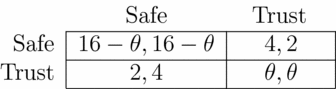

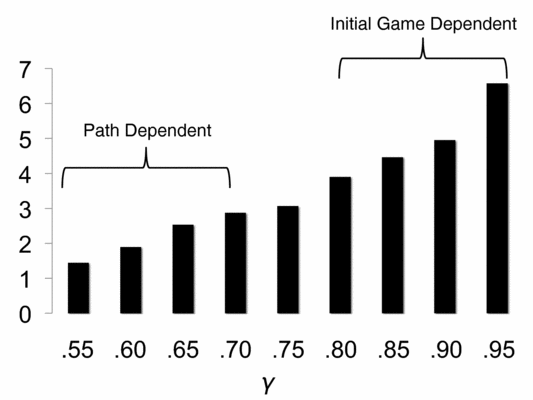
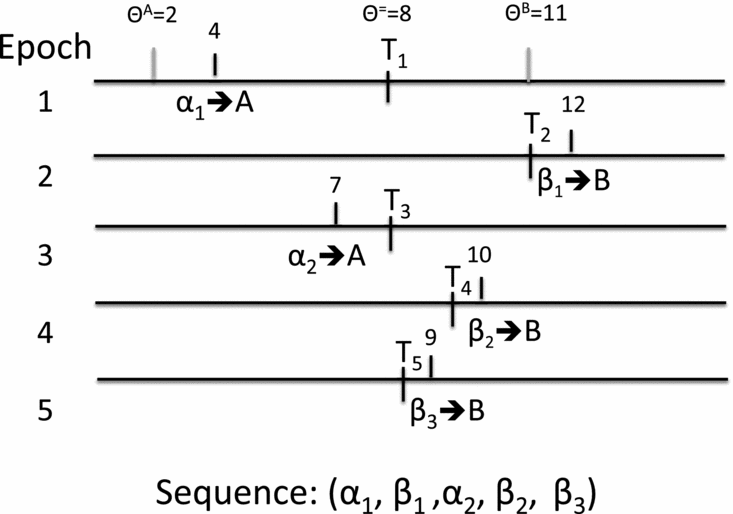
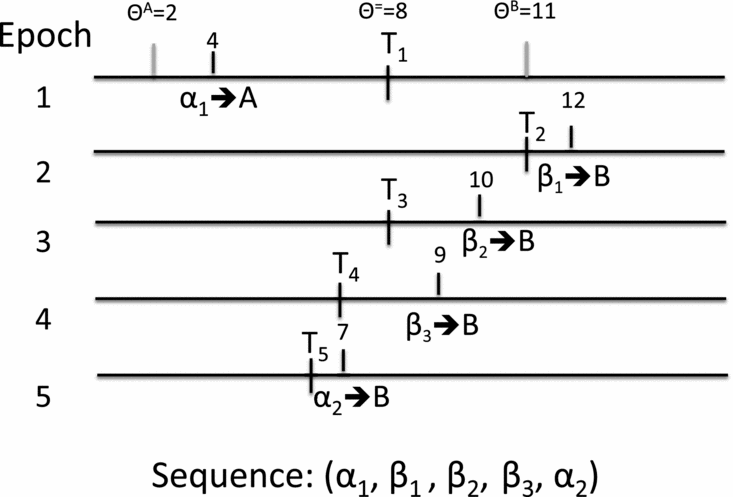
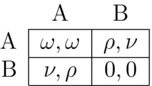
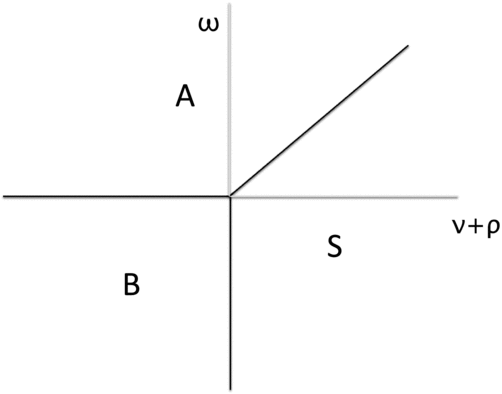



Comments
No Comments have been published for this article.