1 Introduction
This paper provides an account of regular templatic morphology, using general properties of phonology and its interface with morphosyntax.Footnote 1 I claim that regular templatic morphology is epiphenomenal; the apparent templates arise predictably from the interaction of prosodic well-formedness and recursive prosodic word structure triggered by syntactic cyclicity. This claim is supported by data collected by the author on Chukchansi (Penutian), a critically endangered Yokuts language spoken in Central California.Footnote 2
Chukchansi verb roots have different underlying shapes, such as those in (1), attached to the recent past suffix /-it/, which is shortened to [-t] after a vowel.
-
(1)

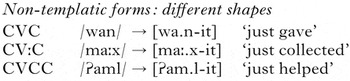
However, the majority of verb roots surface with a single shape, [CVCVː(C)], i.e. an LH disyllable, when in the context of certain suffixes, such as the causative /-la, -e/ in (2).
-
(2)

I will argue in this paper that iambic feet are optimal in Chukchansi, based on evidence from phonotactic vowel epenthesis, lexical root statistics and a small-scale acoustic study (Guekguezian Reference Guekguezian2016). Templatic morphology is the appearance of optimal prosodic structure. This optimal prosodic structure is an emergence of the unmarked effect (Prince & Smolensky Reference Prince and Smolensky1993, McCarthy & Prince Reference McCarthy and Prince1994), which arises when roots with a single underlying vowel are augmented to satisfy a disyllabic minimality requirement. The minimality effect is only visible in Chukchansi when a syntactically cyclic head sends the root (sometimes with the repetitive prefix red- or the unaccusative suffix /-n-/) to the phonology early, so that the sent material forms a prosodic word (ω) by itself. Verb roots with more than one underlying vowel meet the minimality requirement without augmentation, even when forming a ω by themselves, and thus do not have templates even when they would be expected to appear, e.g. when the causative suffix is attached, as in (3).
-
(3)

This paper claims that templatic morphology is not a distinct morphological phenomenon in Chukchansi, but is instead determined by cyclicity in the syntax–phonology interface. Specifically, template-triggering morphemes are phase heads in the syntactic derivation (Chomsky Reference Chomsky, Martin, Michaels and Uriagereka2000, Reference Chomsky and Kenstowicz2001), which send material in their complement to the phonology in an early cycle. Material sent early to the phonology must form its own ω in Chukchansi. For example, in (4a), the phase head B transfers CP to the phonology in Cycle 1. The phonological exponents of CP, /c/ and /d/, form the minimal ω1 in (4b). When AP is transferred in Cycle 2, its exponents, /a/ and /b/, are part of the maximal ω2. The two ω’s corresponding to the two syntactic cycles are recursive, not consecutive.
-
(4)
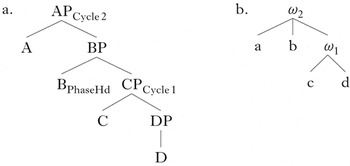
The shape of the internal ω (ω1) is determined by general phonotactic and prosodic constraints. These constraints can force the material inside the internal ω to form more harmonic prosodic structure than it would if there were only a single ω containing all the morphemes in a word. The harmonic prosodic structure in the internal ω gives the appearance of a fixed template shape.
In the model proposed above, regular templatic morphology is a highly restricted yet regular and predictable process. Templates must always be prosodically optimising according to the grammar of a given language. This is in line with the tenets of Generalised Template Theory (e.g. McCarthy & Prince Reference McCarthy and Prince1993, Reference McCarthy, Prince, Beckman, Dickey and Urbanczyk1995), which dispenses with language- and template-specific constraints in favour of universal constraints on prosodic markedness. However, the model proposed here goes a step beyond Generalised Template Theory, which includes correspondence constraints between morphological and prosodic units such as Stem = ω and Morpheme = σ. Instead of these constraints, this model accounts for the isomorphism of morphology and prosody by the cyclic transfer of material from syntax to phonology.
Moreover, in this model, templates only occur in the context of a cyclic head in the syntax that induces ω-recursion through early spell-out of the root. Templatic morphology does not need to be specially associated with either an affix that carries a diacritic feature causing the template to appear (as in an Item-and-Arrangement model of morphology; Chomsky & Halle Reference Chomsky and Halle1968, Halle & Marantz Reference Halle and Marantz1993) or a process that is the exponent of a morphological context (as in an Item-and-Process model; Aronoff Reference Aronoff1976, Anderson Reference Anderson1992). In fact, the cyclic heads do not actually ‘trigger’ the template, since they are in a different cycle than the roots they send, and cannot impose a template on these roots (see e.g. Embick Reference Embick2010). Rather, I claim that regular templatic morphology predictably falls out from syntactic cyclicity and prosodic well-formedness requirements, and does not need to be memorised as a distinct morphological property or operation.
This paper is structured as follows. §2 presents data illustrating regular templatic morphology in Chukchansi, and describes its morphosyntactic and phonological contexts, as well as the prosodic properties of the language. §3 shows that templates are a predictable consequence of the grammar of Chukchansi. §4 demonstrates that this analysis correctly accounts for further complications in the templatic morphology. §5 concludes, with an eye toward applying this model of templatic morphology to other languages.
2 Templatic morphology in Chukchansi
This section provides evidence for the two major claims made in §1 about templatic morphology: templates are restricted to morphological contexts with syntactically cyclic (phase) heads, and their shapes are restricted to prosodically improving structures. The supporting evidence comes from Chukchansi, a member of the Yokuts language family. Another Yokuts language, Yowlumne, referred to in Newman (Reference Newman1944) as Yawelmani, has provided evidence for previous theories of templatic morphology in the work of Archangeli (Reference Archangeli1983, Reference Archangeli1991). The patterns of templatic morphology in Chukchansi are similar to those in Yowlumne, but not identical. This paper uses primary data collected by the author and fellow researchers over a period of six years through elicitation sessions with two native speakers. I note wherever these primary data conflict with previous data on Chukchansi in Newman (Reference Newman1944) and Collord (Reference Collord1968).
Templatic morphology in Chukchansi Yokuts involves changes in the shape of certain roots, the template-bearers, in the context of certain suffixes, the template-triggers. These changes are not predictable from the general phonotactics of Chukchansi, in contrast to predictable changes occurring with all roots and affixes whenever their phonological context is met (see e.g. Kuroda Reference Kuroda1967, Kisseberth Reference Kisseberth1970, Kenstowicz & Kisseberth Reference Kenstowicz and Kisseberth1979 for similar changes in Yowlumne). Since templatic changes are not predictable from the consonant and vowel sequences of the suffix and the root, they must be triggered by the associated suffix (Archangeli Reference Archangeli1983). As we have seen, for forms with the causative suffix in (2), the constant shape triggered is [CVCVː(C)], which forms an iambic foot (σμσμμ); the second vowel is a copy of the first vowel with three-consonant roots and the fixed vowel [aː] with two-consonant roots.
(5) illustrates three surface forms of underlying Chukchansi roots, two of which are repeated from (1) and (2): attached to a consonant-initial suffix (/-taʔ/ (remote past)), a vowel-initial suffix (/-it/ (recent past)) and a template-triggering suffix (/-la, -e/ (causative)) followed by the recent past suffix /-it/, as in (2).Footnote 3
-
(5)
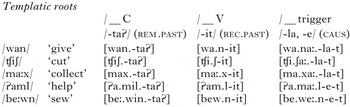
As (5) shows, the templatic forms of the root, found when the root linearly precedes a triggering suffix, are not phonotactically predictable. Phonotactically predictable vowel shortening and epenthesis are motivated by the need to fit consonants and vowels into maximally CVX syllables (where X can be C or V); these processes are shown by the remote past forms in (6) (see Kenstowicz & Kisseberth Reference Kenstowicz and Kisseberth1979, among others, for Yokuts syllable phonotactics).
-
(6)

However, the templatic epenthetic vowel [aː] in the second syllable of the template is not needed to fit the CVX syllable maximum.Footnote 4 The remote past suffix /-taʔ/ is consonant-initial, like the causative template-trigger /-la/, but does not require an epenthetic vowel following biconsonantal roots such as /wan/, /ʧi∫/ and /maːx/. Likewise, the recent past suffix /-it/ is vowel-initial, like the causative template-trigger /-e/, but does not require an epenthetic vowel with triconsonantal roots, e.g. /ʔaml/. Rather, the templatic epenthetic vowel [aː] only appears when template-triggers attach.
Moreover, the templatic epenthetic vowel only appears with certain roots, i.e. not all roots have templatic forms when a template-trigger attaches, e.g. /ʧ’edma/ ‘think’ and /haj'k'it/ ‘finish’, which have the same forms with and without a trigger, as shown in (7).
-
(7)
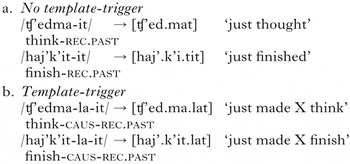
Template-triggers can also cause other changes in roots, including glottal stop infixation, glottalisation of a root consonant and fronting of the second vowel of the template to [e(ː)]. These changes only occur when templatic morphology is present, and are likely the result of autosegments associated with certain template-triggers (see Newman Reference Newman1944 and Zoll Reference Zoll1993 on Yowlumne). This paper focuses only on the prosodic shapes of the templates themselves, as the shapes are constant across template-bearers and triggers. Because the other changes only occur with some template-bearers and triggers, they are outside the scope of this paper.
In the remainder of §2, I present an account of templatic morphology in Chukchansi. The appearance of templates requires two conditions, one on the template-triggering environment (8a) and one on template-bearing morphemes (b).
-
(8)

Syntactically, cyclic head suffixes result in a recursive ω structure where the root forms an internal ω. A minimality condition on ω’s forces phonologically subminimal roots to be augmented to two syllables. As Chukchansi prefers to parse words into iambic feet, the augmented root surfaces with an iambically optimal (LH́) disyllable. If either of these conditions are not met, templates fail to appear, i.e. either when no syntactically cyclic suffix is present or when the root is phonologically large enough to satisfy minimality.
The remainder of §2 accounts for the conditions on the suffixes that trigger the templates (§2.1) and the roots that bear them (§2.2), as well as their shapes (§2.3).
2.1 Triggering condition: syntactically cyclic suffix
I first investigate the triggering condition on templates, i.e. what determines which suffixes occur with a templatic form of a root. The suffixes forming the morphological context of templates do not form a coherent phonological grouping that could conceivably result in templates. Phonotactic constraints in Chukchansi are sensitive to sequences of consonants and vowels, so that if templates were due to phonotactics, the suffixes triggering them would have similar consonant–vowel sequences. This is not the case: the different template-triggering suffixes in (9) consist of a single vowel (a), a single consonant (b), a consonant and a vowel (c) or two consonants followed by a vowel and third consonant (d). The morphological context of templates cannot be determined on a purely phonological basis.
-
(9)
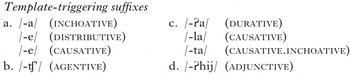
These suffixes do share a semantic property: they all modify the causal or dynamic properties of the event, as in (10). The causative and inchoative add an initial endpoint of causing or becoming to the event, while the durative and distributive modify the internal process of the event.
-
(10)
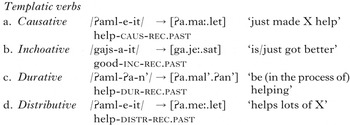
In addition to their nominalising functions, the agentive and adjunctive suffixes in (11) (active verbal noun and instrumental or locative verbal noun respectively) also specify that the event is active or dynamic.
-
(11)

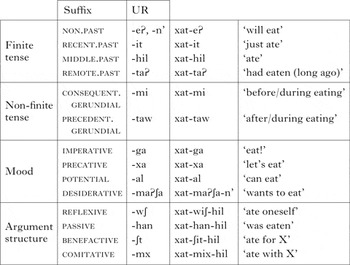
Other suffixes in Chukchansi do not modify the causal or dynamic properties of the event. These suffixes either have temporal (tense) or modal (mood) content, or manipulate argument structure. I give a full list of these in Table I, using the root /xat/, while (12) illustrates the unaccusative suffix /-n/, which does not appear with /xat/.
Chukchansi suffixes not triggering templates.

-
(12)

Syntactic heads specifying causal or dynamic properties of an event are verbalising heads, i.e. v0 (e.g. Burzio Reference Burzio1986, Kratzer Reference Kratzer, Rooryck and Zaring1996; see also Travis Reference Travis, Tenny and Pustejovsky2000). v0 heads are phase heads, which demarcate complete syntactic domains, spelling out their complements and ‘freezing’ the material inside (e.g. Chomsky Reference Chomsky, Martin, Michaels and Uriagereka2000, Reference Chomsky and Kenstowicz2001). I assume a syntactic framework combining Distributed Morphology (Halle & Marantz Reference Halle and Marantz1993), in which categorising phase heads merge with category-less roots, with Bošković’s (Reference Bošković2014) proposal that phasehood percolates to the highest head in the extended projection of a lexical category. In this framework, phasehood percolates from a lower, first-merged v0 (which I call ‘v10’), which verbalises the root, to a higher, later-merged v0 (‘v20’), which modifies the causal or dynamic properties of the verbalised root. In Distributed Morphology, while all categorisers (like v0) are phasal and spell out their complements, there is a difference between a first-merged v10 and a later-merged v20 (Marantz Reference Marantz2001). v10 does not spell out the root that it verbalises, while v20 spells out all material in its complement v1P (see e.g. Embick Reference Embick2010, Kastner Reference Kastner2016 for accounts of this difference).
I claim that suffixes in the template-triggering environment in (9) are all higher v20 phase heads (the agentive and adjunctive suffixes also express a categorising n head). The non-template-triggering suffixes in Table I are not v20 phase heads; tense and mood suffixes appear in Infl0, while argument structure suffixes are either voice, applicative or non-active v heads. For the purposes of this paper, the key property of these v20 suffixes is that they are syntactically cyclic, i.e. they send the verbalised root (the merger of the root with v10) to the interfaces with the phonological and semantic components. When one of these v20 suffixes is not present, the root is not sent to the interfaces early, as the lower v10 suffix does not spell out the root. In (13), the v20 phase head transfers its complement, v1P, to the phonology early in Cycle 1; the remaining syntactic material, including Infl0 and v20, is transferred to the phonology later in Cycle 2 by the phase head C0.Footnote 5
-
(13)

Syntactic cyclicity in the form of phase-based spell-out produces phonological effects, determining stress patterns at both the phrase level (Adger Reference Adger2006, Kratzer & Selkirk Reference Kratzer and Selkirk2007) and the word level (Marvin Reference Marvin2002, Newell Reference Newell2008, Piggott Reference Piggottms). Newell (Reference Newell2008) also demonstrates that phase-based spell-out influences different strategies of hiatus resolution, depending on whether the hiatus occurs across or within a spell-out domain. While it is reasonably certain that syntactic cyclicity can determine the size and position of phonological domains, there are competing theories of how this happens. Several strands of research adopt a derivational theory of phonology, where syntactic and phonological cycles are either necessarily synchronous (Samuels Reference Samuels2010) or can be isomorphic, subject to other parts of the grammar (Marvin Reference Marvin2002, Newell Reference Newell2008). Cheng & Downing (Reference Cheng and Downing2016) adopt a parallel theory of phonology where phase domains may be aligned with phonological domains; the phonology only gets access to syntactic cyclic structure at the end of the entire syntactic derivation. I adopt a similar model, in which phonology evaluates forms in parallel after the syntactic derivation has finished. In parallel phonology, the effects of syntactic cyclicity are retained in recursive prosodic domains, which the phonology builds using limited access to syntactic information.
When material from syntax is transferred to phonology, its syntactic constituents are organised into phonological constituents due to Match constraints (Selkirk Reference Selkirk2009, Reference Selkirk, Goldsmith, Riggle and Yu2011). Match constraints enforce correspondence between syntactic constituents, such as XPs, and equivalent prosodic constituents, such as Phonological Phrases. Here I am concerned with syntactic and prosodic words, which require the constraint MatchWord in (14) (Selkirk Reference Selkirk2009).
-
(14)

If MatchWord is satisfied, every syntactic word corresponds to its own ω (if it is lexical, not functional; Selkirk Reference Selkirk, Goldsmith, Riggle and Yu2011). I assume that ‘syntactic words’ in Chukchansi are complex X0’s formed by head movement of a lexical element (the root) to higher functional heads (Travis Reference Travis1984). The morphological organisation of this word mirrors its syntactic organisation (Baker Reference Baker1986).
(15) illustrates a Chukchansi verb with a higher phase head, with the root /wan/ encoding lexical meaning, a null verbalising v10, /-la/ (Sfx1 (v20)) causal or dynamic properties and /-it/ (Sfx2 (Infl0)) tense or mood. As v20 is a phase head, it transfers its complement v1P, with the root, in Cycle 1. (15b) shows both the abstract derivation, and the derivation for the example in (a).
-
(15)
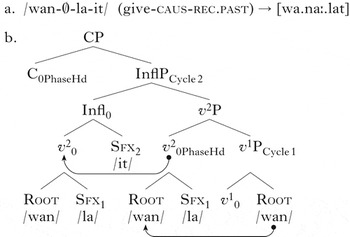
I claim that X0's are spelled out in each syntactic cycle; a word that spans two syntactic cycles will form two X0's. For example, while the Root in (15) moves up the syntactic tree after it is merged with the verbaliser v10, first to Sfx1 and then to Sfx2, it leaves a lower copy of itself in v1P (see Chomsky Reference Chomsky1993 for the copy theory of movement). Since the highest copy in a syntactic cycle is spelled out (Nunes Reference Nunes2004), the lower copy of the Root (+ v10) constitutes its own X0 at Cycle 1 (v1P in (16a)). When the remaining syntactic material (InflP) is transferred at Cycle 2 by C0, including Infl0 and the adjoined material (Root, v10, v20), the adjoined heads (Root + Sfx1+ Sfx2) constitute an X0 at Cycle 2 (InflP in (16b)). The two separate X0’s form the input of the verb to phonology.
-
(16)

Once the syntactic derivation finishes and all material is transferred to phonology, the phonological grammar comes into operation, including the constraint MatchWord (Cheng & Downing Reference Cheng and Downing2016). MatchWord demands that every X0 have a corresponding ω; crucially, both X0’s transferred in the two cycles in (16) must be matched to their own ω in (17).
-
(17)

MatchWord competes with constraints on insertion of morphosyntactic material into the phonology (e.g. Max-M and Dep-M; Wolf Reference Wolf2008). Among other things, such constraints demand that only one phonological entry is inserted for each morphosyntactic unit. To respect this demand, only one exponent of the Root ([wan] in (17)) appears in the phonological output. However, both ω’s in (17), [wan]W1 and [wan-la-it]W2, also appear in the output to satisfy MatchWord. The recursive structure [[wan]W1-la-it]W2 meets both demands: a single copy of [wan] is included in both ω1 and ω2. Due to the phonology of Chukchansi, analysed in §2.3 and §3, the recursive structure surfaces as [[wanaː]W1-la-t]W2 in (18).
-
(18)

In a Chukchansi verb without a Sfx1, no v20 head is present in the syntactic derivation. Instead, the phase head is v10, which, as shown in (19b), does not spell out the root it merges with.
-
(19)
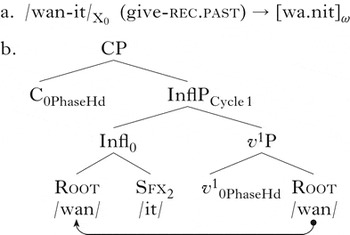
The verb root is transferred to phonology once, with the entire complex X0, including Sfx2 (Infl0), when the phase head C0 spells out its complement InflP. MatchWord demands that a single ω correspond to this X0, comprising the root and Sfx2, as in (20).
-
(20)

I demonstrate below that the difference between (18) and (20) is essentially between templatic verbs (recursive ω’s) and atemplatic verbs (single ω’s). The template's appearance is triggered by the internal (minimal or non-maximal) ω1; (18)). Prosodic well-formedness conditions on ω’s and feet give a constant shape to the internal ω1, depending on the underlying size of the root (and any other material transferred early). The constant shape of the internal ω1 is the template itself, which is thus triggered by the combination of early cyclic spell-out and the phonology of Chukchansi, not a diacritic or subcategorisation requirement of the suffix or a morphological process that is part of the suffix's exponent.
2.2 Bearer condition: phonological subminimality
While the suffix condition on templates is morphosyntactic and results in ω-recursion (§2.1), the bearer condition on templates is purely phonological. Roots that undergo templatic morphology are sufficiently small, i.e. they have one underlying vowel. Roots with more than one underlying vowel do not undergo templatic changes. Parallel with (5) above, (21) illustrates surface forms of underlying atemplatic roots.
-
(21)
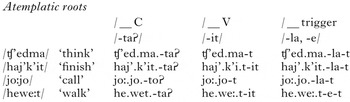
When roots precede non-template-triggering suffixes, their shapes are determined by phonotactics, which can compel vowel epenthesis and shortening. The shape of atemplatic roots next to template-triggering suffixes is also phonotactically determined. However, next to template-triggering suffixes, templatic roots form an LH disyllable, with epenthesis and shortening not due to phonotactics. The relevant difference between templatic and atemplatic roots is the number of underlying vowels: templatic roots have one vowel (short or long), while atemplatic roots have multiple vowels.
With one-vowel roots, templatic morphology is fully productive; all one-vowel roots form an LH sequence when a triggering suffix attaches, though some within-item optionality is apparent. While one-vowel (templatic) verb roots form the majority in Chukchansi, comprising about two-thirds of the total, multi-vowel (atemplatic) roots are also common. Although atemplatic roots do not have templatic morphology, they are fully integrated into Chukchansi morphophonology. /CVCVːC/ roots such as /heweːt/ have an LH sequence in all environments; this sequence, though, is phonotactically predictable. I assume parsimoniously that such roots do not undergo templatic change with triggering affixes, but simply surface with their underlying shape (cf. Newman Reference Newman1944, Archangeli Reference Archangeli1983, Reference Archangeli1991).
The distinction between one-vowel and multi-vowel roots has an equivalent surface generalisation: one-vowel roots form one syllable except when epenthesis is phonotactically necessary, while multi-vowel roots always form (at least) two syllables. Intriguingly, the templatic form of one-vowel roots is always disyllabic. These two generalisations can be unified in terms of minimality, if the relevant minimality requirement is two syllables. One-vowel roots are subminimal except when they bear a template, in which case they satisfy minimality; multi-vowel roots always satisfy minimality. I claim that templatic change is indeed a minimality effect, in which subminimal roots are augmented to satisfy minimality. Since multi-vowel roots are not subminimal, no augmentation is needed, as these roots can form two syllables using underlying material.
2.3 Template shape: (LH́) feet
I now show that Chukchansi has a single template, and that both this template and the language as a whole are iambic. While the stress patterns of Chukchansi are compatible with both iambic and trochaic parsings, phonotactic vowel epenthesis and a statistical study of lexical verb roots (§2.3.1) support iambic parsing. The constant template shape is a (LH́) foot, no matter the template-triggering affix. Long vowels and coda consonants both count for weight in Chukchansi, so /CVː/ and /CVC/ syllables are heavy; open syllables with a short vowel (/CV/) are light (Guekguezian Reference Guekguezian2011, following Archangeli Reference Archangeli1991 for Yowlumne). Moreover, the (LH́) foot is the optimal disyllable in Chukchansi, as it is in any language with iambic parsing (Prince Reference Prince1990, Kager Reference Kager1993, Hayes Reference Hayes1995). The (LH) foot of the template is simply a prosodic target, and can be filled with epenthetic or suffix material if the root does not provide enough segmental content. One-vowel roots with two or three consonants are augmented to (LH́) feet when certain affixes attach, as shown in (22); these include the causative, durative, agentive and adjunctive (see §2.1).
-
(22)
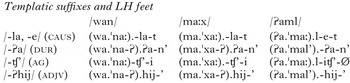
The relatively uncommon distributive suffix in (10d) also triggers an LH shape, as well as fronting the second vowel to [eː], giving [(ʔa.’meː).l-e-t].
One-vowel adjectival roots such as /gajs/ ‘good’ and /limk’/ ‘black’ also become LH disyllables when the inchoative and causative-inchoative verbalising affixes attach; these suffixes also front the second vowel to [e(ː)] , as in (23).
-
(23)
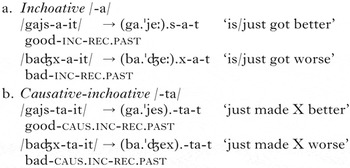
All the forms in (22) and (23) contain an (LH́) foot. This foot comprises as much root material as fits phonotactically; with three-consonant roots like /ʔaml/ and /gajs/, the final consonant falls outside the foot if a vowel follows. With two-consonant roots, the first consonant of the adjunctive suffix /-ʔhij/ is included in the (LH́) foot, which shortens the second vowel, as in (24) (cf. (22)); this is phonotactically predictable, as the glottal stop is in the coda and superheavy /CVːC/ syllables are impossible in Chukchansi.
-
(24)

In other templatic forms with two-consonant roots, the second syllable of the (LH́) foot is occupied by an extra vowel, [aː], intervening between underlying root material and the suffix, as in (25) (cf. (22)).
-
(25)

In the causative and adjunctive forms of two-consonant roots in (25), the templatic epenthetic vowel [aː] is long. In the durative form [(ma.’xa-ʔ).ʔ-an’] (from (22)), the templatic epenthetic vowel [a] is short. The short templatic epenthetic vowel [a] is also found in Collord's (Reference Collord1968) data, though Newman (Reference Newman1944) and Broadbent (Reference Broadbent1958) show long-vowel [aː] forms for Chukchansi. I claim that the absence of a long second vowel is due to a general Chukchansi demand that the glottal stop [ʔ] be linked to coda position (see Howe & Pulleyblank Reference Howe and Pulleyblank2001 for glottalisation's preference for the coda). If all glottal stops must be linked to the coda in Chukchansi (as glottalised sonorants are; Niken Adisasmito-Smith and Chris Golston, personal communication), then the glottal stop in the templatic forms is ambisyllabic, and prevents the previous vowel [a] from being long. I therefore transcribe the glottal stop of the durative in such forms as geminate, making the second syllable heavy.
The only constant in these templatic forms is the (LH́) foot, which may or may not be coextensive with underlying root material. I argue that this (LH́) foot is the sole target of regular templatic change in Chukchansi; the template is not a condition on the root, but a prosodic goal. This generalisation contrasts with the usual interpretation of the Yowlumne data in Newman (Reference Newman1944), in which different templates are triggered by different affixes (e.g. Archangeli Reference Archangeli1983, Russell Reference Russell1999).Footnote 6 In Chukchansi, underlying LH roots, /CVCVː/ and /CVCVːC/, optionally lose their final vowel with the causative and the agentive suffixes respectively. However, there are only three /CVCVː/ roots in Chukchansi, which display additional aberrant phonological behaviour, and are probably irregular. While /CVCVːC/ roots are common, final vowel loss with the agentive is optional, and may be tied to the accompanying glottalisation of a root consonant; since glottalised sonorants cannot occur before a vowel, this would prevent an (LH́) foot.
I now demonstrate that the (LH́) foot of templatic morphology is the optimal disyllable of Chukchansi. On the basis of stress patterns and phonotactic vowel epenthesis, as well as a statistical study of the lexical inventory of verb roots, I claim that Chukchansi is iambic, i.e. it preferably parses words into iambic feet. While (H́) and (LĹ) feet are more marked, only (LĹ) is ill-formed in Chukchansi. I adopt Kager's (Reference Kager1993) account of (LĹ) as the most marked iamb, commonly avoided through iambic lengthening in many languages (Hayes Reference Hayes1995).
Stress in Yokuts languages has not been thoroughly investigated, although Newman (Reference Newman1944) and Collord (Reference Collord1968) give brief descriptions. Newman reports that Yokuts languages, presumably including Chukchansi, have very consistent penultimate stress, with a few morphologically restricted exceptions. Collord states that Chukchansi has primary penultimate stress, as well as secondary stress on non-penultimate heavy syllables ([CVː] and [CVC]). Mello (Reference Mello2012) undertakes a pioneering investigation of Chukchansi stress using a variety of acoustic and phonological methods, including native-speaker judgements. Mello finds that primary stress is typically penultimate, but is attracted to a long-vowelled antepenult; he does not investigate secondary stress, and it cannot be inferred that syllables without primary stress are unstressed. Mello's study is restricted to two- and three-syllable words, and is sometimes at odds with previous knowledge of Chukchansi syllable structure. Other current researchers working on Chukchansi have not found consistent stress at all (Niken Adisasmito-Smith and Chris Golston, personal communication).
To gain a clearer view of Chukchansi stress, I conducted a small acoustic investigation with a single speaker (Guekguezian Reference Guekguezian2016). Using Mello's (Reference Mello2012) finding that pitch (F0) and intensity peaks are phonetic correlates of stress in Chukchansi (as well as in many other languages, e.g. Fry Reference Fry1955, Beckman Reference Beckman1986), this investigation found multiple, quantity-sensitive stress in Chukchansi. Penultimate syllables are the main stress peaks in words, regardless of syllable weight; antepenultimate heavy ([CVː, CVC]) syllables are also stress peaks. Antepenultimate light ([CV]) syllables and final syllables never form stress peaks. Guekguezian (Reference Guekguezian2016) interprets this as follows: the penultimate and any preceding heavy syllables are stressed, and other syllables (light preceding the penultimate and final) are unstressed. These findings do not depart from Mello's (Reference Mello2012) native-speaker judgements on primary stress; however, I could not elicit additional, reliable judgements.
On the assumption that this gives an accurate picture of Chukchansi words in general, the stress patterns are illustrated in (26). Chukchansi is quantity-sensitive: any non-final heavy syllable is stressed, as in (a). Words with heavy penults are amenable to a parsing with left-to-right iambs.
-
(26)
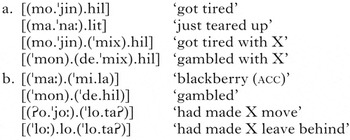
Light penultimate syllables are also stressed, as in (b). This is due to a prohibition on word-final stress (Prince & Smolensky Reference Prince and Smolensky1993, Hayes Reference Hayes1995), which causes a rhythmic reversal of the final foot to an (Ĺσ) trochee (a common phenomenon in iambic systems; see e.g. Prince & Smolensky Reference Prince and Smolensky1993, McCarthy & Prince Reference McCarthy and Prince1993).
The prohibition on word-final stress outweighs quantity-sensitivity: the word-final CVC syllables in (26b), some of which are heavy, are never stressed. These word-final CVC syllables cannot be light, i.e. word-final consonants cannot be non-moraic, since they shorten underlying long vowels (see Archangeli Reference Archangeli1991 for moraic codas causing vowel shortening).
Patterns of phonotactic vowel epenthesis suggest that Chukchansi is iambic, not trochaic. As shown for Yowlumne by Kisseberth (Reference Kisseberth1970) and Kenstowicz & Kisseberth (Reference Kenstowicz and Kisseberth1979), for example, surface clusters of three consonants do not exist in Chukchansi, since three consonants cannot fit into consecutive syllables without forming an illegal tautosyllabic cluster. In a string of three input consonants, a high vowel is epenthesised between the first and second: /CCC/ → [CiC.C]. Input three-consonant clusters mainly occur when roots ending in two consonants, such as /lihm/, attach to consonant-initial suffixes, such as remote past /-taʔ/, as in (27).
-
(27)

This raises the question of why the epenthetic vowel occurs between the first and second consonants rather than between the second and third, i.e. why /lihm+taʔ/ surfaces as [li.him.taʔ], not *[lih.mi.taʔ]. Both output candidates epenthesise the same vowel, and satisfy Chukchansi phonotactics. Under iambic parsing, the reason is immediately clear: [(li.’him).taʔ] has only an (LH́) iamb, but [(’lih).(’mi.taʔ)] has an (ĹL) trochee.Footnote 7
While an iambic analysis of Chukchansi straightforwardly captures the position of phonotactic epenthesis, a trochaic analysis of Chukchansi stress cannot easily do so. Trochaic stress does not favour [li.(’him).taʔ] over *[(’lih).(’mi.taʔ)] (or the clash-avoiding parses *[(’lih).mi.taʔ], *[lih. (’mi.taʔ)]), as both candidates contain well-formed bimoraic trochees. Picking the former candidate would require another, likely ad hoc, constraint, such as the alignment constraints used in Zoll (Reference Zoll1993). Under the iambic analysis, the selection of [(li.’him).taʔ] and [(ʔa.’leː).ʤa.(la.’wi∫).taʔ] is an emergence of the unmarked effect: when the grammar can freely choose between an iambic and a trochaic structure, it chooses the iambic one.
2.3.1 Statistical study of lexical roots
More evidence that Chukchansi is iambic comes from the lexical inventory of verb-root shapes. Verb-root shapes that tend to result in non-final LL syllable sequences are statistically underrepresented in the lexicon, while root shapes that tend to result in other sequences are overrepresented. Non-final LL sequences cannot be faithfully parsed into well-formed iambic feet, in which an even duration of unstressed and stressed units is dispreferred (the Iambic/Trochaic Law (Hayes Reference Hayes1995); see also Kager Reference Kager1993 for the relative ill-formedness of (LĹ) iambs). While many iambic languages avoid LL sequences through vowel lengthening or syncope, Chukchansi does not; rather, non-final LL sequences are rare due to the inventory of root shapes. The relative rarity of roots that surface with LL sequences is motivated if Chukchansi is iambic, but arbitrary if it is trochaic.
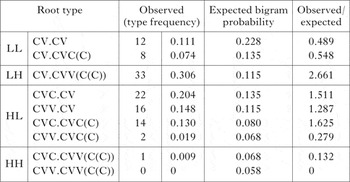
I labelled and counted all verbs in the Chukchansi dictionary (Adisasmito-Smith Reference Adisasmito-Smith2016) with exactly two underlying vowels, eliminating entries clearly derived from already present roots or recently borrowed from Spanish or English.Footnote 8 I divided the syllables into CV, CVC and CVV (ignoring any extra root-final consonants) to calculate the unigram probability of each syllable type and the bigram probabilities of each root type.Footnote 9 Table II displays the number and proportion of roots observed in the dictionary in terms of both CV and LH sequences (with the root-internal syllable boundary, constant across forms, added for clarity), and compares the expected bigram probability to the observed proportion of roots, giving the observed/expected ratio.
Observed vs. expected proportion of two-vowel verb roots by CV and LH sequence.

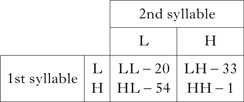
The observed/expected ratios show that LL root types are observed only half as often as expected. In contrast, LH and HL root types are observed more often than expected: two-and-a-half times more for LH (the best iambic root type) and one-and-a-half times more for HL (the next best). A χ2 test over a contingency table comparing just LH sequences (Table III), confirms this: the distribution of root types is not random, at a high level of significance (χ2 = 45.634, p < 0.01).
Contingency table of LH sequences.

The observed/expected ratios and the χ2 strongly suggest that LL root types are disfavoured in Chukchansi, while LH and HL are favoured. While the stress patterns of Chukchansi can be captured equally well with an iambic or a trochaic parsing, patterns of epenthesis and the distribution of lexical verb root shapes are only motivated with iambic parsing. Assuming iambic parsing, the appearance of the (LH́) template is more precisely the appearance of the optimal disyllable.
3 Analysis of templates
§2 provided evidence for the three claims in (28) about Chukchansi.
-
(28)
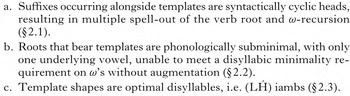
This section demonstrates that the appearance of templates follows completely and predictably from these three points. There is no need to appeal to diacritic properties of suffixes that occur with templates or a paradigm of templatic forms. When syntactically cyclic suffixes (i.e. v20 phase heads) appear, the material they attach to, i.e. the root, forms its own internal ω. ω’s in Chukchansi are minimally disyllabic, so that a root with one underlying vowel, such as /wan/, requires another vowel to meet minimality when it forms an internal ω, and is augmented to [wa.naː], to give (29a).Footnote 10 Because Chukchansi is iambic, the epenthetic material is arranged to form an (LH́) foot, evident both in cluster-repairing (phonotactic) epenthesis (§2.3 above) and in the minimality-meeting (templatic) epenthesis in (29a).
-
(29)
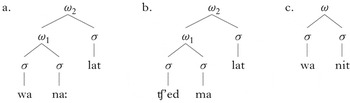
If the root is (at least) bivocalic, such as /ʧ’edma/, then it meets minimality using underlying material, as in (29b), and if it does not form its own internal ω (e.g. /wan/), then minimality is met using suffix material (e.g. /-it/), which always provides another vowel, as in (29c). Since underlying material is less available for manipulation than epenthetic material, an (LH́) foot only appears in the latter situations if it does not require rearrangement of underlying segments.
In what follows I offer a detailed analysis of the appearance of the (LH́) template when triggering (cyclic) suffixes attach to one-vowel (subminimal) roots with a short vowel (§3.1) and with a long vowel (§3.2). I account for the lack of the (LH́) template when triggering suffixes attach to multi-vowel roots in §3.3 and when no triggering suffixes attach to one-vowel roots in §3.4.
3.1 Roots with one short vowel
This section illustrates how the appearance of templatic morphology is a consequence of the combination of syntactically cyclic suffixes and phonologically subminimal roots, resulting from general Chukchansi phonology. I couch my analysis in an parallel optimality-theoretic framework (Prince & Smolensky Reference Prince and Smolensky1993), but a similar account is likely available using serial models, including Stratal OT (Kiparsky Reference Kiparsky2000), OT-CC (McCarthy Reference McCarthy2007) and Harmonic Serialism (McCarthy Reference McCarthy2008). My focus here is on roots with a short vowel; in §3.2 I extend this basic analysis to roots with a long vowel.
The section of the phonological grammar of Chukchansi I focus on involves several constraints, some mentioned above: the faithfulness constraint Dep(μ) (Dep(V) or Dep(seg) could be used instead), the footing constraints Parse-σ, Iamb and FootForm, and the minimality constraint Disyll. I define these in (30).
-
(30)
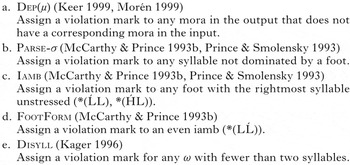
FootForm is a cover constraint for several universal well-formedness constraints on iambic feet, one of whose effects is to penalise (LĹ) feet. (LĹ) feet are also penalised by Stress-to-Weight (Prince Reference Prince1990) and Non-finality(Ft) (Hyde Reference Hyde2007), formulated in (31).
-
(31)

Disyll is a cover constraint whose effects are likely due to independent principles on the correspondence between morphological and phonological units (Kager Reference Kager, Nespor and Smith1996, Downing Reference Downing2006). However, Disyll is not reducible to a requirement that ω’s contain a binary foot (McCarthy & Prince Reference McCarthy and Prince1986); the minimal binary foot in Chukchansi is monosyllabic (H́), but the minimal ω is disyllabic. Many other, unrelated, languages allow monosyllabic (H́) feet but have disyllabic minimal words, including Japanese, Axininca Campa, Turkish and Guugu Yimidhirr (see Kager Reference Kager, Nespor and Smith1996 for references). Kager (Reference Kager, Nespor and Smith1996) and Garrett (Reference Garrett1999) demonstrate that minimality requirements on ω’s are often distinct from requirements that ω’s contain a minimal foot.
I now show how these constraints capture the augmentation of subminimal roots to the optimal (LH́) disyllable when they form an internal ω, using the root /wan/ for illustration. The (LH́) foot's appearance is an emergence of the unmarked effect; when violation of faithfulness (vowel epenthesis) is compelled by a higher-ranked constraint (Disyll), the resulting structure is as harmonic as possible, here in terms of foot parsing. For example, in a syntactic derivation with a v20 phase head, e.g. the causative suffix /la-/, the root /wan/ is spelled out to the phonology twice. This double spell-out causes /wan/ to compose an internal ω, which must be disyllabic, as in (32).
-
(32)

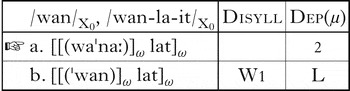
Disyll demands that ω’s contain two syllables; since the underlying material in /wan/ cannot form two syllables, material is epenthesised to support the second syllable. This epenthesis violates Dep(μ); to compel epenthesis of moras to support the second syllable, Disyll dominates Dep(μ), as in (33).
-
(33)
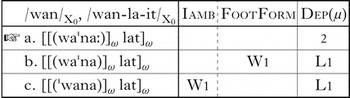
A disyllabic output can have one of four forms: LL, LH, HL or HH; because Chukchansi is iambic, the resulting disyllable is LH. An LL sequence can be parsed into an (ĹL) trochee, violating Iamb, or an (LĹ) iamb, violating FootForm. Because an LH sequence requires one more mora than an LL sequence, Iamb and FootForm dominate Dep(μ), and LH is optimal, rather than LL, as in (34).
-
(34)
An LH disyllable is also more harmonic than an HL or HH disyllable. HL parsed as (H́)L violates Parse-σ, while HH parsed as (H́)(H́) violates Dep(μ) more than LH. No crucial ranking is needed to favour LH, as shown in (35).
-
(35)
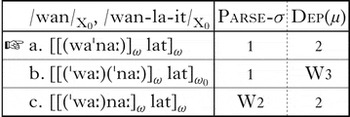
Crucially, in parallel OT, the Non-finality constraint against word-final stress in (36) only has maximal ω’s in its scope (see Prince & Smolensky Reference Prince and Smolensky1993 for Non-finality(ω), and Ito & Mester Reference Ito, Mester, Borowsky, Kawahara, Shinya and Sugahara2012, Reference Ito and Mester2013 and Elfner Reference Elfner2012, Reference Elfner2015 for constraints being sensitive to minimal and maximal ω’s).
-
(36)

In a cyclic OT model like Stratal OT (Kiparsky Reference Kiparsky2000), Non-finality(ω) would be ranked low enough to be inactive until the full ω has been constructed; this can be accomplished by reranking constraints at the second cycle. See also Newell (Reference Newell2008) for a distinction between languages that assign stress early and those that assign stress late; Chukchansi would then be of the latter type, as illustrated by [[(wa’naː)]W lat]W.
The constraint ranking in (33)–(35) also accounts for the templatic forms of the subminimal roots /ʧi∫/ and /ʔaml/ in (37).
-
(37)

The comparative master tableau in (38) illustrates that the templatic forms are the most harmonic (see Prince Reference Prince, Carpenter, Coetzee and de Lacy2002 on comparative tableaux).
-
(38)

Accounting for (37) requires two additions. I claim that a low templatic epenthetic vowel [aː] surfaces in (37a) (rather than a high vowel [iː] as in (39a)) due to the preference for stressed vowels to be more sonorous (de Lacy Reference de Lacy2002). Since this stressed vowel is epenthetic, it can assume the least marked quality for a stressed vowel: [a], the most sonorous vowel.Footnote 11
-
(39)

In a triconsonantal root with an underlying high vowel, the vowels of both syllables are mid, so the templatic epenthetic vowel appears to be a ‘copy’, as in (39b).
In (37b), the final consonant of the root /ʔaml/ (i.e. the spell-out of the morphosyntactic root) is not contained in the internal ω, but instead forms the onset of the next syllable. Because the morphosyntactic root is transferred to the phonology in two X0’s at different cycles (§2.1), its phonological form should correspond exactly to an internal ω. However, in (37b), the edge of the root is mismatched with the internal ω, as in (40).
-
(40)

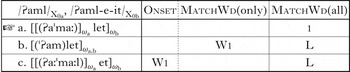
I assume that there is one ranking of all postsyntactic constraints, in which MatchWord is evaluated and ω’s constructed. To force the mismatch between the edges of the root and the internal ω in (40), Onset dominates MatchWord, which penalises mismatching of syntactic and prosodic edges. However, MatchWord, which is a categorical constraint (McCarthy Reference McCarthy2003), does not distinguish between the attested mismatch in (40), in which the X0 consonant /l/ is not contained in the corresponding ω, and the unattested mismatch in (41), in which the entire X0 /ʔaml/ is not contained in a distinct corresponding ω.
-
(41)

To distinguish the two mismatches, I split MatchWord into the two separate (but still categorical) constraints in (42) (see Reference GuekguezianGuekguezian in preparation for an expanded discussion of these two constraints in Creek/Muskogee/Seminole, and Elfner Reference Elfner2012 for a similar reformulation, but with a single Match constraint).
-
(42)
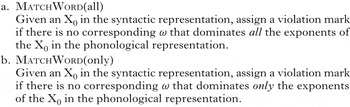
The attested mismatch in (40) violates MatchWord(all), because an exponent of the first X0 (specifically, the /l/ of X0a in (43a)) is not dominated by the corresponding internal ωa.
-
(43)

However, (43a) satisfies MatchWord(only), because ωa only dominates exponents of X0a. The unattested mismatch in (41) violates MatchWord(only), because material from the second X0 (the /et/ of X0b in (43b)) is dominated by a single ω, corresponding to both X0a and X0b. This violation cannot be avoided even if the single ω does not correspond to X0a, since there is still not a ω corresponding to X0a dominating only its exponents.
MatchWord(only) (as well as Onset) dominates MatchWord(all) in Chukchansi, as in (44), to favour the attested mismatches in (40) and (43a).
-
(44)
3.2 Roots with one long vowel
I extend the analysis in §3.1 to one-vowel roots with a long vowel. Long-vowel roots receive an (LH́) foot with triggering suffixes, as in (45).
-
(45)

The same ranking as (38) captures the augmentation of subminimal long-vowel roots to an LH disyllable. A root with one long vowel cannot form a disyllabic ω without epenthesis; when a mora is epenthesised to meet minimality, the resulting material forms an LH disyllable. However, the input vowel is long, while the first output vowel is short and the second long; the input vowel is manipulated to form the LH disyllable. A root with one long vowel (e.g. /maːx/) can become an LH disyllable (e.g. [(ma’xaː)]W) in three ways, illustrated in (46): (a) the first, short output vowel is epenthetic, and the input long vowel metathesises with the second root consonant; (b) the second, long output vowel is epenthetic, and the input long vowel shortens; (c) the second mora of the input long vowel flops onto and lengthens the epenthetic vowel.
-
(46)

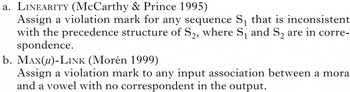
The three options involve violations of different constraints: (a) accrues a violation of Linearity (47a), (b) of Max(μ) (or Ident-V(long)) and an extra violation of Dep(μ) and (c) of Max(μ)-Link ((47b); Morén Reference Morén1999). Since there is no additional evidence to adjudicate, I do not choose between the three derivations.
-
(47)
3.3 Roots with multiple vowels
I have demonstrated that the appearance of the (LH́) foot with subminimal roots is an emergence of the unmarked effect; when epenthesis is necessary, the epenthetic material forms unmarked prosodic structure. I will now show that when a root is not subminimal, i.e. it is large enough to meet the minimality requirement, no epenthesis occurs, and unmarked prosodic structure does not emerge. The difference hinges on the availability of epenthesis: only epenthetic, not underlying, material can be rearranged to form an optimal (LH́) disyllable. While epenthetic material can be manipulated freely without violating faithfulness, since it has no input correspondents, underlying material is less able to be manipulated. Thus the underlying root material in (48) forms its own internal ω without epenthesis, and this material remains faithful to its underlying structure, rather than forming an (LH́) disyllable.
-
(48)

Different constraints prevent underlying material from changing. First, low-ranked Dep(μ) eliminates (LH́) challengers that epenthesise moras to form an optimal iamb; the forms in (48) do not violate the higher-ranked constraints Disyll, Iamb or FootForm in (49), since they contain (H́), a well-formed iamb in Chukchansi.
-
(49)

Second, constraints against changing input structure prevent the emergence of (LH́) feet when epenthesis does not occur. Such constraints include Max(μ)-Link, which penalises rearranging input structure in HL roots like /joːjo/ in (50a), and Linearity, which militates against metathesis in vowel-final roots like /ʧ’edma/ in (b).
-
(50)

3.4 Single-phase spell-out
If no higher v20 phase head is present in the derivation, the root is not transferred early to the phonology (since the lower v10 phase head does not spell out the root it merges with; see §2.1 for details). Because the root is transferred once with all its suffixes, the phonology does not build an internal ω. In this case, a single ω contains all the morphemes of the verb. All Chukchansi verbs require an overt suffix indicating tense or mood. Because all obligatory tense and mood suffixes contain a vowel, there is enough underlying material to form a disyllabic ω with the root and suffix. Thus in (51) no epenthesis is necessary to meet minimality, and material is not rearranged to form an (LH́) foot.
-
(51)

Since forms like (51) satisfy both Disyll and the prosodic constraints Iamb and FootForm, epenthesis of more material is prevented by low-ranked Dep(μ). Final stress is prohibited in the maximal ω, so that a disyllable with a light penult like (52) is an (ĹL) trochee (violating Iamb), not an (LH́) iamb (violating Non-finality(ωmax)).
-
(52)

Non-finality(ωmax) dominates Iamb, eliminating the (LH́) candidate, as in (53).
-
(53)
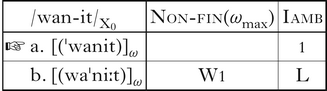
As in §2.3, when phonotactic vowel epenthesis is necessary to resolve a word-internal consonant cluster, a non-final (LH́) iamb emerges, satisfying Iamb, as in (54).
-
(54)

3.5 Summary of the analysis
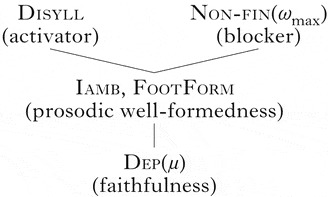
Optimal prosodic structure (the (LH́) disyllable) emerges as a minimality effect in an internal ω (both minimal and non-maximal ω in the recursive ω structure). However, the optimal (LH́) disyllable does not occur in an external ω (i.e. maximal or non-minimal), as external ω’s satisfy minimality using underlying material. Prosodic well-formedness is triggered in an internal ω, but not in an external ω. To capture this, a high-ranked constraint that only has a visible effect in internal ω’s activates a low-ranked prosodic markedness constraint by dominating a faithfulness constraint. In Chukchansi, this activating constraint is Disyll, which dominates faithfulness constraints such as Dep(μ) to allow augmentation to a disyllable. Faithfulness constraints are already violated by augmented forms, which surface with an (LH́) foot due to prosodic well-formedness constraints such as Iamb. External ω’s have at least two overt morphemes, and are almost always disyllabic, due to the lexicon of Chukchansi; Disyll therefore only has a visible effect on internal ω’s (see Piggott Reference Piggottms for more evidence of minimality targeting either an internal, first-cycle ω or an external, second-cycle ω). Prosodic well-formedness is blocked, not activated, in external ω’s. This can be modelled by a high-ranking constraint only relevant to the external ω dominating the relevant prosodic well-formedness constraints. The blocking constraint in Chukchansi is Non-finality(ωmax), which dominates Iamb to prevent an LH from being built in disyllabic maximal ω’s. Disyll and Non-finality(ωmax) both dominate the other faithfulness and prosodic well-formedness constraints whose ranking determines Chukchansi stress, as in (55).
-
(55)
4 Templates and other morphology
This section demonstrates how the analysis of apparently templatic morphology in Chukchansi involving minimality and ω-recursion correctly accounts for interactions of templates with other areas of Chukchansi morphophonology; these interactions are otherwise unmotivated. That templates result from disyllabic minimality correctly predicts that reduplication prevents the appearance of templates (§4.1), quadriconsonantal one-vowel roots do not have templates (§4.2) and intervening suffixes do not necessarily prevent templates (§4.3). An account where templates result from a process or diacritic property associated with the trigger has difficulty accounting for these data.
4.1 Reduplication
The account in §3.1 and §3.2, in which the template appears to meet disyllabic minimality, predicts that the (LH) template will not appear if subminimal root inputs have a disyllabic output due to other means, such as reduplication. The reduplicative prefix in Chukchansi, which typically denotes a repeated action, is always a CVC syllable, which, combined with the root (the base), satisfies disyllabic minimality, as in (56), where the base is underlined.
-
(56)
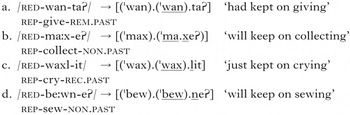
When the repetitive morpheme occurs with a phase-head suffix such as the causative, the phase head takes scope over the repetitive, as in (57).
-
(57)
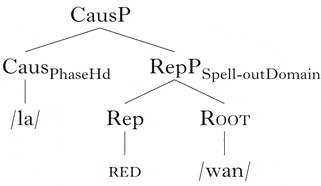
This is illustrated by the semantic composition of verbs with both these morphemes, which display the scope relation [Phase Head [Rep]]. For instance, a verb with both causative and repetitive morphemes (like (58a)) is [Caus [Rep]], meaning that a repetitive action was caused, not [Rep [Caus]], which would mean that an action was caused repeatedly. The scope relations show that the repetitive morpheme is below the phase-head suffix. The repetitive morpheme is spelled out early, along with the root, and forms part of the internal ω. The appearance of the reduplicative prefix provides a second syllable for the internal ω, so that no further augmentation is necessary to meet minimality and satisfy Disyll.
-
(58)

In fact, base–reduplicant faithfulness (BR-Faith; McCarthy & Prince Reference McCarthy, Prince, Beckman, Dickey and Urbanczyk1995) prevents either the base or the reduplicant from being arranged to form an optimal (LH́) foot, since rearrangement sacrifices identity between the base and the reduplicant. In (59), BR-Faith prevents copying less material into the reduplicant, so that the base and reduplicant together form a single (LH́) foot.Footnote 12
-
(59)
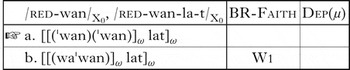
A minimality-based analysis of templates in Chukchansi accounts for reduplication preventing the appearance of a template. If templates are a diacritic property of the triggering morpheme, the presence of a different morpheme should not block them from appearing. Outside of the cyclicity-cum-minimality analysis, there is no principled reason why reduplication would prevent an (LH́)-constructing process from taking place, an abstract template from docking onto the root or a subcategorisation requirement on the root from being satisfied. The inability of templates and reduplication to co-occur would have to be stipulated.
4.2 Quadriconsonantal roots
Under the minimality-based account, templates (i.e. LH disyllables) appear only if the material to the left of the triggering (i.e. syntactically cyclic) suffix is sufficiently small. As shown by the templatic forms in §3.1, a UR with one vowel and three consonants /CVCC/ is ‘sufficiently small’, since it cannot form a disyllable without augmentation. A hypothetical UR with one vowel and four consonants, /CVCCC/, however, will always surface as a disyllable, because the three root-final consonants cannot be syllabified without a second, phonotactic epenthetic vowel [CVC.CiC]. Since such a root is always disyllabic on the surface, the minimality-based account predicts that templatic epenthesis is unnecessary, and that the (LH) template will not appear.
Roots with four consonants, like /haj’k’it/, always surface with at least two vowels, in order to syllabify all the consonants, as in (60).
-
(60)
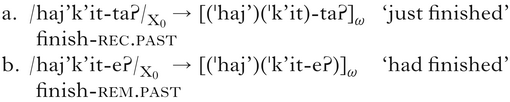
The second vowel in roots like /haj’k’it/ can be analysed as a predictable phonotactic epenthetic vowel [i], so that the underlying form of the root is /haj’k’t/, with one vowel and four consonants. The root /haj’k’t/ does not receive a template when a triggering suffix attaches, as in (61) (modified from (48b) in §3.3).
-
(61)

An (LH́) foot cannot be formed from a quadriconsonantal root without epenthesising too many vowels, violating Dep(μ). The non-templatic form in (61) syllabifies all input consonants with only one phonotactic epenthetic vowel, and parses the internal ω into well-formed (H́) feet. The unattested templatic forms in (62) form an initial (LH́) foot by epenthesising a templatic epenthetic vowel in addition to a phonotactic epenthetic vowel.
-
(62)

The (LH́) forms in (62) violate Dep(μ) more than the non-templatic output in (61), while not improving prosodic well-formedness, as shown in (63).
-
(63)
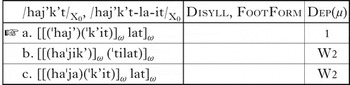
While a minimality-based account predicts that four-consonant roots like /hajk’t/ do not receive templates, it is unclear why such roots would prevent an LH-constructing process from occurring, an abstract template from docking or subcategorisation from being satisfied.
4.3 The unaccusative
The account in §3 also predicts that, if another suffix intervenes between the root and the template-triggering suffix, the template will still appear, as long as the suffix does not automatically result in disyllabicity. Since the template is not a condition on the root by an adjacent suffix, but a repair strategy to satisfy minimality, an intervening suffix should not automatically prevent the template (see Myler Reference Myler, Newell, Noonan, Piggott and Travisto appear for a similarly syntactic account of interactions across an intervening morpheme in Nyakusa, Ndebele and Sanskrit). This prediction is borne out: when the unaccusative suffix /-n/ occurs between biconsonantal one-vowel roots and a triggering suffix, the (LH́) foot appears, as in (64). Newman (Reference Newman1944) calls this behaviour ‘base-faking’, since the /-n/ of the suffix acts like part of the verb root (the ‘base’). In Newman's analysis, templates are operations over roots, so that the /-n/ suffix should not be part of a template. In (a) the unaccusative [-n] falls outside the internal ω, while in (b) it falls inside. The difference is due to predictable phonotactics: in (a) the [-n] is followed by a phonotactic epenthetic vowel [u] (rounded by vowel harmony), and must occupy onset position (see §3.1), while in (b) it is followed by a consonant [ʔ], and must occupy the coda.
-
(64)

The underlying material to the left of the triggering suffixes in (64), /ʤul-n/ and /seːp’-n/, has one vowel and three consonants, not enough to form a disyllabic ω without augmentation (like the triconsonantal one-vowel roots /ʔaml/ and /beːwn/). The minimality requirement is sensitive only to syllable count, not to morphological structure; moras are epenthesised to meet minimality whenever the input cannot do so, regardless of whether the input is just the root or a suffix as well. Ranking Disyll over Dep(μ) (as in (33) in §3.1) compels epenthesis of two moras, arranged into an (LH́) foot as per the prosodic constraints Iamb and FootForm (omitted for clarity in (65)).
-
(65)
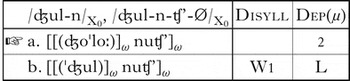
When the unaccusative /-n/ appears between triconsonantal one-vowel roots and a triggering suffix, like /ʔodb-n/ ‘open-unacc’, the (LH́) foot does not appear. These forms behave like four-consonant roots such as /haj'kt/ in §4.2: since a phonotactic epenthetic vowel is necessary to syllabify the final three consonants, disyllabicity is met without templatic epenthesis. (66) shows this atemplatic behaviour; (c) takes /-xo/, the allomorph of the durative suffix that appears when a ωmin satisfies disyllabicity without templatic epenthesis (cf. (64b)).
-
(66)

The forms in (66) all contain a phonotactic epenthetic vowel [i] in their second syllable, in order to syllabify the final three consonants (of the root and the unaccusative suffix). Since this vowel is already necessary to satisfy the phonotactic constraints of Chukchansi, the internal ω to the left of the triggering suffix meets disyllabic minimality without any other augmentation. An (LH́) foot cannot be constructed without epenthesising more moras, as in *[[(ʔo’doː)(‘bin)]W ʧ’i]W, *[[(ʔo’dib)]W (‘ni.ʧ’i)W]. Since the output in (66a) has (H́) feet, which are well-formed iambs in Chukchansi, Dep(μ) eliminates the (LH́) challengers, as in (67).
-
(67)
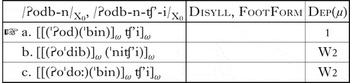
Again, a minimality-based account correctly predicts that when a root and suffix cannot provide two syllables on their own, the (LH́) foot appears by augmentation; if the root and suffix can do so, there is no augmentation or an (LH́) foot. An analysis of templates relying on the triggering suffix subcategorising for a templatic root has difficulty explaining why an intervening suffix does not block subcategorisation. An account where templates are imposed by a morphological mechanism or by a diacritic on the triggering suffix cannot distinguish why an intervening suffix allows templates with biconsonantal roots, but blocks them with triconsonantal roots.
5 Conclusion
This paper has accounted for the appearance of an invariant shape template on certain types of verb roots in Chukchansi Yokuts in the environment of certain verbal suffixes. The appearance of this template is a result of the combination of the syntactic properties of these suffixes and the phonological properties of the root. Suffixes that occur alongside templates are syntactically cyclic phase heads, which spell out verb roots to the phonology early, while roots that display templates are phonologically subminimal, with only one underlying vowel. When these conditions on the suffix and the root are met, the template appears as a minimality effect; the phase-head suffix requires the root (and any other material spelled out early) to form an internal ω, forcing augmentation of the phonologically subminimal root. When either condition is not met, i.e. there is no phase head-suffix that spells out the root early or the root has more than one vowel, the template does not appear, since minimality is satisfied without a template. The invariant shape of the template, an (LH́) iambic foot, is a consequence of general Chukchansi phonology: the ω is minimally disyllabic, and the (LH́) foot is the optimal iambic disyllable.
This paper has also provided new evidence for the claim that phase heads can induce ω-recursion, which can result in phonological minimality effects operating on the output of different syntactic cycles. This can be modelled with the constraint MatchWord, which requires that syntactic words (complex X0’s formed by head movement in Chukchansi) are mapped to prosodic words. These X0’s are sent to the phonology at spell-out, so that a spell-out domain within a morphological word matches a prosodic word. Morphological words that span multiple spell-out domains as in (68a) may thus show ω-recursion (68b), depending on the ranking of other morphological and phonological constraints.
-
(68)
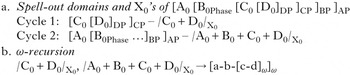
Other phenomena support the claim that cyclic spell-out can induce ω-recursion. In Creek/Muskogee/Seminole, an inner morphological constituent of a verb is exhaustively parsed into iambic feet, while material outside this constituent is typically unfooted (Haas Reference Haas and Hyman1977, Martin Reference Martin2011). Guekguezian (in preparation) shows that this inner constituent is the vP, while the rest of the material is in InflP. Assuming a syntax in which the phasehood of the verbaliser v0 percolates up to the Asp0 head (as Bošković Reference Bošković2014 claims for some languages), then the vP is sent early to the phonology and InflP is sent later, as in (69).
-
(69)

The inputs in (69b) are mapped to recursive ω’s (70), in which only the internal ω is parsed into feet (examples from Martin Reference Martin2011; ω-recursion mine).Footnote 13
-
(70)

Since in Creek the internal ω must be exhaustively parsed, when vP material cannot be parsed into binary iambic feet InflP material from the second X0 is parsed into the internal ω, as in (71a), causing a violation of MatchWord(only) (see §3.1 above), and blocking ω-recursion in some cases.
-
(71)

Overt Asp0 phase heads in Creek contain autosegmental material (Haas Reference Haas1940), which docks onto and lengthens the final vP vowel, allowing ω-recursion (71b).
The claim that regular templatic morphology results from ω-recursion (caused by syntactic cyclicity) and prosodic well-formedness (specifically a minimality requirement) likely extends beyond Chukchansi. For example, in other Yokuts languages, such as Yowlumne (Newman Reference Newman1944) and Wikchamni (Gamble Reference Gamble1978), the majority of fixed templates occurring with suffixes are (LH́) feet, as in Chukchansi. As in Chukchansi, almost all suffixes occurring with templates are higher v20 phase heads, modifying the aspectual event semantics of the verb root. Setting aside suffixes that Newman (Reference Newman1944) calls ‘rare’ or ‘unproductive’ or are restricted to a small subset of one-vowel roots, almost all of these v20 phase-head suffixes either occur with the (LH́) foot ‘template’ or start with a vowel and contain a glottal autosegment. These latter suffixes, like the consequent agentive /-a,?/ in (72), from Newman (Reference Newman1944: 157), potentially prevent the (LH́) foot from appearing, due to the phonotactics of glottalisation (Howe & Pulleyblank Reference Howe and Pulleyblank2001).Footnote 14
-
(72)

Templates outside of Yokuts may also be amenable to an analysis with syntactic cyclicity, ω-recursion and minimality. Stems in Sierra Miwok come in four different forms, three of which can be characterised as fixed templates (Broadbent Reference Broadbent1964). Most templatic forms of stems are disyllabic, suggesting that minimality may come into play here. Bye & Svenonius (Reference Bye and Svenonius2010) argue that the morphemes triggering the templates are aspectual, and that the different templatic forms are due to different autosegmental content interacting with Sierra Miwok phonotactics.
The apparent great variation of templates in Semitic languages may be amenable to a similar analysis. The different templatic forms of verb roots in Modern Standard Arabic (McCarthy Reference McCarthy, Stvan, Ryberg, Olsen, Macfarland, DiDesidero, Bertram and Adams1993) and Modern Hebrew (Ussishkin Reference Ussishkin2000) stem from a disyllabic ‘template of templates’ (cf. underived, basic verb roots, which may be monosyllabic). The morphological material forming the different disyllabic templates consists of the verb root and affixes modifying event and argument structure, i.e. vP material (e.g. Arad Reference Arad2003, Tucker Reference Tucker2010, Kastner Reference Kastner2016). Material outside the templates includes tense, mood and agreement affixes, i.e. InflP material. This suggests that templatic verbs in Semitic languages may have the approximate syntactic and phonological structure in (73), in which the vP material in internal ω forms the disyllabic ‘template’.
-
(73)
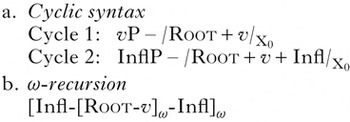
A detailed investigation of both the phasal syntax and the phonological conditions of templates in Sierra Miwok and Semitic languages is necessary to determine whether the account proposed for Chukchansi can be extended to them.
In summary, this paper has proposed two restrictions on templatic morphology. First, affixes which occur alongside templates must be syntactically cyclic phase heads, thus resulting in a recursive ω structure. Second, template shapes must be prosodically optimising, due to general prosodic constraints operating on the internal ω. These restrictions correctly account for templatic morphology in Chukchansi Yokuts. If all productive templatic morphology is amenable to a recursive ω analysis, then templates need no special morphological or phonological mechanisms. Instead, templatic morphology will be a regular phonological process of prosodic optimisation triggered by ω-recursion from syntactically cyclic, phase-head affixes.