This article responds to recent calls for studies that redress the developed-country bias of celebrity studies,Footnote 1 by examining the growth of, and public responses to, celebrity-fronted philanthropy in the People's Republic of China (PRC). Scholarly interest in the socio-political uses of fame is demonstrated by the launch of the Celebrity Studies journal in 2010 and the Journal of Fandom Studies in 2013. The rise of celebrity advocacy and philanthropy is also attracting academic attention, increasingly in the context of North–South relations.Footnote 2 Philanthropy denotes “the planned and structured giving of money, time, information, goods and services, voice and influence to improve the wellbeing of humanity and the community.”Footnote 3 Most contemporary philanthropy is organized in nature and associated with the professionalized not-for-profit sector – charities, foundations and non-governmental organizations (NGOs).
Celebrity-fronted philanthropy or “celanthropy”Footnote 4 encompasses diverse activities. Celebrities act as ambassadors for not-for-profits and the United Nations (UN); they donate money and goods, organize and attend fundraisers, establish and fund foundations, and attend or arrange meetings between policymakers and NGOs and charities more generally.Footnote 5 Specialist liaison companies and foundations now broker relationships between Hollywood talent agencies and not-for-profits. Websites such as Looktothestars.org and Ecorazzi.com also provide celebrity charity news to show “what the top stars are doing to make a positive difference in the world.”Footnote 6
Celanthropy is controversial, being viewed as a driver of positive social change or as something that upholds an exploitative economic system (corporate capitalism) and citizen “slacktivism,” that is, actions performed online in support of a cause that require minimal effort. Supporters argue that leveraging fame raises the profile of a given social issue campaign and its host organization by bringing extra media coverage, attracting new audiences, demystifying campaign issues, encouraging sponsorship, and promoting civic engagement.Footnote 7 Critics insist that celanthropy maintains inequality and is depoliticizing. It allows celebrities as (inexpert) “Big Citizens” to provide overly simplified accounts of socio-economic problems, encourages people to donate or purchase products for good causes, rather than becoming actively involved in change-making action, and focuses attention on Western celebrities and publics, rather than on developing countries and the recipients of aid.Footnote 8
While many academics are unimpressed with the perceived effects of celebrity-fronted philanthropy, there is little empirical research on celanthropy,Footnote 9 and only a small body of work on its extent and uses in developing countries like China.Footnote 10 Yet celanthropy has emerged as a visible phenomenon in China alongside the growth of media industries and the not-for-profit sector. The PRC's post-1978 abandonment of centralized economic planning, followed by the relaxing of state controls over China's media, and the increasingly commercialized, digitalized and internationalized nature of that media, has created new social actors in the form of celebrities, their publicists and management teams, and audiences for celebrity-related entertainment and news.Footnote 11 In the process, China's celebrities have become a new type of social elite. Some host hugely popular blogs, others act as delegates at the National People's Congress and Chinese People's Political Consultative Conference, and yet others promote national development through elite philanthropy and advocacy.Footnote 12
The newness and political importance of professionalized philanthropy in the PRC is highlighted in a 2014 State Council document, “On Promoting the Healthy Development of Philanthropy,” which urges all levels of government to introduce tax incentives to develop a legally registered not-for-profit sector that will complement government welfare services by 2020.Footnote 13 That year coincides with the end of the Thirteenth Five-Year Plan for National Economic and Social Development, which proposes to eradicate absolute poverty in China (just before the Communist Party's centenary in 2021). To develop the not-for-profit sector, the PRC government has made substantial changes to the regulatory framework controlling organized philanthropy in China. These changes aim to encourage the rapid growth of an indigenous not-for-profit sector by supporting demonstrably local organizations, while restricting the role of certain categories of international organizations and donors on the grounds of protecting national security.
The PRC's first Charity Law came into effect in September 2016, followed by the Law on the Management of Foreign Non-Governmental Organizations’ Activities within Mainland China in January 2017.Footnote 14 The Charity Law recommends providing tax incentives for three different types of domestic charitable organizations that meet annual reporting requirements. These are: (1) foundations (jijinhui 基金会); (2) social service organizations (shehui fuwu jigou 社会服务机构); and (3) social or membership associations (shehui tuanti 社会团体).
The law on foreign NGOs requires international NGOs in China to be registered and established not-for-profits that support PRC government policy. To operate legally in China, foreign NGOs must be legally established outside of mainland China and have carried out substantive activities overseas for two or more years, and be able to independently bear civil liability.Footnote 15 They must support PRC government public welfare objectives, including economic development, poverty alleviation, education, environmental protection and disaster relief. They must also register with public security departments, and not engage in or fund for-profit activities, political activities and (illegal) religious activities. Additionally, international NGOs without a China office can only become involved in temporary activities within the PRC if they formally cooperate with government and Party-led organizations.
The central government's endorsement of tax incentives for registered charities, together with a legal framework that limits the activities of international NGOs, suggests that the domestic not-for-profit sector is likely to expand rapidly. Organized philanthropic practice in Western societies is associated with the not-for-profit sector, which is also known as the community or third sector and as a part of civil society and non-governmental organization. In contrast, China's emerging not-for-profit sector is embedded within the Party-state system and hence is often characterized as being insufficiently “autonomous” or “non-governmental.”Footnote 16 This situation constrains the independent operation and development of not-for-profits. At the same time, government efforts to promote a philanthropic culture in China are creating more spaces for “ordinary” and famous people alike to become new actors in government-identified development issues.
Methods
We used three key methods that have been “tried-and-tested” in celebrity studiesFootnote 17 to examine the extent, nature, development and audience reception of PRC celanthropy. These involve analysis of a sample group, interviews and an online questionnaire.
First, we obtained a sample of mainland Chinese celebrities in entertainment and sports by combining five “Top Chinese Celebrity” lists. The five lists accessed on 12 May 2016 were: (1) Forbes’ 2015 China Top 100 Celebrities; (2) Baidu Today's Top 50 Entertainment Celebrities; (3) Sogou Top 100 Celebrities; (4) 123fans Female Entertainment Stars Popularity Rankings; and (5) 123fans Male Entertainment Stars Popularity Rankings.Footnote 18 The Forbes list ranks the highest-paid celebrities with the most media exposure; the Baidu list is based on the number of internet searches; and the Sogou and 123fans lists are based on online votes. The Forbes and Baidu lists are therefore skewed towards A-list or major celebrities, whereas the Sogou and 123fans lists also include minor and different types of celebrities.
A group of 421 celebrities (209 women and 212 men) was obtained as follows. We removed from the combined list the names of: (1) duplicates; (2) bands; (3) people whose date of birth could not be verified; (4) people who could not be identified through internet searches as a contemporary entertainment or sports celebrity; (5) celebrities who were not born in mainland China; and (6) corporate celebrities.
We then conducted an internet search on Google and Baidu, using the name of each celebrity and search terms for philanthropy to find any news stories, links and webpages that mentioned their philanthropic activity between January 2011 and December 2015. The search terms used were: “philanthropy/charity” (cishan 慈善), “public welfare/charity” (gongyi 公益), “compassion” (aixin 爱心) and “donate/donation” (juankuan 捐款). These search terms generated content about celebrity philanthropy-related activities in the broadest sense for subsequent analysis.
Second, we interviewed employees of China-based charities that use celebrity endorsers to explore the nature of organized celanthropy in the PRC and expectations about its prospects. Analysis of the sample group data revealed that 13 domestic charities had a high frequency of mediatized celebrity endorsement (10 or more instances), and 4 international charities had a high frequency of mediatized celebrity endorsement (5 or more instances). We approached these charities with requests for interviews using a systematic sampling method: five charities agreed; the others refused or did not respond.
In November 2016, we conducted five one-hour-long structured interviews with employees of the China Foundation for Poverty Alleviation, China Charities Aid Foundation for Children, Chinese Red Cross Foundation, China Youth Development Foundation, and an international NGO called Save the Children (China). These charities engage in poverty alleviation activities and/or provide humanitarian assistance to young people. The China Foundation for Poverty Alleviation was the only charity among our interview group with a dedicated department for celebrity communication (a “Partnership Office” in its Fundraising Department); the other charities had limited or no dedicated celebrity liaison staff. It also had the largest number of celebrity endorsements (around 100 activities per year), whereas Save the Children (China) had only a few. Our respondents had different employment titles, but their main responsibility is brand communication.
Third, we conducted an online multiple-choice survey of more than 2,000 respondents through the analytics firm Sojump.com. Sojump contacted its list of 2.5 million potential respondents through email, Wechat and QQ on 21 October 2016, using an incentive system (whereby respondents receive points that could be exchanged for products upon completion). The survey closed the day after the first 2,000 responses were received (1 November 2016).
The survey elicited responses pertaining to respondents’ demographic information, experience of donating/volunteering, and knowledge and opinions of celebrities and celanthropy. Potential respondents were not informed of the nature of the survey prior to responding; hence they did not “self-select” because they were interested in celebrity or philanthropy. Sojump uses a real-name registration system based on China's resident identity-card system, preventing multiple responses from the same person. We used a mixture of question types to mitigate problems associated with the use of incentives, which attract respondents but can encourage arbitrary responses. The question types included: categorical (yes/no), multiple choice (one answer only), checkbox (many answers) and interval (“strongly agree” to “strongly disagree”). We also removed incomplete surveys and those with formulaic “tick the first box” and “yes to everything” answering patterns. While our respondents came from diverse regions of China, the use of digital recruiting and response methods skews the survey towards young, educated people in developed provinces who spend considerable time online. This is, however, a key target audience of celanthropy.
Institutionalizing PRC Celanthropy
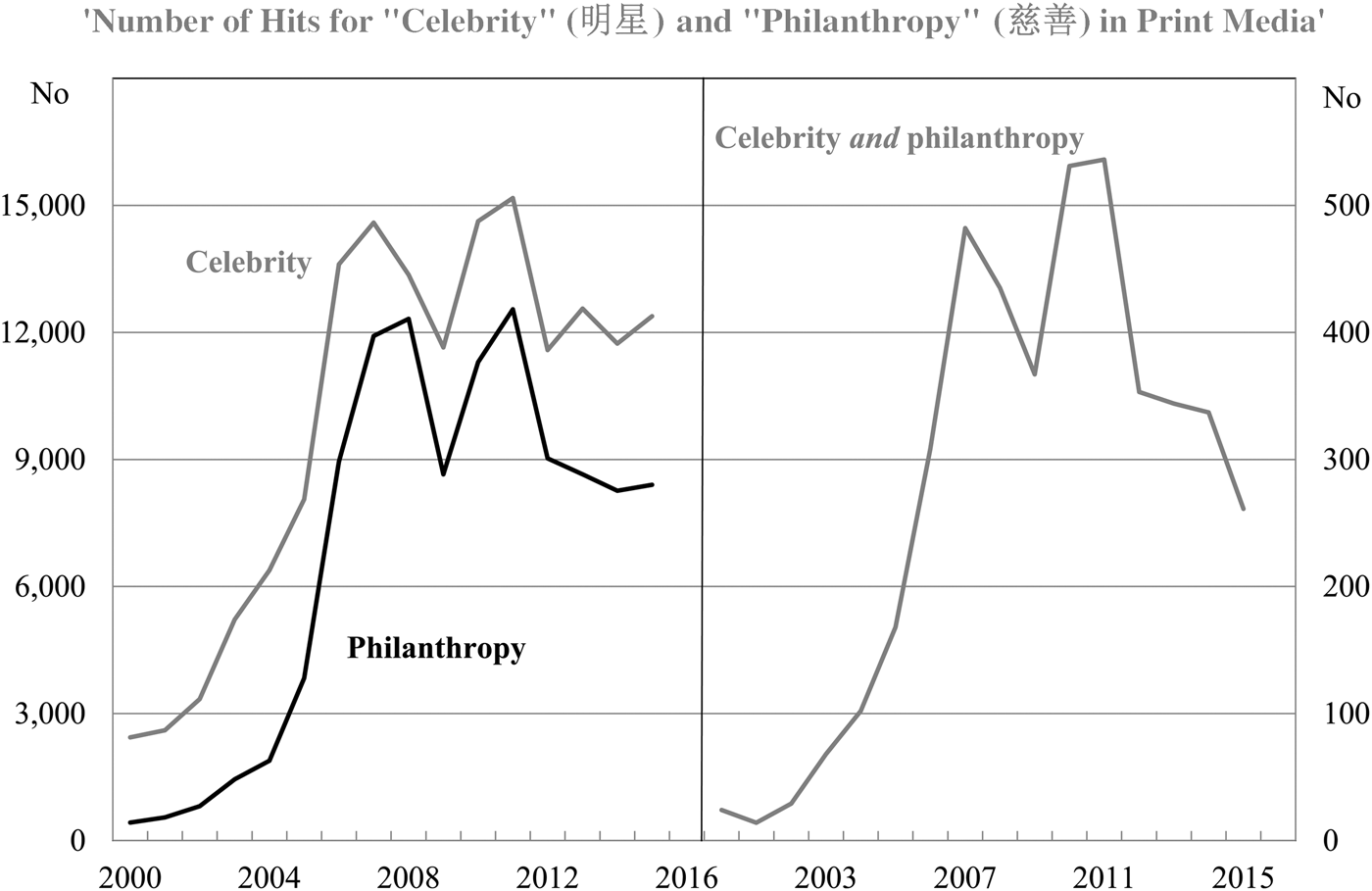
The public visibility of celebrity and philanthropy has surged in China since the turn of the 21st century. Figure 1 illustrates the rapid growth of Chinese press interest in celebrity and philanthropy since 2000. Data was obtained by conducting a search for the keywords “cishan 慈善” (charity/philanthropy) and “mingxing 明星” (celebrity) between 1 January 2000 and 31 December 2015 on the China Core Newspaper Full-text Database of the China Knowledge Resource Integrated Database.Footnote 19 The left-hand panel indicates that press coverage of the words “celebrity” and “charity/philanthropy” has jumped since 2000 (by more than five times and nearly twenty times respectively). The right-hand panel indicates that coverage of the words “celebrity philanthropy” has also grown tenfold, albeit from a lower absolute number of hits. In both panels, the number of hits peaks in 2010–2011 (reflecting widespread media coverage of celanthropy following the 2010 Qinghai-Yushu earthquake), but has remained elevated since then.
Chinese Newspaper Coverage of “Celebrity” and “Philanthropy” (2000–2015)

The emerging links between government, businesses, not-for-profits, media and the celebrity industries (commercial organizations managing the work of celebrities), are demonstrated by the presence of stars in national charity awards. The Ministry of Civil Affairs launched the China Charity Awards in 2005 (Zhonghua cishan jiang 中华慈善奖), which recognize government officials and other individuals for their charitable activities, and private entrepreneurs and state-owned enterprises for the largest donations. The list of award winners was released annually from 2005–2012 and, following a hiatus in 2013–2014, has become a two-yearly event, with the 2015 winners receiving awards in September 2016 to coincide with the opening of the Chinese Charity Museum.Footnote 20 There were nearly 1,000 award winners in total between 2005–2015 (including corporations and individuals), with 13 winners being mainland Chinese celebrities in entertainment and sports (Hong Kong actor, Jackie Chan has also received an award for his charitable work in China).
Commercial entertainment stars feature more commonly on the China Charity Ranking (Zhongguo cishan bang 中国慈善榜), launched by the China Philanthropy Times (Gongyi shibao 公益时报) in 2005.Footnote 21 The China Philanthropy Times is the first national newspaper dedicated to philanthropy and is sponsored by the Chinese Association of Social Workers under the guidance of the Ministry of Civil Affairs. The rankings recognize corporations and entrepreneurs for the extent of their donations, and entertainment and sports celebrities for raising public awareness of philanthropic causes through media publicity. There were around 370 award winners in total between 2005–2015 (including corporations and individuals), with 70 winners or nearly 20 per cent of the total being mainland Chinese celebrities. Another nine celebrities from Hong Kong, Macau and Taiwan also received awards.
The PRC's first dedicated celanthropy ranking – the China Celebrity Philanthropist List (Zhongguo cishan mingren bang 中国慈善名人榜) – was issued in 2013 by the corporate not-for-profit magazine Chinese Philanthropist (Zhongguo cishanjia 中国慈善家).Footnote 22 Founded in late 2010, the magazine is hosted by the China News Service (Zhongguo xinwen she 中国新闻社) with Ci Media (Ci chuanmei 慈传媒). “Ci” is the romanized spelling of the Chinese character for philanthropy. China News Service is the PRC's second largest state-owned news agency after Xinhua News Agency and mainly targets overseas Chinese.Footnote 23 Ci Media is comprised of a group of famous entrepreneurs, media representatives and philanthropists, including Chair and real-estate developer Liu Donghua – also founder of an elite not-for-profit called the China Entrepreneur Club.
The China Celebrity Philanthropist List recognizes 30 celebrities each year. Some of the listed celebrities have received China Charity Awards, for example, singer Han Hong, actors Jackie Chan and Pu Cunxin, and TV hosts and media producers Chen Weihong, Cui Yongyuan and Yang Lan. Others have featured on the China Charity Rankings, including actresses and popstars such as Angelababy, Bibi Zhou, Fan Bingbing, Li Bingbing and Zhao Wei, and actor-singers such as Hu Jun and Huang Xiaoming. The 90 celebrities listed between 2013–2015 include ten celebrities from Hong Kong, Macau and Taiwan.
Also in 2013, the China Charity Federation and the People's Daily launched the China Charity News Network (Zhonghua cishan xinwen wang 中华慈善新闻网), which contains a dedicated celanthropy section.Footnote 24 Founded in 1994, the China Charity Federation is a national-level government-organized charity. The China Charity News Network provides up-to-date information about charitable activities in the PRC, including news about celebrity in a section called Charity Stars (cishan mingxing 慈善明星).Footnote 25 Hence, while there are no dedicated websites in China akin to Looktothestars.org and Ecorazzi.com, interested audiences can follow celanthropy news through government- and corporate-sponsored media.
Apart from endorsing domestic philanthropy, China's celebrities are promoting international development agendas and PRC diplomacy as UN ambassadors. The UN had 180 Goodwill Ambassadors in 2016, including six from mainland China, five of whom are relatively recent appointments. The PRC ambassadors are: actress Gong Li, Food and Agriculture Organization (2000–); actress Li Bingbing, Environment Program (2010–); soprano and first lady Peng Liyuan, World Health Organization (2011–); composer/conductor Tan Dun, Educational, Scientific and Cultural Organization (2013–); actress Yao Chen, Refugee Agency (2013–); and CEO Helen Hai, Industrial Development Organization (2014–).Footnote 26
Analysis of our sample of 421 celebrities confirms that celanthropy is a common, institutionalized activity in the PRC. Elaine Jeffreys’ study of PRC celanthropy, based on celebrity lists obtained in 2011, demonstrates that celanthropy only became a widespread phenomenon in the late 2000s.Footnote 27 The study revealed that around 95 per cent of a sample group of 148 mainland Chinese celebrities had a publicized record of philanthropic engagement, with the majority being under 40 years of age.Footnote 28 But the emergence and rapid growth of PRC celanthropy was correlated with disaster-relief efforts: most notably, the 2004 East Asian tsunami, and the 2008 Sichuan-Wenchuan and 2010 Qinghai-Yushu earthquakes. The study also indicated that PRC celanthropy was mainly linked to large government-organized charities and government-endorsed international NGOs.
The 2011–2015 sample data demonstrates a continued high level of celebrity involvement in philanthropic activities, despite fewer calamitous natural disasters (the 2013 Sichuan-Ya'an earthquake being a prominent exception). The results reveal that around three-quarters of the sample group of celebrities had a documented record of philanthropic engagement. Of the 209 female celebrities, 161 women (77 per cent) were associated with philanthropic activities and organizations. Of the 212 male celebrities, 151 men (71 per cent) were associated with celanthropy. Most of these people were born after the 1970s (77 per cent of the women, and 66 per cent of the men). Hence China's celanthropists are typically aged under forty.
Our data confirms that PRC celanthropy is predominantly linked to large government-organized charities and government-endorsed international NGOs. Based on the data, domestic charities with a high frequency of mediatized celebrity endorsement include: the China Children and Teenagers Fund; the China Foundation for Poverty Alleviation; the China Population Welfare Foundation; the China Siyuan Poverty Alleviation Foundation; the China Women's Development Foundation; the China Youth Development Foundation; and the Chinese Social Assistance Foundation. International organizations with a high frequency of mediatized celebrity endorsement include: Animals Asia, WildAid, World Wild Fund for Nature and the United Nations International Children's Emergency Fund. Accordingly, they focus on conservation issues and supporting young people. The activities of many such organizations are promoted through collaborations with state-owned media such as China Central Television, the People's Central Broadcasting Station, Zhejiang Satellite TV and Southern Media Corporation, and private online media companies such as Sina and Tencent.
The growing number of celebrity-funded foundations suggests that the relationship between China's government and charitable sector, and media and celebrity industries, is becoming more organized and professionalized. Foundations such as the Smile Angel Foundation (established in 2006 by singer Faye Wong and actor Li Yapeng); One Foundation (founded in 2007 by actor Jet Li); Beijing Loving Animals Foundation (established in 2011 by media producer and TV host Li Jing); and the Han Hong Charitable Foundation (founded in 2012 by singer Han Hong) support both government and other charitable initiatives. For example, Han Hong, formerly deputy head of the song and dance troupe of the Air Force Political Department of the People's Liberation Army and now CEO of the Beijing Hualubaina Entertainment Culture Development Company, has worked with various sectors of government to provide medical and other assistance to people living in underdeveloped, ethnic minority regions of western China.Footnote 29
Significant players in the media industries have also formed their own foundations and/or support the work of government-organized charities and celebrity-funded foundations. For example, the Huayi Brothers Media Group – a talent agency and film, television and music producer – and the government-organized China Siyuan Foundation for Poverty Alleviation, jointly established the Siyuan-Huayi Brothers Foundation. The foundation has raised funds to support the China Siyuan Foundation for Poverty Alleviation through collaborations with the Beijing Jackie Chan Foundation, various music companies and China-based versions of international fashion magazines such as Harpers Bazaar and Elle.Footnote 30 The Bazaar Charity Foundation similarly supports the China Siyuan Foundation for Poverty Alleviation. The French high-end fashion brand JAVECE has raised funds for the Smile Angel Foundation, which assists children with clefts, by hosting charity galas.Footnote 31 Boss Style magazine has hosted charity galas and other activities to provide meals for impoverished school children, in collaboration with the Communist Youth League in Hubei Province, the Hubei Government, Hubei TV and the Hubei Youth Development Foundation.Footnote 32 Fashion Weekly magazine and Timberland, a multinational outdoor footwear manufacturing company, support tree-planting initiatives to halt desertification in Inner Mongolia.Footnote 33
The preceding examples demonstrate new alliances between China's government and not-for-profit sectors, and celebrity and media industries, to address major policy issues such as poverty alleviation and environmental protection. However, some celebrity-funded foundations support causes that attract less government attention, which at times leads them to apply pressure to authorities. For example, Li Jing and other co-directors of the Beijing Loving Animals Foundation have leveraged their celebrity to attract media publicity to promote animal welfare.Footnote 34 In 2012, the foundation petitioned the China Securities Regulatory Commission to reject a public listing application from the Fujian Guizhentang Pharmaceutical Company, which produces medicines containing bear bile. The petition was signed by more than seventy Chinese celebrities, including Han Hong.Footnote 35 The foundation also attracted publicity in 2014 for sending a letter of complaint to urban authorities in Inner Mongolia for allegedly “burying alive” impounded stray dogs.Footnote 36 Local authorities denied the allegations, but subsequently adopted a stray dog management policy in response to public outcry. As this example suggests, the resources of celebrity-funded foundations can be used to support heterogeneous rather than strictly government-directed causes.
Embracing Celanthropy
Interviews with employees of China-based charities that use celebrity endorsers reveal that respondents expect celanthropy to become increasingly commonplace, largely because the interests of not-for-profits and celebrities coincide. Not-for-profits lament a lack of public awareness of humanitarian causes and see celebrities as a convenient vehicle to attract widespread attention, including through the ripple effects afforded by social media. Despite admitting to using celebrities in an ad hoc and opportunistic fashion to front various causes, they view celebrities as a pragmatic tool to boost corporate and individual donations. Respondents predict continued demand from celebrities as the latter depend on media exposure, including via charitable activities, to remain in the limelight and profit from their public image.
As a respondent from the China Youth Development Foundation explained:
I think there is an upward trend [in celanthropy] because of the demonstration effect. Today [basketballer] Yao Ming is doing it, tomorrow perhaps [Olympian] Liu Xiang will do it, and the day after tomorrow [pianist] Lang Lang may say: “they do it, so I will too.”Footnote 37
Another respondent from the Chinese Red Cross Foundation noted that:
Celebrities are founding more foundations; they are participating more, asking for more of a say in things, and taking the initiative. This is a good thing because it means they consider philanthropy as part of their work.Footnote 38
Respondents said that Chinese not-for-profits want to work with celebrities to attract media publicity and donations. As philanthropy is a recent phenomenon, public awareness of, and involvement in, charitable activities is modest, and charities find it difficult to attract attention and funds. Individual donations in the US account for around 70 per cent of the total annual donations, compared to only 20–30 per cent in China.Footnote 39 In the words of a respondent from the China Foundation for Poverty Alleviation:
Philanthropy isn't mainstream like politics or economics and it does not attract much attention, unless the charity is associated with scandal or negative, sensationalist rumours. It's hard to get mainstream attention for positive activities. But celebrities are mainstream! So from the perspective of public welfare, it may be necessary to use “star power” to boost public welfare.Footnote 40
Respondents consequently view celebrity-charity publicity as a mutually beneficial arrangement. To cite a respondent from the China Youth Development Foundation:
Celebrities engage in charitable events not only to provide a public welfare service, but also to gain media exposure and maintain their popularity. Stardom is often short-lived… A celebrity can get more media exposure through engaging in public welfare activities. At the same time, the media needs news to report and celebrities are the faces that people look for in the media, and a star can only be a star if they have media exposure. So … the relationship [between charities and celebrities] can be mutually beneficial when it is handled well.Footnote 41
Respondents stated that celebrity-related publicity raises funds for charitable organizations through corporate sponsorship and individual online donations. As a respondent from the China Foundation for Poverty Alleviation explained:
In the big customer (business) fundraising, celebrities bring influence; in public fundraising, stars bring a flow of cash. We need donations from the public and who mobilizes the public? Celebrities have such influence so we invite them to help us promote this type of work.Footnote 42
The same respondent added that:
We get good results whenever a celebrity is involved, and especially when a celebrity interacts with the public through Weibo [a Twitter-like social media platform]. When you post something involving the celebrity and the celebrity also posts about it, the piece immediately reaches over a million people.Footnote 43
A respondent from the Chinese Red Cross Foundation similarly stated that:
People are interested in knowing the whereabouts of a celebrity, what they are doing, and why they participate in charitable activities, which turns public welfare activities into public topics. This has a big impact on online personal donations.Footnote 44
Respondents reported that the celebrity-charity relationship is frequently organized through the celebrity agent and management team, using celebrity resources rather than those of the charity. None of the charities created celebrity-charity news; they used the media stories generated for them by celebrity management teams. A respondent from Save the Children (China) noted that the organization is publicized through videos made by celebrity ambassadors for the UK branch of Save the Children in Hong Kong, and using the services of public relations agencies such as Ogilvy and Mather.Footnote 45
Respondents observed that charities and celebrities often cooperated in a random rather than structured fashion, although the organizations were concerned to ensure that the charity would not incur any potential reputational damage from association with a celebrity. In the words of a respondent from the China Youth Development Foundation:
We usually communicate with a celebrity's agent or management team in advance, in order to avoid any celebrity publicity stunts. The communication is typically a verbal agreement. We rarely sign contracts because it is not a business – you can't agree in advance how many pictures you will take or with whom the star has to shake hands. Generally, it is voluntary. If a [business partner] wants celebrity participation, then we try our best to invite celebrities. But we don't guarantee that we can deliver.Footnote 46
To cite a respondent from Save the Children (China):
I think that charities have used celebrities in an opportunistic rather than strategic fashion. We happened to have a star and therefore would temporarily assign them to a project without thinking about how the influence of celebrities could be used more effectively… . But this is not the best way to communicate through stars. We have to try to consider the work as a whole, for example, over the course of three years and try to think about the kind of stars we need for certain projects, and how we can persuade certain celebrities to join with us for a set period if they see fit, and how we might then adjust our work and cooperate with each other. Changing [our work] by cooperating with celebrities would allow a more mature and effective use of celebrity.Footnote 47
Respondents also said that there were no hard-and-fast rules for matching a celebrity with a particular charity; however, charities wanted a celebrity with a “good” public image, and celebrities generally wanted to be involved with projects that matched their areas of expertise or personal interests. A respondent from the China Youth Development Foundation stated: “there are no clear rules on how to choose and cooperate with a celebrity, but … we usually aim for stars with a positive image and good reputation who are youth role models.”Footnote 48 The same respondent reported that basketballer Yao Ming supported the charity through the Yao Foundation and other projects, generating corporate and public support. In the respondent's words: “now almost all the well-known sports brands cooperate with the Yao Foundation or donate to it, including Nike, Anta and Jordan. We have also done some crowd-funding projects under the flag of the Yao Foundation … and the crowd-funding effect is also good.”Footnote 49
The interviews suggest that not-for-profits value the long-term commitment of a celebrity to an organization by establishing a foundation or fund under its auspices. Such funds typically do not have an independent legal entity, but exist as part of a charity that may oversee multiple funds. For example, actor Li Yapeng founded the Smile Angel Foundation under the Chinese Red Cross Foundation, and basketballer Yao Ming founded the Yao Foundation under the auspices of the China Youth Development Foundation. In the words of a respondent from the latter foundation: “Yao Ming is personally and deeply involved from the start to the end of implementing and fundraising for a project, whereas [other celebrities] will attend a [one-off] charity event and speak a few words to the audience and to offer encouragement to children.”Footnote 50
Some celebrities begin by endorsing a charity and eventually become involved in its management. As a respondent from the Chinese Red Cross Foundation reported:
[Actress and synchronized swimmer] Xiao Taohong was a spokesperson for our cerebral palsy project, which ended because it was too difficult to raise funds. But because of the contact established through that project … she is now a member of the foundation's board of directors.Footnote 51
All of the respondents wanted celebrities to become more rather than less involved with their organization. To quote a respondent from the Chinese Red Cross Foundation:
What we really want is to co-initiate certain types of projects with celebrities. We can help them with project management, operation and execution, and the celebrities can get more exposure and impact for the projects.Footnote 52
Another respondent from the China Charities Aid Foundation for Children said: “there are not many cooperative stars. We want celebrities to be involved in our activities and we would be very pleased if they did want to become involved.”Footnote 53
Respondents thus reiterated key claims in support of celebrity-fronted philanthropy; it gives the host organization extra media coverage, raises public awareness of humanitarian issues, and attracts corporate sponsorship and individual donations. They also highlighted the preference of charities to work on a long-term, professionalized basis with celebrities. The preferred medium is celebrity-supported foundations that are attached to a not-for-profit organization.
The number of celebrity-funded foundations in China is thus likely to increase for three reasons. First, not-for-profits want to work with celebrities to obtain publicity and donations. Second, the Charity Law offers a more transparent and incentivized environment for engaging in “big money” philanthropy, for example, by providing tax incentives for foundations that meet annual reporting practices.
Finally, the PRC government is incentivizing celebrities to demonstrate that they are good social role models. The State Administration of Press, Publication, Radio, Film and Television recently introduced a raft of regulations to ensure that the culture industries disseminate “positive energy” (zheng nengliang 正能量) and “healthy” (jiankang 健康) media products. These regulations ban the broadcasting of any media products involving a celebrity convicted by the public security forces of committing a crime or a serious misdemeanour, and ban any such celebrity and product from winning national industry and other awards.Footnote 54 Media organizations have signed “pacts” agreeing to promote the Communist Party, national interests, and a good professional image, and are inserting such principles into rules of professional association and employment.Footnote 55 Engaging in sustained philanthropic activity is one way for celebrities to demonstrate that they are positive role models.
Audience Reception
But is celanthropy as popular with Chinese audiences as our interview respondents suggest?
Advertising research claims that celebrity endorsement is powerful and effective based almost exclusively on surveys of college students in the US.Footnote 56 In China, around 40 per cent of youth-product advertisements feature a celebrity compared to 25 per cent in the USA.Footnote 57 This implies a stronger degree of youth interest in celebrity in the PRC. However, quantitative studies of the media uptake of celanthropy in the PRC and the US demonstrate that belief in the influence of celebrity may be overblown.Footnote 58 The studies demonstrate that celebrity support for charitable causes is almost invisible in the broadcast media news flow, and conclude that claims regarding the efficacy of celanthropy on social media require empirical verification.
Surveys of nearly 2,000 people in Britain conducted by Dan Brockington and Spencer Hensen also indicate that while there is widespread belief in “star power,” celanthropy is less universally appealing than the populist appeal of celebrity implies.Footnote 59 Their surveys show that most people are uninterested in what celebrities do outside of their achievements in film, music and sport. Celebrity-interested audiences are typically uninterested in celanthropy; and audiences with some interest in celanthropy may already be sympathetic to the causes for which the celebrities are advocating. Focus groups further suggest that British audiences react ambivalently towards celanthropy: the enthusiasm of some respondents is counterbalanced by others’ dislike for celebrities and cynicism about their motives. Brockington and Hensen conclude that celebrity-fronted philanthropy is not a particularly effective way of reaching British audiences, and owes its continued utilization by large charities to its popularity with media industries and the corporate sector.
We therefore conducted an online survey in October 2016 to shed light on the public reception of celanthropy in the PRC, replicating the types of questions in the British study. A total of 2,115 respondents completed valid surveys, with men and women being roughly equally represented. The majority (72 per cent) were aged 21–39 years and had attended university (85 per cent). Respondents covered all of the major occupational groups represented in the Chinese census. But the largest groups were professional and technical workers (26 per cent), followed by students (23 per cent) and clerical and related workers (21 per cent). Only 6 per cent were civil servants.
Most of the survey respondents were low-to-average income earners with limited active interest in philanthropy. In 2016, the monthly average salary being offered to new white-collar employees across 34 major Chinese cities was 7,233 yuan (between 7,000–9,000 yuan in Beijing, Shanghai and Guangzhou, compared to 5,000–6,000 yuan in poorer cities such as Changchun, Xi'an and Taiyuan).Footnote 60 Around 25 per cent of the respondents claimed to earn more than 8,000 yuan per month; 23 per cent earned 5,000–8,000 yuan; 22 per cent earned 3,000–5,000 yuan; and 22 per cent earned less than 3,000 yuan. More than 80 per cent of the respondents had donated occasionally to a charity and over 65 per cent had volunteered. However, a third had never volunteered and only 5 per cent donated regularly.
The data suggest that young educated Chinese are interested in some celebrity formats, and especially online materials. Most of the respondents (80 per cent) had seen news about celebrities in various media, including newspapers, magazines, television and the internet, during the week before the survey. Around half of the respondents claimed to have looked at media stories about celebrities in the last 24 hours, the majority while surfing the internet. More than 70 per cent followed celebrity news on social media such as Baidu, Weibo and Wechat. Most respondents (75 per cent) spent more than five minutes reading about celebrity every week, with 22 per cent spending more than one hour. Only 9 per cent claimed not to read any celebrity news. Hence it appears that young educated Chinese are interested in celebrity, at least tangentially.
Respondents indicated that the consumption of celebrity serves a social function. The majority found news coverage of celebrities interesting or entertaining (44 per cent). Although a quarter of the respondents had no interest in celebrity, nearly 60 per cent spent more than five minutes a week talking with other people about celebrity news, and 27 per cent spent more than 30 minutes. Only 17 per cent claimed not to discuss celebrity news with other people.
Unsurprisingly, the more people are interested in celebrity (measured by how much they read or talk about them each week), the more they tend to follow them on social media. But even among respondents who said that they did not talk or read about celebrity news at all, one-fifth to two-thirds also followed celebrities on social media. Respondents who follow celebrities on social media were much more likely to respond positively to celebrity-fronted campaigns/causes.
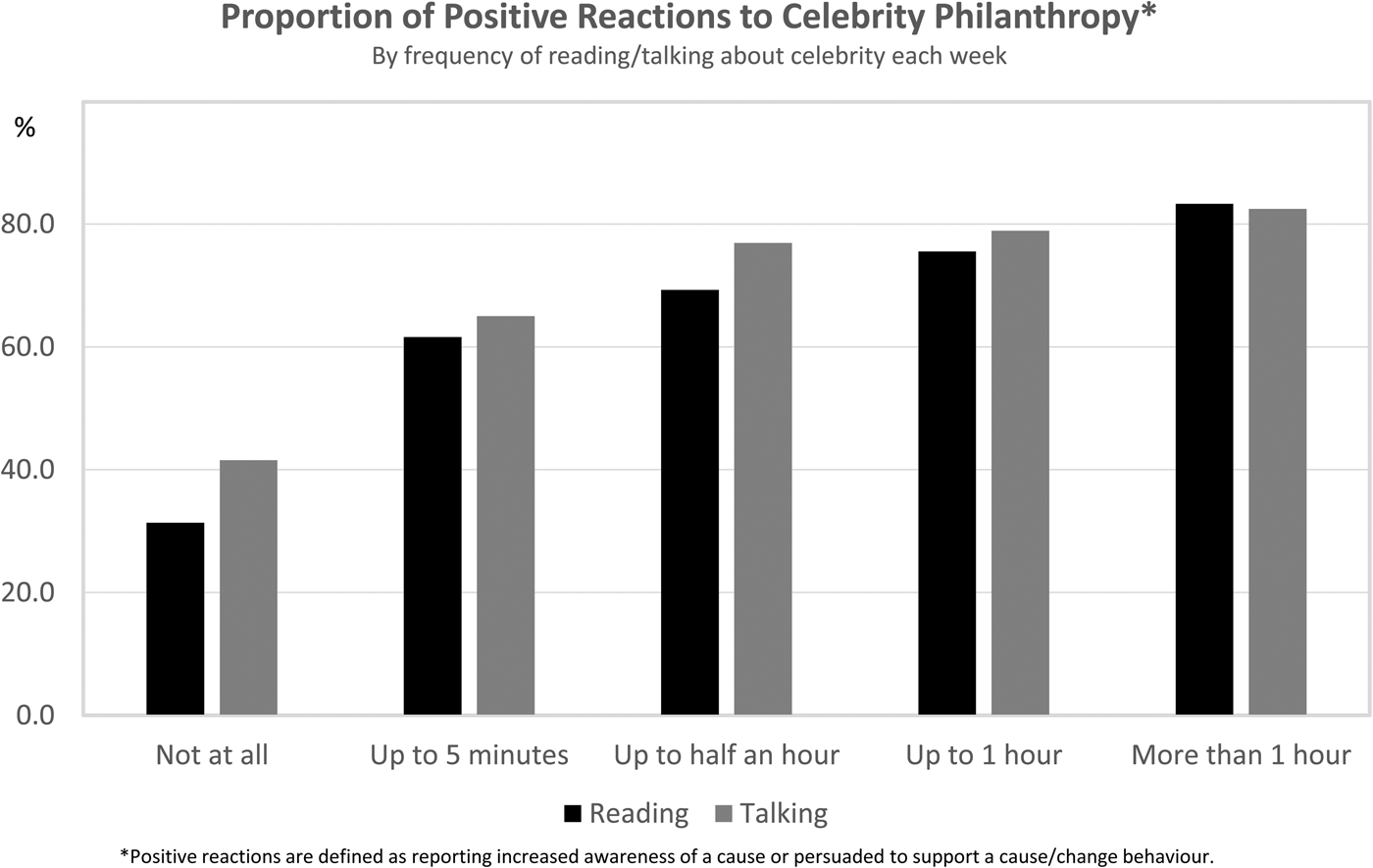
Overall, the survey findings contrast with Brockington and Hensen's conclusion that the ability of celebrity advocacy to reach its target (youth) audience is limited. As Figure 2 shows, respondents who are more interested in celebrity – that is, people in China who read or talk about celebrity – are more likely to react positively to charities or organizations promoted by celebrities, defined as reporting increased awareness of a cause or being persuaded to support a cause/change one's behaviour.
Interest in Celebrity and Attitudes to Celebrity Philanthropy

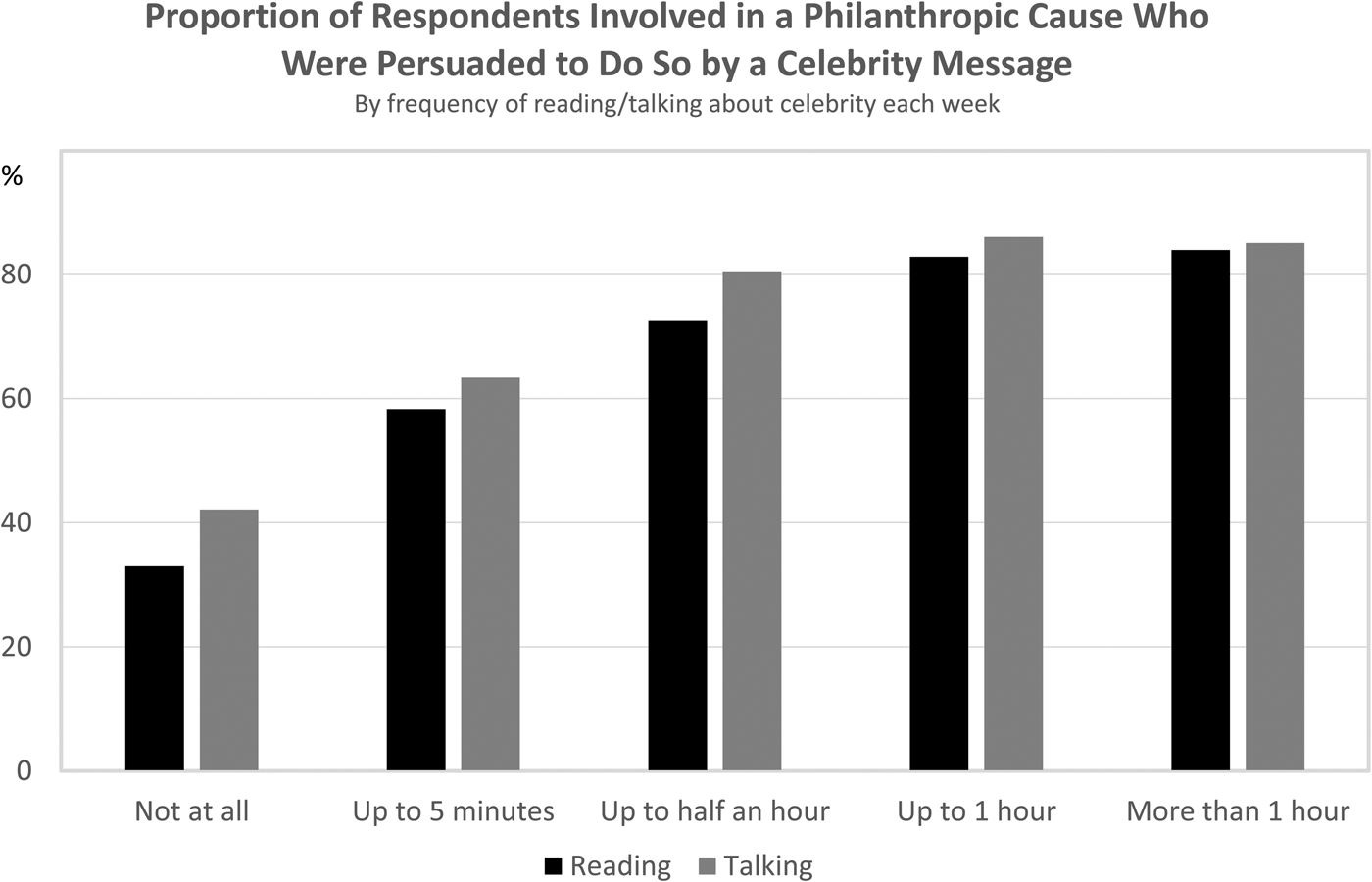
Divergences from Brockington and Hensen's findings are also observed for responses to questions designed to reveal the extent to which people who are interested in celebrity may be persuaded by a celebrity endorsement to support a cause, compared to those who are not interested. The survey data reveal that nearly three-quarters of the Chinese respondents actually involved in a cause were persuaded by a celebrity to do so. Despite a positive correlation between the degree of interest in celebrity and respondents’ responses to celebrity-endorsed charities, 32–42 per cent of those people who appeared to have little interest in celebrity (that is, not reading or talking about celebrity at all in a given week) still reported being persuaded by a celebrity message to support a cause (Figure 3).
Interest in Celebrity and Persuasiveness of Celanthropic Messages

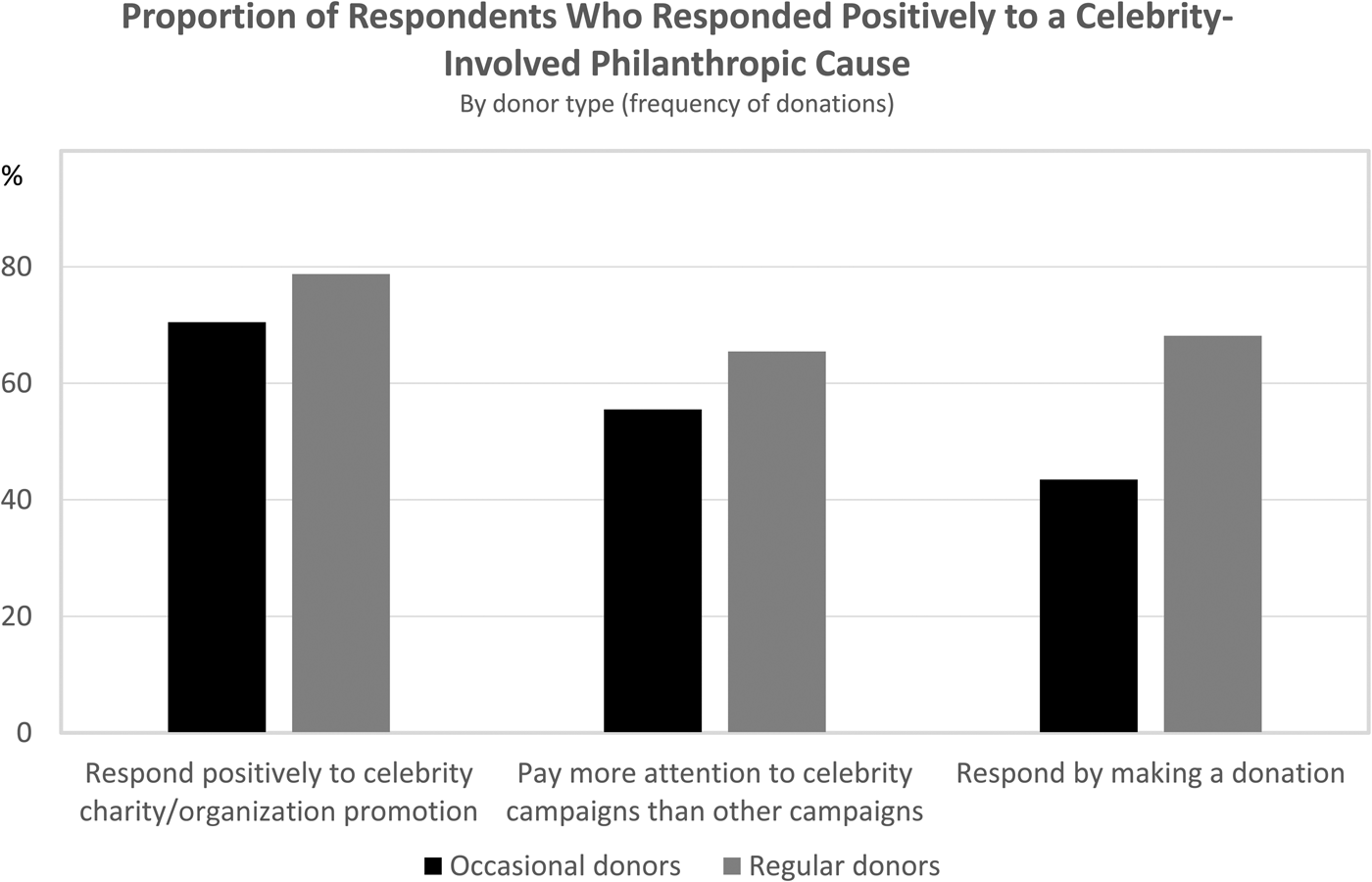
More than half of the respondents responded more to celebrity-fronted charity campaigns than to other campaigns for good causes. Only 5 per cent of respondents were regular donors, but these donors responded more to celebrity-fronted campaigns and responded more positively to celebrity charity/organization promotion than occasional donors (who represented 81 per cent of respondents) (Figure 4). Around 45 per cent of regular or occasional donors said that they were influenced by celebrity messages in making either regular or one-off donations. Around 68 per cent of regular donors were persuaded by celebrity messages to make regular or one-off donations and around 39 per cent of these donors cited celebrity messages as influential in them making regular donations. Reiterating belief in “star power,” 41 per cent of respondents thought that other people paid more attention to celebrity-fronted charity campaigns than them.
Donation Frequency and Responses to Celebrity-Fronted Campaigns

Thus, the evidence suggests that celebrity-fronted charity campaigns on social media, in particular, may help encourage donations and especially regular donations for China-based charities. Reponses to questions about the perceived effectiveness of celebrity as a means to promote philanthropy further indicate that between half and three-quarters of the respondents believe that celebrities have a social responsibility to engage in philanthropy, and that such engagement promotes public awareness and support through media publicity. Over half of the respondents agree that celebrities should spend more time promoting philanthropic causes in China (only 7 per cent disagreed), and nearly 40 per cent agree that mainland Chinese celebrities should spend more time promoting philanthropic causes overseas (13 per cent disagreed). Less than a quarter of the respondents believe that celebrity-fronted philanthropy has negative effects and only 15 per cent see it as a self-promotional exercise. There therefore appears to be a significant degree of public support for certain types of celanthropy in China.
The survey findings also show that while audience awareness of the major charities in question is high (around three quarters), awareness of the celebrity advocates for those charities is low (around one quarter). In the case of WildAid, an international conservation NGO that uses celebrity advocacy extensively, 54 per cent of respondents were aware of the organization brand but only 13 per cent were aware of the celebrities promoting it. The fact that only a minority of celebrities were linked by respondents with the brand they promote suggests that celebrity advocacy fails to focus attention on the celebrity's involvement in philanthropy even if overall awareness of the charity is high. This undermines claims that “to the extent that celebrity advocacy does get people's attention it is the celebrity that gets it more than the cause for which they are advocating.”Footnote 61 It calls into question the assumption that celanthropy functions chiefly to augment celebrity brand power.
Conclusions
This article responds to calls for more empirical and comparative celebrity studies,Footnote 62 by documenting the rise and significance of PRC celanthropy since the mid-2000s. As Dan Brockington has observed, until recently, scholarly conclusions about celebrity culture and the power of celebrity advertising were based almost exclusively on studies of celebrities in the US and quantitative surveys of American college students.Footnote 63 Developing a comparative and more nuanced understanding of celebrity and its uses thus requires mixed-methods studies of the rise of celebrity industries and public responses to celebrity in other parts of the world. Our case study responds to this challenge. Rather than simply viewing Chinese celanthropy through the lens of generalized narratives drawn from Western contexts, we demonstrate that celebrity industries and cultures emerge and evolve in specific historical, social and political contexts, and that the uses and effects of celebrity cannot be simply extrapolated from one country to another.
Our analysis of a sample of mainland Chinese celebrities and interviews with employees of large China-based charities reveals an expanding web of connections between celebrity, media, corporate and not-for-profit sectors, as is the case in Western societies. However, unlike in Western contexts, this development reflects government efforts to combine politics and popular culture by encouraging “ordinary” citizens and new social elites alike to assist the Party-state in addressing national development issues.
Philanthropic practice has become a common activity for young generations of Chinese celebrities. Entertainment and sports celebrities provide diverse forms of support to government-organized charities and government-endorsed international NGOs, which typically focus on poverty alleviation, disaster relief, child support and education, and environment and conservation issues. Interviews with charities underscore their interest in working with celebrities to raise public awareness and funds through media publicity, and preferably by working with celebrities who are willing to commit to supporting an organization in a relatively long-term fashion by establishing a foundation or fund under its auspices.
In contrast to documented findings for Britain, responses to a national survey in the PRC reveal that celebrity affairs and celanthropy have succeeded in piquing the interest of young educated Chinese. Interest in celebrity news is not necessarily a predictor of support for charity. However, the results show that celebrity-fronted philanthropy does help to raise public awareness of, and support for, various causes, especially through social media. This suggests there is some basis for the conviction with which our not-for-profit interview respondents cite the importance of celebrity endorsement. In our survey, regular donors, in particular, report being influenced by celebrity messages in their support of charitable activities. Moreover, Chinese respondents appear less cynical about the motives of celebrity philanthropists than their Western counterparts.
In the constrained context of social action and organization in China, audience interest in celebrity-fronted philanthropy may lead to actions performed online in support of a humanitarian cause that require minimal effort, rather than active citizen participation. However, in a country of the PRC's size, the practical effect even of modest “passive” participation in philanthropy on a large scale may be significant. Interviews with employees of large charities suggest that the use of celebrity boosts awareness of charitable activities in a country that lacks an established philanthropic culture and where even government-endorsed charities struggle to attract public attention and funds.
The government promotion of national charity awards and new legal frameworks with tax concessions are providing a more incentivized environment for celebrity and corporate philanthropy to develop. Government-endorsed media outlets actively encourage the circulation of media stories about celebrity philanthropy. However, bans on broadcasting media products linked with stars who have committed offences, together with self-discipline “pacts” to regulate professional ethics in the media and celebrity industries, also constrain famous people to present in public as good, social role models.
As this regulatory environment demonstrates, mainland Chinese celebrities are not Western-style, free-wheeling “neoliberal Big Citizens” operating outside the terrain of government, and in “cahoots” with the multinational corporate sector. The success of their PRC-based careers depends on their willingness to manage their public personae within parameters established by the one-ruling-party system. Celebrity and elite philanthropy more generally are likely to expand, albeit in a circumscribed fashion, within this “carrot and stick” environment.
The example of celanthropy thus illustrates how the roles and capacities of government in China are being reconfigured and expanded, even as it underscores the space thereby created for certain types of charitable activity, facilitated by the multiplying effects of social media. Entertainment celebrities as newly rich elites are being incentivized to work within a government-organized not-for-profit sector to realize public welfare goals. While the expanding links between the PRC government and the not-for-profit sector may be viewed negatively by those who conceive of philanthropy or the third sector as a wedge against state expansionism, the example of celebrity support for animal welfare demonstrates that the resources of celebrity-funded foundations can be used to support heterogeneous rather than strictly government-directed causes. Notwithstanding the current heavy involvement of government, the growth of celanthropy in the PRC may eventually even generate different spaces for social action.
Acknowledgements
We thank referees for helpful comments and Dan Brockington for providing his survey questions.
Biographical notes
Guosheng DENG is Professor and Vice Dean of the Institute for Philanthropy, Tsinghua University. Recent papers include: “Trends in overseas philanthropy by Chinese foundations”; “The influence of elite philanthropy on NGO development in China;” and “The hidden rules governing China's unregistered NGOs: management and consequences.”
Elaine JEFFREYS is Professor in the School of International Studies, Faculty of Arts and Social Sciences, University of Technology Sydney. Elaine is the author of Governing HIV in China, with Su Gang (2018, Routledge); Sex in China, with Haiqing Yu (2015, Polity); Prostitution Scandals in China (2012, Routledge) and China, Sex and Prostitution (2004, Routledge). She is the editor of New Mentalities of Government, with David Bray (2016, Routledge); Celebrity Philanthropy, with Paul Allatson (2015, Intellect); Celebrity in China, with Louise Edwards (2010, Hong Kong University Press); China's Governmentalities (2009, Routledge); and Sex and Sexuality in China (2006, Routledge).