INTRODUCTION
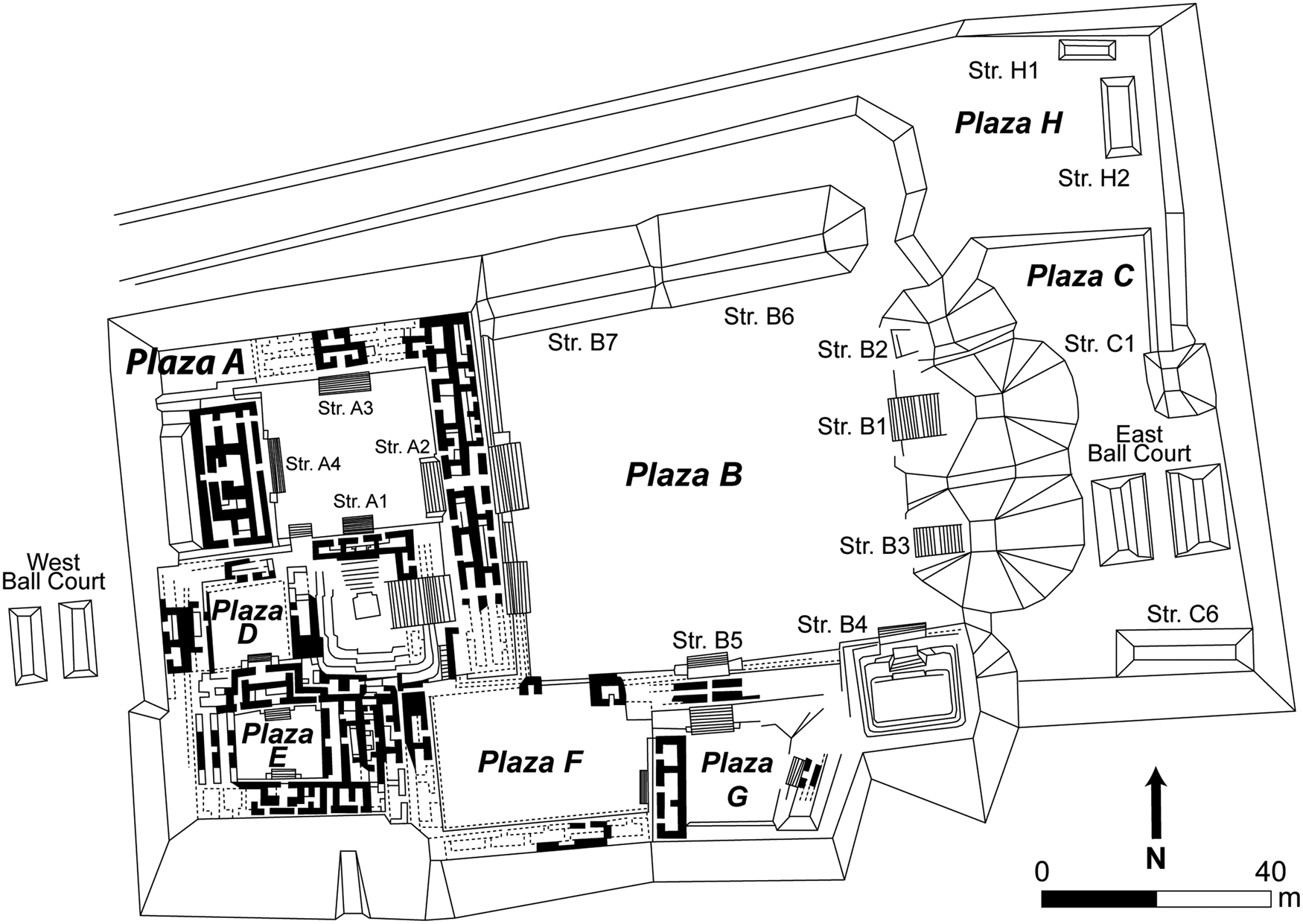
As in many parts of the Maya world, most Belize Valley site cores were abandoned at the end of the Classic period, although occupation continued into the Postclassic period on the peripheries of some sites (Aimers Reference Aimers2004). Cahal Pech is one such site (Figure 1; Aimers et al. Reference Aimers, Hoggarth and Awe2020). Investigations have recovered new data from the site core for a range of Terminal Classic “peri-abandonment” activities from a tomb, a burial, and two problematic deposits in epicentral Plazas A and G (Figure 1; see Aimers et al. [Reference Aimers, Hoggarth and Awe2020] for a review of problematic deposits). Here, we focus on the problematic deposit from just above the Plaza A floor. Similar deposits at other western Belize Maya sites have been interpreted as evidence for de facto refuse or rapid abandonment (e.g., Ball and Taschek Reference Ball and Taschek2003; Chase and Chase Reference Chase, Chase, Demarest, Rice and Rice2004). At Cahal Pech, a number of lines of evidence suggests that the Plaza A problematic deposit, and perhaps some tombs and burials, are the result of pilgrimage to the site core from still-occupied peripheral areas, or that they were deposited by a small group of people who may have continued to reside at the site during and after the time of major abandonment. Below, we discuss the Plaza A deposit, two sealed Terminal Classic deposits (one from a bench and one from a tomb) and another problematic deposit from Plaza G. Overlap in the pottery types present shows that the four contexts are generally contemporaneous, but modal differences suggest that we may be able to distinguish an early and late facet of the Terminal Classic at Cahal Pech.
Plan of the site core of Cahal Pech. Courtesy of the Belize Valley Archaeological Reconnaissance (BVAR) Project.

STRUCTURE H1 TOMB 1 (BU-H1-1)
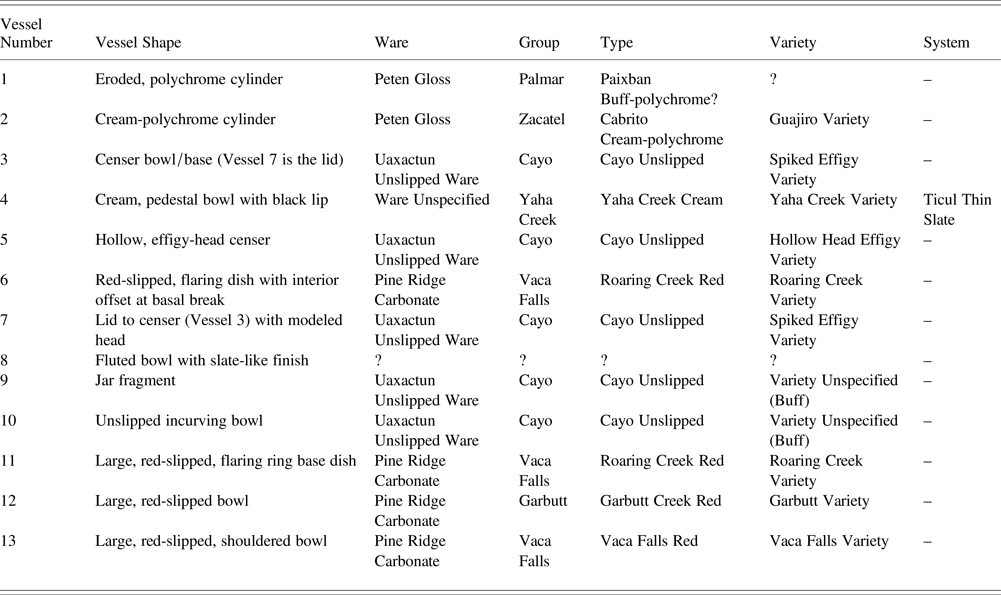
Tomb 1 was a poor-quality tomb built in front of Terminal Classic period structure H1-1st using stones scavenged from a nearby Late Classic structure (Awe et al. Reference Awe, Ebert, Friewald and Green2017). The 10 vessels from Tomb 1 are illustrated and described by Aimers et al. (Reference Aimers, LeCount and Awe2019) and are listed in Table 1.
Pottery types from Tomb 1, Structure H1. All vessels date to the Terminal Classic.

BENCH BURIAL, STRUCTURE A3 (BU-A3-1)
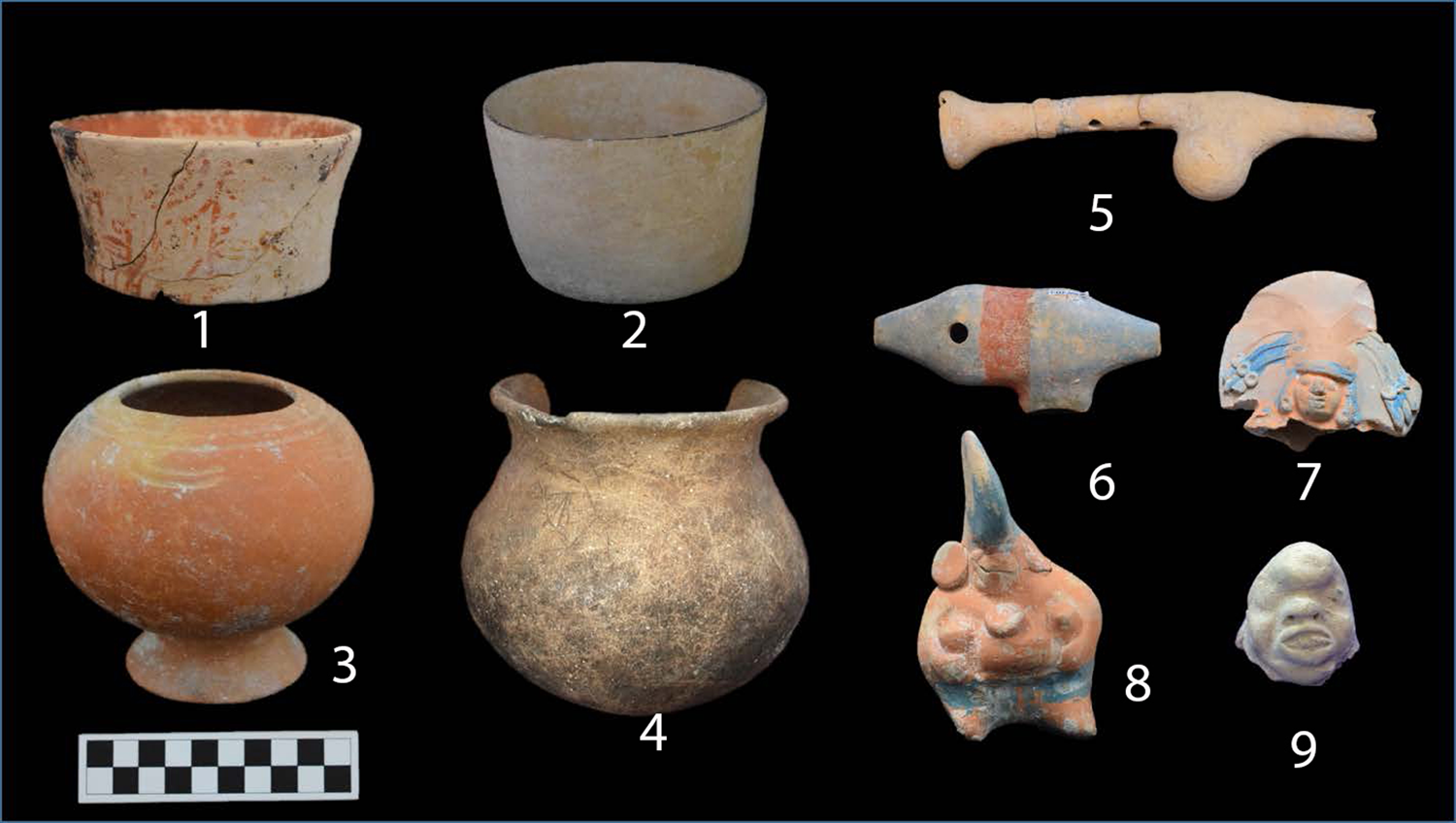
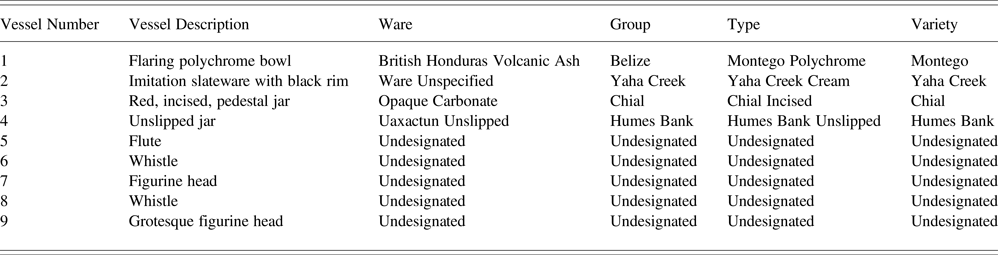
An intrusive bench burial (BU-A3-1) of a child in range Structure A3 contained four ceramic vessels, a pottery flute, two whistles, and the heads of two figurines (Figure 2). Arnold (Reference Arnold2008:108) notes that, on the first day of the Day of the Dead rituals in contemporary communities in Yucatan, Mexico, “pottery whistles are given to the children of the family…to remember their dead siblings” (see Thompson [Reference Thompson1958:Figure 47] for similar contemporary whistles). The vessels in this burial are listed in Table 2.
Artifacts from the child burial in the bench of Structure A3. Photograph by Awe.

Pottery types from the bench burial in Structure A3. All of the identified types date to the Terminal Classic.

THE PLAZA A PROBLEMATIC DEPOSIT
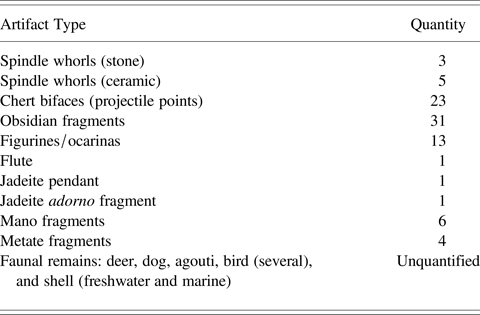
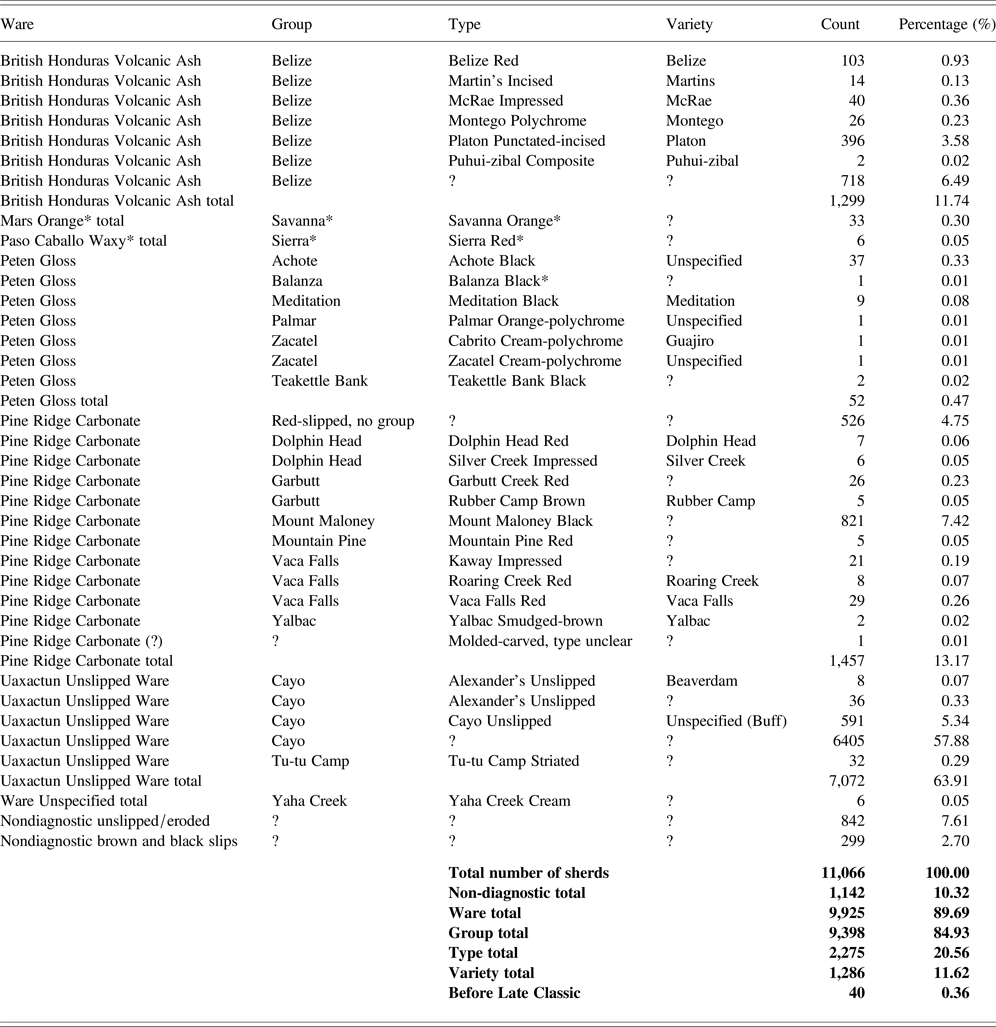
In 2002, during clearing and consolidation of architecture at Cahal Pech for the Tourism Development Project, Awe found large, dense, midden-like concentrations above the plaza floor flanking the central stairways of Structures A2 and A3, on the steps themselves, and where Structures A2 and A3 abut each other in the site core (Figure 1). The deposits contained pottery vessels; sherds; figurines; ocarinas (small pottery flutes); ceramic and stone spindle whorls; obsidian blade fragments; 23 complete, bifacially worked chert points; mano and metate fragments; carved jade fragments; deer antlers; and other faunal remains (Tables 3 and 4) All the ceramic vessels, figurines, and ocarinas were broken (with one exception, an ocarina). Part of an anthropomorphic flute was also found (Audet Reference Audet2006:156–159). Aimers examined the 11,258 sherds from the Plaza A deposit in 2008 and produced a basic type-variety classification (Table 4) with some modal data (i.e., rim diameters and thickness).
Terminal Classic artifacts from the Plaza A deposit. Pottery is listed in Table 4.

Pottery types from the Plaza A Problematic Deposit. Asterisks indicate wares, groups, and types earlier than the Late Classic.

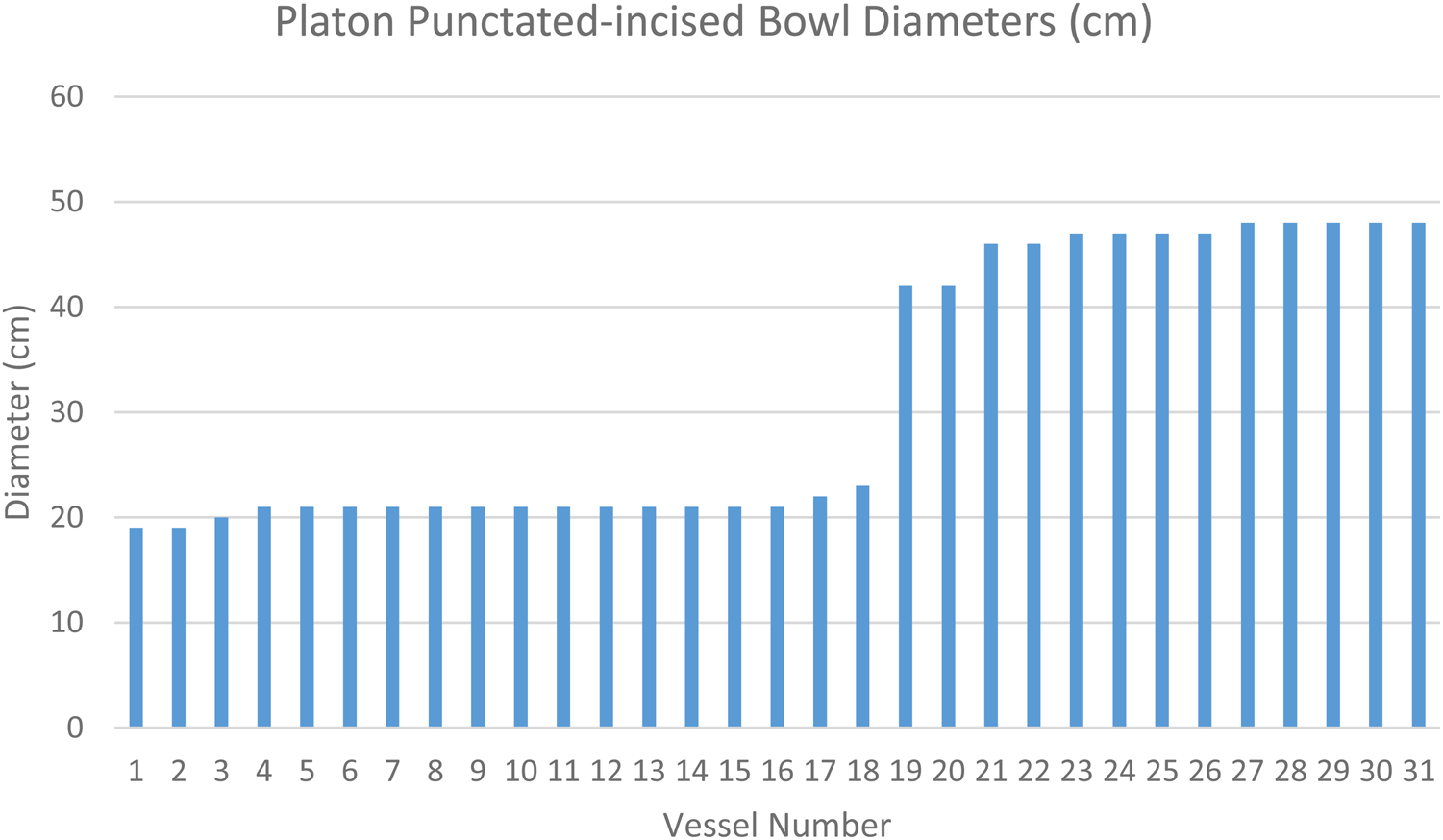
Some of the notable aspects of the sherd material include the following. (1) This was one of the most diagnostic sherd collections ever examined by Aimers. Of the 11,066 sherds, 9,925 (90 percent) were identifiable to the ware level; 9,398 (85 percent) to the group level; 2,275 (21 percent) to the type level; and 1,286 (12 percent) to the variety level. Only 40 sherds (0.36 percent) dated earlier than the Late Classic (Table 4) and probably eroded out of construction fill during the collapse of the adjacent building. This temporal and formal consistency is unusual for an unsealed deposit. (2) Many of the sherds were large and in excellent condition (e.g., clean breaks), suggesting that they were not redeposited from somewhere else (e.g., a midden). Nonetheless, refits were exceptionally rare. Together, these suggest that the deposit was laid down relatively quickly, and that parts of broken vessels may have been removed as in contemporary Maya ritual. (3) The consistency of the sherds in terms of fabric, form, surface treatment, and the relative typological homogeneity of the deposit is notable. This suggests that the deposit was laid down relatively quickly, rather than over time as in middens. Rim modes (e.g., piecrust rims) and the presence of the temporally late (i.e., late Terminal Classic) Buff Variety of Cayo Unslipped (Aimers Reference Aimers2004:80; Gifford Reference Gifford1976:279–282) suggest that these are the latest ceramics yet found in the site-core at Cahal Pech. (4) The Platon Punctated-incised incurving bowls are particularly consistent and have a bimodal size distribution (small and large; Figure 3). Their consistency in size corresponds with their consistency in shape (hemispherical), decoration (a single incised line near the rim), and surface finish/preservation (the slip on all these bowls had eroded off to a similar extent). This consistency suggests that the bowls were made or at least deposited at the same time and were probably made by the same potter(s). [See comments from Arnold (Reference Arnold2008) about the use of two sizes of bowls in contemporary ritual in Ticul, Mexico in section Pilgrimage below.] (5) Functionally, the deposit does not appear to be specialized in any particular way (e.g., utilitarian or ritual). In fact, the types in the Plaza A deposit represent a full Terminal Classic ceramic complex (i.e., the full range of types and forms for a given period), or very close to one. Bowls, jars, plates, dishes, vases, tecomates, and censer fragments are represented. Some sections of the floor, however, showed evidence of burning and there was a considerable amount of charcoal in some areas of the deposits. We suspect this burning was associated with ritual.
Platon Punctated-incised bowl diameters (cm) showing there are two sizes rather than a range of sizes.

THE PLAZA G PROBLEMATIC DEPOSIT
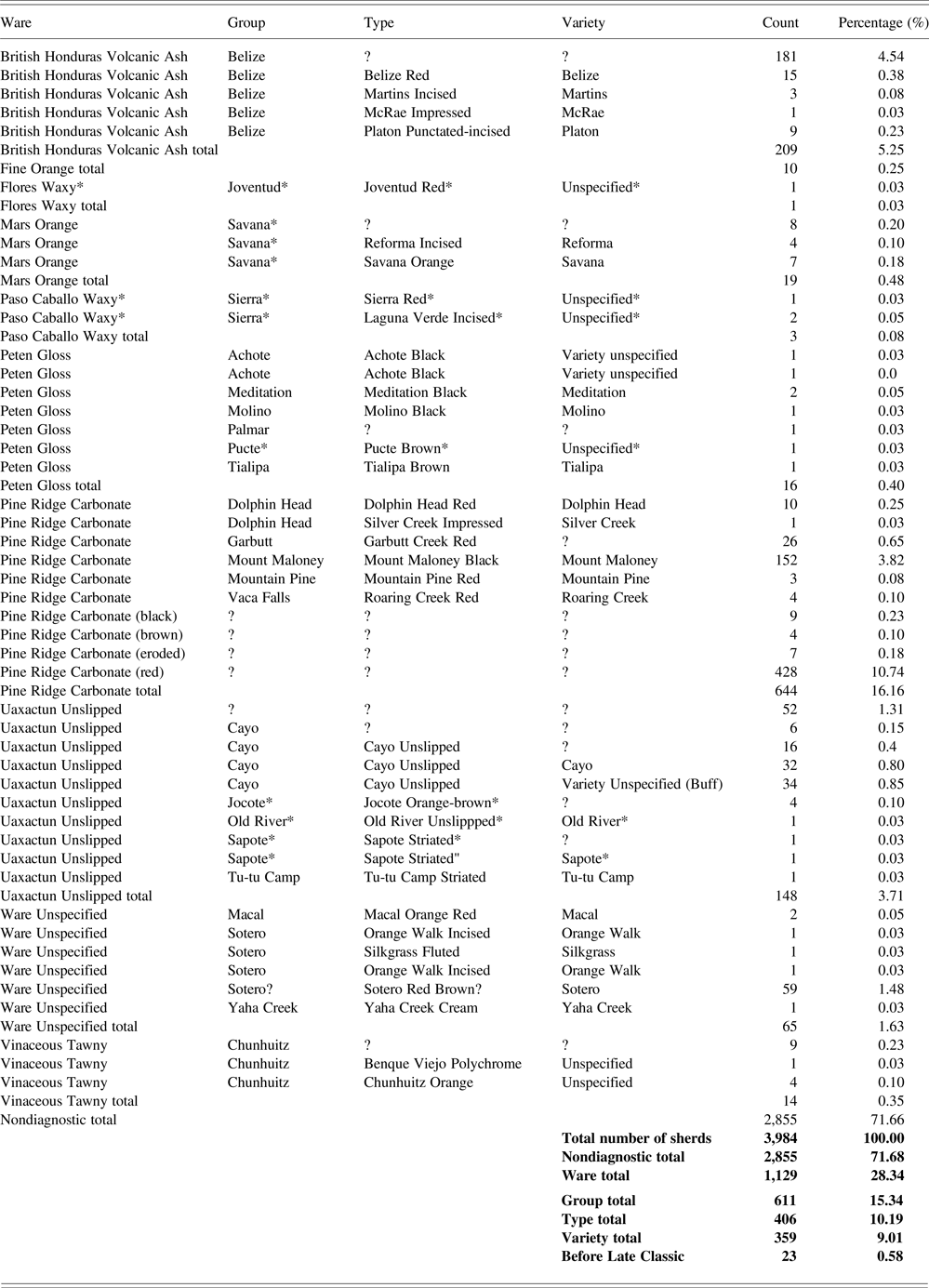
Excavations at the base of Structure G2 (Unit 5) in 2014 produced a substantial Terminal Classic pottery deposit scattered across the plaza floor at the base of the building (Table 5). This assemblage was excavated carefully, and clusters of sherds were bagged as features for potential refitting in the lab. Despite this, there were only a few conjoinable sherds and no fully (or even substantially) reconstructible vessels. The floor assemblage was a typical Late-to-Terminal Classic mixture of Belize Group ash-tempered serving vessels (e.g., Belize Red and Platon Punctated-incised), Cayo Unslipped: Buff Variety jars, Mount Maloney Black large bowls with incurving rims, and small numbers of other Late Classic types like Dolphin Head Red (simple hemispherical bowls) and Garbutt Creek Red (medium to large incurving bowls with diagnostic beveled-in lips). The Belize Group Platon Punctated-incised vessels were relatively simple outflaring or outcurving dishes with incised lines near the rims and/or bases. All of these are well-illustrated in Gifford (Reference Gifford1976). Only 23 sherds, (0.58 percent) dated earlier than the Late Classic. This temporal consistency is unusual for an unsealed deposit.
Pottery types from the Plaza G Problematic Deposit. Asterisks indicate wares, groups, and types earlier than the Late Classic.

COMPARISON OF THE PLAZA A AND PLAZA G DEPOSITS
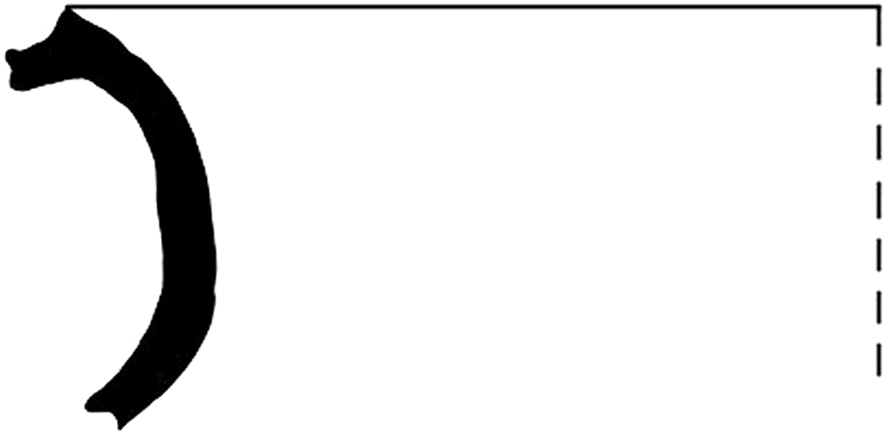
The Platon Punctated-incised sherds from Plaza G contrast with the more elaborate forms found in the Plaza A problematic deposit. Also missing was the incurving bowl form which was found in large quantities in Plaza A. Furthermore, virtually all of the unslipped sherds from G2 Unit 5 were from Cayo Unslipped: Buff Variety jars. Research at Baking Pot led Aimers (Reference Aimers2004:80) to suggest that the Buff Variety of Cayo Unslipped occurred temporally late in the Late Classic Spanish Lookout phase. Few of the Plaza G jar rims, however, exhibited the elaborate exterior everted lips or piecrust rim form which are diagnostic of the Terminal Classic period, although the grooved and everted lips of some of the Cayo Unslipped jars are also characteristic of the Terminal Classic. Figure 4, a profile of one of the Cayo Unslipped Buff Variety outcurving jar rims from Plaza A, shows the sort of exterior, everted lip that is probably later than the simpler form shown in Gifford (Reference Gifford1976:Figures 180a–180e). Most archaeologists in the Belize Valley agree that the piecrust rims are later than the simpler lip forms on Cayo Unslipped, including grooved and everted lips.
Cayo Unslipped: Buff Variety jar rim showing exterior everted lip (rim diameter = 30 cm). Drawing by Aimers.

Another notable aspect of the Plaza G deposit is that it contained very few sherds from Roaring Creek Red outflaring dishes, another diagnostic of the Terminal Classic at Cahal Pech. Furthermore, the Plaza G deposits were on or very close to the floor level, whereas the Plaza A deposits were laid down after some accumulation of debris on the plaza floor. The stratigraphy in Plaza A, and the varied nature of the artifacts associated with the pottery there, suggest that it is the evidence of some sort of activity after the site had been abandoned for some time, or after Plaza A was no longer inhabited. The types of pottery found in both loci are basically the same and indicative of Terminal Classic activity, but the modes are different (e.g., more elaborate modeling and incising on Platon Punctated-incised bowls, and more elaborate lip forms on Cayo Unslipped: Buff Variety jars). We suspect that modes like vessel shape, decoration, and lip form can form the basis for distinguishing early and late facets of the Terminal Classic at Cahal Pech. The Structure G deposit could represent the early facet while the Plaza A deposit represents the later facet.
The Plaza G deposit, consisting almost entirely of relatively small sherds from non-reconstructible vessels, probably represents the end point of the long usage of the locus, probably extending back as early as the Preclassic. This looks like de facto refuse—as pottery broke, it was swept out of the building but never removed from the floor. The remains suggest that people were living at Cahal Pech in the Terminal Classic but the system that maintained the buildings and the grounds had ceased or slowed. The Plaza A deposits included much larger sherds and many more types of objects, suggesting different activity in the site-core at the very end of the Terminal Classic.
ALTERNATIVE EXPLANATIONS OF THE PLAZA A PROBLEMATIC DEPOSIT
The overlap in ceramic types and forms from the Plaza A and G deposits, the Structure H1 tomb, and the bench burial in Structure A3 (as well as other intrusive burials not discussed here) suggest that these deposits all dated to the Terminal Classic, although the Plaza G deposits may have been slightly earlier than the Plaza A deposits. For example, there was a single Cabrito Cream-polychrome: Guajiro Variety sherd from the Plaza A deposit virtually identical to Vessel 2 from Structure H1 Tomb 1 (Aimers et al. Reference Aimers, LeCount and Awe2019) and to the eroded Vessel 1 from the intrusive Structure B4 Burial 1 at Cahal Pech (Zanotto Reference Zanotto2017:95). Rim sherds and other fragments from at least one Cayo Unslipped: Hollow Head Effigy Variety censer from the Plaza A floor deposit are from a censer similar to Vessel 5 from the H1 Tomb 1. Other overlaps include Yaha Creek Cream imitation slateware vases from the child burial in Structure A3 (Vessel 2) and Vessel 4 from the Tomb in Structure H1. Below, we discuss several ways that the Plaza A deposit can be explained, and the implications of this particular deposit for our understanding of the gradual abandonment of Cahal Pech.
Terminal Occupation Debris or de facto Refuse
Awe et al.’s (Reference Awe, Aimers, Helmke and Wrobel2009) initial interpretation of the Plaza A deposit was that it did not represent garbage (or de facto refuse) left behind by Terminal Classic (or post-abandonment) occupants of the site. The subsequent discovery of the bench burial in Structure A3, the Structure H1 tomb and several intrusive burials in the site-core (see Awe et al. Reference Awe, Helmke, Aimers, Ebert, James Stemp and Hoggarth2020a, Reference Awe, Ebert, Hoggarth, Aimers, Douglas, Helmke and James Stemp2020b), provided additional support for this idea. These activities actually reflect patterned and intentional ritual behavior (mortuary ritual). The fact that Plaza H was occupied well into the Terminal Classic period suggested that these activities were likely associated with the last residents of the site.
Research across the Maya lowlands indicates that the abandonment of sites was not an overnight phenomena but rather a gradual process (Inomata and Webb Reference Inomata and Webb2003). The absence of complete vessels in the two floor deposits and on floors generally at Cahal Pech suggests that complete vessels were curated as part of a fairly orderly abandonment. While the Plaza G deposit may indicate de facto refuse from the terminal occupation of that part of the site, the debris layer below the artifacts in the Plaza A deposit suggests that it represents renewed activity during or shortly after abandonment.
Termination Deposit
The variety of artifact remains in the Plaza A deposit could support the idea that this a termination ritual of some sort:
Public feasts and banquets would have been occasions of conspicuous display and consumption of local and non-local food, drink (such as cacao), and palace-produced material goods such as pottery, musical instruments, clothing, masks, ornaments, and so on; the remains of such feasts, often including massive quantities of broken polychrome pottery, are typically found behind elite or ceremonial structures (Rice Reference Rice2009:78).
Some of the Plaza A materials, however, are difficult to explain through feasting (e.g., projectile points, spindle whorls, and jade beads). Furthermore, animal remains associated with feasting events typically display evidence of butchering and processing, features that are conspicuously absent from the animal remains in the deposit. Burke et al. (Reference Burke, Tappan, Wisner, Hoggarth and Awe2020) provide a comprehensive list of the animal remains recovered in the peri-abandonment deposits of the sites of Western Belize and highlight the distinguishing features between remains associated with feasting and ritual activities. Another problem with the feasting hypothesis is that we would have to assume that almost all feasts in the Maya world ended with the destruction of the utensils used in the feasts (see Shott [Reference Shott2018] for commmets on archaeological versus systemic inventories) and that the remains of the broken utensils were consistently placed on the flanks of stairways and corners of buildings. In summary, while it does seem possible that the Plaza A deposit represents ritual activity, we do not believe that these deposits support the feasting hypothesis (see Aimers et al. [Reference Aimers, Hoggarth and Awe2020] for more comments on feasting).
Remains of a Market
Most Mayanists believe that site-core plazas were the most likely place for markets to be held and there is now good evidence for this from murals in the Chiik Nahb Complex at Calakmul. The standardization of the ceramics from Plaza A, especially the Belize Group and Mount Maloney Group bowls, is interesting in this light. The Platon Punctated-incised incurving bowls are particularly consistent and have a bimodal size distribution (small and large). In a market situation, whole vessels would be removed or exchanged, explaining the presence of broken ones and the rarity of ritual vessels (there were only about 20 censer sherds). A market function is something that might continue in central plazas even after the elite have abandoned it because we know that some people were still living in the Belize Valley after the Terminal Classic (Aimers Reference Aimers2004). At the same time, the presence of complete spindle whorls, whistles, jade and shell beads, projectile points, and a fragmented jade pendant in the deposits does not support this argument. In contrast, these objects, along with the fragmented ceramics, manos, and metates, are similar to deposits in ritual cave contexts.
Pilgrimage
Even after the abandonment of the site core, it would not have disappeared from the consciousness of the local people, and Maya pilgrimage is well-documented (e.g., Lacandon Maya visits to Bonampak and Yaxchilan; see also comments in Aimers et al. [Reference Aimers, Hoggarth and Awe2020]). Postclassic pottery from Mayapan was deposited in the cenote at Chichen Itza, presumably by pilgrims (Ball Reference Ball and Coggins1992). Landa wrote about Yucatec Maya New Year's Day celebrations that included the veneration of an “idol” with incense burned in a brazier, various offerings, and the consumption of large amounts of food and alcoholic drinks (Tozzer Reference Tozzer1941:151–153). Similarly, in the Mam village of Todos Santos in the 1940s, Oakes (Reference Oakes1951:67, 230, 245) described rituals around the most important local ancient mound which involved burning copal, the deposition of various ritual objects, and sometimes human remains. Coe and Houston (Reference Coe and Houston2015:292) mention Momostenango pilgrimage that involves the deposition of potsherds.
Arnold (Reference Arnold2008:108–109) has recently described the stable use of pottery in Day of the Dead rituals in Ticul, Mexico, from 1965 to 1997, a practice that is assumed to have pre-Columbian roots:
The offering of food is central to these rituals, but pottery objects such as bowls (cajetes; Thompson Reference Thompson1958:106 [Figure 30b]), incense burners (Thompson Reference Thompson1958:49 [Figure 14a], 110 [Figure 132c]), candle holders, and flower vases are also used. Pottery in these rituals appears to be an important symbol of the departed ancestors because it links the present to the past through vessels made of materials that come from the location of their departed ancestors, the earth…Tradition dictates that a family should buy new objects of pottery annually for these rituals. A family does not need to buy all their objects each year, but they should at least buy bowls. Each family usually requires six to eight bowls that consist of two different sizes [emphasis ours]. After these rituals are over, some households continue to use the bowls and others give them away.
Similarly, at Iximche,
Hansen has noted that offerings consist of blood (chicken) sacrifices, flowers, candles, aguardiente, and pine boughs and are made at the base of an unexcavated pyramid off the main plaza and at the edge of the plateau, with rituals carried out at three altars or pyres built along the base of the structure. Hansen has also observed offerings consisting of candles, flowers, coins, and postcards placed in a hidden niche in a small pit on the summit of the dominant pyramid at Izamal, Yucatan, on the day of the Virgin of Guadalupe in December (Hansen et al. Reference Hansen, Howell, Guenter, Stanton and Magnoni2008:54).
Hansen and colleagues (Reference Hansen, Howell, Guenter, Stanton and Magnoni2008:52) also discuss evidence for Terminal Classic activities and the ideas around them at Late Classic loci at El Mirador: “This behavior is perhaps similar to that described by Gillespie (Reference Gillespie, Silverman and Small2002) in which a small corporate group retains possession not only of property but also of the ancestral spirit by curating the dead in the ancestral place. Such activity would require that the corporate group…maintain a memory of an ancestral place through time.” Another case may be evident in the Postclassic at Lamanai, where broken Late Postclassic Chen Mul System censers were deposited on a prominent abandoned structure (Howie et al. Reference Howie, Aimers, Graham and Martinon-Torres2014).
In the most comprehensive study of pilgrimage in Mesoamerica to date, Palka (Reference Palka2014) notes that all Mesoamerican people continue to make regular pilgrimages to archaeological sites and sacred landscapes. These events never fail to incorporate the burning of incense, the offering of food, music, and the deposition of “gifts” (material objects) to rain gods, earth deities, and ancestors. These events are particularly common during times of communal stress. Given the fairly ordinary ceramics used in the Day of Dead rituals above and in cave ritual, the Plaza A deposit could be a ritual deposit and the strongest evidence for this is its context in one of the most important plazas at the site. There are also a few fragments of a “hollow” head censer identical to the one from Tomb H1, and unusual thick sherds that resemble thick tree bark that may be from censers. Considering that the Maya were witnessing the disintegration of their society during the Terminal Classic period, it should come as no surprise that ritual activity intensified during a time of gradual, but widespread, site abandonment. The traditional location for these rituals of intensification were site-cores and sacred caves. Interestingly, these are the very same places we discover evidence for peri-abandonment activities and peri-abandonment deposits.
Limited Reoccupation
Reoccupation is similar to pilgrimage because it occurs after abandonment, but it would be more prolonged. In discussing reoccupation, Awe et al. (Reference Awe, Ebert, Friewald and Green2017, Reference Awe, Ebert, Hoggarth, Aimers, Douglas, Helmke and James Stemp2020b) note that Terminal Classic buildings at Plaza H were constructed of crude stones atop Late Classic buildings. These same occupants then ripped off cut stones from the earlier Late Classic building to construct the tomb, removed and repositioned fragments of stelae and altars from Plaza B, built a low wall or albarrada in Plaza C, and placed several intrusive burials in abandoned buildings in the site-core. Similar scavenging of cut stones and peri-abandonment activities have been recorded elsewhere in the Belize Valley (e.g., Lower Dover, Lower Barton Creek, and Xunantunich) and the same is true at Caracol (Awe et al. Reference Awe, Helmke, Aimers, Ebert, James Stemp and Hoggarth2020a). Excavation to the southeast of Structure H1 in 2016 and 2017 (Douglas and Brown Reference Douglas, Brown, Ebert, Burke, Awe and Hoggarth2017; Johannesen Reference Johannesen2019:5) also uncovered a large deposit above the final Plaza H surface that contained “a variety of stone, ceramic, shell, and bone objects—a few complete, but many broken and incomplete” (Douglas and Brown Reference Douglas, Brown, Ebert, Burke, Awe and Hoggarth2017:102). The ceramics included Belize Group types, fragments of Benque Viejo Polychrome, and Mount Maloney Black sherds. Among the stone objects were obsidian blade fragments, a spindle whorl, shell adornos, plus a jadeite pebble or adorno. Douglas and Brown (Reference Douglas, Brown, Ebert, Burke, Awe and Hoggarth2017:102) suggest that the deposit was likely associated with the final activity conducted by the residents of Plaza H. The cultural remains recovered in Plaza H included three simple Terminal Classic platforms, a tomb, tertiary flakes related to stone tool production, and a midden, all associated with domestic activities.
CONCLUSIONS
While the Plaza G deposit may be de facto refuse, our preferred explanation for the Plaza A deposit is pilgrimage activity. Interestingly, the Plaza A deposits are like those we find on the surface of chambers in caves, which are also sacred landscapes and places where ritual events and offering began in the Preclassic and continue today. These parallels are demonstrated in Table 1 of Awe et al. (Reference Awe, Ebert, Hoggarth, Aimers, Douglas, Helmke and James Stemp2020b), which shows that the cultural remains in caves and surface sites in Western Belize are very similar. The burn marks and charcoal we find with these deposits are also not associated with militaristic burning and destruction of buildings. They are the residues of fires, hearths, and spent incense during these ceremonies. At least six lines of evidence point to pilgrimage for the Plaza A deposit at Cahal Pech. (1) The epicentral location of the Plaza A deposit. Even today the Maya recognize this plaza as a preferred place for ritual. (2) The stratigraphy (deposits in Plaza A are over accumulated matrix, not so in Plaza G). (3) The wide variety of artifact types in the Plaza A floor assemblage. (4) Modal differences in the Plaza A pottery that indicate it is later than other deposits at the site (e.g., Plaza G) that probably represent the initial abandonment of the site. (5) Architectural evidence such as scavenged stones in Plaza H and the intrusive nature of the Plaza A bench burial. (6) Similar findings at other sites in Western Belize (Awe et al. Reference Awe, Helmke, Aimers, Ebert, James Stemp and Hoggarth2020a, Reference Awe, Ebert, Hoggarth, Aimers, Douglas, Helmke and James Stemp2020b).
All these lines of evidence, plus overlapping accelerator mass spectrometry 14C dates and similarities in ceramic types recovered in burials and peri-abandonment deposits, strongly suggest that after the Classic period florescence of the site, small groups of local people continued to visit the site-core of Cahal Pech, and possibly continued to live in, or reoccupy, limited parts of it (e.g., Plaza H). These Terminal Classic people also continued to conduct rituals involving food, burial, and other activities in the places where their ancestors previously resided, the residues of which we have recovered and labelled peri-abandonment deposits. Although we have not recovered Postclassic remains from the site-core at Cahal Pech, Postclassic materials have been found in many areas of the Belize Valley. Together, this evidence suggests that the abandonment of Cahal Pech was a more protracted process than the term collapse implies.
RESUMEN
Investigaciones en el área nuclear del sitio maya de Cahal Pech, localizado en el valle de Belice, han recuperado un rango de datos que reflejan actividad durante el clásico terminal. Los materiales, los cuales fueron recuperados en una tumba, un entierro y en depósitos de plazas en el área nuclear del sitio, incluyen un diverso grupo de restos culturales. Estos comprenden vasijas parciales y enteras, puntas de proyectil, fragmentos de navajas de obsidiana, astas de venado, figurillas, flautas, malacates (o husos) y cuentas de jade. Depósitos similares encontrados en sitios mayas en el occidente de Belice han sido interpretados como basura de facto o evidencias de un rápido abandono. Los análisis contextuales de los datos de Cahal Pech sugieren que los depósitos fueron, con más certeza, resultados de actividades que se dieron lugar posteriormente al abandono de actividades como peregrinaciones de la periferia al área nuclear del sitio.
ACKNOWLEDGMENTS
Archaeological excavations at Cahal Pech were conducted under the auspices of the Belize Valley Archaeological Reconnaissance (BVAR) Project, directed by Jaime Awe and Julie Hoggarth. Funding for the research and conservation programs at the site were generously provided by the Canadian Commission to UNESCO, the Gordon Childe Fund of the University of London, the Tilden Family Foundation, the Social Sciences and Humanities Research Council of Canada (Awe), the National Science Foundation (BCS-1460369, Hoggarth), the Belize Ministry of Tourism Culture, SUNY Geneseo, and the BVAR Project.