Introduction
Protecting children from harm, mistreatment and even death has become a long-standing issue of worldwide significance, with most western democracies struggling to establish policy and practice approaches that result in a significant change (Ferguson, Reference Ferguson2004; Herrenkohl, Leeb, & Higgins, Reference Herrenkohl, Leeb and Higgins2016). In this study, child protection services underwent a transition from forensically oriented practice to a renewed interest in child protection management, with increased understanding about broader risk factors as well as the protective factors, and the ways to build resilience in families (Parton, Reference Parton2010). After the tragic death of baby Peter in England in 2008 and significant public criticism of the role of the child protection services, policy and practice approaches moved in a new direction. Parton (Reference Parton2010) noted a commitment from the political establishment to reshape the child protection system, which prompted an independent review commission chaired by a Professor in Social Work, Eileen Munro, in 2010. The Munro commission argued for an empowerment-focused approach that moved away from the bureaucratic compliance approach towards a learning culture and broader vision focusing on whether children and families are effectively helped and protected (Munro, Reference Munro2011).
In Canada, child protection policy and practice has also seen stages of transformation from intrusive investigatory or forensic assessment models to a differential response model and, now, an inclusive and participatory model (Cameron & Freymond, Reference Cameron and Freymond2014). In the United States, the public child protection system relies substantially on family centred philosophical values, which empower the services to engage, involve, strengthen and support the families (Myers, Reference Myers2008; US Department of Health and Human Services, 2016).
In Australia, the practice and policy approach operates slightly differently to that in North America. Here, the child protection system prioritises risk in investigating and assessing reported or suspected maltreatment (Lonne, Brown, Wagner, & Gillespie, Reference Lonne, Brown, Wagner and Gillespie2015). The services are subsequently accessed following the substantiation of maltreatment or, alternatively, referral to other services may occur where need is identified, but the risk of harm is assessed as not requiring an ongoing statutory involvement. But frontline line practice has always been critiqued in terms of ethical values and competencies to connect with hard-to-engage and vulnerable families (Ainsworth & Hansen, Reference Ainsworth and Hansen2006; Harris, Reference Harris2012; Lonne et al., Reference Lonne, Brown, Wagner and Gillespie2015). In a recent work, Loanne, Harries, Featherstone, and Gray (Reference Lonne, Harries, Featherstone and Gray2016) raised significant concerns regarding the current state of practice in terms ethical values and its multiple effects on the services. In their work on ethical values in child protection practice, Loanne et al. (Reference Lonne, Harries, Featherstone and Gray2016) described practitioners’ current state as ‘ethically confused’ amid the competing quagmires of the risk-driven diagnostic model and the family empowerment focused model, and the authors argued for ‘real support and practical assistance’ for the children and families. The family focused practice agenda has also been well supported by the National Child Protection Framework, which pledges to move from seeing ‘protecting children’ merely as a response to abuse and neglect to promoting the safety and wellbeing of children in families (Commonwealth of Australia, 2009). However, the statistical scenario does not look very positive. A recent report by the AIHW (2015) suggests a 6% rise in reporting over the past 12 months, and what is statistically significant is that around three quarters (73%) of these children were repeat clients. These re-referral reports highlight a gap in the child protection services in terms of the unmet empowerment needs of the families (Khan, Reference Khan2015). Lonne and colleagues noted that since 1997, Australia has had 42 major inquiries with inquiry-led reforms to improve the system in working with families and children (Lonne et al., Reference Lonne, Brown, Wagner and Gillespie2015, p. 2). However, in spite of the statutory initiatives to improve the system, there is no credible change noted on the ground in relation to supporting and empowering the families (Ainsworth & Hansen, Reference Ainsworth and Hansen2006; Lonne et al., Reference Lonne, Brown, Wagner and Gillespie2015).
In addressing the gaps in the child protection service system, several approaches (e.g., residual, institutional, differential response and family group conference) have been articulated and tried by statutory services internationally, and replaced one after the other when they did not address the issues of increasing notifications or repeat presentations, or postinterventions practice management (Bromfield, Arney, & Higgins, Reference Bromfield, Arney, Higgins, Hayes and Higgins2014). Most recently, in Australia, we have seen considerations of a public health approach, but no major impact has been noted in meeting the national expectations of a substantial reduction in child protection issues (Commonwealth of Australia, 2009). Bromfield et al. (Reference Bromfield, Arney, Higgins, Hayes and Higgins2014) attributed this failure largely to its processes of implementation, which substantially failed to adopt family support measures (Ghaffar, Manby, & Race, Reference Ghaffar, Manby and Race2012; Office of the Children's Commissioner, 2010) and systemic reform (Higgins, Reference Higgins2011; Waldfogel, Reference Waldfogel2009). Harris (Reference Harris2012) also reiterated that this lack of positive outcomes from innovative approaches like the differential response model or Family Group Conferencing is due to families’ alienation resulting from the ongoing child-focused assessment approach.
So, an argument seems to be developing for enhancing family empowerment focused practice, which is reinforced by relationship (with families) based practice. Scholarly works in the last ten years have strongly advocated for advanced levels of engagement with the families to facilitate appropriate child protection interventions that are embedded in empowerment (D'Cruz & Gillingham, Reference D'Cruz and Gillingham2014; Ghaffar et al., Reference Ghaffar, Manby and Race2012; Harris, Reference Harris2012; Office of the Children's Commissioner, 2010; Platt, Reference Platt2008). Engagement is a two-way road; the quality of professional practice is as important as the client's sense of trust and confidence in the system, and the client's motivation to continue with the intervention. Platt (Reference Platt2007) noted that case workers’ congruent and cooperative relationship with clients was the prime factor that influences the quality of child protection intervention and outcomes. Farmer and Owen (Reference Farmer and Owen1998) outlined the importance of agreement being reached in the early intervention stage between parents and case workers regarding the diverse aspects of engagements. This is to establish the clarity of the plan (e.g., who, when, what and how) and to ensure all parties understand and agree with future intervention plans. Ghaffar et al. (Reference Ghaffar, Manby and Race2012) and Harris (Reference Harris2012) also called for collaborative approaches that build on the families’ strengths and take account of their views and experiences.
Since the “discovery” of child abuse in the 1960s, child protection policy and practice has been going through significant change processes in the Anglophone world amidst growing recognition for the significant roles of family, and the need for empowerment (Commonwealth of Australia, 2009; Lonne, Parton, Thomson, & Harries, Reference Lonne, Parton, Thomson and Harries2009; Myers, Reference Myers2008; Parton, Reference Parton2010). The United Nations has also mandated for the member nations to adopt policy and legislation to support and protect the institution of the family (OHCHR, 2007).
Within the context of change and ongoing recognition for the significant role of families in the care and protection of children, the tasks of undertaking effective engagement and promoting the empowerment of families are important. This research examines the concept of empowerment in terms of the lived experiences of families (Ivec, Braithwaite, & Harris, Reference Ivec, Braithwaite and Harris2012; Khan, Reference Khan2015). The empowerment perspective has received a lot of attention in contemporary scholarly literature, especially in terms of its application in multiple clinical and social development contexts (Rivest & Moreau, Reference Rivest and Moreau2014). In social work practice, empowerment has been used as a method of intervention or as a broader philosophy that can guide practitioners in their engagement with service users and their attempts to impact and influence larger communities (Rivest & Moreau, Reference Rivest and Moreau2014; Solomon, Reference Solomon1976). Empowerment can also be seen as the transfer of power that is manifest as a process as well as an outcome (Page & Chzuba, Reference Page and Chzuba1999). In this study, the discussion was built on meta-synthesis of diverse empowerment theories and philosophical approaches in order to develop a theoretical framework (integrated construct of empowerment theories (ICET)) for exploring the experiences of the parents about their sense of empowerment in terms of ongoing child protection policy and practice.
The increasing focus on the family and its empowerment in critiques of the role and functioning of child protection policy and practice has opened discussion about conflict between family and the need for an empowerment-focused approach, versus the existing risk averse forensic perspective. This research has attempted to expand the discussion about these two often conflicting priorities and their associated literature, and provides an opportunity to explore this further. The aims of this research project were as follows:
1. To explore the experiences of parents who have been involved with public child protection services.
2. To analyse the potential of ‘family empowerment’ as a framework to understand the experience of parents.
3. To explore the possibilities for improving child protection services based on the experiences and views of the parents.
Methodology
The project was part of a PhD (Doctor of Philosophy) study, undertaken with ethics approval from James Cook University, Australia. It was conducted in North Queensland in two phases. In phase one, a cohort of ten parents from ten families was recruited through snowball sampling, following an extensive recruitment drive involving members of a self-help community support agency. The recruitment process for the families commenced with different forms of notifications in the community, including the display of pamphlets on key noticeboards at a variety of agencies including a local hospital, a health and wellbeing centre, community-based NGOs working in family and parent support and indigenous community housing support centres. Based on their expression of interest, the participating parents signed their consent on the designated form as approved by the ethics committee. However, very limited interest in participation was noted except among the small cohort of families who finally consented to participate. These families had very complex lives, as a result of which they felt their voices were rarely heard and they felt alienated – although this did not necessarily mean there had been no efforts to better engage them in the system. Given the project's aims of exploring deeper and open-ended human experiences, a qualitative in-depth interviewing method was used to conduct the study (Rubin & Babbie, Reference Rubin and Babbie2008). Given the contexts of families’ experiences as articulated in the literature, a critical theory framework was used in theorising the study. In applying the critical theoretical process, the primary data itself represented the families’ reasoning and scrutiny of the child protection services as informed by Sen's public reasoning and valuational scrutiny theory (Sen, Reference Sen1999, Reference Sen2005). The analysis of the primary data was considered against the families’ practical experiences, critical reflections and judgements based on their service experiences, and informed by Habermas's critical social theory (Habermas, Reference Habermas and Dews1986; Ngwenyama, Reference Ngwenyama, Myers and Avison2002). The whole data collection and analysis process was conducted with appropriate sensitivity informed by the values of moral philosophy principles (Gray, Reference Gray2010). The analysed findings have been thematically processed (Ryan & Bernard, Reference Ryan and Bernard2003) and presented in consolidated form with direct or indirect commentaries. Phase two of the project focused on mapping the core themes from findings using an empowerment framework, i.e., ICET, a three-stage empowerment process comprising of individual, group and systemic/community domains. This was developed against meta-synthesis of diverse empowerment literature from a range of disciplines including the humanities and social sciences, and developmental economics. A qualitative concept map has been used to systematically present the various concept meanings embedded in the empowerment framework of propositions (Brightman, Reference Brightman2003; Daley, Reference Daley2004). The meta-synthesis process was followed using the seven-step approach of Noblit and Hare (Reference Noblit and Hare1988) to identify common themes and/or to contrast different groups of approaches on a common topic (i.e., empowerment) and provide deeper insights into a social phenomenon (Erwin, Brotherson, & Summers, Reference Erwin, Brotherson and Summers2011). This theoretical framework has broadly supported the experiences of the service users. The themes arising from the key findings are discussed in light of the literature and using diagrams to articulate how these themes make for a new way of thinking and contribute to arguments for changes to the child protection practice culture and system that are embedded in family empowerment.
Findings
The presentation of the primary data has been organised under the emerging themes, and explored using the verbatim transcripts, as informed by the work of Ryan and Bernard (Reference Ryan and Bernard2003).
Ignoring and Undermining the Families’ Openness to Engage
The families spoke about their desire to engage with the child protection service given their own concerns about their children, but felt they did not get enough opportunity to do so. Ten parents acknowledged the background for the statutory child protection service's (CPS) intervention, and, despite not always agreeing with the outcomes, they demonstrated some insight into the role of services. For example, one parent who is a victim of domestic violence commented:
“Everybody in the community needs to know what family services all about are; they [don't] just dramatically take away children from the family, they take them away from domestic violence situations. Sometimes they do good job, some children need to be saved . . . they do. . . . [But] even then they shouldn't treat the parents like dogs.”
The comments suggest that these parents did acknowledge the concerns and need for protective intervention. Yet, although the parents in this study could acknowledge the concerns, they were almost unanimous in their criticism of the ways in which the CPS went about its intervention. In all situations, parents felt they were treated poorly, left unsupported, isolated and humiliated, which raises concerns around ethical values in professional practice.
Missed Opportunities
The families articulated how their early (pre-intervention) help-seeking attempts were ignored and undermined, and left them disappointed and frustrated. In these instances, the families had asked for support from the CPS before any formal involvement with the services. One parent who sought early help commented:
“I approached the department with the kids for help, they gave me couple of ideas . . . but in a nutshell, they say, ‘Unless children are abused we can't help you’. I was having tremendous problems with the children . . . very, very difficult to manage the rivalry, age gap, the emotions they were going through about their mum walked out, the ugliness of the [parental] separations.”
Some comments referred to individuals earnestly seeking help and volunteering to be critically assessed to work with the system, and even the families offered ideas and help pathways. When help was not forthcoming, they felt helpless, frustrated and abandoned.
Undermining the Role and Dignity of Parents
The families sometimes struggled to make sense of the views and attitudes of the services in relation to their parenting rights and dignity. Despite the services making critical decisions regarding the future care and protection of their children, none of the ten parents reported being consulted before the removal the child/children. One parent who lost a child into care without prior consultation or preparation felt that his role as parent was undermined and never treated with dignity:
“I never had a chance to show people how much of a good father I am. As I am [at] the bottom of the ladder they do not take my claim seriously. I reckon they should have come to me instead of removing my children. Child Protection Act says they must work with me before the child was born. They never did.”
Comments by the parents suggest their overall sense of pain, distress and invisibility, their alienation from the service due to their experiences of being very poorly treated and judged, and finding themselves “punished” in their extremely vulnerable situations. They felt any opportunity to show their potential strength as parents had been blocked. The remarks of the parents reflected their wishes to be included, to be treated with deserved dignity and sensitivity in the assessment of their situations and to be supported before a protection order to remove children was enforced.
Practice and Management Issues and Alienation
Alienation was reported by all ten families at the time of the initial child protection assessment and intervention. A father who was trying to actively engage with the service, but felt he was labelled and excluded by the bureaucracy, said:
“I had to pursue on the department to increase contact and they as a result label me a serial complainer. . . Eventually they cut me off and refused to have any contact with me.”
Another parent reflected:
“The professionalism of Child Safety Officer is called into question. They are unable to separate their feelings about somebody questioning . . . they can't look at it objectively . . . they considered me just a trouble maker. They are trying to punish me, but at the same time they are punishing the children.”
“[I felt] disillusioned [by] just how little information they give you, how the procedure is going to go . . . Every week I learned something new [about] what's going to happen next. I am dealing with them for last four years. . . [Still] don't know what they want.”
The comments of the families underline their sense of disempowerment in the face of a lack of real support, reassuring interaction, feedback and, crucially, an information deficit. This led to parents experiencing significant uncertainty and confusion about the process. It was noted that almost all the parents (9 out of 10) reported their needs were not taken seriously and they were treated poorly by the services. The comments of the parents suggest their lack of confidence in the functioning and integrity of the service, coupled with a sense of fear of unfair treatment and rejection, with negative emotional consequences for a struggling family.
Organisational Disruption and Impact
Families described the impact of organisational disruptions on their lives. They also reflected on the ordeals of remaining engaged with the services in light of changes in the workforce and staff retention issues:
“Frequent turnover of staff in the department was shocking. I had eight CSOs [Child Safety Officer], 16 leaders [team leaders], three managers in probably 13 months . . . it's infuriating . . . [having] to rehearse whole case [to the new workers].”
“Most department workers working a number of years are cold, distant; [then] they become de-sensitised. Anyone who becomes compassionate and genuinely caring—very, very passionate, like social worker background—don't stay on in the job for long because it takes a toll on them and the cold, callus hearts stay on.”
The families’ insights regarding staffing issues in the system demonstrate not only their struggles but also their expectations of consistency and stability in the system, as well as their lack of confidence in the operational functioning and integrity of the services.
Powerful Position of Child Safety and Comparative Weakness of Legal Aid
This theme relates to the families’ sense of disempowerment that arose from the legal support services available to them to defend their cases. Parents also questioned the priorities and scope of the current legislation and policies to empower families, as the following comments show:
“I would rather go to court myself. . . . Legal Aid and Women's Aid are too scared to challenge child protection due to losing funding. You have to hire a private solicitor. If you are poor you don't feel that [you can access to a private solicitor] at all.”
“I think it is the adversarial legal system . . . [When] you go to the Children’ Court, it is adversarial, there is conflict . . . one side must win . . . there is no allowance for a win-win situation.”
The comments of the families reflected their very complex relationships with the CPS. They perceived the CPS to be not only more powerful but unchallengeable. While it may be acknowledged that rulings which uphold the legal authority and power of CPS can be very dependent upon the particular magistrate, the comments of the parents highlight perceptions of the CPS as all powerful, and the comparative weakness of legal aid systems that encourage compliance instead of challenge. Parents felt they were in a constant search for competent assistance from the state-funded legal support services, which they did not believe they were getting. However, when they could not find dependable professional support, some attempted to stand up for their own rights and tried to support and encourage others in very difficult circumstances. This suggests that, while concerned about their relationship with the CPS and their sense of disempowerment, they did not necessarily feel too daunted to take the service on.
Issues on Out-of-Home Care Arrangements
The families struggled at times to make sense of the wellbeing issues affecting their children, and shared their distress regarding the impact of the care system on children's lives. Their accounts touched on the social and emotional wellbeing of their children while living in state care, and eight parents talked about their observations of a lack of quality basic care in terms of the safety and emotional wellbeing of their children. Expressing his sense of distress and helplessness, one parent said:
“My daughter, since she is in care, she is no longer virgin, has substance abuse problem, drink problem, smoking cigarette constantly. In visit [family contact], I say, ‘Honey! What are you doing, you are just 12 years old’ . . . [father became upset and teary] . . . I am just stressed all the time, that's why sniffing, that's why huffing, that's why smoke dope, that's why I drink . . . for a while I forget.”
These profound voices not just outline the significant issues in the current management of out-of-home care service but its negative impact on the children and families as well as ability to trust the system. This issue also raised a broader policy question whether current child-focused practice approach is protecting the wellbeing needs of children in the care system.
Discussion
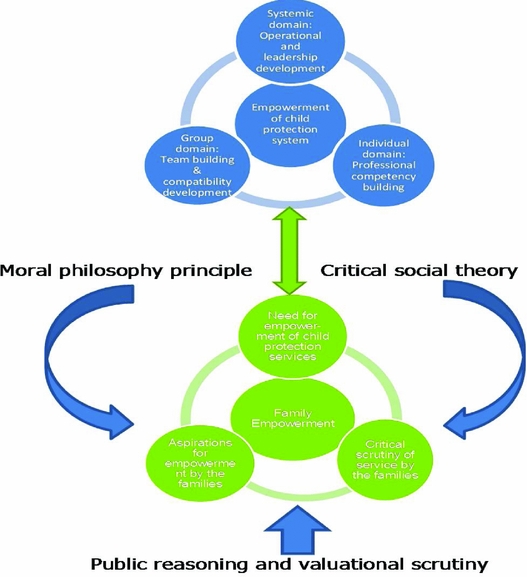
Like previous studies also undertaken with limited data (for example, D'Cruz & Gillingham, Reference D'Cruz and Gillingham2014; Ghaffar et al., Reference Ghaffar, Manby and Race2012), this study does not make any claim that the views of the participating families in this research are representative of the families typically involved with the public child protection services. However, it is suggested that, based on their lived experiences with the services, the range of views, critiques and aspirations of the participating families is likely to be shared by other families (Ghaffar et al., Reference Ghaffar, Manby and Race2012). The participating families seemed to welcome the opportunity to reflect on their very sensitive personal experiences in a private space. The discussion below introduces the structure and organisation of the mapping process, linking between the empowerment framework (ICET), critical theories and the core themes from findings. This process provides the basis for the empowerment concept map (Figure 1).
Family informed pathways of empowerment under ICET-staged process.

Empowerment Concept Map Informed by the Families
Figure 1 represents the empowerment concept map, which articulates the whole process of its development encompassing the primary data as analysed and mapped by the theoretical frameworks,Footnote 1 which all direct to three-tier domains of empowering child protection system as pathways for building family empowerment-based practice.
The identified three-tier domains, professional competency development; team compatibility development and operational and leadership development, have articulated scope for building the child protection service informed by the voices of the families. On the whole, the empowerment concept map has identified an intrinsic link between the families’ critiques and aspirations for a better service and the scope for comprehensively addressing the developmental needs of the child protection services.
The Aspirations of the Families: Pathways of Empowerment in Staged Process
What needs to change: The families’ vision of future services
• Fairness in the service – families to be treated with dignity and included in each level of interventions.
• Consistency of communication to provide clear directions and support for the best chance for children growing up at home.
• Sincerity and consistency in all matters relating to the implementation of the care plan/court decisions, so that parents do not get confused or feel kept in the dark, and children do not suffer.
• Appropriate ethical conduct and a commitment to integrity by all practitioners, recognising that “there are families’ lives at the end of this”.
• Support for change to the current “adversarial” policy and legal system, so that the process becomes family focused and leads to a “win–win” situation for all parties as far as possible.
• Careful planning of out-of-home care arrangements so that already traumatised children are not further traumatised due to a delay or poor selection of placement.
• Opportunities for confidential, independent advice and guidance within the public child protection services, which parents can access at any time without fear or intimidation.
• Access to efficient, independent complaint services, which families can use without any fear or intimidation in the event of needing to lodge a complaint.
Building Child Protection Practice Embedded in the Vision of the Families
While there have been many compelling arguments and innovative initiatives for improving child protection practice – like reinforcing ethical values, relationship-based engagement, family support, using a strength focus and improving learning culture – no major changes have been noted on the ground in terms of improving the families’ experiences, statistics of notifications and substantiations or public confidence in child protection system. It is important to acknowledge that there is no shortcut to overcoming the challenges unless we comprehensively understand the current functioning of the system and address the “road blocks”, which have prevented optimum and sustainable outcomes from the previous developmental initiatives. Previous and current service models like the Differential Response model, Family Group Conferencing (FGC), family supports programmes in NSW as well as Child FIRST and Integrated Family Services (IFS) in Victoria are not meeting the national expectations of a substantial reduction in child protection issues (Bromfield et al., Reference Bromfield, Arney, Higgins, Hayes and Higgins2014; Commonwealth of Australia, 2009; Harris, Reference Harris2012; Lonne et al., Reference Lonne, Brown, Wagner and Gillespie2015). This research has thrown some light on the current systemic issues and identified a three-tier development approach (Figure 1) informed by the voices of the families, to address the road blocks and potential ways forward, for building ethical child protection practice that is embedded in family empowerment. Each of the staged domains is unique in terms of the nature, scope and boundaries for development.
Change in Systemic Capacity
The systemic domain encompasses the operational development and social care governance aspects of the child protection system, which is considered with an international example regarding a statutory model of care, which takes into consideration all aspects of organisational development. This is drawn on the social care governance framework of Gloucestershire County Council (2012, p. 2):
“Social Care Governance is a framework for making sure that social care services provide excellent ethical standards of service and continue to improve them. Our values, behaviours, decisions and processes are open to scrutiny as we develop safe and effective evidence-based practice. Good governance means that we recognise our accountability, we act on lessons learned and we are honest and open in seeing the best possible outcomes and results for people.”
These points reinforce the themes identified in this study in terms of building a frontline practice framework, and providing training and staff development to facilitate effective engagement and partnerships, and respond to the lived experiences of the families (Bunting, Webb, & Shannon, Reference Bunting, Webb and Shannon2015).
Change in Team/Group Capacity
The core theme of the families’ alienation is not simply a practice issue but reflects the lack of intense professional engagement skills required to connect with the vulnerable people, skills that are often identified as wanting by the literature (D'Cruz & Gillingham, Reference D'Cruz and Gillingham2014; Platt, Reference Platt2008; Shulman, 1999, in Morrison, Reference Morrison2007, p. 156). Engagement competencies are described in contemporary literature as consisting of intra-personal and inter-personal emotional intelligence skills (Morrison, Reference Morrison2007). The frontline practitioners are constantly exposed to significant demands for these skills, which do not simply come with working under the policy and legal frameworks but, as Bunting et al. (Reference Bunting, Webb and Shannon2015) emphasised, are part of the relationally based approaches required to build the alliances.
The lack of engagement skills that contributed to the families’ alienation and difficulty in building connection with workers is considered here in terms of individual compatibility and collective team capacity. Compatibility, defined as ‘the state in which two or more people relate harmoniously because their attitudes, traits, and desires match or complement those of the other or others’, is an important attribute for the members of professional teams (APA, n.d.). It facilitates a team's capacity to offer an appropriate, nurturing environment for clients and support the capabilities of team members themselves. Dias (Reference Dias2015) indicated, for example, that a group-based professional development culture is needed to build team members’ morale, sense of belonging, mutual empathy, safety and connection with the work environment and culture. By building greater compatibility among team members, each team member's interpersonal attitudes and behaviours are more likely to reflect shared values, contributing to an empowered team environment that is able to nurture the individual competency of the workers, and support the system to grow and flourish. If only the individual worker, rather than a whole team or group, is empowered to promote empathy, safety, respect and morale, the particular worker will be always at risk of being negatively challenged by the other disempowered team members. One parent, in fact, shared his experience of how the service suffered when a passionate case worker, isolated in a team of very many not-so-committed staff members, eventually left the service. Obviously, the parent's experience also demonstrated that there are positive attempts (albeit not enough) in the CPS to engage with the families. While this discussion needs to continue with more research and practice-based evidence and input, it can be argued that the process of building the emotional skills and competence of the frontline workers to effectively engage with families can be better considered in a group domain, from a whole team building perspective.
Change in Individual (Professional) Competency
The mapping process has located the issue of professional competency in the individual capacity building domain. The practice issues highlighted by the families have been analysed and identified as disempowering amidst a lack of regard for ethical values, and this is echoed in the findings of D'Cruz and Gillingham (Reference D'Cruz and Gillingham2014), Dumbrill (Reference Dumbrill2006) and Harris (Reference Harris2012). The practice issues associated with engagement and building effective partnerships are also noted by Bunting et al. (Reference Bunting, Webb and Shannon2015) and Platt (Reference Platt2008). Other significant practice issues in terms of the quality of safe out-of-home care management are also noted in a number of research studies (Harris, Reference Harris2012; Ivec et al., Reference Ivec, Braithwaite and Harris2012), as well as in the reports of public child protection inquiry commissions (Queensland Child Protection Commission of Inquiry, 2013). The mapping process has consolidated and structured those voices of the families in building our understanding of potential pathways of their empowerment through the workers’ achieving appropriate tertiary level professional competency in human services discipline leading to the empowerment of the team and the whole child protection system. In reinforcing the practice empowerment process, the Munro Review of Child Protection in the United Kingdom (Munro, Reference Munro2011, p. 38) recommended the creation of positions like ‘principal child and family social worker’ who, as a senior manager, should carry lead responsibility for practice development in frontline practice, and who could report the views and experiences from the frontline to all levels of management. However, D'Cruz and Gillingham (Reference D'Cruz and Gillingham2014) as well as Ainsworth and Hansen (Reference Ainsworth and Hansen2006) expressed concerns regarding the scope of practice development in light of current recruitment trends in Australia, where, unlike other Anglophone countries, the statutory child protection authorities in most Australian states do not recruit social workers primarily for frontline child protection work. This qualification factor is significant in terms of building ethically driven human service practice competency and, therefore, deserves appropriate attention in systemic and group competency development domains.
Ethical Issues
The limitation and ethical issues of the study lie in its small cohort, resulting from the difficulties in recruiting people through snowball sampling and associated assumed biases. However, if it is assumed that those interviewed for this study were among the most complex families with critical views about the CPS, understanding more fully their sources of grievance nevertheless matters and may provide new insight into how to effectively engage with such families in the future (D'Cruz & Gillingham, Reference D'Cruz and Gillingham2014; Ivec et al., Reference Ivec, Braithwaite and Harris2012). Ethical issues also stem from the researchers’ assumed personal biases in the processes of qualitative data analysis and synthesis (Sandelowski, Reference Sandelowski2004).
Conclusions and Recommendations
The purpose of the research was to promote our understanding of the views and experiences of families with the public child protection system by using an empowerment framework for analysis and articulating ways forward based on the families’ accounts. The findings have identified themes of alienation common to the families at all stages of intervention, alongside ongoing practice and operational management issues, which have created obstructions for family empowerment and practice development initiatives. While the research has reinforced previous literature regarding reasons for the lack of effectiveness of many innovative practice building initiatives (chiefly due to unaddressed broader systemic issues relating to policy, practice, operation, leadership, governance, etc.), it also reiterates the call for the issues in the system to be comprehensively addressed, and offers the three-domain empowerment pathways as ways for building a better CPS which embeds the values of family empowerment. This study supports the notion that broader system change should be the primary focus for improving the outcomes of any innovative practice development strategies. The process of enhancing practice development should not be seen in isolation, rather it should be aligned with broader systemic functioning.
Acknowledgement
The author would like to acknowledge James Cook University, Townsville for providing practical support in undertaking the research.