INTRODUCTION
Durian (Durio zibethinus L.) is one of the most popular and economically important fruit crops in South-East Asia. Thailand is the leading country for durian production, with a yield of 686 500 Mg in 2007 (http://www.dit.go.th/agriculture/product/agri_5/agri_50650.htm). Durio zibethinus was introduced to Thailand more than 300 y ago (Brown Reference BROWN1997, Subhadrabandhu & Ketsa Reference SUBHADRABANDHU and KETSA2001) and it is hardly surprising therefore that at least 200 cultivars, resulting from human selection, have been reported in Thailand (Hiranpradit et al. Reference HIRANPRADIT, JANTRAJOO, LEE-UNGULASATIAN and POLPRASID1992). Some of these (e.g. ‘Mon Thong’, ‘Chanee’, ‘Kan Yaw’, ‘Kradum Thong’) are more popular than others and are grown commercially in large plantations. However, unnamed seed-planted semi-wild durian has been grown traditionally for household consumption in southern Thailand, Malaysia and Indonesia. Although extensive information on the floral biology and pollination ecology of commercial durian is available (Honsho et al. Reference HONSHO, YONEMORI, SOMSRI, SUBHADRABANDHU and SUGIURA2004a, Reference HONSHO, YONEMORI, SUGIURA, SOMSRI and SUBHADRABANDHUb, Reference HONSHO, SOMSRI, TETSUMURA, YAMASHITA, YAPWATTANPHUN and YONEMORI2007a, Reference HONSHO, SOMSRI, TETSUMURA, YAMASHITA and YONEMORIb; Lim & Luders Reference LIM and LUDERS1998, Salakpetch et al. Reference SALAKPETCH, CHANDRAPARNIK and HIRUNPRADIT1992), little is known about semi-wild durian which is probably closest to the ancestral form.
Although durian flowers conform to the syndrome of chiropterophily, and fruit bats have been postulated to be the major pollinators by previous authors (Soepadmo & Eow Reference SOEPADMO and EOW1976, Start & Marshall Reference START, MARSHALL, Burley and Styles1976), only Soepadmo & Eow (Reference SOEPADMO and EOW1976) confirmed that with pollination experiments. However, their experiment was based on only a single tree and the pollination results were assessed 5 d later. This is questionable since a recent study suggested that the durian breeding system is characterized by late-acting self-incompatibility which appears to work within 4 wk of pollination (Honsho et al. Reference HONSHO, YONEMORI, SOMSRI, SUBHADRABANDHU and SUGIURA2004a). In addition, some authors have suggested that insects are potential pollinators of durian (Boonkird Reference BOONKIRD1992) while nectarivorous birds were confirmed as pollinators in some species of Durio (Yumoto Reference YUMOTO2000). Furthermore, almost complete pollination failure occurred in open pollination of a commercial durian cultivar planted in a horticultural station (Honsho et al. Reference HONSHO, YONEMORI, SOMSRI, SUBHADRABANDHU and SUGIURA2004a), which may reflect the loss of natural pollinators in the area. If this is the case, it is a matter of serious concern for future durian yields since decreased crop production resulting from pollination failure has been found in other animal-dependent crops (Kevan & Phillips Reference KEVAN and PHILLIPS2001). Indeed, the actual pollinators of D. zibethinus need to be clearly identified. Therefore, the objectives of the present study are to determine the floral biology of semi-wild durian and to test the hypothesis that fruit bats are the principal pollinator of this crop plant.
METHODS
Study species
Durio zibethinus is suggested to be native to Borneo, Sumatra and Peninsular Malaysia (Morton Reference MORTON1987, Subhadrabandhu & Ketsa Reference SUBHADRABANDHU and KETSA2001). From at least 28 recognized species of Durio, D. zibethinus is the most common cultivated species, although no wild extant D. zibethinus has been reported. In Thailand, a few cultivars of D. zibethinus are planted on a commercial scale, using trees cloned from the vegetative parts of a selected variety to preserve the original characters. Farmers in south-east Thailand also carry out hand-crossed pollination of commercial cultivars. On the other hand, unnamed semi-wild durian grown from seed and exposed to little or no artificial management, is commonly planted in southern Thailand, Malaysia and Indonesia. Since the seed from which it grows results from open pollination, this semi-wild durian is assumed to be phylogenetically close to extinct wild durian. The genetic diversity of the semi-wild durian is reflected in a variety of taste and aril characters. Semi-wild durian trees are robust, and resist drought and fungal infection much better than commercial varieties. Thus, it is normally used as grafting stock for commercial cultivars, and also as stock for breeding selection. Generally, trees begin to flower when they are about 8 y old. The fruits of semi-wild durian are found on old branches (i.e. durian is ramiflorous). They are small and round, and there are a large number per tree. They are typically collected from the ground after they have ripened and fallen. Semi-wild durian trees are usually large and some trees have a diameter at breast height in excess of 1 m. Currently, large semi-wild durian trees are selected for furniture wood, while young trees are rarely planted.
Study sites
The present study was undertaken in lowland traditional mixed-fruit orchards 0.5–3 km from Ton Nga Chang Wildlife Sanctuary, Songkhla Province (6°56′N, 100°14′E, 100 m asl). Tropical lowland rain forest covers most of this wildlife sanctuary. A cave containing a colony of the fruit bat Eonycteris spelaea is c. 18 km from the study orchards. In mixed-fruit orchards, a large number of fruiting plants are planted to form several vertical layers. Canopy-top species are planted well-spaced, while subcanopy and understorey species are planted in the spaces between. Durian and petai (Parkia speciosa Hassk.) are canopy-top species while duku (Lansium domesticum Corr.), mangosteen (Garcinia mangostana L.), banana (Musa spp.) and ginger (Zingiber spp.) predominate in the subcanopy and understorey. In these orchards, natural streams, if present, are maintained as a source of water for plants. Farmers normally do not use herbicide to control weeds, and organic fertilizer is rarely applied. This kind of orchard supports high biodiversity (Round et al. Reference ROUND, GALE and BROCKELMAN2006). The study orchards are surrounded mainly by Hevea brasiliensis (A. Juss.) Müll.Arg. plantations, and other mixed orchards. Durian trees in the study orchards varied in age from 15 y to more than 80 y old, with the majority more than 50 y old. Tree height ranges from 15–25 m. In the study area, although it rains every month, the rainy season is from mid-April to December and rain is heaviest in late October to mid-December. Average annual rainfall in Ton Nga Chang Wildlife Sanctuary is 1801 mm.
Floral biology
Flowers of eight semi-wild durian trees were accessed using climbing gear. Floral biology was determined including flower opening time, nectar secretion rate, time of anthesis and time of corolla drop. Hydrogen peroxide was applied to determine whether the stigma was receptive when the anthers dehisce, and the presence of a bubble of oxygen is an indicator of stigma receptivity. Nectar was collected using 80-μl microcapillary tubes once an hour until the corolla dropped. Nectar standing volume was also measured before the corolla dropped. Nectar concentration was measured with a pocket refractometer.
Pollination experiments
Since up to 100 flowers are tightly packed in an inflorescence, flowers were cut until there were 15–30 flowers per inflorescence to minimize the effect of number of flowers on pollination success. The pollination experiments comprised: (1) open pollination: all potential pollinators were allowed to access flowers; (2) automatic autogamy: all pollinators were excluded by bagging flowers from 15h00–18h00, before anthesis occurred; (3) insect pollination: inflorescences were covered with plastic nets (16 mm mesh size) allowing access by insects but not bats; (4) hand-crossed pollination: anthers were removed before anthesis, and stigmata were rubbed directly with dehisced anthers of the ‘Mon Thong’ durian cultivar and bagged; (5) facilitated autogamy: stigmata were rubbed with anthers from the same tree and then bagged; (6) emasculation pollination: the anthers were removed before anthesis with sharp scissors and the flowers were left uncovered allowing access by pollinators. Flowers were subjected to hand-crossed pollination and facilitated autogamy at 20h00 after anthesis. Large semi-permeable cloth bags (diameter 20 cm, 35 cm high) with a plastic net inside to stop the flowers touching the cloth were used for bagging flowers. In seven sampling trees, three to six replicates per treatment were applied, while only one replicate per treatment was undertaken in the eighth sampling tree. It takes about a week for all flowers in the whole inflorescence to finish blooming. Fruit set was determined at 10, 20, 30 and 60 d after the experiment. Since D. zibethinus appears to have a late-acting self-incompatibility breeding system (Honsho et al. Reference HONSHO, YONEMORI, SOMSRI, SUBHADRABANDHU and SUGIURA2004a, Lo et al. Reference LO, CHEN and CHANG2007), the fruit set at 10 and 20 d may include both persistent pistils or unfertilized fruits as well as those fertilized fruits. The study was undertaken during April to May of 2003 and 2005. Nested ANOVA was applied to examine the difference in pollination success between treatments in each period. Inflorescences were nested within tree. All statistical analyses were carried out using SPSS 15.0.
Observation of flower visitors
Nocturnal visitors were observed with a night-shot video camera equipped with infrared light at a distance of c. 15 m from inflorescences. Observations were undertaken continuously between 19h00 until the corolla dropped (c. 01h00), from 28 April to 5 May 2003 on 11 inflorescences. The number of visits was counted. Crepuscular visitors to flowers were also noted.
Long-distance observations by video camera may be biased toward larger objects like bats, so an alternative technique, a scouting camera, was used to observe visitors to durian flowers at a closer distance. Four digital scouting cameras (Game Spy I-40, Moultrie Feeders, USA) were set in five durian trees for 1–2 nights in each tree on 19–23 April 2008. This observation was carried out in a mixed durian plantation that included both the ‘Mon Thong’ cultivar and semi-wild durian, with most scouting cameras set on the former, since they were more accessible and fewer semi-wild durian trees were in flower during that period. It was assumed that visitor community structure was similar between semi-wild and ‘Mon Thong’ cultivar trees. Infrared cameras were pointed at two to five inflorescences of opened flowers at a distance of c. 2 m. Both 5-s video and still pictures were taken when cameras were triggered. The movement of some objects, such as bats, birds or branches, but not insects, up to 16 m from a sensor can trigger the camera. Thus the number of pictures of insects visiting the flowers largely depended on other moving objects. Visitors to sampled flowers at 18h00–06h00, the period during which pollination is most likely to occur in this durian, were observed and identified, and the frequency percentage of each was calculated. This may be under-estimated for bats as the trigger time of the cameras was 3 s which may not be rapid enough to capture flower visit by bats that usually last for 1–2 s. Bats were identified to species, when possible, by size and hair colour. Three species of bat that are mainly nectarivorous occur in this area: Eonycteris spelaea, Macroglossus sobrinus and M. minimus (nomenclature according to Corbet & Hill Reference CORBET and HILL1992). Eonycteris spelaea is the largest with fore-arm (FA) length of 61–78 mm and body mass (BM) of 45–60 g with dark fur while M. sobrinus and M. minimus are much smaller (FA = 44–50 mm, BM = 13–23 g and FA = 36–44 mm, BM = 11–16 g respectively, Corbet & Hill Reference CORBET and HILL1992, Payne et al. Reference PAYNE, FRANCIS and PHILLIPPS1985) with brighter red fur. Insects were identified to groups such as bees, moths, and to species in the case of the giant honey bee (Apis dorsata). The behaviour of visitors at flowers was also noted.
Bat sampling at flowering trees
Mist-nets (2.6 m × 9 m) were set 6 m high in durian plantations where scouting cameras were set during the flowering period to confirm the species identity of bats. Nets were checked every 15 min for netted bats. Captured bats were identified to species following Corbet & Hill (Reference CORBET and HILL1992).
RESULTS
Floral biology
Semi-wild durian had a short flowering period which occurred at the same time in three different years. Its main flowering period was mid-March to late April. In each individual tree, flowering lasted for c. 10 d. Petal lobes began to separate and the style obviously exserted at 16h00: the petal lobes gradually recurved outward, the anthers gradually exserted and recurved outward followed by the petal lobes which fully separated from the stigma by 20h00. When fully open, most of the study trees had a flower with a style exserted beyond the anthers (i.e. herkogamy), although one tree had a style and anthers nearly at the same height. Anthers dehisced at 19h30–20h00. The stigma was moist when the anthers released pollen, and was already receptive. Nectar secretion began in the late afternoon (c. 16h30) after flowers opened, and the c. 0.37 ml of nectar had accumulated by 19h00. The secretion rate was about 0.05 ml h−1 from that time until 01h00 when the corolla dropped. The average (± SD) total nectar volume was 0.65 ± 0.14 ml (range = 0.48–1.00 ml, n = 18). Sucrose concentration was highest in the early evening, 21.9%, and gradually decreased until flowers dropped (13.3%) with an overall average concentration of 17.2%. Nectar standing volume at 01h00 was 0.97 ± 0.26 ml (range = 0.65–1.4 ml, n = 9) with average concentration of 15.4% ± 1.14% (range = 12.8–16.4%). The androecium of most flowers (>50%) dropped at 01h00, and by 06h00, all androecia had dropped.
Pollination experiments
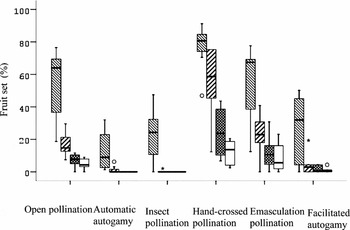
Pollination experiments were carried out on 3089 flowers of 127 inflorescences from eight trees. The average number of flowers in each sampled inflorescence was 23.7 ± 9.5 (mean ± SD, range = 9–71) and the number of inflorescences in each treatment was 16–30 (mean ± SD = 21 ± 4.9). Ten days after the pollination experiments, most fruit had set as a result of hand-crossed pollination (mean = 76.6 %, median = 80.6 %, n = 8 trees), followed by open pollination (mean =54.4%, median = 64%), emasculation pollination (mean = 53.3%, median = 64.4%), facilitated autogamy (mean = 26.3%, median = 31.9%), insect pollination (mean = 22.6%, median = 24.2%) and automatic autogamy respectively (mean = 12.8%, median = 8.9%, Figure 1). There was a statistically significant difference between treatments (F = 5.11, df = 36, P < 0.001), with the exception of hand-crossed pollination and open pollination (F = 4.2, df = 1, P = 0.062), and the latter and emasculation pollination (F = 0.01, df = 1, P = 0.923). Fruit abortion occurred in all treatments. The majority of fruit abortion occurred during the first 20 d after pollination experiments, and after that period, fruit abortion gradually decreased (Figure 1). At 60 d when fruit was almost mature, the pattern of pollination success was generally similar to that recorded at 10 d. It was greatest after hand-crossed pollination (mean = 12.2%, median = 13.7%) followed by emasculation (mean = 8.7%, median = 5.6%), and open pollination (mean = 5.1%, median = 4.3%). Facilitated autogamy also yielded a very small percentage of fruit (mean = 1.2%, median = 0.7%). No fruit was found from automatic autogamy and insect pollination (Figure 1). Pollination success was significantly different between treatments (F = 5.29, df = 5, P = 0.001). Although pollination success from hand-crossed pollination was higher, it was not significantly different from open pollination (F = 3.35, df = 1, P = 0.087) and emasculation pollination (F = 0.68, df = 1, P = 0.418). Also, pollination success between open pollination and emasculation pollination was not significantly different (F = 0.59, df = 1, P = 0.45).
Per cent fruit set at 10, 20, 30 and 60 d, respectively after anthesis in six pollination treatments carried out in eight semi-wild durian trees during April–May 2003, and 2005. The different shading represents different times after anthesis. The box represents lower quartile, median and upper quartile. The whiskers and star represent minimum, maximum and extreme outlier values.

Observation of flower visitors
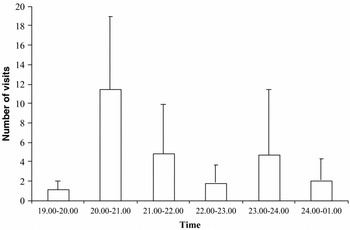
From video observations, the commonest nocturnal visitors were bats, probably E. speleae from its size and typical ‘tseet’ call. Bats visit flowering trees either as a flock, more than 30 bats when trees were in full bloom, or only a few individuals after the main flowering period of the tree had just passed. Visits by bats were sporadic and erratic. Some inflorescences were rarely visited by bats, others were repeatedly visited. From 11 inflorescences observed over four nights, bats made 26.1 visits per inflorescence per night (SD = 20.7, range = 6–72 visits). The peak of visits occurred at 20h00–21h00 (Figure 2). The number of visits was then lower and relatively stable until 01h00 when visits by bats ceased. Bats mostly spent c. 1–2 s, and occasionally, up to 1 min in each visit. Beetles and moths were also observed. Some nectarivorous birds (flowerpeckers, Nectariidae) were rarely found feeding on flowers during the late afternoon.
The frequency of bat visits at inflorescences (n = 11) of durian for the period 28 April–5 May 2003. Bats were observed with infrared night-shot video at a distance of c. 15 m. Error bar represents 1 SD.

From 64 h of observation with infrared scouting cameras, 1964 clips of 5-s video and 2078 still pictures were taken. No visitors were seen in most of these clips and pictures (75% of video clips and 77.3% of pictures). From 490 video clips and 471 pictures with observed visitors, bees predominated both from video (80%) and still pictures (92.5%). These bees were large, presumably giant honey bees (Apis dorsata) which visit during both day and night. Bats were observed in only 11.4% of video clips and 5.7% of still pictures. Moths and other visitors were least observed, in 8.5% of video clips and 1.8% of still pictures. With identifiable pictures from scouting cameras, bats visiting flowers were all identified as Eonycteris spelaea (n = 25). Bats land on inflorescences, head up or nearly horizontal in the face-up position, thumb claws holding opened flowers, and they insert their muzzle into the corolla tubes of flowers. For visits longer than 1 s, the bat fed on several flowers consecutively. However, bats appear to collect pollen or check for the presence of nectar rather than feeding on nectar during those shorter visits (≤ 1s). At every visit, the momentum of the flying bat shook the inflorescence and consequently the bat's wings, body and face rubbed against anthers and stigmas. No bats were observed at durian flowers after the corolla dropped.
Bat sampling at flowering trees
Five bats were captured during 10 net hours. All were identified as Eonycteris spelaea. Three were juvenile and two were mature males. Pollen was found on the body of all captured bats.
DISCUSSION
Floral biology
Although the floral biology of semi-wild durian is broadly similar to that reported in commercial cultivars, some aspects, which may have a significant effect on its pollination ecology, differ slightly from that reported for cultivars. Previous studies indicated that anthesis and anther dehiscence of the ‘Chanee’ cultivar in south-east Thailand occur simultaneously at 19h00 (Boonkird Reference BOONKIRD1992, Honsho et al. Reference HONSHO, SOMSRI, TETSUMURA, YAMASHITA, YAPWATTANPHUN and YONEMORI2007a) or even earlier (17h45) in some cultivars (Salakpetch et al. Reference SALAKPETCH, CHANDRAPARNIK and HIRUNPRADIT1992, Subhadrabandhu & Ketsa Reference SUBHADRABANDHU and KETSA2001). All floral organs except gynoecia of durian are shed the morning after flowering (c. 09h00) in the ‘Mon Thong’ and ‘Chanee’ cultivars (Honsho et al. Reference HONSHO, YONEMORI, SUGIURA, SOMSRI and SUBHADRABANDHU2004b, Reference HONSHO, SOMSRI, TETSUMURA, YAMASHITA and YONEMORI2007b, W. Thawiphon unpubl. data) or within 16–48 h after anthesis in commercial durian cultivars planted in Australia (Lim & Luders Reference LIM and LUDERS1998). The timing of anther dehiscence in the present study is comparable with that reported by Soepadmo & Eow (Reference SOEPADMO and EOW1976) at around 19h30–20h00, whereas that of commercial cultivars is earlier. Androecium abscission of semi-wild durian occurs much earlier than in commercial activars in our study and that of Soepadmo & Eow (Reference SOEPADMO and EOW1976) (01h00) or even earlier (23h00) according to Valmayor et al. (Reference VALMAYOR, CORONEL and RAMIREZ1965). The time of anther dehiscence of the ‘Mon Thong’ cultivar planted sympatrically in the study orchards is similar to that reported previously in south-east Thailand, but androecium abscission is earlier, as in semi-wild durian (S. Bumrungsri, pers. observ.). The results from hand-crossed pollination suggest that the effective pollination period (i.e. the interval of time during which pollination can occur) of some commercial cultivars (e.g. ‘Chanee’) is between 6 h before anthesis and 12 h after (Honsho et al. Reference HONSHO, SOMSRI, TETSUMURA, YAMASHITA and YONEMORI2007b), so it is synchronized with flower longevity although stigma receptivity was reported to be much longer (Salakpetch et al. Reference SALAKPETCH, CHANDRAPARNIK and HIRUNPRADIT1992). Compared with commercial cultivars, the effective pollination period in open pollination of semi-wild durian is much shorter than that in the natural pollination of commercial cultivars, which is only 5.5 h, from 19h30 to 01h00. Thus, all pollination success in open pollination is the result of nocturnal pollinators. This challenges the suggestion of Boonkird (Reference BOONKIRD1992) that stingless bees (Trigona spp.), the major diurnal flower visitors, are potential pollinator of D. zibethinus.
The concentration and volume of nectar in semi-wild durian are comparable to those reported in commercial cultivars (Boonkird Reference BOONKIRD1992, W. Thawiphon unpubl. data). The optimal sucrose concentration for pollen germination was 10–15% in the ‘Mon Thong’ and ‘Chanee’ cultivars (Honsho et al. Reference HONSHO, SOMSRI, TETSUMURA, YAMASHITA, YAPWATTANPHUN and YONEMORI2007a, W. Thawiphon unpubl. data).
Pollination experiments
Although a relatively high percentage of fruit set was found in all treatments 10 d after pollination experiments, considerable fruiting (>5%) at 60 d was found only in three treatments, namely open, hand-crossed and emasculation pollination, while a significantly smaller fruiting percentage was observed in facilitated autogamy. The latter yields a lower fruit set or no fruit set at all compared with cross-pollination in commercial cultivars (Honsho et al. Reference HONSHO, YONEMORI, SOMSRI, SUBHADRABANDHU and SUGIURA2004a, Lim & Luders Reference LIM and LUDERS1998, Lo et al. Reference LO, CHEN and CHANG2007). Lim & Luders (Reference LIM and LUDERS1998) also indicated the poor quality of fruits from facilitated autogamy (e.g. mis-shaped, distorted, up to 50% lighter flesh weight, and fewer arils). The result from the present study supports the previous suggestion that most durian trees are highly self incompatible (Honsho et al. Reference HONSHO, YONEMORI, SOMSRI, SUBHADRABANDHU and SUGIURA2004a, Lim & Luders Reference LIM and LUDERS1998). A different degree of self incompatibility was recognized in different D. zibethinus cultivars from partially self-incompatible to completely self-incompatible (Brown Reference BROWN1997, Honsho et al. Reference HONSHO, YONEMORI, SOMSRI, SUBHADRABANDHU and SUGIURA2004a, Lim & Luders Reference LIM and LUDERS1998, Lo et al. Reference LO, CHEN and CHANG2007, Valmayor et al. Reference VALMAYOR, CORONEL and RAMIREZ1965, S. Somsri unpubl. data). Late-acting self-incompatibility which was suggested to characterize D. zibethinus, was considered to take place within 4 wk of pollination (Honsho et al. Reference HONSHO, YONEMORI, SOMSRI, SUBHADRABANDHU and SUGIURA2004a). Most self-pollinated fruits of the ‘Chanee’ cultivar dropped within 10 d and all such fruits drop within 35 d after pollination (Lo et al. Reference LO, CHEN and CHANG2007). Cross-pollination between different cultivars was found to markedly increase pollination success (Lo et al. Reference LO, CHEN and CHANG2007, S. Somsri unpubl. data). Herkogamy, one of the mechanisms to promote out-crossing pollination, was also described in some cultivars (Honsho et al. Reference HONSHO, SOMSRI, TETSUMURA, YAMASHITA and YONEMORI2007b). Herkogamy is also observed in most but not all semi-wild durian trees in our study. When no pollination occurs, almost all unfertilized fruit of semi-wild durian dropped within 20 d, as also previously observed in commercial cultivars (Honsho et al. Reference HONSHO, YONEMORI, SOMSRI, SUBHADRABANDHU and SUGIURA2004a). Specifically, non-pollinated flowers of ‘Mon Thong’ and ‘Chanee’ abscised within 8 d (Lo et al. Reference LO, CHEN and CHANG2007). No mature fruit has been observed in autogamy pollination in D. zibethinus, although some clones are self-compatible. Pollen transfer without animal vectors was suggested to be impossible since durian pollen is sticky and is not released at dehiscence. In addition, its pollen is clumped and still adheres to the pollen sac for at least 6 h (Honsho et al. Reference HONSHO, SOMSRI, TETSUMURA, YAMASHITA, YAPWATTANPHUN and YONEMORI2007a).
Fruit bats are clearly effective pollinators of this semi-wild durian, although visits by bats are sporadic (Gould Reference GOULD1978, Start Reference START1974). A further investigation on pollen load per fruit bat visit is recommended. Since D. zibethinus has big-bang flowering (i.e. a large number of flowers available for a short period), it attracts a number of visitors including nectarivorous bats. Several species of fruit bat are reported to visit D. zibethinus flowers (Brown Reference BROWN1997, Gould Reference GOULD1977, Reference GOULD1978). Eonycteris speleae appears to be the major pollinator since it is a true nectarivore and also the most common nectarivorous species in Thailand, and can travel at least 38 km per night (Start & Marshall Reference START, MARSHALL, Burley and Styles1976). Previous studies indicated a varying proportion of D. zibethinus pollen found in faeces of E. spelaea (Soepadmo & Eow 1977, Start & Marshall Reference START, MARSHALL, Burley and Styles1976) and a recent study indicated that pollen of Durio contribute 39–42% of the diet of captured E. spelaea in March and April (n = 30–41 in each month) (Bumrungsri et al. unpubl. data). Although a previous study indicated that stingless bees and bees are responsible for the majority of flower visits (Boonkird Reference BOONKIRD1992, W. Thawiphon unpubl. data), our pollination experiments did not show that they are pollinators of D. zibethinus. A recent study on stigma pollen load found that both bees and stingless bees visit D. zibethinus flowers primarily for collecting pollen and did not touch and transfer pollen onto stigmata (W. Thawiphon unpubl. data, S. Bumrungsri pers. obs.) which mostly exsert beyond the anthers. During D. zibethinus flowering, 90% of pollen loads collected from stingless bees returning to their nests is pollen of this species (W. Thawiphon unpubl. data).
Since pollination success in durian depends on fruit bats, protecting fruit bat populations, especially nectarivorous ones, is vital for securing the future of the durian crop, otherwise no natural pollination will occur. In one case, open pollination carried out in Chantaburi Horticulture Research Center was reported to yield very low fruit set (0–1.4%) (Honsho et al. Reference HONSHO, YONEMORI, SOMSRI, SUBHADRABANDHU and SUGIURA2004a). This may indicate that pollinator activity is minimal, probably resulting from a relatively small population of fruit bats. In such areas, most fruit farmers treat fruit bats as a nuisance, so they are netted and killed and when a colony is found, it is eradicated (S. Bumrungsri, pers. obs.). An alternative explanation for pollination failure is resource-density dependence in pollinator activity. Since D. zibethinus has a big-bang flowering system, and flowering is synchronous between trees, bats may ignore a small number of flowers in experimental inflorescences (i.e. two to five flowers, Honsho et al. Reference HONSHO, YONEMORI, SOMSRI, SUBHADRABANDHU and SUGIURA2004a) compared with a large number of opened flowers available in other inflorescences. Field observations based on scouting cameras also suggests that a very small number of visits occurred when there were few opened flowers in inflorescences. As the nectarivorous bats, especially E. spelaea are also the principal pollinators of other chiropterophilous plants, e.g. Parkia speciosa Hassk. and P. timoriana (DC.) Merr. (Bumrungsri et al. Reference BUMRUNGSRI, HARBIT, BENZIE, CARMOUCHE, SRIDITH and RACEY2008), Oroxylum indicum Vent. (Srithongchuay et al. Reference SRITHONGCHUAY, BUMRUNGSRI and SRIPAO-RAYA2008, Start & Marshall Reference START, MARSHALL, Burley and Styles1976), the protection of bat populations and their habitats is ecologically and economically important. A recent economic assessment in the area of 8756 km2 in southern Thailand surrounding four caves with colonies of E. spelaea indicated that the economic value in 2007 of the pollination services of fruit bats to D. zibethinus and P. speciosa was at least 13 million dollars annually (K. Petchmunee unpubl. data).
ACKNOWLEDGEMENTS
Thanks are due to Dr Chris Wilcock from Aberdeen University, who commented on the original research proposal, to Drs S. Sotthibundhu and C. Satasuk for valuable discussion especially during the beginning of the project, and to the 4th year students of the Biology Department of Prince of Songkla University (PSU) between 2003 to 2006, and Masters students both from PSU and Khon Kaen University for help in the field. We are grateful to the owners of the durian orchards for permitting us to conduct research and for their hospitality during field work, to Prof. P. Poonsawad for training in tree-climbing techniques. Thank are due to the Ministry of University Affairs and the Thailand Research Fund for providing us with an opportunity and financial support to conduct this research. Additional financial support was also made by Prince of Songkla University, the Carnegie Trust for the Universities of Scotland, and The British Council.