Accurate identification of lichenized fungal species remains challenging (Crespo & Pérez-Ortega Reference Crespo and Pérez-Ortega2009; Crespo & Lumbsch Reference Crespo and Lumbsch2010; Lumbsch & Leavitt Reference Lumbsch and Leavitt2011). In many cases, characters used for identification may be subtle or difficult to discern; diagnostic morphological and chemical characters may be lacking in juvenile or fragmentary samples, and the traditional phenotype-based approach to species recognition in lichenized fungi has been shown in some cases to substantially misrepresent diversity (Kroken & Taylor Reference Kroken and Taylor2001; Divakar et al. Reference Divakar, Figueras, Hladun and Crespo2010; Leavitt et al. Reference Leavitt, Fankhauser, Leavitt, Porter, Johnson and St. Clair2011a, Reference Leavitt, Johnson and St. Clairb).
Molecular-based techniques may provide a valuable additional tool for species identification (reviewed in Begerow et al. Reference Begerow, Nilsson, Unterseher and Maier2010; Seifert Reference Seifert2009). Given well-circumscribed taxa, a reference DNA sequence database generated from expertly identified specimens can provide an effective alternative to phenotype-based identification of species by using DNA barcoding (Begerow et al. Reference Begerow, Nilsson, Unterseher and Maier2010; Kelly et al. Reference Kelly, Hollingsworth, Coppins, Ellis, Harrold, Tosh and Yahr2011). The usability of DNA barcoding as a major tool for identification of fungi largely depends on the development of high-quality sequence databases that are thoroughly curated by taxonomists and systematists (Begerow et al. Reference Begerow, Nilsson, Unterseher and Maier2010). The internal transcribed spacer region (ITS) of the nuclear ribosomal RNA cistron is the most frequently sequenced fungal genetic marker, and was recently proposed for adoption by the Consortium for the Barcode of Life as the first fungal barcode marker (Schoch et al. Reference Schoch, Seifert, Huhndorf, Robert, Spouge, Levesque and Chen2012). Investigating the well-known lichen flora of Great Britain, Kelly et al. (Reference Kelly, Hollingsworth, Coppins, Ellis, Harrold, Tosh and Yahr2011) demonstrated that a high proportion of lichen-forming fungal samples were correctly identified to the species level by comparing sequence similarity using BLAST-based identification from fragments of the ITS region. Although in a limited number of cases it may not be possible to discriminate samples to the species level with the ITS marker, unknown samples have been shown to be reliably ascribed to a genus or group of closely related congeneric species (Kelly et al. Reference Kelly, Hollingsworth, Coppins, Ellis, Harrold, Tosh and Yahr2011).
While DNA sequence-based species identification has been shown to be highly effective in cases where lichenized fungal taxonomy is well characterized and a reference DNA database has been generated (Kelly et al. Reference Kelly, Hollingsworth, Coppins, Ellis, Harrold, Tosh and Yahr2011), reference DNA barcodes are largely non-existent for most taxa and geographic regions. The Barcode of Life Data Systems (BOLD; Ratnasingham & Hebert Reference Ratnasingham and Hebert2007) includes a BLAST-based identification tool for fungi using the ITS region. However, the current small size of the BOLD reference database limits the utility of this tool. For example, in Lecanoromycetes, the largest class of lichenized fungi with more than 13500 species (Miąowska et al. Reference Miądlikowska, Kauff, Hofstetter, Fraker, Grube, Hafellner, Reeb, Hodkinson, Kukwa and Lücking2006), only 723 specimens with sequences, representing 189 lecanoromycete species with DNA barcodes, are currently included (http://www.boldsystems.org/; 27 March 2012). In contrast, the National Institute of Health's (NIH) genetic sequence database, GenBank, includes over 10 000 ITS sequences from Lecanoromycetes, representing a broad range of taxonomic and geographic diversity (http://www.ncbi.nlm.nih.gov/genbank/). However, the GenBank database is not curated by expert taxonomists and systematists and contains a small, but significant, amount of erroneous and/or incomplete data, including species misidentifications (Bridge et al. Reference Bridge, Roberts, Spooner and Panchal2003, Reference Bridge, Spooner and Roberts2004; Harris Reference Harris2003; Nilsson et al. Reference Nilsson, Ryberg, Kristiansson, Abarenkov, Larsson and Koljalg2006). In spite of these limitations, GenBank currently provides the largest number of sequences from lichen-forming fungi and may provide a valuable resource for species identification through BLAST-based sequence similarity searches of DNA sequence data obtained from unidentified samples.
The application of DNA-based identification of lichenized fungi may be particularly important in instances where users may not have access to the expertise or reference material necessary to make accurate identifications. Those interpreting morphological and chemical characteristics often need years of training and experience to make accurate identifications, which may not be practical in cases where time is of the essence. Traditional phenotype-based floristic surveys are commonly limited to local-scale site sampling, followed by a lengthy period of processing and enumeration of sample taxonomic units, which can take months to years, and often results in unverifiable taxonomic precision. Rapid inventories of lichen diversity are particularly relevant in many understudied regions due to increasing threats from urban development, pollution, and potentially climate change, among other factors (Bokhorst et al. Reference Bokhorst, Bjerke, Tømmervik, Callaghan and Phoenix2009; Bjerke Reference Bjerke2011; Leavitt & St. Clair Reference Leavitt and St. Clair2011).
The diversity of lichenized fungi in western Africa is largely unknown, and currently only 101 lichenized fungal species are reported for the Republic of Cameroon (Feuerer Reference Feuerer2011). Given the large amount of sequence data available from broad taxonomic groups of lichenized fungi through public databases, we were interested in assessing the utility of BLAST-based identifications using the NIH GenBank database for identifying lichen-forming fungal species in poorly studied areas, such as Mount Cameroon. We specifically asked: 1) are we able to assign unidentified samples to a species, or a closely related congeneric species-group, using BLAST-based searches in GenBank and 2) how well is the genetic diversity of lichenized fungi from understudied regions represented in GenBank? To address these questions, we sampled commonly occurring lichens at six sites on Mount Cameroon in western Africa, and compared ITS sequence similarity generated from the collected specimens to accessions in the NIH GenBank database using BLAST-based searches.
Mount Cameroon is located in the South-west Region of the Republic of Cameroon, on the coastal belt of the Gulf of Guinea. It is the highest mountain in Central and West Africa, rising up steeply from sea level to 4100 m at the summit, covering a land surface area of c. 24 900 km2. In White's phytogeographical classification (1983), the area falls within the afromontane eco-region (Ndenecho Reference Ndenecho2009). Human-related activities are presently fragmenting, degrading, and isolating the remaining native forest patches despite conservation efforts. This study included samples from 6 collection sites associated with Mount Cameroon at elevations ranging from 3 m to 2178 m above sea level. The study sites and their locations are: Ekona (14°09′1″N, 18°29′9″ E), Buea (10°56′2″ N, 12°16′7″ E), Batoke (02°00′2″ N, 05°49′9″E), Bakinglili (03°17′4″N, 03°40′2″ E), Idenau (14°15′8″N, 59°31′8″E), and Bomana (17°01′3″N, 03°38′0″E). This combination of sampling sites provides a broad overview of the lichen diversity of Mount Cameroon by including ecologically diverse sites throughout the study area.
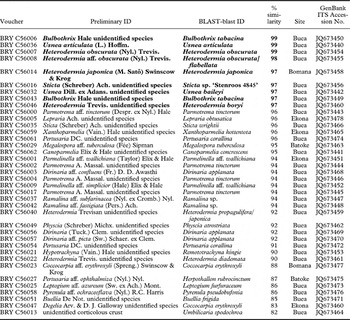
Collection, morphological identification, and preservation of lichen samples followed the methods of Nayanakantha & Gajameragedara (Reference Nayanakantha and Gajameragedara2003), with slight modifications. At each study site, lichens were observed and recorded on rocks and bark of randomly selected trees up to 2 m above ground level. Fieldwork was carried out between 2010 and 2011. Microscopic observations of hand-cut sections of thalli and fruiting bodies were made to characterize thallus and apothecial characteristics for identification purposes. Chemical spot tests were performed to distinguish some species based on chemical differences. Freshly prepared aqueous solutions of calcium hypochlorite and potassium hydroxide, as well as a solution of paraphenylenediamine dissolved in ethyl alcohol, were used for chemical spot tests. Collections are deposited in the botany laboratory at the University of Buea, Cameroon, with duplicates at the Herbarium of Nonvascular Cryptogams at Brigham Young University (BYU), Provo, Utah. From these collections, a total of 58 specimens (Table 1) were selected for molecular analyses, representing commonly sampled morphological and chemical diversity.
Sequence similarity of ITS data based on BLAST searches against the NCBI GenBank database*, †, ‡. Sequence similarity≥97% are shown in bold.

* BLAST searches were performed through the NCBI GenBank website 15 January 2012.
† Unsuccessful PCR amplifications, including heterogeneous PCR products, include the following specimens: Lepraria aff. ecorticata (J. R. Laundon) Kukwa; Porina aff. heterospora (Fink ex J. Hendrick) R. C. Harris BRY C56011; Psilolechia aff. lucida (Ach.) M. Choisy BRY C56019; Pertusaria aff. hymenea (Ach.) Schaer; Psilolechia aff. lucida (Ach.) M.Choisy BRY C56020; Leptogium aff. furfuraceum (Harm.) Sierk BRY C56026; Herpothallon Tobler sp. BRY C56028; Usnea aff. hirta (L.) F.H. Wigg BRY C56030; Cladonia crispata var. cetrariiformis (Delise) Vain. BRY C56031; Leptogium (Ach.) Gray sp. BRY C56033; Usnea aff. florida (L.) Weber ex F.H. Wigg BRY C56039; Lecanora aff. cenisia Ach. BRY C56041; aff. Graphis unidentified species BRY C56050; Buellia De Not. sp. BRY C56052; Graphis scripta (L.) Ach. BRY C56053; and Megalospora Meyen unidentified species. BRY C56063.
‡ ITS sequence data from non-target fungi were generated from the following collections: unidentified corticolous crust BRY C56010, Leptogium (Ach.) Gray sp. BRY C56018; Coccocarpia Pers. sp. BRY C56024; Pertusaria aff. subpertusa Brodo BRY C56034; Usnea aff. cirrosa. Motyka BRY C56038; Physcia aff. aipolia (Ehrh. ex Humb.) Fürnr. BRY C56044; unidentified corticolous crust BRY C56045; Usnea aff. dasypoga (Ach.) Röhl BRY C56048; Caloplaca aff. ferruginea (Huds.) Th. Fr. BRY C56055; and Megalospora aff. tuberculosa Fée (Sipman) BRY C56060.
Total genomic DNA was extracted from carefully prepared fresh thallus material lacking visible symptoms of secondary fungal growth using the PrepEase DNA Isolation Kit (USB, Cleveland, Ohio, USA), following the plant leaf extraction protocol. Fungal specific primers ITS1F (White et al. Reference White, Bruns, Lee, Taylor, Innis, Gelfand, Sninsky and White1990) and ITS4A (Larena et al. Reference Larena, Salazar, González, Julián and Rubio1999) were used to amplify the entire internal transcribed spacer region (ITS). We used a robust amplification protocol that required little optimization. Polymerase chain reactions (PCR) were performed using Illustra pureTaq Ready-To-Go PCR bead kit (GE Healthcare), following the manufacturer's protocol. PCR cycling parameters employed a 66°–56°C touchdown cycle described in Lindblom & Ekman (Reference Lindblom and Ekman2006). Amplification products were visualized on a 1% agarose gel and stained with ethidium bromide. PCR fragments were cleaned using the PrepEase PCR Purification Kit, following the manufacturer's protocol (USB), and complementary strands were sequenced using the same primers used for amplification. Sequencing reactions were performed using BigDye v3.1 (Applied Biosystems, Foster City, California, USA). Products were run on an ABI 3730 automated sequencer in the Pritzker Laboratory for Molecular Systematics and Evolution at The Field Museum, Chicago, Illinois, USA. Sequences were assembled and edited using the programs Sequencer v4.2 (Gene Codes Corp., Ann Arbor, Michigan) and Se-Al v2.0a11 (Rambault Reference Rambault1996). Sequence identity was then assessed using the ‘mega BLAST’ search function in GenBank (Wheeler et al. Reference Wheeler, Barrett, Benson, Bryant, Canese, Chetvernin, Church, DiCuccio, Edgar and Federhen2006).
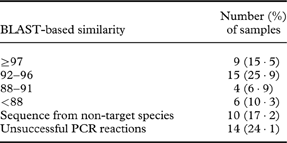
For the purely organizational purposes of this study, we assigned results of the BLAST searches to one of six categories: BLAST sequence similarity>97%; sequence similarity 92–96%; sequence similarity 88–91%; sequence similarity<88%; sequence from non-target fungal species; or unsuccessful PCR. The relationships between genetic distances and genus delimitation in fungal families suggests that intraspecific variation probably varies among families of euascomycetes (Lumbsch Reference Lumbsch2002), and defining specific intraspecific threshold values of sequence similarity for the majority of lichen-forming fungal families remains untested (exception Del-Prado et al. Reference Del-Prado, Cubas, Lumbsch, Divakar, Blanco, Amo de Paz, Molina and Crespo2010). In cases where the sequence similarity was ≥97%, we assumed that the unidentified specimen belonged to the species, or closely related congeneric species-group with which it aligned in the GenBank database. Although intraspecific sequence similarity varies for different genera and families, the arbitrary 97% threshold value for assigning specimens to a closely related congeneric species-group provides an objective criterion for assessing ‘successful’ species identification. Although the taxonomic identification of some lichen-forming fungal sequences available on GenBank are dubious, for the purpose of this study we arbitrarily assumed that identifications of the most similar sequences selected through the BLAST search were correct. To test the utility of a general protocol for successfully amplifying the targeted lichen-forming fungal species, our definition of unsuccessful PCR amplifications also included heterogeneous PCR products. Therefore, we did not attempt to survey all fungal ITS types present in heterogeneous PCR amplifications via other methods, such as cloning.
ITS sequence data were obtained from 44 of the 58 samples submitted for identification using BLAST searches. Missing sequence data was a result of either heterogeneous amplification products, or unsuccessful PCR amplifications. Amplification of non-target fungal species, such as Aspergillus spp., Daldinia eschscholzii, Diaporthe phaseolorum, Hypoxylon sp., Phomopsis viticola and Veronaea botryose, represent 10 of the 44 ITS sequences generated in this study. Sequence similarity of sampled ITS data based on BLAST searches against the NCBI GenBank database (15 January 2012), including successful identifications, is reported in Table 1. Preliminary phenotype-based identifications reported here were used for comparison to results from BLAST searches, and a floristic treatment on the lichens of Mount Cameroon will be presented in a companion paper (E. A. Orock, unpublished data). Overall sequence similarity and success rates are reported in Table 2. All species successfully identified with BLAST-based searches (sequence similarity≥97%) are not currently listed on the checklist of lichens from the Republic of Cameroon (Feuerer Reference Feuerer2011), potentially representing at least six new records for Cameroon.
Distribution of BLAST-based similarity of specimens from Mount Cameroon.
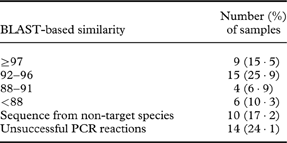
Results from this study demonstrate that the genetic diversity of common lichen-forming fungi from Mount Cameroon is poorly represented in the NIH sequence database GenBank, with only 15% of individual specimens showing sequence similarity≥97%. These results suggest that, in spite of the large number of publicly available ITS sequences, representing taxonomically and geographically diverse lichenized fungi, a substantial proportion of species-level genetic diversity in poorly studied regions is not currently represented in the most comprehensive sequence database available. The relatively high frequency of sequences from non-lichenized fungal contaminants recovered from lichen thalli (16%), and a substantial number of unsuccessful PCR amplifications or sequencing reactions (24%), further confounded the effective use of DNA-based identification for lichenized fungi in this study. These results underscore several potential challenges related to the use of molecular tools for identifying lichen species from under-explored regions based on currently available public databases.
One of the critical assumptions of sequence-based identification is the availability of accurate baseline taxonomic information for meaningful comparison. The lichen flora of Mount Cameroon has only recently begun to be investigated (E. A. Orock, unpublished data). The unknown lichen diversity of this region, coupled with incomplete and potentially erroneous data in public databases, highlights important challenges that must be addressed in order to maximize the potential use of DNA-based identification for lichenized fungi in understudied regions. Although intraspecific sequence similarity varies for different genera and families of lichenized fungi (Lumbsch Reference Lumbsch2002; Del-Prado et al. Reference Del-Prado, Cubas, Lumbsch, Divakar, Blanco, Amo de Paz, Molina and Crespo2010; Kelly et al. Reference Kelly, Hollingsworth, Coppins, Ellis, Harrold, Tosh and Yahr2011), the vast majority of sequences generated for this study were<97% similar when compared to accessions available on GenBank. This pattern suggests that a substantial amount of species-level diversity is not currently represented in GenBank. Developing expertly curated taxonomic and region-specific sequence databases through resources such as BOLD (Ratnasingham & Hebert Reference Ratnasingham and Hebert2007) will be essential to the successful use of BLAST-based species identification.
The lichen mycobiota in most regions, especially in the tropics, is still largely unknown. Despite the potential limitations and challenges to DNA-based identification of lichenized fungi, molecular sequence data will most likely play an increasingly important role as a tool for accelerating the inventory and analysis of species diversity in lichen communities (Kelly et al. Reference Kelly, Hollingsworth, Coppins, Ellis, Harrold, Tosh and Yahr2011; Schoch et al. Reference Schoch, Seifert, Huhndorf, Robert, Spouge, Levesque and Chen2012). In some cases, the use of molecular operational taxonomic units (MOTUs) may serve as a valuable surrogate for phenotypically circumscribed taxa (Blaxter et al. Reference Blaxter, Mann, Chapman, Thomas, Whitton, Floyd and Abebe2005). Furthermore, with the development of more effective software programs researchers will likely be able to more consistently facilitate the objective delimitation of MOTUs (Jones et al. Reference Jones, Ghoorah and Blaxter2011; Puillandre et al. Reference Puillandre, Lambert, Brouillet and Achaz2011). However, our results suggest that regional and/or taxon-specific reference sequence databases must be developed to effectively characterize diversity in poorly studied regions and taxonomic groups. Therefore, given carefully orchestrated experimental design, the meticulous use of molecular tools for lichenized fungal species identification can have increasingly effective applications in even poorly studied regions.
Similar to Kelly et al. (Reference Kelly, Hollingsworth, Coppins, Ellis, Harrold, Tosh and Yahr2011), PCR amplification of non-target fungal species remains a significant challenge that needs to be addressed in order to effectively make use of DNA barcoding with lichen-forming fungi. While some non-lichenized fungal lineages may only be superficially, or facultatively, associated with lichens, evidence increasingly suggests the possibility that many fungal lineages are more intimately associated with lichen symbioses (Arnold et al. Reference Arnold, Miąowska, Higgins, Sarvate, Gugger, Way, Hofstetter, Kauff and Lutzoni2009; Bates et al. Reference Bates, Berg-Lyons, Lauber, Walters, Knight and Fierer2012). This implies that PCR amplifications based on ‘total’ genomic data from lichens will likely detect non-targeted or multiple fungal lineages in even the most carefully prepared samples.
This study provides important insight into many relevant challenges associated with sequence-based identification of lichen-forming fungi. As molecular sequence data continue to play an increasingly important role as a tool for species identification in a wide range of lichen research efforts, we will inevitably begin to better understand diversity in lichenized fungi, appropriately interpret distribution and ecological patterns, and more accurately monitor environmental disturbance and climate change. The major challenge we are facing is the development of robust and comprehensive reference sequence data, particularly in underexplored regions where resources may be limited or lacking altogether. The increasing number of collaborative projects in lichenology (e.g. Gueidan et al. Reference Gueidan, Savić, Thüs, Roux, Keller, Tibell, Prieto, Heiðmarsson, Breuss and Orange2009; Crespo et al. Reference Crespo, Kauff, Divakar, del Prado, Perez-Ortega, Amo de Paz, Ferencova, Blanco, Roca-Valiente and Núñez-Zapata2010; Lumbsch et al. Reference Lumbsch, Ahti, Altermann, Amo de Paz, Aptroot, Arup, Barcenas Peña, Bawingan, Benatti and Betancourt2011) will be essential in successfully developing appropriate taxonomic and regional reference sequence databases.
This paper is part of the Ph.D. thesis of Elizabeth Ayuk Orock, completed within the multidisciplinary research framework at the Faculty of Science, University of Buea under the theme ‘Understanding the environment of Mount Cameroon’, coordinated by Professor Emmanuel Suh. We thank anonymous reviewers whose comments greatly improved the manuscript. Support from the Negaunee Foundation and National Science Foundation is gratefully acknowledged (“Hidden diversity in parmelioid lichens”, DEB-0949147).