

As of August 2017, there were over 114,000 men, women and children awaiting organ transplants in the USA alone. It is estimated that about 20 people die in the USA every day due to a lack of viable organs for transplant that could have prolonged their lives (see https://www.organdonor.gov/statistics-stories/statistics.html). This shortage has been increasing for many years now and is expected only to be exacerbated in the years to come. Because of the acute and chronic nature of the problem, various solutions have been proposed, tested and used in different situations, all trying to maximize the potential for procuring viable organs for transplantation.
Solutions often target potential organ donors, trying to maximize the proclivity of people to become organ donors. The choice architecture (Thaler & Sunstein, Reference Thaler and Sunstein2009) of this decision has been identified as a central factor and has garnered much debate and research. Comparing the rates of consenting (explicitly, or by default) organ donors between countries that employ an opt-in (required consent) policy versus an opt-out (presumed consent) one has shown that the latter are much higher (i.e., Johnson & Goldstein, Reference Johnson and Goldstein2003). Alas, when actual donation rates are considered, the default's effect shrinks considerably; presumed consent is not “the hoped for silver-bullet for organ shortage” (Abadie & Gay, Reference Abadie and Gay2006, p. 612).
Ethical, cultural and legal considerations constrain the ways one can directly incentivize or compensate organ donors or their families. Approaches that have been implemented include: promoting access to organ transplantation queues (Lavee et al., Reference Lavee, Ashkenazi, Gurman and Steinberg2010); paid medical leave for live organ donors (Ashkenazi et al., Reference Ashkenazi, Lavee and Mor2015); reimbursement of funeral expenses for deceased donors; recognizing donors with a ‘donor medal of honor’ (Board, Reference Board2002); and more. Additionally, exchange programs and ‘clearinghouses’ for live organ donations (primarily kidneys) have been developed and are used successfully in the USA (Roth et al., Reference Roth, Sönmez and Ünver2004).
One country that boasts an extremely high rate of organ donations and successful transplants is the People's Republic of China. By their own testimony, over 10,000 transplants a year have been performed in China for over a decade, second only to the USA. Extensive investigation has shown that these include organs taken in life, or procured posthumously, from prisoners given the death penalty. This practice, though operative since 1984, was only first admitted by China in 2007. Although the Chinese authorities announced that they would no longer use executed prisoners as organ sources, many indications point to the practice's continuance. More troubling still, independent researchers have found that organs have been procured not only from convicts legally sentenced to death by criminal courts for heinous crimes, but also – maybe even predominantly – from political prisoners of conscience (primarily Falun Gong practitioners, but possibly also Uighur Muslims, Tibetans and Christians) arrested for their beliefs and imprisoned without trial (Sharif et al., Reference Sharif, Singh, Trey and Lavee2014). China consistently denies this, but has failed to convince the informed international transplant community.
Practically all reputable global organizations have unequivocally rejected the very notion of using prisoners as organ donors (Sharif et al., Reference Sharif, Singh, Trey and Lavee2014), arguing that prisoners in general, and those condemned to death in particular, cannot be assumed able to provide autonomous, uncoerced, informed consent, and therefore, ethically, should not be considered voluntary donors. In the USA, death-row prisoners may voluntarily donate their organs posthumously only to a close relative.
In contrast to these normative and deontological moral grounds, some utilitarian or consequentialist arguments have been made, defending the practice. These include the obvious fact that procuring organs from the dead, irrespective of who they are, prevents the waste of rare and precious resources that might help the living and save lives. Moreover, where Confucian ethics obtain, it is “a morally praiseworthy act of the prisoner who is willing to make the final effort to repent and correct his/her evil conduct and to leave something good to the world” (Wang & Wang, Reference Wang and Wang2010, p. 197).
Studies of prevailing attitudes toward voluntarily donating organs posthumously have revealed various factors that can affect them: education and awareness (Rumsey et al., Reference Rumsey, Hurford and Cole2003); and beliefs stemming from religious, cultural, altruistic or normative aspects (Radecki & Jaccard, Reference Radecki and Jaccard1997). However, how the general populace regards organ procurement from executed prisoners has been neglected to date. This issue not only affects the Chinese, but also the sizable number of so-called transplant tourists who travel to China from abroad for organ transplants.
Our study offers preliminary evidence on how laypeople in the USA view the practice of procuring organs posthumously from executed prisoners for the benefit of needy patients – evidence presently lacking in the literature. We did not describe the practice in its worst possible manifestation (killing convicts for their organs, a practice denied by China), but only in its less objectionable form. Previous researchers may have shied away from such research, worrying, as do we, that the very inquiry might confer a semblance of legitimacy on the practice. We wish to emphasize that this survey should not be taken as any kind of endorsement on our part, nor serve to argue when and why it could be used ethically. It is a purely descriptive endeavor, based on the conviction that even a normative discussion of the issue is incomplete without considering how the general public views it. We acknowledge the limitations of generalizing from an American sample of lay respondents to a practice that possibly only exists in China and that, moreover, was presented without any details – not even the method and timing of the executions.
Our study consists of two surveys. Survey 1 comprises 28 items, which respondents answered on a five-point disagree–agree scale. Survey 2 consisted of six hypothetical situations, to which other respondents gave yes–no answers.
Survey 1
Method
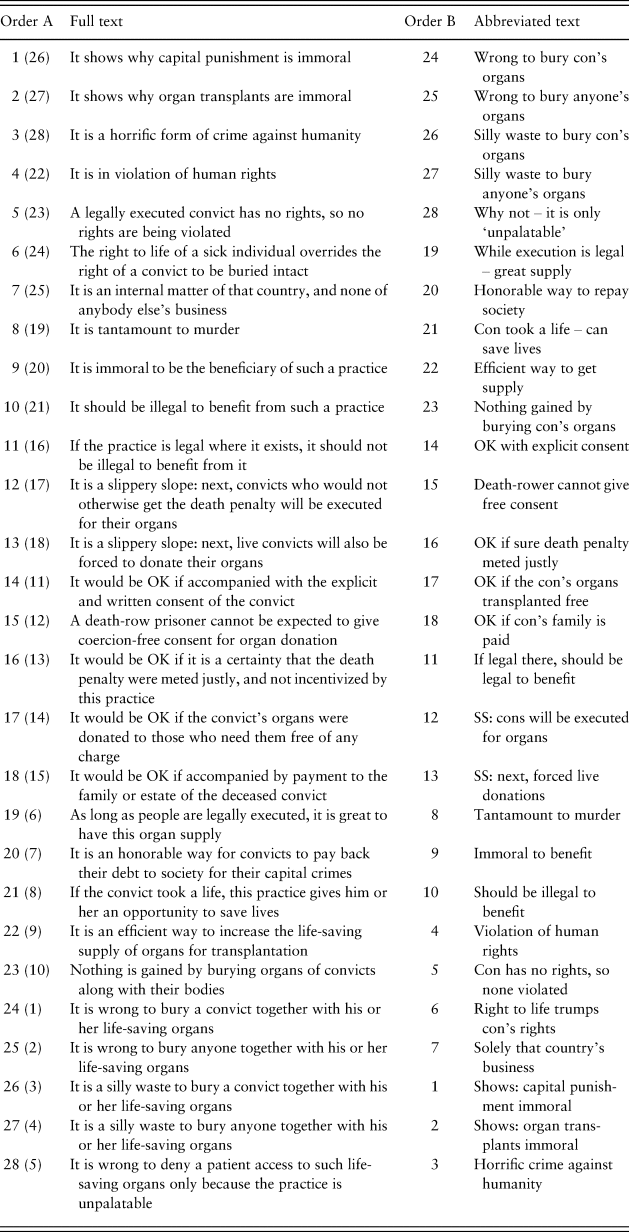
This survey appeared as a final and separate section following a totally unrelated verbal experiment, for which respondents received modest monetary compensation. Participants were 280 adult Americans,Footnote 1 recruited on Amazon MTurk (54% females, M(age) = 38). Twenty-eight statements were presented (shown verbatim in the second column of Table 1 and abbreviated in the fourth column), subsequent to the following instructions:
In some faraway country, capital punishment is practiced. The authorities harvest organs from the bodies of executed convicts, without receiving their consent, and sell the organs on the international market. For many years, tens of thousands of transplants of these organs were performed, and many lives were saved. What is your opinion of this practice?
Below is a list of pro and con arguments. Please rate each one on the following scale:
1 – strongly disagree. 2 – disagree. 3 – unsure. 4 – agree. 5 – strongly agree. 0 – no opinion
Please read through the arguments before rating them. Some strengthen each other, some oppose each other, some are orthogonal to each other, etc.
The survey items and their two orders of presentation.

Items were given in one of two orders, each presented to half the participants. In the first column of Table 1, the items are numbered from 1 to 28, according to the actual order in which respondents in Order A received them.Footnote 2 The numbers in parentheses are the items’ respective positions in Order B. The third column shows the items, abbreviated for convenience, in order of their appearance in Order B. Order B was roughly a last-to-first reversal of Order A – the correlation between the two orders is –0.96. Consequently, since one order began mostly with possible objections to the practice, the other mostly ended with them.
Results and discussion
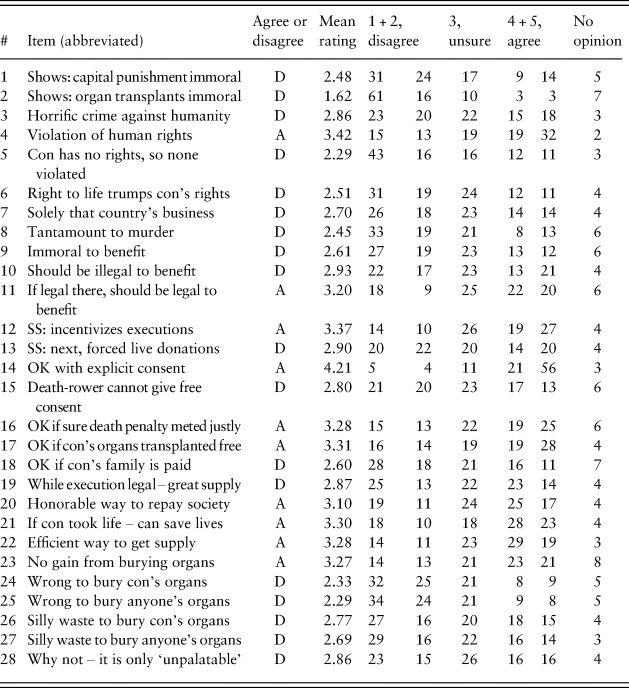
Survey 1's results appear in Tables 2 and 3. They present the answers to 28 different yet not unrelated questions about a complex, sensitive and controversial topic that many may never have thought about before. Some questions seem quite similar to each other (e.g., #24 and #25), while others seem contradictory (e.g., #4 and #5); agreement with some seems to be incompatible with agreement with others (e.g., #20 and #8). Note that (dis)agreement with an item's argument does not imply (dis)agreement with the practice of concern, since an abhorrent policy can have pros and an exemplary policy can have cons. The items addressed, unsystematically, the multitude of considerations that crossed our minds – moral, pragmatic, deontological, consequentialist, emotional, rational, specific, general – except for religious ones.
Response distributions per item in percentages.

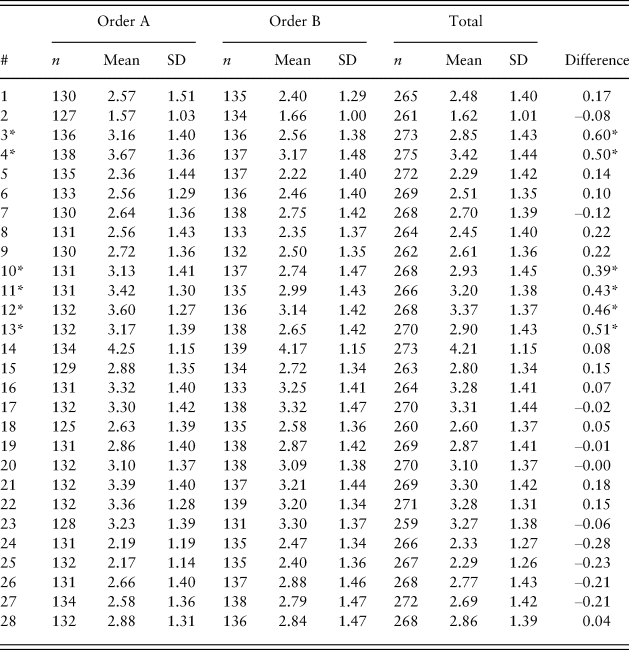
Mean ratings by survey order.

*Difference between the two orders was significant (t-test, p < 0.05).
The raw data do not speak for themselves. Due to the length and complexity of the survey, we had to first rule out the possibility that respondents’ answers were just noise – careless arbitrary replies. The evidence against this possibility appears in the Appendix. We henceforth combine the orders, and our presentation will simplistically equate an item's result with its most popular opinion (where ‘disagree’ combines responses 1 and 2 and ‘agree’ combines responses 4 and 5). Our discussion of the results packaged the 28 items into six groups. The first two yield the two principles we found and the rest are interpreted in light of these two. Within the six groups, all 28 items will be addressed individually.
Convicts have the same rights to their organs as non-convicts
Seven items (#24–#27, #4–#6) yielded the first emerging principle: convicts have the same rights to their bodies and organs as non-convicts. The evidence lies in these facts: (1) responses to #24 are the same as to #25, and those to #26 are the same as to #27 – it makes no difference whether the item concerns a convict or just anyone; (2) item #4 explicitly states that the practice at hand is a violation of human rights, eliciting pretty strong agreement, whereas item #5, stating that these forced convict donors have no rights to be violated, elicits even stronger disagreement; and (3) item #6 directly pits a convict's rights against those of a sick non-convict, and respondents reject the notion that the latter trump the former.
Benefiting from ill-gotten organs is tolerable
From another set of items (#7, #9–#11, #19, #22) emerges the second principle: benefiting from the organs should not (in the opinion of our respondents) be held to the same moral and legal standards as procuring them to begin with. It is indeed unrealistic to expect any seriously ill patient to refuse a life-saving organ only because it was procured without consent from a dead donor – convict or not. Our respondents disagree that it is immoral (#9) or should be illegal (#10) to benefit from such organs, and if the practice is legal in that distant unnamed land, they explicitly tolerate benefiting from it (#11). Their reservations are nonetheless expressed in their disagreement with #7, that it is solely that country's business, and their unwillingness to call the fruits of this practice ‘great supply’ (#19) – although they are willing to use a more neutral and factual word: ‘efficient supply’ (#22). What sounds like inconsistency can be resolved by noting that #7, #19 and #22 are not about benefiting from the practice, but about the practice itself. And, as we saw, benefiting from the practice is held to a lower standard than the practice itself.
‘OK if…’ items
Several items give the practice approval, conditional on it being consistent with the first principle – convicts are like other donors. Respondents agree with #14 and #17, which essentially state the counterfactual that if procuring organs from convicts were with their explicit consent (#14) and without pecuniary motivation (#17), then it would be alright. They disagree with #18: reimbursing the convict's family for the involuntary donation does not make it acceptable. These, of course, are precisely the requirements for organ donations from regular donors, including the prevailing prohibition against the sale of organs! Even #15, which states that death-rowers cannot really give free consent, denies that they are different from other donors.
The one item irreconcilable with the first principle is #16. Our respondents’ agreement that a legal execution suffices to justify the practice is inconsistent with the principle that a convict has the same rights as any donor (we will encounter no other exceptions).
Rejection of blanket condemnation
Items #1, #2, #3 and #8 condemn the practice in terms both extreme and non-specific. Respondents disagreed with all four, with #2 being far and away the least popular on the entire list of 28.Footnote 3 Common sense suggests these items are too extreme to be plausible positions regarding procuring organs involuntarily from the dead – convicts and non-convicts alike.
The practice has pros, its cons notwithstanding
Respondents agree that procuring a murderer's organs, even without consent, creates an ‘opportunity’ for him to save lives (#20); that ‘nothing is gained’ from burying those life-saving organs with their owners (#23); and even agree to call it ‘honorable’ (#21). Yet, they refuse to call the abstention from procuring organs without permission either ‘silly waste’ (#26, #27) or, worse still, ‘wrong’ (#24, #25). And they disagree that the practice is no worse than ‘unpalatable’ (#28). Our first principle – convicts are no different from non-convicts – can explain this. After all, organ donation by non-convicts enjoys the same pros: it is ‘honorable’, life-saving and contributes to societal welfare. Yet we find it unacceptable to let the pros carry the day, disregarding the donor's wishes. The pros must be weighed alongside the cons, which – under present prevailing moral standards – require respecting the dignity of the dead, the autonomy of the living and the sovereignty of a person over his or her corpse – convict and non-convict alike.
By analogy, consider a less sensitive and dramatic practice: the custom of placing flowers – often many and expensive – on a grave; and, moreover, leaving them there to rot or dry. One can argue, or even agree, that ‘nothing is gained’ thereby, certainly by the deceased. It does not follow, however, that the custom is a ‘silly waste’ or ‘wrong’. It is a custom, a public expression of esteem or love for the deceased. Actions have symbolic as well as material consequences. Emotional or social aspects need not always defer to cold, rational ones.
Slippery slope arguments
We only had two such items. Respondents agree with #12 and disagree with #13.Footnote 4 Item #12 worries that tolerating the practice might incentivize a lowering of the bar for meting the death penalty. Item #13 worries that if involuntary procurement is allowed from dead convicts, it might next be allowed from living ones. It is a safe extrapolation that were our respondents asked to consider the actual practice alleged to exist in China, which is already down that slippery slope – namely, killing untried political prisoners for their organs – they would be as horrified about it as those who make the allegations.
Survey 2
Method and results
Survey 2 was also appended as a final section to the same unrelated study as was Survey 1, and the 194 adult Americans (53% females, M(age) = 39) who participated were similarly recruited. Six hypothetical situations were presented, following the same opening paragraph as in Survey 1.
In some faraway country, capital punishment is practiced. The authorities harvest organs from the bodies of executed convicts, without receiving their consent, and sell the organs on the international market. For many years, tens of thousands of transplants of these organs were performed, and many lives were saved.
They were then asked to reply ‘yes’ or ‘no’ to the following six hypotheticals, presented in the following order (the numbers in parentheses are the percentages of ‘yes’ answers):
a. If you could be saved by the transplantation of such an organ, and by nothing else, would you avail yourself of it? (71%)
b. If someone dear to you (a child, parent, sibling or spouse) could be saved by the transplantation of such an organ, and by nothing else, would you urge them to avail themselves of it? (76%)
c. If someone you know could be saved by the transplantation of such an organ, and by nothing else, would you tell them about it? (79%)
d. If you knew that the convict's execution was facilitated in order to harvest his organs, would you avail yourself of it? (41%)
e. If you represent a health insurance company who is obligated to pay for an organ transplant in some particular patient, would you include organs from this source (assuming they cost no more)? (55%)
f. If you were a lawmaker in your country, would you make it illegal for your citizens to avail themselves of organs from this source? Footnote 5 (47%)
Discussion
Survey 2 is simpler than Survey 1. Most respondents admit that they would avail themselves of such an organ if their life depended on it (a.); they would urge it if the life of a dear one were at stake (b.); and they would share the knowledge even with a mere acquaintance (c.) (all three majorities significantly greater than 50%, but not from each other).
We tentatively attribute the slightly increased support as the circle widens – from self to dear ones to anyone – to the decreasing responsibility of the respondent. Regarding oneself, most would allow themselves to benefit. Dear ones? One only urges them to benefit – responsibility for the decision is theirs. Acquaintances? One does not even urge, one merely informs. This interpretation is strengthened by noting that support diminishes when the responsibility for the decision is laid at one's door ex officio (all differences between a., b. and c. on the one hand and e. and f. on the other are significant). Whether as an insurance official or as a lawmaker, support for benefiting from ill-gotten organs drops to barely a majority (e. and f. not significantly different from 50%).
The high rate of people willing to admit their acceptance of benefiting from ill-gotten organs, considering the low social desirability of the practice (and considering that the MTurk platform does not guarantee responders anonymity), is surprising. But it is consistent with the leniency toward organ recipients found in Survey 1. Albeit, the low social desirability of the practice does manifest itself in lower support for e. and f. – situations where the decision to allow the transplanting requires public accountability.
Finally, if organs are explicitly known to be tainted with the possibility that their donors were unjustly executed (d.), there is a statistically significant reversal, and the majority (though not a statistically significant one) now profess that they would no longer avail themselves of those organs. These sentiments, too, are consistent with what we found in Survey 1.
General discussion
There is in fact a ‘faraway country’ that practices the policy that this study is about. Some may have recognized the People's Republic of China behind the description (since of the 56 countries that currently retain capital punishment, only China procures organs from executed prisoners for transplants) – the less informed may have not. Some may have even heard the persistent, if denied, allegations that among the forced donors are not only heinous criminals, but also political prisoners, whose ‘crime’ is their opposition to the Chinese regime (denied by China, in spite of considerable evidence; see Rogers et al., Reference Rogers, Trey, Singh, Bridgett, Bramstedt and Lavee2016; Reference Rogers, Robertson and Lavee2017; Trey et al., Reference Trey, Sharif, Schwarz, Fiatarone Singh and Lavee2016). The organs from China are so abhorrent to so many – political activists, human rights organizations, the transplant community, journalists, physicians and others – more because of concern about who the organs were procured from than because of the absence of consent alone. If organs had been taken only from the worst kind of justly convicted criminals, there likely would have been less objection from these organizations. After all, many quite civilized countries abide by an organ donation policy of merely implied consent from their ordinary citizens (‘opt out’), rather than explicitly expressed consent (‘opt in’). The former is a step short of being ‘without consent’ (though not ‘against their will’). It is precisely because there are grounds to suspect that in China some people (Lavee and his colleagues believe that many) are condemned to death for their organs, not for their crimes, that there is so much opposition – and horror – at that practice.
This may explain why the lay public is as forgiving as our results indicate. Our respondents do not like the policy described to them, primarily on the grounds that convicts should have the same rights to their organs as other people. But neither are they so critical of it as to disallow benefitting from these ill-gotten organs; they would do so themselves, if necessary.
But our setting was non-specific and spare, making the study sound perhaps more like a stylized ‘trolley problem’ abstraction (Thompson, Reference Thomson1976) than about the real-world case it is. We gave no indication of who the executed convicts or their crimes might be. In the abstract, ‘death-rower’ connotes, rightly or wrongly, criminals of the worst kind. Imagine a ‘Ted Bundy’ – a sane, adult, sadistic serial murderer – who is executed after having gone through the various stages of the criminal justice system with proper legal representation and after having exhausted the appeal process. Imagine further that in the execution's wake, his organs are procured, without consent. Few would shed tears or write their congressmen (more likely, some would be mortified at the thought of hosting his organs in their own bodies; see Rozin et al., Reference Rozin, Millman and Nemeroff1986). Surely, the taking of a convict's organs without his consent pales beside the taking of his very life – no doubt also without consent.
On the other hand, imagine a prisoner of conscience, who – to ensure a successful transplant that has already been handsomely paid for – is killed, without trial, by the very surgeons who must procure his heart and lungs while they are still being perfused by oxygenated blood, at a time and place determined by the priorities of some specific patient standing by to receive them. Quite a different intuitive reaction, no doubt.
For one of us (Lavee), whose medical career is dedicated to performing heart transplantations and who is immersed in the facts and politics of organ procurement, the second image is the dominant one. For most of our respondents, on the other hand, something closer to the first image probably dominated, especially since that is the one fostered by our brief and spare words of introduction. They rejected #3 (‘horrific crime against humanity’) and #8 (‘tantamount to murder’) and the unnerving possibility of #13 (‘leads to forced live donations’). At the same time, some better-informed respondents may have contributed to the minority opinion.
There remains the matter of the seeming double standard between disapproval of the procurement and reluctance to disapprove of its beneficiaries, a double standard not shared by the international transplant community of experts, who object strenuously to the transplantation of these organs. It oftentimes happens that some procedure is illegal, immoral or misguided but its outcome is, nonetheless, desirable. An illegal search may yield valuable evidence; an unethical study may yield invaluable scientific insights; surrendering to extortion or blackmail may save the day – or even lives; exploited workers may produce cheap, accessible goods; and terrible suffering of animals can produce food many people cannot begin themselves to forgo (myself included; see Bar-Hillel, Reference Bar-Hillel2017). This complicates the attitude toward ill-gotten gains of any kind. There is no single right panacea. But in practice, benefiting from ill-gotten gains is usually not judged as harshly as the ill-getting itself; and in some jurisdictions, societies or ad hoc cases, it is officially permitted.
It turns out, however, that even the well-informed transplant community, although it has been proactive in trying to change the Chinese policy and consistently opposes transplantation of ill-procured organs from China, does itself tolerate – albeit without approving of – a different kind of ‘double standard’: some people do not accept ‘brain death’ and regard procuring organs from a brain-dead donor as murder (https://www.ynetnews.com/articles/0,7340,L-3524163,00.html) – yet have no qualms about queuing for life-saving organs procured from such ‘merely’ brain-dead donors.Footnote 6 Transplant surgeons perform organ transplantations on these patients, who regard the surgeons as killers and would never give consent for organ procurement based on brain death.
We did not set out to write a treatise on morality per se, but moral as well as practical considerations cannot be ignored when one tries to shape a legal policy, or a moral position, on ill-procured organs. A double standard for judging procurement and transplantation can be seen as nuanced, pragmatic and moderate – or as hypocritical and both morally and strategically myopic. As long as there is demand for organs and the means whereby they were procured are disregarded by the grateful recipients and the society that judges them, there will be supply. Hence, if a practice is truly abhorrent and heinous, benefiting from it should not casually be tolerated.
That, however, is not at present the opinion of our respondents – as well as of the many transplant tourists desperately seeking a life-changing or life-saving organ who continue to flock openly to China from all over the world. Another survey, with a more detailed and realistic portrayal of the actual practice, could well yield harsher judgments.
The continuous aspiration toward increasing legitimate organ donations serves not only the survival needs of the sick, but also protects them from the temptation to make moral compromises in their fight to survive, and society from violation of human rights.
Acknowledgments
We thank Shane Frederick for allowing us to attach this survey to his study. We thank Eyal Peer for contributing to all phases of this study. We thank Dror Bar-Natan, Tom Noah, Yosi Rinott and Netanel Cohen for assisting in the data analysis.
Appendix
We first checked whether the results were consistent across presentation order. Famously, order invariance cannot be taken for granted, and in surveys has a common, and often legitimate, effect (e.g., Schuman & Presser, Reference Schuman and Presser1981). We considered two kinds of order effects: on the entire questionnaire and on the individual items.
Table 3 presents mean ratings for the 28 items, for each order separately and for both combined, on a scale extending from 1 (‘strongly disagree’) to 5 (‘strongly agree’), with 3 being ‘unsure’ and 0 being ‘no opinion’. In calculating the means, ‘no opinion’ was treated like missing data (which is why the n values in Table 3 range from 125 to 139).
We first calculated the correlation between item means in the two orders. Although the correlation between items’ positions in the two orders was –0.96, the correlation between their means was a reassuringly strong +0.902 (p < 0.001). To compare it to the reliability of answers within each of the two fixed orders, we performed a Monte Carlo run of 10,000 for each order. The 140 respondents were randomly split into two groups of 70 each in order to calculate the correlation of the item means between the halves. The between-order correlation of 0.902 fell between the reliability of Order A (0.923) and that of Order B (0.897) and did not differ significantly from either. A third Monte Carlo run on all 280 respondents, creating two mixed-order halves, yielded a mean reliability of 0.951, which is not significantly higher than 0.902. Therefore, we cannot reject a null hypothesis that comparing the respondents of Order A with those of Order B is the same as comparing any 140 respondents to the other 140 respondents.
The ratings were not only correlated – they were also close (which is neither implied by nor implies the above). For 18 items, Order A yielded higher means, and for the other 10 items, Order B means were higher (z-test, NS). Since the scale's midpoint of 3 separates agreement from disagreement, the majority opinion turned out the same for the two orders for 24 of the 28 items (z-test, p < 0.05). At the same time, Order A yielded item means that were higher on average by 0.12 (p < 0.05).
Regarding individual items, for six items (#3, #4, #10–13, marked by asterisks in Table 3) the difference between the two orders was significant (t-test, p < 0.05). In four of those (#3, #10–#12), the means in the two orders lay on different sides of the midpoint.
Our next analysis required data of higher resolution. Since the previous analysis shows the two orders to yield consistent enough results, they were combined in Table 3, which gives the distribution of responses for each item. The ‘unsure’ responses ranged between 10% and 26% of respondents (mean = 17%), with the ‘no opinion’ responses adding 2–7% (mean = 4.5%). So for every item, most respondents gave a one-sided opinion. A and D in the third column of Table 3 stand for Agree and Disagree, respectively, according to the majority opinion (excluding the ‘unsure’ and the ‘no opinion’ responses). Unsurprisingly, it completely overlaps with mean ratings that are over 3 or under 3, respectively.
To check consistency in intra-item patterns, we added the 1 and 2 ratings and the 4 and 5 ratings, and calculated the ratio between the larger of these two sums to the lower one. The more consensus an item elicits, the greater this ratio should be. Few items elicited a strong consensus: only seven (25%) yielded a ratio exceeding 2:1; for four more, it exceeded 1.5:1; for the rest, the call was even closer to 1:1.
It stands to reason that an ambiguous or controversial item would manifest in the data in another, mathematically independent way: a high percentage of 3 (‘unsure’) ratings. These two measures of an item's difficulty – more ‘unsure’ responses and a lower ratio of majority-to-minority opinions – should therefore be negatively correlated. Indeed, the actual correlation (–0.79) was negative (p < 0.001).