Numerous studies demonstrate that children's understanding and regulation of emotions is associated with peer-related social competence across development in low- and middle-income children in both socially adjusted and maladjusted populations. These relations hold regardless of how social competence is assessed (Denham, Blair, Schmidt, & DeMulder, Reference Denham, Blair, Schmidt and DeMulder2002; Eisenberg, Gershoff, et al., Reference Eisenberg, Gershoff, Fabes, Shepard, Cumberland and Losoya2001; Garner, Reference Garner1996; Garner, Jones, & Miner, Reference Garner, Jones and Miner1994; Gottman, Katz, & Hooven, Reference Gottman, Katz and Hooven1996; Shields & Cicchetti, Reference Shields and Cicchetti2001).
Given the central role of emotional competence to social and emotional functioning, there has been a rapid proliferation of research on the socialization of emotion over the past decade. In general, this work has shown that high levels of positive parental emotion are associated with preschool children's knowledge of emotion (Eisenberg et al., Reference Eisenberg, Valiente, Morris, Fabes, Cumberland and Reiser2003), their ability to regulate the expression of emotion (Eisenberg et al., Reference Eisenberg, Valiente, Morris, Fabes, Cumberland and Reiser2003), and to show less distress and more empathy than other children (Fabes et al., Reference Fabes, Eisenberg, Karbon, Bernzweig, Speer and Carlo1994; Garner et al., Reference Garner, Jones and Miner1994). In contrast, high levels of negative emotion expressed in families is related to poorer social and emotional functioning in preschool children across the preschool and early elementary years (Carson & Parke, Reference Carson and Parke1996; Cummings, Iannotti, & Zahn-Waxler, Reference Cummings, Iannotti and Zahn-Waxler1985; Garner et al., Reference Garner, Jones and Miner1994; Shields & Cicchetti, Reference Shields and Cicchetti2001), although moderate levels of negative emotional expression and empathic responses to children's displays of negative affect are associated with preschool children's emotional and peer competence (Denham & Grout, Reference Denham and Grout1993). Negative emotion in the family is also associated with school-age children's likelihood of bullying their peers (Shields & Cicchetti, Reference Shields and Cicchetti2001).
Significant relations with emotional competence also have been found for parental discussion of emotions. Parents who frequently discuss emotional reactions tend to have preschoolers who are socially competent (Denham, Reference Denham1997) and are competent at understanding and regulating emotions (Denham, Cook, & Zoller, Reference Denham, Cook and Zoller1992; Dunn, Bretherton, & Munn, Reference Dunn, Bretherton and Munn1987; Dunn, Brown, & Beardsall, Reference Dunn, Brown and Beardsall1991; Kuersten-Hogan & McHale, Reference Kuersten-Hogan and McHale2000).
In addition to direct discussion of emotions with children, the ways parents interact with children and express their own emotions has been associated with children's adjustment. Various forms of negative parenting (including derogation, expressing anger/negative affect, unresponsiveness, controlling, and harshness) were related to poorer social outcomes (Gottman et al., Reference Gottman, Katz and Hooven1996; Gottman & Katz, Reference Gottman and Katz1989; Hakim-Larson, Dunham, Vellet, Murdaca, & Levenbach, Reference Hakim-Larson, Dunham, Vellet, Murdaca and Levenbach1999; LaFreniere & Dumas, Reference LaFreniere and Dumas1992), more externalizing behavior (Ackerman, Brown, & Izard, Reference Ackerman, Brown and Izard2003; Denham et al., Reference Denham, Workman, Cole, Weissbrod, Kendziora and Zahn-Waxler2000), and more aggression (McDowell, Kim, O'Neil, & Parke, Reference McDowell, Kim, O'Neil and Parke2002) for both young and school-age children. Similarly for positive parenting, the way parents discuss emotions directly with their children and coach their children how to handle emotion-laden situations were related to children's behavioral competence (Katz & Windecker-Nelson, Reference Katz and Windecker-Nelson2004), social competence, and emotion regulation (McDowell et al., Reference McDowell, Kim, O'Neil and Parke2002). Thus, the way parents interact with their children on an emotional level has been associated with children's social and emotional functioning.
The Current Study
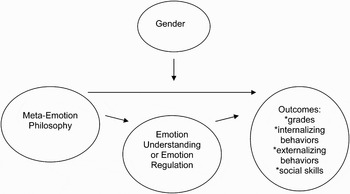
In the present study we set out to determine if maternal emotion socialization practices would predict urban, African American school-age children's later understanding of emotions, emotion regulation ability, and psychosocial adjustment while considering the potential mediating roles of emotion regulation and emotion understanding. The 6-month longitudinal study was conducted in order to tease out, to the extent that is possible, the temporal ordering of the variables we were studying. Emotion socialization variables were derived from Gottman's Meta-Emotion Philosophy Interview (Gottman, Katz, & Hooven, Reference Gottman, Katz and Hooven1996, 1997; Hooven, Katz, & Mittman, Reference Hooven, Katz and Mittman1996) and included awareness (of caregiver's own and children's emotions), acceptance (of own and child's emotions), and coaching their child about how to handle their emotions (Gottman et al., Reference Gottman, Katz and Hooven1996). Child adjustment measures included grades, social skills, internalizing behaviors, and externalizing behaviors. See Figure 1 for the hypothesized model of study variables. The approach of the present study was based on a recent conceptual model, which postulated that emotion understanding and emotion regulation ability act as two distinct mediators to link emotion socialization and children's social competence and adjustment (Eisenberg, Cumberland, & Spinrad, Reference Eisenberg, Cumberland and Spinrad1998). Evidence from a small-scale study of preschoolers also provides preliminary support for the notion that emotional competence serves as a mediator between parental emotion socialization behavior and peer-related competence (Garner et al., Reference Garner, Jones and Miner1994).
Model of emotion socialization tested in this study with emotion understanding and emotion regulation serving as separate potential mediators of the relationship between maternal caregiver meta-emotion philosophy and child outcomes six months later with gender as a moderator.

We expected that the combination of high awareness, high acceptance, and high coaching would be most strongly associated with later social and emotional competence and academic functioning. We also expected that emotion understanding and emotion regulation (considered separately) would mediate the relationship between maternal emotion socialization practices and child competence.
Gender
We also sought to further understand the role of gender in the emotion socialization process for children. Our focus on gender was based on recent work by Brody (Reference Brody and Fischer2000) that found that although maternal caregivers' emotional socialization practices did not differ by gender, these practices impacted boys and girls differently. Researchers have shown that emotional competence differs across gender. With respect to emotion understanding, girls tend to perform better on these tasks than boys (Hall, Reference Hall1978). For example, girls use more emotion terms than boys (Cervantes & Callanan, Reference Cervantes and Callanan1998; O'Kearney & Dadds, Reference O'Kearney and Dadds2004), show greater differentiation in their explanations of the causes of anger and sadness in themselves and others (Hughes & Dunn, Reference Hughes and Dunn2002), and use more interpersonal explanations for emotions than boys (Strayer, Reference Strayer, Eisenberg and Strayer1987). When asked about their expectations for the outcomes of emotion-provoking peer situations, school-age girls expected more negative emotional reactions from peers than did boys (Underwood, Reference Underwood1997). Regarding emotion regulatory behavior, school-age girls and boys express similar levels of anger and sadness in their descriptions of peer conflicts, but girls report friendlier goals and more constructive peer responses than boys (Murphy & Eisenberg, Reference Murphy and Eisenberg2002) and girls are more able and/or willing than boys to control the display of negative emotional expression across the preschool and elementary school years (Davis, Reference Davis1995); whereas preschool boys are also more likely than girls to incorrectly attribute anger to the emotion of others (Schultz, Izard, & Ackerman, Reference Schultz, Izard and Ackerman2000). Contrary to the previous studies, Shields and colleagues (2001) failed to find gender differences in preschoolers' emotion understanding or emotion regulation.
Findings from numerous studies have suggested that the gender differences reported above are due to the fact that parents' socialization of emotion is dependent upon the child's gender. For example, mothers make more references to emotions during discussions about everyday events with their school-age girls than with their similarly aged boys (Flannagan & Perese, Reference Flannagan and Perese1998), are more likely to initiate talk about emotions with girls than with boys (Dunn et al., Reference Dunn, Bretherton and Munn1987), and mention sadness and disliking more often with daughters than with sons (Adams, Kuebli, Boyle, & Fivush, Reference Adams, Kuebli, Boyle and Fivush1996). In addition, parents expect girls to inhibit angry responses whereas boys are expected to inhibit sad and fearful responses across development (Garside & Klimes-Dougan, Reference Garside and Klimes-Dougan2002; Zahn-Waxler, Reference Zahn-Waxler and Davidson2000). Other studies have found no gender differences in emotional socialization practices of caregivers (Eisenberg & Fabes, Reference Eisenberg and Fabes1994) or did not mention gender differences (Brody, Murry, Kim, & Brown, Reference Brody, Murry, Kim and Brown2002; Gottman et al., Reference Gottman, Katz and Hooven1996; Maughan & Cicchetti, Reference Maughan and Cicchetti2002; Shipman & Zeman, Reference Shipman and Zeman2001).
We expected that girls would have higher emotion understanding and that emotion understanding may be a more critical form of emotional competence for school-age girls compared to emotion regulation. We expected that emotion regulation would play a more critical role in mediating the relationship between emotion socialization and child adjustment for boys than emotion understanding.
Contextual and Developmental Considerations
In addressing these emotion socialization questions, we chose to focus on school-age African American children being reared in moderate–high violent, urban neighborhoods, as exposure to community violence can put children living in violent communities at risk for peer difficulties (Patterson, Vaden, & Kupersmidt, Reference Patterson, Vaden and Kupersmidt1991), emotion dysregulation (Gilliom, Shaw, Beck, Schonberg, & Lukon, Reference Gilliom, Shaw, Beck, Schonberg and Lukon2002; Randolph, Koblinsky, & Roberts, Reference Randolph, Koblinsky and Roberts1996), psychological maladjustment (Gilliom, et al., Reference Gilliom, Shaw, Beck, Schonberg and Lukon2002; Randolph et al., Reference Randolph, Koblinsky and Roberts1996), and academic difficulties in early childhood (Randolph et al., Reference Randolph, Koblinsky and Roberts1996). Specific to emotional competence, children's exposure to community violence has been associated with increased fear or anxiety, acting out or lack of impulse control, emotional numbing, and academic impairments in response to the violence exposure (Randolph et al., Reference Randolph, Koblinsky and Roberts1996). These findings suggest that children who have experienced more community violence may have more difficulty understanding and handling emotions compared to children who have not experienced community violence. Parents may have an even more powerful role in helping children develop emotional competencies because of the press of the environment. Thus, this is an important population to study in regard to effective parenting practices related to emotions.
Ethnicity is another sociodemographic variable that has had differential relationships with socialization. Studies have shown that ethnicity was related to coping with economic hardship (Gomel, Tinsley, Parke, & Clark, Reference Gomel, Tinsley, Parke and Clark1998), to family functioning (Gorman-Smith, Tolan, Henry, & Florsheim, Reference Gorman-Smith, Tolan, Henry and Florsheim2000), and to emotion coaching (Katz & Windecker-Nelson, Reference Katz and Windecker-Nelson2004). For example, a study of family functioning with urban families showed that African American families tended to be less emotion focused in their interactions than other ethnic groups (Gorman-Smith et al., Reference Gorman-Smith, Tolan, Henry and Florsheim2000). Thus, it is important to examine how underresourced African American families socialize their children regarding emotions.
In fact, research has shown that effective parenting can protect children from impact of potentially negative environmental variables. Affiliation with positive peer groups can be influenced by parents' effective childrearing practices and protect youth from the development of long-term behavioral problems (Criss, Pettit, Bates, Dodge, & Lapp, Reference Criss, Pettit, Bates, Dodge and Lapp2002). Research has shown that there is wide variation in parenting practices and child adjustment in low-income African American families (Gutman & McLoyd, Reference Gutman and McLoyd2000; Hofferth, Smith, McLoyd, & Finkelstein, Reference Hofferth, Smith, McLoyd and Finkelstein2000; Smith, Reference Smith2001). There are many urban African American children who are well adjusted and it is important to explore the factors related to their competency, especially in light of ecological risk factors that research has shown can have a negative impact on children's development. Therefore, we sought to examine emotion socialization practices that were associated with positive adjustment for urban African American youth.
In addition to exploring community context in further investigating emotion socialization, considering children's developmental stage is important. Despite the importance of emotion-related competencies across development, emotion socialization research has focused primarily on the narrow developmental period of early childhood (see Eisenberg, Cumberland, & Spinrad, Reference Eisenberg, Cumberland and Spinrad1998). McDowell et al. (Reference McDowell, Kim, O'Neil and Parke2002) specifically cite the need for research examining parental emotional socialization, child emotion regulation, and child social competence for school-age children in a variety of contexts. Social and emotional difficulties show considerable stability across middle childhood and into adolescence (Lahey et al., Reference Lahey, Loeber, Hart, Frick, Applegate and Zhang1995); thus, identifying the emotion-related family factors that enhance the development of social and emotional competence in middle childhood is important.
Researchers have shown a progression in emotional understanding as children age (Denham, McKinley, Couchoud, & Holt, Reference Denham, McKinley, Couchoud and Holt1990; Denham, Zoller, & Couchoud, Reference Denham, Zoller and Couchoud1994; Garner et al., Reference Garner, Jones and Miner1994; Harter & Whitesell, Reference Harter, Whitesell, Saarni and Harris1989), which appears to be related to child adjustment. For school-age children, higher levels of emotional understanding were associated with fewer internalizing problems (Southam-Gerow & Kendall, Reference Southam-Gerow and Kendall2000) and higher levels of active emotion management and changing the way they think about anger-eliciting situations (Tangney et al., Reference Tangney, Hill-Barlow, Wagner, Marschall, Bornstein and Sanftner1996).
Similar to emotion understanding, the ability to regulate one's emotions improves with age (Kochanska, Murray, & Coy, Reference Kochanska, Murray and Coy1997; Shipman & Zeman, Reference Shipman and Zeman2001; Tangney et al., Reference Tangney, Hill-Barlow, Wagner, Marschall, Bornstein and Sanftner1996). The way people coped with anger had differential effects on long-term consequences depending on age. For example, children who employed more repressive strategies to manage their anger had more positive long-term outcomes, but this strategy became less adaptive with age (Tangney et al., Reference Tangney, Hill-Barlow, Wagner, Marschall, Bornstein and Sanftner1996). For both Caucasian and African American preschool and school-age children, emotion regulatory ability is associated with better adjustment, including better peer relations (Contreras, Kerns, Weimer, Gentzler, & Tomich, Reference Contreras, Kerns, Weimer, Gentzler and Tomich2000; Gottman et al., Reference Gottman, Katz and Hooven1996; Smith, Reference Smith2001) and general school adjustment 6 months later (Shields et al., Reference Shields, Dickstein, Seifer, Giusti, Magee and Spritz2001). Emotional regulation partially mediated the relationship between mother–child attachment and peer competence in middle childhood (Contreras et al., Reference Contreras, Kerns, Weimer, Gentzler and Tomich2000), although emotion regulation was not a mediator for preschool children (Eisenberg & Fabes, Reference Eisenberg and Fabes1994). Thus, further understanding the way emotional socialization, emotional competence, and child adjustment are related in school-age children would contribute to the developmental and emotion socialization literature.
Summary
The literature review highlights connections between maternal emotion socialization practices, child emotion competence, and child adjustment. Generally, the more parents talk about and teach their children about emotions, the better adjusted their children are in multiple areas of development. This study sought to further examine the connections between these variables with an urban, African American population of maternal caregivers and school-age children. Gottman's Meta-Emotion Philosophy Interview was used to assess maternal emotion socialization practices (awareness, acceptance, and coaching of emotion). Outcome variables included emotional, social, behavioral, and academic functioning. Child emotion understanding and emotion regulation were tested as mediators of the relation between emotion socialization and child adjustment. Patterns of association were examined separately by gender in this study, as gender was anticipated to moderate these relationships.
Method
Participants
Sixty-nine maternal caregiver–child pairs who completed both phases of a longitudinal study were included in the sample. Initially, 101 families participated in Time 1 interviews. Seventy families returned for the Time 2 interview 6 months later, but one child did not assent to completing the interview (although the caregiver did complete her Time 2 interview), reducing the sample size to 69. The sample included 35 female and 34 male African American youth (2% identified as biracial) ranging in age from 9 to 13 (M = 11.29 years, SD = 1.26 years). Most caregivers were the child's biological mother (88.6%), but the sample also included other female relatives (11.4%). Fifty percent of caregivers had never been married, 21.4% were married or cohabitating, 24.3% were separated or divorced, 1.4% widowed, and 1.4% had some other relationship or marital history. Twenty-seven percent of youth lived with a biological father or father figure, including caregiver's spouse (not biological father), boyfriend, or the father of another child living in the home. Caregiver education level ranged from some high school (25.7%) to high school diploma or GED (55.7%) to education beyond high school (some college, technical school, college degree, or graduate education, 18.6%). Household income was reported per week, with 82% reporting less than $400 per week (20% reported less than $100 per week). Participants lived in moderate to high violence areas of a midsized Southeastern city based on police statistics. During the course of data collection for this project, six neighborhoods from where most of this sample was recruited had 32 homicides, 199 robberies, and 2,140 assaults. These six neighborhoods alone had over 9,100 crimes of all types during data collection. The children in the current study reported the following exposure to community violence for the past year: More than half of the children had been slapped, hit, or punched (59%); and around a quarter had been chased by gangs or older youth (29%), were threatened with serious harm (27%), and had been beaten up or mugged (26%). Besides direct victimization, the majority of children had witnessed some type of community violence. Almost three-quarters of children reported hearing gunfire outside their home (73%). In addition, children had seen someone slapped, hit, or punched (68%); seen drug activity (66%); seen someone chased (54%); seen someone beaten up or mugged (52%); seen someone shot (18%); seen a knife attack (15%); and witnessed a murder (4%).
Attrition analyses
Families who returned for the Time 2 interview were compared with the 31 families who did not to determine if systematic biases existed in the data. Of the 31 families who did not return for their Time 2 interview, 2 were ill at the time of the interview; 6 could not be called back because we did not have Institutional Review Board approval when it was time for their follow-up interview (all research at our institution was stopped for a period of time); 10 could not be located; 7 refused; and 6 were not called back because of Child Protective Services referral, high child depression scores, or suspect data.
Families who did not return for their Time 2 interview did not differ from those who did on caregiver's education, household income, number of times they moved in the past 2 years, household size, or major life events (all ts < 1.28, ps > .05). Families who did not return did not differ on maternal meta-emotion emotion philosophy scores from families who did return, t (98) < 1, p > .05. However, families where the child interviewed was male were less likely to return for the Time 2 interview than if the child participant was female, t (99) = 2.11, p < .05. Children whose maternal caregivers rated them higher social skills, t (98) = −2.05, p < .05, were more likely to return for follow-up than children rated as less competent on these variables. Children who did not return had higher caregiver-rated delinquent behavior, t (99) = 2.75, p < .01, and aggressive behavior, t (99) = 2.14, p < .04, than those children who completed Time 2 interviews.
To test whether families who did not return for the Time 2 interview affected the results of this study, correlations were run between meta-emotion factor and Time 1 outcomes for all youth and then only for youth participating in both data collection points. In no case were patterns of correlations different between the whole sample and only Time 2 sample; thus, it appears that the relationships between meta-emotion and child adjustment were not significantly affected by attrition in this study.
Measures
Emotional socialization
Emotional socialization was measured by five indicators from the open-ended meta-emotion philosophy interview (Gottman et al., Reference Gottman, Katz and Hooven1997), assessed at Time 1. Caregiver awareness of her own and her child's emotions, acceptance of her own and her child's emotions, and coaching of emotions for both sadness and anger were coded from this measure. The awareness scale included caregivers' ability to recognize and describe their own emotions, their understanding of the causes of their emotions, their capacity to recognize their children's emotions, and their ability to provide detailed examples of each emotion. The caregiver awareness scale comprised 12 items (e.g. “parent has no problem distinguishing this emotion from others”). The child awareness score comprised 9 items (e.g., “parent is descriptive of child's experience of this emotion”). Both the parent and child scales were rated on a 5-point scale.
Acceptance scores included caregivers' ability to share their emotions with others and their ability to express emotion openly, their comfort level when the child expressed emotion, and how they responded when the child expressed emotion. The caregiver acceptance scales had 17 items (e.g., “parent says it is important to express this emotion”) and child acceptance scales had 13 items (e.g., “parent wants child to know it is OK to have this feeling”).
Coaching scores had 11 items that rated caregiver strategies for responding to children's emotions (e.g., talking about the situation that led to the children's feelings, teaching children how to calm themselves down when they get upset, and having goals about what caregivers wanted to teach their children about emotions; Gottman et al., Reference Gottman, Katz and Hooven1996).
A coding team was trained for 20 hr using written manuals and corresponding audiotapes of meta-emotion interviews with parents (Hooven et al., Reference Hooven, Katz and Mittman1996). Average interrater reliability (Pearson correlation coefficient) for practice tapes comparing individual coders with meta-emotion training ratings from Katz's lab was .78 and ranged from .62 to .92. Pearson correlations were utilized for this measure because of the continuous nature (vs. categorical) of the ratings (Sackett, Reference Sackett1978). These interrater reliabilities were similar to those used by Katz and Windecker-Nelson (Reference Katz and Windecker-Nelson2004). Each of the meta-emotion interviews was audiotaped at data collection and later was transcribed verbatim (to the degree possible) by members of our research team. The 10 raters were randomly assigned case numbers to score. Both audiotapes and transcripts were used to code each interview. Raters used the coding system manual (Hooven et al., Reference Hooven, Katz and Mittman1996) for each item while rating interviews, and each interview took approximately 45–60 min to code. Two independent coders rated each interview and the scores were averaged. Prior to averaging the interrater reliability was calculated, and the overall correlation (Pearson's r) between raters was .72 for the total score. This was a conservative strategy because multiple raters were involved and same rater was not always Rater 1 or Rater 2. The ratings were averaged because of the complexity of the coding in order to increase our confidence in the findings. The strategy of averaging ratings has been used in recent work to increase confidence in the data (see Kliewer et al., Reference Kliewer, Adams-Parrish, Taylor, Jackson, Walker and Shivy2006).
Correlations between awareness, acceptance, and coaching variables were high (r = .5–.8), so combining subscales seemed appropriate. Factor analysis using generalized least squares as the extraction method was used to reduce the data. Generalized least squares provides a weighted factor loading that indicates how much variance is shared between one variable and all others on that factor. Thus, the higher the factor loading, the more shared variance. Based on the eigenvalues and scree plot, one factor was retained, which explained 52.47% of the variance. Based on the factor loadings, one index of meta-emotion philosophy was created. The factor loadings for the meta-emotion philosophy variables were as follows: maternal awareness of own emotions = .729, maternal awareness of child's emotions = .839, maternal acceptance of own emotion = .552, maternal acceptance of child's emotions = .564, and emotion coaching = .875. A chi-square goodness of fit test indicated a significant fit, χ2 (5) = 20.67, p < .005. In a validation study (Cunningham & Kliewer, Reference Cunningham and Kliewer2005) coaching was negatively associated with caregiver's own depression, hostility, and comfort with emotion, and was positively related to use of positive restructuring to cope with their own problems. Awareness also was negatively associated with caregiver's comfort with emotion. Awareness and acceptance were positively associated with caregiver's use of positive restructuring and ventilation to cope.
Emotion regulation and emotion understanding
Emotion understanding was assessed by a semistructured interview during Time 2 data collection and was created by the first author for this project. Most emotional knowledge tasks were developed for use with preschoolers and included the use of puppets or pictures of faces, so a semistructured interview was developed that was appropriate for this population based on developmental considerations of emotion understanding components (Garner, Reference Garner1996; Harter & Whitesell, Reference Harter, Whitesell, Saarni and Harris1989; Nannis & Cowan, Reference Nannis and Cowan1987). Emotion understanding is a generic term that has been applied to many types of emotion knowledge. In this research, we were interested in emotional understanding that included children's awareness and labeling of emotions, their understanding of the causes of emotions, their recognition of multiple/mixed emotions, and their ability to understanding emotion-laden situations from someone else's perspective. Multiple studies have demonstrated the importance of emotion knowledge for peer-related social competence in both early and middle childhood (Garner, Reference Garner1996; Schultz, Izard, Ackerman, & Youngstrom, Reference Schultz, Izard, Ackerman and Youngstrom2001) and knowledge about hiding emotions has been inversely related to internalizing behavior (Southam-Gerow & Kendall, 2000).
Interviewers read scenarios with the child as the main character interacting with another person. Scenarios reflected situations that are relevant to school-age children of diverse backgrounds (e.g., forgetting sack lunch and taking someone else's, a friend moving, and beating your friend in an athletic competition). Children were asked how they would feel in this situation and why, what they could do to change the feeling(s) they described in the scenario, to give the other character's perspective, and to explain why they think the other person would feel that way. The three scenarios were developed so the target child would be likely to feel different emotions than the other character.
Each emotion understanding interview was transcribed verbatim and rated by one of four coders. Scores from the emotional understanding interview were calculated across all three scenarios. Subscales and ratings were based on the emotional understanding literature and included the child's understanding of his/her own feelings and that of another person also involved in the situation. The five emotion understanding components are important concepts that appear in the emotion understanding literature (Garner, Reference Garner1996; Harter & Whitesell, Reference Harter, Whitesell, Saarni and Harris1989; Nannis & Cowan, Reference Nannis and Cowan1987). In this study, emotion knowledge was the recognition of felt emotion(s) and the appropriate form of expression for that emotion for oneself. Children who were able to verbalize what the main character was feeling and how s/he would express that feeling in the given scenario received higher scores. Multiple emotions were recognition of having multiple, simultaneous emotion in same situation for self and for others. Participants received higher scores for being able to label or recognize contrasting emotions in the main character (“you”) and also in the secondary character (teacher, neighbor, and best friend). Control knowledge included knowing how to control one's emotions. Children were rated on the degree to which they suggested viable strategies to change (or continue if pleasurable feeling) their mood in the scenario. Causation included understanding what causes one to have various feelings and how the child determined what they were feeling. For example, children who could give plausible clues for their feelings and how they interpreted that information received higher scores for the more clues they used to identify their feelings. Perspective taking was the ability to understand that another person may experience different emotions from self in the same situation, depending on the circumstances. In these scenarios, ratings were the degree to which the participant was able to describe the possible experiences of the secondary character differently from what they described for themselves.
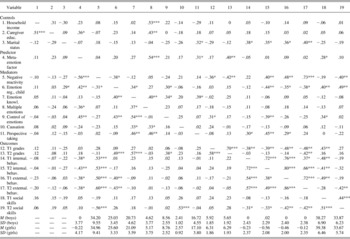
Rater training included both in-lab group training and completing practice ratings out of the lab. Differences in ratings done outside the lab were discussed as a team until agreement was reached. Each scenario was rated for the five components and the scores were combined across the three scenarios. The possible ranges of scores for each of the scenarios are 0–16 for emotion knowledge, 0–8 for multiple emotions, 0–7 for knowing cause of emotions, 0–4 for knowing how to control their mood, and 0–15 for perspective taking. For training, interrater reliability correlation coefficients between raters on items included in the five emotion understanding factors were rs = .99–1.0. There were no mean differences between boys and girls on any dimension of the emotional understanding interview. Support for concurrent validity for this child emotion understanding interview was suggested by the moderate relationships between components of the independent-rater scores on the emotional understanding interview, parent-rated emotion regulation skills, and parent- and child-rated adjustment. Specifically, parent-rated emotion regulation skills were significantly but moderately related to independent raters' scores on emotional knowledge (girls, r = .34, p < .05; boys, r = .40, p < .01) and control of emotions (girls, r = .30, p < .05; boys, r = .43, p < .01). Emotion regulation skills would be expected to be moderately related to emotion understanding skills that include being able to recognize emotions and knowledge of how to control one's emotions. In addition, components of the emotion understanding interview were significantly associated with adjustment measures (see Table 1).
Correlations between all study variables by gender

Note: T1, Time 1; T2, Time 2. The top half of the correlation matrix is for girls (n = 35) and the bottom half is for boys (n = 34).
*p < .05. **p < .01. ***p < .001.
The five-factor scores were used in subsequent analyses because they are theoretically distinct and important concepts of emotion understanding. Further, the correlations between the five emotion understanding factor scores were low to moderate. None of the correlations for girls were above .5, and only one correlation for boys was above .5 (emotion knowledge and control, r = .54). Factor analysis failed to reduce these variables; thus, the five emotion understanding components were maintained because they appear to represent distinct emotion understanding concepts.
We included two aspects of emotion regulation: emotion self-regulation and emotionality, which could be considered a temperamental dimension of emotion regulation. Research shows that emotional reactivity/emotionality and regulation are two distinct dimensions of emotional regulatory competence (Eisenberg, Cumberland, et al., Reference Eisenberg, Cumberland, Spinrad, Fabes, Shepard and Reiser2001; Rydell, Berlin, & Bohlin, Reference Rydell, Berlin and Bohlin2003), although both are related to the way a child responds to an emotion. Rydell et al. (Reference Rydell, Berlin and Bohlin2003) found that emotion regulation and emotionality each added a significant amount of variance explained in predicting internalizing and externalizing behaviors. Emotion self-regulation focuses on how children manage positive and negative emotions in their bodies and minds and how they act in response, whereas emotionality focuses on “how easily and how intensely emotions are aroused” (Rydell et al., Reference Rydell, Berlin and Bohlin2003, p. 30).
At Time 2, caregivers completed the eight-item emotion regulation subscale from the Emotion Regulation Checklist (ERC; Shields & Cicchetti, Reference Shields and Cicchetti1995), which is included as the “emotion self-regulation” measure. (Note that “emotion self-regulation” will specifically refer to the ERC and “emotion regulation” will refer to the larger concept of emotional regulatory competence.) The subscale includes items that indicate situationally appropriate displays of emotion, empathy, and emotional awareness in the child (e.g. “responds positively to neutral or friendly overtures by adults” and “displays appropriate negative emotion in response to hostile, aggressive, or intrusive acts by peers”). Items are rated on a 4-point Likert scale from 1 (never true) to 4 (almost always true). The Cronbach α was .62. The higher the emotion self-regulation score, the greater the child's ability to regulate his/her affect.
Emotionality, which could be considered a temperamental dimension of child emotion regulatory competence, was assessed with the negative reactivity subscale of the School-Age Temperament Inventory (McClowry, Reference McClowry1995), a Likert-type parental report scale for children 8–11 years old. Questions about the child, such as “when angry, yells or snaps at others” or “reacts strongly (cries or complains loudly) to a disappointment or failure,” are rated from 1 (never) to 5 (always). This measure was chosen because internal consistency has been demonstrated with diverse cultural samples (McClowry, Reference McClowry1995). In the current sample, the Cronbach α was .89. The higher the negative reactivity score, the greater the child's emotional arousal and intensity and the greater the emotional dysregulation.
Adjustment
All child outcome measures used in the study were collected at both Time 1 and Time 2. Social competence was assessed by the Teacher–Child Rating Scale (TCRS; Hightower et al., Reference Hightower, Work, Cowen, Lotyczewski, Spinell and Guare1986) and completed by the children's maternal caregivers. This procedure was used previously by the authors of the TCRS (Wyman et al. Reference Wyman, Cowen, Work, Hoyt-Meyers, Magnus and Fagen1999), who adapted the questionnaire by having maternal caregivers answer 18 questions about their children's behavior on a scale from 1 (not at all) to 5 (very well). The validity and reliability of the TCRS has been thoroughly verified in at-risk, urban samples (Wyman et al., Reference Wyman, Cowen, Work, Hoyt-Meyers, Magnus and Fagen1999). The TCRS has three problem scales (acting out, shy/anxious, and learning problems) and four competency scales (frustration tolerance, assertive social skills, task orientation, and peer sociability). Two of the seven subscales from the TCRS, assertive social skills and peer sociability, were used in the present study, which were similar to the subscales that were used in the Wyman et al. (Reference Wyman, Cowen, Work, Hoyt-Meyers, Magnus and Fagen1999) study with children's maternal caregivers. These two scales were selected to represent competence. We did not include other subscales because of the overlap with other variables (internalizing and externalizing behaviors, grades, and emotion regulation). Assertive social skills and peer sociability were correlated r = .46 and when they were combined into the social skills factor, the Cronbach αs were .78 for Time 1 and .77 for Time 2.
Internalizing behaviors were assessed with the anxiety–depression subscale of the Child Behavior Checklist (CBCL; Achenbach, Reference Achenbach1991), completed by caregivers, and the 27-item Child Depression Inventory (CDI; Kovacs, Reference Kovacs1985) and the 28-item Revised Children's Manifest Anxiety Scale (RCMAS; Reynolds & Richmond, Reference Reynolds and Richmond1978), both completed by youth. The measures were standardized and combined to form an overall index of internalizing behavior problems. All three measures have exceptional reliability and validity. The Cronbach αs were .84 for Time 1 and .82 for Time 2 for the CBCL, .85 for Time 1 and .87 for Time 2 for the CDI, and .89 for Time 1 and .88 for Time 2 for the RCMAS.
Externalizing behaviors were measured with the aggressive and delinquent subscales from the CBCL, completed by caregivers, and the 23-item Youth Hostility Scale (Cook, Reference Cook1986), completed by youth. The measures were standardized and combined to form an overall index of externalizing behavior problems. All three measures have exceptional reliability and validity. The Cronbach αs were .91 for aggressive behavior for both Time 1 and 2, .69 for Time 1 and .68 for Time 2 for delinquent behavior, and .89 for Time 1 and .87 for Time 2 for the Youth Hostility Scale.
Academic competence was assessed from a specific question in the parent interview. Most recent school grades were rated as mostly As, As, and Bs, mostly Bs, Bs, and Cs, and so forth. The mean grade reported by parents was between Bs and Cs and mostly Cs. The higher score for grades indicate better grades.
Procedure
Families were recruited in various ways, including posters advertising the study in areas serving residents of violent neighborhoods, community recruiters who went door to door in at least moderately violent government housing projects, and nominal referral bonus ($5) for participants who referred other families. Participants needed to meet the following criteria to qualify for the study: have legal custody of a 9- to 13-year-old child, live in a moderate to high violent area of the city, have lived in the same neighborhood for at least 6 months, and were willing to be reinterviewed in 6 months. Once a family qualified, they were brought to the university in order to be interviewed, where the person supervising the interviews (graduate students or the second author) reviewed the informed consent forms and procedures for the 3-hr interview session. Once separated from their parent, youth provided additional assent. The protocols were administered by trained graduate and undergraduate interviewers who were specifically trained on the caregiver or child interview. Interviews consisted of open-ended semistructured interviews and orally administered questionnaires. The open-ended interview segments were audiotaped. Comparisons of interviewer race and gender revealed no systematic differences in participants' responses. Families were paid $40 at each interview (initial and 6-month follow-up) and were entered into two random drawings for $100.
Mediational analyses with the meta-emotion factor
Criteria outlined by MacKinnon, Lockwood, Hoffman, West, and Sheets (Reference MacKinnon, Lockwood, Hoffman, West and Sheets2002) to test for mediation using the joint significance test was used for mediational analyses. Mediation occurs if the predictor variable is associated with the mediator in one analysis, and the mediator predicts the outcome variable in another analysis while including the predictor variable (which is not significantly related to the outcome variable in that analysis).
Regression analyses were conducted to determine if the relationship between maternal meta-emotion philosophy and child adjustment 6 months later (Time 2) was mediated separately by child emotion understanding and child emotion regulation while controlling for Time 1 child adjustment, household income, maternal education, marital status, and child age. It is important to control for the relations of parental and household characteristics on emotion socialization practices and child adjustment because the research is equivocal about the role they play (Dunn & Brown, Reference Dunn and Brown1994; Hooven, Gottman, & Katz, Reference Hooven, Gottman and Katz1995; Katz & Windecker-Nelson, Reference Katz and Windecker-Nelson2004; Mandara & Murray, Reference Mandara and Murray2000; Ramsden & Hubbard, Reference Ramsden and Hubbard2002; Smith, Reference Smith2001). Gender was included as a moderator. A moderator variable describes the condition(s) under which the strength of the relationship between the predictor and criterion occurs (Baron & Kenny, Reference Baron and Kenny1986).
Multivariate outliers were examined using Cook's D distance measure (Cook & Weisberg, Reference Cook and Weisberg1982), and zero or one outlier was removed from each regression analysis. All of the outcome variables were predicted by the corresponding Time 1 variable, but most of the outcome variables were also predicted by other variables.
Results
Preliminary analyses with demographic information
There were no significant group differences between boys and girls on most of the study variables, with two exceptions. Maternal caregiver report of most recent grades in school was higher for girls than for boys, t (67) = 2.94, p < .01, and girls' composite internalizing scores were lower than boys', t (67) = 2.10, p < .05. With respect to age, younger children had higher grades than older children, r (69) = −.29, p < .02, and older children had fewer composite internalizing behaviors, r (69) = −.28, p < .03. Age was evenly distributed across gender, t (68) < 1, p > .05. There was a trend for older children to have less negative reactivity than younger children, r (69) = −.24, p < .06. Overall meta-emotion philosophy did not differ for caregivers of boys versus girls (p > .10) nor was it correlated with child age (p > .10). However, the meta-emotion variable differed by caregiver education (Fs ≥ 3.36, ps < .05). Caregivers who had not completed high school were less aware of their own emotions (M = 83.29, SD = 7.63) and the emotions of their children (M = 63.97, SD = 6.44) relative to the caregivers who had completed high school (M = 87.96, SD = 5.82 for own emotions; M = 67.70, SD = 5.43 for child's emotions), or who had training beyond high school (M = 88.49, SD = 7.82 for own emotions; M = 68.15, SD = 3.51 for child's emotions). Further, caregivers who had not completed high school coached their children about emotions less (M = 73.89, SD = 12.00) than the other two groups (M = 79.59, SD = 9.38 for high school degree; M = 83.76, SD = 3.97 for training beyond high school). Caregivers who had education beyond high school were most accepting of their children's emotions (M = 90.21, SD = 7.33) relative to caregivers without a high school education (M = 82.73, SD = 7.75) or those who had completed high school (M = 84.35, SD = 8.18). With respect to household income, only children's understanding of multiple emotions was correlated with income, r (68) = .29, p < .05. The higher the families' income, the more multiple emotions the child discussed in the emotion understanding vignettes.
Analyses of central hypotheses
A systematic set of analyses was undertaken to evaluate the hypotheses that parental socialization of emotion was related to child adjustment 6 months later, and that these associations were mediated by children's understanding of emotions and their emotion regulatory capabilities.
Correlational analyses
Correlations among the study variables were run separately by gender and are presented in Table 1. Because patterns of associations differed by gender, and because we were interested in gender differences, gender was included as a moderator in all subsequent analyses. Means and standard deviations of all study variables by gender are presented in Table 1.
Meta-emotion philosophy correlates with mediators: Emotion understanding and emotion regulation
The first step in using the joint significance test for mediation was to determine whether the predictor variable, meta-emotion philosophy, was significantly related to the potential mediators, which were child emotion understanding and child emotion regulation. Each mediator comprised multiple components. Emotion understanding had five components: emotion knowledge, multiple emotions, control knowledge, causation, and perspective taking. Emotion regulation comprised emotion self-regulation and negative reactivity. Correlations conducted separately by gender revealed that meta-emotion philosophy was significantly related to multiple emotions and perspective taking for girls and to multiple emotions and control knowledge for boys. For emotion regulation analyses, meta-emotion philosophy was significantly related to emotion self-regulation and negative reactivity for boys. Neither of the emotion regulation variables for girls was related to maternal socialization of emotion. Thus, when analyzing emotion regulation as a mediator, mediation was only possible for boys because the link between the predictor variable (meta-emotion) and the mediator (emotion regulation) was not significant for girls. Emotion regulation did not mediate emotional socialization and girls' adjustment in this sample.
Emotional understanding as a mediator of meta-emotional philosophy and child adjustment
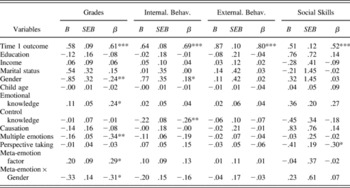
The second step for the joint significance test for mediation was to determine whether the mediators were significantly related to the outcome variables with the predictor in the model (but not significant). The regression with emotion understanding and Time 2 child adjustment was conducted with four outcome variables: grades, internalizing behaviors, externalizing behaviors, and social skills. See Table 2 for regression analyses with emotion understanding. For each of the regression analyses, a hierarchical multiple regression analysis was performed with Time 1 adjustment in the first step; maternal education, household income, marital status, child gender, and child age in the second step; the emotion understanding components (hypothesized mediator) in the third step; meta-emotion philosophy factor (predictor) in the fourth step; and the interaction term for Meta-emotion Philosophy × Gender in the fifth step.
Regression analyses evaluating emotion understanding as a mediator of relations between meta-emotion philosophy and Time 2 outcomes

Note: Statistics are from the final step of each regression equation. For the model predicting Time 2 grades, R 2 = .67, F (13, 51) = 7.87, p = .001. For Time 2 internalizing behaviors, R 2 = .71, F (13, 52) = 9.65, p = .001. For Time 2 externalizing behaviors, R 2 = .65, F (13, 53) = 7.63, p = .001. For Time 2 social skills, R 2 = .40, F (13, 52) = 2.64, p = .007. β, standardized beta weight.
*p < .05. **p < .01. ***p < .001.
For Time 2 child grades, after controlling for Time 1 grades and age, both emotion knowledge and multiple emotions were significant predictors of Time 2 grades, as well child gender, meta-emotion philosophy, and Meta-emotion × Gender interaction (see Table 2). Even though emotion understanding was a significant predictor of grades, meta-emotion philosophy was also significant; thus, the criteria for mediation were not met. To explain the significant Meta-emotion Philosophy × Gender interaction effect, partial correlations were calculated separately by gender. For girls high meta-emotion scores were related to higher grades, whereas meta-emotion scores did not impact boys' grades.
Regression analyses for Time 2 internalizing behavior, with Time 1 internalizing behaviors, maternal education, household income, marital status, and child age controlled, indicated that emotional understanding (control knowledge) was a significant predictor of Time 2 internalizing behaviors, as was child gender (see Table 2). Coupled with the previous correlations, these analyses indicated that boys', but not girls', understanding of their emotions explained the links between caregivers' meta-emotion philosophy and change in internalizing behaviors. However, for Time 2 externalizing behaviors, when controlling for Time 1 externalizing behaviors, none of the other variables were significant predictors. This indicates that emotion understanding does not mediate the relationship between meta-emotion philosophy and externalizing behaviors. Note, however, that there was a significant negative zero-order correlation between meta-emotion philosophy and boys' externalizing behavior problems at Times 1 and 2.
For Time 2 social skills, while controlling for Time 1 social skills, maternal education, household income, marital status, and child gender, emotional understanding (perspective taking) significantly predicted Time 2 social skills (see Table 2). Again, coupled with the previous correlations, these analyses indicate that girls', but not boys', understanding of their emotions explained links between caregivers' meta-emotion philosophy and change in social skills. See Table 1 for gender-specific correlations. In summary, emotional understanding was an independent predictor of changes in grades for girls, and accounted for links between caregivers' meta-emotion philosophy and changes in internalizing behaviors in boys, and changes in social skills in girls. Emotional understanding did not mediate the relation between meta-emotion philosophy and externalizing behavior for either gender.
Emotion regulation as a mediator of meta-emotional philosophy and child adjustment
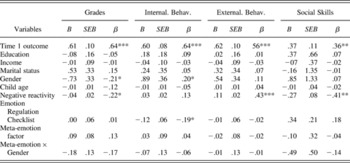
For each of the regression analyses, a hierarchical multiple regression analysis was performed with Time 1 adjustment in the first step, maternal education, household income, marital status, child gender, and child age in the second step, the emotion regulation components (hypothesized mediators) in the third step, meta-emotion philosophy factor (predictor) in the fourth step, and the interaction term for Meta-emotion Philosophy × Gender in the last step. See Table 3 for regression analyses with emotion regulation. Note that all of the emotion regulation mediational analyses apply only to boys because meta-emotion and emotion regulation components were not significantly correlated for girls. The independent variable (meta-emotion) has to be significantly related to the mediator (emotion regulation) in order for mediation to occur.
Regression analyses evaluating emotion regulation as a mediator of relations between meta-emotion philosophy and Time 2 outcomes

Note: Statistics are from the final step of each regression equation. For the model predicting Time 2 grades, R 2 = .62, F (10, 54) = 8.90, p = .001. For Time 2 internalizing behaviors, R 2 = .69, F (10, 55) = 12.04, p = .001. For Time 2 externalizing behaviors, R 2 = .77, F (10, 55) = 18.52, p = .001. For Time 2 social skills, R 2 = .44, F (10, 55) = 4.36, p = .001. β, standardized beta weight.
*p < .05. **p < .01. ***p < .001.
After Time 1 grades, maternal education, household income, marital status, and child age were controlled, negative reactivity and gender remained significant predictors of Time 2 grades (see Table 3). This indicates that caregiver emotion socialization practices were related to boys' grades through the child's ability to contain his negative emotions.
For Time 2 internalizing behaviors, emotion regulation (emotion self-regulation) and child gender were significant predictors after controlling for Time 1 internalizing behaviors, maternal education, household income, marital status, and child age (see Table 3). This indicates that emotion regulation mediated the relationship between emotion socialization and boys' internalizing behaviors.
After controlling for Time 1 externalizing behaviors, maternal education, household income, marital status, and child age, emotion regulation (negative reactivity) significantly predicted Time 2 externalizing behaviors (see Table 3). Once again, emotion regulation mediated the relationship between emotional socialization and boys' externalizing behaviors.
Finally, for Time 2 social skills, emotion regulation (negative reactivity) was a significant predictor while controlling for Time 1 social skills, maternal education, household income, marital status, and child age (see Table 3). As before, emotion regulation accounted for the relationship between caregivers' meta-emotion philosophy and boys' social skills.
In summary, emotion regulation accounted for links between caregivers' meta-emotion philosophy and changes in boys', but not girls', grades, internalizing and externalizing behaviors, and social skills.
Discussion
The purpose of this study was to investigate linkages between maternal caregiver emotion socialization strategies and changes in adjustment in a school-age sample living in low-income, high crime areas. In general, our findings demonstrated that both emotion understanding and emotion regulation appeared to explain the link between maternal caregiver emotion socialization strategies and child adjustment. Specifically, emotion understanding mediated the association between meta-emotion philosophy and changes in boy's internalizing behaviors and in girls' social skills. For boys, emotion regulation mediated the association between meta-emotion philosophy and changes in grades, internalizing behavior, externalizing behavior, and social skills. These findings support the linkages between maternal emotion socialization practices and child adjustment via child emotional competence. How caregivers handle their emotions and respond to children's emotions appears to be important to children's emotional competence and well-being. Although caregivers of boys and girls had similar meta-emotion philosophy scores, the pattern of meta-emotion associations with mediators and adjustment differed between boys and girls in our small sample.
These findings are similar to previous studies of meta-emotion philosophy with primarily Caucasian middle-class families, in that meta-emotion was related to child adjustment (academic achievement and peer relations) and that emotion regulation sometimes mediated that relationship (Gottman et al., Reference Gottman, Katz and Hooven1996). In addition, emotion regulation mediated the association between meta-emotion philosophy and potential psychopathology (internalizing and externalizing behaviors) for boys. Thus, caregivers who were more accepting, aware, and coaching of their son's emotions had boys who were better adjusted if the boys were also able to regulate their own emotions. In this urban, African American sample, boys' emotion regulation appeared to be a protective factor. Katz and Windecker-Nelson (Reference Katz and Windecker-Nelson2004) also found a negative association between meta-emotion philosophy and conduct problems in Caucasian, middle-class families.
Ours is the first known study to focus on gender differences in the patterns of association between meta-emotion and child competence. Our findings suggest the importance of exploring gender differences in the socialization of emotion, even when caregivers do not report gender differences in their emotion socialization practices, as was the case here. This study also supports exploring emotion understanding as a possible mediator of emotion socialization and child adjustment.
These findings are consistent with other recent work showing that emotion regulation explains the link between emotional socialization and child adjustment (Brody et al., Reference Brody, Murry, Kim and Brown2002; Maughan & Cicchetti, Reference Maughan and Cicchetti2002; Ramsden & Hubbard, Reference Ramsden and Hubbard2002). For example, in a recent cross-sectional study, emotion regulation mediated associations between meta-emotion and aggression (Ramsden & Hubbard, Reference Ramsden and Hubbard2002). Our longitudinal findings, however, were different from that of Ramsden and Hubbard in that the effect only held for boys. Maughan and Cicchetti's work (2002) also had findings consistent with this study, as they found that child emotion regulation mediated the relationship between mothers' dysfunctional interaction with children (maltreatment) and children's internalizing behaviors, although their study failed to find significant relations between delinquent or aggressive behavior and emotion regulation.
Another study using African American youth found similar patterns, although the variables studied were general rather than emotion focused. Brody et al. (Reference Brody, Murry, Kim and Brown2002) found that child self-regulation (goal setting, planning, and persistence) mediated mother's competence-promoting parenting and child social, cognitive, and psychological adjustment 1 year later, after controlling for initial child adjustment. This suggests that it is important for children to develop their own regulatory skills in conjunction with competent parenting.
In addition to the importance of the mediating role of child emotional competence (emotional understanding and/or emotion regulation), the differential relationship between maternal caregiver emotional socialization and girls' and boys' emotional, social, and academic competence deserves further consideration. Although maternal caregivers' emotional socialization practices did not differ by gender, meta-emotion practices impacted boys and girls differently. Brody (Reference Brody and Fischer2000) also found a lack of gender differences in maternal reports of emotional socialization of boys and girls, and, like this study, gender differences were found in the pattern of association between maternal emotional socialization and children's emotional competence. This finding points to the importance of examining the pattern of associations between variables by gender, rather than just examining mean differences and concluding that gender is not impacting emotional socialization and competence.
Emotional socialization practices (meta-emotion philosophy) are strongly related to emotion regulation for boys but not for girls. When African American, middle-class boys were interacting with both parents, mothers validated their sons more than their daughters, and boys were more receptive to their mothers than were girls (Smetana, Abernethy, & Harris, Reference Smetana, Abernethy and Harris2000). This could explain why emotional socialization practices appeared to have a stronger association with adjustment for boys than girls in this study. The boys may take in what their mothers are teaching them about emotions more readily than girls, and mothers may give their sons more subtle reinforcement or praise for containing their emotions than their daughters.
Boys may be encouraged in subtle ways to curtail emotional expression in order to conform to gender stereotypes (Chaplin, Cole, & Zahn-Waxler, Reference Chaplin, Cole and Zahn-Waxler2005). A retrospective study of college students reporting emotional socialization by their parents during childhood showed few differences in how males and females perceived emotional socialization by their mothers (Garside & Klimes-Dougan, Reference Garside and Klimes-Dougan2002), although the few differences may help explain some of the gender differences in the current study. The retrospective study found that mothers were more dismissive of sons' sadness and more punishing of sons' anger compared to their daughters'. This may have taught boys to express fewer emotions compared to their female counterparts. Thus, this may have given boys more practice or reason to regulate or control their emotions.
An alternate explanation for the gender findings in the study is that caregivers were responding to their children's behaviors. Emotion regulation may be more strongly related to emotion socialization for boys than girls because school-age boys may have more problematic behavior toward which caregivers respond more intensely or frequently. Our finding of higher levels of internalizing behaviors in boys compared to girls is not inconsistent with other research on gender differences in preadolescent behaviors (Forehand et al., Reference Forehand, Neighbors and Wierson1991; Kumpulainen, Rasanen, & Henttonen, Reference Kumpulainen, Rasanen and Henttonen1998). Forehand et al. (1991) found that school-age boys displayed more internalizing and externalizing behaviors than girls, but by midadolescence, boys were more competent than girls.
Maternal caregivers may not describe differences in their emotional socialization practices but it may be the amount, intensity, and/or valence of emotion expressed or discussed depends on the gender of the child. Research has shown that mothers report more positive emotional expression with girls than with boys (Garner, Robertson, & Smith, Reference Garner, Robertson and Smith1997). Thus, girls may learn to express their emotions more freely, whereas boys may “hold in” their feelings or learn how to dismiss their feelings or distract themselves from feelings. This study assessed caregiver's meta-emotion philosophy for sadness and anger but did not explore socialization of positive emotions.
One puzzling finding was gender differences in the relation between emotional understanding and meta-emotion philosophy. Multiple emotions, one component of emotional understanding, had a positive correlation with mothers' meta-emotion philosophy for girls, but a negative one for boys. It may be that mothers socialize their boys about one discrete emotion at a time. Boys may also be more likely to express one particular or observable emotion, so that may be the emotion to which mothers respond. Perhaps in mothers' discussions of negative emotions with girls, mothers also express positive affect or talk about positive emotions more often, thus helping their daughters recognize multiple emotions in a given situation. Mothers may not explore the same complexity of emotions with their sons compared to their daughters. A recent study by Chaplin et al. (Reference Chaplin, Cole and Zahn-Waxler2005) found that parents were more attentive to girls than boys when they were expressing anxiety and sadness; thus, possibly subtly dismissing these internalizing emotions in boys so they would be less likely to acknowledge these feelings in the future. The negative correlation between meta-emotion philosophy and boys' multiple emotions may indicate that boys who receive little emotional socialization recognize many conflicting emotions and may or may not know how to make sense of these feelings. Another explanation could be that boys who receive more coaching of emotions may rely on others (particularly mothers) to process their affect or to talk about emotion-laden situations and may not as easily be able to independently provide a variety of emotions from one situation. Boys who rely on their caregivers to help them sort out their emotions may not have as much of a chance to figure out their emotions on their own.
Caregivers' meta-emotion philosophy was related to emotional understanding for both boys and girls, although the components of emotional understanding differed by gender. Meta-emotion was positively correlated with girls' multiple emotions and perspective-taking, whereas it was negatively correlated with boys' multiple emotions and positively correlated with boys' control knowledge. A study of preschool children's peer play found that girls express more positive emotion in triadic, same-gender peer interactions than do boys (Garner et al., Reference Garner, Robertson and Smith1997). This may support the notion that girls are more aware of emotions and how they impact interpersonal relationships. In the current study, girls whose caregivers engaged in more emotion coaching had higher scores on multiple emotions and perspective taking than girls whose caregivers were not as sensitive to or coaching of emotions.
Mandara and Murray (Reference Mandara and Murray2000) found that African American adolescent boys' self-esteem was more affected by the family organizational factors (structure, control, and activities), whereas girls were more affected by the family relational factors (cohesion, conflict, and expressiveness). Emotion regulation may be more similar to having structure and control for emotions, where emotional understanding may be more related to relational factors. This may also help explain why emotion regulation appeared to be more important to boys' adjustment, whereas emotional understanding was related to some aspects of girls' adjustment when emotion regulation was not related to girls' adjustment. This hypothesis merits further investigation.
Like the current study, Rydell et al. (Reference Rydell, Berlin and Bohlin2003) found more consistent associations between emotionality and adjustment compared to associations between emotion regulation (self- and other induced) and adjustment. Both emotion regulation and emotionality contribute to problematic behavior in different ways. In our mediational analyses, boys' emotional self-regulation processes were significantly associated with internalizing behaviors and mediated the link between emotion socialization and internalizing behaviors. Many studies of children's regulation did not specifically use emotion regulation measures, so direct comparisons are difficult to make (Rydell et al., Reference Rydell, Berlin and Bohlin2003). The emotionality variable, measured by a negative reactivity temperament index, was significantly associated with boys' grades, externalizing behavior, and social skills. The differences in association between emotion self-regulation and emotionality seem important. Parents' teaching about emotions seems helpful for boys' outward activities and action but only through children's development of low levels of emotionality.
Other work has shown the same association between emotion regulatory competence and academic performance (Shields & Cicchetti, 2001), peer relationships (Gottman et al., Reference Gottman, Katz and Hooven1996), and acting out behaviors (Ramsden & Hubbard, Reference Ramsden and Hubbard2002). When caregivers taught their children about emotions and boys developed the ability to control their emotional behavior, boys had fewer internalizing behaviors. It makes sense that controlling one's emotional behavior would be related to fewer internalizing behaviors. Of interest, when caregivers taught their children about emotions and children experienced emotions in a controlled way (i.e., low negative reactivity), this was linked to boys' grades, externalizing behavior, and social skills. The more control children have over their initial emotional reaction, the more energy or effort they may have left to deal with tasks and peers. Rather than dwelling only on their emotional reactions, these children can focus their attention on tasks in the social environment (e.g., schoolwork and social relationships).
There is an interesting connection between the emotion regulation measures and the component of emotion understanding that mediated the relationship between emotion socialization and boys' internalizing behavior. The significant component of emotion understanding in the mediation results was children's knowledge of how to control emotions. Although this is an important part of emotion understanding, it is obviously linked to emotion regulation in that children who know what to do to change or manage their emotions are more likely to successfully control their feelings than children who do not have strategies to control their emotions. This is supported by recent research showing that children who were able to identify and use more adaptive strategies to regulate their emotions were nominated as good versus poor emotion regulators (Georges, Reference Georges2001).
Study strengths and limitations
This study has several strengths that are important to highlight. First, this study is one of few that employed a longitudinal design and included a low-income population of African American school-age youth (9–13 years old) from violent urban areas that examine both positive (social skills, grades) and poor adjustment (internalizing and externalizing behaviors) through structured and semistructured interview data. The examination of differential patterns of association by gender on the relationship between emotion socialization practices and child competence is an important contribution that supports previous work (Brody, Reference Brody and Fischer2000) and highlights the importance of examining gender closely in future emotion socialization studies.
In addition to the unique aspects of this study, there are several limitations that should be mentioned. Although the study was longitudinal, the correlational nature of the data limit determination of cause–effect relations. The longitudinal design does, however, make it easier to tease out temporal ordering of variables. In addition, our small sample size limited the number and type of analyses that could be conducted, and affected the power with which we could detect effects. We anticipated being able to reduce our emotion understanding variables further than the results of our factor analysis indicated. Our significant findings may be robust, but there may be additional significant associations that could not be detected, which could alter the conclusions drawn from this study. The relationship between emotion socialization and child competence was found to be mediated by emotion understanding and emotion regulation (for boys) and these relationships may be stronger than our results indicate. If the sample size was larger, the gender differences may diminish slightly or completely, so the findings of this study need to be considered preliminary and tentative.
Attrition may be influencing our results in some manner. As mentioned earlier, there were no differences in meta-emotion between families who returned for Time 2 and those who did not. Further, the pattern of associations between meta-emotion scores and child adjustment did not differ between those participants who did and did not return for the second interview, thus suggesting with some confidence that attrition effects were somewhat minimal. However, our sample may have had more variability had all of the participants completed both interviews. The fact that boys who were rated as less competent were less likely to return may have caused the range of children's behavior to be abbreviated in our longitudinal study. It is possible that attrition affected our results in some unforeseen manner and we believe it is important to acknowledge that possibility.
The emotion understanding interview developed for this study needs further validity evidence to increase confidence in the findings from this interview. The lack of statistical support to reduce the emotion understanding components may suggest less than desirable construct validity, although there were also theoretical reasons to keep these five distinct components that is supported by research on emotion understanding. The findings from this study need to be replicated in a larger scale study to further support the conclusions from this sample.
Directions for Future Research
Future research on emotional socialization needs to include more diverse samples of youth, especially school-age or adolescent participants, and needs to use multiple sources of information to provide robust indicators of socialization and adjustment. Both positive and negative adjustment measures should be included to get a fuller picture of the paths of resiliency and risk. Research on emotion socialization in general, and specifically meta-emotion philosophy, needs to include minority samples in various contexts to learn more about the nuances of child competence during the school-age years.
In addition, exploring differences in gender is likely to be important in understanding emotion socialization more fully. Chaplin et al. (2005) found that parents responded differently to boys' and girls' expressions of internalizing verses externalizing emotions and this impacted future emotional expression. In addition, including paternal caregivers in future research would be important, as fathers may display more gender-related emotion socialization than mothers (Chaplin et al., Reference Chaplin, Cole and Zahn-Waxler2005). This research clearly has clinical implications for both parents and children that also should be researched further with larger samples before developing emotional competence interventions based on this small, preliminary study.
Summary
A key take-away message of this study is that among families living in low-income high-violence areas, there appears to be considerable diversity in the emotion socialization practices of maternal caregivers. Caregivers who are more aware and accepting of their own and their child's emotions, and who engage in emotional coaching have school-age children who seem to benefit directly and/or indirectly from these practices. Boys living in this context appear to have a larger benefit than girls of competent emotion socialization, but girls benefit as well. The finding that the pathways by which emotion socialization affected boys' and girls' adjustment differed suggest that gender needs to be considered more prominently in our theorizing about the role of emotion socialization in resilience.