Introduction
The saccule is the vestibular organ most sensitive to acoustic stimuli.Reference Popper, Platt and Saidal 1 A vestibular evoked myogenic potential is an otolith-mediated reflex that occurs in response to loud sounds and is recorded from the sternocleidomastoid muscle during contraction. It is mediated by an ipsilateral neural pathway that originates from the saccule and then travels along the inferior vestibular nerve to the lateral vestibular nucleus in the brainstem, the vestibulospinal tract, the accessory nucleus, the accessory cranial nerve and, finally, to the sternocleidomastoid muscle.Reference Hain 2
Since 1994, the vestibular evoked myogenic potential has been the most reliable measure of the integrity of the sacculocollic reflex.Reference Colebatch, Halmagyi and Skuse 3 Recently, a large negative deflection with 3–4 ms latency within the auditory brainstem response (ABR) has been reported in some adult patients with profound hearing loss of peripheral origin after intense acoustic stimulation. This has been termed the N3 potential (or acoustically evoked short latency negative response) and is assumed to be a vestibular evoked potential.Reference Ochi and Ohashi 4 Kato et al. suggested a saccular origin for the N3 potential,Reference Kato, Shiraishi, Eura, Shibata, Sakata and Morizono 5 and this hypothesis was confirmed later in many studies.Reference Ochi and Ohashi 4 , Reference Nong, Ura, Kyuna, Owa and Noda 6 – Reference Nong, Ura, Owa and Noda 12 Considering the short latency of the N3 potential, Nong et al. speculated that the sensory organ that generates the N3 potential may comprise the saccule and vestibular nuclei.Reference Nong, Ura, Kyuna, Owa and Noda 6 In addition, an intact auditory brainstem may be necessary to generate the N3 potential.Reference Ochi and Ohashi 4 In contrast to the vestibular evoked myogenic potential, the N3 potential has not been reported in individuals with normal hearing using conventional stimuli. However, it has been evoked in individuals with normal hearing using white noise ipsilateral to the stimulated ear to mask ABR waves.Reference Murofushi, Iwasaki, Takai and Takegoshi 7 However, the relationship between cochlear function and N3 potential generation remains undefined.
An N3 potential has been reported in 29.0–41.7 per cent of ears with severe to profound hearing loss.Reference Ochi and Ohashi 4 , Reference Nong, Ura, Kyuna, Owa and Noda 6 – Reference Zagólski 11 , Reference Kumar, Bhat and Guttedar 13 In contrast, two large-scale studies reported N3 potential rates of only 5.8 per cent and 11.9 per cent, respectively.Reference Kato, Shiraishi, Eura, Shibata, Sakata and Morizono 5 , Reference Nong, Ura, Owa and Noda 12 Some studies have reported the presence of vestibular evoked myogenic potential in all patients with a preserved N3 potential. However, not all patients with a normal vestibular evoked myogenic potential response had an N3 potential, suggesting that additional mechanisms generate these responses.
The present study investigated the relationship between the N3 potential and the cervical vestibular evoked myogenic potential in patients with profound sensorineural hearing loss (SNHL) and the association of these potentials with loss of auditory function. The mechanisms responsible for generating the N3 potential, especially where the vestibular evoked myogenic potential response is absent, were also investigated.
Materials and methods
Participants
This cross-sectional study was conducted in the Audiology Clinic, King Faisal Specialty Hospital and Research Center Jeddah, Saudi Arabia, from February 2013 to May 2014. Of 70 potential participants, only 50 fulfilled the inclusion criteria, which were: age at least 4 years (to be able to respond on behavioural audiometry), profound SNHL (either bilateral or unilateral) of varying aetiology and a type A tympanogram. Exclusion criteria were: a history of chronic medical or neurological illness; middle-ear disease; or a history of dizziness or any vestibular disorder. Some participants were recruited during routine patient visits to the Audiology Clinic, while others were recruited from local deaf schools with permission from the Department of Education, Jeddah. Written consent was obtained from all patients or their guardians for enrollment. The study was approved by the Ethical Committee and Otorhinolaryngology Department of Kasr Alainy Hospital, Cairo University, and complied with the Helsinki Declaration of 1975, as revised in 2008.
Audiometry
All patients provided a comprehensive medical history and underwent otological examination and audiometric testing using an Affinity 2.0 audiometer (Interacoustics, Middelfart, Denmark). Pure tone audiometry was performed at 0.25, 0.5, 1, 2, 4 and 8 kHz to measure the air-conduction threshold. Bone-conduction testing was performed at 0.5, 1, 2 and 4 kHz to exclude the presence of conductive hearing loss. Immittancemetry was performed using an AZ26 impedance audiometer (Interacoustics). Ipsilateral tympanometry at 0.5, 1, 2 and 4 kHz was performed to exclude middle-ear pathology and acoustic reflexes.
Vestibular evoked myogenic potential testing
Vestibular evoked myogenic potentials were recorded using an ICS Chartr EP200 (Otometrics, Taastrup, Denmark). For this, the skin was first prepared using alcohol swabs and abrasive cream. A conducting gel was then applied to ensure an overall impedance of less than 5 kOhm and an inter-electrode pair impedance of under 3 kOhm to maintain conductivity. Surface electrodes were placed as follows: an active (positive) electrode was placed on the upper sternum, reference (negative) electrodes were applied to the middle of the sternocleidomastoid muscles and a ground electrode was placed on the centre of the head.
Participants were placed in the supine position and asked to raise and turn their heads to the side contralateral to the stimulated ear to activate the sternocleidomastoid muscle. Electromyography activity was monitored during the entire recording to ensure equal muscle contraction on both sides. A short tone burst acoustic stimulus of 0.5 kHz (2 ms plateau and 1 ms rise and fall times) at the rarefaction phase was delivered monaurally via TDH 49P headphones (Telephonics). A stimulus intensity of 90 dB nHL was used as the default intensity. Two traces were collected to ensure reproducibility. The signal repetition rate was 5.1 pulse per second and the analysis time was 100 ms. Responses from 150 sweeps were averaged, amplified and band pass filtered within 0.01–1 kHz. The vestibular evoked myogenic potential response was evaluated for the presence or absence of a biphasic P13–N23 wave, the P13 and N23 latencies (in ms), and the P13–N23 amplitude (in μV) at a stimulus level of 90 dB nHL.
N3 potential testing
The N3 potential was recorded using an ABR protocol with an ICS Chartr EP200 (Otometrics). Skin preparation was the same as for vestibular evoked myogenic potential testing. Surface electrodes were placed as follows: an active electrode was placed high on the forehead just below the hair line, reference electrodes were placed over the left and right mastoid processes, and a ground electrode was placed on the centre of the forehead. The patient was asked to stay relaxed and quiet during the examination, but no sedatives were used. Click acoustic stimuli at the rarefaction phase were delivered monaurally via TDH 49P headphones (Telephonics). A stimulus intensity of 90 dB nHL was used as the default intensity. The signal repetition rate was 21.1 pulse per second and the analysis time was 15 ms. Responses from 2000 sweeps were averaged, amplified and band pass filtered within 0.1–3 kHz. Two traces were collected to ensure reproducibility.
The presence of an N3 response was determined using Murofushi and colleagues’ criteriaReference Murofushi, Iwasaki, Takai and Takegoshi 7 : (1) it is a negative deflection with a V-shaped wave (where there are two or more candidates, the largest peak is defined as N3); (2) it is evoked by loud sounds; (3) its latency is approximately 3–5 ms; (4) its amplitude is more than 0.05 μV; and (5) it is reproducible. The N3 response was evaluated for latency and amplitude at a stimulus of 90 dB nHL. Vestibular evoked myogenic potential and N3 potential testing were performed in a single session of approximately 15 minutes.
The median patient age of 15 years was used as the cut-off point for the paediatric population. Patients were thus divided into two groups: those aged 15 years or below and those aged over 15 years. Other studies have used a similar age classification.Reference Bleyer 14 – Reference Thomas, Albritton and Ferrari 16 Examined ears were divided into two groups according to the presence or absence of a vestibular evoked myogenic potential response.
Statistical analysis
Data were collected, revised, coded and entered to IBM SPSS Statistics software version 20.0 (Armonk, New York, USA). Qualitative data are presented as numbers and percentages, while quantitative data are presented as means and standard deviations. Qualitative data were compared between two groups using the χ2 test. Quantitative data with a parametric distribution were compared between two independent groups using an independent t-test. The Spearman's correlation coefficient between the presence of an N3 potential and the presence of a vestibular evoked myogenic potential response was determined. A p value of less than 0.05 was considered statistically significant.
Results
This study included 50 patients (38 female and 12 male): 16 patients (32 ears) had bilateral profound SNHL and 34 had unilateral lesions (15 right ears, 19 left ears), so the total number of ears examined was 66 ears. Participants were aged from 4 years to 36 years, with a mean age of 16.48 ± 6.93 years (median age 15 years). The average pure tone audiometry thresholds were 90–120 dB HL (mean 103.56 ± 8.53 dB HL).
Vestibular evoked myogenic potential results
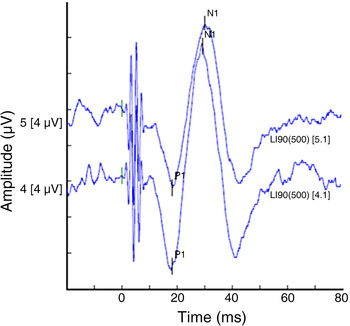
The 66 examined ears were divided into 2 groups based on the presence or absence of a vestibular evoked myogenic potential: the vestibular evoked myogenic potential response group included 34 ears (52 per cent) and the no vestibular evoked myogenic potential group included 32 ears (48 per cent). The mean P13 latency was 17.02 ± 2.76 ms, the mean N23 latency was 25.12 ± 3.97 ms and the mean P13–N23 amplitude was 10.76 ± 7.42 μV. Figure 1 shows a normal vestibular evoked myogenic potential response in one patient in the study.
Graph showing the left vestibular evoked myogenic potential response recorded from an 18-year-old female patient with profound hearing loss.

N3 potential results
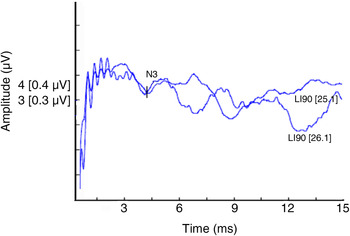
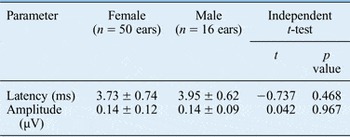
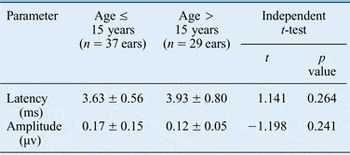
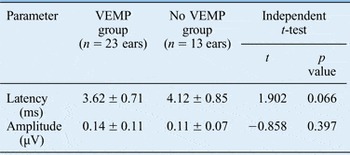
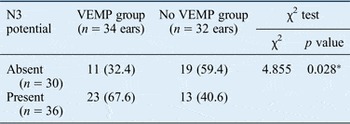
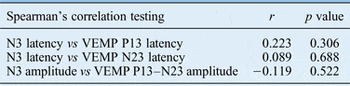
A click-evoked N3 potential was recorded in 36 ears (55 per cent; an example is shown in Figure 2). N3 potentials had a mean latency of 3.80 ± 0.79 ms and a mean amplitude of 0.13 ± 0.10 μV. There was no significant difference in the N3 potential response rate between sexes (χ2 = 0.199, p = 0.656) or age groups (χ2 = 0.702, p = 0.402). Moreover, there was no significant difference in the latency or amplitude of the N3 response between male and female patients or between patients aged over 15 years and those aged 15 years or younger (Tables I and II). The N3 latency and amplitude did not differ between ears with or without a vestibular evoked myogenic potential response (Table III). An N3 potential was recorded in 23 out of 34 ears (68 per cent) with a vestibular evoked myogenic potential response and absent in 19 out of 32 ears (59 per cent) without a vestibular evoked myogenic potential response. Interestingly, an N3 potential was recorded in 13 out of 32 ears (41 per cent) without a vestibular evoked myogenic potential response. There was a significant association between the presence of an N3 potential response and the presence of a vestibular evoked myogenic potential response (p = 0.028; Table IV). However, there was no significant correlation between N3 latency or amplitude and the presence of a vestibular evoked myogenic potential (Table V).
Graph showing an N3 potential evoked in the same patient as shown in Figure 1. The N3 potential latency is 4.25 ms and the N3 potential amplitude is 0.16 μV.

N3 Potential parameters by sex

Data are means ± standard deviation.
N3 Potential parameters by age group

Data are means ± standard deviation.
N3 Potential parameters in the presence or absence of a vestibular evoked myogenic potential

Data are means ± standard deviation. VEMP = vestibular evoked myogenic potential
Association between the N3 potential and the vestibular evoked myogenic potential response

Data are n (%). *p < 0.05. VEMP = vestibular evoked myogenic potential
Correlations between N3 potential and vestibular evoked myogenic potential parameters

VEMP = vestibular evoked myogenic potential
Discussion
Both a vestibular evoked myogenic potential and an N3 potential were recorded in about half of the examined ears with profound SNHL. A vestibular evoked myogenic potential response was detected in 51 per cent of ears. Jacot et al. reported that approximately 50 per cent of children examined before cochlear implantation had normal bilateral vestibular (i.e. canal and otolith) function.Reference Jacot, Van Den Abbeele, Debre and Wiener-Vacher 17 Sazgar et al. reported that patients with SNHL of more than 40 dB HL had significantly more saccular deterioration, indicated by the absence of a vestibular evoked myogenic potential response.Reference Sazgar, Dortaj, Akrami, Akrami and Karimi Yazdi 18 These authors suggested that such patients may have subclinical disturbances of the vestibular system, especially the saccule. The underlying mechanism may be simultaneous damage to both the cochlea and saccule due to the same factors. In the embryo, saccule and cochlea formation starts during the sixth week of gestation and both structures originate from the same portion of the utriculosaccular chamber.Reference Weber, Baptista, Zurhellen, Gumpert and Kerner 19 Acoustically sensitive neural cells are believed to remain in the saccule. These saccular afferents differ from cochlear afferent in that they need a short, intense acoustic signal to be stimulated.Reference McCue and Guinan 20
The N3 potential was present in 55 per cent of the 66 ears included. Previous studies reported comparable figures, with some variability according to the number of patients included, type of stimulus used and the aetiology of profound hearing loss. There was no significant difference in N3 distribution or parameters between sexes. This is consistent with studies by Kato et al. and by Jafari and Asad Malayeri who reported no effect of sex on the N3 response rate, as well as its latency and amplitude.Reference Kato, Shiraishi, Eura, Shibata, Sakata and Morizono 5 , Reference Jafari and Asad 10 Although N3 potentials had delayed latency and smaller amplitudes in those aged over 15 years compared with those aged 15 years and below, the differences were not significant. This means that younger and older patients had similar rates of N3 responses and parameters. In contrast, Kato et al. and Kumar et al. reported a higher N3 response rate in children aged below 10 years than in adults,Reference Kato, Shiraishi, Eura, Shibata, Sakata and Morizono 5 , Reference Kumar, Bhat and Guttedar 13 while Nong et al. reported a higher N3 response rate in the 20–30 years age group.Reference Nong, Ura, Owa and Noda 12
There was a significant association between the presence of an N3 potential and the presence of a vestibular evoked myogenic potential response (p = 0.028). This result is consistent with studies by Emara and by Jafari and Asad Malayeri, who reported a significant association between the presence of an N3 potential and the presence of a vestibular evoked myogenic potential, as well as a significant correlation between the N3 latency and the vestibular evoked myogenic potential latencies (P13 and N23).Reference Emara 8 , Reference Jafari and Asad 10 , Reference Zagólski 11 In addition, Ochi and Ohashi reported a significant correlation between the thresholds of the vestibular evoked myogenic potential and the N3 potential in 10 out of 24 ears.Reference Ochi and Ohashi 4 Zagólski also reported a significant correlation between the presence of an N3 potential and the presence of a vestibular evoked myogenic potential, and concluded that this indicated that these potentials are likely to have common receptors and afferent pathways.Reference Zagólski 11
Most previous studies reported that a vestibular evoked myogenic potential response is present in all ears with an N3 response. However, not all patients with profound hearing loss and a normal vestibular evoked myogenic potential in the present study had an N3 potential: 32 per cent of ears (11 out of 34) with a vestibular evoked myogenic potential had no N3 potential. A similar finding was made by Ochi and Ohashi, who reported that 37.5 per cent of ears with a vestibular evoked myogenic potential had no N3 response.Reference Ochi and Ohashi 4 This rate is consistent with those reported by Emara and by Jafari and Asad Malayeri, who recorded vestibular evoked myogenic potentials in 53 per cent and 22 per cent of ears, respectively, with no N3 response.Reference Emara 8 , Reference Jafari and Asad 10 Nong et al. also recorded vestibular evoked myogenic potentials in a third of ears without an N3 potential but these had raised thresholds compared with controls and patients with an N3 response, suggesting saccular hypofunction.Reference Nong, Ura, Kyuna, Owa and Noda 6 Similarly, Hajari et al. reported that seven ears (20.5 per cent) with a normal vestibular evoked myogenic potential lacked an N3 response.Reference Hajari, Sheibanizadeh, Pourbakht, Zarrinkoub, Kamali and Ramezani 21 The presence of a vestibular evoked myogenic potential response in patients with profound hearing loss suggests that they have a normal reflex neural pathway, that is, normal function of the saccule, the inferior vestibular nerve, the lateral vestibular nucleus, the vestibulospinal tract, the accessory nucleus, the accessory cranial nerve and the sternocleidomastoid muscle.Reference Hain 2 The significant association between the presence of a vestibular evoked myogenic potential and an N3 response, together with absence of an N3 potential in some patients with a vestibular evoked myogenic potential response, suggests that additional factors are necessary to generate an N3 potential.Reference Ochi and Ohashi 4 Kato et al. suggested two potential mechanisms for generating the N3 potentialReference Kato, Shiraishi, Eura, Shibata, Sakata and Morizono 5 : (1) a direct potential from the lower brainstem, including the cochlear nuclei or superior olive; and (2) a stationary potential that is generated when the propagating saccular nerve action potential crosses the conductivity boundaries to the lower brainstem, similar to the origin of human brainstem response wave II.Reference Burian, Gstoettner and Zundritsch 22 – Reference Waring 24
Surprisingly, in the present study, an N3 potential could be recorded in 13 out of 32 ears (41 per cent) without a detectable vestibular evoked myogenic potential response, indicating poor vestibular function. This finding was previously reported only by Hajari et al., who investigated the presence of a vestibular evoked myogenic potential and an N3 potential in 20 profoundly deaf volunteers (39 ears) aged 18–40 years.Reference Hajari, Sheibanizadeh, Pourbakht, Zarrinkoub, Kamali and Ramezani 21 Of the five ears with no vestibular evoked myogenic potential response, an N3 negative response (i.e. N3 potential) was present in three ears and absent in two. Versino et al. reported the case of a multiple sclerosis patient who relapsed, and documented that a lesion located at the nucleus and root entry zone of the VIIIth cranial nerve may affect the N3 potential but not the sound-evoked vestibular evoked myogenic potential.Reference Versino, Ranza, Colnaghi, Alloni, Callieco and Romani 25 These authors stated that the N3 potential seems to be more sensitive than the sound-evoked vestibular myogenic potential in detecting dysfunction along the saccular pathways, which could be useful providing that the two techniques share a similar diagnostic specificity. Finally, they speculated that an abnormal vestibular evoked myogenic potential combined with a normal N3 potential may be explained by impairment of the reflex pathway downstream of the vestibular nuclei. In contrast, an abnormal N3 potential and a normal vestibular evoked myogenic potential suggest impairment upstream of the vestibular nuclei. The current authors speculate that impairment of the pathway at or below the level of the vestibular nuclei may explain the unique finding of an N3 potential in patients with an absent vestibular evoked myogenic potential response. Moreover, a lesion affecting inferior vestibular nerve fibres above the level of the internal auditory canal could spare the N3 potential response but not the vestibular evoked myogenic potential response.
Nong et al. reported the presence of an acoustically evoked short latency negative response (i.e. N3 potential) in profound hearing loss with residual hearing.Reference Nong, Ura, Kyuna, Owa and Noda 6 Therefore, they investigated the N3 potential response in ears with residual low frequency hearing before and after cochlear implantation. They found that 3 out of 16 ears had almost identical pre- and post-implantation N3 potential response thresholds. Of these, only one ear became totally deaf after implantation, while the other two deteriorated but retained some residual hearing (pure tone averages of 105 and 110 dB nHL). Therefore, the data of Nong and his colleagues support a non-cochlear origin for the N3 potential response.
Previous investigations into the origin of the N3 potential excluded a cochlear contribution because only the afferent cochlear pathway was considered, and not the more obscure efferent pathway. However, because the N3 potential has a peculiar V-shaped negative waveform, it is not thought to be generated via the conventional auditory pathway.Reference Nong, Ura, Owa and Noda 12 A new hypothesis is that the efferent cochlear system participates in N3 potential generation through the olivocochlear bundle and various vestibulocochlear anastomoses. Anatomical studies have demonstrated that the medial and lateral olivocochlear efferent fibres, originating from the superior olivary nuclei, run within the inferior vestibular nerve and only join the cochlear nerve at the anastomosis of Oort.Reference Ciuman 26 Oort first described the vestibulocochlear anastomosis in 1918 in a series of temporal bone dissections.Reference Oort 27 This anastomosis lies at the bottom of the internal auditory canal and consists of 1300 nerve fibres running from the saccular branch of the inferior vestibular nerve to the cochlear nerve before reaching the organ of Corti.Reference Ünel, Yilmaz, Albayram, Işık, Ceyhan and Isildak 28 The vestibulocochlear anastomosis was also documented by high-resolution special magnetic resonance imaging performed as part of the radiological evaluation of 73 human temporal bones.Reference Oort 27 Wang et al. reported another novel pathway for vestibulocochlear anastomosis with a consanguineous functional connection between the ventral part of the cochlear nucleus and the peripheral vestibule, especially in the inferior vestibular nerve.Reference Wang, Chi, Zhao and Xin 29
Detection of an N3 potential in patients with normal vestibular function and poor peripheral hearing would depend on preservation of the efferent system. This mechanism explains the absence of an N3 potential in some patients with profound SNHL and normal vestibular function, as indicated by a normal vestibular evoked myogenic potential response. It could reflect cochlear projections lost through vestibulocochlear anastomosis depending on the extent of retrocochlear degeneration, which varies according to the aetiology and degree of auditory dysfunction.
-
• The N3 potential is defined as a large negative deflection with 3–4 ms latency of saccular origin
-
• It has been reported in patients with profound hearing loss of peripheral origin after intense acoustic stimulation
-
• In the present study, it was detected in profound sensorineural hearing loss patients with good (68 per cent) or poor (41 per cent) vestibular function
-
• An N3 potential in such patients with no vestibular evoked myogenic potential may be mediated by the efferent cochlear pathway via olivocochlear fibres that join the inferior vestibular nerve
-
• Absence of an N3 potential in such patients may reflect the loss of cochlear projections through vestibulocochlear anastomosis
The peak latency of 3–4 ms suggests that the generator might be located around the vestibular nucleus.Reference Cazals, Erre and Aurousseau 30 However; the early latency of the N3 potential at 3 ms supports the hypothesis of superior olivary complex involvement in its generation. In normal hearing, auditory brainstem wave III is generated from the superior olives,Reference Moller, Jannetta and Jacobson 31 with a positive peak at the vertex because it is mainly ascending, while the efferent olivocochlear pathway is descending from the superior olivary complex to the cochlea through the inferior vestibular nerve. This theory is also supported by the early findings of Cazals and Aurousseau, who showed that the superior olives were excited in a guinea pig model of saccular acoustic responses, whereas the inferior colliculi did not seem to be involved.Reference Cazals, Aurousseau, Graham and Kemink 23 The N3 potential could be a good objective tool for assessing the prognosis of children before cochlear implantation surgery in whom only the inner ear is damaged, the brainstem nuclei are preserved and vestibular function is normal. Speech could be improved by modifying the interaural frequency and intensity (whether the other ear is implanted or aided) mediated by the lateral olivocochlear efferent fibres ipsilaterally.
Conclusion
The N3 potential was present in 41 per cent of ears with no vestibular evoked myogenic potential. The presence of an N3 potential in a case of profound SNHL with either good or poor vestibular function could be explained by the contribution of the efferent cochlear pathway through olivocochlear fibres that join the inferior vestibular nerve. Impairment in the pathway at or below the level of the vestibular nuclei or in the inferior vestibular nerve fibres above the level of internal auditory canal could spare the N3 potential but not the vestibular evoked myogenic potential response. This new theory is supported by the early latency of the N3 potential (3 ms; ABR wave III originates from the superior olivary complex), its reversed polarity (negative to the vertex, as it is an efferent pathway) and the fact that it is masked in normal hearing by conventional afferent ABR waves. In addition, previous studies showed excitation of the superior olives in a guinea pig model of saccular acoustic responses. However, this theory needs future experimental confirmation.
Acknowledgements
The authors thank Prof. M El-Khosht for intellectual discussions and valuable comments during the editing process. Grateful appreciation is given to King Faisal Specialist Hospital and Research Center, Jeddah branch, Saudi Arabia, for hosting this research. Sincere gratitude is also given to the Alamal Institutes in Jeddah (girls and boys sections) and the General Directorate of Education for their help in accomplishing this work. Finally, we warmly appreciate the participation of all patients, especially children and their parents.