Background
It is currently estimated that 35.6 million people globally have dementia. The most prevalent subtype of dementia is Alzheimer's disease (AD), accounting for up to 65.0% of all dementia cases (Brunnström et al., Reference Brunnström, Gustafson, Passant and Englund2009). Cognitive deficits in dementia are associated with functional impairment in everyday activities (Royall et al., Reference Royall2007) often leading to the inability to function independently. Currently, the efficacy of pharmacological treatments is limited to symptomatic management, and hence there is a crucial need for alternative treatment methods to help those already diagnosed with AD, along with the projected 106.2 million new AD cases that will be diagnosed by 2050.
To date, several research studies have been carried out into modifiable lifestyle factors that might prevent or delay the onset of dementia. Factors that have been implicated in positively affecting outcome include diet (Barberger-Gateau et al., Reference Barberger-Gateau2007; Gu et al., Reference Gu, Nieves and Stern2010), cognitive activities (Verghese et al., Reference Verghese2003; Akbaraly et al., Reference Akbaraly2009), and social environment (Fratiglioni et al., Reference Fratiglioni, Wang, Ericsson, Maytan and Winblad2000; Wang et al., Reference Wang, Karp, Winblad and Fratiglioni2002). Perhaps one of the most researched lifestyle factors over the past 20 years is exercise. Research has shown that being physically active may both delay the onset of developing dementia (Larson et al., Reference Larson2006) and reduce the risk of dementia (Laurin et al., Reference Laurin, Verreault, Lindsay, MacPherson and Rockwood2001; Andel et al., Reference Andel, Crowe, Pedersen, Fratiglioni, Johansson and Gatz2008; Ravaglia et al., Reference Ravaglia2008; Buchman et al., Reference Buchman, Boyle, Yu, Shah, Wilson and Bennett2012). Though exercise as a preventative approach is important, there is also a need to investigate the impact of exercise post-diagnosis. Due to the pathological differences between a healthy population (generally used in prevention studies) and a dementia population, efficacy of exercise as a treatment, and particularly its impact on rate of decline, cannot be inferred. Therefore, it is important that the effects of exercise on cognitive decline in an AD population are explored.
This review into the effects of exercise in AD addresses a gap in previous literature. It focuses purely on exercise interventions, compared to previous reviews that have incorporated exercise interventions with additional social or cognitive activities (Penrose, Reference Penrose2005; Coelho et al., Reference Coelho, Santos-Galduroz, Gobbi, Stella, Gomes and Coelho2009) precluding conclusions about the explicit role of exercise in the outcome. Further, previous reviews have neglected to differentiate between subtypes of dementia (Forbes et al., Reference Forbes, Forbes, Morgan, Markle-Reid, Wood and Culum2008; Littbrand et al., Reference Littbrand, Stenvall and Rosendahl2011). Determining the specific effects of exercise interventions on the cognitive outcome of AD patients will inform management strategies.
Objectives
The purpose of this review was to evaluate the efficacy of evidence for the influence of exercise interventions on the cognitive outcome of AD patients. This review will synthesize and evaluate the studies highlighted to determine whether exercise interventions are effective in combating cognitive decline in AD.
Methods
Type of studies
All selected studies implemented an exercise intervention. Only randomized controlled trials (RCTs) were included in this review. The only requirement of the exercise interventions was that they lasted a minimum of four weeks and were solely exercise-based. Whilst many exercise tasks have some social and cognitive elements, interventions were only excluded if they actively combined exercise with cognitive or social task. There were no limitations to the measurements taken as long as quantitative and objective measures of cognition (e.g. executive function, language, and memory) were recorded. All included studies had to be published and written in English.
Types of participants
All participants were required to have a diagnosis of AD, though there was no limitation on dementia severity or duration of the disorder. The age of participants in studies was not restricted. Participants with vascular dementia, Lewy body dementia, fronto-temporal dementia, and other rarer forms of dementia were excluded.
Types of outcome measures
Any quantitative, objective measure of cognitive performance, or cognitive subdomain.
Search methods for identification of studies
A series of medical, scientific, and psychology databases were searched, including: PubMed, Science Direct, Web of Knowledge, and PsychINFO. The following search terms were used: exercise, physical, training, walk*, danc*, movement, Alzheimer’s, dementia, intervention, and program. Several search terms were employed to exclude irrelevant studies: “cognitive training,” “memory training,” “language training.” Papers were restricted to those published in English between 1991 and 2012.
Assessment of risk of bias in included studies
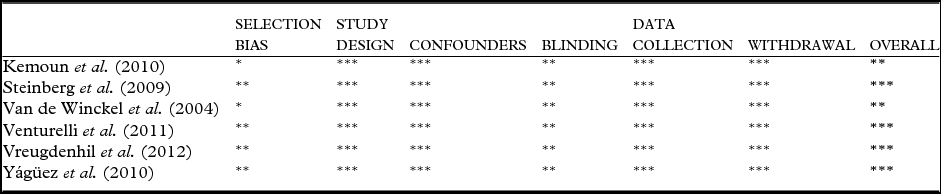
Research quality was assessed by author NF, and confirmed by an independent researcher, using the Quality Assessment Tool for Quantitative Studies (Thomas et al., Reference Thomas, Ciliska, Dobbins and Micucci2004). The Quality Assessment Tool for Quantitative Studies covers several components of bias: (1) selection bias – the use of a sample representative of the target population; (2) study design – participant allocation and randomization; (3) confounders – controlling for factors related to the outcome; (4) blinding – the blinding of participants and assessors; (4) data collection – the use of valid and reliable outcome measures; (5) withdrawal –description and numbers of withdrawals and drop-outs. Each component was rated strong, moderate, or weak. A global rating of paper quality was derived by taking into account all the component ratings. A strong global rating was assigned if four components were rated strong with no weak ratings. The paper was deemed to have a moderate global rating if less than four components were rated strong and at least one weak. A weak global rating was assigned to papers that had two or more components with a weak rating. Studies that did not have a moderate or strong global rating were excluded from the review.
A funnel plot was used to assess publication bias in which the effect sizes of individual studies are plotted against the studies precision. An asymmetrical plot is representative of publication bias.
Data extraction
A table of predefined criteria was developed to ensure that data extraction was focused and accurate. Participant numbers, diagnosis, severity, intervention type and schedule, cognitive measures, and key cognitive outcomes were recorded. Where available, the means and standard deviations were extracted from each cognitive measure at baseline and end of the study. All data were extracted by a single author (NF).
Results
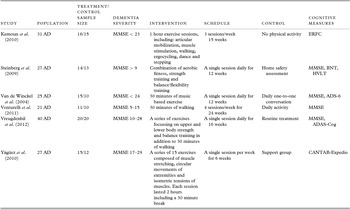
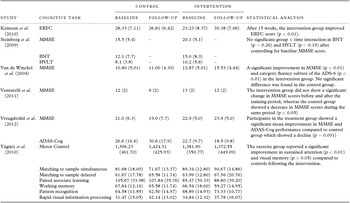
Five-hundred and ninety papers were initially identified using the above search terms in the various databases. Following the removal of duplicates, poster abstracts, and those that were not published in English, 360 papers remained. Two-hundred and eighty-six studies were subsequently excluded because they did not implement an exercise intervention. Thirty-five studies were excluded because they did not use an AD population. Seven studies were excluded because they combined exercise interventions with another intervention, whilst two studies were excluded because the intervention duration was less than four weeks. Nineteen studies were excluded because they did not use a quantitative, objective cognitive outcome measure. Of the 11 studies remaining, five studies were excluded because they did not have an RCT design. A total of six studies met the inclusion criteria and were included in this review. Key information about the RCTs design (Table 1) and cognitive outcomes from the studies were extracted and tabulated (Table 2). Study quality was then subsequently assessed using the Quality Assessment Tool for Quantitative Studies (Table 3). All the studies were deemed to have a moderate to strong research quality.
A descriptive overview of exercise interventions with control group

BNT = Boston Naming Task; HVLT = Hopkins Verbal Learning Test; ERFC = Rapid Evaluation of Cognitive Functions; MMSE = Mini-Mental State Examination; ADAS-Cog = Alzheimer's Disease Assessment Scale–Cognitive Sub-Scale; ADS-6 = Amsterdam Dementia Screening Test 6; CANTAB = The Cambridge Neuropsychological Test Automated Battery.
The means (and standard deviations) of cognitive outcomes from the reviewed RCTs. The main statistical analyses described in the studies are also reported

BNT = Boston Naming Task; HVLT = Hopkins Verbal Learning Test; ERFC = Rapid Evaluation of Cognitive Functions; MMSE = Mini-Mental State Examination; ADAS-Cog = Alzheimer's Disease Assessment Scale–Cognitive Sub-Scale; ADS-6 = Amsterdam Dementia Screening Test 6.
The quality assessment of included RCT studies. All studies revealed a moderate to strong research quality
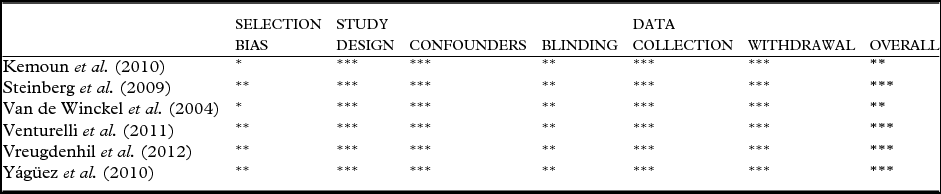
*Weak quality; **moderate quality; ***strong quality.
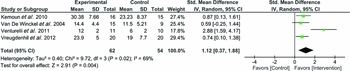
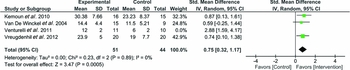
A meta-analysis was subsequently carried out across four of the RCTs that assessed global cognitive outcome (Figure 1). Two studies were not entered into the meta-analysis, one due to a lack of publication of cognitive outcome means (Steinberg et al., Reference Steinberg, Leoutsakos, Podewils and Lyketsos2009) and the other due to exclusively reporting domain-specific cognitive outcomes (Yágüez et al., Reference Yágüez, Shaw, Morris and Matthews2010). The meta-analysis of the remaining studies reported a positive effect size, with an average effect of 1.12 (95% CI = 0.37–1.88). Heterogeneity among the studies was statistically significant (I2 = 69%, p = 0.02). Running a leave-one-out sensitivity analysis revealed that by removing the study by Venturelli and colleagues, heterogeneity became non-significant (I2 = 0%, p = 0.89). The study was likely to increase heterogeneity due to its substantially longer intervention duration compared to the next longest intervention (24 weeks vs. 16 weeks). The subsequent model, comprising of three studies, revealed that exercise significantly improved global cognitive performance compared to controls, 0.75 (95% CI = 0.32–1.17, p < 0.001) (Figure 2).
A forest plot of the meta-analysis of RCT studies that have measured global cognitive outcome. Exercise interventions were found to have a positive effect on global cognitive outcome.

A forest plot of the meta-analysis intervention-controlled studies that have measured global cognitive outcome following the removal of a single study (Venturelli et al., Reference Venturelli, Scarsini and Schena2011). Exercise interventions were found to have a positive effect on global cognitive outcomes.

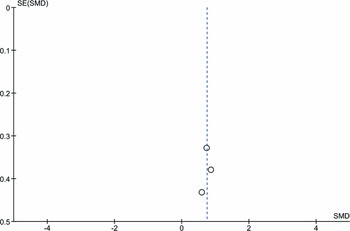
To evaluate whether publication bias existed amongst the studies within the final model, a funnel plot was conducted (Figure 3.) As there was no evidence of skew or asymmetry in the funnel plot, it was interpreted that there was no evidence of publication bias in the three studies.
A funnel plot of the three studies included in the meta-analysis. Standard Error (SE) represents the precision of the estimate of the treatment effect, with the smaller the SE the more precise the estimate. The standard mean difference (SMD) measures the treatment effect size.

Discussion
The purpose of this review was to evaluate published research investigating the effects of exercise interventions exclusively on cognitive outcomes for individuals with a diagnosis of AD, to increase our understanding of the potential role that exercise may play on the rate of cognitive decline. The systematic review revealed preliminary evidence of the beneficial effects of exercise on cognition for people with AD, though methodological heterogeneity limits conclusions that can be made.
A total of six eligible studies were identified in the search, which revealed generally positive effects. Though selection bias was the most common weakness, particular attention needs to be taken for confounding variables. Controlling for confounders was of a high standard, though only core factors were generally controlled for (e.g. age, gender, and Mini-Mental State Examination, MMSE) limiting the study outcome. For example, participants may have different exercise habits prior to the intervention and hence have different fitness levels at the outset. This would mask the impact of the exercise intervention. This has been resolved in a single RCT study (Kemoun et al., Reference Kemoun2010) and other non-RCTs (Palleschi et al., Reference Palleschi1996; Yu and Kolanowski, Reference Yu and Kolanowski2009; Hernandez et al., Reference Hernandez, Coelho, Gobbi and Stella2010; Yu et al., Reference Yu, Savik, Wyman and Bronas2011) by implementing a target effort level for participants, this methodology should be a requirement in any exercise intervention study.
No two studies identified in this review implemented the same exercise intervention, though the interventions could broadly be categorized into three types: (1) aerobic exercise intervention such as walking (Venturelli et al., Reference Venturelli, Scarsini and Schena2011); (2) interventions that aimed to improve flexibility, balance, and strengthen muscles (Van de Winckel et al., Reference Van de Winckel, Feys, De Weerdt and Dom2004; Yágüez et al., Reference Yágüez, Shaw, Morris and Matthews2010; Vreugdenhil et al., Reference Vreugdenhil, Cannell, Davies and Razay2012); and (3) interventions that combine the previous two types (Steinberg et al., Reference Steinberg, Leoutsakos, Podewils and Lyketsos2009; Kemoun et al., Reference Kemoun2010). Heterogeneity was also observed in the exercise program schedule, both in the overall intervention duration and the number of intervention sessions conducted over this time period. Out of the studies reviewed, the longest intervention period lasted 24 weeks (Venturelli et al., Reference Venturelli, Scarsini and Schena2011) and the shortest lasting six weeks (Yágüez et al., Reference Yágüez, Shaw, Morris and Matthews2010). Yágüez et al. (Reference Yágüez, Shaw, Morris and Matthews2010) also implemented the least intensive program, with only a single exercise session per week, whereas several other studies had an exercise session daily (Van de Winckel et al., Reference Van de Winckel, Feys, De Weerdt and Dom2004; Steinberg et al., Reference Steinberg, Leoutsakos, Podewils and Lyketsos2009; Vreugdenhil et al., Reference Vreugdenhil, Cannell, Davies and Razay2012). From this literature, it is impossible to make strong recommendations toward an optimal exercise intervention. Future research is needed to determine the effects of different exercise types on cognition, this is in line with previous conclusions made in a review focused on a cognitively healthy population (Voss et al., Reference Voss, Nagamatsu, Liu-Ambrose and Kramer2011). It is likely that different exercise types are more effective in certain individuals, therefore engaging those with AD in a combined exercise type may prove to be more effective than any single exercise type alone. More importantly, comparisons are needed between low intensity (e.g. once a week) and high intensity (e.g. daily) exercise interventions to determine the optimum protocol.
Other lifestyle factors that have been implicated in cognitive outcomes include diet, cognitive activities, and social activities. It is therefore important that these factors are controlled for. Out of the six RCT studies, only four studies implemented an active control (Van de Winckel et al., Reference Van de Winckel, Feys, De Weerdt and Dom2004; Steinberg et al., Reference Steinberg, Leoutsakos, Podewils and Lyketsos2009; Yágüez et al., Reference Yágüez, Shaw, Morris and Matthews2010; Venturelli et al., Reference Venturelli, Scarsini and Schena2011). An active control is important with regard to exercise studies as there is generally a cognitive or social (if group exercise) component to the activities. Not only is it important that certain activities are matched, it is essential that the control groups are not participating in similar levels of physical activity as the intervention group. Steinberg et al. (Reference Steinberg, Leoutsakos, Podewils and Lyketsos2009) was the only study that took into consideration that members of the control group may also be participating in non-interventional exercise.
Although a meta-analysis was conducted within RCTs, the cognitive outcomes were limited to measures of global cognition, as there were insufficient studies to explore individual cognitive subdomains. There are obvious benefits in using standardized global measures of cognition, particularly the ease of administration and comparability between studies. Unfortunately in the literature reviewed there is an over-reliance on global cognitive measures which was often used as the primary cognitive outcome measure (Van de Winckel et al., Reference Van de Winckel, Feys, De Weerdt and Dom2004; Kemoun et al., Reference Kemoun2010; Venturelli, et al., Reference Venturelli, Scarsini and Schena2011, Vreugdenhil et al., Reference Vreugdenhil, Cannell, Davies and Razay2012). One commonly used global cognitive measure, the MMSE, though a quick method of providing a clinical screening of cognitive performance, has previously been criticized as overly reliant on language and education (Borson et al., Reference Borson, Scanlan, Brush, Vitaliano and Dokmak2000). Perhaps more importantly, the total MMSE score reveals nothing of cognitive subdomain changes. It is therefore important that if general cognitive measures (e.g. MMSE and ADAS-cog) are taken that it should be alongside a more comprehensive cognitive battery. The need to improve cognitive measures used in exercise intervention studies is in line with conclusions made in a recent review (Yu, Reference Yu2011).
An additional issue revealed by this review is that the majority of studies measure cognitive outcome exclusively at baseline and endpoint of the intervention. There are several problems with this design. First, as dementia is progressive in nature, the longer the intervention the more likely there will be a decline in cognition. It is therefore important that measures are taken throughout the intervention period, allowing researchers to be more effective in determining whether exercise at any point can alter the trajectory of cognitive decline. Only a single study (Van de Winckel et al., Reference Van de Winckel, Feys, De Weerdt and Dom2004) implemented a cognitive measure prior to the end of the intervention. Second, no RCTs used a follow-up measure taken some time after the end of the exercise intervention, which would allow for researchers to determine the sustainability of any benefits gained through the intervention. Determining the sustainability of benefits is clearly an important factor when considering the practicalities of implementing an exercise intervention. It should be noted, also, that since physical disability increases with age (Jagger et al., Reference Jagger, Clarke and Cook1989), this could prevent the longer term adherence to an intervention.
It is important to note that the studies identified in this review do not directly address the mechanisms that mediate exercise and cognition in AD because they do not include objective indices of these mechanisms. Exercise has generally been reported to have a positive effect on various cognitive outcome measures in a healthy elderly population (van Gelder et al., Reference van Gelder, Tijhuis, Kalmijn, Giampaoli, Nissinen and Kromhout2004; Etgen et al., Reference Etgen, Sander, Huntgeburth, Poppert, Förstl and Bickel2010). A systematic review of double-blinded exercise interventions in a healthy older adults concluded that exercise is beneficial to cognitive function, though the effects are modest (Angevaren et al., Reference Angevaren, Aufdemkampe, Verhaar, Aleman and Vanhees2008). Two mechanisms have been proposed to mediate the effects of exercise on cognition. The first is that exercise has a nutritive influence on neuronal function. Exercise has been shown to promote neurotrophic effects, including synaptic plasticity, neurogenesis, and vascular function (Cotman and Berchtold, Reference Cotman and Berchtold2002, Reference Cotman and Berchtold2007; Ratey and Loehr, Reference Ratey and Loehr2011). Second, regular exercise has been found to improve aerobic capacity and cerebral vascular perfusion (Rogers et al., Reference Rogers, Meyer and Mortel1990). Such improvements to vascular health may be a significant feature for any intervention in AD, where poor vasculature represents a potential mechanism for disease (Kalaria and Ballard, Reference Kalaria and Ballard1999; Kalaria, Reference Kalaria2002; De la Torre, Reference De la Torre2004). These may not be the primary or exclusive mediators of exercise effects in an AD population. Cognitive decline in AD is attributable at least in part to the buildup of amyloid and tau proteins, which promote neuronal dysfunction and death (Hardy and Selkoe, Reference Hardy and Selkoe2002; Karran et al., Reference Karran, Mercken and De Strooper2011). Evidence in transgenic mouse models of AD, in which the mice have artificially elevated amyloid load, suggests that exercise programs are able to improve cognitive function (Adlard et al., Reference Adlard, Perreau, Pop and Cotman2005; Nichol et al., Reference Nichol, Parachikova and Cotman2007). Adlard and colleagues also determined that the improvement in cognitive performance occurred in conjunction with a reduced amyloid load. Research that includes direct indices of change in such biomarkers will help to determine the mechanisms by which exercise may act on cognition in AD.
Whilst the implementation of a more liberal study inclusion criterion allowed a better insight into the current state of literature, it is also responsible for a greater heterogeneity between studies. As such, a meta-analysis was only performed in a subgroup of studies that used a general cognitive outcome measure. Even within this subgroup, only following a sensitivity analysis and the removal of one study was homogeneity achieved. The validity of the meta-analysis performed may be compromised following the exclusion of a study if it seriously changes the overall result (Walker et al., Reference Walker, Hernandez and Kattan2008). The large positive effect size that was reported in both meta-analyses (d = 1.12 vs. d = 0.75) reflects the robustness of the effect of exercise on general cognitive outcome in AD. Clearly, the data in this review should be interpreted cautiously; whilst there does not appear to be any publication bias, the review encompasses a limited number of studies with generally small sample sizes. Therefore, it is possible that other studies also with small sample sizes were not published as they failed to report a positive outcome.
In the most general terms, current research into the effects of exercise on the cognitive progression of AD has yielded positive results. Heterogeneity between study designs precludes comment on optimal interventions, cognitive domains affected, and underlying mechanisms. The consistency of positive findings, albeit in small sample sizes and varying design, does highlight that a range of exercise interventions can potentially be of benefit to AD populations. Future studies should use improved methodological designs, building upon previous intervention studies and theoretical knowledge. In particular, the role of other factors that may differ between patients such as diet, social interactions, and cognitive activities should be considered. The use of sensitive cognitive measures for a range of subdomains should also be developed. This will allow researchers to determine the potential role of exercise, to hone in on the underlying mechanism, and to further optimize interventions.
Conflict of interest
None.
Description of authors’ role
N.F. completed the search, assessed the research quality, and wrote the first draft of the review. N.T. and J.R. provided input and amendments throughout the development of the paper.
Acknowledgments
We acknowledge the contribution of Jeremy Young, who independently evaluated the quality of the included studies.
This work was supported by the Economic and Social Research Council (ES/102803X/1) and the Sussex Partnership NHS Foundation Trust.