Introduction
On a world-wide grade, there have been many mass-casualty incidents (MCIs) involving children,Reference Grindlay and Breeze1 since they comprise almost 50% of individuals impacted by disasters.Reference Chang, Bradin and Hashikawa2 For example, in the 2010 Haiti earthquake, more than 300,000 people were wounded and around 220,000 lost their lives; one study valued that almost one-half of those injured were children.3 Despite being more severely affected in these situations, children’s needs are historically under-represented in preparedness.Reference Dziuban, Peacock and Frogel4 Likewise, it is well-recognized that children are a population segment especially vulnerable to disasters,Reference Waisman, Aharonson-Daniel and Mor5 because of their unique anatomical, physiological, psychological, and developmental particularities,Reference Cichon, Fuchs and Lyons6,Reference Weiner7 leading to higher risks of morbidity and mortality in disaster events than adults.Reference Grindlay and Breeze1 While health professionals commonly acknowledge that children are not just little adults, specific disaster planning has to be aimed at their needs,Reference Grindlay and Breeze1 and special considerations are necessary to properly care for them during an MCI.Reference Brandenburg, Ogle, Washington, Garner, Watkins and Brandenburg8 Recognizing that children’s normal physiological parameters differ from adults and that prehospital providers often have less experience with injured children,Reference Jenkins, McCarthy and Sauer9 it is therefore essential that pediatric hospital responders be explicitly trained and be prepared to receive and manage children in an MCI.Reference Bank and Khalil10 Still, pediatric care, including clinical specialists’ expertise and customized resources, remains limited at many hospitals.Reference Bank and Khalil10–Reference Petrosyan, Guner, Emami and Ford17 In turn, in a mass-casualty situation, this condition may leave pediatric victims vulnerable to mismanagement, avoidable complications, and death.Reference Burke, Kim, Bachman, Iverson and Berg11,Reference Burke, Berg and Vee14 Considering the pediatric peculiarities and the difficulty of assisting this population in mass-casualty situations, this study aims to identify the main topics regarding children’s health care in MCIs that are discussed in the Emergency Medicine area.
Methods
This systematic review was performed according to the recommendations of Preferred Reporting Items for Systematic Reviews and Meta-Analyses (PRISMA) and registered with the PROSPERO database of systematic reviews with the number CRD42021229552.Reference Moher, Liberati, Tetzlaff and Altman18 The systematic review question was “What are the main topics regarding children’s health care in MCIs that are discussed in the Emergency Medicine area?”
Eligibility Criteria
Studies that addressed children’s health care in any kind of MCI (eg, terrorism, mass intoxication, hurricane, or earthquake) with a population of pediatric patients of any age (considering the maximum age <18 years) were considered as inclusion criteria. Moreover, only the randomized clinical trials (RCTs), quasi-experimental (non-randomized trials), cohort, and analytical cross-sectional studies were considered.
The inclusion criteria also included the peer-reviewed papers in English, Portuguese, Spanish, and Italian languages that were utterly available (full-text) in the databases used for this research. Furthermore, documents that were available with full-text access through CAPES (Coordination of Improvement of Higher Education; Ministry of Education, Brazil), Google (Google Inc.; Mountain View, California USA), or Google Scholar (Google Inc.; Mountain View, California USA) were included.
Books, non-academic research, reviews, summaries, commentaries, policy statements, case reports, and content in languages other than the presented ones were represented as exclusion criteria for the retrieved articles from the databases. Studies with no focus on pediatric range and/or MCIs were also excluded.
Sources of Information
Four authors (VS, GM, FS, MC) conducted the first search on December 18, 2020. The last update was performed on May 27, 2021 by the same authors. The studies were identified in four databases: PubMed (all fields; National Center for Biotechnology Information, National Institutes of Health; Bethesda, Maryland USA), Scopus (article title, abstract, keywords; Elsevier; Amsterdam, Netherlands), MEDLINE/Bireme ([Virtual Library of Health – VLH] title, abstract, subject; US National Library of Medicine, National Institutes of Health; Bethesda, Maryland USA), and Web of Science (article title, abstract, keywords; Thomson Reuters; New York, New York USA).
Literature Search Strategy
The first step in achieving the study’s objective was to establish a research plan embracing the research questions the authors were interested in answering. It was composed of the research questions of interest, the keywords, and inclusion and exclusion criteria. For the documents search, the descriptors selected were based on the Medical Subject Headings (MeSH). The keywords used by the authors in all of the databases mentioned above were: (“child*”) AND ((“emergency medicine”) OR (“pediatric emergency medicine”)) AND (“disaster*”) AND (“mass casualty incident”). The electronic search was complemented with a manual search through the tracking of citations, adding five more studies to the review.
Study Selection and Data Extraction
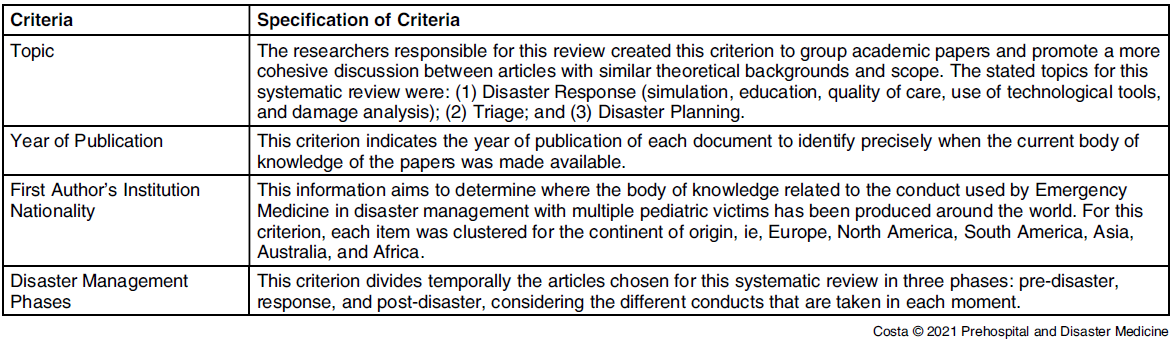
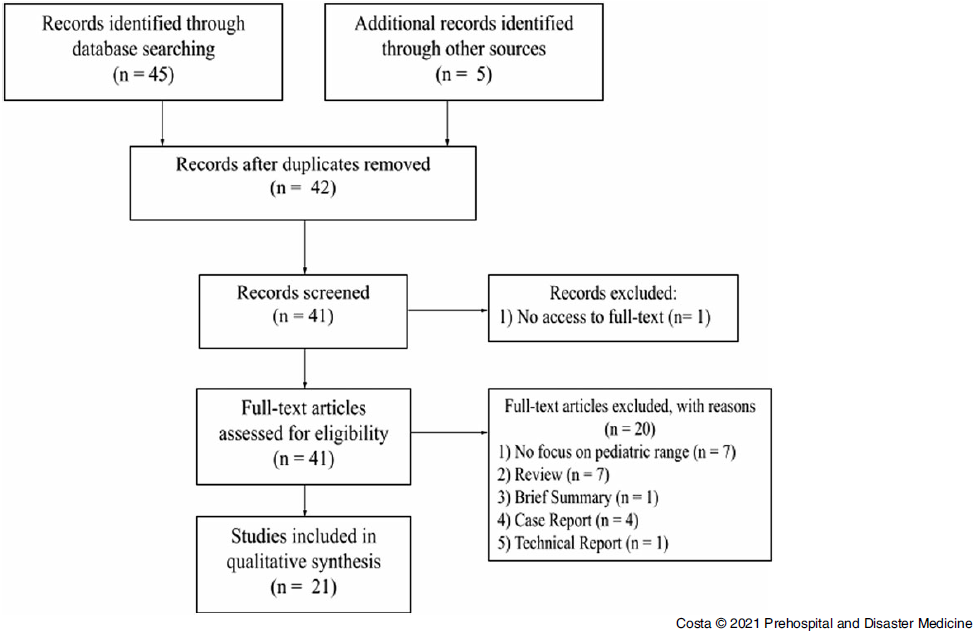
The second step consisted of four procedures. First, the author checked for duplicate documents using the tool “find duplicates” from the software EndNote X9 (Clarivate Analytics; Philadelphia, Pennsylvania USA; EndNote version X9 for Windows), eliminating six documents. Besides, another two documents not excluded by the tool were manually deleted, leaving 37 articles. The researchers excluded one article on the second procedure that could not be found as PDF files, remaining 36 articles to be analyzed. In the third procedure, the four authors (VS, GM, FS, MC) read the titles and abstracts to ensure that they covered the eligibility criteria, reducing the number of documents to 21. As long as there was no disagreement among the authors, the fifth researcher (HF) consultation was not necessary. In the final procedure, the resulting papers that fulfilled the inclusion criteria were analyzed. The relevant data regarding the research aim were entered into the knowledge matrix, responsible for organizing and systematizing relevant information in columns using the Microsoft Excel spreadsheet Version 7.0.25 (Microsoft Corporation; Redmond, Washington USA) for Windows.Reference Ferenhof and Fernandes19 For the presentation of the results, it was established some criteria are reported in Table 1.
Specification of Criteria

Quality Appraisal
Four review authors (VS, GM, FS, MC) independently assessed all included studies for risk of bias; any disagreement was resolved by discussion. The authors used the Joanna Briggs Institute (JBI) Critical Appraisal Checklists for RCTs, Quasi-Experimental Studies (non-randomized experimental studies), Cohort Study, or Analytical Cross-Sectional Study.20
The JBI Critical Appraisal Checklists mentioned above had four possible answers: Yes (Y), No (N), Unclear (U), and Not Applicable (NA). The bias risk assessment was calculated by the amount of “Y” that had been answered on the checklist. According to the JBI guidelines, when “NA” was selected, this respective question was not considered in the calculation.20 This tool enabled the researchers to order each study in three possible groups: high risk of bias (up to 49%), moderate risk of bias (from 50% to 70%), and low risk of bias (above 70%).Reference Azevedo, Ledesma, Pereira, Oliveira and Bahmad Junior21
Synthesis of Results
The authors considered narrative synthesis an appropriate method for presenting multiple studies’ results, whereas heterogeneous studies were included in this systematic review. The data tabulated on the knowledge matrix were used to write up the findings and discuss the main information. A discussion on the impact of the methodological quality of the included studies was carried out. Then, the authors established the understanding of the main topics regarding children’s health care in MCI that are discussed in the Emergency Medicine area. For statistical analysis, the data were also tabulated in spreadsheets using Microsoft Excel spreadsheet Version 7.0.25 (Microsoft Corporation; Redmond, Washington USA) for Windows, and the relative frequency of responses was analyzed.
Results
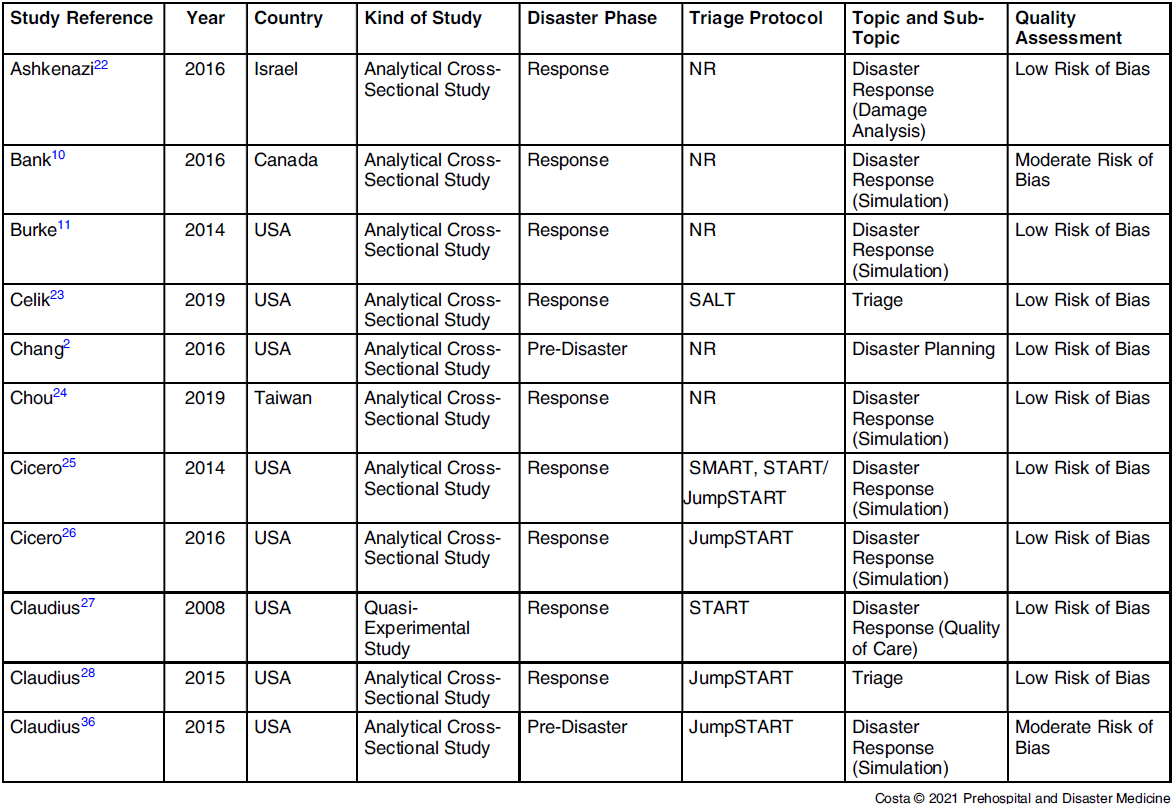
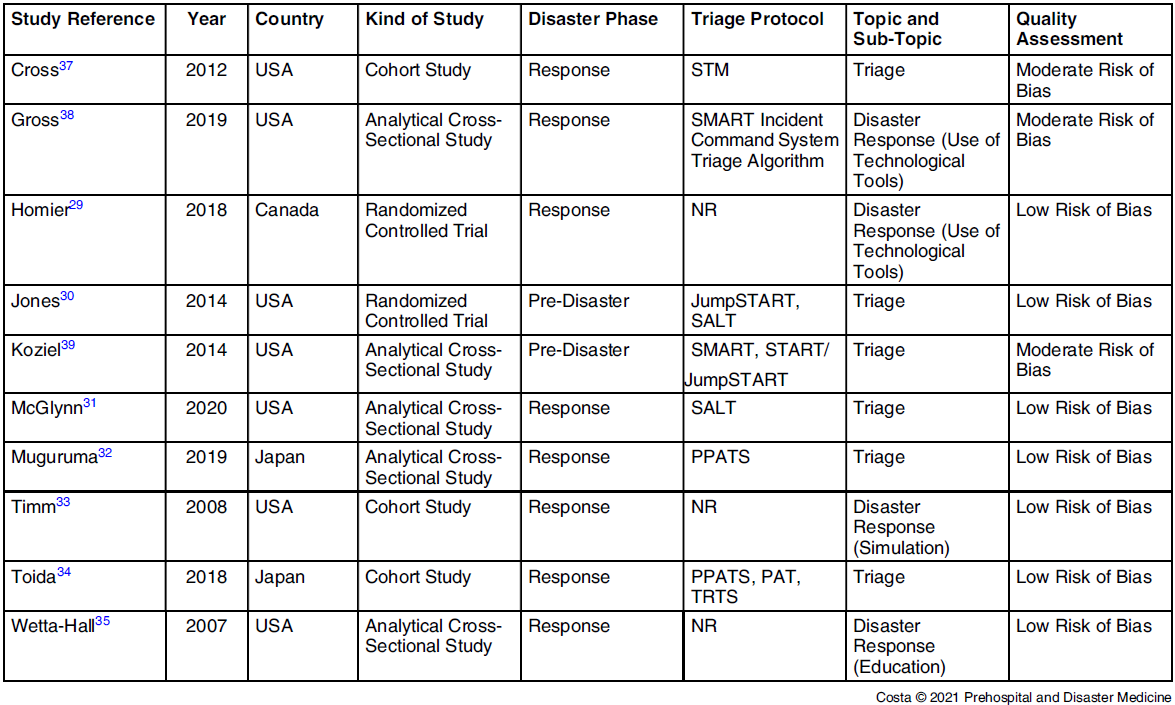
Overall, the search identified 50 references, with 42 unique papers. Of these references, 21 were excluded as they did not meet the inclusion criteria or were not available in full text. Therefore, a total of 21 were identified as meeting all the criteria, as shown in Figure 1. Table 2 and Table 3 present the characteristics of the included studies. The analysis of the results is shown below, presenting insights into the study of this review’s subject.
PRISMA Flowchart

Characteristics of the Included Studies
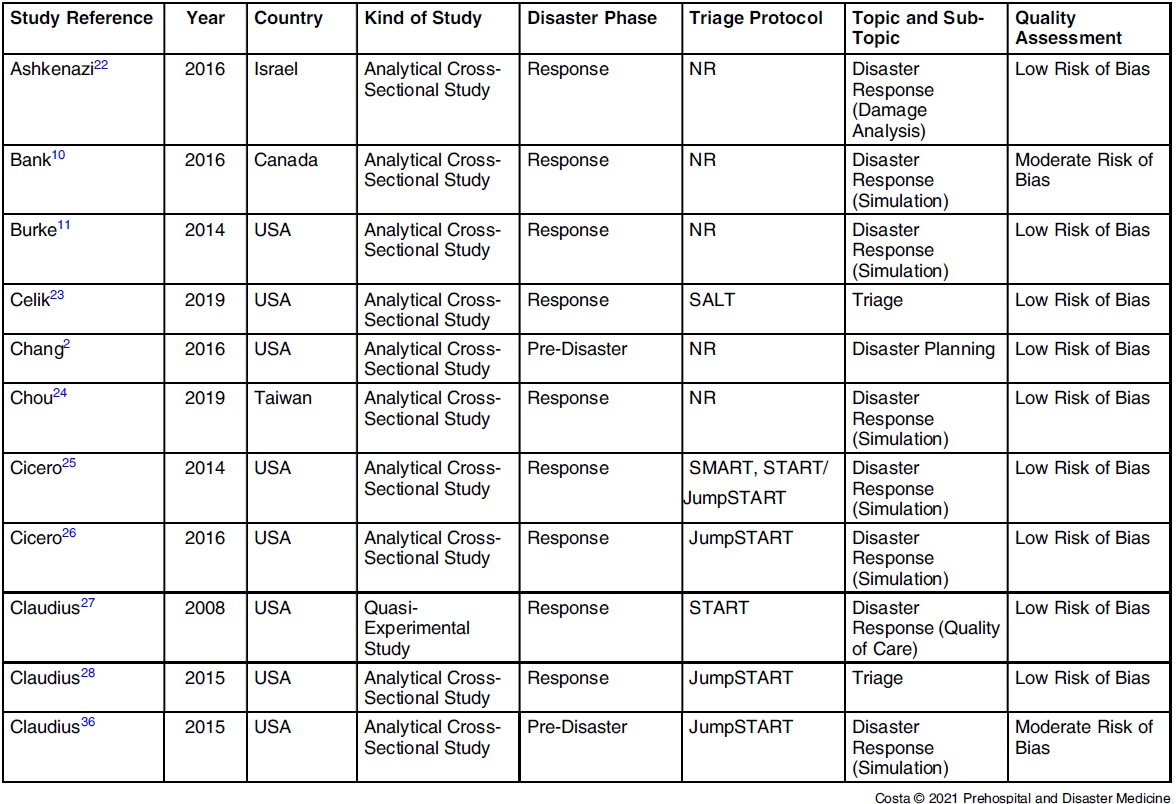
Abbreviations: NR, not related; SALT, Sort, Access, Life-Saving Intervention, Treatment; START, Simple Triage and Rapid Treatment.
Characteristics of the Included Studies

Abbreviations: STM, Sacco Triage Method; NR, not related; SALT, Sort, Access, Life-Saving Intervention, Treatment; START, Simple Triage and Rapid Treatment; PPATS, Pediatric Physiological and Anatomical Triage Score; PAT, Pediatric Assessment Triangle; TRTS, Triage Revised Trauma Score.
Study Selection
All 21 articles were analyzed using the JBI Critical Appraisal Checklists for RCTs, Quasi-Experimental Studies, Cohort Studies, and Analytical Cross-Sectional Studies according to each type of study. Sixteen articlesReference Chang, Bradin and Hashikawa2,Reference Burke, Kim, Bachman, Iverson and Berg11,Reference Ashkenazi, Einav, Olsha, Turegano-Fuentes, Krausz and Alfici22–Reference Wetta-Hall, Berg-Copas, Cusick Jost and Jost35 showed low risk of bias and five articlesReference Bank and Khalil10,Reference Claudius, Kaji and Santillanes36–Reference Koziel, Meckler and Brown39 showed moderate risk of bias. Therefore, none of the 21 articles included in the qualitative synthesis were excluded for poor methodological quality. Further information regarding the critical appraisal tools used in this systematic review can be consulted in the supplementary material (available online only).
Topic
Three topics (Disaster Response, Triage, and Disaster Planning) were categorized to present the main results of each retrieved article.
Disaster Response
In the portfolio of articles reviewed for this study, 12 articles addressed this topic. In this context, the researchers identified the main sub-topics covered in the analyzed articles that referred to the phases of preparedness and response in disasters: simulation, education, quality of care, use of technological tools, and damage analysis, which are presented below.
Simulation
In total, seven articles presented simulation exercises that described preparation activities to assist in the response phase.Reference Bank and Khalil10,Reference Burke, Kim, Bachman, Iverson and Berg11,Reference Chou, Lin, Cheng, Chen and Shih24–Reference Cicero, Whitfill and Overly26,Reference Timm and Kennebeck33,Reference Claudius, Kaji and Santillanes36 Considering that children are a population segment especially vulnerable to disasters because of their unique anatomical, physiological, psychological, and developmental particularities, it is vital for pediatric hospital responders to be explicitly trained and be prepared to receive and manage children in an MCI.Reference Bank and Khalil10
Regular exercises may improve communication between hospitals, physician participation, and knowledge of pediatric-specific protocols.Reference Burke, Kim, Bachman, Iverson and Berg11 Burke, et alReference Burke, Kim, Bachman, Iverson and Berg11 demonstrated that the disaster exercise enhanced respondents’ perceived preparedness to care for the pediatric population during an MCI, besides revealing opportunities to improve multiple aspects of emergency response. Bank and KhalilReference Bank and Khalil10 found that the simulation workshop improved the learners’ perceived ability to manage patients in a disaster scope and identified strengths and areas needing improvement for the patient care within the disaster context. Furthermore, another study showed that disaster exercises did not appear to significantly affect the promptness of care to non-disaster drill emergency department (ED) patients.Reference Timm and Kennebeck33
Regarding the modality for education and drilling of an MCI, Claudius, et alReference Claudius, Kaji and Santillanes36 reported that, among a limited group of pre-clinical medical students, the participants triaged live adult actors representing children more accurately and more quickly than victims shown in a computerized simulation, performing the JumpSTART algorithm (modification of the Simple Triage and Rapid Treatment). They also noted that the median stress levels during a live actor simulation were significantly higher than during computerized scenarios, offering greater fidelity for MCI drilling. Chou, et alReference Chou, Lin, Cheng, Chen and Shih24 showed that functional exercises (FE), an operation-based exercise modality, could significantly increase the familiarity of the hospital staff with pediatric MCI response and may be applied as a new training method of hospital preparedness. Furthermore, Cicero, et alReference Cicero, Brown and Overly25 tested a modified Delphi process to derive novel pediatric disaster triage (PDT) simulation and evaluation tools, resulting in a high degree of consensus among the participating subject matter experts and eliminated biases toward specific PDT strategies in the evaluations. In a subsequent article, Cicero, et alReference Cicero, Whitfill and Overly26 found that the multiple-victim, multiple-simulation curriculum elaborated in the previous study yielded a durable 10% improvement in simulated triage accuracy.
Education
Wetta-Hall, et alReference Wetta-Hall, Berg-Copas, Cusick Jost and Jost35 observed that the unique problems associated with children and seniors were among the essential content areas addressed in continuing education training. It was predictive of self-reported improvement in competence after attending a mass-casualty burn disaster continuing education program.
Quality of Care
Claudius, et alReference Claudius, Behar and Ballow27 concluded that the documentation and the quality of care provided during a pediatric disaster drill were deficient compared with conventional care at the same institution. Overall, they pointed out that triage class, weight, allergies, vital signs, physical examination, assessment, vital disposition signs, and disposition time were rarely being recorded during the disaster drill.
Use of Technological Tools
In the context of an MCI response, communication was challenging secondary to the inherent entropy of these usually unpredictable events,Reference Gross, Coughlin, Cone, Bogucki, Auerbach and Cicero38 and the application of technologies such as Global Positioning System (GPS) was essential to facilitate the response. Gross, et alReference Gross, Coughlin, Cone, Bogucki, Auerbach and Cicero38 showed that using GPS may improve estimated arrival time accuracy and staff members’ situational awareness, even in unreliable radio communication. Homier, et alReference Homier, Hamad, Larocque, Chassé, Khalil and Franc29 identified the most reliable and efficient staff recall method using three different communication tools: manual phone tree, Short Message Service (SMS), and Instant Messaging Application (IMA). The authors identified that both the phone tree and IMA groups had a significantly higher response than the SMS group. There was no significant difference between the proportion of responses at 45 minutes in the phone tree group and the IMA group. This way, this study suggested that an IMA may be as effective as a manual phone tree in reaching ED staff members within 45 minutes.
Damage Analysis
Some specific wounds were frequently seen in the pediatric range in an MCI, requiring specialized medical care. Thus, pediatric trauma patients may require a specialized approach during an MCI that must be analyzed to enhance preparedness. Although the main finding was that elderly victims were the primary resource consumers in an MCI situation, Ashkenazi, et alReference Ashkenazi, Einav, Olsha, Turegano-Fuentes, Krausz and Alfici22 pointed out that the difficulties in treating injured children may arise from staff inexperience with this population, the need for specialized equipment, and unique care protocols.
Triage
In a disaster drill with pre-clinical medical students, Claudius, et alReference Claudius, Kaji and Santillanes28 reported the JumpSTART algorithm for the triage of pediatric patients in an MCI had an overall accuracy of 85.7% and an overall mean time to assign a triage category - expectant, immediate, delayed, or minor - of 70.4 seconds, with decreasing times as triage acuity level decreased. Also, they concluded that an increase in time to perform JumpSTART was associated with increasing triage category, the performance of inappropriate actions, and omission of recommended actions. However, the causality of these relationships noted was not studied and explained.
Sort, Access, Life-Saving Interventions, Treatment (SALT), another triage protocol, was studied by McGlynn, et al.Reference McGlynn, Claudius and Kaji31 They reported the inter-rater reliability was consistently poor-to-moderate across the different SALT triage scenarios - 10, 100, and 1,000 pediatric victims - with decreasing agreement as the number of victims increased. Besides that, Celik, et alReference Celik, Mencl, Debacker, Kurland, Wilber and Frey23 demonstrated that school personnel could learn and apply the triage method SALT after brief training, using theoretical and practical methodologies.
Jones, et alReference Jones, White and Tofil30 compared SALT and JumpSTART regarding the accuracy, speed, and ease of use. They identified no difference in triage accuracy between the two triage protocols, supporting their hypothesis that SALT is at least as good as JumpSTART as a pediatric MCI tool. Both systems were considered easy to use. However, JumpSTART was eight seconds faster per patient in the time taken to assign triage designations.
Toida, et alReference Toida, Muguruma and Abe34 developed a secondary triage method, the Pediatric Physiological and Anatomical Triage Score (PPATS), and reported that it could accurately identify pediatric patients with the triage priority as “immediate” among the patients transported to an emergency center. Some studies tried to validate specific triage protocols for the pediatric range: Sacco Triage Methods (STM) and PPATS.Reference Muguruma, Toida, Furugori, Abe and Takeuchi32,Reference Cross and Cicero37 Cross and CiceroReference Cross and Cicero37 demonstrated that STM might be a highly accurate predictor of mortality in pediatric trauma patients and a solid strategy for prioritizing the injured children. Furthermore, Muguruma, et alReference Muguruma, Toida, Furugori, Abe and Takeuchi32 concluded that the PPATS for injured pediatric patients was superior to current secondary triage methods in terms of accuracy. However, it was not a substitute for the other triage methods.Reference Muguruma, Toida, Furugori, Abe and Takeuchi32
Also, in the context of triage performance, Koziel, et alReference Koziel, Meckler and Brown39 determined the barriers Emergency Medical Service providers faced when they performed PDT. The authors stratified these barriers into two categories: those that could be modified or overcome with education and resources and those that were unalterable.Reference Koziel, Meckler and Brown39 Thus, they identified the following barriers to PDT: (1) lack of familiarity with children and their physiology; (2) challenges with triaging children with special health care needs; (3) emotional reactions to triage situations, including a mother holding an injured/dead child; and 4) training limitations, including low simulation fidelity.Reference Koziel, Meckler and Brown39
Disaster Planning
Planning for a disaster involves ensuring timely preparedness and effective emergency response. It is especially important in childcare environments because regardless of a disaster’s etiology, young children are at particular risk for multiple casualties.Reference Chang, Bradin and Hashikawa2 Chang, et alReference Chang, Bradin and Hashikawa2 identified that in a state without mandated childcare guidelines for disaster preparedness, a notable percentage of the 210 analyzed Michigan (USA) childcare programs were missing critical disaster planning components. They also noticed that few childcare programs collaborated with local fire (22%), police (27%), or pediatric or Emergency Medicine organizations (11%).
Year of Publication
These data revealed that it was possible to notice that the topic of MCI in the pediatric range was relatively recent and had only started to appear as academic publications in the last two decades. The year of publication of each article was specified in Table 2 and Table 3.
First Author’s Institution Nationality
The retrieved papers’ analysis showed that authors, mainly from the USA, were interested in this subject of study. Regarding the continent of origin, 17 studies (80.95%) of the 21 were published in North America and four (19.05%) in Asia. The first author’s institution nationality of each article was specified in Table 2 and Table 3.
Disaster Management Phases
It was clear that the response phase was the most researched: 17 studies from the 21 retrieved for this systematic review (80.95%). Pre-disaster (four studies) and post-disaster (no studies) phases were less explored when it came to MCI in the pediatric range. The disaster management phases of each article were specified in Table 2 and Table 3.
Discussion
In an MCI, pediatric victims are the most prevalent vulnerable population due to their age-specific vulnerabilities that increase their risks and magnify their unique needs, and the limited availability of resources, a common condition in a disaster, may result in mismanagement, avoidable complications, and death.Reference Dziuban, Peacock and Frogel4,Reference Bank and Khalil10
Disaster response is multi-disciplinary and multi-agency and requires a coordinated team response.Reference Grindlay and Breeze1 In terms of Emergency Medicine, the response to MCIs may be divided into three steps: the “chaos” occurs in the first 10 to 20 minutes;Reference Stein and Shemer40 the command step in the following 10 to 30 minutes; and the restoration step takes place from 50 to 70 minutes from the incept of the event.Reference Waisman, Aharonson-Daniel and Mor5,Reference Waisman, Amir and Mor41 Twelve articles addressed this topic in the Emergency Medicine literature, which represented more than one-half (57.14%) of the primary studies retrieved for this review.
Simulations of distinct types have been the traditional way of testing hospital plans and training hospital staff in skills that are used in disaster response. The simulation offers a superior and longer-lasting learning experience than traditional didactic methods alone and provides a means to educate and prepare for a future real MCI, monitor, evaluate, and potentially document the competency of an emergency team.Reference Dull and Bachur42 Among the multiple functions of the MCI simulation, these drills provide the opportunity to apply lessons learned to disaster response.Reference Hsu, Jenckes and Catlett43 In the retrieved literature, some studies concluded that the simulation could improve respondents’ perceived preparedness to care and manage pediatric patients in an MCI, besides revealing the strengths and opportunities to improve multiple aspects of emergency response.Reference Bank and Khalil10,Reference Burke, Kim, Bachman, Iverson and Berg11 One of the articles noted that both the documentation and the quality of care provided during an MCI drill were deficient when compared with conventional care in the same institution; this showed that more standardization of documentation and care is required in the pediatric disaster setting and the simulation could be used for the planning of the institution and the preparedness of the respondents.Reference Claudius, Behar and Ballow27
Moreover, regarding some technical aspects related to MCI drills, it was found that live actor simulations provide a more realistic scenario than computerized simulations,Reference Claudius, Kaji and Santillanes36 and the FEs could be a useful and cost-effective way to familiarize health care providers with disaster response.Reference Chou, Lin, Cheng, Chen and Shih24 However, they are not so frequently conducted and studied.Reference Chou, Lin, Cheng, Chen and Shih24
According to the discussions on simulations as an essential tool in disaster response, the authors also considered that it plays a significant role in developing skills and competencies. So, the simulations represent a relevant educational tool for the health care providers in an MCI context. It was noted that another crucial educational tool described in the current literature is the continuing education program. With this in mind, children’s unique problems are a vital content area to be addressed in these programs due to the related improvement in confidence and competence to perform new skills needed in a pediatric MCI.Reference Wetta-Hall, Berg-Copas, Cusick Jost and Jost35 Thus, the researchers recommend that continuing education programs include these particular problems in their contents to better prepare the health care providers for an MCI involving the pediatric range.
Another strategy used to assist the response to an MCI could be the implementation of technological tools. Some of them, such as GPS, manual phone, SMS, and IMA, have already been applied as communication tools in a few studies.Reference Homier, Hamad, Larocque, Chassé, Khalil and Franc29,Reference Gross, Coughlin, Cone, Bogucki, Auerbach and Cicero38 Nevertheless, further studies are needed to fully understand the differences in performance between different communication tools and determine whether the results obtained could be generalized to other centers.Reference Homier, Hamad, Larocque, Chassé, Khalil and Franc29
Regarding the triage algorithms, most existing systems are focused on the adult range, and none of them performed consistently for use in children owing to age-related differences in the physiological parameters. The triage topic was extensively addressed, accounting for 38.10% of the primary studies retrieved for this review. Thus, there is a need for a reliable pediatric mass-casualty triage tool.Reference Muguruma, Toida, Furugori, Abe and Takeuchi32 The most addressed triage protocols for the pediatric range in the retrieved literature were JumpSTART and SALT. Jones, et alReference Jones, White and Tofil30 found no difference between these two protocols, showing that SALT is at least as good as JumpSTART as a pediatric MCI tool. However, in the current studies, the SALT protocol was the only one learned and applied by non-health-care providers, specifically school personnel, after brief training, using theoretical and practical methodologies. It is important that other non-health-care providers know how to perform simple triage to assist the medical attendance during a pediatric MCI. Thus, further studies are needed to identify the best triage protocol in terms of accuracy and ease of use for this context and how to enhance non-medical respondents’ participation in a disaster situation.
Some child-specific algorithms, such as JumpSTART, were validated through pediatric MCI drills. However, further studies using larger groups could demonstrate differences between child-specific algorithms regarding some critical characteristics, such as triage accuracy, speed, and ease of use.Reference Jones, White and Tofil30 These studies are needed before the triage protocols are accepted universally. Furthermore, none of the existing triage systems apply to all hazards, and there is a lack of validated child-specific algorithms, including biological, chemical, or radiological toxins.Reference Jenkins, McCarthy and Sauer9
Disasters are inherently chaotic, and childcare providers are unlikely to respond in a calm, organized, and efficient manner without written plans to address specific types of disasters or regular drills to practice their plans. Multiple organizations have recognized the substantial deficiencies in pediatric disaster preparedness and the need for more standardized protocols.Reference Chang, Bradin and Hashikawa2 When a disaster occurs, young children are at particular risk for multiple casualties. Thus, disaster planning considering childcare settings is fundamental for efficient service. This planning has to encompass emergency supplies and resources, children’s developmental and physical needs, reunification strategies, transport conditions, and simple access to plans. Furthermore, drill practice and community involvement should be encouraged to enhance disaster situations’ preparedness regarding the regional specificities.Reference Chang, Bradin and Hashikawa2
After the preparedness and response, the last phase of disaster management is post-disaster, which is rarely explored in current Emergency Medicine literature. This topic encompasses the prevention and treatment of complications, the on-going surgical demand, the psychological consequences resulting from the event, the children reunification with their parents, the victims’ shelter needs (including the referral of unassisted children), the lack of essential resources, the new trauma due to recovery activities, and the environmental and infectious disease.Reference Grindlay and Breeze1 It is reasonable to consider that further studies focusing on the post-disaster phase could be essential to better understand the consequences of an MCI for the pediatric population and gather experiences to assist the preparedness for future events.
In an attempt to minimize children’s psychological consequences resulting from a disaster, it is crucial to avoid in care settings the additional exposure to traumatic sights and sounds, and wherever possible, provide care for children in the same facility as their families.Reference Grindlay and Breeze1 Although these conducts are already well-known, it was not found in the literature research any article that dealt with children’s psychological aspects in a post-disaster context. Future studies of other aspects of traumatic injuries, such as short- and long-term psychological consequences, could provide a more comprehensive frame of the damage inflicted on children.
Limitations
This study has some limitations. The researchers deliberately chose a wide study question since it is still an unexplored theme and there has been no previous review with this scope. Thus, the authors understood that the information collection presented in this review could be a great base to foster new research about this subject of study. Although a relevant portion of the primary studies presented a low risk of bias, which increased the confidence in the results obtained, some studies used a limited sample size, and a few articles reported unclear or no information. Lastly, because this paper is a systematic review, the analysis is restricted by each of the component studies’ limitations.
Conclusions
This paper aimed to identify the main topics regarding children’s health care in MCIs that are discussed in the Emergency Medicine area. Despite children being one of the most affected groups in an MCI, little is studied and published about their specific needs during management in these episodes. Subsequently, this work used a systematic literature review of extant research on MCIs involving pediatric victims.
The topics regarding child’s health care in MCIs found in the primary studies of this review, in order of frequency, were: Disaster Response (including the following sub-topics: simulation, education, quality of care, use of technological tools, and damage analysis); Triage; and Disaster Planning. These primary studies were also divided according to their disaster management phase, showing that exists a far superior amount of articles concerning the response phase than the pre-disaster or the post-disaster phases. What can be understood is that the Emergency Medicine operation was focused on harm reduction after the occurrence of an MCI.
Further studies focusing on the post-disaster phase are needed to provide a more comprehensive frame of the damage inflicted on children. Also, the monitoring of these victims is essential to obtain minor sequelae resulting from the MCI event. Also, the researchers understand that more research about the prevention and mitigation of these events may help avoid future physical, psychological, and material loss. Furthermore, the present systematic review may contribute to orientate future studies and help stakeholders plan for disaster management.
Conflicts of interest
The authors report no conflict of interest.
Supplementary Materials
To view supplementary material for this article, please visit https://doi.org/10.1017/S1049023X21001060