Introduction
The rainforests of Rondônia in the Amazon Basin are lichenologically largely unknown; until 2010 only 30 lichen species had been reported, mostly foliicolous species (Lücking Reference Lücking2008) and species of Cladonia (Ahti Reference Ahti2000). However, recent projects to survey the lichens in these still mostly primary forests have started and the first results show that the region is among the richest sites for lichen diversity in the world (Cáceres et al. Reference Cáceres, Rivas Plata and Lücking2012; Aptroot & Cáceres Reference Aptroot and Cáceres2013; Parnmen et al. Reference Parnmen, Cáceres, Lücking and Lumbsch2013). It is especially surprising that some undescribed species are locally abundant, like some of the Pyrenula species recently described from the area (Aptroot et al. Reference Aptroot, Sipman and Cáceres2013).
The vast majority of the lichen species in Rondônia grow on tree bark in closed rainforest. Fewer species occur on other substrata, such as living leaves or on the soil of termite nests (Aptroot & Cáceres Reference Aptroot and Cáceres2014). The lower tree trunks in the rainforest in Rondônia are predominantly covered by crustose lichens, not by bryophytes as is usual in many lowland rainforests. The reason seems to be that the trees are naturally more dispersed than in many other rainforest areas, such as the Guyana Highlands (M. E. S. Cáceres & A. Aptroot, pers. obs.), due to the poor soils that do not sustain a denser vegetation. As a result of the availability of more light at forest floor level, more lichen species occur on the lower trunks than usual. Therefore, sampling the lichen diversity does not depend much on the lucky encounter of recently fallen trees or the availability of logging sites. As a result, many different species could be collected within a relatively short period during two collecting trips in 2012.
The lichen flora of a tropical lowland rainforest is largely composed of crustose species. Macrolichens are sparse, and mostly represented by microfoliose species. Among the crustose lichens, there are four speciose and abundant groups, viz. the Arthoniales, the Ostropales (mainly Graphidaceae), the Lecanorales and the pyrenocarpous lichens (comprising several non-related groups). Within the Arthoniales, the genera belonging to the Roccellaceae in a wide sense are much better known than those in the Arthoniaceae in a wide sense, partly because they have ascomata with more characters and because more, and generally smaller, genera are described in the family Roccellaceae, making it more feasible to identify undescribed species. Here we describe six new species of Arthoniales, in five different genera.
Material and Methods
Identification and descriptive work was carried out in Itabaiana, Universidade Federal de Sergipe, using a Leica EZ4 stereomicroscope and a Leica DM500 compound microscope, and also in Soest using an Olympus SZX7 stereomicroscope and an Olympus BX50 compound microscope with interference contrast, connected to a Nikon Coolpix digital camera. Sections were mounted in tap water, on which all measurements were also made, and often IKI (undiluted Lugol) was added later to examine iodine reactions. The specimens from this study are preserved in ISE, with a complete set of duplicates in ABL. The chemistry of all specimens was investigated by a UV lamp, and occasionally spot tests with 10% KOH were made. Some specimens were investigated by thin-layer chromatography (TLC) using solvent A (Orange et al. Reference Orange, James and White2001).
All specimens cited below were collected by M. E. S. Cáceres & A. Aptroot in Rondônia State, Brazil at c. 100 m elevation, and are preserved in both ABL and ISE. Collection numbers in the 11000s refer to collections from March 2012, numbers in the 15000s refer to collections from November 2012. Unless otherwise stated, the collections are from tree bark in rainforest. Only one representative collection is mentioned. Full collection details are given below only for the newly described species.
Main collecting sites and corresponding short name:
- Buriti:
-
Sítio Ecológico Buriti on Lago Cujubim E of Porto Velho, 8°35′17″S, 63°40′40″W.
- Circuito:
-
Porto Velho, Parque Circuito, 8°43′54″S, 63°54′04″W.
- Cuniã:
-
Estação Ecológica de Cuniã, km 760 on road BR 319 N of Porto Velho, 8°02′44″S, 63°29′11″W.
- São Francisco:
-
Fazenda São Francisco off BR319, 30 km N of Porto Velho, 8°24′33″S, 63°58′56″W.
- Parque:
-
Porto Velho, Parque Natural Municipal de Porto Velho, 8°41′10″S, 63°52′05″W.
- Santo Antonio:
-
Porto Velho, Santo Antonio church, 8°48′27″S, 63°56′40″W.
- UNIR:
-
Porto Velho, UNIR Federal University campus S of city, 8°50′14″S, 63°56′25″W.
The New Species
Alyxoria fuscospora Ertz, Aptroot & M. Cáceres sp. nov.
MycoBank No.: MB 805957
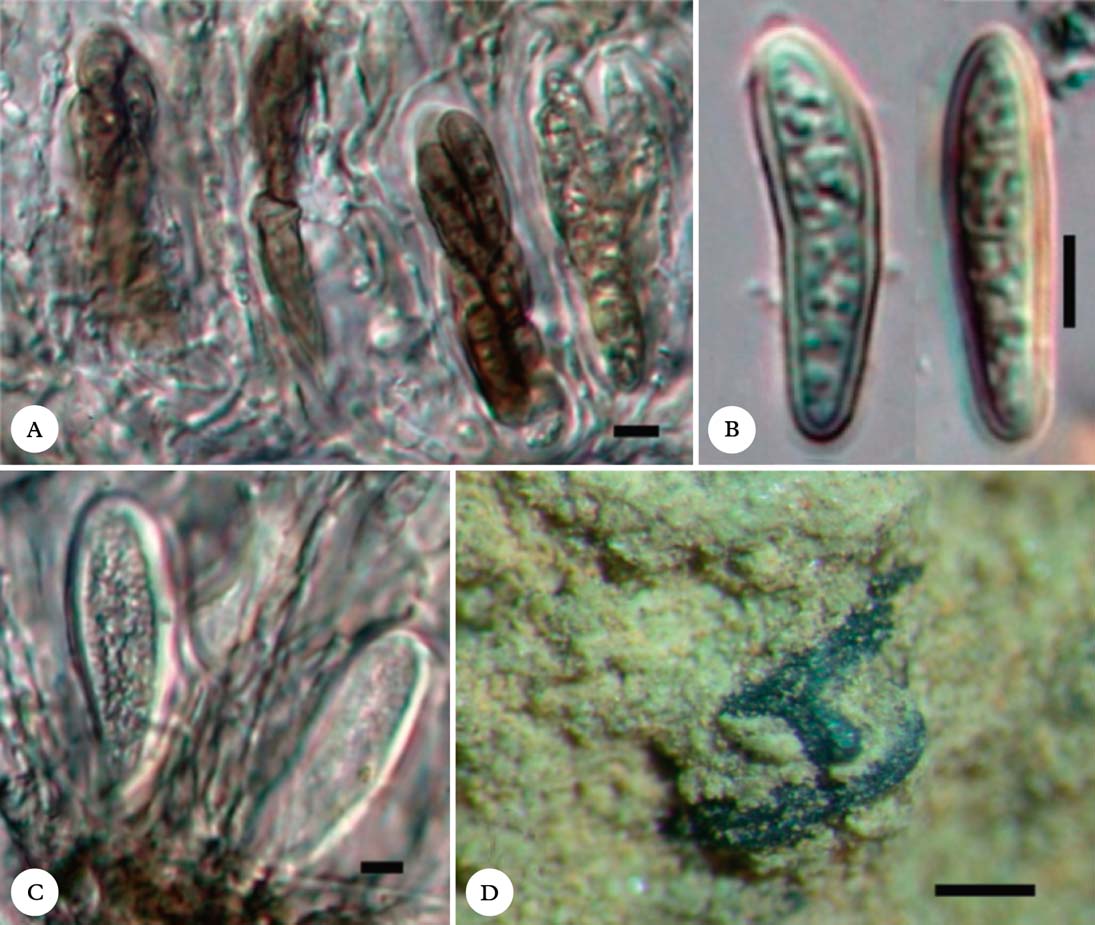
Alyxoria growing on soil or bark, with non-pruinose ascomata, 3-septate clavate ascospores 20–23×4·5–5·5 µm with c. 1·5 µm thick gelatinous layer which soon appears uniformly brown.
Type: Brazil, Rondônia, Sítio Ecológico Buriti on Lago Cujubim E of Porto Velho, 8°35′17″S, 63°40′40″W, alt. c. 100 m, on tree bark in primary rainforest, 18 November 2012, M. Cáceres & A. Aptroot 15372 (ISE—holotype; ABL—isotype).
(Fig. 1)
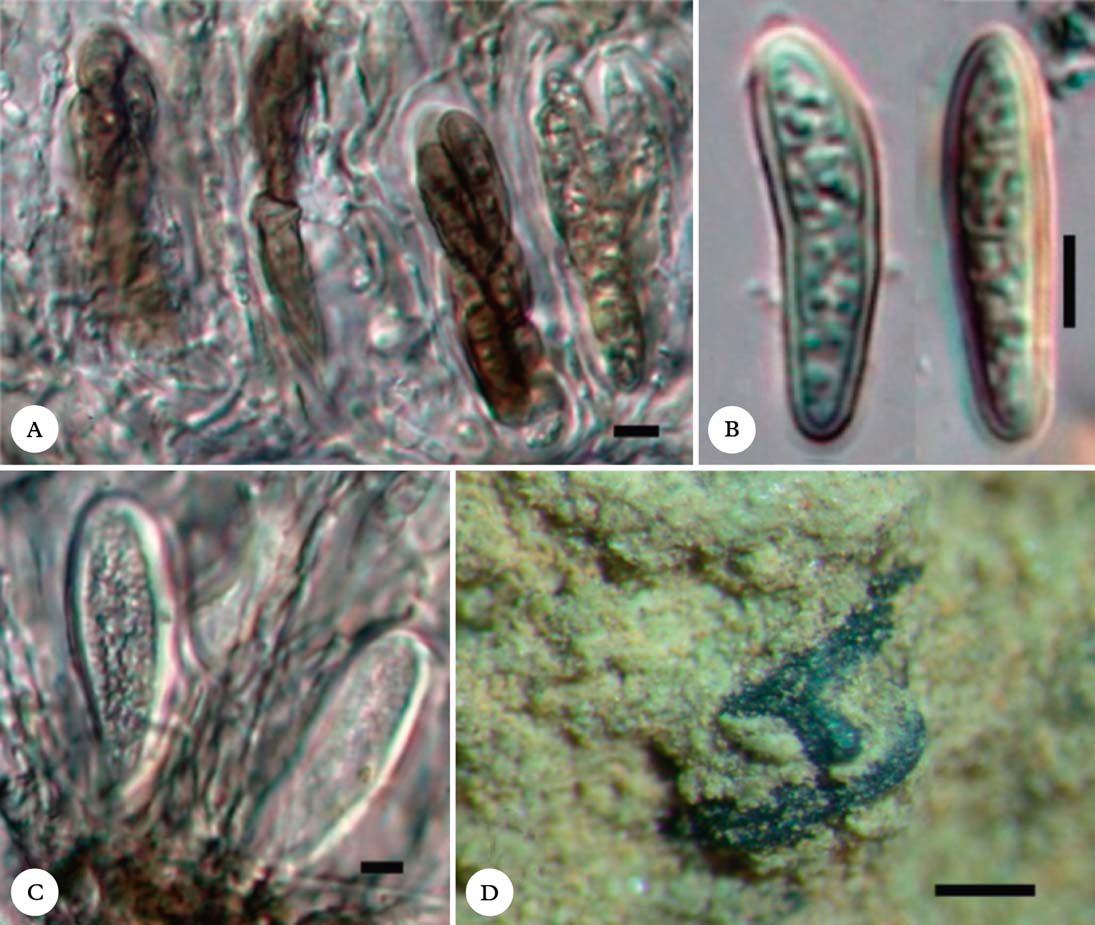
Alyxoria fuscospora (isotype); A & C, asci; B, ascospores; D, thallus with apothecia. Scales: A–C=5 μm; D=0·5 mm. In colour online.
Thallus continuous, slightly shiny, green, without prothallus. Algae trentepohlioid.
Apothecia dispersed, immersed to erumpent, elongate to furcate, partly simple but mostly branched, up to 1·5 mm long, 0·2–0·3 mm wide, margin black, c. 0·1 mm wide; disc not or narrowly exposed. Excipulum carbonaceous, continuous and often very thick below the hymenium, c. 50–100 µm thick. Hymenium not inspersed, partly IKI+ yellowish, partly pale bluish (hemiamyloid); paraphysoids anastomosing, c. 1 µm wide, apices not swollen. Asci clavate, c. 30–55× 12–18 µm. Ascospores 8 per ascus, initially hyaline but soon (and in the majority in every section) appearing brown, 3-septate, clavate, 20–23×4·5–5·5 µm, with smooth, c. 1·5 µm thick gelatinous layer that probably contains most of the brown pigment, lumina rounded-rectangular.
Pycnidia not observed.
Chemistry
Thallus UV−, C−, P−, K−. TLC: no secondary metabolites detected.
Ecology and distribution
On soil of a terricolous termite nest in primary rainforest (type material), but also on tree bark in rainforest. Pantropical, so far known from Brazil, Guatemala, Bénin, Gabon, Malaysia, Papua New Guinea and Thailand.
Discussion
The genus Opegrapha is a large assemblage of lineages, some of which are apparently speciose (Ertz Reference Ertz2009; Ertz et al. Reference Ertz, Miądlikowska, Lutzoni, Dessein, Raspe, Vigneron, Hofstetter and Diederich2009). Alyxoria Ach. is a genus that was recently reinstated for the Opegrapha varia group based on phylogenetic studies (Ertz & Tehler Reference Ertz and Tehler2011). The genus is morphologically recognizable and characterized by, for example, wide open apothecium discs, asymmetrical ascospores and asci of the ‘Varia type’ as defined by Torrente & Egea (Reference Torrente and Egea1989). Our new species most probably belongs to this group, as indicated by its ascomata, ascus and ascospore types, and is therefore described in Alyxoria. This species is easily recognized by its 3-septate ascospores with a distinct gelatinous layer soon becoming brown. Other species of Opegrapha s. lat. usually have ascospores that become pale brown only when postmature, and most of them have a roughly ornamented exospore.
Opegrapha species with brown ascospores were traditionally described in the genus Sclerographa (Vain.) Zahlbr. Only five species have ever been placed in this genus, including two European species which have hyaline ascospores, and three tropical corticolous species, viz. Opegrapha indica (Räsänen) Upreti & Ajay Singh from India, which turned out to be a Graphidaceae (Ertz Reference Ertz2009), Opegrapha agelaeotera Vain. described from Mozambique, which also have hyaline ascospores (Ertz Reference Ertz2009), and Opegrapha quinqueseptata Vain. from Brazil with 5-septate ascospores.
The new species is identical to the paleotropical material named Opegrapha herbarum Mont. s. lat. by Ertz (Reference Ertz2009). Opegrapha culmigena Lib. is considered as an older name for O. herbarum Mont. (Sérusiaux et al. Reference Sérusiaux, Diederich, Brand and van den Boom1999) and differs from our new species in the sense of its type [isotype of O. culmigena Lib. examined by AA and DE; now Alyxoria culmigena (Lib.) Ertz] by the ascospores that only become brown when over-mature. This would mean that the new species A. fuscospora is pantropical and also commonly occurs corticolous.
Our species shares some key characters with Opegrapha bengalensis Upreti & Ajay Singh from India, which is said to have brown, 3-septate ascospores which are, however, longer and especially much wider (29–34×8–12 µm) than in the new species (Upreti & Singh Reference Upreti and Singh1987). Its assignment to the Arthoniales is, however, questionable (Ertz Reference Ertz2009).
Additional specimens seen. See Ertz (Reference Ertz2009) sub Opegrapha herbarum Mont. s. lat.
Chiodecton complexum Aptroot & M. Cáceres sp. nov.
MycoBank No.: MB 805958
Corticolous Chiodecton species with discrete soralia, immersed apothecia in branched lines in stromata and 3-septate ascospores (26–)33–40×2·5–3·5 µm.
Type: Brazil, Rondônia, Porto Velho, UNIR Federal University campus S of city, 8°50′14″S, 63°56′25″W, alt. c. 100 m, on tree bark in forest remnant, 8 March 2012, M. Cáceres & A. Aptroot 11020 (ISE—holotype; ABL—isotype).
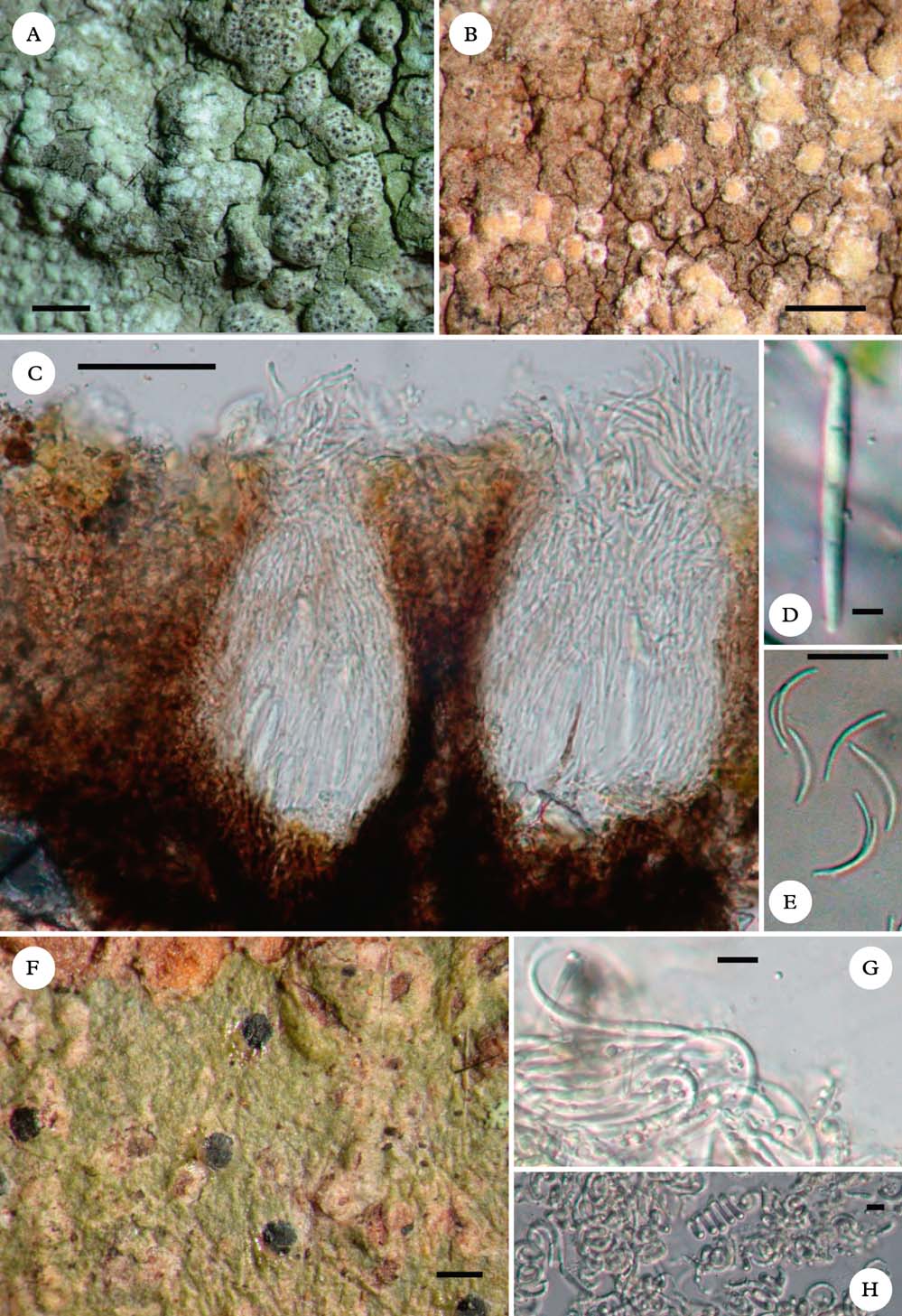
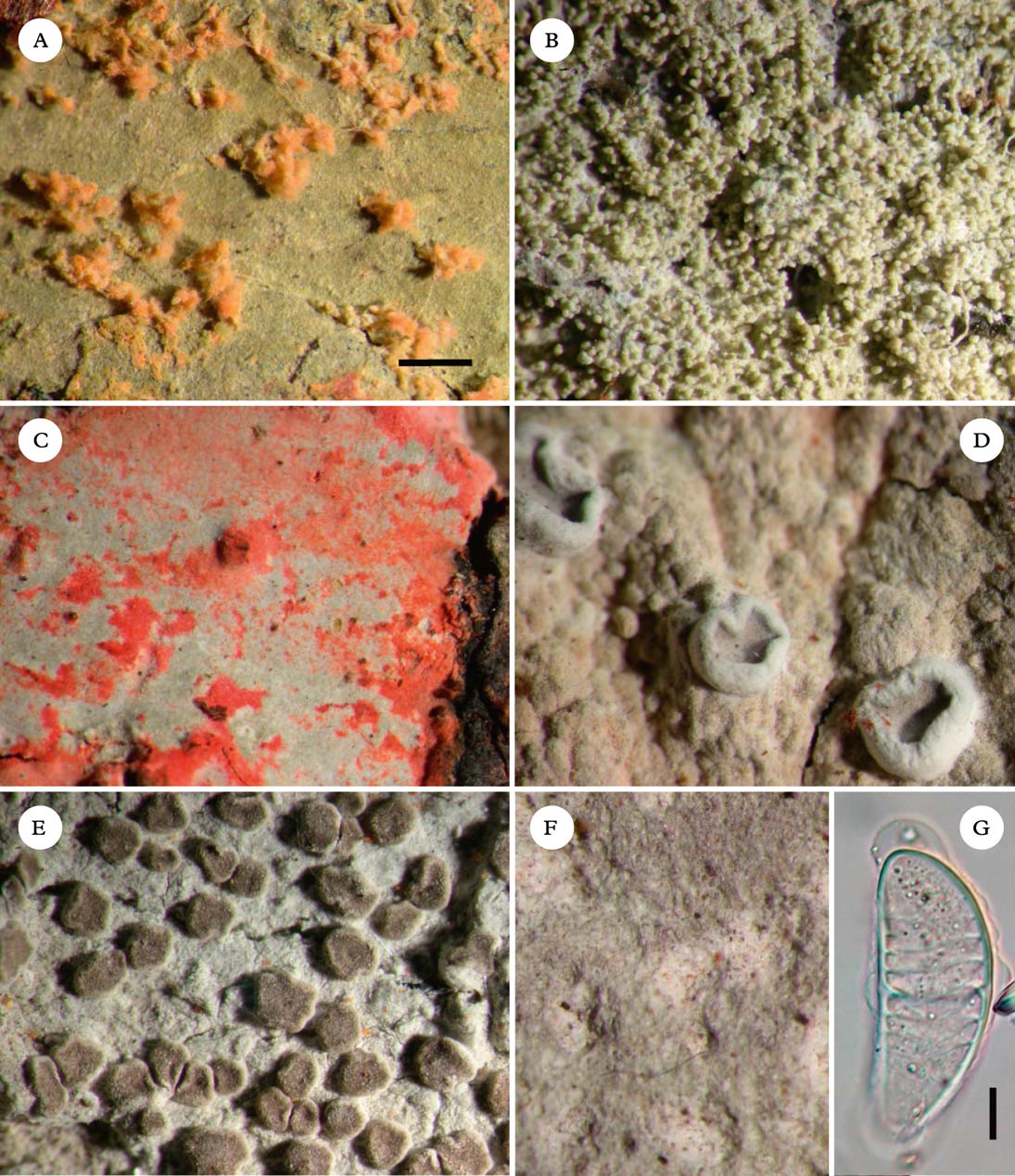
A–E, Chiodecton complexum (isotype); A, thallus with soralia (left) and stromata (right); B, thallus with soralia and pycnidia, fresh specimen; C, section through ascomata; D, ascospore; E, conidia. F–H Eremothecella helicella (isotype); F, thallus with pycnidia; G & H, conidia, in G uncoiled, in H coiled. Scales: A, B & F=0·5 mm; C=50 μm; D, E, G & H=5 μm. In colour online.
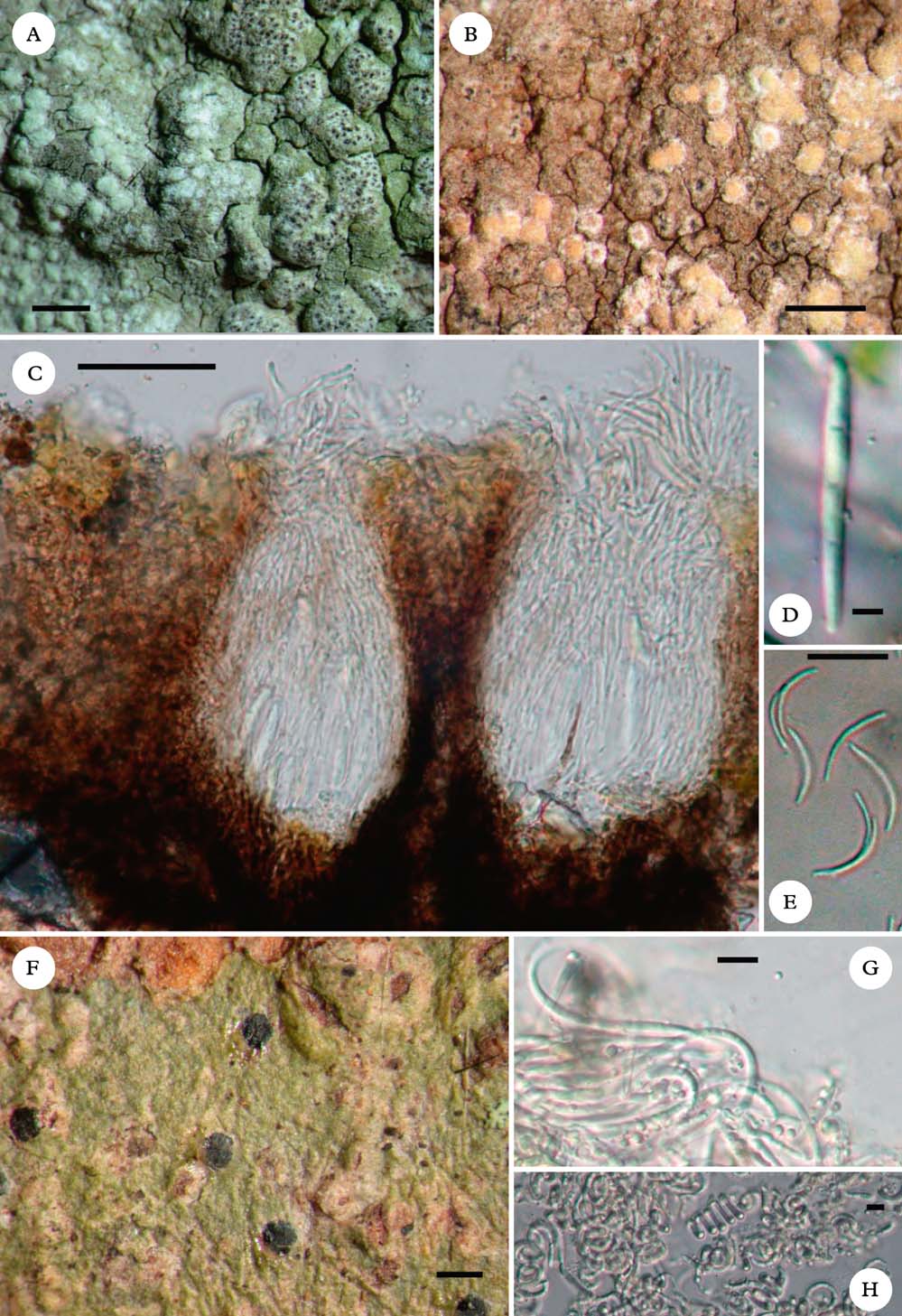
Thallus continuous, rimose in places, covering areas up to 5 cm diam., smooth to felty, closely appressed, greenish grey, with pinkish hue when fresh, dull, partly uneven/verrucose due to the presence of initials of soralia, pycnidia or stromata, surrounded by a felty dark brown prothallus line. Soralia numerous, mostly in central areas of the thallus, rounded, capitate, 0·2–0·6 mm diam., occasionally confluent but individual soralia remaining recognizable, with farinose soredia, pale green with a pink hue that fades in the herbarium. Algae trentepohlioid.
Apothecia immersed and pyriform, 0·1–0·2 mm diam., only visible from above by black shiny ostioles c. 0·05 mm diam. Stromata originating in the marginal areas of some thalli, outside of thallus colour or generally somewhat paler, emergent from the thallus, 0·5–2·5 mm diam., containing 5–50 ascomata in branched lines, without yellow pigment. Excipulum black, dark brown in section; hypothecium black, extending far downwards; epihymenium hyaline. Hymenium not inspersed, IKI+ blue (amyloid); paraphysoids 1·0–1·5 µm wide, anastomosing. Asci cylindrical, 45–50×10–13 µm. Ascospores 8 per ascus, hyaline, 3-septate, narrowly fusiform, (26–)33–40×2·5–3·5 µm, not constricted at the septa, without gelatinous sheath, ends rather pointed.
Pycnidia originating in the marginal areas of some thalli, black, punctiform, c. 0·1 mm diam., immersed in c. 0·2 mm diam. emergent warts of thallus colour or generally somewhat paler. Conidia hyaline, filiform, curved, 13–18×1 µm.
Chemistry
Thallus UV−, C−, P−, K−. TLC: roccellic acid (but in concentrations too low to cause a significant UV-reaction).
Ecology and distribution
On smooth bark of trees in or near rainforest. Known only from Brazil.
Discussion
This species is characterized by the abundance of discrete soralia and the regular presence of stromata with punctiform apothecia in branched lines, and pycnidia with long, filiform conidia. The genus Chiodecton currently comprises 20 accepted species, most of which were treated by Thor (Reference Thor1990). Among the species that have since been described (Harada Reference Harada1990; Henssen & Thor Reference Henssen and Thor1998; Thor Reference Thor2007; Lumbsch et al. Reference Lumbsch, Ahti, Altermann, Amo de Paz, Aptroot, Arup, Bárcenas Peña, Bawingan, Benatti and Betancourt2011), there is one more or less sorediate species, Chiodecton pustuliferum Aptroot (Lumbsch et al. Reference Lumbsch, Ahti, Altermann, Amo de Paz, Aptroot, Arup, Bárcenas Peña, Bawingan, Benatti and Betancourt2011). It differs notably by the paler, much thicker thallus with black byssoid prothallus. The new species also differs from all described species in Chiodecton when the soredia are disregarded, that is if the material is interpreted as a sorediate morph of a normally non-sorediate species. It would key out close to the Australasian Chiodecton leptosporum Müll. Arg. in Thor (Reference Thor1990) (recently recorded from one outpost locality in Réunion; van den Boom et al. Reference van den Boom, Brand, Ertz, Kalb, Magain, Masson, Schiefelbein, Sipman and Sérusiaux2011), but that species differs by the absence of soredia, evenly dispersed apothecia (not in lines) and shorter conidia. These characters, together with the occurrence on another continent, exclude the possibility that the Rondônian material is just a sorediate morph of C. leptosporum.
Additional specimens seen. Brazil: Rondônia: same as the type, M. Cáceres & A. Aptroot 11089; Porto Velho, Parque Natural Municipal de Porto Velho, 8°41′10″S, 63°52′05″W, alt. c. 100 m, on tree bark of Ceiba samauma in primary rainforest, 2012, M. Cáceres & A. Aptroot 11225; Porto Velho, Parque Circuito, 8°43′54″S, 63°54′04″W, alt. c. 100 m, on tree bark of Hevea brasiliensis in plantation, 2012, M. Cáceres & A. Aptroot 11447 (all ISE & ABL). Ceará: Chapada do Araripe, Aerupuerto Antigo, on bark of tree, c. 800 m, 2013, M. M. E. Alves 027, 897 (ISE).
Coniarthonia rosea Aptroot & M. Cáceres sp. nov.
MycoBank No.: MB 805959
Corticolous Coniarthonia similar to C. pulcherrima but with the apothecia pink and more irregular in outline and the ascospores 13–16×5·5–6·5 µm.
Type: Brazil, Rondônia, Estação Ecológica de Cuniã, km 760 on road BR 319 N of Porto Velho, 8°02′44″S, 63°29′11″W, alt. c. 100 m, on tree bark in primary rainforest, 20 November 2012, M. Cáceres & A. Aptroot 15696 (ISE—holotype; ABL—isotype).
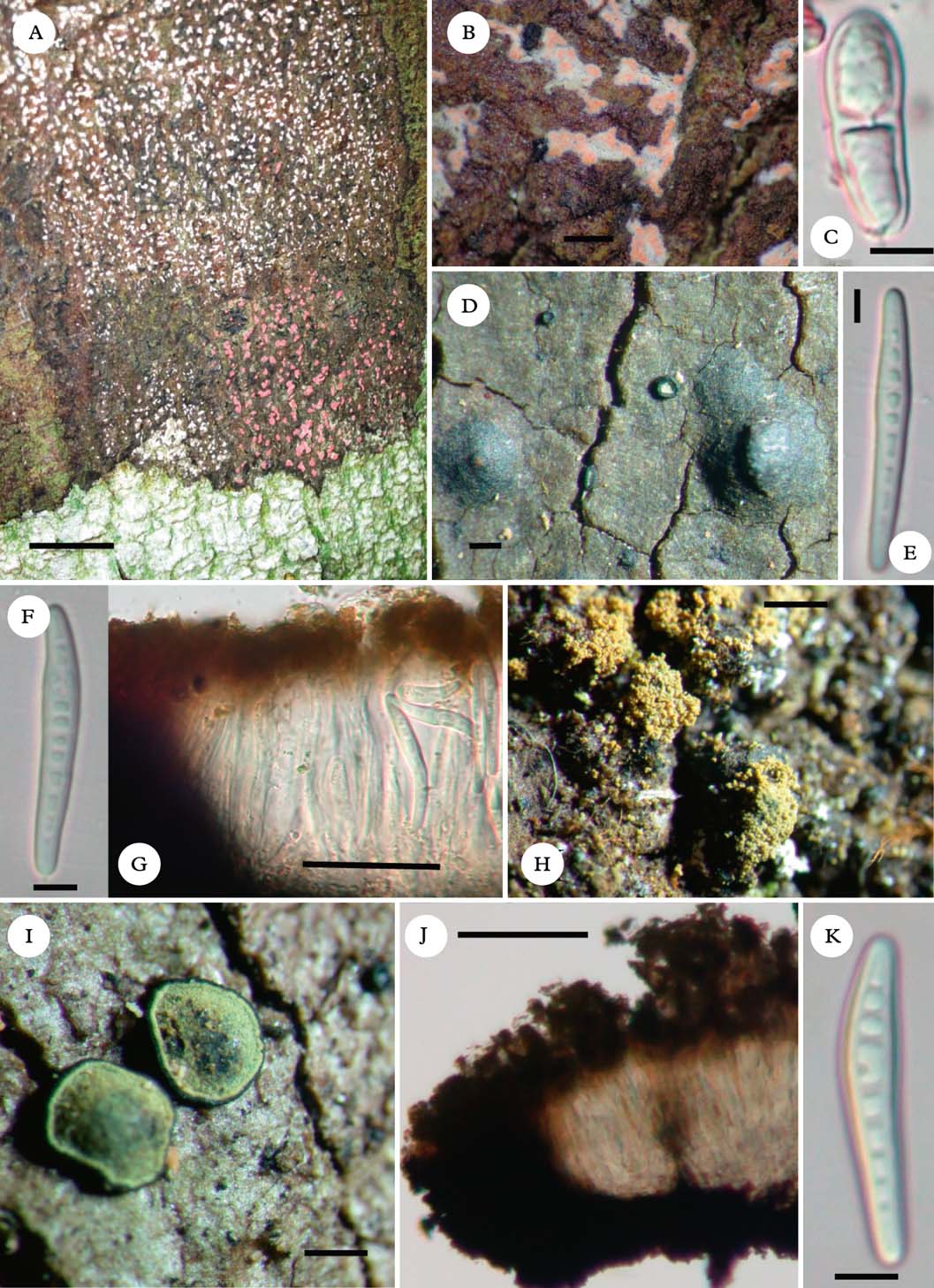
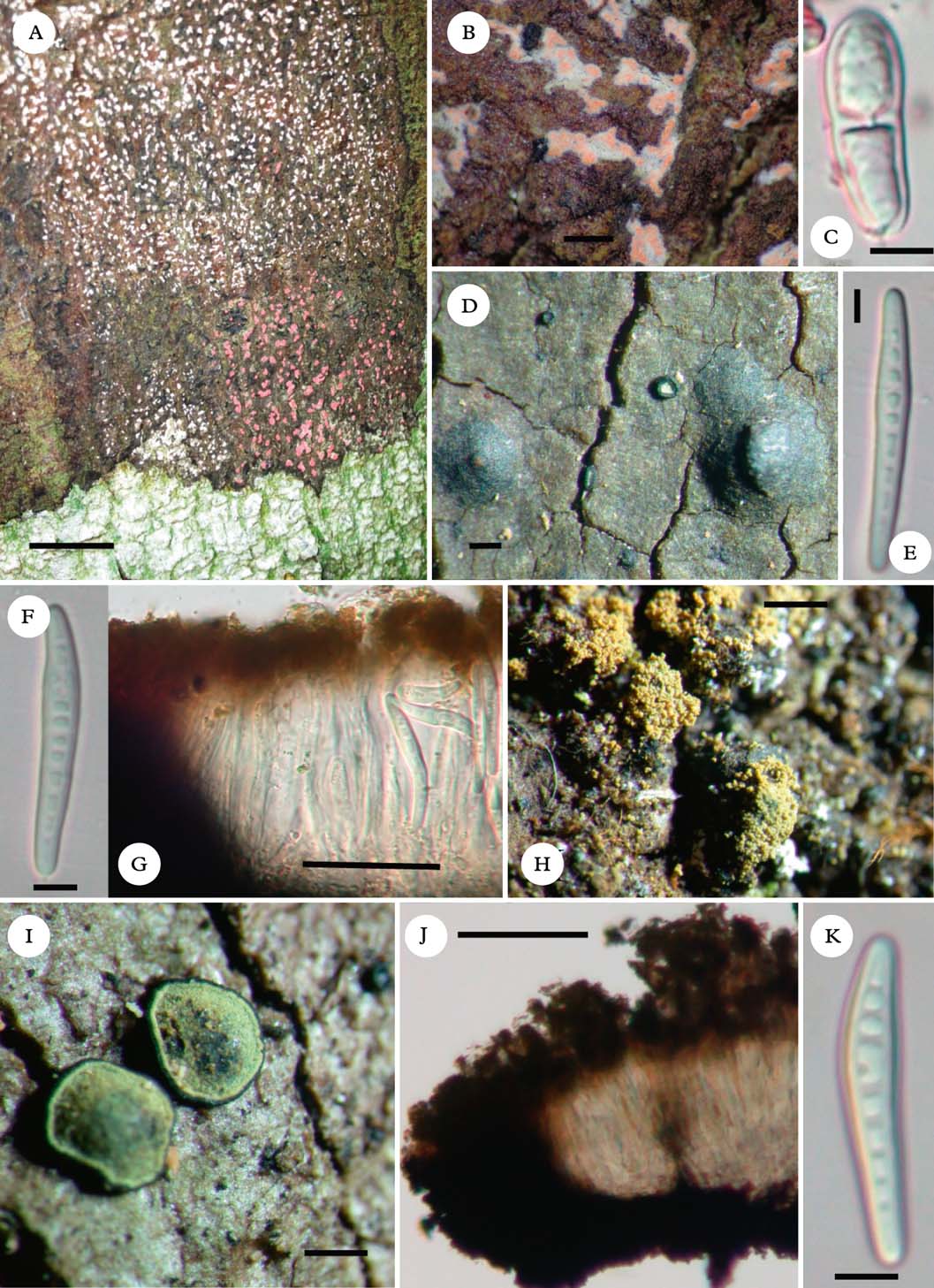
A–C, Coniarthonia rosea; A, habitus in the field (the pale apothecia), side by side with C. pulcherrima (pink); B, apothecia (holotype); C, ascospore (isotype). D–G Cresponea lichenicola (isotype); D, habitus; E & F, ascospores; G, section through apothecium. H–K, Cresponea flavosorediata (isotype); H, soredia; I, apothecia; J, section through apothecium; K, ascospore. Scales: A=1 cm; B, D, H & I=0·5 mm; C, E, F & K=5 μm; G & J=50 μm.
Thallus spreading, covering an area of up to 5 cm diam., brown to dark brown, very thin and mostly visible near the ascomata, dull, without prothallus. Algae trentepohlioid.
Apothecia irregular in outline with linear or branched shapes, only slightly raised above the thallus, 0·5–1·4 mm diam., occasionally confluent, pale pink throughout, without differently coloured pruina, margins not differentiated. Excipulum not developed. Hymenium without gel, IKI+ blue; paraphysoids anastomosing. Asci short ellipsoid to nearly globose, IKI−, dispersed in the hymenium, 25–30 µm diam. Ascospores 8 per ascus, hyaline, clavate, 1-septate, 13–16×5·5–6·5 µm, slightly constricted at the septum, ends broadly rounded, wall and septum c. 1 µm thick.
Pycnidia not observed.
Chemistry
Apothecia UV−, C−, P−, K+ purple-red, pigment dissolving and colour becoming orange before vanishing. TLC: an anthraquinone.
Ecology and distribution
On smooth bark of trees in primary rainforest. Known only from Brazil.
Discussion
The genus Coniarthonia is a small genus with only seven known species (Grube Reference Grube2001; Menezes et al. Reference Menezes, Lima, Xavier-Leite, Maia, Aptroot and Cáceres2013). It is characterized by the hydrophobic ascomata with red pigments and without margins, and also by the crustose thallus. This new species grows side by side with Coniarthonia pulcherrima (Müll. Arg.) Grube (see Fig. 1A, showing both species in the field) and mainly, but consistently, differs by a much paler colour of the apothecia which also have a more irregular outline and are smaller. The apothecium pigment is probably an anthraquinone (Rf 4 in solvent A), not chiodectonic acid as in C. pulcherrima. The possibility that it is badly developed, pigment-poor, young or old material of C. pulcherrima can be ruled out because there is also a difference in the shape of the apothecium.
Additional specimens seen. Brazil: Rondônia: same as the type, 2012, M. Cáceres & A. Aptroot 11716; Fazenda São Francisco off BR 319, 30 km N of Porto Velho, 8°24′33″S, 63°58′56″W, alt. c. 100 m, on tree bark in primary rainforest, 2012, M. Cáceres & A. Aptroot 11952 (all ISE & ABL).
Cresponea flavosorediata Aptroot & M. Cáceres sp. nov.
MycoBank No.: MB 805960
Corticolous Cresponea with yellow-olive soralia, apothecia with yellow pruina and ascospores 7–9-septate, 26–38(–50)×5·0–6·5 µm.
Type: Brazil, Rondônia, Estação Ecológica de Cuniã, km 760 on road BR 319 N of Porto Velho, 8°02′44″S, 63°29′11″W, alt. c. 100 m, on tree bark in primary rainforest, 20 November 2012, M. Cáceres & A. Aptroot 15661 (ISE—holotype; ABL—isotype).
Thallus covering large areas of bark on tree trunks (up to nearly 10 dm2), not corticate, dull to slightly glossy, olivaceous green to usually olivaceous brown, without prothallus line. Soralia always present but varying from sparse (as few as 1 per 10 cm2) to abundant and then often confluent and covering most of the thallus, individual soralia mostly round, 0·5–2·5 mm diam., raised above the thallus. Soredia farinose, yellow-olive. Algae trentepohlioid.
Apothecia sessile, round to slightly lobate, solitary, often sparse (as few as 1 per 10 cm2), 0·5–1·6 mm diam.; disc flat, densely vivid greenish yellow pruinose, margin black, inner side with yellow pruina, entire, somewhat glossy, higher than the disc. Excipulum black, outside rough; epihymenium dark brown; hypothecium black. Hymenium hyaline, IKI+ blue; paraphysoids branched, tips brown and covered by a dense and thick layer of pruina. Asci numerous, clavate, with 8 irregularly arranged ascospores. Ascospores hyaline, 7–9-septate, narrowly clavate, 26–38(–50)× 5·0–6·5 µm, often slightly curved, ends rounded.
Pycnidia not observed.
Chemistry
Thallus and apothecia UV−, C−, P−; thallus K−; epihymenium K+ red (an anthraquinone). TLC: thallus with zeorin and pigment (not an anthraquinone).
Ecology and distribution
On smooth bark of trees in primary rainforest. Known only from Brazil.
Discussion
The genus Cresponea so far contains two sorediate species, viz. C. leprieuroides (Nyl.) Egea & Torrente and C. sorediata Elix et al. The first has whitish rather than greenish yellow soredia and contains lecanoric acid, and the second is a subarctic species known only sterile. The unidentified pigment colouring the soredia of C. flavosorediata is different from the anthraquinone of the pruina, and also different from the xantholepinone pigment in the only other known species with a medullary pigment, Cresponea endosulphurea A. A. Menezes et al. (Menezes et al. Reference Menezes, Lima, Xavier-Leite, Maia, Aptroot and Cáceres2013). The new species is quite conspicuous in the field, not by its colour, but mostly because it occupies large parts (up to nearly 10 dm2) of single trunks. If the material is interpreted as a sorediate morph of a normally non-sorediate species, it would key out close to Cresponea leprieurii (Mont.) Egea & Torrente in Egea & Torrente (Reference Egea and Torrente1993), but that species differs by more septate, viz. (8–)9–14-septate, and longer, viz. (34–)38–65 µm long, ascospores, as well as by the absence of soredia; C. proximata (Nyl.) Egea & Torrente differs by shorter, viz. 25–38(–40) µm long, ascospores, and a hemiamyloid IKI reaction of the hymenium.
It is surprising that two apparently undescribed Cresponea species were found in Rondônia, but no known species could be found in the region. This is very different to experiences on past collecting trips elsewhere in the tropics, when invariably one or more of the pantropical Cresponea species were found. See also the discussion under the next taxon.
Additional specimens seen. Brazil: Rondônia: same as the type, 2012, M. Cáceres & A. Aptroot 11609, 11611 & 11699 (all ISE & ABL).
Cresponea lichenicola Aptroot & M. Cáceres sp. nov.
MycoBank No.: MB 805961
Cresponea growing lichenicolous on Pyrenula thallus, having 0·1–0·3 mm wide apothecia with yellow pruina.
Type: Brazil, Rondônia, Porto Velho, Parque Natural Municipal de Porto Velho, 8°41′10″S, 63°52′05″W, alt. c. 100 m, on tree bark in primary rainforest, lichenicolous on Pyrenula thallus, 9–12 March 2012, M. Cáceres & A. Aptroot 11412a (ISE—holotype; ABL—isotype).
Thallus not visible; lichenicolous on Pyrenula thallus.
Apothecia sessile, round, solitary, rather dispersed; disc flat, densely vivid greenish yellow pruinose, margin black, somewhat glossy, higher than the disc. Excipulum black, outside rough; epihymenium dark brown; hypothecium black. Hymenium hyaline, IKI+ blue; paraphysoids branched, tips brown and covered by a dense and thick layer of pruina. Asci numerous, clavate, with 8 irregularly arranged ascospores. Ascospores hyaline, 11–13-septate, narrowly clavate, 30–45×4·5–5·5 µm, often slightly curved, ends rounded.
Pycnidia not observed.
Chemistry
Apothecia UV−, C−, P−; thallus K−; epihymenium K+ red (an anthraquinone).
Ecology and distribution
On thallus of Pyrenula species on smooth bark of trees in primary rainforest. Known only from Brazil.
Discussion
So far 17 species are described in the genus Cresponea, mostly treated in Egea & Torrente (Reference Egea and Torrente1993), the remainder in some later publications (Egea et al. Reference Egea, Sérusiaux and Torrente1996; Elix Reference Elix2007; Sakata et al. Reference Sakata, Harada and Sato2009; Elix et al. Reference Elix, Øvstedal and Gremmen2011; Lumbsch et al. Reference Lumbsch, Ahti, Altermann, Amo de Paz, Aptroot, Arup, Bárcenas Peña, Bawingan, Benatti and Betancourt2011; Menezes et al. Reference Menezes, Lima, Xavier-Leite, Maia, Aptroot and Cáceres2013). This is the first species reported without a proper thallus and with apparently a lichenicolous lifestyle. It is morphologically rather close to the species above, which differs by the sorediate thallus, the much larger apothecia and the wider ascospores with fewer septa. If the material is interpreted as lichenicolous material of a usually autonomous species, it would key out close to Cresponea leprieurii (Mont.) Egea & Torrente in Egea & Torrentes (1993), but that species differs, as well as by the presence of soredia, by larger ascomata and broader, viz. 5–7 µm wide, ascospores.
Additional specimen seen. Brazil: Rondônia: Fazenda São Francisco off BR 319, 30 km N of Porto Velho, 8°24′33″S, 63°58′56″W, alt. c. 100 m, on tree bark in primary rainforest, lichenicolous on Pyrenula thallus, 2012, M. Cáceres & A. Aptroot 11841a (ISE & ABL).
Eremothecella helicella Aptroot & M. Cáceres sp. nov.
MycoBank No.: MB 805962
Corticolous Eremothecella with helicoid curved c. 17–29-septate conidia, c. 70–95×2 µm long if uncoiled, with septa 3–6 µm apart.
Type: Brazil, Rondônia, Porto Velho, Parque Natural Municipal de Porto Velho, 8°41′10″S, 63°52′05″W, alt. c. 100 m, on tree bark in primary rainforest, 9–12 March 2012, M. Cáceres & A. Aptroot 11309 (ISE—holotype; ABL—isotype).
Thallus continuous, green, slightly glossy, without prothallus line. Algae trentepohlioid (not Phycopeltis).
Apothecia not observed.
Pycnidia black, round to oval or with slightly wavy outline, superficial, flat, 0·2–0·4 mm diam. Conidia hyaline, filiform, mostly helicoid curved like a corkscrew, c. 17–29-septate, c. 70–95×2 µm long if uncoiled, septa 3–6 µm apart.
Chemistry
Thallus UV−, C−, P−, K−. TLC: no secondary metabolites detected.
Ecology and distribution
On smooth bark of trees in primary rainforest. Known only from Brazil.
Discussion
The genus Eremothecella is a small genus with only six species known to date (Lücking Reference Lücking2008), all of them strictly foliicolous. The new species is the first to be found growing corticolous. In gross morphology it is very reminiscent of the foliicolous members of the genus, which are mainly characterized by the very applanate grey pycnidia with filiform conidia arising on one side. Although the new species is known only in the pycnidial state, the conidia differ from those of the described species by their strong coiling, which has not been reported in any species of Eremothecella before, or among other lichenized ascomycete is known only in Micarea subnigrata.
Key to the corticolous Arthoniales of Rondônia
There is no doubt that the Arthoniales are one of the most speciose lichen groups in the region. However, only about half of the corticolous species could be identified to species level with some certainty. Here we present a key for a rapid identification of these taxa (and a few saxicolous species). Long numbers between brackets are collecting numbers of the authors. Foliicolous species are not included; they are mentioned below. For details about morphology and nomenclature see, for example, Thor (Reference Thor1990), Egea & Torrente (Reference Egea and Torrente1994), Grube (Reference Grube2001), Aptroot & Sparrius (Reference Aptroot and Sparrius2003), Cáceres (Reference Cáceres2007), Lücking (Reference Lücking2008), Aptroot (Reference Aptroot2009), Aptroot et al. (Reference Aptroot, Thor, Lücking, Elix and Chaves2009), Lücking et al. (Reference Lücking, Seavey, Common, Beeching, Breuss, Buck, Crane, Hodges, Hodkinson and Lay2011) and Lima et al. (Reference Lima, Mendonça, Aptroot and Cáceres2013).
This key indicates the diversity present. Much of the remaining unidentified diversity is in the genera Arthonia s. lat., Cryptothecia s. lat., and Opegrapha s. lat. No fruticose Arthoniales were encountered. There are in particular many sterile species with a crustose thallus, often with soredia or isidia and a characteristic chemistry, but most of these are undescribed and their affiliation is unknown. In the absence of apothecia, it is difficult to decide in which genus they should be placed. They may partly belong to additional groups, such as the largely sterile genus Herpothallon.
-
1 Thallus and/or apothecia with yellow, orange, pink or red pigments ... 2
Thallus and apothecia without pigments ... 17
-
2(1) Thallus and/or apothecia with yellow or yellow-orange pigments ... 3
Thallus and/or apothecia with pink or red pigments ... 7
-
3(2) Pigment on the apothecium disc, another pigment sometimes present in discrete soralia ... 4
Pigment in medulla, prothallus and/or pseudisidia, or throughout the leprose thallus, if on the apothecia, then apothecia completely yellow, also in section, not only on the disc surface ... 5
-
4(3) Lichenicolous on Pyrenula ... Cresponea lichenicola Aptroot & M. Cáceres (Fig. 3D–G)
Lichenized, with discrete soralia ... Cresponea flavosorediata Aptroot & M. Cáceres (Fig. 3H–K)
-
5(3) Thallus byssoid, pigment localized in medulla, prothallus and/or pseudisidia. Cuniã (15639) & Parque ... Herpothallon aurantiacoflavum (B. de Lesd.) Aptroot et al. (Fig. 5A)
Thallus granular, leprose throughout ... 6
-
6(5) Thallus bright golden yellow. Parque (15241) ... Chrysothrix xanthina (Vain.) Kalb
Thallus mostly vivid greenish yellow. Parque (15239), first report from the Neotropics ... Chrysothrix occidentalis Elix & Kantvilas (Fig. 4D)
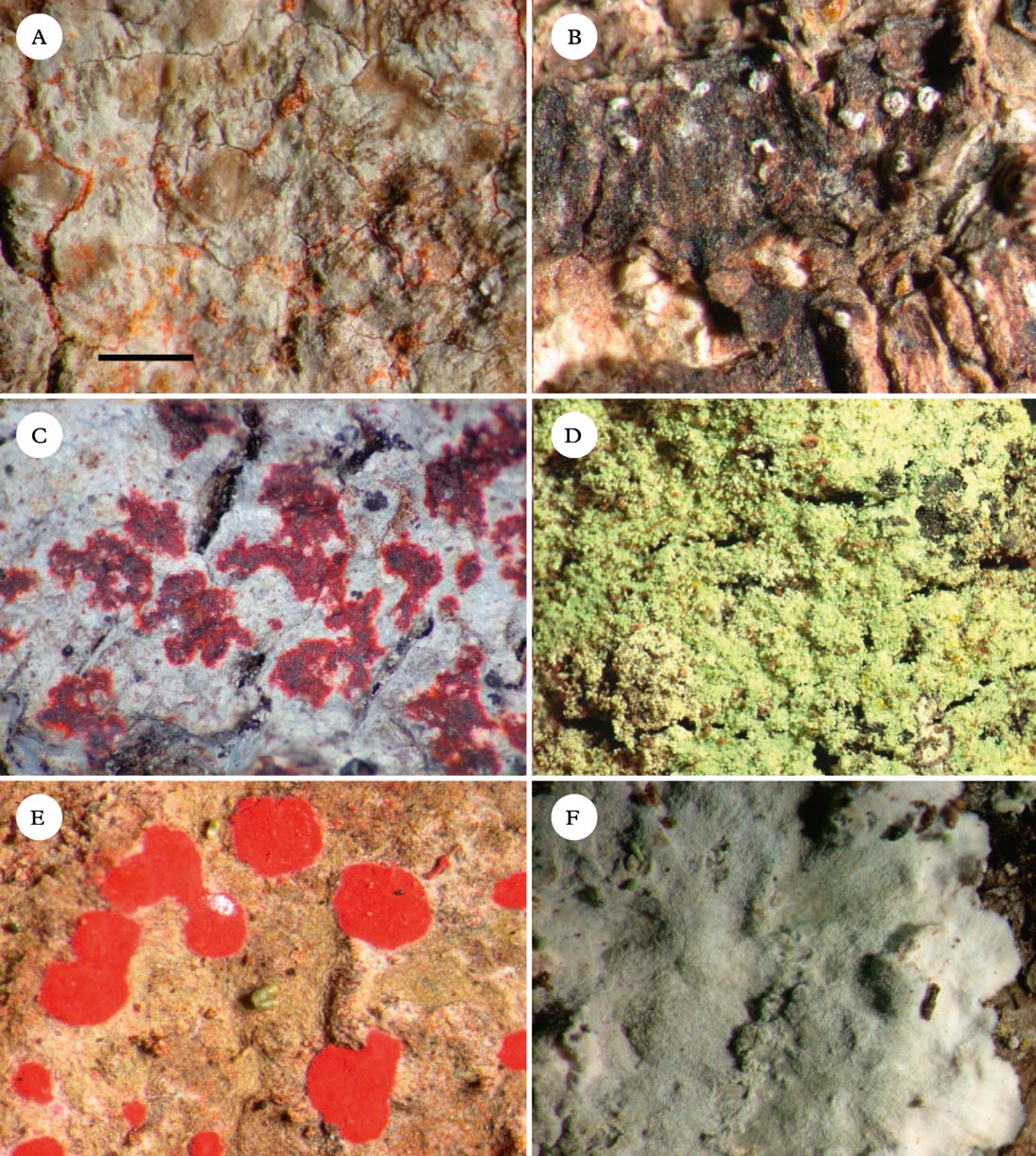
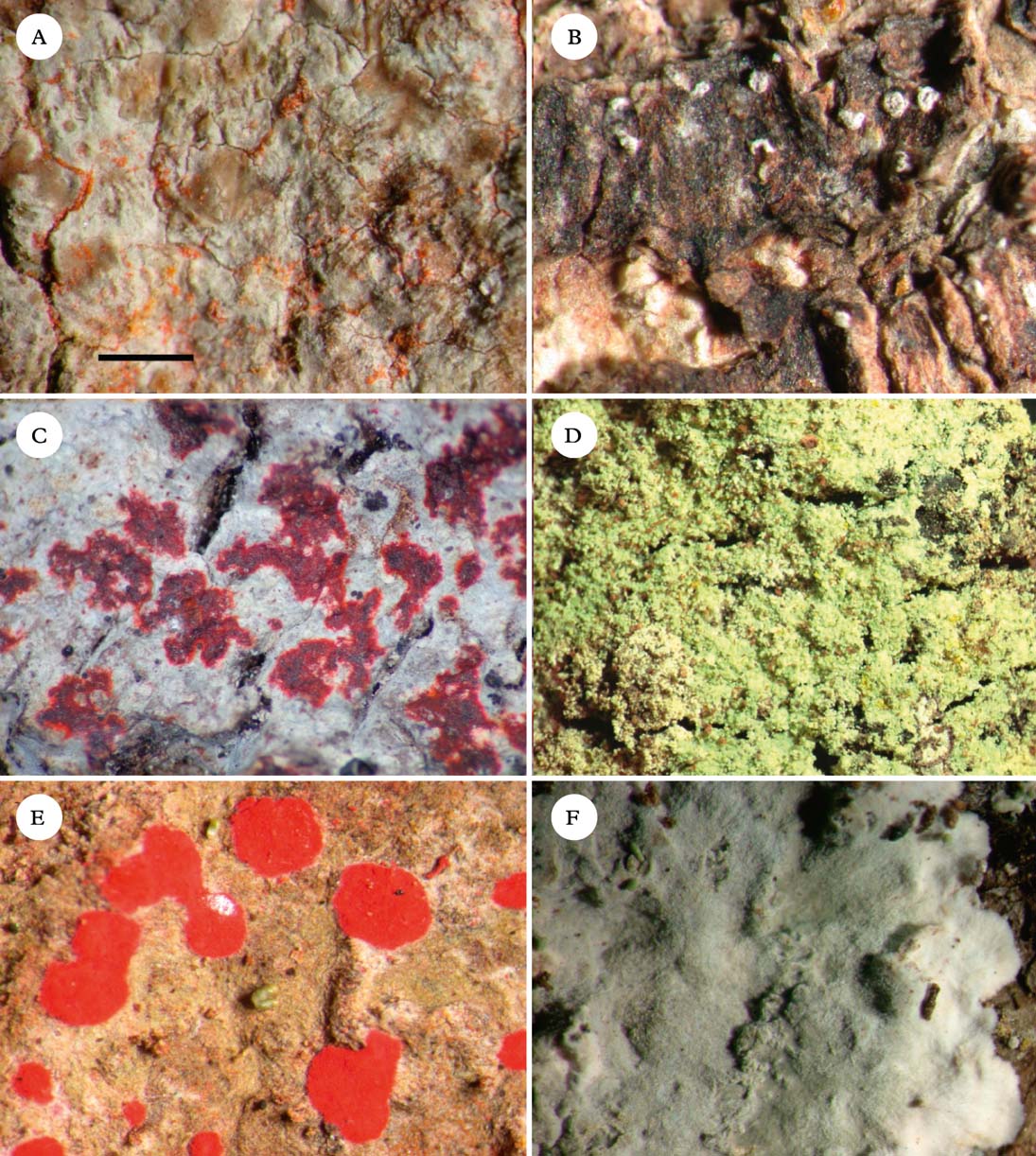
Fig. 4.Habitus of species of Arthoniales; A, Arthonia parantillarum (11423); B, A. redingeri (11122a); C, A. rubrocincta (Cáceres 9124); D, Chrysothrix occidentalis (15239); E, Coniarthonia pulcherrima (11731); F, Cryptothecia striata (15089). Scale: A–F=0·5 mm.

-
7(2) Thallus byssoid or felty/squamulose, pigment localized in medulla, prothallus and/or pseudisidia ... 8
Thallus not byssoid, pigment in the apothecia ... 13
-
8(7) Thallus felty, squamulose, green, apothecia immersed in stromata, usually present. Cuniã (11722) ... Erythrodecton granulatum (Mont.) G. Thor
Thallus byssoid, some shade of grey, apothecia absent ... 9
-
9(8) Thallus rather thick and easily removed intact from the substratum, confluentic acid the major secondary metabolite besides the pigments ... 10
Thallus thin, not easily removed from the substratum, often neodiffractaic acid the major secondary metabolite besides the pigments ... 11
-
10(9) Prothallus red. Cuniã (11650) & Parque ... Herpothallon rubrocinctum (Ehrenb. : Fr.) Aptroot et al.
Prothallus pale pink. São Francisco (11884) ... Herpothallon roseocinctum (Fr.) Aptroot et al.
-
11(9) Hypothallus whitish, confluentic acid the major secondary metabolite besides the pigments. (Parque 15542) ... Herpothallon adnatum G. Thor
Hypothallus red or black, neodiffractaic acid the major secondary metabolite besides the pigments ... 12
-
12(11) Hypothallus black. Buriti (15477) ... Herpothallon nigroisidiatum G. Thor
Hypothallus red. Cuniã (15621) ... Herpothallon rubromaculatum G. Thor (Fig. 5C)
Fig. 5.A–F, habitus of species of Arthoniales; A, Herpothallon aurantiacoflavum (11258); B, H. echinatum (11705); C, H. rubromaculatum (11851); D, Sagenidiopsis undulata (15584); E, Lecanactis elaeocarpa (11418a). F & G, Stirtonia macrocarpa (15089); F, habitus; G, ascospore showing complex gelatinous sheath with large pads at the top and bottom. Scales: A–F=0·5 mm; G=10 μm.
-
13(7) Hymenium without gel ... 14
Hymenium with gel between the filaments ... 15
-
14(13) Apothecia pale pink ... Coniarthonia rosea Aptroot & M. Cáceres (Fig. 3A–C)
Apothecia dark pink to dark salmon. Cuniã (11731) ... Coniarthonia pulcherrima (Müll. Arg.) Grube (Figs 3A & 4E)
-
15(13) Ascospores consistently 3-septate. UNIR (11122a) ... Arthonia redingeri Grube (Fig. 4B)
Ascospores variably 3–7-septate ... 16
-
16(15) Ascospores 4–7-septate. Parque (11215) ... Coniocarpon cinnabarinum DC.
Ascospores (3–)4-septate. Parque (11208); also many specimens found in various localities that seem to differ by smaller ascospores than is usual for this species ... Arthonia rubrocincta G. Merr. ex Grube & Lendemer (Fig. 4C)
-
17(1) Apothecia absent; little differentiated ascigerous areas without hymenium may be present ... 18
Apothecia with differentiated hymenium present ... 26
-
18(17) Thallus not byssoid, except sometimes the prothallus, without pseudisidia ... 19
Thallus byssoid, with pseudisidia ... 25
-
19(18) Thallus at least partly C+ pink or red ... 20
Thallus C− ... 22
-
20(19) Thallus partly C+ pink (gyrophoric acid), ascospores if present only transversely septate. UNIR (11112) ... Stirtonia neotropica Aptroot
Thallus at least partly C+ red (lecanoric acid), ascospores if present muriform ... 21
-
21(20) Thallus with soredia. Buriti (15362) ... Cryptothecia punctosorediata Sparrius
Thallus without soredia. Santo Antonio (15089) ... Cryptothecia striata G. Thor (Fig. 4F)
-
22(19) Thallus Pd+ yellow (psoromic acid). Parque (15205) ... Cryptothecia fabispora M. Cáceres et al.
Thallus Pd− ... 23
-
23(22) Thallus with helicoid conidia ... Eremothecella helicella Aptroot & M. Cáceres (Fig. 2F–H)
Thallus without helicoid conidia ... 24
-
24(23) Thallus UV+ yellow. Buriti (15353) ... Cryptothecia lichexanthonica E. L. Lima et al.
Thallus UV−. Here would key out many unidentifiable sterile species, the only one that is identifiable is this species with transversely septate, thick-walled ascospores. Fresh ascospores have a gelatinous sheath that is lobe-like at the upper and bottom end, and wavy near the septa, a character that was not reported. Parque (11197) ... Stirtonia macrocarpa Makhija & Patw. (Fig. 5F & G)
-
25(18) Thallus Pd+ yellow (psoromic acid). São Francisco (11886) ... Herpothallon echinatum Aptroot et al. (Fig. 5B)
Thallus Pd−. São Francisco (11896) ... Herpothallon minimum Aptroot & Lücking
-
26(17) Apothecia with differentiated margin ... 27
Apothecia without differentiated margin ... 34
-
27(26) Apothecia closed, immersed in stromata ... Chiodecton complexum Aptroot & M. Cáceres (Fig. 2A–E)
Apothecia open or with closed slit-like disc, not in stromata ... 28
-
28(27) Apothecia partly carbonized ... 29
Apothecia not carbonized ... 32
-
29(28) Ascospores brown ... 30
Ascospores hyaline ... 31
-
30(29) Ascospores 1-septate. Cuniã (15630), lichenicolous on Graphis ... Melaspilea microspilota Nyl.
Ascospores 3-septate. In Rondônia on soil of termitarium ... Alyxoria fuscospora Ertz et al. (Fig. 1)
-
31(29) Disc densely white pruinose, ascospores 3-septate. Santo Antonio (15087), see Egea & Torrente (Reference Egea and Torrente1994) ... Lecanographa aff. lynceoides (Müll. Arg.) Egea & Torrente
Disc not white pruinose ... Opegrapha spp.
-
32(28) Thallus farinose, apothecia tiny and partly elongate or branched. On papery substance of epiphytic termitarium. Parque (15308). TLC revealed gyrophoric acid and methyl gyrophorate, not the erythrin reported from the type and so far only specimen known (Sparrius Reference Sparrius2004) ... Enterographa zephyri Sparrius
Thallus not farinose, chalky, apothecia round to lobate ... 33
-
33(32) Thallus ochraceous, apothecia with thick whitish margin, mostly over 1·5 mm diam. Parque (15584) ... Sagenidiopsis undulata (Fée) Egea et al. (Fig. 5D)
Thallus whitish, apothecia without conspicuous margin, mostly under 1·5 mm diam. Parque (11418a) ... Lecanactis elaeocarpa (Nyl.) Tehler (Fig. 5E)
-
34(26) Alga chlorococcoid, on soil of termitaria. Buriti (15475) ... Arthonia muscigena Th. Fr.
Alga trentepohlioid. Many species of Arthonia s. lat. would key out here. ... 35
Only two are keyed out, which share pale branched/lobate apothecia and 3-septate ascospores.
-
35(34) Thallus UV+ yellow (lichexanthone). Santo Antonio (15076) ... Arthonia antillarum (Fée) Nyl.
Thallus UV−. Circuito (11423) ... Arthonia parantillarum Aptroot (Fig. 4A)
Foliicolous Arthoniales from the same collections
Foliicolous species were only collected extensively in Parque. All species in the material could be identified. Some of the species were also collected at Buriti: Sítio Ecológico Buriti, Cuniã and/or São Francisco. In Buriti, many foliicolous species were also found on the smooth surface of old painted planking of a bridge. Numbers refer to collection numbers of selected collections made by the authors. For details about morphology and nomenclature see Lücking (Reference Lücking2008). The following species were found: Arthonia accolens Stirt. (11187q), A. aciniformis Stirt.(11187o), A. cyanea Müll. Arg.(11419n), A. epidendri (Rehm) R. Sant.(11187p), A. leptosperma (Müll. Arg.) R. Sant.(11419p), A. orbygniae (H. P. B. Upadhyay) Matzer*(11187n), A. palmulacea (Müll. Arg.) R. Sant.(11419j), A. trilocularis Müll. Arg.(11170f), Cryptothecia filicina (Ellis & Everh.) Lücking et al. (11187ds), Enterographa angustissima (Vain.) R. Sant.(11212), Eremothecella calamicola Syd.(11419q), Herpothallon adnatum G. Thor (15452), H. aurantiacoflavum (B. de Lesd.) Aptroot et al. (11419bu), Mazosia bambusae (Vain.) R. Sant.(11419cj), M. dispersa (Hedr.) R. Sant*(11170y), M. melanophthalma (Müll. Arg.) R. Sant*(11170l), M. phyllosema (Nyl.) Zahlbr.(11799w), M. pilosa Kalb & Vězda (11170j), M. pseudobambusae Kalb & Vězda*(11187bq), M. rotula (Mont.) A. Massal.(11187bn), M. rubropunctata R. Sant.(11799t), M. tumidula (Stirt.) Müll. Arg. (11187bt), and Opegrapha serusiauxii Lücking (11187bx). The above include some of the few lichen species that were previously reported from Rondônia, marked with * (Lücking Reference Lücking2008).
The CNPq (Conselho Nacional de Desenvolvimento Científico e Tecnológico) is thanked for a research grant to MESC (Processo 501633/2009-0). The collecting expeditions were financed by CNPq (CNPq-Simbiota Processo 563342/2010-2). Elton Bill Souza and Allyne Christina Gomes Silva are thanked for logistical support and for organizing the collecting trips. We are grateful to Leo Spier for performing thin-layer chromatography.