


Introduction
A gunshot wound (GSW) victim arrives at a hospital every 30 minutes in the United States[Reference Rowh, Zwald, Sumner, George, Sheppard and Holland1], generating median hospital charges of over $53,000 per case[Reference Miller, Downing, Wheeler and Fischer2]. GSW survivors face enduring physical impairments, psychological trauma, disruption to social and economic stability[Reference Vella, Warshauer and Tortorello3], and remain at elevated risk of violent reinjury[Reference Pear, McCort, Kravitz-Wirtz, Shev, Rowhani-Rahbar and Wintemute4]. Hospital-based violence intervention programs (HVIPs) are a strategy to support GSW victims[Reference Affinati, Patton and Hansen5–Reference Jay, Pino and Georges7]. To support GSW survivors, HVIPs leverage the “teachable moment” of hospitalization to engage patients who experienced a violent injury and provide intensive case management, linkages to community services, and support targeting social and behavioral risk factors for violence[Reference Affinati, Patton and Hansen5–8]. Emerging evidence suggests HVIPs can reduce reinjury[Reference Affinati, Patton and Hansen5,Reference Jay, Pino and Georges7,Reference Webster, Richardsonjr, Meyerson, Vil and Topazian9], yet adequately powered randomized controlled trials (RCTs)[Reference Webster, Richardsonjr, Meyerson, Vil and Topazian9], and studies of whether HVIPs impact health and social outcomes beyond violence recidivism are needed[Reference Gorman, Coles and Baker10].
This study presents pilot-phase findings from the Houston-HVIP[Reference Testa, Bluth and Monroe11], focusing on recruitment and retention metrics and baseline survey outcomes. Beyond establishing feasibility for a full-scale trial, the pilot also informs the design of HVIP studies by addressing whether patients hospitalized for GSWs can be enrolled, randomized, and retained in a trial in which treatment arms are differentiated primarily by the dosage and directness of case management, while an enhanced usual-care control preserves an ethically adequate standard of care.
Patients and methods
The pilot study recruitment period spanned from January 13 to March 14, 2025, at Memorial Hermann Hospital-Texas Medical Center (MHH-TMC). The study protocol was approved by the University of Texas Health Science Center at Houston Committee on the Protection of Human Subjects and Memorial Hermann Research Committee (#HSC-MS-23-0904) and registered at ClinicalTrials.gov (NCT06263647). Eligibility was defined as: (1) presentation to MHH-TMC with a GSW from community-based or intimate partner violence; (2) age 16–35 years; (3) English-speaking (limited to English during the pilot phase while Spanish study materials were finalized); and (4) residence in Harris County, Texas. Exclusion criteria included: (1) self-inflicted GSWs or unintentional GSWs; (2) being in police custody during hospitalization; (3) primary residence outside Harris County; and (4) inability to provide informed consent due to psychological or developmental impairments. Participants were compensated $50 for each survey completed.
Recruitment
GSW patients were identified in the hospital electronic medical records (EMR), and eligibility was confirmed via a bedside four-item screener by a case manager (Appendix A). Case managers reviewed the informed consent form with participants and obtained written consent. For patients discharged before bedside engagement, case managers made up to 8 follow-up phone calls within 2 weeks using contact information from the EMR. Enrollment was permitted up to one-month post-discharge. Randomization was implemented in REDCap using a 1:1 allocation ratio and permuted blocks of varying sizes[Reference Harris, Taylor and Minor12].
Intervention and control conditions
Participants randomized to the treatment arm received the Houston-HVIP intervention, a three-month, intensive case management program designed as a “high-touch” model of care[Reference Viswanathan, Kennedy and Sathe13]. Following randomization, case managers conducted an initial assessment of participants’ social needs and risk factors for violent reinjury, which informed the development of individualized case management plans. These plans emphasized frequent, sustained engagement, with case managers meeting with participants weekly for 30 minutes or more. Case managers referred participants to community-based services tailored to their immediate needs (e.g., job training, housing assistance, nutritional support, financial resources) and provided counseling on key social determinants of violence (e.g., conflict resolution, anger management). Participants assigned to the control condition received a “light-touch” intervention conceptualized as enhanced usual care[Reference Neadley, Shoubridge, Lynch, Boyd and Poirier14]. At discharge, they were provided with a list of community resources addressing social and economic needs. Case managers made up to three follow-up contact attempts within two weeks post-discharge to help participants navigate services. Contacts were initiated by phone, with follow-up via text and email if calls went unanswered. Participants were blinded to the treatment versus control conditions. For additional information, please refer to the study protocol[Reference Testa, Bluth and Monroe11].
Developed in part through consultation with a community advisory board[Reference Thompson, McKay and Testa15], the study design framed the control condition as an enhanced standard of care, providing services beyond what the hospital currently offers GSW patients, to ensure all enrolled patients received an ethically adequate level of care. While the high-touch and light-touch conditions are intensive relative to some prior HVIP evaluations[Reference Jay, Pino and Georges7,Reference Webster, Richardsonjr, Meyerson, Vil and Topazian9], the design nonetheless differentiates the two arms primarily through the dosage and directness of case management.
Data
At enrollment, participants completed a baseline survey measuring sociodemographic and health domains (see Appendix B). See Appendix C for a list of questions and response options.
Outcomes
Firearm violence
Exposure to firearm violence was assessed using self-reported data from a survey instrument adapted from the Conflict Tactics Scales, Revised (CTS2)[Reference Straus, Hamby, Boney-McCoy and Sugarman16]. At baseline, participants were asked: In the past 3 months, including today, how often did the following occur?
-
a. A friend, neighbor, co-worker, or stranger threatened me with a gun or used/fired a gun on me.
-
b. My partner threatened me with a gun or used/fired a gun on me.
-
c. I threatened a friend, neighbor, co-worker, or stranger with a gun or used/fired a gun at them.
-
d. I threatened my partner with a gun or used/fired a gun at them.
Responses were coded as never (0), once (1), or more than once (2). Items were summed to create a single firearm violence scale, with higher scores indicating greater exposure.
Non-firearm victimization
Non-firearm victimization was measured using CTS2 items, focusing on violence involving physical force or weapons other than firearms. Using the same 3-month reference period and response options, participants reported whether they experienced:
-
a. My partner pushed, shoved, or slapped me.
-
b. My partner kicked, punched, beat me up, or threatened/used a knife or sharp object on me.
-
c. A friend, neighbor, co-worker, or stranger pushed, shoved, or slapped me.
-
d. A friend, neighbor, co-worker, or stranger kicked, punched, beat me up, or threatened/used a knife or sharp object on me.
Responses (0 = never, 1 = once, 2 = more than once) were summed to create a non-firearm victimization scale.
Attitudes toward guns and violence
Attitudes toward guns and violence were assessed with six items capturing beliefs about the acceptability and utility of firearms in conflict situations[Reference Shapiro, Dorman Rebekah, Burkes William, Welker Carolyn and Clough17]. Each item used a 4-point Likert scale (0 = strongly disagree to 3 = strongly agree). Responses to the items below were summed into a single scale:
-
a. It is okay to shoot a person if that is what it takes to get something you want
-
b. It is okay to use a gun to shoot someone who insults or hurts you.
-
c. Carrying a gun makes you feel powerful/potent.
-
d. Carrying a gun makes you safer.
-
e. It is okay to carry a gun if you live in a rough neighborhood.
-
f. It is okay to use a gun to threaten someone who disrespects you.
Post-traumatic stress disorder symptoms (PTSD)
PTSD symptoms were assessed using the two-item Post-Traumatic Stress Disorder Checklist, Version 2 (PCL-2)[Reference Lang and Stein18]. Participants were asked how much, in the past month, they were bothered by:
-
a. Repeated, disturbing, and unwanted memories of the stressful experience.
-
b. Feeling very upset when something reminded you of the stressful experience.
Each item was rated from not at all (0) to extremely (3). Responses were summed to create a total PTSD symptom score.
Aggression
Aggression was measured using three items from the Copeland-Linder Scale[Reference Copeland-Linder, Jones, Haynie, Simons-Morton, Wright and Cheng19]. Participants rated their agreement on a 4-point scale (strongly disagree = 0 to strongly agree = 3):
-
a. I believe that if someone hits you, you should hit them back.
-
b. I believe revenge is a good thing.
-
c. I believe it is okay to hurt people if they hurt you first.
Scores were summed to produce a single aggression scale, with higher scores reflecting greater endorsement of aggressive beliefs.
Self-rated health
Self-rated health was measured using a single survey item that asked respondents, “In general, would you say your health is?” with response options of poor, fair, good, very good, and excellent.
Results
Figure 1 provides the Consort Diagram. During the recruitment period (January 13 to March 14, 2025), 85 patients with GSWs were screened for eligibility; 24 met the inclusion criteria, and 61 were excluded. Among eligible patients, 19 were approached, of whom 4 declined to participate and 15 enrolled (79% enrollment rate). An additional five potentially eligible patients were not approached because the pilot’s enrollment capacity had been reached. One enrolled participant withdrew consent soon after enrolling, leaving 14 participants with completed baseline surveys. At the 3-month follow-up, 12 of the 14 participants (85.7%) completed the survey (6 in the control and 6 in the intervention group).
Pilot study consort diagram.

Figure 1. Long description
A flowchart illustrating the enrollment and randomization process of a pilot study involving gunshot wound victims. The process begins with patients admitted to the emergency department due to gunshot wounds between specific dates. Out of 85 patients, 61 are excluded based on various criteria such as age, language, and other factors. This leaves 24 patients eligible for screening. A case manager approaches these 24 patients, and 15 consent to participate. These 15 participants are then randomized into two groups: 7 to the control group and 8 to the intervention group. The control group completes baseline assessments, with 1 participant being incomplete due to loss of follow-up. The remaining 6 participants complete up to 3 contacts over 2 weeks, with another participant being incomplete due to loss of follow-up. The 6 remaining participants complete a 3-month survey. In the intervention group, 1 participant withdraws consent, leaving 7 participants who complete baseline assessments. Out of these, 3 participants have incomplete data due to various reasons, and 4 participants complete 12 weeks of case management. One participant is incomplete due to loss of follow-up, and the remaining 6 participants complete a 3-month survey.
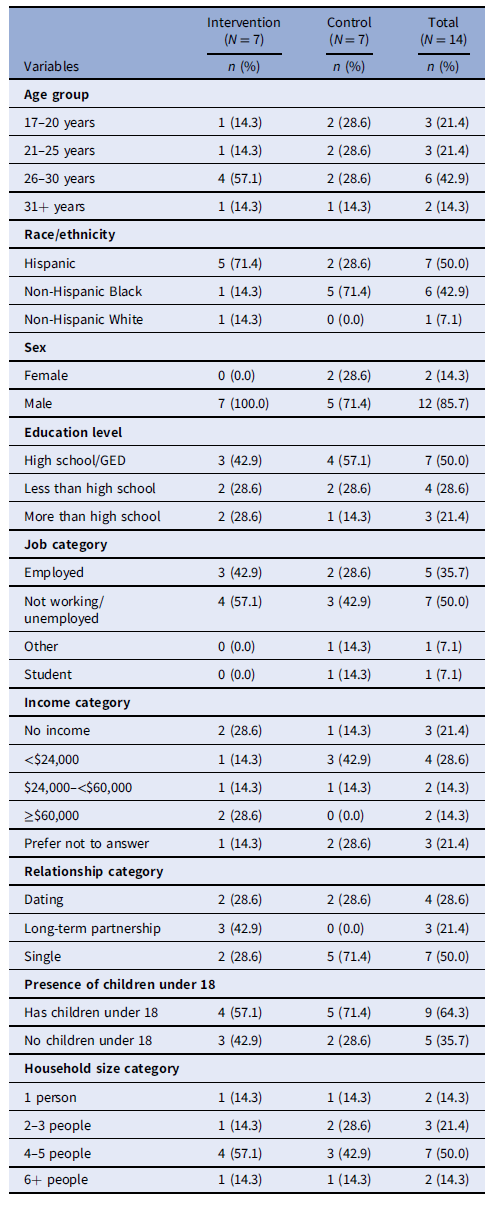
Table 1 provides an overview of the sample sociodemographic characteristics. The average age of participants was 25.6 (standard deviation [SD] = 4.9) years. The sample was 42.9% non-Hispanic Black, 50.0% Hispanic, and 7.1% non-Hispanic White, and the majority identified as male (85.7%). Regarding education, 50.0% had completed a high school diploma or GED, 28.6% had less than a high school education, and 21.4% had pursued education beyond high school. Half of the participants were unemployed at the time of enrollment. Annual household income was low: 50% reported earning less than $24,000, 14.3% between $24,000 and <$60,000, and 14.3% $60,000 or more. Regarding relationship status, 50.0% identified as single, 21.4% as being in a long-term unmarried partnership, and 28.6% as dating (see Table 1).
Sociodemographic profile of sample

Table 1. Long description
A table comparing sociodemographic characteristics of intervention and control groups. The table has 14 rows and 7 columns. Columns are labeled as Intervention (N=7), Control (N=7), and Total (N=14). Rows are labeled with variables such as Age group, Race/ethnicity, Sex, Education level, Job category, Income category, Relationship category, Presence of children under 18, and Household size category. Each row provides percentages for each variable in the intervention, control, and total groups. Notable trends include a higher percentage of Hispanic participants in the intervention group and a higher percentage of non-Hispanic Black participants in the control group. The majority of participants in both groups are male. Half of the participants in both groups have completed a high school diploma or GED. Half of the participants are unemployed. Annual household income is low, with 50% reporting earnings less than $24,000. Regarding relationship status, 50.0% identified as single, 21.4% as being in a long-term unmarried partnership, and 28.6% as dating.
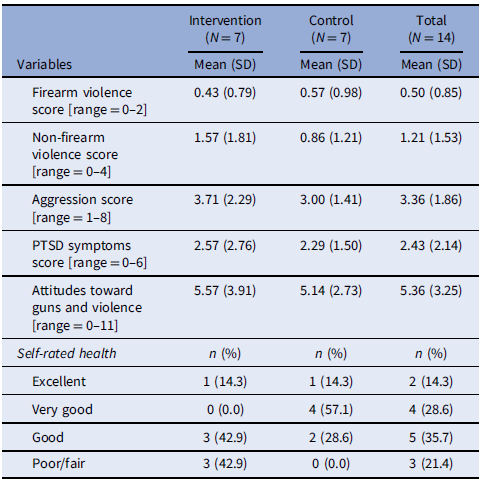
Levels of firearm violence exposure were generally low in the sample, with scores ranging from 0 to 2 and a mean score of 0.50. In contrast, exposure to non-firearm violence in the three months before the baseline survey was more commonly reported. Scores for non-firearm violence ranged from 0 to 4, with a mean of 1.21 (see Table 2). For details on the individual items for firearm and non-firearm violence, see Appendix D.
Sociodemographic profile of sample

Table 2. Long description
A table comparing sociodemographic profiles of intervention and control groups. The table has 14 rows and 7 columns. The columns are labeled as Variables, Intervention (N = 7), Control (N = 7), and Total (N = 14). The rows are labeled with different variables and their respective mean scores and standard deviations. Row 1: Firearm violence score [range = 0–2], Intervention Mean (SD) 0.43 (0.79), Control Mean (SD) 0.57 (0.98), Total Mean (SD) 0.50 (0.85). Row 2: Non-firearm violence score [range = 0–4], Intervention Mean (SD) 1.57 (1.81), Control Mean (SD) 0.86 (1.21), Total Mean (SD) 1.21 (1.53). Row 3: Aggression score [range = 1–8], Intervention Mean (SD) 3.71 (2.29), Control Mean (SD) 3.00 (1.41), Total Mean (SD) 3.36 (1.86). Row 4: PTSD symptoms score [range = 0–6], Intervention Mean (SD) 2.57 (2.76), Control Mean (SD) 2.29 (1.50), Total Mean (SD) 2.43 (2.14). Row 5: Attitudes toward guns and violence [range = 0–11], Intervention Mean (SD) 5.57 (3.91), Control Mean (SD) 5.14 (2.73), Total Mean (SD) 5.36 (3.25). Row 6: Self-rated health Excellent, Intervention n (%) 1 (14.3), Control n (%) 1 (14.3), Total n (%) 2 (14.3). Row 7: Self-rated health Very good, Intervention n (%) 0 (0.0), Control n (%) 4 (57.1), Total n (%) 4 (28.6). Row 8: Self-rated health Good, Intervention n (%) 3 (42.9), Control n (%) 2 (28.6), Total n (%) 5 (35.7). Row 9: Self-rated health Poor/fair, Intervention n (%) 3 (42.9), Control n (%) 0 (0.0), Total n (%) 3 (21.4).
Participants reported moderate levels of aggression, with scores ranging from 1 to 8 (mean = 3.36). Symptoms of PTSD were moderately present, with scores ranging from 0 to 6 and an average of 2.43. Attitudes towards guns and violence were also moderately elevated in this sample, ranging from 0 to 11, with a mean of 5.36. Self-rated health revealed variability across participants. Two individuals (14.3%) reported excellent health; four (28.6%) very good; five (35.7%) good; and three (21.4%) fair or poor.
Upon exiting the program, 12 respondents (6 from the control and 6 from the treatment) were asked to rate the services they received from the case manager on a scale of 0 (worst) to 10 (best)[Reference Myers, Kapa, Garcia, Vega and Fein20]. The average score of the intervention group was 9.17 (SD 1.17) compared to 7.17 (SD 3.54) for the control group (t-score = 1.31, p = 0.219).
Discussion
This pilot study demonstrated the feasibility of recruiting young adults hospitalized for GSW into an HVIP. Over a two-month recruitment window, nearly 80% of eligible patients approached consented to participate, and retention at three-month follow-up exceeded 85%. Despite relatively low firearm-related victimization in the immediate months before enrollment, participants reported notable exposure to non-firearm violence, moderate symptoms of post-traumatic stress, and levels of aggression, and attitudes toward guns and violence. These findings align with prior work demonstrating the substantial psychosocial burdens and unmet physical, mental, and social health needs (e.g., unemployment, low income) among GSW populations[Reference Jang, Thomas and Slocum21,Reference Semenza, Baker, Ziminski, Mastrocinque, Whye and Heredia22]. These barriers highlight the need for HVIPs to extend beyond clinical care and directly link participants to community-based resources that address structural and socioeconomic drivers of violence[Reference Bonne and Dicker6,Reference Gorman, Coles and Baker10].
Limitations include a small sample size and a restriction to English-speaking participants. The short follow-up period does not capture longer-term retention or outcomes. Because participants in both arms may engage with other programs and community services in the broader violence intervention ecosystem, their risk trajectories may be shaped by exposures outside the HVIP. To address this, the study tracks the programs and services participants use throughout the follow-up period.
Conclusion
The results indicate that randomization to conditions differing in case-management dosage is practicable in a population experiencing GSW at a Level I trauma center. Randomization was balanced between arms, and participants in both arms rated case management services favorably. These findings provide insights into study design for future HVIP using an RCT and are foundational for the forthcoming Houston-HVIP evaluation[Reference Testa, Bluth and Monroe11].
Supplementary material
The supplementary material for this article can be found at https://doi.org/10.1017/cts.2026.10824.
Author contributions
Alexander Testa: Conceptualization, Data curation, Formal analysis, Funding acquisition, Investigation, Methodology, Project administration, Supervision, Visualization, Writing - original draft, Writing - review & editing; Eresha F. Bluth: Conceptualization, Project administration, Supervision, Writing - review & editing; Latanya S. Monroe: Investigation, Writing - review & editing; Karlton Harris: Investigation, Writing - review & editing; Ruosha Li: Conceptualization, Formal analysis, Investigation, Methodology, Writing - review & editing; Brian Heckler: Formal analysis, Investigation, Writing - review & editing; Zixi Yang: Formal analysis, Investigation, Writing - review & editing; Sandra McKay: Conceptualization, Funding acquisition, Investigation, Methodology, Project administration, Supervision, Writing - original draft, Writing - review & editing.
Funding statement
Research reported in this publication was supported by the National Institute of Nursing Research of the National Institutes of Health under Award Number UG3NR021232 and UH3NR021232. The content is solely the responsibility of the authors and does not necessarily represent the official view of the National Institutes of Health or any other federal agency.
Competing interests
The authors report no conflicts of interest.



 Open access

