Introduction
The surgical treatment of an enlarged or dissected aorta associated with a connective tissue disease or inflammatory vasculitis in children and infants has been reported sporadically in case reports.Reference Turtle, Sule and Webb 1 – Reference Bolin, Moodie, Fraser, Guirola, Warren and Eldin 3 Despite the long observational period in clinical studies, there were a small number of enrolled patients who had surgical treatment for aortic problems associated with a connective tissue disease or inflammatory vasculitis.Reference Cattaneo, Bethea and Alejo 4 , Reference Williams, Loeys and Nwakanma 5 In the present study, surgical outcomes and follow-up data from patients at our institution were reviewed to establish the surgical and follow-up strategy that is appropriate for them.
Materials and methods
Patients, methods, and ethics
From January 2000 to June 2017, 11 children and adolescents (<18 years old) who underwent surgery for enlarged aortic lesions associated with a connective tissue disease or inflammatory vasculitis were enrolled into the study. Two patients had already undergone cardiovascular surgery before the study period. One had patent ductus arteriosus ligation followed by ascending aorta graft interposition with aortic valve sparing because of an aneurysmal change in the ascending aorta; the other patient underwent mitral valve replacement because of mitral regurgitation. The clinical outcomes of these patients were retrospectively reviewed using their medical records. Cases of post-stenotic dilatation associated with a bicuspid aortic valve, or aortic root enlargement associated with congenital conotruncal anomalies, such as tetralogy of Fallot, double-outlet right ventricle, and transposition of great arteries, were excluded. The institutional review board at the hospital approved this study.
Surgery
Surgical treatment of the ascending aorta was most commonly performed because this was the most commonly involved area. Ascending aorta graft interposition was performed in five patients with or without aortic root implantation or remodelling techniques (three patients with Marfan syndrome, one with Loeys-Dietz syndrome, and one with Takayasu arteritis); ascending aorta aneurysmorrhaphy was performed in one patient (a 5-month-old with Loeys-Dietz syndrome). Resection of the ascending aorta aneurysm and patch angioplasty were performed in two patients with asymmetrical aneurysmal change (one patient with Kawasaki disease and one with PHACE syndrome, which is a combination of posterior fossa anomalies, haemangioma of head and neck, arterial malformation, cardiovascular anomalies, eye malformations, and ventral developmental defects). For patients who showed moderate to severe degrees of aortic valve regurgitation, accompanying aortic valve replacement or repair was applied (two patients). Aortic arch aneurysm repair was performed in two patients. One patient who had undergone ascending aorta graft interposition before the study period (Loeys-Dietz syndrome) received aortic arch replacement from the distal part of the previously interposed graft to the proximal part of the descending thoracic aorta. For the other patient who showed focal aortic arch aneurysmal change between the left common carotid artery and the left subclavian artery (unknown baseline disease), the aneurysmal portion was resected and a graft was interposed. The same procedure was used for the patient with tuberous sclerosis showing a focal proximal descending aorta aneurysm.
Results
Patients’ characteristics
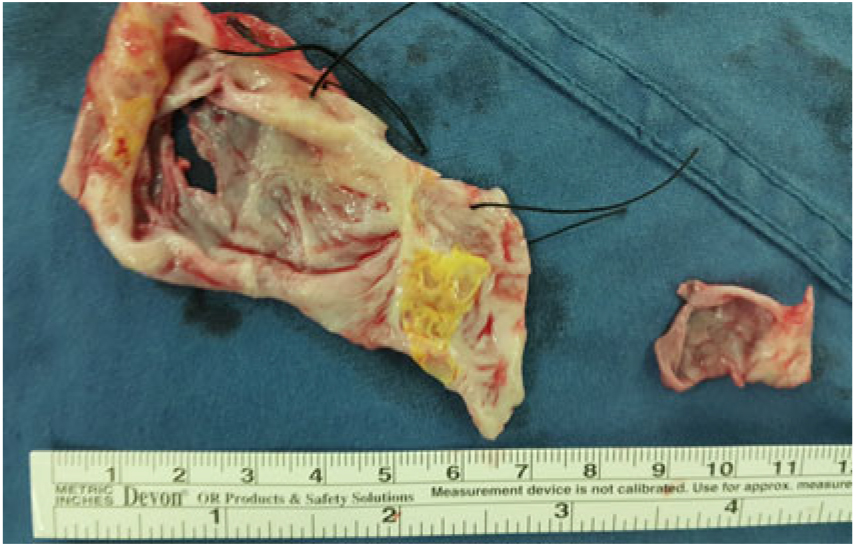
The patients’ median age and body weight at the time of the aorta surgery during the study period were 9.6 years (range 5.4 months–15.5 years) and 25.8 kg (range 6.8–81.5), respectively. The associated connective tissue diseases or inflammatory vasculitis included Marfan syndrome (n = 3), Loeys-Dietz syndrome (n = 3), Kawasaki disease (n = 1), Takayasu arteritis (n = 1), PHACE syndrome (n = 1), and tuberous sclerosis (n = 1). The one remaining patient with pathologic findings of aneurysmal aortic tissue showed some myxomatous degenerative features in the intima that seemed to be associated with some kind of connective tissue disease (Fig 1), which we did not clarify.
Resected distal aortic arch aneurysm showing myxoid changes in the intima. The associated connective tissue disease or vasculitis was not identified.

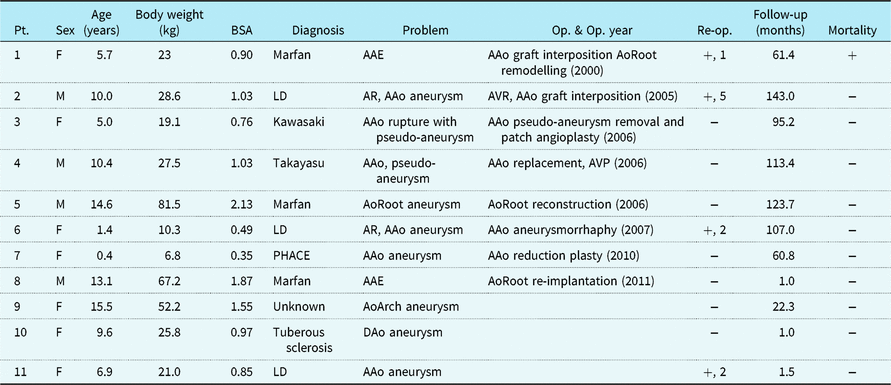
The most commonly involved areas of the aorta at the initial diagnosis were the ascending aorta and aortic root (9 of 11 patients). Three patients showed only ascending aorta dilatation without significant dilatation of the aortic root; however, eight patients showed simultaneous enlargement of both the ascending aorta and aortic root. Three of the 11 patients showed progression of dilatation of the aorta from the ascending part to the aortic arch (one patient) or to the descending thoracic and abdominal aorta (two patients) over time. They were all Loeys-Dietz syndrome patients. Patients’ characteristics are summarized in Table 1.
Summary of patients’ profiles

AAE = annuloaortic ectasia; AAo = ascending aorta; AoArch = aortic arch; AoRoot = aortic root; AR = aortic valve regurgitation; AVP: aortic valvuloplasty; BSA = body surface area; DAo = descending aorta; F = female; LD = Loeys-Dietz syndrome; M = male; Op. = operation; PHACE = PHACE syndrome, which is a combination of posterior fossa anomalies, haemangioma of head and neck, arterial malformation, cardiovascular anomalies, eye malformations, and ventral developmental defects; Re-op = re-operation
Mortalities
During the 66.4 ± 35.9 months of follow-up, two deaths were reported in the two Marfan syndrome patients. The first patient died 13 days after out-patient clinic visit with a tolerable general condition (43 days after aortic root re-implantation surgery). This patient showed severe aortic valve regurgitation with preserved left ventricular function at the most recent echocardiography that was performed 10 days after aorta surgery. Another late death occurred in patients who underwent cardiac surgery three times for mitral valve replacement, ascending aorta graft interposition with aortic root remodelling, and aortic valve replacement. The timing of death was 5.2 years after ascending aorta graft interposition with aortic root remodelling, and 2.1 years after aortic valve replacement. At the time of mitral valve replacement, this patient already showed a mild-to-moderate degree of aortic regurgitation, which progressed even after aortic root remodelling surgery. When the patient underwent aortic valve replacement, the patient’s left ventricular function was severely depressed (left ventricular ejection fraction 12%).
Re-operations
During the study period, four patients (three with Loeys-Dietz syndrome and one with Marfan syndrome) underwent two or more re-operations. No re-operations were performed on patients with vasculitis. The patient with Marfan syndrome was previously mentioned in the “Mortalities” section.
The abovementioned three Loeys-Dietz syndrome patients underwent three or more operations during the follow-up period. The initial surgeries were performed on the ascending aorta. The first patient underwent ascending aorta aneurysmorrhaphy during the initial operation as a palliative operation for the dilated ascending aorta at the age of 1.4 years. At the age of 5.6 years, she underwent ascending aorta replacement with valve sparing aortic root remodelling using a 24-mm vascular graft. At the age of 11.1 years, she underwent total aortic arch replacement because of a progressively enlarged aortic arch.
The second patient underwent ascending aorta replacement with aortic valve sparing because of an enlarged ascending aorta (18 mm in diameter) at the age of 2 years; a 20-mm vascular graft was used. Eight years after the initial aorta surgery, he underwent hemi-arch replacement (lesser curvature of the aortic arch from the distal part of the previous graft to the proximal descending thoracic aorta) for an enlarged aortic arch; a 24-mm vascular graft accompanied by a Bentall procedure using a 23-mm mechanical aortic valve was performed. However, because of the progression of thoracoabdominal aorta dilatation and residual native aortic arch area, the patient underwent graft replacement for the thoracoabdominal aorta and aortic arch (26-mm vascular graft) at 5 and 9 years, respectively, after hemi-arch replacement using a Bentall procedure.
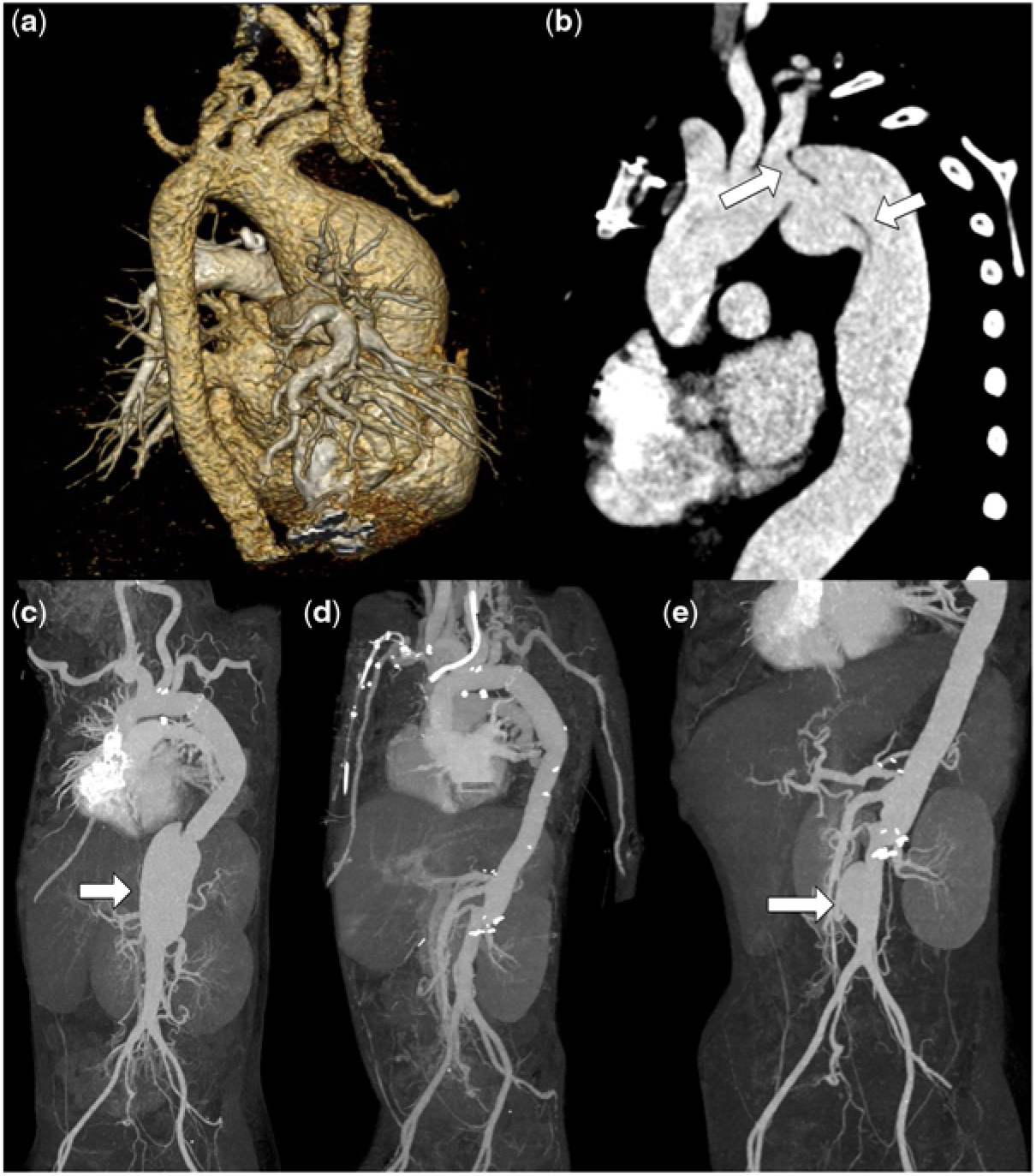
The third patient showed a rapid dilatation of the whole aorta after initially presenting with ascending aorta dilatation. At the age of 7 years, dilatation of the ascending aorta was found (Fig 2a), and the patient underwent ascending aorta replacement with a 20-mm vascular graft. Two months after the first operation, she experienced severe chest pain during defecation; CT-angiography showed a newly developed dissecting aneurysm of the residual aorta, from the distal part of the previously placed vascular graft, including the aortic arch, to the native abdominal aorta (Fig 2b). Her aortic arch and proximal descending thoracic aorta were replaced with a vascular graft to exclude the entry point of dissection. Six days after the second operation, during post-operative care in the ICU, a sudden rupture occurred at the proximal descending thoracic aorta. Emergent descending thoracic aorta replacement with vascular graft to the level of the diaphragm was performed (Fig 2c). Three weeks later, a scheduled residual thoracoabdominal aorta replacement was performed (Fig 2d), but the CT-angiography that was done 4 months after the final operation (2 months after discharge) showed a newly developed aneurysm in the residual native abdominal aorta just distal to the area of the previously interposed vascular graft (Fig 2e). The patient is currently being closely observed through regular short-term follow-up visits.
Serial 3D reconstructed CT images of a 7-year-old girl with Loeys-Dietz syndrome showing a rapid progression of dilated aortopathy. ( a ). Right lateral view of the ascending aorta aneurysm before the first operation. Other parts of the aorta seemed intact. ( b ). A dissecting aneurysm was found at the proximal descending aorta (arrows), and the aneurysmal change extended down to the level of renal arteries 1 month after the replacement of ascending aorta. ( c ). Emergent replacement of the descending thoracic aorta to the level of the diaphragm because of massive bleeding caused by a sudden rupture at the dilated descending thoracic aorta 6 days after aortic arch replacement. The abdominal aorta was dilated (arrow), but not corrected at this operation. ( d ). A scheduled replacement of the dilated abdominal aorta was performed 3 weeks after the emergent operation. ( e ). A new aneurysmal change at the distal part of the previously replaced abdominal aorta (an arrow) 2 months after abdominal aorta replacement.

Discussion
If cases associated with congenial conotruncal anomalies, such as tetralogy of Fallot, double-outlet right ventricle, truncus arteriosus, and transposition of great arteries, or congenital aortic valve problems, such as bicuspid aortic valve and congenital aortic stenosis or regurgitation, are excluded, then dilated aortopathy is rarely seen in children. Moreover, among these already rare cases, patients who require surgical treatment are even rarer. They are typically observed in the setting of connective tissue diseases accompanied by genetic disordersReference Turtle, Sule and Webb 1 , Reference Cattaneo, Bethea and Alejo 4 , Reference Patel, Alejo and Crawford 6 – Reference Rodriguez-Gonzalez, Matamala-Morillo, Segado-Arenas and Marin-Iglesias Mdel 8 and, sometimes, in patients with inflammatory vasculitisReference Karthekeyan, Vakamudi and Thangavel 2 , Reference Bolin, Moodie, Fraser, Guirola, Warren and Eldin 3 or systemic immune diseases.Reference Rached-d’Astous, Dahdah, Brochu and Saint-Cyr 9 There is little information on the adequate timing of prophylactic aortic surgery in children, as well as on the guidelines regarding the size of prosthetic vascular graft to be used as replacement for the diseased aortic portion. Additionally, it is not easy to control the level of anticoagulants in patients requiring mechanical aortic valves because of aortic regurgitation associated with dilatation of the aortic annulus. During 17 years of follow-up, only 11 pediatric patients (child or adolescent patients <18 years old) with aortic disease associated with vasculitis or connective tissue disease requiring surgical treatment were identified.
Connective tissue diseases
Our series included seven patients who were surgically treated for congenital connective tissue diseases associated with a dilated aorta: three with Marfan syndrome, three with Loeys-Dietz syndrome, and one with PHACE syndrome. During the follow-up period, all deaths and re-operations occurred in this category (two patients with Marfan syndrome, three with Loeys-Dietz syndrome). Loeys-Dietz syndrome patients are well known to show a wider extension of the aortic disease and a malignant cardiovascular natural course compared with Marfan syndrome patients.Reference Williams, Loeys and Nwakanma 5 , Reference Judge 10 Two of the three patients with Loeys-Dietz syndrome in this study required repeated re-operations because of aortic pathology progression. Among them, a 7-year-old girl who presented with mutations in the gene for the transforming growth factor-β type I receptor showed an unusually rapid progression of the dilated aortopathy despite adequate timing of corrective surgeries. In contrast to our expectation, all deaths occurred in patients with Marfan syndrome, and all patients with Loeys-Dietz syndrome survived despite repeated operations. The clinical pathologic features of the aorta were similar between the Marfan syndrome and Loeys-Dietz syndrome patients; however, in children with Marfan syndrome, the pathologic aortic area tended to be limited to the ascending aorta and aortic root,Reference Judge 10 and showed a less aggressive course than in Loeys-Dietz syndrome patients. Genetically, the Loeys-Dietz syndrome patients showed abnormal transforming growth factor-β signalling but normal fibrillin-1, which is usually abnormal in Marfan syndrome patients.Reference Neptune, Frischmeyer and Arking 11 In this study, all patients with Marfan syndrome who died showed not negligible amount of aortic regurgitation immediately after aortic surgery, including the aortic root remodelling procedure; aortic regurgitation aggravated over time. A Marfan syndrome patient who survived did not show any residual intra-cardiac lesions, including aortic regurgitation. A significant aortic regurgitation seemed to induce severe irreversible left ventricular enlargement and dysfunction over time, which may be one of the most critical causes of death in these two patients. We noticed that valve replacement is not the optimal option in young patients for several reasons, such as difficulty in adjusting the level of anticoagulants and the predicted repeated valve re-operations as patients grow. However, because it seems critical to correct intra-cardiac lesions as completely as possible before irreversible changes progress in the ventricle in these particularly fragile patients, valve replacement accompanying the initial operation, or early re-operation for the replacement of aortic valve, even not long after the aorta operation, seems necessary in these cases. Despite repeated operations and a well-known malignant cardiovascular course, patients with Loeys-Dietz syndrome in this study survived with tolerable functional class. We suggest that an aggressive and rapid evaluation of patients’ newly developed clinical symptoms and signs and immediate operation in those requiring surgical interventions might be helpful to avoid a sudden cardiac death during the follow-up period.
Our series also included a 5-month-old girl with PHACE syndrome. The aetiology of PHACE syndrome remains unclear. However, it has been suggested that the media of the great vessels and carotid arteries are affected by developmental errors in the neural crest, as observed in patients with this condition.Reference Etchevers, Vincent, Le Douarin and Couly 12 PHACE syndrome was first reported by Frieden et al in 1996.Reference Frieden, Reese and Cohen 13 Patients with this condition have a higher risk of progressive arteriopathy and associated narrowing and occlusion.Reference Drolet, Dohil and Golomb 14 For the cardiovascular system, approximately 40% of PHACE syndrome patients have intra-cardiac, aortic arch, or brachiocephalic anomalies, and approximately 35% of them required interventions.Reference Bayer, Frommelt and Blei 15 The most common anomaly is an aberrant origin of the subclavian artery, followed by coarctation of aorta with long hypoplastic arch segments, transverse arch interruption, or dilatation of arch segments.Reference Metry, Heyer and Hess 16 Our patient showed dilatation of the ascending aorta without a hypoplastic arch segment, which is different from the usual pattern. The dilated ascending aorta was surgically treated by dilated wall resection and re-anastomosis method, and the patient did well without recurrence of aortopathy during 61 months of follow-up.
There was a very rare case requiring surgical treatment for dilated aortopathy that was associated with tuberous sclerosis. Patients with tuberous sclerosis tended to show aneurysmal change in the aorta rather than stenotic lesions,Reference Salerno, Marsenic, Meyers, Kaplan and Hellinger 17 although aortic aneurysm has thus far been rarely reported in such cases. Wang et al categorised tuberous sclerosis as a connective tissue disease according to the predisposing factors associated with the aortic aneurysmal change, particularly in the abdominal aorta.Reference Wang and Tao 18 The 10-year-old girl in our study had a 60-mm-diameter aneurysm at the proximal descending thoracic aorta, which seemed infectious inside the lumen in the operating room. Thus, to avoid a possible graft infection, instead of a prosthetic vascular graft, we used a xenograft patch and bovine pericardial roll 15 mm in diameter to replace the aneurysmal lesion. Follow-up on this patient continues, and fortunately, there has been no recurrence of the aortic lesion.
Inflammatory vasculitis
During the study period, there were three patients with inflammatory vasculitis associated with aortic dilatation that required surgical treatment: one had Kawasaki disease, one had Takayasu arteritis, and one had non-specific vasculitis. Aneurysmal changes mainly occurred in the mid-sized arteries, particularly the coronary arteries in patients with Kawasaki disease.Reference Kato, Koike and Yokoyama 19 Rarely, the 5-year-old girl who was suspected of having Kawasaki disease (persistent high fever; large amount of pericardial effusion; high C-reactive protein, 14.5 mg/dl, and erythrocyte sedimentation rate, 120 mm/h; and thrombocytosis, 503 K/μg) showed ascending aorta pseudo-aneurysm (55 mm in diameter) and rupture with recurrent pericardial effusion 1 month after fever onset. We removed the aneurysmal tissue and repaired the defect of the ascending aorta using a vascular graft patch.
The patient with Takayasu arteritis also presented with unusual features in our series. Takayasu arteritis rarely presents in children <10 years old because the symptoms are non-specific in the early phase of this disease; the condition also affects females more frequently.Reference Rodriguez-Gonzalez, Matamala-Morillo, Segado-Arenas and Marin-Iglesias Mdel 8 , Reference Faivre, Collod-Beroud and Ades 20 However, our patient was a 10-year-old boy. Because one of the main features of Takayasu arteritis is stenosis of the involved arteries, resulting from the inflammation of the involved vessel walls, the most commonly used surgical interventions are bypass graft, endarterectomy, and sometimes patch repair.Reference Liang and Hoffman 21 In contrast to the usual cases, our patient showed severe ascending aorta dilatation and aortic regurgitation; therefore, we had to replace the ascending aorta using a vascular graft and perform aortic valvuloplasty. The recent echocardiography showed that residual aortic regurgitation had developed to a moderate degree, but the general condition of the patient was acceptable. In contrast to the patients with Marfan syndrome having severe aortic regurgitation in this series, who died even after undergoing surgery for dilated aortopathy, this patient seemed to endure a significant degree of aortic regurgitation with tolerable left ventricular function.
In one patient, a 16-year-old girl, the specific aetiology of aortic dilatation could not be determined. She did not display any other syndromic features, and the pathologic finding on the removed dilated aortic arch was myxoid degeneration (Fig 1). The dilated portion was limited between the left common carotid artery and the left subclavian artery, and the dilated area was replaced with a 20-mm polyester vascular graft. There were no changes in the other great vessels, such as the main or branch pulmonary arteries in these inflammatory vasculitis patients.
All the patients in this category showed a better post-operative course during follow-up with no re-operations and no progressive dilatation of other parts of the aorta after the initial aortic operation.
In conclusion, the post-operative course of the patients with a connective tissue disease was more malignant compared with inflammatory vasculitis. Patients who already had advanced intra-cardiac problems, such as clinically meaningful aortic regurgitation, showed a worse post-operative course even after being operated for dilated aortopathy. Those with inflammatory vasculitis showed better surgical outcomes after the initial aortic operation compared with patients with a connective tissue disease. Frequent and regular follow-up seems to be necessary for patients with connective tissue diseases accompanied by genetic disorders, especially those with Loeys-Dietz or Marfan syndrome, because of the tendency of a rapid progression of dilated aortopathy, a possible sudden rupture of dilated aortic lesions, and the requirement of repeated operations.
Author ORCIDs
Jae Hong Lim 0000-0002-4371-9686; Jae Gun Kwak: 0000-0002-6375-1210
Acknowledgement
None.
Financial Support
This research received no specific grant from any funding agency, commercial or not-for-profit sectors.
Conflicts of Interest
None.
Ethical Standards
The institutional review board at the hospital approved this study.