I
The late financial development of Latin America was traditionally regarded as an important determinant of its economic backwardness (Haber Reference Haber1991 and Reference Haber and Haber1997; Marichal Reference Marichal and Haber1997). However, a recent stream of literature has begun to challenge this view. In the case of Brazil, a number of studies show that well-functioning credit markets had developed in the transition from the nineteenth to the twentieth century and contributed (especially in the case of stock exchanges and debentures) to the industrialisation of the country. Triner (Reference Triner2000) outlines the emergence of a banking system in the early twentieth century. Rajan and Zingales (Reference Rajan and Zingales2003) emphasise the strong development of the Brazilian capital market compared to other countries. Hanley (Reference Hanley2005) demonstrates the importance of domestic investors not only for banks, but also for stock and bond markets since the second half of the nineteenth century. Marques (Reference Marques2005) explores, in the case of a brewery company, the financial connections that were fundamental for its growth. Finally, Musacchio (Reference Musacchio2009) demonstrates the existence of a high level of financial development in the early twentieth century compared to later periods, when financial markets experienced a significant reversal.
This article contributes to the literature by providing evidence that Brazil's industrialisation was heavily funded by a credit boom based on mortgage issuances. The literature on Brazil's pre-World War I financing of industrialisation is limited. Existing studies focus on the development of the industrial sector, but hardly explore how this was funded.Footnote 1 On the other hand, studies dealing with Brazil's early financial development do not make an explicit connection with the emerging industrial sector.Footnote 2 The paucity of existing data makes it difficult to assess empirically the factors that enhanced the financing of Brazil's industrialisation. In fact, Lewis (Reference Lewis1999), in a classic survey of the literature, regards this as one of the ‘permanent questions’ in economic history.
For this study, we hand-collected data on mortgage loans raised by industrial firms in one of the most important Brazilian industrial centres, São Paulo. Mortgage loans were loans secured by real assets (land, improvements, machinery and equipment); they were a source of external finance for industrial firms that have gone unnoticed so far in the existing literature.Footnote 3 The state of São Paulo experienced a remarkable demographic and economic development during the nineteenth century. The city of São Paulo was the administrative, commercial and financial centre of this dynamic process. The growth of the coffee economy spurred investments in many other sectors, such as railway construction, public services and manufacturing. The European immigrants that came to work on coffee plantations were important for the emergence of a Brazilian industrial class (Dean Reference Dean1969; Suzigan Reference Suzigan2000). Different authors also emphasise the relevance of resources generated by the coffee economy for the funding of industrial activities (see Dean Reference Dean1969; Saes Reference Saes1986; Suzigan Reference Suzigan2000; Hanley Reference Hanley2005; and Marcondes and Hanley Reference Marcondes and Hanley2010). Our evidence shows that mortgage loans for manufacturing started as early as 1866 and became quite widespread after the 1870s. Since then, we observe a sustained development of the mortgage market related to industrial investment until World War I. We also find that: (i) the mortgage credit market was a key source of funding for industrial investments in São Paulo; (ii) most of the industrial credit transactions were carried out with non-banking and domestic agents; and (iii) mortgages were an important proxy for industrial investment, as machinery imports Granger-caused mortgage loans.
This article is structured as follows. Section II describes the Brazilian institutional and financial development in the period under study. Section III provides a descriptive analysis of the data and discusses the relevance of mortgage credit for industrial firms. Section IV presents the empirical methodology and our results. Section V concludes.
II
In the second half of the nineteenth century, a considerable number of institutional reforms allowed the expansion of business and credit in Brazil. Among these changes, the Commercial Code of 1850, the Land Law of 1850 and the Mortgage Reforms of 1846 and 1864 stand out. These improvements allowed the development of a mortgage credit market, since they defined property rights and feasible chartering requirements for corporations (Musacchio Reference Musacchio2009, pp. 32-4).
The Commercial Code (introduced by law no. 556, 25 June 1850) facilitated the enforcement of contracts and the establishment of joint-stock companies, including banks. Since then, government securities and private stocks began to be traded on the Rio de Janeiro Stock Exchange. Subsequent legislation (Lei de Entraves, law no. 1083, 22 August 1860) was also beneficial for entrepreneurial undertakings, as it introduced limited liability, stipulated minimum capital requirements for firms issuing stocks, and mandated the publication of balance sheets (Musacchio Reference Musacchio2009). Eventually, in 1882 the requirement of government authorisation for the incorporation of joint-stock companies was suppressed (law no. 3150, 4 November 1882).
The Land Law (no. 601, 18 September 1850) was fundamental because it marked a turning point in the definition of property rights. Traditionally, the land could be distributed freely or simply appropriated (posse), thus generating harsh conflicts. Over time a market for land developed, as demonstrated by the taxation of urban real estate after 1808 (decimal predial urbana; siza). The law limited the occupation of public domain lands, legitimised ‘peaceful and undisputed’ land holdings (posses mansas e pacíficas), but established that after 1850 land could only be acquired by purchase (Dean Reference Dean1971, p. 616; Alston et al. Reference Alston, Harris and Mueller2012, p. 762). Later, a related law (no. 840, 22 January 1855) required that each purchase and sale of property be recorded in the local notary's ledger for public registration. Despite serious difficulties in enforcing the law, urban and rural real estate increased its value. Rising coffee exports also gave a boost to rural land prices. In urban areas, mass immigration and population growth were key factors leading to an increase in the value of property. In fact the city of São Paulo experienced a real-estate price boom as urbanisation progressed in the last decade of the nineteenth century (Rolnik Reference Rolnik1995, pp. 166–7). Thanks to these institutional improvements, an essential precondition for the development of a collateral-based market was met.
Although mortgages were widely used in Brazil from the beginning of colonisation, reforms were critical for the development of a market. An early piece of legislation (decree no. 482, 17 November 1846) had authorised the creation of a general register of mortgage credit, but this was not established on a regular basis until later. A second reform (law no. 1237, 24 September 1864) sought to create better conditions for lenders; it also led to improved information and a wide variety of mortgages in terms of value, interest, maturity and collateral (decree no. 3453, 26 April 1865). Several assets were admitted as collateral, such as real estate, equipment/machinery, livestock and even slaves, which were actually preferred. Finally, the law allowed mortgage banks to issue bonds to raise resources for their loans.
Despite the efforts to expand credit, only a few banks were interested in the mortgage business – virtually none but the Banco do Brasil. Thus, ten years later the government tried to promote the banks' interest in mortgage lending by providing a government guarantee on mortgage bonds' interest and amortisation (decree no. 2687, 6 November 1875). Slowly, real-estate banks began to expand their activities in the 1880s. After the establishment of the Brazilian Republic in 1889, new reforms facilitated the creation of companies and their financing, mainly through the issuing of debentures.Footnote 4 Finally a new bankruptcy law (decree no. 917, 24 October 1890) gave mortgage contracts priority in bankruptcy proceedings, thus spreading its use by industrial corporations.
We emphasise the Mortgage Reform of 1864 because it critically allowed the gradual expansion of this type of credit, not exclusively through banks. In fact, in spite of the serious banking crisis that hit the economy in the late nineteenth and early twentieth century, the mortgage and capital markets remained important sources of long-term external finance for the industrial and real-estate sectors. In the next section, our analysis focuses on the rise of mortgage credit granted to industrial firms.
III
How did the mortgage credit market for industrial companies develop? Was it a stable or a volatile source of funding? Who were the main creditors who engaged in funding Brazil's infant industry? In order to answer these questions, we collected data on 530 mortgages granted to industrial firms in the city of São Paulo during the period 1866–1914.
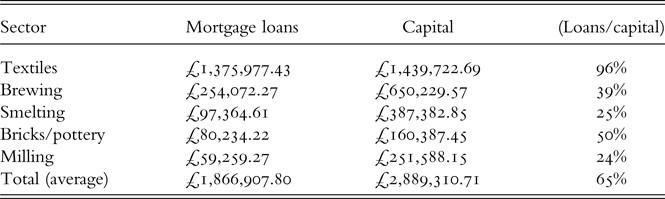
The number of transactions and the values increased significantly over time, especially in urban areas. Until 1880, we could identify only 20 industrial mortgage transactions, but at the turn of the twentieth century the number had increased to 240. In 1907 outstanding mortgage loans amounted to more than 27 per cent of the existing stock of industrial capital.Footnote 5 For São Paulo's main manufacturing industries, mortgage loans represented on average 65 per cent of the firms' capital. In the textile sector, the most important one, the ratio was about 96 per cent of the sector's total capital. Thus we can conclude that mortgages played an extremely important role in financing entrepreneurs at that time.
The mortgage credit evolution in São Paulo suggests a relationship with institutional changes. Figure 1 reports the number and value of mortgages registered against a number of institutional and political benchmark dates.
Brazilian institutional/historical events: number and value of industrial mortgages in São Paulo

Average interest rates and maturities of industrial mortgages (1866−1914)
In fact, in addition to the institutional changes already mentioned, the period under study saw noteworthy events in Brazil's economic and political history, including the monetary-credit crisis period known as Encilhamento (1890–4), the recession caused by Murtinho's tight monetary policy (1898–1902) and the beginning of World War I (1914). In the transition from Empire to Republic in 1889, the Brazilian government adopted an expansionary monetary policy due to the transition to wage labour brought by mass immigration and the abolition of slavery. New firms were established and stock markets experienced a phase of buoyancy. The new policy enhanced private investment, although it had a negative effect on macroeconomic stability, leading to inflation and exchange rate devaluation.Footnote 6 Our data show that the value of industrial mortgages rose about 40 times, while the number of registered mortgages almost quadrupled in the years 1886–91. The data are consistent with the existing literature (Stein Reference Stein1957; Fishlow Reference Fishlow and Di Marco1972; Levy Reference Levy1977; Luz Reference Luz1978; Triner and Wandschneider Reference Triner and Wandschneider2005) in confirming that during the Encilhamento, a credit boom allowed the emerging industrial sector to expand both investments (especially through the import of machinery) and production.
Following the Encilhamento, industrial mortgages recorded a rapid decline, possibly due to the excesses of the previous period. The very restrictive monetary policy of the Finance Minister Joaquim D. Murtinho allowed the government to keep inflation and currency devaluation under control, but many banks went bankrupt. This had a negative impact on industrial investment, reflected in a sizeable fall in imported machinery. Consequently, until 1905 the value of industrial mortgages was stabilised at a level below that reached during the Encilhamento. Although the economic recession led to a reduction in bank deposits, the decrease in the mortgage values was considerably lower, thereby suggesting that (as already argued by Peláez and Suzigan Reference Peláez and Suzigan1981, pp. 146–7) banks were not the sole creditors in the mortgage market.
After the credit shortage, the mortgage values underwent a spectacular recovery. However, the period leading up to World War I (1912–14) caused a steep decline in industrial mortgage financing: from a peak of 46 industrial mortgages registered in 1911 to only four in 1914. This latter number was the smallest in the 22 years since the establishment of the Brazilian Republic in 1889.
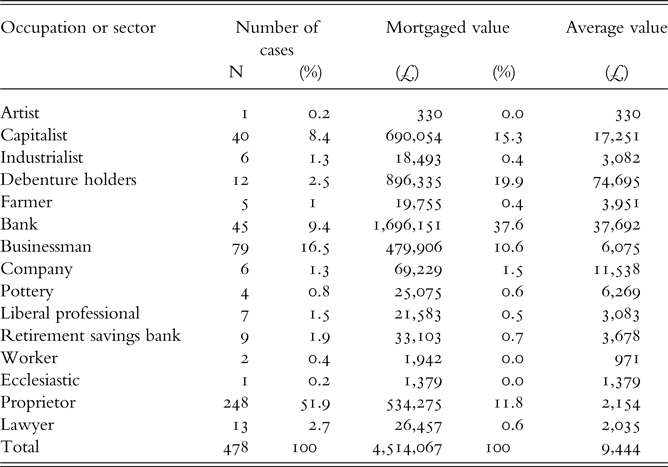
A closer examination of the creditors' profile shows that the most important lenders were proprietors, representing 51.9 per cent of cases, although only 11.8 per cent of the value of industrial mortgages (Table 1).Footnote 7 On the other hand, banks, capitalists, securities brokers and businessmen accounted for 36.8 per cent of cases, but for 83.3 per cent of all industrial mortgage values. Within this group, non-banking creditors represented more than 90 per cent of the number of mortgages and more than a half of the mortgage value.Footnote 8 In fact, mortgage credit provided by banks decreased in Murtinho's period, but total credit did not decrease especially due to non-banking creditors.Footnote 9 Finally, the average value of mortgages granted by debenture holders was twice the value of banks and four times the value of capitalists.
Number and values of industrial mortgages by creditor's occupation or sector (1866–1914)
Source: APESP, First Notary Office of the Capital. Observation: 53 registries do not provide information on occupation. It explains the difference between the 531 registries used in the descriptive analysis and the 478 above.
As far as the creditors' domicile is concerned, we can disaggregate data by residents and non-residents. International capital represented about 12 per cent of the total mortgage value, although on average foreign creditors provided larger sums than domestic creditors. If we observe the number of mortgages, international capital becomes even less relevant: only about 6 per cent of all the industrial mortgages came from foreign lenders. Thus, the empirical evidence reinforces the hypothesis (advanced by Dean Reference Dean1969 and Hanley Reference Hanley2005) of the preponderance of national capital in the financing of industrial activities.
Another important aspect of the mortgage credit market is the evolution of funding conditions for industrial firms. The average maturity of mortgages shows a rising trend over the period (from 30 to 40 months), although the series exhibits a large volatility. The average interest rates had a gently declining trend but remained around 11 per cent p.a., showing more stability than the maturity series. The behaviour of average interest rates and maturities suggests that the two variables became negatively and significantly correlated after 1878 (−0.45), when the market deepened, as suggested by the increasing number of observations and the lack of interruptions in the series of registries.
As was observed for the total mortgage value, funding conditions became less favourable at the end of nineteenth century. Minister Murtinho's strict monetary policy led to higher interest rates, whereas maturities decreased considerably. The start of the 1910s saw interest rates decrease once again and maturities lengthen until the onset of World War I, which reversed the trend, making interest rates rise again and maturities fall to their lowest levels.
Finally, how costly were mortgage loans when compared to other available sources of funding? Figure 3 shows the ratio of the mortgage average interest rates and the average yields on Brazilian government bonds traded on the London Stock Exchange (obtained from two different sources).
Ratio of industrial mortgage average interest rate and yields of Brazilian government bonds (1880–1914)
For most of the period, mortgages commanded a sizeable premium on government bonds, with interest rates more than twice the yields of bonds both in the 1880s and after 1900. This result confirms that investors perceived a higher risk in lending to industrial companies.
IV
A critical question is: were mortgages really important for industrial investment? This section empirically assesses the relevance of the mortgage credit market for manufacturing firms.
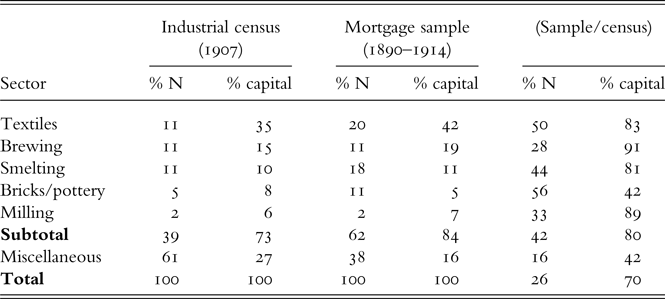
As initial evidence, we compare mortgage credit with data from the Brazilian industrial census of 1907, which provides the number of firms by sector and their capital. By cross-referencing the data from the census in São Paulo and our mortgage data, we found 45 firms represented in both data sets, which we defined as the mortgage sample.Footnote 10 Both the census and the sample indicate that the most significant industrial sectors were textiles, brewing, metal smelting, bricks/pottery and milling – totalling 73 per cent (census) and 84 per cent (sample) of the existing industrial capital (see Table 2).
Capital by sector: industrial census versus mortgage sample (1890–1914)
Source: IBGE, Brazilian industrial census of 1907 and APESP, First Notary Office of the Capital.
We then assess how well the sample covers the population of firms sector by sector. In the case of textiles, only half of the firms included in the 1907 census recorded at least one mortgage between 1890 and 1914; their capital, however, represents 83 per cent of all existing firms in the textile industry. We observe the widest coverage in the brewing sector, in which firms included in the mortgage sample represent 91 per cent of the sector's capital.Footnote 11 The opposite situation can be detected in the brick/pottery sector, in which the capital of firms included in the mortgage sample represents less than 50 per cent. However, in the five main sectors, the sample represents 80 per cent of the censused capital. Thus, the data suggest that the most representative firms in 1907 were actively involved in the mortgage market.
More specifically, we found that in the case of the textile sector – the most important industry in Brazil at the time – the ratio between mortgage loans and capital was 96 per cent (Table 3). In other sectors, this proportion was lower, but the average ratio between mortgages and capital was still high, around 65 per cent.
Share of mortgage loans in industrial capital by sector (in 1907 £)
Source: See Table 1. Observation: all values are from the mortgage sample.
Additional evidence can be obtained by time series analysis. In this case we compare our mortgage data with existing data on imports of industrial machinery, which are commonly used as a proxy for industrial investment in Brazil.Footnote 12Figure 4 shows the evolution of each series during the period.
Industrial machinery imports and industrial mortgaged value (1866–1914)
We can visually observe that both series have a common trend during the period. However, we can formally test their relationship through cointegration analysis. If there exists a relationship between mortgage credit and the machinery imports series, then we can suggest that mortgage credit is also representative of industrial investment.
We explore the existence of an equilibrium relationship between these two variables. According to Enders (Reference Enders2004), the existence of a long-run equilibrium relationship between nonstationary variables implies that their stochastic trends are linked. Additionally, an equilibrium relationship means that the variables cannot move independently of each other and that there is a mechanism to correct short-term deviations from this equilibrium.
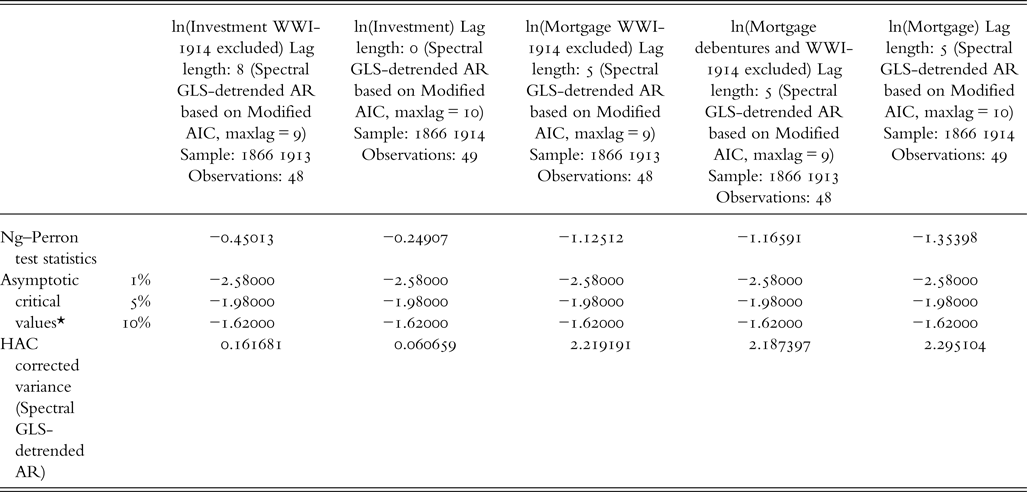
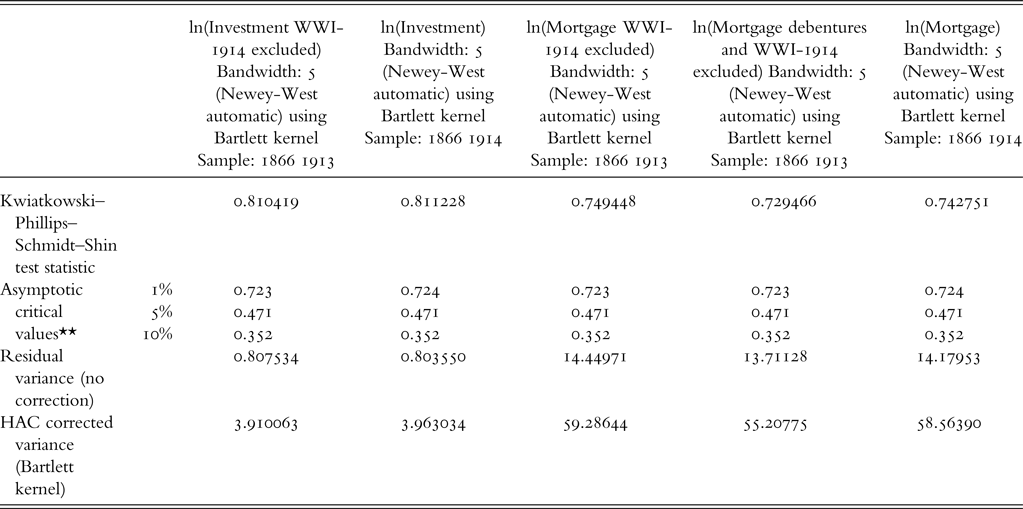
Initially, we ran the Ng–Perron unit root test (Ng and Perron, Reference Ng and Perron2001), which showed that the unit root hypothesis cannot be rejected for all series in logs – (i) Industrial machinery imports with and without 1914; (ii) Mortgage value with and without 1914; and (iii) Mortgage without 1914 and debentures – at the 1 per cent level. Additionally, we ran the KPSS unit root test that ‘confirmed’ the nonstationarity of all series. The results of the tests are available in Appendix B.
The usual procedure to check the existence of this relationship is by performing two cointegration tests (trace and eigenvalues) developed by Johansen (Reference Johansen1995). We ran both tests for industrial machinery imports and industrial mortgage value. For robustness, we tested three specifications of the mortgage series: (i) all cases; (ii) World War I (1914) excluded; and (iii) debentures and World War I (1914) excluded. This decision was taken in order to avoid distortions caused by outliers.Footnote 13 Given the presence of heteroscedasticity, we log-transformed our variables, then estimated a model with deterministic trend (restricted constant) and no lags.
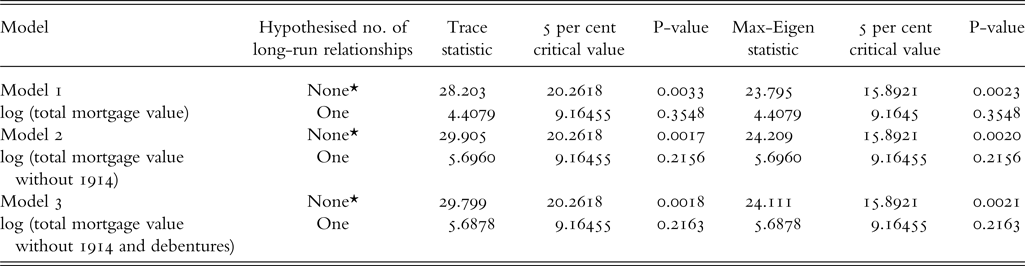
Table 4 shows the results for both the trace test and the max-eigenvalue test. They indicate the existence of one cointegrating equation at the 5 per cent level. In other words, we can conclude that there is an equilibrium relationship between industrial machinery imports and industrial mortgage value variables.
Johansen cointegration test
Notes: *Denotes rejection of the hypothesis at the 5% level by employing critical values from Osterwald–Lenum. Critical values and p-values are computed via MacKinnon–Haug–Michelis (Reference Mackinnon, Haug and Michelis1999). Sample (adjusted): 1867–1914; included observations: 48 after adjustments for model 1 and 47 for models 2 and 3; series: log (total mortgage value), with or without outlier and debentures, log (industrial machinery imports); trend assumption: no deterministic trend (restricted constant); lag intervals (in first differences): no lags.
Additionally, we estimated the following Vector Error Correction Model (VECM) as a representation of a cointegrated system, for
 $$\Delta y_t = \mu_c + \alpha \beta^{\prime} y_{t - 1} + \sum_{i = 1}^{\,p - 1} \Gamma_{\rm i} \Delta y_{t - 1} + \epsilon_t$$
where: μt is the model's deterministic part; β is the cointegrating vector; α is the adjustment vector and measures the degree to which the respective variable responds to the deviation from the long-run equilibrium relationship, and the ∑i=1p−1 ΓiΔy t−i component corresponds to the short-term.
In our case, we have:
 $$\left[\matrix{\Delta Mortgage \cr \Delta Imports} \right]= \left[\matrix{\alpha_{mortgage} \cr \alpha_{imports}} \right]\lsqb \beta_1 Mortgage_{t - 1} + \beta_2 Imports_{t - 1} + constant \rsqb + \left[\matrix{\epsilon_{mortgage_t} \cr \epsilon_{imports_t}} \right]$$
The results are similar for the analysis with each of the three versions of the mortgage series, but the model without World War I (1914) provides a better fit,Footnote 14 and is reported below (standard error in parentheses):
 $$\left[\matrix{\Delta Mortgage \cr \Delta Imports} \right] = \left[\matrix{-0.7634 \cr \lpar 0.1393\rpar \cr -0.0044 \cr \lpar 0.0128\rpar} \right] \left[\matrix{Mortgage_{t - 1} &-3.5310 Imports_{t -1} &+36.994 \cr {} &\lpar 0.5124\rpar &\lpar 6.6980\rpar} \right] + \left[\matrix{\epsilon_{mortgage_t} \cr \epsilon_{imports_t}} \right]$$
The results state the direct relationship between mortgage loans and machinery imports series. The component of the cointegration vector (β2) is statistically significant. More specifically, it suggests that about 353 per cent of variations in machinery imports are transferred to mortgage loans in the long run. Only the adjustment coefficient for mortgage loans (αmortgage) is statistically significant and its estimated value (−0.7634) seems to indicate a higher adjustment speed, i.e. at a rate of 76 per cent per year.
We also observe that causality runs from machinery imports to mortgage loans. In other words, we can infer that an increase in the purchase of industrial machinery caused (in the Granger sense) an increase in mortgage loans by industrial firms.
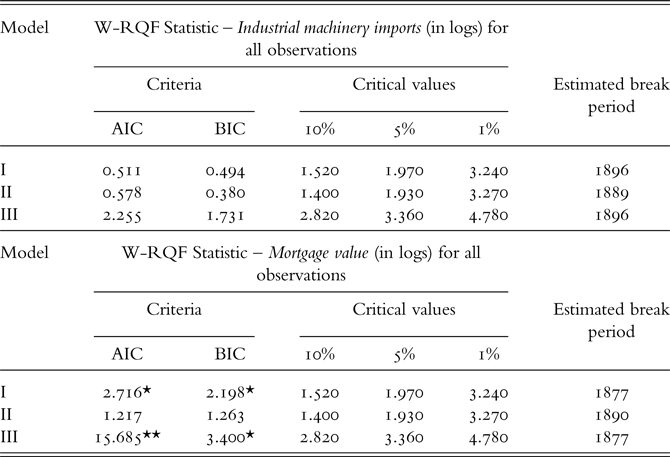
At this point a question arises about the possibility of structural breaks, which can distort the results of the analyses conducted. Thus the methodology developed by Perron and Yabu (Reference Perron and Yabu2009) was adopted to endogenously identify the point of structural break for each series.Footnote 15 The results indicate that for the variable industrial machinery imports (in logs) for all observations and World War I (1914) excluded, no break can be found.Footnote 16 Therefore, the results of the unit root tests maintain their relevance.
On the other hand, for the variable mortgage value (in logs) for all observations, one break was found in 1877. Figure 1 shows that this is precisely the point at which time the series begins to show only non-null values. This result requires performing a unit root test that incorporates this structural break. The methodology developed by Kim and Perron (Reference Kim and Perron2009) is used, taking 1877 as the structural break.Footnote 17 The results show that there are no indications, in any of the specifications, of the presence of a unit root for the mortgage value (in logs) for all observations.
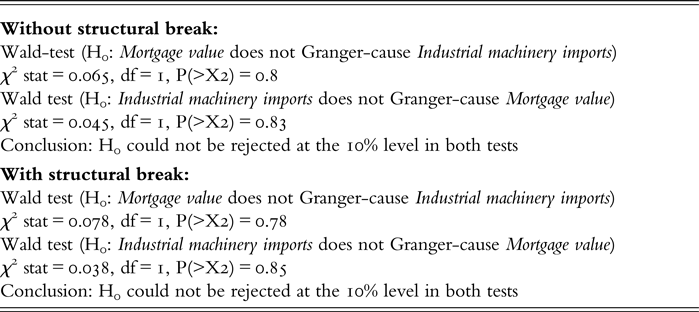
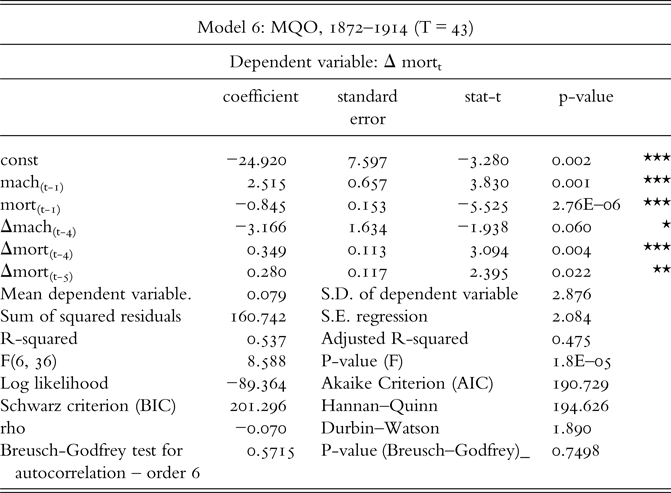
Thus, the application of the ARDL / Bounds Testing methodology of Pesaran and Shin (Reference Pesaran, Shin and Strom1999) and Pesaran et al. (Reference Pesaran, Shin and Smith2001) is useful because it allows verification of a long-term relationship between a set of variables, even though some are stationary while others are not.Footnote 18 We must first determine the direction of causality by using the test proposed in Toda and Yamamoto (Reference Toda and Yamamoto1995), which is applicable to non-stationary series. The results did not show any temporal precedence relationship between the variables.Footnote 19 Thus, we used the causality direction indicated in the Johansen procedure, in other words, from machinery imports (mach) to mortgage loans (mort).Footnote 20
The specification selected on the base of the information criteria AIC and BIC and the absence of autocorrelation of residualsFootnote 21 is:
 $$\Delta mort_t = \beta_0 + \beta_1 \Delta mort_{t - 4} + \beta_2 \Delta mort_{t - 5} + \gamma_1 \Delta mach_{t - 4} + \theta_0 mort_{t - 1}+ \theta_1 mach_{t - 1} + e_t$$
We are testing here for the absence of a long-run equilibrium relationship between the variables. This absence is represented by the condition θ0 = θ1 = 0 in the previous equation. A rejection of the null hypothesis implies that we have a long-run relationship.Footnote 22 After calculating the statistics we retrieve the lower and upper bounds on the critical values as reported in Pesaran et al. (Reference Pesaran, Shin and Smith2001). The lower bound is based on the assumption that all variables are stationary, while the upper bound is based on the assumption that all variables have one unit root. If the computed F-statistic falls below the lower bound we may conclude that the variables are I(0), so that there is no cointegration. If the F-statistic exceeds the upper bound, we can conclude that there exists a cointegration relationship. Finally, if the F-statistic falls between the bounds, the test is inconclusive.
The Wald or F-statistic produced by our model is 15.5184, whereas the lower and upper bounds for the F-test statistic at the 10, 5 and 1 per cent significance levels are [4.04, 4.78], [4.94, 5.73] and [6.84 , 7.84] respectively.Footnote 23 As the value of our F-statistic exceeds the upper bound at the 1 per cent significance level, we can conclude that there is evidence of a long-run relationship between the two time series. The long-run multiplier between industrial machinery imports (in logs) and mortgage value (in logs) is 0.3358. We also estimate the short-run dynamic parameter, whose value of −0.8477 is statistically significant. This implies that nearly 85 per cent of any disequilibrium between mortgage value and industrial machinery imports was corrected within one year.
V
The main findings of this study can be summarised as follows. We demonstrate that the mortgage credit market was a key source of funding for early industrial investments in Brazil. The market was only in part bank-based; in fact, non-banking domestic creditors, mainly identified as businessmen, debenture holders, capitalists and proprietors, prevailed. The cross-referencing of mortgages and industrial census suggests that mortgages were a very important source of external finance for the main industries of the emerging Brazilian manufacturing sector. The empirical tests based on cointegration confirm that mortgages had a significant long-run relationship with industrial investment, proxied by industrial machinery imports. The direction of causality runs from machinery imports to mortgage loans. These findings confirm the sustained financial development of the Brazilian economy in the pre-1914 period and demonstrate empirically a link between financial deepening and the process of industrialisation.
Appendix A: Sources, Data and Variables
It was only after the law in 1864 that all mortgages were registered for every loan in detail in specific books. The primary documentation used in this study comes from these books – Livro de Inscrição Especial no Registro Geral e das Hipotecas da Comarca de São Paulo (SP) − available in the Arquivo Público do Estado de São Paulo (APESP). The mortgage registry books provide micro-level data: the creditor and debtor names, their professions, their domiciles, the details of the collateral, etc. (see Table A1). Concerning quantitative aspects, the registry books provide information on the amount of credit, interest rates and maturities of each negotiated loan. Because debenture registration in mortgage books was accessorial rather than mandatory, our database contains only 12 registries. Certainly these were not the totality of debenture emissions.
Some firms registered more than one mortgage, e.g. Francisco Matarazzo, a prominent Italian-Brazilian industrial businessman, with eight cases. Although there are a few cases with no information on interest rates and some that did not even charge those, more than 90 per cent of the mortgages had rates spanning from 6 to 18 per cent per annum. The mode and median for interest rates were 12 per cent per annum. (Figure A1). On the other hand, maturities had a less symmetric distribution: an average of 42 months, but with mode and median of 24 months.
Histograms of mortgage interest rates and maturities
It is possible to identify the industrial agents among others through their professional identification (e.g. industrialist, businessman) and/or by their collateral details (e.g. textile industry building, brewing factory). The mortgage values were deflated using the price index proposed by Catão (Reference Catão1992), then converted from the Brazilian currency (réis) to pounds sterling using the exchange rate presented in Instituto Brasileiro de Geografia e Estatística (IBGE 1990, p. 570). All values from the figures and tables are expressed in pounds sterling of 1913, except those in Table 3, where they are expressed in pounds sterling of 1907.
Although the Mortgage Law dates from 1864–5, the first industrial registry only appeared in 1866. We therefore use 1866 as the starting point of our work. The end point was chosen to limit the analysis to the earliest industrialisation phase in Brazil.
Data for industrial machinery imports for the period under study are frequently used as proxy for industrial investment. The series was constructed by Wilson Suzigan (Reference Suzigan2000, appendix 1) by collecting data on industrial machinery exports for Brazil from its four major suppliers: United States, United Kingdom, France and Germany for the period from 1855 to 1939.
Finally, the industrial census for 1907 represents the first industrial survey in Brazil. Although it is considered a wide-ranging survey, it did not include small and medium-small firms. Thus, the industrial census from 1907 underestimates the Brazilian industrial park (see IBGE 1990, p. 366).
Appendix B: Unit root tests
Ng–Perron unit root test
KPSS unit root test
Appendix C: Structural break analysis
Perron and Yabu (Reference Perron and Yabu2009) EXP test statistic (W-RQF)
Kim and Perron (Reference Kim and Perron2009) unit root test for Mortgage value (in logs) for all observations, considering lags(k) 0 and 5

Critical values – Perron (Reference Perron1989, table VI.B)
Toda and Yamamoto (Reference Toda and Yamamoto1995) procedure results
ARDL model selected