Introduction
Together with water availability, temperature is the most important of the environmental factors that participate in the decision of seed germination opportunity (Bewley et al., Reference Bewley, Bradford, Hilhorst and Nonogaki2013). For this reason, germination experiments that include assessments of seed thermal responses are widespread in the literature. However, temperature has a multiplicity of roles in seed germination behaviour that often leads to misinterpretation of the results of such experiments. On the one hand, temperature determines the velocity of germination in non-dormant seeds, while, on the other hand, it regulates seed dormancy changes, establishing the fraction of a seed population that will be able to germinate under certain environmental conditions in a specific time period. More frequently than expected, both effects take place at the same time, thus making it even more difficult to interpret results. The fact that changes in seed dormancy can only be assessed through changes in seed germination (percentage or velocity) is the nature of these misinterpretations in seed lots presenting some degree of dormancy (Vleeshouwers et al., Reference Vleeshouwers, Bouwmeester and Karssen1995). These incorrect interpretations of obtained germination data, in turn, lead to the quantification of erroneous temperature-related germination parameters, as for example, base or optimum temperatures for seed germination. These errors are very frequent in wild species in which dormancy is a common attribute affecting germination behaviour, but can also happen in cultivated species showing very low levels of dormancy, often termed ‘residual dormancy’. In the present paper we discuss the effect of temperature in the regulation of dormancy (physiological type) level and its implications in dormancy expression, as an attempt to construct a conceptual framework which should allow the discrimination of temperature effects on dormancy from those on germination. We present examples of how a better understanding of these effects could help us to interpret the mixed effects of temperature on both processes during incubation of seeds presenting dormancy.
Temperature effects on seed germination and dormancy
Non-dormant seeds can achieve full germination in the widest thermal range possible for the genotype, and within this range, temperature just affects the speed of seed germination. This thermal range can be characterized by three cardinal temperatures: base temperature (T b), optimum temperature (T o) and ceiling temperature for seed germination (T c). While T b and T c are the temperatures below and above which germination does not occur, T o is the temperature at which germination is faster (Bewley et al., Reference Bewley, Bradford, Hilhorst and Nonogaki2013). Analysis of germination data in non-dormant seeds showed that there is little variation in T b among individual seeds (García-Huidobro et al., Reference García-Huidobro, Monteith and Squire1982; Covell et al., Reference Covell, Ellis, Roberts and Summerfield1986; Dahal and Bradford, Reference Dahal and Bradford1990), and consequently this parameter can be considered constant within a seed population, even though in some cases, variations of T b within the seed population have been considered (Labouriau and Osborn, Reference Labouriau and Osborn1984; Kebreab and Murdoch, Reference Kebreab and Murdoch2000; Chantre et al., Reference Chantre, Batlla, Sabbatini and Orioli2009). In contrast, germination data analysis showed that T c values are distributed within the seed population (Covell et al., Reference Covell, Ellis, Roberts and Summerfield1986; Ellis et al., Reference Ellis, Covell, Roberts and Summerfield1986; Alvarado and Bradford, Reference Alvarado and Bradford2002), although common T c values for all seeds have been reported as well (García-Huidobro et al., Reference García-Huidobro, Monteith and Squire1982; Hardegree, Reference Hardegree2006). Considering a constant T b in the population implies that non-dormant seeds (or, at least, the non-dormant fraction of the population) should achieve almost full germination once the temperature exceeds T b, while a distributed T c means that obtained germination percentage should decrease with increasing temperatures above T c. Between T b and T c, temperature just modulates the germination rate of seeds. Germination rate increases with increasing temperature between T b and T o, while it decreases between T o and T c. Times to germination for seeds incubated at different temperatures can be characterized using a thermal-time approach, in which a certain quantity of thermal time (°C days or hours) is required to be ‘accumulated’ to complete germination (García-Huidobro et al., Reference García-Huidobro, Monteith and Squire1982). In the sub-optimal thermal range (between T b and T o) times to germination at different temperatures can be described mathematically as:
 $$ \theta _{T}( g ) = ( T - T _{b}) t _{g}, $$
where θT(g) is the thermal time to completion of germination of percentage (g), T is the prevailing temperature, and t g is the time to completion of germination of percentage (g). Thermal time is ‘accumulated’ above T b and each seed requires a different quantity of thermal time for the completion of germination.
This differential requirement of thermal time within seeds accounts for differences observed in timing of seed germination. In the supra-optimal thermal range (between T o and T c) thermal time is accumulated below T c and it is supposed to be constant for each seed of the population (differences in timing of germination are accounted for by variations in T c); although variations in thermal time have also been considered (García-Huidobro et al., Reference García-Huidobro, Monteith and Squire1982). This thermal-time approach has been used successfully to characterize and quantify the germination response to temperature of many non-dormant seed populations (Covell et al., Reference Covell, Ellis, Roberts and Summerfield1986; Ellis et al., Reference Ellis, Covell, Roberts and Summerfield1986, Reference Ellis, Simon and Covell1987; Dahal and Bradford, Reference Dahal and Bradford1990). However, it normally fails to describe germination of seeds presenting some degree of dormancy, because the model could not account for a decrease in maximum obtained germination due to the expression of dormancy, particularly between T b and T o, but also at temperatures above T o.
In seeds presenting dormancy, temperature modifies its level (i.e. either increases or decreases it) which, at the same time, is defined through the temperature range within which dormancy is expressed. This adds to the above-mentioned complexity of seed thermal responses. In the case of summer annual species, dormancy relief is produced by the low temperatures experienced during winter, while their dormancy level is enhanced by high temperatures experienced during summer (Bouwmeester and Karssen, Reference Bouwmeester and Karssen1992; Baskin and Baskin, Reference Baskin and Baskin1998). Winter annuals show the reverse temperature-dependent dormancy pattern, in which high temperatures during summer result in dormancy relief, and low temperatures during winter can induce seeds into secondary dormancy (Baskin and Baskin, Reference Baskin and Baskin1976; Karssen, Reference Karssen and Khan1982; Probert, Reference Probert and Fenner1992). However, other types of dormancy responses to temperature, particularly for some winter annual species, have also been reported (Baskin and Baskin, Reference Baskin and Baskin1998).
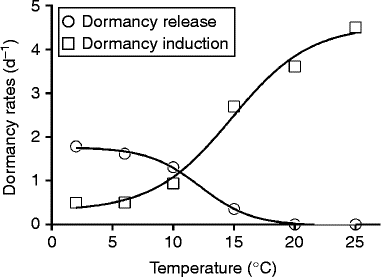
Experimental evidence showed that dormancy loss in most summer annual species takes place under moist conditions at temperatures below 15–17°C, a process commonly referred to as stratification or chilling, while for winter annuals, dormancy loss takes place in dry seeds and the dormancy loss rate increases with increasing temperature (Probert, Reference Probert and Fenner1992; Baskin and Baskin, Reference Baskin and Baskin1998; Allen et al., Reference Allen, Benech-Arnold, Batlla, Bradford, Bradford and Nonogaki2007). Although much work has been devoted to the quantification of the relationship between temperature and dormancy loss, less is known about the effect of temperature on dormancy induction. In this respect, Batlla et al. (Reference Batlla, Grundy, Dent, Clay and Finch-Savage2009), working with seeds of the summer annual weed Polygonum aviculare, quantified the effect of temperature on both dormancy release and induction rates within the range 2–25°C, showing that the dormancy release rate was higher the lower the temperature below 20°C; conversely, the dormancy induction rate was higher the higher the temperature above 2°C (Fig. 1). In addition, the dormancy induction rate was found to be two orders of magnitude higher than the dormancy release rate.
Dormancy release and induction rates in relation to temperature for a Polygonum aviculare seed population. Lines are fitted exponential equations; dormancy release rate function
 $$y = 1.758/\left (1 + 10^{\left (\left (12.14 - x \right )\ast - 0.2092\right )}\right ) $$
, R
2 0.99; dormancy induction rate function
 $$y = 4.546/\left (1 + 10^{\left (\left (14.79 - x \right )\ast 0.135\right )}\right ) $$
, R
2 0.99 (adapted from Batlla et al.
Reference Batlla, Grundy, Dent, Clay and Finch-Savage2009).

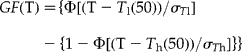
These temperature-dependent changes in the dormancy level of the seeds are expressed as changes in the environmental conditions permissive for seed germination. As seeds are released from dormancy, the permissive environmental range of conditions for seed germination becomes wider, while during the entrance to dormancy the range becomes narrower (Vleeshouwers et al., Reference Vleeshouwers, Bouwmeester and Karssen1995; Batlla and Benech-Arnold, Reference Batlla and Benech-Arnold2010). This relationship between seed dormancy level and the range of environmental conditions permissive for seed germination was first proposed by Vegis (Reference Vegis1964). This author introduced the concept of degrees of relative dormancy from the observation that as dormancy is relieved, the temperature range permissive for germination gradually widens until it is maximal, while as dormancy is induced, the range of temperatures under which germination takes place narrows, until germination is no longer possible at any temperature and full dormancy is reached. Therefore, except for seed populations (or a fraction of a seed population – see Figs 2 and 3) that display absolute dormancy, and consequently do not germinate under any condition, dormancy is a relative phenomenon which, depending on the dormancy level of the seed population, can be expressed under certain incubation temperatures but not at others (Hilhorst, Reference Hilhorst, Bradford and Nonogaki2007). In summer annual species, changes in the temperature range for seed germination during dormancy release and induction are mainly a consequence of an increase or decrease, respectively, in the capacity of seeds to germinate at low temperatures, while just minor changes in germination at high temperatures have been observed. On the contrary, in winter annual species changes in the thermal range for germination according to seed dormancy level are mainly explained by changes in the capacity of seeds to germinate at high temperatures, showing minor changes at low temperature (Karssen, Reference Karssen and Khan1982; Probert, Reference Probert and Fenner1992; Baskin and Baskin, Reference Baskin and Baskin1998). Therefore, seeds from species whose life cycle takes place in spring/summer usually express dormancy at low incubation temperatures but not at high ones, while seeds from autumn/winter species express dormancy at high incubation temperatures but not at low ones. The relationship holds even for domesticated species: summer cereals express dormancy at low incubation temperatures while winter cereals at high ones. So long dormancy is alleviated, dormancy expression takes place only under a limited range of temperatures, which is equivalent to saying that the population can germinate under a wide thermal range, as has been stated previously. The concepts of ‘lower limit temperature (T l)’ and ‘higher limit temperature (T h)’ introduced by Washitani (Reference Washitani1987) can deal with this incubation temperature-dependant expression of dormancy when considering the germination rate-dependency on temperature (García-Huidobro et al., Reference García-Huidobro, Monteith and Squire1982) of seed populations displaying relative dormancy. As mentioned above, the ‘thermal-time’ theory does not give a satisfactory explanation under such circumstances. When a seed population displays temperature-dependant expression of dormancy, final germination percentages decrease gradually as incubation temperature departs from that at which no (or less) dormancy is expressed, a temperature sometimes erroneously regarded as ‘optimum temperature’ (Figs 2 and 3). The thermal-time theory, as developed by García-Huidobro et al. (Reference García-Huidobro, Monteith and Squire1982), assumes that all fractions within a seed population have different required thermal times for germination [θT(g)] but a common base temperature (T b) (equation 1). If the latter is true, as explained before, final germination percentages should go from maximum to 0 when the common T b is passed. Because a different T b for each germination fraction g (i.e. T b normally distributed within the population) is not considered by the thermal-time theory, this gradual decrease in final germination percentage as incubation temperatures depart from the ‘optimum’ can be regarded as a consequence of a different dormancy level in the individuals composing the population. Indeed, there is evidence showing that in some cases this dormancy can be overcome by incubating seeds in the presence of a stimulating concentration of gibberellins or ethylene, making seeds germinate at temperatures that, otherwise, would allow the expression of dormancy (Dutta and Bradford, Reference Dutta and Bradford1994; Benech-Arnold et al., Reference Benech-Arnold, Enciso, Sánchez and Rodríguez2003; Batlla and Padilla, 2006). This different dormancy level among individuals would be manifested as a different temperature at which dormancy starts to be expressed or, in terms of Washitani's equation, as a different ‘lower limit (T l)’ or ‘higher limit temperature (T h)’. For this reason, it is considered that both T l and T h are normally distributed within the population, with mean T l (50) and T h (50) respectively, and standard deviation σTl and σTh respectively (Washitani, Reference Washitani1987; Kruk and Benech-Arnold, Reference Kruk and Benech-Arnold1998; Batlla and Benech-Arnold, Reference Batlla and Benech-Arnold2003) (Figs 2 and 3). Therefore, the fraction of seeds able to germinate at a given temperature can be calculated as:
 $$ GF (T) = \{\Phi [(T - T _{l}(50))/ \sigma _{ T l}] - \{1 - \Phi [(T - T _{h}(50))/ \sigma _{ T h}]\}\} $$
where GF(T) is the fraction of seeds germinating at temperature T and Φ is the normal probability integral. Hence, when the prevailing temperature is lower than T l of a certain fraction of the seed population, dormancy is expressed in seeds belonging to that fraction, while it is not expressed in seeds belonging to fractions with a T l lower than the prevailing incubation temperature. In this way, as incubation temperature departs from that at which no dormancy is expressed, further fractions of the population start to express dormancy and, consequently, final germination decreases gradually (Fig. 2). In the same way, as dormancy is alleviated, for example by stratification, the entire T l distribution is displaced towards lower temperatures and, consequently, additional fractions of the seed population will have a T l lower than the prevailing incubation temperature, and will be able to germinate; the same principle can be applied for changes in T h during dry afterripening in winter annual species (displacing T h distribution towards higher temperatures) (Fig. 3). It should be noted that a normally distributed T h (which may not necessarily be supra-optimal in the terms of the thermal-time theory) results in progressively decreasing germination percentages at high incubation temperatures, similar to those resulting from regarding a normally distributed T c in a, supposedly, non-dormant seed population assessed with the thermal-time theory (Alvarado and Bradford, Reference Alvarado and Bradford2002). Within the present theoretical framework, thermal time required for germination is accumulated above T b or below T c only when prevailing temperature exceeds T l or is below T h for a given seed fraction. This shows no contradiction with the ‘thermal-time’ theory in the sub-optimal thermal range, since a common T b for the whole population continues to be the cardinal temperature above which seeds that are incubated at a permissive temperature (i.e. a temperature at which the population fraction does not express dormancy) accumulate θT for completion of germination. Although, as mentioned above, T c might be regarded as distributed within, supposedly, non-dormant seed populations (Bewley et al., Reference Bewley, Bradford, Hilhorst and Nonogaki2013), when dealing with dormant populations, and to avoid conceptual duplications in explaining the progressive decrease in final germination with increasing incubation temperatures, we prefer to assume a constant T c for the supra-optimal range, accounting for differences in timing of germination through variations in θT (García-Huidobro et al., Reference García-Huidobro, Monteith and Squire1982; Washitani, Reference Washitani1987) (Figs 2 and 3). Therefore, while limit temperatures for germination, namely T l and T h, establish the thermal range in which dormancy is not expressed (and which is related to the dormancy level of the seed population), it is within this range and for those fractions not expressing dormancy that the effects of temperature on seed germination can be accounted for using thermal-time equations. This flexible approach allows us to clearly distinguish those parameters characterizing the dormancy state of the seed population from those related to germination, and has been used successfully to model dormancy and germination in many wild species (Washitani, Reference Washitani1987; Reference Kruk and Benech-Arnold1998 Reference Kruk and Benech-Arnold2000; Batlla and Benech-Arnold, Reference Batlla and Benech-Arnold2003).
Seed population germinating fraction and germination time courses at different temperatures for a summer annual species showing different levels of dormancy. Left panels: germinating fraction (solid line) in relation to incubation temperature for seed populations with a high (A), intermediate (C) and low (E) dormancy level. The values of the mean lower-limit temperature [T l(50)] and mean higher-limit temperature [T h(50)] were: 19 and 24°C (A), 10 and 24.5°C (C), and 5 and 25°C (E), respectively. The standard deviations of both limit temperatures (σTl and σTh) were assumed to be constant with a value of 1.5°C in all panels; however, changes in dormancy level can also comprise changes in standard deviation of limit temperatures. Normal distributions of T l and T h are represented by broken lines, and thermal ranges in which dormancy is or is not expressed are marked with vertical dotted lines on the x-axis (it is important to note that in the thermal range in which dormancy is not expressed there can be some expression of dormancy, as a decrease in the germination rate in comparison to that of non-dormant seeds). Right panels; simulated germination time courses of seed populations represented in the left-hand panels, presenting high (B), intermediate (D) and low (F) dormancy levels when incubated at different temperatures in the sub-optimal thermal range. Germination thermal parameters used for simulating germination curves were: base temperature for seed germination (T b) 0°C, ceiling temperature for seed germination (T c) 31°C, optimum temperature for seed germination (T o) 25°C, mean thermal time for seed germination [θ(50)] 100°Cd and standard deviation of thermal time (σθ) 15°Cd. Germinating fractions and germination time courses were simulated according to equation (2) and equations (2) and (1), respectively. In (A) the seed population germinating fraction at temperatures under which the normal distributions of limit temperatures overlap was calculated according to the limit temperature being more restrictive for seed germination, and the fraction of seeds showing absolute dormancy (not germinating at any incubation temperature) is marked by dashed arrows.

Seed population germinating fraction and germination time courses at different temperatures for a winter annual species showing different levels of dormancy. Left panels: germinating fraction (solid line) in relation to incubation temperature for seed populations with a high (A), intermediate (C) and low (E) dormancy level. The values of the mean lower-limit temperature [T l(50)] and mean higher-limit temperature [T h(50)] were: 7 and 12°C (A), 6.5 and 24°C (C), and 6 and 30°C (E), respectively. The standard deviations of both limit temperatures (σTl and σTh) were assumed constant with a value of 1.5°C in all panels; however, changes in dormancy level can also comprise changes in standard deviation of limit temperatures. Normal distributions of T l and T h are represented by broken lines, and thermal ranges in which dormancy is or is not expressed are marked with vertical dotted lines on the x-axis (it is important to note that in the thermal range in which dormancy is not expressed there can be some expression of dormancy, as a decrease in the germination rate in comparison to that of non-dormant seeds). Right panels: simulated germination time courses of the seed populations represented in the left-hand panels, presenting high (B), intermediate (D) and low (F) dormancy levels when incubated at different temperatures in the sub-optimal and supra-optimal thermal range. Germination thermal parameters used for simulating germination were: base temperature for seed germination (T b) 0°C, ceiling temperature for seed germination (T c) 36°C, optimum temperature for seed germination (T o) 25°C, mean thermal time for seed germination [θ(50)] and standard deviation of thermal time (σθ) in the sub-optimal and supra-optimal thermal range, 100 and 15°Cd, and 44 and 8°Cd, respectively. Germinating fractions and germination time courses were simulated according to equation (2), and equations (2) and (1), and θT(g) = (T c− T)t g for the supra-optimal thermal range, respectively. In (A) the seed population germinating fraction at temperatures under which the normal distributions of limit temperatures overlap was calculated according to the limit temperature being more restrictive for seed germination, and the fraction of seeds showing absolute dormancy (not germinating at any incubation temperature) is marked by dashed arrows.

Based on the discussion above, we can conclude that not considering dormancy as a relative phenomenon that can be expressed differentially depending on the incubation temperature, might lead to important mistakes in the interpretation and the quantification of temperature effects on germination. In relation to experimental procedures in dormancy research, this fact highlights the importance of testing germination at various temperatures when comparing dormancy levels between seed lots, or after the application of dormancy relief or inductive treatments.
The effect of temperature as a dormancy-terminating factor
Dormancy-terminating factors can be defined as those that remove the ultimate constraints for germination once dormancy is sufficiently low (Benech-Arnold et al., Reference Benech-Arnold, Sánchez, Forcella, Kruk and Ghersa2000). Temperature fluctuations and light can be listed among this category. They can be distinguished from factors that modify dormancy level (i.e. temperature, as referred to in previous sections) in that they abruptly alter some physiological process that was preventing germination, instead of exerting a gradual modification of the dormancy status of the seed population (Finch-Savage and Leubner-Metzger, Reference Finch-Savage and Leubner-Metzger2006). For example, light, through the conversion of phytochrome into its active form Pfr, triggers the synthesis of gibberellins (GA) through the up-regulation of the expression of a GA 3-β hydroxylase, a gene encoding an enzyme committed to the last step of synthesis of GA with biological activity (Toyomasu et al., Reference Toyomasu, Kawaide, Mitsihashi, Inone and Kamiya1998). This immediate build up of GA content results in germination promotion through activation of any of the GA-controlled mechanisms behind dormancy termination (i.e. cell wall loosening, increase in embryo growth potential, micropylar endosperm degradation, etc.). In a similar way, fluctuating temperatures have recently been found to terminate dormancy by turning off abscisic acid (ABA) synthesis through the down-regulation of a gene encoding 9-cis-epoxycarotenoid dioxygenase (NCED), an enzyme committed to ABA biosynthesis (Huarte and Benech-Arnold, Reference Huarte and Benech-Arnold2014). This alters the ABA/GA hormone balance in favour of GAs, thus leading to a germination promotion similar to that described for light (Huarte and Benech-Arnold, Reference Huarte and Benech-Arnold2010). In contrast, temperature as a regulator of dormancy level, as has been referred to in previous sections, usually acts on a longer time scale, more gradually, possibly sensitizing the population to the processes (hormonal/physiological) that, in a more immediate way, will be triggered by dormancy-terminating environmental factors (i.e. light and fluctuating temperatures).
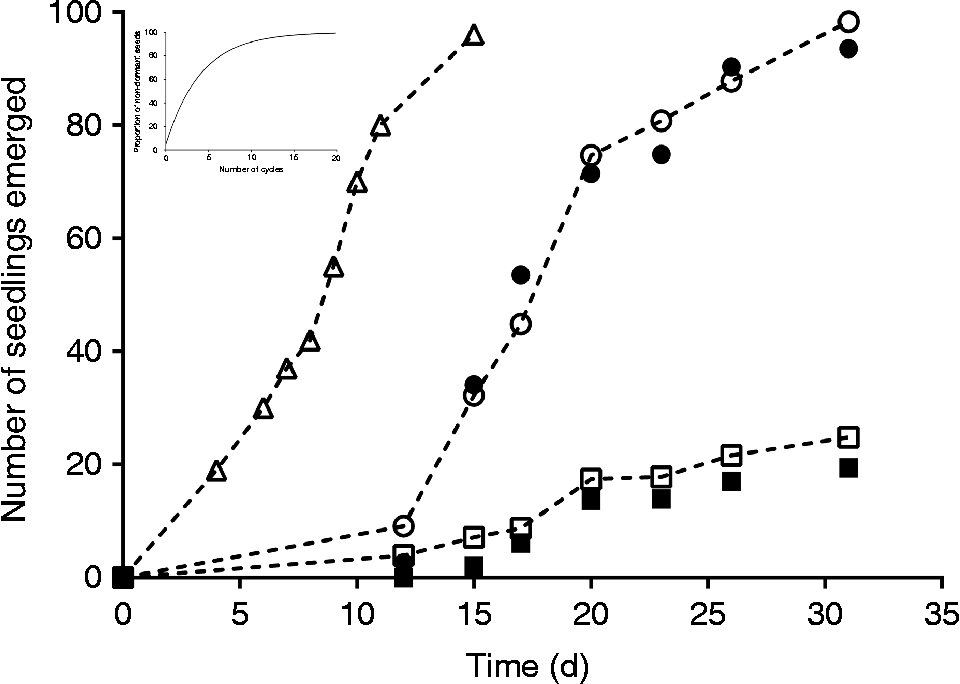
Seed responses to the effect of fluctuating temperatures are widespread (Thompson and Grime, Reference Thompson and Grime1983; Probert, Reference Probert and Fenner1992). Due to the functional considerations discussed above, it becomes clear that the effect of fluctuating temperatures cannot be regarded as any of the other effects of temperature mentioned before (i.e. neither as a dormancy regulator, nor as a modulator of germination rate as considered by the thermal-time theory). The effect of a fluctuating temperature regime will be seen as an increase in the final germination percentage with respect to that obtained under a continuous temperature regime that can be the average of the lower and the higher temperature composing the fluctuating cycle (i.e. 20°C/30°C versus 25°C) or any of the components of the cycle (i.e. 20°C/30°C versus 20°C, or 20°C/30°C versus 30°C). The magnitude of this increase will be related to: (1) the dose at which the factor ‘fluctuating temperatures’ is given; and (2) the sensitivity of the seed population to the effect of the factor, which, in turn, might be a function of its dormancy level. A ‘dose’ of fluctuating temperatures can be different things: Totterdell and Roberts (Reference Totterdell and Roberts1980) identified nine possible stimulatory attributes of fluctuating temperatures (amplitude of the cycle, number of cycles, higher temperature, lower temperature, rate of increase from the lower to the higher and vice versa, time spent at the higher temperature, time spent at the lower) each of which can be regarded as a way of considering a ‘dose’. The number of cycles of a highly stimulating cycle composition (i.e. wide thermal amplitude plus adequate temperatures composing the cycles) has been used frequently as a ‘dose’, particularly for modelling purposes (Benech-Arnold et al., Reference Benech-Arnold, Ghersa, Sánchez and Insausti1990a, Reference Benech-Arnold, Ghersa, Sánchez and Insaustib; Batlla et al., Reference Batlla, Verges and Benech-Arnold2003). Therefore, each time a fluctuating temperature cycle with stimulatory effect (i.e. a dose) is met with by the dormant seed population, a further fraction of the population has its dormancy terminated and begins to respond to temperature according to the thermal-time theory (i.e. it ‘accumulates’ thermal time above T b or below T c until germination is completed). This conceptual approach was used successfully by Benech-Arnold et al. Reference Benech-Arnold, Ghersa, Sánchez and Insausti(1990a) to predict seedling emergence of Sorghum halepense in the field under different thermal situations (Fig. 4). In the model, the fraction of seeds able to germinate (i.e. with its dormancy terminated) in a certain time period is dependent on the number of accumulated stimulatory temperature cycles (Fig. 4 inset), while the germination timing of that fraction is calculated using a thermal-time model. Not taking into account the effect of fluctuating temperatures on dormancy termination produces an erroneous prediction of the seedling emergence dynamics (Fig. 4). This example shows how both temperature effects (i.e. those on dormancy by fluctuating temperature; those on germination of non-dormant seeds) can be treated separately, either for interpretation of results or for modelling.
Cumulative number of emerged seedlings of Sorghum halepense in relation to days from seeding under two different thermal regimes. Circles and squares correspond to observed (full) and simulated (empty) data under bare soil and shaded soil conditions, respectively. Seedling emergence under both conditions were simulated combining the effect of fluctuating cycles on dormancy termination and a thermal-time model for calculating germination timing of the non-dormant seed fraction, according to Benech-Arnold et al. Reference Benech-Arnold, Ghersa, Sánchez and Insausti(1990a). Open triangles represent simulated emergence using just a thermal-time model without accounting for the effect of fluctuating temperatures on dormancy termination (for details see Benech-Arnold et al., Reference Benech-Arnold, Ghersa, Sánchez and Insausti1990a). Inset: Fraction of the seed population liberated from dormancy in relation to the number of cycles of fluctuating temperatures with a stimulatory effect. (Redrawn from Benech-Arnold et al., Reference Benech-Arnold, Ghersa, Sánchez and Insausti1990a, b.)

As mentioned above, the magnitude of an eventual increase in final germination as a result of incubation under fluctuating temperatures, in comparison to that obtained under constant temperature, also depends on the sensitivity of the population to the effect of fluctuating temperatures. It is generally accepted that in seeds that are gradually released from dormancy by low or high temperatures (see above), changes in dormancy also comprise modifications in the sensitivity to the effect of factors that terminate dormancy (i.e. light and/or fluctuating temperatures) (Benech-Arnold et al., Reference Benech-Arnold, Sánchez, Forcella, Kruk and Ghersa2000). This means that a recently shed population, with high dormancy, will not only germinate under an extremely narrow (or non-existing) range of (thermal) conditions, but also will need an extremely high (or infinite) dose of light or fluctuating temperatures to have their dormancy terminated. As the seeds are released from dormancy, lower doses (i.e. fewer cycles of a less-specific composition) will be required to terminate dormancy and, consequently, to obtain a larger germination increment as a result of incubation under fluctuating temperatures, until a point at which a seed population of very low dormancy may not require the fluctuating temperature stimulus to promote germination, and maximum germination values can be achieved under constant temperatures. Batlla et al. (Reference Batlla, Verges and Benech-Arnold2003) measured these changes in the sensitivity of a P. aviculare seed population to the effect of fluctuating temperatures, as the population was gradually released from dormancy by the effect of low stratification temperatures. This study yielded a quantitative dynamic model that predicts the acquisition of sensitivity to fluctuating temperatures by the seed population. But overall, it constitutes an example of the possibility of assessing separately temperature effects on dormancy alleviation and on dormancy termination.
Interpreting mixed effects of temperature on seed dormancy and germination during incubation
In dormancy studies, seeds are generally exposed to treatments that alter their dormancy level, and then, samples of seeds are taken and tested for germination under different conditions, to measure seed dormancy level through the range of conditions allowing seed germination. Behind this type of approach is the assumption that during germination tests the dormancy level of the seeds is not affected or, in other words, that the effect of temperature on seed germination and on seed dormancy is acting at different time scales. However, under many circumstances, particularly when working with seeds of wild species which are very reactive to temperature-dependent dormancy changes, this might not be exactly true, and temperature can be affecting seed dormancy level during germination tests (Batlla et al., Reference Batlla, Grundy, Dent, Clay and Finch-Savage2009; Batlla and Benech-Arnold, Reference Batlla and Benech-Arnold2010; Windauer et al., Reference Windauer, Martinez, Rapoport, Wassner and Benech-Arnold2012). For example, in the case of seeds of some summer annual species (which require cold temperatures under moist conditions to diminish their dormancy level, i.e. stratification) three competing ‘forces’ may exist during the germination test: (1) germination, (2) dormancy release, and (3) dormancy induction; and, depending on the relative strength of each ‘force’, a particular germination dynamics will emerge (Batlla and Benech-Arnold, Reference Batlla and Benech-Arnold2010).
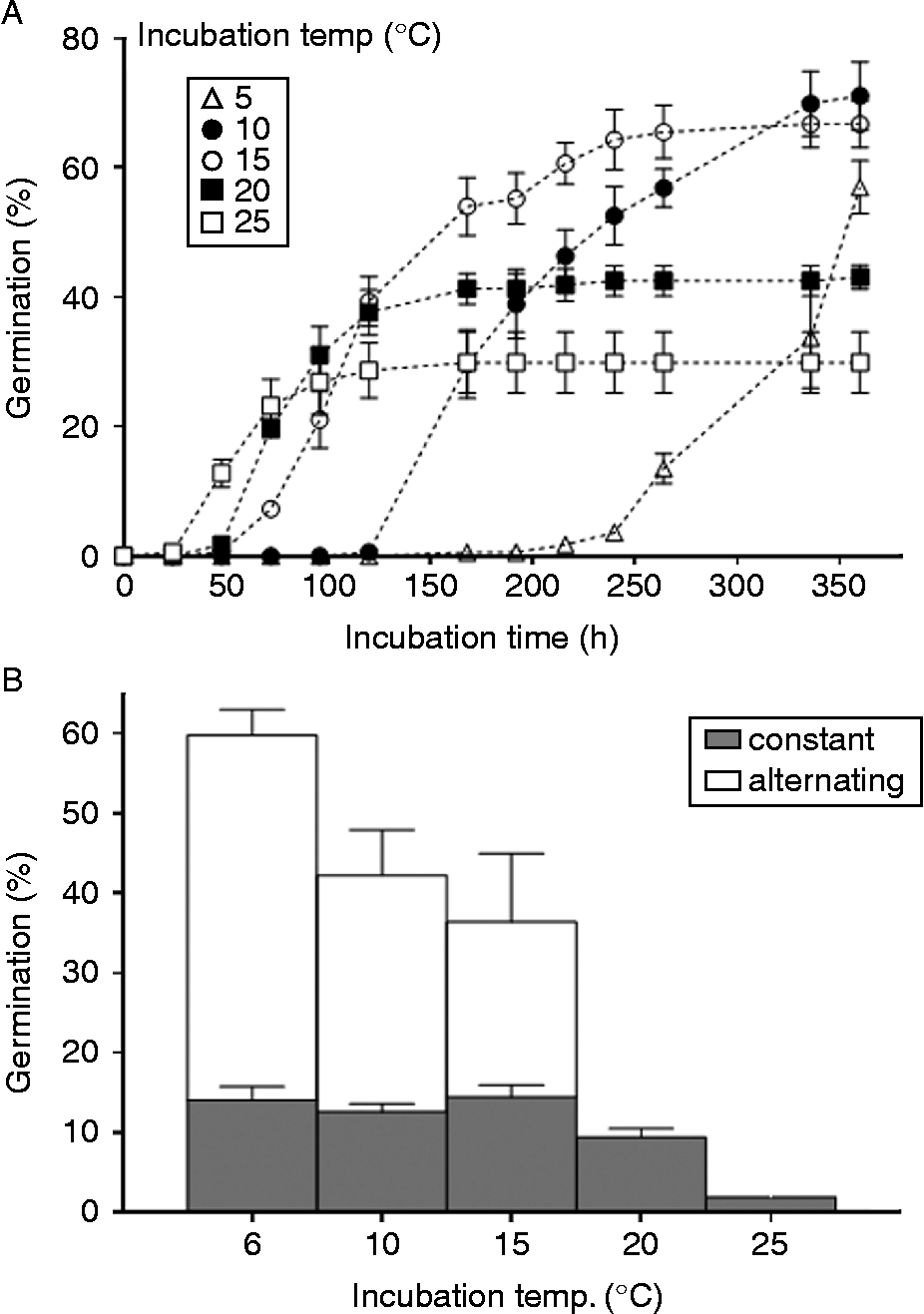
An example is presented in Fig. 5A for germination of previously stratified P. aviculare seeds incubated in water in the range 5 to 25°C. Seeds germinate faster at higher temperatures, for example at 25°C or 20°C than at 15°C or lower; however, maximum germination percentages are obtained at lower temperatures, for example at 10 or 15°C than at 25 or 20°C. This type of germination behaviour, in which under the sub-optimal thermal range (between T b and T o) maximum germination rate and percentage are obtained at different temperatures, is typical of partially dormant seeds (Roberts, Reference Roberts, Long and Woodward1988) and does not match the common thermal regulation of germination observed in non-dormant seeds, in which under the optimum germination temperature seeds also achieve maximum germination percentage. Therefore, this type of germination behaviour could not be described by available germination models developed for non-dormant seeds, as for example the thermal-time model (equation 1). A similar germination temperature-dependent response pattern prevented the accurate prediction of seed germination of the summer annual weed Datura ferox using the hydrothermal-time model in Dorado et al. (Reference Dorado, Fernández-Quintanilla and Grundy2009).
(A) Germination dynamics of Polygonum aviculare seeds stratified at 5°C for 70 d then incubated at different temperatures in the range 5–25°C. (B) Germination of P. aviculare seeds stratified at 2°C for 57 d then incubated for 15 d at constant temperature (6, 10, 15, 20 or 25°C) +15 d at a fluctuating temperature regime of 6/22°C (12/12 h). Grey bars correspond to germination percentage obtained after incubation at constant temperatures. White bars correspond to germination percentage obtained after further incubation at fluctuating temperatures (adapted from Batlla et al. Reference Batlla, Grundy, Dent, Clay and Finch-Savage2009). Vertical bars indicate standard errors in both panels.

In the case of incubation at high temperatures (25 and 20°C in the cited example), there are two competing processes: (1) germination and (2) induction into secondary dormancy. Germination dynamics of seeds incubated at 25 and 20°C showed a fraction of the seed population germinating at relatively high rates until a sudden fall in the germination rate finally stops seed germination (Fig. 5A). This clearly shows that just the speediest fraction of the seed population germinates, while the remaining seeds in the population are rapidly induced into secondary dormancy, stopping the germination process. At lower temperatures the opposite is seen. For example, in seeds incubated at 5°C two process are taking place: (1) germination and (2) dormancy release. Germination percentage for seeds incubated at 5°C showed almost an exponential increase between 240 and 350 h of incubation, suggesting that dormancy release is taking place during incubation at low temperatures, thus increasing germination rate beyond that expected based on the effect of incubation temperature on the germination process alone (Fig. 5A). It should be noted that seeds that did not germinate during incubation at the different temperatures do so if they are exposed to alternating temperatures after an extended dormancy-releasing treatment (i.e. stratification for 4 months).
The same effect was observed when previously stratified seeds were exposed to a fluctuating temperature regime of 6/22°C after being incubated for 15 d at different constant temperatures (Batlla et al., Reference Batlla, Grundy, Dent, Clay and Finch-Savage2009) (Fig. 5B). The fraction of the seed population able to respond to the fluctuating temperature regime (the fraction sensitive to fluctuating temperatures) was dependent on the temperature experienced by seeds during previous incubation. The higher the previous constant incubation temperature, the lower the subsequent response to the fluctuating temperature regime, indicating that while higher incubation temperature induces seeds into secondary dormancy, decreasing their sensitivity to fluctuating temperatures, lower incubation temperatures decrease the seed population dormancy level, increasing subsequent sensitivity to fluctuating temperatures.
An effect of induction of secondary dormancy on germination dynamics during incubation of Jatropha curcas seeds at temperatures above 25°C was also reported by Windauer et al. (Reference Windauer, Martinez, Rapoport, Wassner and Benech-Arnold2012). Using the hydrotime model (for details, see Gummerson, Reference Gummerson1986; Bradford, Reference Bradford1990, Reference Bradford, Kigel and Galili1995) to analyse germination of J. curcas seeds at different temperatures and water potentials, these authors found that base water potential of the seed population (Ψb; the water potential below which germination does not take place) for seeds incubated at 30°C should be displaced towards more positive values to match observed germination curves at water potentials below 0 MPa. This displacement of Ψb to more positive values as incubation time prior to germination at 30°C was prolonged by a low water potential incubation medium, suggests induction into secondary dormancy under these conditions. This was further confirmed with an additional temperature transference experiment to show a role of high incubation temperatures on induction into secondary dormancy: incubation of seeds for 48 h at temperatures of 30 and 35°C provoked a decrease in subsequent germination after incubation at 25°C for 18 d, in relation to that obtained when seeds were incubated at constant 25°C. This work showed not only how dormancy induction during incubation can be affecting final germination percentage, but also that the effect of dormancy induction during incubation can be accounted for by a displacement of Ψb of the seed population. Preliminary work done by Batlla and Benech-Arnold (Reference Batlla and Benech-Arnold2011) with P. aviculare seeds also suggested that changes in seed dormancy level on germination dynamics during incubation can be accounted for by shifting Ψb during incubation.
Based on the above considerations in relation to the ‘forces’ that can be affecting seed germination dynamics, we propose an explanation for observed changes in the thermal range permissive for seed germination during dormancy release and induction in summer annual species presenting dormancy. During dormancy release there is an increase in seed germination potential, while during dormancy induction there is a decrease of this potential. This increase in seed germination potential joined to dormancy release ‘forces’ at low incubation temperatures increase germination capacity at low temperatures, ‘pushing’ distribution of T l to lower temperature ranges. Germination potential also increases at high temperatures (it increases at all temperatures between T b and T c), but the counteracting effect of dormancy induction makes changes in T h much lower. This may explain why, in summer annual species, dormancy changes are expressed as modifications in the capacity of the seeds to germinate at lower temperatures (i.e. changes in T l), while minor changes are observed in relation to germination at higher temperatures (Fig. 2). Finally, at those temperatures at which germination is maximal (i.e. the thermal range at which dormancy is not expressed), the increase in germination potential is expressed as an increase in the speed of germination.
These results show that seed scientists should be very careful when interpreting germination data in wild species, in which germination and dormancy ‘forces’ could be affecting germination dynamics during incubation. The possibility to correctly interpret the effect of temperature on dormancy from that on germination is of paramount importance if we intend to develop models able to simulate the effect of temperature on dormancy and germination for wild species (Batlla and Benech-Arnold, Reference Batlla and Benech-Arnold2010). Moreover, confounding temperature effects on dormancy and germination can lead to erroneous interpretation of results obtained from physiological and/or molecular studies.
Finally, another possible confusion in relation to dormancy and germination is due to the presence of residual dormancy, which is very common in many cultivated species. Although cultivated species have been heavily selected against dormancy during domestication, in many genotypes some residual dormancy can be present, which can affect germination during incubation. In sunflower, for example, achenes usually present a relatively high dormancy level at harvest, which gradually diminishes during storage through dry afterripening. In some genotypes, depending on the storage conditions, the rate of reduction in achene dormancy level can be very low, and some degree of coat-imposed dormancy can be expressed when achenes are incubated at low temperatures, even 1 year after harvest (Bodrone, Reference Bodrone2014). This residual dormancy can affect the determination of temperature-related germination parameters, for example T b for seed germination.
Even in seeds from crops that do not usually present dormancy, there is evidence indicating that residual dormancy can be affecting germination at temperatures closer to the lower or maximum threshold temperatures for seed germination. This seems to be the case with maize grains, in which a residual dormancy that is expressed at a temperature close to T b appears to explain the poor germination of some maize genotypes at low temperatures (Benech-Arnold et al., Reference Benech-Arnold, Batlla, Vázquez-Ramos and Prioul2012). In this respect, data from Batlla and Padilla (Reference Batlla and Padilla2006) showed that germination percentage at low incubation temperatures (6°C) can be significantly improved by the addition of GAs to the incubation medium. Additionally, incubation of maize grains in the presence of paclobutrazol (a GA synthesis inhibitor) delays germination at 10°C, while incubation in the presence of fluridone (an ABA synthesis inhibitor) improves maize seed germination rate at this temperature. These latter results, obtained at an incubation temperature of 10°C, indicate that dormancy changes due to manipulation of hormone levels are not expressed as a reduction in the obtained final germination percentage, but as a delay in germination as compared to that of a seed lot showing no dormancy.
Concluding remarks
In the above paragraphs we have attempted to present a conceptual framework, with the aim of allowing an easier discrimination of the effect of temperature on dormancy from those on germination, and we showed some examples in which both processes can be confounded, giving erroneous analysis of obtained germination data. If incubated seeds do not achieve maximum germination under a certain incubation temperature or temperature range, excluding the possibility of seed death, we can suspect that dormancy is expressed under those conditions (this can be further tested by the addition of germination-stimulating substances, i.e. GA, to the incubation media). This situation cannot be analysed using just a thermal-time model approach, assuming a unique T b for the seed population; instead we propose to use the concept of limit temperatures for seed germination (T l and T h). These parameters are related to the expression of dormancy at different temperatures and are distributed within the seed population. Germination timing for the seed fraction with a T l or T h, lower or higher than T, respectively, can be accounted for by ‘accumulating’ thermal time above T b or below T c, as is usually done for non-dormant seeds. This approach allows us to analyse separately those parameters related to the effect of temperature on germination from those on dormancy. On the other hand, fluctuating temperature effects can be interpreted as a factor, the dose of which terminates dormancy in a certain fraction of the seed population. Once dormancy is terminated for that fraction (i.e. it is non-dormant) germination timing can be calculated based on a thermal time approach. Finally, when maximum germination rate and percentage are recorded at different temperatures, or when germination rate at low temperatures is higher than that expected based on a thermal-time analysis of germination at higher temperatures, dormancy induction and release, respectively, can be suspected of affecting seed germination dynamics during incubation time; this can be further tested by performing temperature transference experiments.
It is not our intention to claim here that the proposed framework is the only way of analysing the above-described situations, but we believe that the presented approach can help researchers in the analysis of germination data obtained from seed populations showing dormancy.
Acknowledgements
The authors would like to thank Dr Verónica Rodríguez for critical reading of previous versions of the manuscript and helpful comments.
Financial support
This work was supported by the Consejo Nacional de Investigaciones Científicas y Técnicas (PIP 0504/11) and Universidad de Buenos Aires (UBACYT 20020130100874BA and 20020130100653BA).
Conflicts of interest
None.