1. Introduction
This article explains the different responses of the stock returns of some economic sectors to inflation announcements by considering two important factors in decisions about economic policy. These two factors should explain, to some extent, the relationship between stock returns and inflation news using event-study methodology.
This study includes two innovative variables: core inflation (measured by the CPI–consumer price index–removing non-manufactured products and energy) and the spread between the Spanish and European inflation rates (harmonized). The latter grants knowledge of how much the Spanish inflation rate diverges from the European inflation rate; additionally, this variable has major implications for the economy.
This analysis aims to study whether these proposed variables lead to the same effects in all economic sectors. The study hypothesizes that, during the inflation announcement, not only is the increase or decrease of the inflation rate important, but so is the gap between Spanish and European inflation rates.
The event-study method literatureReference Barrett, Gosnell and Heuson 1 – Reference Telatar and Hasanov 7 includes this research and analyses how unexpected inflation news affects stock returns according to sector in the Spanish economy. To this end, the study takes into account aspects such as the direction of the inflation surprises and the state of the economy. Additionally, this research contributes to the previous literature by including two innovative variables: the spread between Spanish and European inflation rates, and core and ‘non-core’ inflation rate components.
The rest of the article is organized as follows. The second section includes a literature review about event-study methodology. Section 3 reviews the data used for the research: core inflation, spread between Spanish and European inflation rates, and stock returns. The fourth and fifth section show an analysis of the short-term response of the stock returns by sector to unanticipated components of inflation announcements using the event-study methodology. Section 6 analyses the long-term response and seventh and final section includes a summary of the main results and conclusions.
2. Literature Review
Using time-series event-study methods, much of the previous literature provides evidence that stock returns show significant responses to announcements of, among other results, profits, sales, and dividends: microeconomic news. Therefore, firm-specific news points to the probable path of future profits and thus affects the expected current value of future profits for stockholders. Some of the previous literature, however, defends the idea that stock returns react in response to macroeconomic surprises, which indicates the present state of the economy. Market participants take into account the publication of announcements about macroeconomic data, and this fact suggests a close relationship between movements of stock prices and these macroeconomic announcements.
Some studies use this approach to analyse repercussions of some macroeconomic announcements on returns of different market indexes, interest rates, or stocks. These studies examine the linearity and asymmetry of responses by considering macroeconomic news, and the path, speed, and stability of responses (see, for instance, Refs Reference Andersen, Bollerslev, Diebold and Vega8–Reference Pearce and Solakoglu13).
When one analyses the relationship between inflation rates and stock returns using the time-series event-study methodology, one should take into account the ‘efficient market’ hypothesis. Considering this hypothesis allows for some assessment of the efficiency of financial markets in processing information. The ‘efficient market’ hypothesis predicts that asset prices only respond to the unexpected component of new data, or ‘news.’
According to this hypothesis, stock prices should only respond to unexpected changes in inflation announcements (which are really news), as stock prices already include the expected component of inflation announcements. Therefore, investors only respond to new and relevant information about the market, checking their expectations about future cash flows and company value; thus, stock prices reflect this information. This response to inflation news should occur immediately in an efficient market. If private information exists, stock prices reflect this response because the market reacts to news before its official publication. Finally, there is no consensus over the efficiency of the market. Nevertheless, most of the empirical literature supports the weak efficient market hypothesis, meaning that stock prices generally move whenever new and relevant information arrives in an inflation announcement. This adjustment also depends on the sector of activity and the stock size.
On the one hand, some studies assume that the interpretation of the macroeconomic announcements depends on the context in which the market receives the news; that is, the recent direction of the market or the recent state of the economy may influence investors’ response to new information (‘behavioural finance hypothesis’Reference Veronesi 14 ). Studies such as those by Adams et al.Reference Adams, McQueen and Wood 15 and VeronesiReference Veronesi 14 report that the market should perceive any increase in inflation rates as ‘bad news’ during expansions, as this situation could result in fears of an overheating economy. Nevertheless, during recessions, the market interprets the same increase as ‘good news’ because economic agents think the economy is growing above expectations. That is, the positive inflation surprise could indicate both the end of the depression and higher forecasts of firms’ cash flows; thus, one should expect an increase of stock prices and returns. In addition, prices seem to overreact to ‘bad news’ during good times. Docking and Koch,Reference Docking and Koch 16 who include market volatility in the interpretation of macroeconomic announcements, qualify this position.
By contrast, Estep and HansonReference Estep and Hanson 17 propose that the relationship between stock returns and unexpected inflation news depends on the ability of firms to transmit inflation shocks to the prices of the products and services sold by the company – ‘flow-through hypothesis’.Reference Díaz and Jareño 4 , Reference Asikoglu and Ercan 18 – Reference Jareño and Navarro 20 Companies with a high flow-through coefficient should have the ability to reflect inflation rate changes in their product prices and thus ‘flow through’ the effects of inflation to customers. These companies should be less inflation sensitive than companies with a low flow-through coefficient.
This study of the relationship between unanticipated inflation news and stock returns uses event-study methodology and assumes that investors’ reactions could be sensitive to a combination of factors such as the nature of the news (good or bad), the state of the economy, or the flow-through ability of each sector of activity.Reference Telatar and Hasanov 7
Various recent analyses support the importance of the two selected variables: core inflation and the spread between Spanish and European inflation. In recent years, the main purpose of monetary policy has been price stability, and several central banks have implemented inflation-targeting policies. The previous literature has developed many methods of analysing inflation, mainly either measures of core inflation or those derived from the harmonized index of consumer prices (HICP). For instance, Cristadoro et al.Reference Cristadoro, Forni, Reichlin and Veronese 21 propose a new core inflation indicator for the Euro Area, which they estimate by cleaning monthly price changes from short-run volatility, idiosyncratic risk and measurement errors. HahnReference Hahn 22 estimates core inflation in the Euro Area using a structural vector autoregressive (VAR) approach; in his opinion, HICP sometimes proves a misleading indicator of monetary policy. Considering that core inflation plays an important role in the deliberations of monetary policymakers, Vega and WynneReference Vega and Wynne 23 evaluate a number of measures of core inflation constructed using euro-area data; they also focus on core measures derived from the HICP both because the European Central Bank has chosen to define its mandate for price stability in terms of this index and because this index is the only measure of consumer prices comparable across all members of the European Union. Cogley 24 as well as Bagliano and MoranaReference Bagliano and Morana 25 also propose some estimates of core inflation. In the Spanish case, López-Salido, Restoy, and VallésReference López-Salido, Restoy and Vallés 26 study the determinants and macroeconomic implications of persistent inflation differentials in Spain within the EMU, using some descriptive evidence and simulation exercises.
On things outside of the EU, remarkable articles include Hogan, Johnson, and LaflècheReference Hogan, Johnson and Laflèche 27 and Bauer, Haltom, and Peterman.Reference Bauer, Haltom and Peterman 28 The latter analyse the composition of inflation in the United States over time, and they examine the drop in core inflation over the analysed period (2002–2003). Ultimately, they find that relative price changes of two components explain this decrease in core inflation. In addition, Peach et al.Reference Peach, Rich and Antoniades 29 study the growing gap between the rate of increase of goods and services prices, as the latter tend to increase faster than the former. In this analysis, they use core inflation excluding food and energy components. Finally, Cecchetti and WynneReference Cecchetti and Wynne 30 emphasize that HICP is very important when central banks define the monetary policy strategy and the main purpose of price stability.
The previous literature supports this study in its inclusion of these two variables (core inflation and the spread between Spanish and European inflation) and, specifically, its use of the spread between Spanish and European inflation rates as the main explanatory factor. This study goes further in proposing to split the total inflation rate into the core and ‘non-core’ inflation rate components.
3. Data
3.1. Core Inflation
Most of the literature considers core inflation (underlying inflation) to be the persistent component of the inflation rate, and this study obtains this inflation measure by removing the impact of goods and services with the most volatile prices from the CPI (Consumer Price Index), that is, non-manufactured products and energy. Therefore, core inflation is the long-run component and the most persistent trend in the total inflation rate.
To analyse the repercussion of unexpected inflation changes on stock returns, this research uses monthly announcements of the Spanish consumer price index (IPC) and distinguishes between underlying/core and ‘non-underlying/non-core’ components – released by the Instituto Nacional de Estadística (INE) – and the exact date of each announcement between February 1995 and December 2004 in the short-term analysis (event-study analysis). Nevertheless, data from February 1993 factors into the long-term analysis.
The study features 119 IPC monthly announcements and, to remove the seasonal component of the IPC series, uses a year-to-year inflation rate. Therefore, the study obtains the monthly inflation rate after seasonal adjustment (π t ) using the following expression:
 $$\pi _{t} ={{IPC_{t}^{{}} {\minus}IPC_{{t{\minus}12}}^{{}} } \over {IPC_{{t{\minus}12}}^{{}} }}$$
where IPC t is the consumer price index at time t.
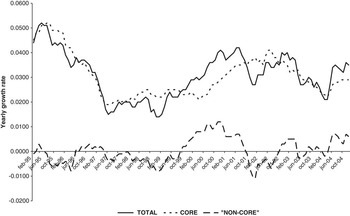
Figure 1 plots the evolution of the total inflation rate and its two components, core and ‘non-core’ inflation, and shows the non-stationarity of the three variables. 31
Evolution of the total inflation rate and its two components, core and ‘non-core’ inflation.

Following Leiser and Drori,Reference Leiser and Drori 32 this research uses a naïve model (‘myopic expectations’) that assumes that the best forecast of the inflation rate coincides with the information of the previous month. 33 Therefore, unexpected changes in inflation rate equal total changes in the expected inflation rate, ΔE t (π t,t+12), that is,
 $$\Delta E_{t} \left( {\pi _{{t,{\rm }t{\plus}12}} } \right)=\left\lfloor {E_{t} \left( {\pi _{{t,{\rm }t{\plus}12}} } \right){\minus}E_{{t{\minus}1}} \left( {\pi _{{t{\minus}1,{\rm }t{\plus}11}} } \right)} \right\rfloor =\pi _{{t{\minus}12,{\rm }t}} {\minus}\pi _{{t{\minus}13,{\rm }t{\minus}1}} $$
Additionally, this research can decompose the total inflation rate into two parts, core and ‘non-core’ inflation. Thus, the following equation can express the total change of expected inflation rate:
 $$\Delta E_{t} \left( {\pi _{{t,{\rm }t{\plus}12}} } \right)=\Delta E_{t} \left( {\pi _{{t,{\rm }t{\plus}12}}^{C} } \right){\plus}\Delta E_{t} \left( {\pi _{{t,{\rm }t{\plus}12}}^{{NC}} } \right)$$
where π C t,t+12 is core inflation rate and π NC t,t+12 is ‘non-core’ inflation.
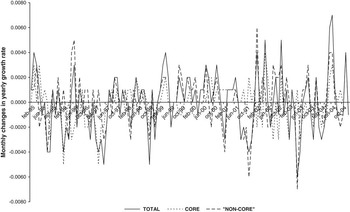
Figure 2 displays the evolution of the inflation rate changes and its core and ‘non-core’ components. Therefore, these series are stationary in mean.
Evolution of the inflation rate changes and its core and ‘non-core’ components.

3.2. Spread between Spanish and Euro Area HICP
This work also uses data about the Spanish and Euro Area harmonized index of consumer prices (HIPC) released by the statistical office of the European communities (EUROSTAT) and hypothesizes that the exact date of this announcement coincides with the Spanish core inflation announcement. 34
The HICP data cover the same period as core inflation data, that is, from February 1995 to December 2004, so this work relies on 119 HICP monthly announcements. To remove the seasonal component of the HICP series, this study uses a year-to-year inflation rate. Therefore, the work obtains the Spanish and Euro Area monthly harmonized inflation rate after seasonal adjustment (π t ) using the following expression:
 $$\pi _{t} ={{HICP_{t}^{{}} {\minus}HICP_{{t{\minus}12}}^{{}} } \over {HICP_{{t{\minus}12}}^{{}} }}$$
where HICP t is the harmonized index of consumer prices at time t.
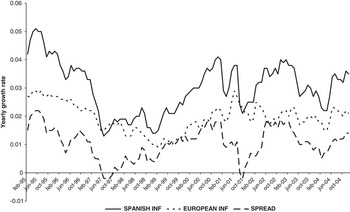
Figure 3 plots the evolution of Spanish and European harmonized inflation rates and the spread between the two. This study obtains the latter as follows:
 $$E_{t} \left( {spread_{{t,{\rm }t{\plus}12}} } \right)=E_{t} \left( {\pi _{{t,{\rm }t{\plus}12}}^{S} } \right){\minus}E_{t} \left( {\pi _{{t,{\rm }t{\plus}12}}^{{EA}} } \right)$$
where π S t,t+12 is the Spanish and π EA t,t+12 the Euro-Area harmonized inflation rate. This spread is normally positive in this study’s sample, so the Spanish harmonized inflation rate is higher than the European one.
Evolution of Spanish and European harmonized inflation rates and the spread between them.

The analysis of this work focuses on examining the repercussion of changes in the spread between Spanish and European harmonized inflation rates on stock returns. Therefore, the study again assumes economic agents with myopic expectations, which Leiser and DroriReference Leiser and Drori 32 consider a realistic hypothesis. Thus, the best forecast of harmonized inflation rate coincides with the information of the previous month:
 $$E_{t} \left( {\pi _{{t,{\rm }t{\plus}12}} } \right)=\pi _{{t{\minus}12,{\rm }t}} $$
One can express changes in the spread between the Spanish and Euro-Area harmonized inflation rates as follows:
 $$\Delta E_{t} \left( {spread_{{t,{\rm }t{\plus}12}} } \right)=\Delta E_{t} \left( {\pi _{{t,{\rm }t{\plus}12}}^{S} } \right){\minus}\Delta E_{t} \left( {\pi _{{t,{\rm }t{\plus}12}}^{{EA}} } \right)$$
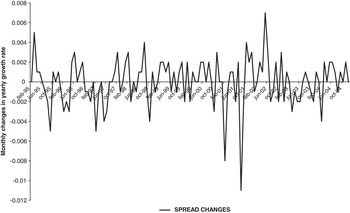
One can observe the evolution of changes in this spread in Figure 4, which indicates that the change in this study’s spread is a stationary series. This work assumes that positive changes in this spread convey higher changes in the Spanish HICP than in the European HICP and vice versa.
Evolution of changes in the spread between Spanish and Euro Area harmonized inflation rates.

3.3. Returns by Sector
For the same sample period of inflation data (February 1995 to December 2004), this study obtains daily (close-to-close) returns of 115 individual companies traded on the electronic system of the Spanish Stock Exchange, SIBE. 35 This work considers all Spanish companies quoted during some period in the sample to avoid a possible survival bias of considering only the companies that cover the whole sample. Also, this work removes foreign companies quoted in the Spanish Stock Exchange from the sample. This study uses daily data; thus, this research can isolate the IPC announcement effects from any other macroeconomic announcements during the month.Reference Adams, McQueen and Wood 36 Finally, this study verifies that, in general, the Spanish Economy does not publish announcements about other macroeconomic magnitudes on the announcement day and during the event window.
This study’s sample includes 115 Spanish companies, creating daily equally weighted sector-based stock portfolio returns, aggregating by industry on an equally weighted basis to obtain the series of monthly returns for each sector. 37 The research uses the Madrid Stock Exchange sector definition scheme (see Table 1) and calculates a daily equally weighted total market return as a proxy of the market return (M). 38
Number of companies included in this analysis and the sector to which they belong.

4. Short-term Response of Stock returns to Inflation Announcements
Most of the literature about the event-study methodology focuses not only on the announcement day but also on the two previous and two following days. Therefore, this study builds an ‘event window’ that contains five days: the announcement day (t j ), two days before the announcement day or ‘pre-announcement period’ (t j –1 and t j –2), and two days after the announcement or ‘post-announcement period’ (t j +1 and t j +2). The ‘pre-event window’ contains the days between two consecutive event windows (t j–1+3, t j –3).Reference Mestel and Gurgul 39
This work estimates returns corrected by the expected return, that is, abnormal returns, to eliminate possible effects beyond inflation announcements. The literature uses multiple alternative approximations to obtain the expected return, but all of them base themselves on pricing models (the market model, the Capital Asset Pricing Model, Conditional CAPM, the Fama and French three-factor models, and so on). Thus, this study avoids making the results conditional on the hypotheses of the pricing model. Rather, this study estimates the expected return with its unbiased estimator; that is, this work computes abnormal returns, ar i (t), for each day inside the event window, from two days before (t j –2) to two days after (t j +2) the IPC announcement (t j). The abnormal return of sector i on the day t j +k, ar i (t j +k), (i=S1, S2, …, S6, M; and k=–2, …, +2) constitutes the difference between the observed return (ex-post return) on day t j +k, r i (t j +k) and the expected return of the sector in the absence of an inflation event, E[r i (t j )]. One can estimate this expected return as the average daily return of the sector during the days out of the last four event windows:
 $$ar_{i} \left( {t_{j} {\plus}k} \right)=r_{i} \left( {t_{j} {\plus}k} \right){\minus}E\left[ {r_{i} \left( {t_{j} } \right)} \right]=r_{i} \left( {t_{j} {\plus}k} \right){\minus}{{\mathop{\sum}\limits_{\tau =t_{{j{\minus}3}} {\plus}3}^{t_{j} {\minus}3} {r_{i} \left( \tau \right)} } \over {\mathop{\sum}\limits_{\tau =t_{{j{\minus}3}} {\plus}3}^{t_{j} {\minus}3} {t_{\tau } } }}$$
where
 $$\tau \notin\left( {t_{h} {\minus}2,{\rm }t_{h} {\plus}2} \right)$$
in the last four announcements is (h=–3, –2, –1, 0).
Having calculated these abnormal returns by sector, which homogenizes the average returns of different sectors, the next part of this study analyses the existence of some behavioural norms by taking into account the sector of activity.
4.1. Response of Stock Returns by Sector to Inflation Announcements, Taking into Account Core and ‘Non-Core’ Inflation Rate Components
This section proposes this work’s model for analysing the abnormal returns response to inflation rate movements, distinguishing between core (without taking into account non-manufactured products and energy) and ‘non-core’ inflation rates.
The estimated model is as follows:
 $$ar_{j} (t)=\alpha _{j} {\plus}\beta _{{j1}} \cdot\Delta \pi _{t}^{C} {\plus}\beta _{{j2}} \cdot\Delta \pi _{t}^{{NC}} {\plus}u_{{jt}} $$
where ar j (t) represents the abnormal returns of sector j on each period t, π C t is core inflation, π NC t is the ‘non-core’ component of the inflation rate, and u jt is the error term of sector j (assuming ‘myopic expectations’).
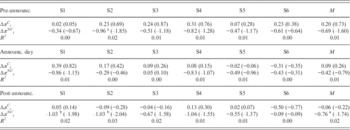
Table 2 shows the results of the estimation of model 10, using the ‘seemingly unrelated regression’ technique (SUR) and taking into account heteroscedasticity and the possible contemporaneous correlation in the error terms across equations.
Response by sector to inflation announcements taking into account core and ‘non-core’ inflation rate components.

S1, S2…, S6, M: each sector and the total market. In the expressions: ar;
j
(t) is the abnormal returns of sector j in each period t, π
C
t
is core inflation, π
NC
t
is the ‘non-core’ component of the inflation rate, and u;
jt
is the error term of sector j (assuming ‘myopic expectations’). Sample: Feb. 1995–Dec. 2004 (SUR estimation):
 $$ar_{j} (t)=\alpha _{j} {\plus}\beta _{{j1}} \cdot\Delta \pi _{t}^{C} {\plus}\beta _{{j2}} \cdot\Delta \pi _{t}^{{NC}} {\plus}u_{{jt}} $$
t-statistics in parentheses: a p<0.10, b p<0.05, c p<0.01
These results resemble those of Díaz and Jareño,Reference Díaz and Jareño 3 , Reference Díaz and Jareño 4 albeit this research decomposes the inflation rate into core and ‘non-core’ inflation rate components. This study finds relevant differences in the sign and value of the estimated coefficients of different sectors, mainly in the pre- and post-announcement periods.
As expected, this study finds a stable behaviour among sectors, characterized by a negative response of the stock returns to inflation changes when focusing on ‘non-core’ inflation (i.e. the most volatile component of the inflation rate). Also, this negative response is statistically significant in the pre-announcement period (two previous days) in sector 2, ‘Basic Materials, Industry and Construction’, and in the post-announcement period (two following days) in sector 1, ‘Oil and Energy’, sector 2 and the total market (M).
On the other hand, all sectors demonstrate positive responses to inflation changes if one analyses core inflation in the two days before the announcement (pre-announcement period). On the announcement day, the stock-return response is also positive, except in sectors 5 and 6, ‘Financial and Real State Services’ and ‘Technology and Telecommunications,’ respectively. Finally, in the two days after the announcement (post-announcement period), three sectors show a positive response (S1, S4: ‘Consumer Services,’ and S5) to core inflation movements, whereas the other three sectors show a negative response (S2, S3: ‘Consumer Goods,’ and S6) to core inflation movements.
Therefore, most stock returns by sector mainly show negative coefficients to ‘non-core’ inflation changes, so companies of these sectors seem to have low flow-through ability with regard to the ‘non-core’ component of the inflation rate (the most volatile component). Sector 2 appears the most sensitive sector to ‘non-core’ inflation changes, showing a high level of statistical significance.
5. Response of Stock Returns by Sector to Inflation Announcements, taking into Account Core and ‘Non-Core’ Inflation Rate Components and the Spread between Spanish and European HICP, according to the Direction of the News and the State of the Economy
This study’s analysis also contributes to the literature in this area because this work includes the spread between Spanish and Euro-Area harmonized inflation rates. This research proposes an innovative explanatory variable in its analysis of the stock return response by sector: the distance or differential between the HICP registered in Spain and the Euro Area. Therefore, the analysis of this study features a measure of Spain’s approximation to or distance from the European inflation level.
First, this study tracks the correlation matrix between the explanatory variables and observes a high correlation (nearly 40%) between changes in both the spread and the two components of the inflation rate (core and ‘non-core’). To avoid the possible existence of multicollinearity between the explanatory variables, much of the previous literature usually uses an orthogonalization procedure. Therefore, this study regresses its spread measure on a constant and the unexpected changes of the two inflation rate components (core and ‘non-core’) using OLS (ordinary least squares) estimation. Therefore, the present research isolates the effect of each factor, and the residuals capture the movement that remains: 40
 $$\Delta spread_{t}^{{}} =a{\plus}b\cdot\Delta \pi _{t}^{C} {\plus}c\cdot\Delta \pi _{t}^{{NC}} {\plus}{\varepsilon}_{t} $$
Many previous studies show that stock returns do not respond significantly to unexpected inflation changes, but they do not distinguish between positive and negative surprises, indicating an insignificant net effect. Andersen et al.Reference Andersen, Bollerslev, Diebold and Vega 8 argue that ‘bad news’ has greater impact than ‘good news’ after macroeconomic announcements, that is, that a sign effect characterizes the adjustment response pattern of foreign exchange rates. This study thus considers positive inflation surprises (‘bad news’ in the literature, i.e. total inflation higher than expected inflation) and negative surprises (‘good news,’ i.e. total inflation lower than anticipated inflation) separately.
To check these asymmetric effects, this study applies two modifiers to its dummy variables. These modifiers represent a positive spread (between Spanish and European inflation rates) or ‘bad news’ (D ∙ + ) and a negative spread or ‘good news’ (D ∙ − ), and they take on the following values:
 $$D_{{\bullet}}^{{\plus}} =\langle \matrix{ {1,{\rm if }\Delta spread_{t} \gt 0} \cr {0,{\rm if }\Delta spread_{t} \lt 0} \cr } \quad \quad \quad D_{{\bullet}}^{{\minus}} =\langle \matrix{ {1,{\rm if }\Delta spread_{t} \lt 0} \cr {0,{\rm if }\Delta spread_{t} \gt 0} \cr } $$
Authors such as Adams et al.,Reference Adams, McQueen and Wood 15 Docking and KochReference Docking and Koch 16 and Veronesi,Reference Veronesi 14 using arguments of the ‘behavioural finance’ hypothesis (BFH), declare that the interpretation of macroeconomic announcements depends on the context in which the market receives the news. In the case of inflation rate news, one should perceive any increase in this variable as ‘bad news’ during expansions, as this bad news could result in fears of an overheating economy. Nevertheless, during recessions, one could consider the same increase as ‘good news’ because economic agents think that the economy is growing above expectations. This situation could indicate higher forecasts of the firms’ cash flows, so one should expect an increase of stock prices and returns.
The current research examines a possible different response of abnormal stock returns by sector in the Spanish economy to unexpected changes in the spread between Spanish and Euro-Area inflation rates, depending on the direction of the inflation surprises and the state of the economy. Therefore, this study, in an effort to classify the economic activity by levels, follows McQueen and Roley’s methodology.Reference McQueen and Roley 41 , 42
To control for the state of the economy, this study includes two modifiers in the dummy variables: D H (‘High’) and D NH (‘Non-High’). Each dummy is equal to one if economic activity in month t belongs to the corresponding state (‘high’ in the first one, and ‘medium’ or ‘low’ in the second one) and zero otherwise. 43 As in previous research, the current research combines the medium and low states of the economy to have enough observations.
This study checks for a possible different response of abnormal stock returns by sector in the Spanish economy to changes in its spread measure depending on the direction of the inflation surprises and the state of the economy (i.e. accounting for whether Spanish inflation is nearer to or farther from Euro-Area inflation). This research assumes that investors’ interpretations of inflation announcements differ between periods of expansion and recession. Therefore, this study proposes the following model:
 $$\eqalignno{ ar_{j} \left( t \right)= \,& \alpha _{j} {\plus}\beta _{{j1}} \cdot\Delta \pi _{t}^{C} {\plus}\beta _{{j2}} \cdot\Delta \pi _{t}^{{NC}} {\plus}\beta _{{j3}} \cdot D_{H}^{{\plus}} \cdot\left| {\Delta spread_{t} } \right| \cr & {\plus}\beta _{{j4}} \cdot D_{{NH}}^{{\plus}} \cdot\left| {\Delta spread_{t} } \right|{\plus}{\plus}\beta _{{j5}} \cdot D_{H}^{{\minus}} \cdot\left| {\Delta spread_{t} } \right|{\plus}\beta _{{j6}} \cdot D_{{NH}}^{{\minus}} \cdot\left| {\Delta spread_{t} } \right|{\plus}u_{{jt}} $$
where ∆spread t represents changes in the spread between Spanish and European inflation, both harmonized, assuming that total changes correspond to unexpected changes (myopic expectations).
Four dummy variables account for all the possible combinations between the two considered factors. On the one hand, superscript + in dummy variables (D ∙ + ) denotes positive inflation spreads (‘bad news’, i.e. Spanish HICP higher than Euro-Area HICP), and superscript – (D ∙ − ) denotes negative inflation spreads (‘good news’, i.e. Spanish inflation lower than European inflation). On the other hand, the subscripts H (D H ∙ ) and NH (D NH ∙ ) indicate a high and non-high state of economic activity, respectively. Each dummy variable takes on the value 1 when the two conditions take place simultaneously.
This study estimates model 11 for all sectors and for the whole market simultaneously as a system of seemingly unrelated regressions (SUR). This technique accounts for heteroscedasticity and the possible contemporaneous correlation in the error terms across equations. 44 Also, this research expresses the change in the spread between Spanish and European inflation in terms of absolute values to facilitate the interpretation of the results.
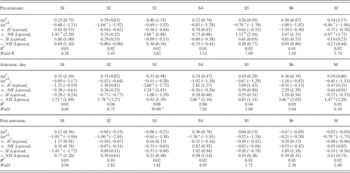
This study reports results for this regression, which takes into account the direction of the news and the state of the economy (model 11), Table 3.
Response by sector to inflation announcements taking into account core and ‘non-core’ inflation rate components and the spread between Spanish and European HICP, according to the direction of the news and the state of the economy.

S1, S2…, S6, M: each sector and the total market. In the expressions: ar j (t) represents the abnormal returns of sector j in each period t, π C t is core inflation, π NC t is the ‘non-core’ component of the inflation rate, spread t represents the spread between Spanish and European inflation, both harmonized (orthogonalized), and u jt is the error term of sector j. Dummy variables distinguish between positive (+) and negative (−) inflation spreads and between a high (H) and non-high (NH) state of economic activity. Sample: Feb. 1995-Dec. 2004 (SUR estimation):
 $$ \, ar_{j} (t)=\alpha _{j} {\plus}\beta _{{j1}} \cdot \Delta \pi _{t}^{C} {\plus}\beta _{{j2}} \cdot \Delta \pi _{t}^{{NC}} {\plus}\beta _{{j3}} \cdot D_{H}^{{\plus}} \cdot\left| {\Delta spread_{t} } \right|{\plus}\beta _{{j4}} \cdot D_{{NH}}^{{\plus}} \cdot \left| {\Delta spread_{t} } \right|{\plus}\beta _{{j5}} \cdot D_{H}^{{\minus}} \cdot \left| {\Delta spread_{t} } \right|{\plus}\beta _{{j6}} \cdot D_{{NH}}^{{\minus}} \cdot\left| {\Delta spread_{t} } \right|{\plus}u_{{jt}} $$
# Test of equality between inflation coefficients in different scenarios.
t-statistics in parentheses: a p<0.10, b p<0.05, c p<0.01
This analysis increases coefficient R 2 so that the model can explain a higher percentage of the variations experienced by returns of each sector.
Stock returns respond the same (in sign and significance level) to changes in core and ‘non-core’ inflation with respect to the previous analysis.
A positive, if generally insignificant, response of stock returns to core inflation movements in the pre-announcement period and on the announcement day summarizes this behaviour of stock returns by sector to changes in both inflation components. But in the post-announcement period, this study observes positive responses of abnormal returns to the core inflation component for three sectors (1, 4 and 5) and negative responses for the other three sectors (2, 3 and 6). Regarding the ‘non-core’ inflation changes, the stock return response is negative for the entire event window, although coefficients are only statistically significant in the pre- and post-announcement periods.
On the days before the announcement, sectors 2 and 5 and the whole market (M) show a negative and significant response to changes in the ‘non-core’ inflation component. On the days after the announcement, sectors 1, 2 and 4 and M show the same negative and significant response to shocks in this more volatile component of inflation rates.
Focusing attention on this study’s other innovative variable, the change in the spread between Spanish and European HICP, most of the sectors have positive and insignificant coefficients in the pre-announcement period. However, sectors 1, 3 and 5, ‘Oil and Energy,’ ‘Consumer Goods’ and ‘Financial and Real Estate Services,’ and the whole market (M) show highly significant coefficients when the spread is positive in non-high states of the economy (+, NH). According to this sign, these sectors and the whole market interpret the fact that the Spanish inflation rate is higher than the Euro-Area inflation rate in medium and low states of activity as good news for stock returns, for this difference in inflation rates means that the Spanish economy is growing more than the other European economies. In addition, these sectors and the whole market associate this period of higher economic growth with a better ability of firms to transfer inflation shocks to prices of products and services, that is, they have ‘flow-through’ capability, which seems to depend on the economic cycle. Therefore, positive changes in this study’s spread measure during non-high states of the economy have a positive and significant impact on stock returns.
Using arguments of the ‘behavioural finance’ hypothesis, the market should perceive any increase in this study’s spread variable as ‘good news’ during medium and low states of economic activity (+, NH), because economic agents think that the Spanish economy is growing above the expectations for the Euro Area as a whole.
On the announcement day, most of the sectors show insignificant responses to spread changes, although the current research emphasizes the homogeneity in the sign of the coefficients that accompany negative changes in this study’s spread measure (Spanish inflation is close to Euro Area inflation) during non-high states of economic activity (–, NH). Sectors 1, 2, 4 and 6, ‘Oil and Energy,’ ‘Basic Materials, Industry and Construction,’ ‘Consumer Services’ and ‘Technology and Telecommunications,’ and the whole market (M) show positive responses in this scenario. According to the ‘flow-through capability’ hypothesis, this ability seems to depend on the economic cycle; thus, when Spanish inflation is lower than European inflation, the market interprets this situation as good news in this period. A general reduced capability to transfer inflation shocks to output prices characterizes these kinds of periods.
This research highlights the statistically significant behaviour displayed by sector 3, ‘Consumer Goods,’ which shows a negative response to positive changes in this study’s spread measure during expansions because of the traditional difficulties of this sector subject to strong foreign competition. This research also interprets a positive spread in medium and low states of the economy as good news, a sign that Spain is starting a phase characterized by high economic growth (higher than in the Euro Area), indicating that companies demonstrate high flow-through capability. Therefore, stock returns significantly increase in this scenario. Finally, sector 3 is the only sector that shows a significantly different response across scenarios, according to the Wald test.
Finally, in the post-announcement period, the sign of the response among different sectors is not clear, and, in general, this response is not statistically significant. Nevertheless, all sectors demonstrate stable behaviour: a positive response to negative surprises in this study’s spread measure (Spanish inflation converges with Euro-Area inflation) during non-high states of economic activity (–, NH). Therefore, this research associates the period of ‘non-high’ economic growth with a reduced ‘flow-through’ capability of firms; therefore, negative changes in this study’s spread measure (Spanish inflation close to Euro-Area inflation) during non-high states of the economy positively impact stock returns and mean ‘good news.’ This research also calls attention to a negative and significant response of the stock returns from sector 1, ‘Oil and Energy,’ if Spanish inflation converges with European inflation during expansions.
Companies related to crude oil determine, to some extent, the trend of the inflation rate in each country. Thus, if the inflation rate decreases and converges with the Euro-Area inflation rate, one could construe this situation as ‘bad news,’ which, in turn, negatively affects sector stock returns.
An intersectoral test of the equality of response in each scenario does not reject the null hypothesis. Nevertheless, stock returns by sectors show significant different responses both to positive changes in this study’s spread measure during non-high states of the economy (the χ 2 statistic in Wald test, 26.07, rejects the null hypothesis of equality of coefficients among sectors at the 1% significance level) as well as to negative changes in the spread measure during expansions (χ 2=12.90, at the 5% significance level).
6. Long-term Response of Stock Returns to Inflation Announcements
To analyse the repercussion of unexpected inflation changes on stock returns by sector in the long term, distinguishing between underlying/core and ‘non-underlying/non-core’ inflation rate components and taking into account the spread between Spanish and European inflation rates, this study uses monthly stock returns by sector in the Spanish Economy. This research aggregates data (from 115 companies) by industry on an equally weighted basis to obtain the series of monthly returns for each sector from February 1993 to December 2004. This study uses the Madrid Stock Exchange sector definition scheme and calculates a monthly equally weighted total market return as a proxy for the market return (M). 45
This study proposes the following model:
 $$\eqalignno{ r_{{jt}} = \, & \alpha _{j} {\plus}\beta _{{j1}} \cdot\Delta \pi _{t}^{C} {\plus}\beta _{{j2}} \cdot\Delta \pi _{t}^{{NC}} {\plus}\beta _{{j3}} \cdot\Delta spread_{t} {\plus}\beta _{{j4}} \cdot\Delta \pi _{{t{\minus}1}}^{C} {\plus} \cr & {\plus}\beta _{{j5}} \cdot\Delta \pi _{{t{\minus}1}}^{{NC}} {\plus}\beta _{{j6}} \cdot\Delta spread_{{t{\minus}1}} {\plus}u_{{jt}} $$
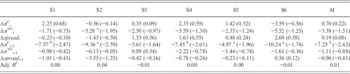
where r jt is the monthly stock return of sector j in period t. This work also includes lagged values of core and ‘non-core’ inflation rate components and the spread between Spanish and European inflation rates. Table 4 reports results using SUR estimates.
Long-term response by sector.

S1, S2…, S6, M: each sector and the total market. In the expressions: r jt is the monthly stock return of sector j in period t, π C t is core inflation, π NC t is the ‘non-core’ component of the inflation rate, spread t represents the spread between Spanish and European inflation, both harmonized (orthogonalized), and u jt is the error term of sector j. Sample: Feb. 1993−Dec. 2004 (SUR estimation):
 $$r_{{jt}} =\alpha _{j} {\plus}\beta _{{j1}} \cdot\Delta \pi _{t}^{C} {\plus}\beta _{{j2}} \cdot\Delta \pi _{t}^{{NC}} {\plus}\beta _{{j3}} \cdot\Delta spread_{t} {\plus}\beta _{{j4}} \cdot\Delta \pi _{{t{\minus}1}}^{C} {\plus}\beta _{{j5}} \cdot\Delta \pi _{{t{\minus}1}}^{{NC}} {\plus}\beta _{{j6}} \cdot\Delta spread_{{t{\minus}1}} {\plus}u_{{jt}} $$
t-statistics in parentheses: a p<0.10, b p<0.05, c p<0.01
The most important results follow. On the one hand, this research finds significant negative responses of stock returns by sector to the lagged core inflation component (i.e. the structural component of the inflation rate). This result appears in all sectors (except sector 3, ‘Consumer Goods’) and means that the structural part of the inflation rate affects stock returns principally in the long term and after the announcement of the inflation rate (lagged core inflation).
On the other hand, the stock return responds negatively to current ‘non-core’ inflation changes (although coefficients are only statistically significant in the case of sector 2, ‘Basic Materials, Industry and Construction’). Therefore, the most volatile component of the inflation rate affects stock returns by sector at the very moment the ‘non-core’ inflation change occurs. This effect is also significant in the case of sector 2.
Regarding this study’s spread measure, which to some extent can reflect the competitiveness level of each country, the coefficient sign is unstable and statistically insignificant.
Finally, the Wald test of the equality of intersectoral responses in each scenario rejects the null hypothesis at the 5% significance level for changes in the lagged ‘non-core’ inflation rate component and in this study’s lagged spread measure.
7. Summary and Conclusions
Many researches have analysed the repercussion of macroeconomic announcements on returns of different market indexes, interest rates or stock returns.Reference Boyd, Hu and Jagannathan 2 , Reference Funke and Matsuda 11 , Reference Pearce and Solakoglu 13 , Reference Adams, McQueen and Wood 15 , Reference Docking and Koch 16 , Reference Mestel and Gurgul 46 This study contributes to the existing literature by proposing innovative explanatory variables with which to analyse how unexpected inflation news affects stock returns by sector in the Spanish economy: the spread between Spanish and European inflation rates and core and ‘non-core’ inflation rate components.
Some recent studies,Reference Cecchetti and Wynne 30 , Reference Matilla-García 47 , Reference Wynne and Rodríguez-Palenzuela 48 show the importance of the selected variables for decisions on monetary policy. The spread between Spanish and European inflation rates, this study’s main explanatory factor, reveals the effect of the differential between Spanish inflation and Euro-Area inflation on stock returns by sector.
Regarding the short-term response of stock returns to inflation announcements, the most volatile ‘non-core’ component of the inflation rate significantly and negatively affects sector returns; this research would expect the above-mentioned effect because the ‘non-core’ component is the temporary element of the inflation rate. Adams et al.,Reference Adams, McQueen and Wood 15 Jareño,Reference Jareño 49 and Joyce and ReadReference Joyce and Read 50 show a negative relationship between the total inflation rate and stock returns without splitting this inflation rate into core and ‘non-core’ components.
Considering the direction of the inflation surprises and the state of the economy, on the announcement day, the present results show that negative changes in this study’s spread measure have a positive effect on stock returns by sector in non-high states of the economy. In these kinds of periods, according to the ‘flow-through capability’ hypothesis, this ability to reflect inflation rate changes in their product prices seems to depend on the economic cycle. Thus, when Spanish inflation is lower than European inflation, the market interprets this situation as good news in this period, which displays a reduced capability to transfer inflation shocks to output prices. The most sensitive sectors include ‘Oil and Energy’, ‘Basic Materials, Industry and Construction’, ‘Consumer Services’ and ‘Technology and Telecommunications’, for they show a statistically significant response to changes in the spread measure.
In addition, in the post-announcement period, positive changes in the spread measure affect sector 3 negatively during expansions and positively in non-high states of the economy, and, in both cases, the results are significant. The market interprets the fact that the Spanish inflation rate is higher than the Euro-Area inflation rate as ‘bad news’ only in high states. Companies seem to face difficulties in transferring higher Spanish shocks to their input prices than they do in the case of European inflation shocks. This result completely coincides with the traditional difficulties (including being subject to strong foreign competition) of sector 3, ‘Consumer Goods.’
Finally, in the long-term analysis, changes in the ‘core’ inflation rate component negatively affect stock returns by sector. This study shows that the structural part of the inflation rate has significant negative effects in the long term, as one would expect.
In the short term, more changeable indicators (the ‘non-core’ inflation rate component and the spread between Spanish and European inflation rates) affect stock returns by sector, whereas in the long term, the structural indicator (core inflation) shows a higher effect on stock returns by sector.
Eliseo Navarro is professor of finance at Universidad de Alcalá, Madrid, Spain. He received a postgraduate Diploma in Actuarial Science from Heriot-Watt University, UK and a PhD in Economics from Universitat de Valencia, Spain. He is interested in credit and interest rate risk issues and he has published in high quality Spanish and international journals.
Francisco Jareño is a professor of finance at Universidad de Castilla-La Mancha, Albacete, Spain. He received a PhD in Economics from UCLM, Spain, and he is interested in the term structure of interest rates, term structure of volatilities and risk management. He has been published in high quality international journals.