





Introduction
Imagine being at a café, and a friend asks you to pass “that cup.” You glance at the table—there are three cups: one with coffee, one with tea, and one with water. Without more details, you are stuck guessing. But if the friend says, “The red coffee cup next to your phone,” the meaning is instantly clear. This everyday exchange is a simple example of referential communication. The concept of referential communication refers to the ability to communicate to others the representation of an idea, object, or event (San Martín et al., Reference San Martín, Montero, Isabel Navarro and Biglia2014), such that they can identify it. Referential communication is normally assessed by tasks that involve a speaker describing something and a listener interpreting it. It is a skill we take for granted, but it plays a crucial role in how we navigate the world, from giving directions to telling stories. It is a powerful communication tool, as it is used to establish common ground and maintain joint reference when communicating information (Markman & Makin, Reference Markman and Makin1998).
Referential communication requires providing sufficient descriptive information to a listener to understand the speaker’s intended meaning (Greenspan et al., Reference Greenspan, Burka, Zlotlow and Barenboim1975), since the main goal of the speaker is to be able to correctly transmit the message to the listener. The listener would need enough context to be able to recognize what is being discussed. To communicate a message about a referent that might or might not be known by the receiver, referential communication relies on using clear, detailed language, which often requires the use of syntactically complex language (e.g., subordination or noun phrases containing several modifiers, such as pass me the red striped cup with the spoon in it).
The ability to successfully communicate referentially develops with age, and it has been documented that children struggle to detect ambiguity during elementary school years (Lloyd, Reference Lloyd1994). There exist several studies investigating referential communication in children, and fewer studies with adults, despite growing recognition that adults, too, are not immune to egocentric biases in communication (Keysar et al., Reference Keysar, Lin and Barr2003), similar to children. Referential communication in children undergoes significant developmental changes from infancy through late childhood. From as early as 12 months, infants show sensitivity to their communicative partner’s knowledge, adjusting gestures such as pointing depending on what the partner knows (Liszkowski et al., Reference Liszkowski, Carpenter and Tomasello2008). As children acquire spoken language, they begin to adapt their verbal messages accordingly. For instance, by age two, they can respond to clarification requests, and by age three, they modify their speech depending on whether the listener can see the referent (Campbell et al., Reference Campbell, Brooks and Tomasello2000; Matthews et al., Reference Matthews, Butcher, Lieven and Tomasello2012).
However, despite these early signs of sensitivity, younger children still struggle with producing sufficiently informative descriptions on their own (i.e., egocentric bias). For instance, children aged five to seven often fail to spontaneously include key features that would disambiguate their message, even when the listener makes clear that the listener misunderstood the referent (Karabenick & Miller, Reference Karabenick and Miller1977). One central challenge lies in selecting the most relevant features of a referent in a given context—a process that requires integrating linguistic knowledge with assumptions about the listener’s perspective and needs.
Referential communication skills continue to mature well into later childhood. By around six years of age, children begin to show greater awareness of communicative ambiguity and start producing more context-sensitive utterances, taking into account what information is required for the listener to correctly identify the referent (Nilsen & Fecica, Reference Nilsen and Fecica2011). This improvement is especially evident when children engage in cooperative tasks, such as constructing models based on verbal instructions, where success depends on shared understanding. In such contexts, older children are more likely to use strategies like joint review—where the speaker and listener explicitly confirm shared understanding—and to revise their messages proactively, even without receiving a clarification request (Sidera et al., Reference Sidera, Perpiñà, Serrano and Rostan2018).
Researchers have suggested several factors that predict performance in referential communication. Studies conducted with children and teens suggest that the development of referential communication might be related to linguistic experience, i.e., a person gains proficiency with language and communication, where language needs to be used in decontextualized settings (Yule, Reference Yule1997). Linguistic experience is heavily influenced by reading. People who read more tend to have stronger language skills, including better vocabulary and grammar (Dabrowska, Reference Dąbrowska2018; Montag & MacDonald, Reference Montag and MacDonald2015). This is argued to be an effect of written modality being linguistically richer than spoken language (e.g., Roland et al., Reference Roland, Dick and Elman2007). Exposure to print enhances language skills as people are exposed to novel words and ideas through printed materials like books, magazines, newspapers, and other physical or digital print materials. A higher exposure to print is connected with enhanced lexical representations as well as better word recognition during reading (Lowder & Gordon, Reference Lowder and Gordon2017). Print exposure is also correlated with declarative knowledge (Stanovich et al., Reference Stanovich, West and Harrison1995). Mol and Bus (Reference Mol and Bus2011) also reported that the more time individuals spend reading, the more they positively increase their language skills, creating reciprocal causation. As a result, people with higher print exposure may be likely to perform better in tasks requiring precise communication merely because precise communication may require the use of complex structures in descriptions. A related factor to this is practicing writing. When writing a letter or an essay, the writer has to explain their ideas clearly enough so that the reader can understand them and the meaning without the help of the writer. Writing clearly requires some level of referential communication skills, as the writer needs to adjust their message in a way that is comprehensible by readers who may not know anything about the topic. Therefore, print exposure appears to be a predictor of interest in referential communication performance.
A second factor is knowing and adjusting what needs to be communicated so that the message is conveyed and understood accurately. This involves the ability to put oneself in other people’s positions and consider what they do not know (see also Paal & Bereczkei, Reference Paal and Bereczkei2007; Resches & Pérez-Pereira, Reference Resches and Pérez-Pereira2007; Sidera et al., Reference Sidera, Perpiñà, Serrano and Rostan2018). This ability, theory of mind (ToM), is defined as the fundamental cognitive capacity of understanding other people’s beliefs, desires, emotions, and intentions, which might be different from one’s own. There is growing evidence of a strong relationship between referential communication abilities and ToM. In a recent meta-analysis, Sidera et al. (Reference Sidera, Perpiñà, Serrano and Rostan2018) reported that some ToM skills, such as second-order false-belief and faux-pas understanding, were related to strategies used in referential communication in children. False-belief understanding is the ability to understand that someone else can hold a belief that is different from reality and from one’s own belief. In a false-belief task, the observer’s own belief about an event is accurate because it is based on direct observation; however, the other person holds a false belief due to being unaware of a change in the original situation (Mayes et al., Reference Mayes, Klin, Tercyak, Cicchetti and Cohen1996).
Resches and Perez-Pereira (Reference Resches and Pérez-Pereira2007) concluded that the understanding of false belief seems to be the strongest predictor of children’s development of communicative competence. Children with higher ToM scores showed a higher descriptive accuracy and less ambiguous messages when performing referential communication tasks (Resches & Pereira, Reference Resches and Pérez-Pereira2007). Similarly, a study by Maridaki-Kassotaki and Antonopoulou (Reference Maridaki-Kassotaki and Antonopoulou2011) reported a relationship between children’s ability to attribute false beliefs and referential communication skills, such as the ability to recognize pictures based on oral messages, the ability to understand and follow directions, and the capacity to detect ambiguity and be able to answer adequately to oral messages. Acknowledging that other people may have false beliefs is fundamental when communicating, as it allows us to take into account that the reality that people create might not correspond to the reality of our own perception of it.
Since children appear to successfully answer these false-belief tasks by around the age of 8 (see Ögel Balaban & Hohenberger, Reference Ögel Balaban and Hohenberger2020), there is not much research available on how typically developing adults perform in these false-belief tasks or how performance in such tasks may relate to performance in other tasks (i.e., referential communication). However, there are other ToM tasks that were developed to be used with adults. One of these is the faux-pas task, which assesses a person’s ability to assess what should or should not be said in a particular situation (Stone et al., Reference Stone, Baron-Cohen and Knight1998). A study by Banerjee et al. (Reference Banerjee, Watling and Caputi2011) found that scores on a faux-pas task were related to peer relations, as the ability to understand and detect faux pas is linked with a person’s ability to maintain social relationships. They argue that faux-pas tasks relate to day-to-day peer relations more closely than false-belief tasks because “faux pas differs from other relatively demanding assessments of mental-state reasoning, such as second-order false-belief tasks, insofar as it maps onto real-life differences in interpersonal relations in a more intimate way” (Banerjee et al., Reference Banerjee, Watling and Caputi2011, p. 1890). Following from this, one would expect the various ToM skills discussed here to be relevant in a referential communication task.
Another factor at hand is that previous research has suggested that ToM skills may further develop as a function of reading. Research by Ebert (Reference Ebert2020) demonstrated that literacy stimulation at home as well as the home environment is correlated with a child’s language development. This relationship appears to remain in adulthood, albeit to a smaller extent. For instance, Dodell-Feder and Tamir (Reference Dodell-Feder and Tamir2018) show in a meta-analysis a small but positive relationship between reading fiction and ToM skills in adults, potentially because reading fiction requires the practice of some ToM-related skills. As discussed previously, reading and writing experience improves language skills. Similarly, this improved knowledge of language helps with second-order false-belief understanding, at least in children (Lohmann & Tomasello, Reference Lohmann and Tomasello2003) since items that test second-order false-belief understanding rely heavily on subordinating clauses.
Education and nonverbal reasoning skills are also important factors in the development of referential communication abilities. Education offers many opportunities for the development of referential communication for several reasons (Yule, Reference Yule1997). First, it provides opportunities and settings for pupils to communicate with non-familiars, involving the exchange of information or knowledge using decontextualized language. Second, it requires pupils to read written materials and practice writing, both of which are theoretically important for the development of language skills. Third, education improves intelligence profoundly; Ritchie and Tucker-Drob (Reference Ritchie and Tucker-Drob2018) show that one year of schooling improves IQ scores by 1–5 on average.
That being said, there is good reason to theoretically assume that nonverbal IQ may also be relevant to referential communication skills. First, while scores on ToM tasks are related to a more specific ability to reason about social issues, nonverbal IQ scores reflect the participants’ ability to reason in general. One could also argue that better nonverbal IQ (henceforth IQ) scores are indicative of faster and more efficient information processing, a better working memory, and reasoning (Alloway & Passolunghi, Reference Alloway and Passolunghi2011). These advantages combined could overall improve the capacity to deal with the demands of referential communication. However, since there is a dearth of research on this topic, we do not know the role IQ plays in referential communication skills.
Finally, socioeconomic status (SES) would arguably be an important factor in referential communication skills. There is a plethora of research studies showing that SES significantly predicts many cognitive psychological concepts, including language skills (e.g., Hart & Risley, Reference Hart and Risley1992), ToM skills (e.g., Ebert, Reference Ebert2020), and educational opportunities (e.g., Lervåg et al., Reference Lervåg, Dolean, Tincas and Melby-Lervåg2019). Ebert (Reference Ebert2020) even suggest that SES-related differences predict the opportunities for daily activities through which children can improve their ToM skills. Thus, if SES contributes to the development of language skills, then these SES-related differences in language skills may be reflected in the performance in referential communication. In addition to this, since most psychological research with adults has been conducted with WEIRD populations, avoiding overgeneralizations based on samples collected from WEIRD populations (e.g., Blasi et al., Reference Blasi, Henrich, Adamou, Kemmerer and Majid2022) requires working with participants from different SES backgrounds.
To accommodate this and the research gap in referential communication and its relationship to ToM, IQ, and reading abilities, we aim to answer the following research questions: How does ToM, such as faux-pas detection and false-belief understanding, and nonverbal IQ influence referential communication? What is the relationship between reading and referential communication? Exploring the answers to these questions will have important implications for how we imagine referential communication in adulthood.
Method
Participants
We collected data from 20 female low-SES participants (mean age = 48.05, SD = 12.82) and 24 female high-SES native Spanish speakers (mean age = 48.21, SD = 9.23), in Monterrey, Mexico. Low-SES participants had an average education of 10.3 years, while high-SES participants received 18 years of formal education on average. Low-SES participants were recruited through a nonprofit organization dedicated to increasing life quality in Cerro de la Campana, Monterrey, Nuevo León. Cerro de la Campana is a marginalized neighborhood in the city of Monterrey that lacks proper paving and planning, with houses scattered over a mountain and connected by dirt roads, making it difficult for even cars to navigate around. It lacks basic utilities, with only the houses at the lower portion of the mountain having access to electric and water services and no access to natural gas. According to MarketDataMéxico (https://www.marketdatamexico.com/es/article/Colonia-Cerro-De-Campana-Monterrey-Nuevo-Leon, accessed April 24, 2025), the average household income is slightly above MXN $15,000, whereas in comparison, in Brisas del Valle, where most of the high-SES speakers live, this number is roughly more than double, at about MXN $36.200. This shows the stark difference in average household income. Low-SES participants were mostly stay-at-home mothers or were working in low-paying jobs (e.g., cleaning, janitorial staff). However, high-SES participants were adults of upper-middle socioeconomic status. All of the high-SES participants had finished their university education, and in contrast to the low-SESs, they had well-paying jobs (e.g., teachers, engineers, and human resources managers).
Background questionnaire
After providing informed consent to participate in the experiment, participants were given a questionnaire that asked general information about themselves. Participants were asked about their age, gender, education level, and reading habits in Spanish. To examine reading habits, three questions were asked: how many hours they generally devote to reading in a typical week, how much they had read the previous week, and how much they read in comparison to their peers. The questionnaire used a Likert scale, which asked participants to rate their level of agreement or disagreement with each topic. Participants could get between 3 and 17 points on the questionnaire, with a higher score indicating a higher degree of self-reported print exposure. The background questionnaire was administered on a laptop for control participants, while low-SES participants answered it using pen and paper since these participants had relatively little experience with computers, as their income is quite low and access to technology may not be affordable for people with these socioeconomic conditions.
Referential communication task
The referential communication task involves participants working together to find differences between pairs of similar pictures. Some of the items depicted in the pictures are not easily namable and/or occur in non-canonical locations or positions. This makes the pictures difficult to describe and therefore requires a considerable amount of negotiation of meaning. Participants can see each other and can interact in any way they like (including gesturing), but they cannot see their partner’s picture. The objective is for participants to identify as many differences as they can within a time limit (5 minutes per picture set). At the beginning of the task, participants are shown a practice item in which the differences are highlighted (see Figure 1); in this phase, participants can see both items. The test trials comprise 8 picture pairs, and the entire task takes 40 minutes to complete. The participants’ score is the number of differences successfully identified.
Practice item for referential communication task (note: during test trials, each interlocutor sees only one of these images, e.g., interlocutor A sees the left image while interlocutor B sees the other image).

Second-order false-belief tasks
In order to measure false-belief understanding, a second-order belief task was used. The task consisted of two different stories that were read to participants: the chocolate bar story (Perner and Wimmer, Reference Perner and Wimmer1985) and the birthday present story (Sullivan et al., Reference Sullivan, Zaitchik and Tager-Flusberg1994). In the task, participants needed to infer the belief of one of the characters from another one. The stories were supported by pictures (Flobbe et al., Reference Flobbe, Verbrugge, Hendriks and Krämer2008). This task was originally designed for children; therefore, the language used in it was quite simple. Both stories are composed of five different questions: a first reality control question, a 1st-order ignorance question, a linguistic control question, a 2nd-order belief question, and a justification question.
For example, in one of the stories, a mother wants to surprise her son with a puppy. However, she tells him that she got him a toy. The participant is asked to answer the first reality control question (“What did the mother get her son as a gift?”). Later in the story, the boy goes down to the basement and sees the puppy being hidden there. Then, the 1st-order ignorance question is asked (“Does the boy know that the mother got him a puppy as a gift?”), followed by the linguistic control question (“Does the mother know that the son saw the dog?”). The story progresses as the grandma calls the mother and asks the mother what she thinks the boy got for him as a gift. The participant answers the 2nd-order belief question (“What will the mother say to the grandma?”), followed by a justification question (“Why does she think that way?”).
We employ two scoring methods: one that follows the standard procedure in order to maintain comparability with past studies and a second one with a more sensitive scoring by Gedik et al. (under review). In the traditional method, participants received one point per story if they correctly answered both control questions and the second-order false-belief question; thus, the maximum possible score is 2. In the sensitive method, for each, participants were awarded 1 point if they answered the reality control question and the first-order ignorance question, another point if they answered both control questions and the second-order false-belief question, and another point if they answered the justification question correctly. Thus, the maximum possible score is 6.
Faux-pas task
A faux pas is defined as an embarrassing situation that happens when someone says or does something inappropriate in a particular context. The tasks used to evaluate faux pas detection are often used to test the theory of mind. To test faux pas detection, we used the Spanish short-version adaptation of the faux-pas task by Fernández-Modamio et al. (Reference Fernández-Modamio, Arrieta-Rodríguez, Seco, Santacoloma-Cabero, Gomez de Tojeiro, García-Polavieja, González-Fraile, Martín-Carrasco, Griffin and Gil2018). This version of the task includes 10 stories, 5 of which include a faux pas. To minimize cognitive demands, the stories are read aloud to the participant while, at the same time, the participant reads them from a written copy. Six subcategories were scored: (1) Faux-pas detection, (2) Understanding. (3) Inappropriateness, (4) Intentions score, (5) Belief score, and (6) Empathy score. Each one of the subcategories’ scores ranges from 0 to 1. The final score was obtained in our study by calculating the mean of the six subcategories (Fernandez-Modamio, 2018). The maximum score that could be obtained by a participant was 1.
In the task, each story contains six questions. In the stories that contain a faux pas, 1 point is given to each correct answer. In the control stories, 1 point is given when the first question is answered correctly, and 1 point is given by default to the rest of the questions if the first question is answered correctly. When in a story the control questions are answered incorrectly, the rest of the questions for that story are scored with 0. Scores for every subcategory are calculated by dividing the total sum of the points obtained in each question in all the stories by the perfect score (either 10 or 20, depending on the subcategory). For example, one of the stories on the test reads as follows:
Elena’s husband was planning a surprise party for her birthday. He invited Elena’s friend Sara and told her, “Don’t tell anyone, especially Elena.” The day before the party, Elena was at her friend Sara’s house, and Sara spilled some coffee on a new dress that was propped up on a chair.
“Oh,” Sara said, “I was going to wear this dress to your party.”
“What party?” Elena said.
“Come on,” Sara said, “let’s see if we can get the stain out.”
After listening to the story, participants are asked if they think someone said something inappropriate. This item evaluates faux-pas detection. If they answer yes, they proceed to answer a set of questions:
Who said something they shouldn’t have said or something inappropriate?
Why shouldn’t they have said it, or why was it inappropriate?
Why do you think they said it?
Did Sara remember that the party was a surprise party?
How do you think Elena felt?
In the story, who was the surprise party for?
What was spilled on the dress?
Minute word-reading task
We developed a Spanish version of the 1-Minute Word Reading Task as a literacy measure. This test was created based on previous similar tasks that were created for English, Greek, and Turkish (Deeney, Reference Deeney2010; Gedik et al., Reference Gedik, De la Garza and Dabrowskaunder review; Simos et al., Reference Simos, Sideridis, Kasselimis and Mouzaki2013; Torgesen et al., Reference Torgesen, Wagner, Rashotte, Rose, Lindamood, Conway and Garvan1999). The task involves a series of 120 real words and 120 nonce words. The words and nonce words selected for the tasks were obtained from lexique.org, a lexical database that generates nonce words in a variety of languages. In both real and nonce words, the words increase in length, creating four different letter conditions: for real words, 5, 6, 7, or 8 letters; for nonce words, 6, 7, 8, or 9 letters. Participants are instructed to read as many words as they possibly can within one minute for both sections separately. For each word they read correctly, they earn one point; for every misread word, they get a penalty of −1 point. In the case of correcting a misreading, they get the point.
Spanish author recognition test
The Spanish Author Recognition Test (SART) was applied as a measure of print exposure, since author recognition tests are relatively reliable and quick ways of measuring print exposure (e.g., Acheson et al., Reference Acheson, Wells and MacDonald2008). The SART includes the names of 81 authors and 41 foil names. In order to develop the SART, a list of 200 author names from bestseller lists from different Spanish webpages (such as bestsellers on amazon.es), records from national libraries (Biblioteca Nacional de España), and bookstores (for example, Casa del Libro, La Central, Liberia Española, and Libreria Agapea) was created. On the list, we included Spanish and international authors, for example, Miguel de Cervantes, Federico Garcia Lorca, George Orwell, and Stephen King, among others. A Google Forms questionnaire was created that included this list of 200 authors. In the questionnaire, the instructions told the participants to tick those authors’ names that they knew or had once heard of. Then, 150 Spanish native speakers between the ages of 17 and 75, residing in Spain at the moment of the study, answered the questionnaire. Based on the results, the top 81 authors (those ticked by the highest number of participants) were selected as part of the stimuli on the SART. Later, foil names were created to avoid social desirability effects. In order to create the foil names, we used an online random name generator. The 81 author names were then included in a second list together with 41 foil names. We maintained the balance ratio of female-male names and the percentage of Spanish—non-Spanish names. We verified that the foil names did not belong to real authors by searching online for the names generated by the random name generator. In this test, participants have to insert a check mark next to each name they think belongs to an author. Participants were warned to carefully select their answers, as checking the name of a non-author would be penalized. Responses were coded as correct (1) or incorrect (0).
Shipley’s blocks
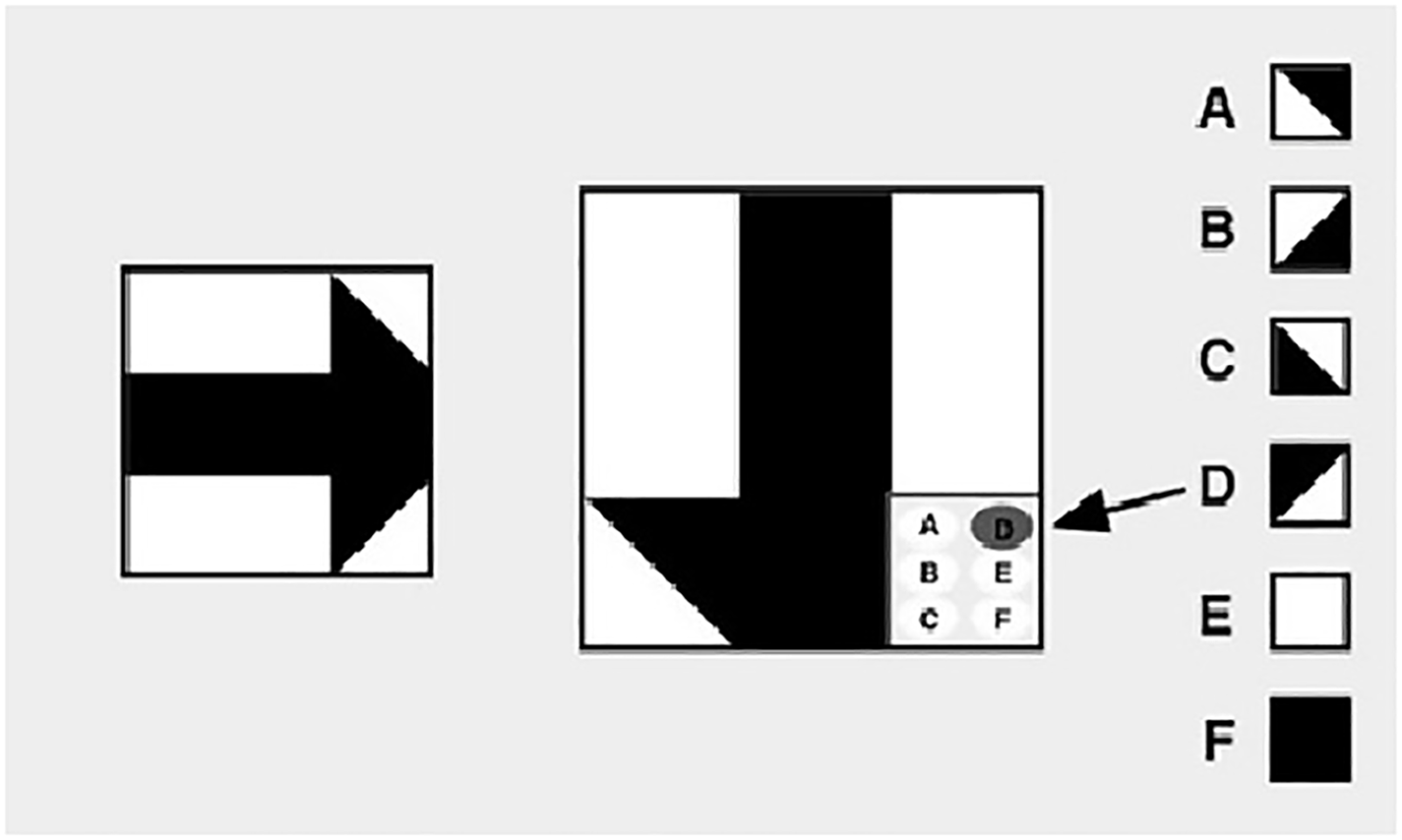
We used the Shipley Block Pattern (BP) subtest from the Shipley Institute of Living Scale-Second Edition (Shipley et al., Reference Shipley, Gruber, Martin and Klein2009) in order to measure cognitive ability. The block pattern subtest of the Shipley-2 is composed of 26 multiple-choice questions (See Figure 2). The questions increase in difficulty as the test progresses. The test contains 12 pictures of blocks. The first four pictures of blocks belong to the first four items, and they are missing one block each. From pictures 5 to 9, two blocks are missing; these pictures make up items 5 to 14. From pictures 10 to 12, four blocks are missing; these pictures make up the items 15 to 26. One point is given for every correct answer, and the maximum possible score is 26.
Practice item from the Shipley’s Blocks test. From Shipley et al. (Reference Shipley, Gruber, Martin and Klein2009).

Procedure
Participants were tested individually on all tasks except for the referential communication task, which was conducted in pairs. Individuals were tested in a comfortable environment. Low-SES participants were tested in a community center facility they currently attended. All participants were informed about the study and then proceeded to give consent for voice and video recording. Experimenters constantly gave participants positive reinforcement to keep them motivated and willing to continue participating in the tasks. For high-SES participants, the background questionnaire, the second-order false-belief task, the faux pas, Shipley’s Blocks, and the Spanish Author Recognition Test were conducted on a laptop. Tasks were adapted into Google Forms so they could be answered electronically. However, the tasks were provided on paper to low-SES participants to minimize stress and avoid the biases associated with using laptops, as they may not have been as familiar with computers as the high-literacy group.
Materials, data, and the code are available in the following link: https://osf.io/uxpdt/.
Data analysis
Statistical analyses were conducted in R Core Team (2024). To further explore the relationships between the variables, a linear regression model was fit with Referential Communication Score as the dependent variable. The independent variables in the full model were age, years of education, faux pas and false-belief sensitive scoring, reading composite (one-minute reading task real words, one-minute reading task nonce words, and SART), and IQ. We then simplified the model following the guidelines by Crawley (Reference Crawley2010), leaving only the significant predictors, where we started removing the predictor with the highest non-significant p-value and running ANOVA tests in between. We used the scale() function in R when we ran the regression models to facilitate the interpretation of the estimates. The contribution of each predictor was evaluated using the LMG (Lindeman, Merenda, and Gold) metric, calculated with the relaimpo package in R (Grömping, Reference Grömping2007). This metric determines predictor importance by averaging the sequential sum-of-squares across all possible predictor orderings. Functionally similar to a squared semi-partial correlation (sr2), it provides a way to quantify how much each predictor uniquely contributes to the variance explained by the model (see Larson-Hall & Herrington, Reference Larson-Hall and Herrington2010).
Results
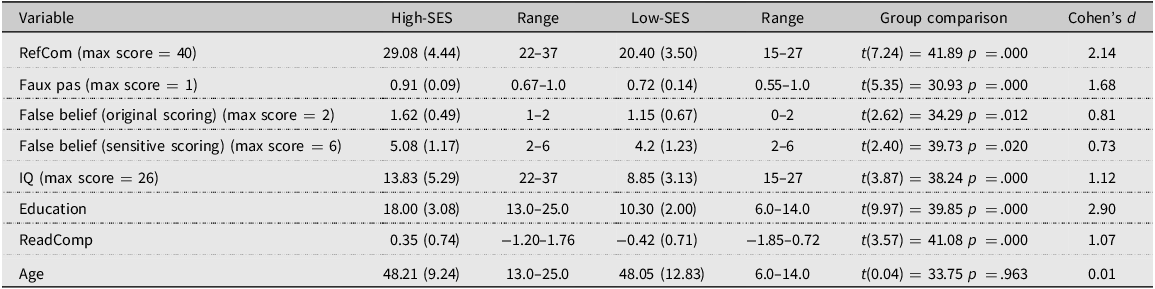
The descriptive statistics for each task are provided in Table 1. Table 1 also includes data for age and years of education. ReadComp stands for a composite score obtained by averaging standardized scores for real-word reading, nonce-word reading, and the SART. We also computed correlations between the variables in the entire dataset and within each respective dataset, available in the appendices.
Descriptive statistics for the variables per group, standard deviations in parentheses

Note: RefCom = referential communication scores, ReadComp = reading composite.
As can be observed in Table 1, except for age, the two groups differ significantly in terms of performance on tasks and the number of years spent in formal education from the control group across the board with large effect sizes. The largest differences are in education, followed by performance on the referential communication task, then performance on the faux-pas task, IQ, and then the false-belief task. The high-SES group showed roughly 72% accuracy in the referential communication task, while the performance of the low-SES group was approximately 51%. Similarly, faux-pas performance differed significantly between the two groups, with high-SES speakers achieving 91% accuracy and low-SES speakers achieving 72% accuracy.
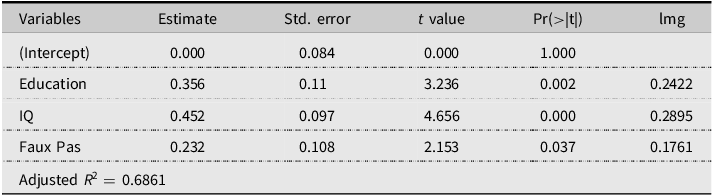
To investigate the effects of our predictors on referential communication performance, we ran a linear regression model as explained in the methods section. The final model, as seen in Table 2, estimated using standard linear regression modeling, explained approximately 68% of the variance in referential communication ability. Among the predictors, IQ had the strongest effect, uniquely accounting for about 29% of the variance (β = 0.452, p <.001), followed by years of formal education, which explained approximately 24% (β = 0.356, p =.002) as seen by the lmg scores. Faux-pas comprehension, while contributing less, remained a significant predictor, explaining about 17% of the variance (β = 0.232, p =.037).
The final best-fitting model

Discussion
This study analyzed the referential communication skills of participants differing in the number of years spent in formal education and how IQ, theory of mind, and literacy may influence it. Our results show that adults differed in their ability to successfully communicate about the pictures used in the task. Our regression analyses indicated that IQ, education, and faux-pas detection were significant predictors of performance on the referential communication task.
Given that success in referential communication crucially depends on the ability to make inferences about the interlocutor’s knowledge and beliefs, we would expect theory of mind skills to be the most important predictor of performance on the task. However, our strongest predictor was nonverbal intelligence, which accounted for about 29% of the variance in the task. This might be surprising at first, since the demands of the two tasks are completely different (reasoning about abstract shapes vs. tying together multiple pieces of linguistic and non-linguistic cues about the interlocutor so that the message can be adjusted accordingly). On the other hand, to perform well in the referential communication task, participants need to generate and test hypotheses about what the listener knows, recognize that the message has been misunderstood, and rapidly reformulate their descriptions accordingly. Individuals with higher nonverbal intelligence are likely to be better at all of these tasks. From this perspective, high IQ does not merely facilitate general processing efficiency but may also reflect an enhanced ability to strategically adapt to task demands and social ambiguity—a skill set that is crucial in interactive referential contexts. Furthermore, given that intelligence is associated with executive functioning (Ardila et al., Reference Ardila, Pineda and Rosselli2000), participants with higher IQs might be better at updating representations of the listener’s perspective and adjusting their messages accordingly (which relies on inhibition and working memory).
Our second strongest predictor is education. As briefly explained in the introduction, education plays an important role in the development of referential communication for several reasons (see also Yule, Reference Yule1997). First, since education involves acquiring new knowledge, often through reading, it supports the development of vocabulary and grammar, which should facilitate the expression and comprehension of complex messages. Furthermore, education creates numerous opportunities for practicing referential communication. In educational settings, students need to interact with teachers and fellow students whose life experiences are different from their own. This entails less shared knowledge and hence the need to be more explicit (cf. Wray & Grace, Reference Wray and Grace2007). Students also practice expressing their thoughts and knowledge through written texts. By its very nature, written communication requires the producer to be more explicit, since the addressee is not there to ask for clarification; in addition, students often receive feedback from the teacher about the quality of the texts they produce. Although much of the feedback concerns features that are only relevant to written language, such as spelling, teachers may also draw the students’ attention to parts of the text that are ambiguous or misleading, thus encouraging reflection on the need to take the addressee’s perspective into account. Finally, classroom activities such as group projects and explaining a concept to the rest of the class (either when asked to do so by a teacher or in a formal presentation) also contribute to the development of communication skills. When students’ explanations are not clear, the teacher or other students may ask clarification questions, thus signaling that the message has not been understood; on some occasions, students may receive explicit feedback about the quality of the message. Group projects require students to be explicit about who does what, when, and how. Misunderstandings may lead to censure from the other members of the group or from the teacher and to discussions of what the speaker meant and what the listener understood; both of these create opportunities for learning. For instance, in the context of foreign language learning, many task-based curriculum activities make use of referential communication (e.g., information gap exercises).
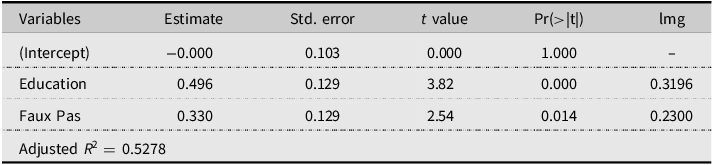
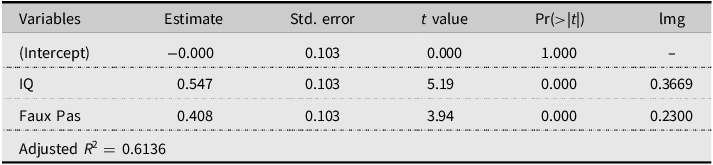
Since educational attainment and IQ are known to be strongly correlated (Ritchie & Tucker-Drob, Reference Ritchie and Tucker-Drob2018), we conducted additional exploratory regression analyses to determine to what extent their contribution to performance on the referential communication tasks overlaps. To do this, we removed each of the predictors from the model in order to see what effect it has on the other predictor. We found that when IQ is removed from the model, the contribution of education increases from 24.22% to 31.96% (see Table A4 in the Appendix for details). Similarly, when we remove education, the contribution of IQ increases from 28.95% to 36.69% (see Table A5 in the Appendix). This confirms that while there is some shared variance, education and IQ make largely independent contributions to the performance in the referential communication task.
As explained earlier, we expected ToM skills to be a strong predictor of performance on the communication task, since success in referential communication crucially depends on being able to distinguish between what one knows and what the interlocutor knows, and then adjusting the message accordingly (Sidera et al., Reference Sidera, Perpiñà, Serrano and Rostan2018). This prediction was partially confirmed, as performance on the faux-pas task also accounted for some variance in the model, albeit less than the other two predictors: IQ and education. Interestingly, however, the effects of performance on the false-belief task were not significant. This might appear surprising at first, since the false-belief task assesses a person’s ability to distinguish between one’s own and another person’s beliefs, which should be more relevant to referential communication than the ability to recognize that what another person said in a conversation is socially inappropriate.
We offer several accounts as to why faux pas detection is a better predictor of referential communication performance than false-belief understanding. First, the faux-pas task contained more items, making it more reliable or more sensitive in comparison to the false-belief task. This sensitivity may have captured more variance in the analysis. Second, it might be that the faux-pas task may be more complex than the false-belief task, since, in addition to the cognitive component (recognizing that a particular utterance is inappropriate), the faux-pas task also includes an emotional component (the ability to understand how another person might feel in the situation: cf. Şahin et al., Reference Şahin, Bozkurt, Usta, Aydın, Çobanoğlu and Karabekiroğlu2019). From this point of view, the false-belief task is simpler: it only requires attributing beliefs. In this vein, Bannerjee and colleagues (Reference Banerjee, Watling and Caputi2011) argue that although performance in false-belief tasks may relate to the understanding of self-presentation and social emotions, false-belief tasks may not be adequate to accurately reflect the mental-state reasoning required in everyday peer interactions. This line of argument becomes convincing considering that autistic children who can successfully pass false-belief tasks struggle with everyday mind-reading activities (i.e., social and conversational skills where one needs to do mental-state reasoning). Therefore, Bannerjee and colleagues (Reference Banerjee, Watling and Caputi2011) argue that faux pas detection may be a more relevant way of measuring everyday mind-reading activities. These are also relevant to performance on our task: for instance, participants who are able to infer from subtle nonverbal cues that their interlocutor is not sure if they understood the message or are not confident about their own description of the picture are more likely to take actions that will resolve potential ambiguities (for example, rephrase their own utterance or ask for clarification).
Finally, contrary to our predictions, our composite measure of reading did not have a significant effect on referential communication. We reasoned that since speakers who read more tend to have larger vocabularies and a better command of the grammar of their language (see Dabrowska, Reference Dabrowska, Mauranen and Vetchinnikova2012, Reference Dabrowska, Mauranen and Vetchinnikova2021), this would be an advantage during referential communication, where one would need to use more complex linguistic structures for more precise communication (i.e., subordination and noun phrases containing several modifiers, such as a denture with a yellow marker). This turned out not to be the case. It is possible that success in referential communication is more strongly related to writing skills, since, as argued earlier, producing comprehensible written texts requires understanding that the addressee does not have knowledge of the situational context in which the message was produced, and hence the language needs to be more explicit. Future research could investigate whether this is indeed the case.
On the other hand, the ability to produce fully explicit structures might not be so relevant in face-to-face communication, where speakers can negotiate meaning and engage in interactive repair (cf. Dingemanse & Enfield, Reference Dingemanse and Enfield2024). In such contexts, producing a simple but not fully explicit structure (e.g., the cup or the red cup instead of the red cup with a spoon) is enough to start the negotiation process; if the speakers’ description is not explicit enough, the interlocutor can always request additional information.
This perspective (i.e., negotiating meaning over a series of simpler structures) may help explain why nonverbal intelligence emerged as the strongest predictor of task performance.
Rather than supporting linguistic knowledge directly, a higher IQ may aid in flexibly managing cognitive demands—such as resolving ambiguity, monitoring for misunderstanding, or selecting alternative strategies when lexical retrieval fails. In contrast, print exposure, while beneficial for building grammatical and lexical knowledge, may not impact real-time performance unless that knowledge can be or needs to be accessed under communicative pressure. Similarly, although faux-pas detection was included to capture socio-cognitive sensitivity, its predictive power may be reduced in tasks where visual context and interactive feedback reduce the need for detailed perspective-taking. From this view, referential communication draws not just on stored linguistic knowledge, but also on adaptive, resource-efficient production strategies—a domain where general cognitive ability plays a central role.
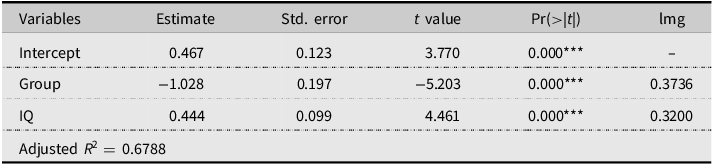
A final and more plausible possibility is that there are reciprocal effects between education, IQ, and faux-pas detection skills. The development of all three predictors depends on opportunities. Access to education and the duration of formal schooling are predicted by SES (e.g., Lervåg et al., Reference Lervåg, Dolean, Tincas and Melby-Lervåg2019). The duration of education, as previously mentioned, has an important influence on IQ, making the development of cognitive skills, like IQ, highly opportunity-dependent. In a similar vein, the development of ToM skills is tied to personal circumstances, as it depends on the stimuli a person receives through social interactions (i.e., how often individuals encounter contexts where they would need to utilize advanced ToM skills, see also Ebert Reference Ebert2020). The more speakers engage in ToM-dependent social situations, the more they may be able to identify other people’s mental states. In fact, Ebert (Reference Ebert2020) propose something to this effect: children who lived in rural, low-SES-income environments had fewer opportunities to attend cultural activities (i.e., visiting a library, museum, or theater), and the ToM skills of such children may develop more slowly in comparison to children from urban settings with high-SES backgrounds. In fact, our alternative regression analyses show that a model with IQ and group (see Table A6 in the Appendix) is just as good as the model we presented in the results section.
Referential communication skills are taught and practiced up to some extent in educational settings. We interviewed several teachers from different educational levels in Mexico, and they all agreed that in one way or another, they try to incorporate these types of activities into their teaching (see their responses to our questions in the appendices). In order to provide readers with an example of how education helps the development of referential communication skills, we explain a relevant real-life example here by a second-grade teacher working in the US (Sloan, Reference Sloan2025). The teacher assigned their students to write down the instructions to make a peanut butter and jelly sandwich as homework. In the video, she follows the written instructions of several students and attempts to make sandwiches following these instructions, but all of these attempts fail. In the end, the teacher asks her students to explain clearly how the sandwich should be made, giving them the opportunity to try again. This is a way of teaching referential communication skills, and it is plausible that receiving explicit feedback on various assignments (i.e., similar to the one in the video) can improve pupils’ need to be more explicit.
The findings of this study carry several important implications for education policy, adult communication training, and our broader understanding of how communicative competence develops. There is a need for training in referential communication abilities, particularly in adult education programs. Referential communication abilities are crucial for many real-life situations (e.g., healthcare providers, governmental agencies, and collaborative workplaces, among others) and professional contexts (i.e., medical settings and air traffic controllers).
There are several limitations of the study. First, the correlational nature of our study limits drawing causal interpretations of the effects of each predictor on the referential communication performance. While IQ, education, and faux-pas comprehension emerged as significant predictors, we cannot determine the direction of these relationships. Future research should employ longitudinal or experimental designs to clarify causality. Second, although group differences captured socioeconomic disparities, we did not measure SES with a questionnaire or with average household income. Since SES encompasses many things, such as income, cultural exposure, and access to resources, future studies should include standard SES indicators to disentangle its effects more precisely. The sample size (N = 40) and group composition also limit generalizability. Larger samples are needed to confirm these findings. One final limitation concerns the focus on reading skills without assessing writing ability. As writing requires greater referential clarity and explicitness, future research should include measures of writing to determine its potential role in referential communication. Future studies should also explore the relationship between these variables longitudinally to shed light on how this development occurs.
Conclusion
This study examined how nonverbal IQ, education, literacy, and theory of mind contribute to referential communication abilities in adults with differing educational and literacy backgrounds. Through a series of carefully designed tasks—including referential communication, faux-pas detection, false-belief reasoning, and reading fluency—we found that nonverbal intelligence, years of formal education, and faux-pas comprehension were significant predictors of referential communication performance. Contrary to expectations, print exposure did not independently predict communicative clarity, suggesting that reading experience alone may not directly enhance pragmatic language use by improving grammatical competence.
These findings highlighted the interplay between cognitive, social, and educational factors in adult communication. While intelligence and education provide foundational support for message planning and clarity, the ability to navigate social nuances—reflected in faux-pas detection—also plays a crucial role. At the same time, the absence of a reading effect invites further exploration into the distinct contributions of reading versus writing in the development of communicative competence.
By focusing on an underrepresented population and using a diverse set of tasks, this study contributes to a better understanding of how referential communication is influenced by other factors in adulthood. The results hold practical implications for adult education, language intervention, and communication training programs, particularly in contexts where formal schooling and cognitive stimulation may be limited. In broad terms, our findings highlight the importance of supporting not only literacy but also general cognitive development and social reasoning as part of any effort to improve communicative abilities.
Replication package
Materials, data, and the code are available in the following link: https://osf.io/uxpdt/.
Acknowledgements
This research was funded by an Alexander von Humboldt Professorship (ID-1195918) and by the Bavarian Equal Opportunities Sponsorship—Realisierung von Chancengleichheit von Frauen in Forschung und Lehre (FFL)—Realization of Equal Opportunities for Women in Research and Teaching.
Competing interests
We have no conflict of interest to disclose.
Appendix
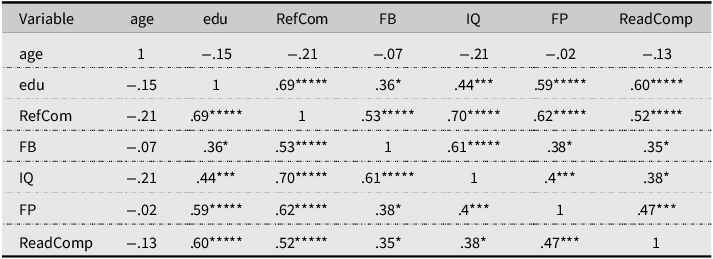
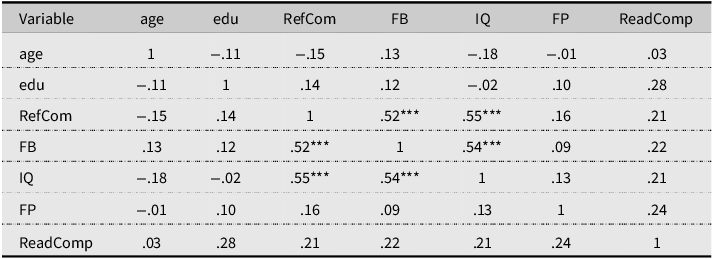
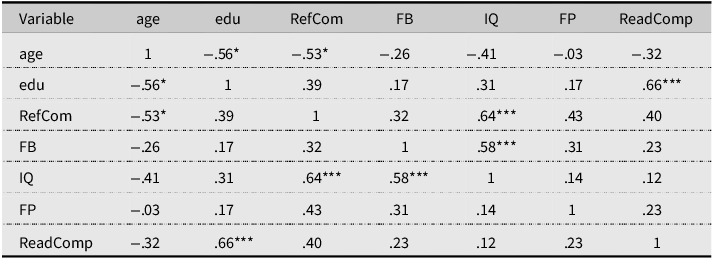
Tables A1–A3 show the correlations between all variables. We computed correlations for the variables in the control group, the low-SES, low-literate group, and both groups together. In each group, several intriguing correlations can be observed. For instance, in the low-SES, low-literate group, age is negatively correlated with referential communication, while that is not the case in the high-SES group. IQ is correlated with performance in the referential communication task, but interestingly in the high-SES group, we observe a correlation between faux pas detection and referential communication. Similarly, IQ is moderately correlated with faux pas detection in both groups.
Correlations between all variables in both groups

Note: edu: years spent in formal schooling, RefCom: referential communication score, FB: sensitive false belief score, IQ: Shipley’s blocks, FP: faux pas, ReadComp: reading composite, *p <.05, ***p <.001, *****p <.0001.
Correlations between variables in the high-SES group

Note: edu: years spent in formal schooling, RefCom: referential communication score, FB: sensitive false belief score, IQ: Shipley’s blocks, FP: faux pas, ReadComp: reading composite, ***p <.001.
Correlations between variables in the low-SES group.

Note: edu: years spent in formal schooling, RefCom: referential communication score, FB: sensitive false belief score, IQ: Shipley’s blocks, FP: faux pas, ReadComp: reading composite, ***p <.001.
Exploratory analysis without IQ (final best-fitting model without IQ)

Exploratory analysis without education (final best-fitting model without education)

The alternative final best-fitting model

Note: edu: years spent in formal schooling, RefCom: referential communication score, FB: sensitive false belief score, IQ: Shipley’s blocks, FP: faux pas, ReadComp: reading composite, ***p <.001.


 Open access

