1. INTRODUCTION
In Modern English, morphological case is traditionally said to survive in personal pronouns, and, to a lesser extent, in some interrogative/relative pronouns. We still distinguish between nominativeI and who on the one hand, and accusativeme and somewhat obsolescent whom on the other. In general, the nominative is used for subjects and the accusative for objects, as shown in examples (1) and (2).Footnote 2
(1) I called him.
(2) He called me.
Nominative and accusative may no longer seem appropriate labels for describing the case marking on Present-Day English pronouns, because there are no separate dative forms for what would conventionally be called indirect objects. It might therefore be more accurate to talk about ‘subjective’ and ‘objective’ forms of pronouns, the former covering the nominative and the latter comprising the accusative and dative. This, however, could be misleading. The ‘subjective/nominative’ case can now mark the subject of a finite verb and (marginally) a subject complement, whereas the ‘objective/accusative’ is frequently used not only for objects but also for subject complements, as in (3). What is more, morphologically ‘objective/accusative’ forms can even function as subjects, which is shown in (4).Footnote 3
(3) I'm sure they're as good as we are but, they're them and we're us. And that's that. (BNC)
(4) Me and my brother are gonna be off at the same time. (BNC)
Judging by such examples, ‘subjective’ and ‘objective’ are no more precise labels than nominative and accusative. Admittedly, ‘nominative’ and ‘accusative’ are not perfect either, but we adopt this terminology, following Payne & Huddleston (Reference Payne, Huddleston, Huddleston and Pullum2002: 456), because it is the most widely accepted terminology for talking about case.Footnote 4 The terms ‘nominative’ and ‘accusative’ can be more easily reserved for reference to the morphological marking, without making any claims concerning the syntactic behaviour of those morphological forms. That is why we will continue to use them for the rest of the exposition.
This paper will focus on the regularities that govern pronominal case assignment in Modern English, with special emphasis on contexts where things seem to ‘go wrong’. In the next section, we identify three varieties of Modern English with regard to canonical and non-canonical case assignment. We then argue that non-canonical case is allowed as long as the relevant pronoun is not a head – this claim is substantiated in Section 3. Section 4 offers discussion of some previous treatments, pointing out what their particular contribution is and the respects in which they are found to be lacking, while Section 5 outlines a new proposal that is more comprehensive and succinct. It relies on constituent structure, functional categories such as subject and object, as well as lexical specifications constraining individual pronominal forms. The final sections place our model in the context of earlier ones and justify the stance that Present-Day English retains case on its pronouns. The approach taken throughout this article is that of Lexical-Functional Grammar (LFG), including the basic assumptions about (noun) phrase structure, coordination, apposition, and the use of terms such as head and determiner. It is believed that the flexibility of this framework, as well as the tripartite distinction it makes between constituent structure, functional structure and lexical constraints, means that it is well placed to offer a satisfactory solution encompassing a wide range of complex data, which has so far remained unattainable for many proposals.
2. CANONICAL AND NON-CANONICAL CASE ASSIGNMENT IN THREE VARIETIES OF STANDARD ENGLISH
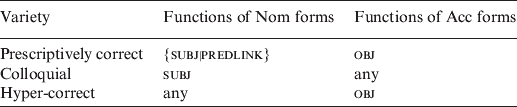
If the nominative is used to mark subjects and the accusative to mark objects (including prepositional objects), we are dealing with canonical case assignment. This is what happens in a variety of Standard English exemplified in the (a) sentences in (5)–(11) below. We will be referring to this sub-system as the prescriptively ‘correct’ variety. Another variety allows accusative forms to be non-canonically assigned to subjects, as shown in (5b) and (6b). This will be labelled Colloquial Standard English. The third variety also allows non-canonical case assignment – this time nominative forms can appear in object functions, as in (9b) – a usage typical of the hyper-correct variety of Standard English.Footnote 5
- (5)
(a) He and I tried to make conversation. (COCA)
(b) Him and me tried. We used a fingernail file once. (COCA)
- (6)
(a) We two speak together. (COCA)
(b) If us two don't play, then it's strictly political. (COCA)
- (7)
(a) We all left at the same time. (BNC)
(b) *Us all left at the same time.
- (8)
(a) It was I who opened the door. (COCA)
(b) It was me that had to tell her. (COCA)
- (9)
(a) The affinity between him and me… (BNC)
(b) all the protection to both he and I (BNC)
- (10)
(a) I probably won't go. (BNC)
(b) *Me probably won't want to go. (Grano Reference Grano2006: 6)
- (11)
(a) She poisoned him against me. (COCA)
(b) *Her poisoned him against me.
(c) *She poisoned him against I.
(d) *She poisoned he against me.
The ungrammatical examples in (7b), (10b) and (11b, c, d) suggest that non-canonical case assignment is far from random. Below, it will be argued that non-canonical case may only appear on pronouns which are not the head of the relevant construction that receives case. This is what many scholars believe about conjoined phrases, which are often described as headless or exocentric. In the next section, it will be demonstrated that the same distinction accounts for the grammaticality judgements in (6) and (7).
Admittedly, there is a certain amount of circularity because we appeal to pronoun usage to distinguish the three linguistic sub-systems, which in turn will be relied on in order to understand pronoun usage. One way of determining register that is independent of the behaviour of pronouns might be to look at the source of our corpus examples. As expected, pronouns tended to be used colloquially in very informal texts, replete with other colloquial vocabulary and abbreviations, even slang words and swearing. By contrast, hyper-correct examples were often associated with formal, solemn occasions, such as a hearing at the High Court of Justice – this context definitely presupposes being on one's best linguistic (and non-linguistic, for that matter) behaviour, to the extent of possibly overdoing it.
Unfortunately, however, things were not always as simple as that, and we sometimes encountered hyper-correct usage in informal contexts, and colloquial usage in relatively formal ones. This calls the distinctions into doubt, but the following grammaticality judgements from Kershaw (Reference Kershaw1992) (quoted in Johannessen Reference Johannessen1998: 137) confirm that we are indeed dealing with three different sub-systems of English: the first one colloquial, shown in (12) below, the second normatively ‘correct’, in (13), and the third hyper-correct, in (14). On the basis of his intuitions, we can conclude that Kershaw is a speaker, or at least a writer, of ‘institutionally sanctioned’ English, which he finds unobjectionable, as in (13), setting it apart from the other two varieties presented in (12) and (14). Crucially, (15) demonstrates that the two ‘deviant’ varieties, neither of which Kershaw accepts without reservation, are incompatible in the same clause. For more discussion of the different registers of English with their different grammars, see Householder (Reference Householder1987) and Klima (Reference Klima1964).
(12) %Me and him went out.
(13) He and I went out.
(14) %They know he and I.
(15) *Me and him know she and I.
(all examples from Kershaw Reference Kershaw1992; quoted in Johannessen Reference Johannessen1998: 137)
It could raise concern that, in the present account, non-canonical case will be regarded as optional in the colloquial and hyper-correct varieties, thus allowing Him and me went out, Him and I went out, and even He and I went out, in the grammar of colloquial English.Footnote 6 Essentially, everything that can be generated in the prescriptively correct variety can also be generated either by the colloquial or the hyper-correct grammars. This redundancy arguably brings to the fore the somewhat artificial nature of the ‘proper’ rules for the deployment of pronouns – the result of formal education, often based on pre-conceived notions and foreign models, as opposed to authentic usage, introduced later in life via schooling as a secondary appendage to already existing (sub-)grammars. Be that as it may, the present author sees no reason why different (sub-)systems with partially overlapping outputs should not be able to coexist.
Moreover, there are attestations of nominative subjects in what is otherwise a relaxed, everyday conversation with contractions such as gonna and ‘d, as in the extended quotation in (16).
(16) I and she'd never said a word! Oh I said, well she had to say something gave the three back, get her flowers and er chocolates or something and the same for his mum. Oh no, nothing like that she said. She said er well they came to us in the interval and Con was just like, I thought she'll call me when Sally has gone, Sally had their address, she'd just you know, she was gonna be in there and Con said … (BNC)
This suggests that the concerns expressed above are exaggerated and misplaced, and some speakers feel comfortable with nominative subjects in an informal atmosphere (for whatever reason, schooling or otherwise). Switching from one register to another within the same discourse is conceivable, but probably not within the same clause (note the contracted ‘d). The boundaries between patterns based on register would of necessity have to be fuzzy at least in part. Such ‘sub-Englishes’ are anything but watertight and should be seen more as helpful approximations or anchoring points with grey areas between them than as clear-cut domains. If worries persist nevertheless, it would be expedient to stipulate that colloquial English must involve at least one accusative subject, though this stipulation is largely orthogonal to our discussion, as it only concerns matters of stylistic differentiation and pigeonholing, rather than the overall output of our grammar(s).
Having introduced the concepts of canonical and non-canonical case in the three registers, we are now ready to return to the claim that non-canonical case assignment can only occur if the pronoun in question is not the head of the relevant construction. This issue will be addressed in Section 3, after which we examine how some earlier theories cope with the complex data and finally outline our own.
3. PRONOUNS AS HEADS OR DEPENDENTS
Mention was made above of a crucial distinction between We/*Us all left and We/Us two left – namely, that the pronoun is the head in the former example and a dependent in the latter (cf. (6) and (7) above). We believe that the difference between these patterns holds the key to a better understanding of pronominal case assignment in English. In this section, the different case-assignment options in these two phrases will be attributed to their different syntactic structures. Pronouns have to get canonical case when they head the relevant phrase but are free to get non-canonical/default case when they are dependents, and it is essential for any theory of English case to be able to capture these facts.
3.1 Empirical evidence
A substitution test lends support to such an analysis. In the sentence We/Ustwo left, if we replace we/us with central determiners like those/the, we get grammatical results like Those/The/Whichtwo left (see Baker Reference Baker1995: 153; Wales Reference Wales1996: 12). Such a substitution is impossible in Weall left – *The/*Whichall left. The sentence Those all left is grammatical because the demonstrative pronoun those can also stand on its own. Similarly, if we replace a pronoun functioning as head with a full NP, we get a grammatical sentence (The men all left), but trying to replace a pronoun functioning as determiner with a full NP results in ungrammaticality (*The men two left) (Mary Dalrymple, p.c.). We can also say Those/Us three all left, where either a central determiner or a pronoun functioning as determiner co-occurs with all, so all is compatible with determiners, including determiner pronouns, as long as there is a head (the numeral three, in our case). Determiner pronouns, on the other hand, are incompatible with other determiners, unless there is an intonation break, which makes such phrases instances of apposition: *we the linguists, *you the students (Hudson Reference Hudson1987: 122; see Postal Reference Postal, Reibel and Schane1969 and the next section). These differences in syntactic behaviour point to an interpretation whereby the pronoun is a determiner in us two and the head in we all. Kim & Sells (Reference Kim and Sells2008: 156) note that all in The boys will all be there is a floating quantifier, which can follow the auxiliary verb, so all may not be part of the phrase at all.
In terms of semantics, we all is equivalent to all of us, whereas us two is not equivalent to two of us. In us two, us must refer to two people, while in two of us, us must refer to at least three people.Footnote 7 Another fact to note is that us girls, you girls and we girls are all perfectly well-formed, whereas *they girls clearly is not. Them girls is only possible in varieties of non-standard English in which them has the same determiner function as those. *I girl and *she/*her girl are obviously out too. These examples make it apparent that only some of the personal pronouns can act both as pronouns and as determiners – third-person pronouns may be precluded from determiner functions due to blocking by the definite article (see Abney Reference Abney1987; Quinn Reference Quinn2005: 288).
Payne & Huddleston (Reference Payne, Huddleston, Huddleston and Pullum2002: 374) also consider first- and second-person pronouns in examples like (17) and (18) to be determiners, because they mark a noun as definite and their distribution is exactly parallel to that of other definite determiners, as demonstrated in (19).
(17) all we supporters of a federal Europe
(18) all you students
(19) all those supporters of a federal Europe and all the students
(all examples from Payne & Huddleston Reference Payne, Huddleston, Huddleston and Pullum2002: 374)
Such determiner pronouns permit the universal quantifier all as pre-determiner. Payne & Huddleston point out that this property distinguishes determiner pronouns from personal pronouns, which permit all only when post-modified, as shown in (20a, b) (cf. Quirk et al. Reference Quirk, Greenbaum, Leech and Svartvik1985: 353, 382). The positioning of all already tells us that a pronoun followed by a relative clause is no independent head.
- (20)
(a) All we/you who support a federal Europe will win the argument.
(b) *All we/you will win the argument.
(both examples from Payne & Huddleston Reference Payne, Huddleston, Huddleston and Pullum2002: 374)
Since the pronouns in (21) and (22) are not sole heads which stand alone in the matrix clause, they are free to get non-canonical case:
(21) Everything comes to he who waits.Footnote 8
(Corby trouser-press advertisement, London Underground, 7 November 1994, from Wales Reference Wales1996: 96; quoted in Quinn Reference Quinn2005: 304)
(22) Them she lived with would have killed her for a hat-pin.Footnote 9
(George Bernard Shaw, Pygmalion, from Visser Reference Visser1963: 248; quoted in Quinn Reference Quinn2005: 307)
The paraphrasability with ‘those [people] who [can] wait/that [one] who waits/those [people] [who(m)] she lived with’ can hardly be denied. The skeleton is thus made up of a determiner (demonstrative or pronominal), plus a head (overtly present or omitted), followed by a relative clause modifying the head. As no nominal can be reinstated in (21), and no third-person pronouns normally act as determiners, he might be more profitably interpreted as a fused Det-Head, combining in it ‘the/that person/individual/one [+who waits]’, or he who might be a periphrastic free relative – a single unit composed of two parts which spells out whoever. We cannot get *Everything comes to who waits – the pronoun he, or its functional equivalent, the morpheme -ever, are indispensable in licensing what is basically a free relative clause in Everything comes to whoever waits/to he who waits; if so, the pronoun does not even belong to the matrix clause as a separate constituent; rather, it forms a syntactic unit with who (see Hristov Reference Hristov2012: Chapter 6; on the fused relative construction, see Huddleston, Pullum & Peterson Reference Huddleston and Pullum2002: 1068ff.). If, on the other hand, he is a non-free standing, fused Det-Head post-modified by a relative clause, then the structure reminds one of a pronoun followed by an appositive phrase or a pronoun that co-occurs with an adjectival modifier (see examples (23) and (31) below). We now turn to these contexts.
3.2 Apposition
The evidence adduced in the previous section is unequivocally in favour of treating pronouns in phrases like we two or we linguists as determiners. If, however, compelling reasons turn up that such pronouns should not be considered determiners, an alternative analysis whereby those constructions are instances of apposition will always be available (although see Postal Reference Postal, Reibel and Schane1969, who argues against it). Apposition is similar to coordination in that there are two elements, neither of which is the head, so we will essentially make the same predictions (on apposition and coordination, see Sadler & Nordlinger Reference Sadler, Nordlinger, Butt and King2006). We would have to resort to the apposition explanation for examples like (23) anyway. The pronoun we in (23) cannot be plausibly construed as a determiner because there is one already (a rather different analysis is proposed by Quinn Reference Quinn2005: 301). Although there are archaic analogues with two determiners from Early Modern English like (24), such idiom would not be judged grammatical in Present-Day English.
(23) Finally, I must speak of the frustrations of we, the journalists.
(The Observer, 12 August 1984; quoted in Kjellmer Reference Kjellmer1986: 448)
(24) No, this my hand will rather the multitudinous seas incarnadine.
(William Shakespeare, Macbeth)
3.3 Fossilised nominalisations
In Section 3.1 we saw that pronouns can be either heads or dependents in the relevant phrase. If they are heads, they must be assigned canonical case. If they are dependents, they may be assigned non-canonical default case. Yet another possibility, illustrated in (25), involves pronouns which have been nominalised and function as nouns, therefore exhibiting no morphological case inflections.Footnote 10
(25) a whole new meFootnote 11
An additional complication arises from phrases like poor him. In this sub-section we explore possible reasons why they end up with non-canonical case and identify at least three: first, such phrases often appear as independent constituents (in separate clauses); secondly, the pronoun can be analysed as a frozen nominalisation that does not inflect for case; thirdly, there are indications that such pronouns act as determiners.
The non-canonical default case on pronouns used with adjectives, as in poor him, may not be due to the hierarchical internal organisation of the phrase itself, but to the fact that they frequently occur as part of independent non-sentential constituents without a case-assigning verb (see Quinn Reference Quinn2005: 288). And yet, there are examples where they are integrated in finite clauses, as in (26).
(26) Poor him never got a word in edgeways. (Quinn Reference Quinn2005: 75)
As pointed out by Catherine Mary MacRobert (p.c.), such constructions as poor him or lucky me might be idiomatic set expressions which are not built on the basis of syntactic rules at all, because they cannot combine freely with any adjective (e.g. *ridiculous us/*hungry me). Schütze (Reference Schütze2001: 213–214), Zwicky (Reference Zwicky2004) and Grano (Reference Grano2006: 4) consider only the accusative to be grammatical in sentences like (27) and (28) below. There exists a certain parallelism between poor me and lucky me from examples (27) and (28), on the one hand, and the real me in example (29), on the other. Case variation is precluded in all three of them, with the accusative being the only option (provided that we trust Schütze's, Zwicky's and Grano's intuitions about grammaticality).
(27) Lucky me/*I gets to clean the toilets. (Schütze Reference Schütze2001: 213–214)
(28) Poor *I/me will have to start all over again. (Grano Reference Grano2006: 4)
(29) The real me/*I is finally emerging. (Schütze Reference Schütze2001: 214)
(30) Lucky me/the real me is/*am … (Schütze Reference Schütze2001: 214)
Taking these insights on board, we propose to treat the pronouns in phrases like poor/lucky him as fossilised nominalisations, as suggested by the parallels between lucky me and the unambiguously nominalised the real me. This is indeed supported by the agreement facts in (27) above, where no first-person agreement would be tolerated by me. The grammaticality judgements in (30) also point in this direction – the third-person agreement on the verb means that the subject is a (third-person) noun, not a first-person pronoun. However, it remains a mystery why the pronoun is barred from co-occurring with a determiner in (27) and (28) (*the lucky me). More damagingly, nominative forms are also attested in such contexts, as shown in (31).
(31) This is hard for poor we. (Householder Reference Householder1987: 164)
This is evidence of real case assignment, as opposed to a frozen nominalisation. One way out is to say that both the nominative and the accusative forms have given rise to two synonymous nominalised lexemes (maybe in different idiolects), which do not allow overt determiners. Another route is to emphasise the incompatibility of such pronouns with determiners, which might be due to the conceivable determiner status of the pronoun.Footnote 12 However, such pronouns would have to be the only post-adjectival determiners (as an anonymous JL referee also alerts). Yet another potential analysis might be apposition, which was considered in the previous section (Quirk et al. Reference Quirk, Greenbaum, Leech and Svartvik1985: 423–424, Sections 17.65, 17.88 promote similar ideas regarding phrases like we British), but the same word-order issues arise from placing the pronoun last. We leave this for future research.
3.4 The formal treatment of pronouns as heads or dependents
The syntactic differences between a pronoun which is the head of a structure and a pronoun which is a dependent will prove pivotal in our analysis. The formal treatment of pronouns in general, and pronouns functioning as determiners in particular, remains controversial, with scholars disagreeing over the very basics of what they believe to be the correct phrase-structure representation (Postal Reference Postal, Reibel and Schane1969; Jackendoff Reference Jackendoff1977: 106; Quirk et al. Reference Quirk, Greenbaum, Leech and Svartvik1985: Section 6.1; Abney Reference Abney1987: 169ff.; Hudson Reference Hudson1987: 122ff.; Cardinaletti Reference Cardinaletti1994: 202–205; Longobardi Reference Longobardi1994; Wales Reference Wales1996: 11; Panagiotidis Reference Panagiotidis, Simon and Wiese2002; Payne & Huddleston Reference Payne, Huddleston, Huddleston and Pullum2002: 374; Quinn Reference Quinn2005).
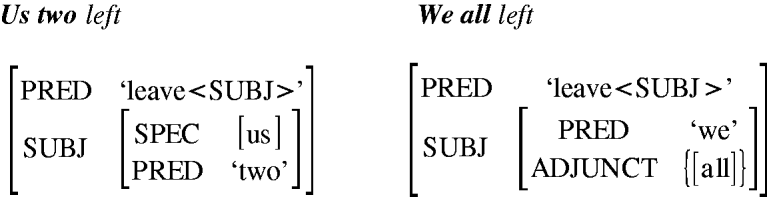
The whole phrase-structure problem can be circumvented by using LFG functional structure, especially since what is the head in the constituent structure does not necessarily have to be the head at functional structure (see Bresnan Reference Bresnan2001: 102; Dalrymple Reference Dalrymple2001; and the brief outline of LFG in Section 5 below). We propose the LFG f-structure treatment presented in Figure 1. If pronouns behave like determiners, they will supply the value of the specifier (spec) at f-structure, which will enable them to get default case, as they are not the f-structure head. If pronouns function as heads, they will contribute the pred value in the relevant f-structure and will only be able to get canonical case (see Section 5 below).
Functional-structure analysis of pronouns as heads or dependents.

The aim of this section has been to demonstrate that an adequate analysis of case assignment in Present-Day English will have to be able to reflect the disparities between pronouns functioning as heads and pronouns functioning as dependents – heads always have to be assigned canonical case, whereas dependents are allowed to get non-canonical default case. This is valid for the material we have been examining here, as well as for coordination, which will be discussed in more detail below. After this excursus, we turn to reviewing a small sample of the vast literature on pronominal case in English. It will emerge that while coordinated constructions have featured prominently in previous work, often no attempts have been made to extend the analysis to what we have labelled determiner pronouns.
4. PREVIOUS ACCOUNTS
This section contains thumbnail sketches of some earlier attempts at tackling case in English, with special reference to case assignment to conjoined phrases. We first present the treatments offered in the two standard reference grammars of Modern English – Huddleston & Pullum et al. (2002) and Quirk et al. (Reference Quirk, Greenbaum, Leech and Svartvik1985) – followed by a discussion of the work of two more theoretically-minded authors – Johannessen (Reference Johannessen1996, Reference Johannessen1998) and Quinn (Reference Quinn2005). As we go along, we also point out some of the problems previous proposals face. Finally, we argue against the purely tree-based explanations that have dominated the specialist literature. In the next section, we will outline our alternative proposal and then set it against a backdrop of similar ideas.
4.1 Payne & Huddleston (Reference Payne, Huddleston, Huddleston and Pullum2002)
Payne & Huddleston (Reference Payne, Huddleston, Huddleston and Pullum2002: 462) list three strategies for assigning case to coordinate constructions. The first one involves having the same case-assignment rules for both conjoined and non-conjoined pronouns (equivalent to what we have labelled the prescriptively ‘correct’ variety). The second one involves treating the coordinating conjunction as a preposition and is exemplified by sentences where only the second conjunct gets accusative case, like (32). The third strategy is to have accusative case for both conjuncts. Payne & Huddleston's second and third strategies are subsumed under what we have called the colloquial variety of Standard English.
(32) She and us are going to be good friends. (Payne & Huddleston Reference Payne, Huddleston, Huddleston and Pullum2002: 462)
In relation to the hyper-correct insertion of nominative forms into object slots, Payne & Huddleston (Reference Payne, Huddleston, Huddleston and Pullum2002: 463) distinguish two patterns. The first one features a ‘deviant’ conjunct in second position, as in (33) below. The second pattern has the ‘deviant’ conjunct in first position, as in (34), or both conjuncts are ‘deviant’, as in (35). The authors point out that the first pattern is much more common than the second.
(33) The present was supposed to represent Helen and I …
(34) They've awarded he and his brother certificates of merit.
(35) There's a tendency for he and I to clash.
(all examples from Payne & Huddleston Reference Payne, Huddleston, Huddleston and Pullum2002: 463)
A difficulty arises from attributing the assignment of non-canonical accusative case in the colloquial variety to the reanalysis of the conjunction as a preposition. Such an explanation cannot be invoked when both conjuncts get non-canonical accusative case, or, more importantly, when it is the first conjunct that gets non-canonical accusative case, but not the second. We have attested examples from the Internet:
(36) Me and he are having a heated discussion about this.
(http://www.digitalspy.co.uk/forums/showthread.php?t=287273&page=162b; accessed 13 April 2010)
(37) She can't take the fact that me and he are happy together, she's jealous, actually she wants him back.
(http://www.country-couples.co.uk/datingtips/does-your-man-flirt-with-other-women/; accessed 13 April 2010)
Nor can this explanation be extended to the constructions with determiner pronouns discussed in the previous section. Although Payne & Huddleston (Reference Payne, Huddleston, Huddleston and Pullum2002: 374) correctly identify pronouns used in this way as determiners, they do not offer a comprehensive solution that applies to both instantiations of what seems to be the same phenomenon.
4.2 Quirk et al. (Reference Quirk, Greenbaum, Leech and Svartvik1985)
In order to explain the mechanisms of case assignment, Quirk et al. (Reference Quirk, Greenbaum, Leech and Svartvik1985) divide the finite clause into ‘subject territory’ (the pre-verbal subject position) and ‘object territory’ (which includes all noun-phrase positions apart from that immediately preceding the verb).Footnote 13 In informal English, the accusative is the unmarked default case form which is used ‘in the absence of positive reasons for using the nominative form’ (Quirk et al. Reference Quirk, Greenbaum, Leech and Svartvik1985: 338). This is how the authors account for accusative subject complements such as that in (38). This also explains the preference for me in ‘absolute’ functions, as in (39) (see Erdmann Reference Erdmann1979: 68).
(38) That'll be them.
(39) ‘Who's there?’ ‘Me.’
(both examples from Quirk et al. Reference Quirk, Greenbaum, Leech and Svartvik1985: 338; bold face mine)
According to Quirk et al. (Reference Quirk, Greenbaum, Leech and Svartvik1985: 338), the same idea of ‘object territory’ is responsible for the tendency to find accusative conjoined pronouns functioning as the subject of the finite clause. The pronoun is no longer said to be in subject territory here, because coordination means that it is:
separated to some extent from the following verb, either by position or by failure of concord, as in the non-standard Him and Mary/Mary and him are going abroad for a holiday. (Quirk et al. Reference Quirk, Greenbaum, Leech and Svartvik1985: 338)
It is mysterious, however, that him should be accusative, despite immediately preceding the verb in its ‘subject territory’. Having recourse to ‘failure of concord’, on the other hand, is circular: an accusative subject is said to constitute an exception merely by virtue of being accusative. An anonymous JL referee protests that failure of concord/agreement is not meant to be the same as being accusative; instead, it only means that the verb fails to agree with the individual pronoun. Even if we accept this point, which arguably justifies removing the pronoun from subject territory, it remains unclear why a pronoun in the same slot might be nominative.
Hyper-correct nominative objects are attributed to the prescriptive bias in favour of nominative forms. Nevertheless, conjoined nominative pronouns which have encroached on ‘object territory’ pose a problem for Quirk et al.'s explanation, as it predicts that anything in the object territory will be in the accusative (compare between you and I, as for John and I, etc.).
In order to salvage these otherwise neat insights, we might stipulate that, in the hyper-correct register, the defaults have been flipped around (this is what we will do in our analysis below). Although the problem of hyper-correction can be eliminated by positing another default, Quirk et al.'s (Reference Quirk, Greenbaum, Leech and Svartvik1985) model would have a hard time explaining why it is possible to get the default case in Ustwo left, but not in Weall left. Since neither of the two pronouns immediately precedes the verb, they are not in ‘subject territory’, and default case should be available to both of them. Although the authors offer convincing analyses of the headedness of such constructions (Quirk et al. Reference Quirk, Greenbaum, Leech and Svartvik1985: 339, 353, 423–424, Sections 7.25, 17.65, 17.88), the case marking options in them cannot be covered by the concepts of subject and object territory. What is more, nominative subject complements remain unaccounted for.
With regard to the interrogative/relative pronoun who/whom, Quirk et al. (Reference Quirk, Greenbaum, Leech and Svartvik1985: 367) note that the accusative form is the marked one, unlike the unmarked accusative form of personal pronouns.Footnote 14 The advantage of their approach is that it naturally anticipates this discrepancy. Since ‘subject territory’ in colloquial English is defined as the position preceding the verb, and since the fronted wh-pronoun in interrogative and relative clauses can only appear in subject territory, regardless of whether it functions as subject or not, there is a tendency in informal English to avoid accusative whom and to replace it by who (Quirk et al. Reference Quirk, Greenbaum, Leech and Svartvik1985: 367; see Section 5.8 below, where we set out our ideas). We now turn to an analysis cast in the Minimalist framework and its hierarchy-based account of the same facts, or at least a subset of them.
4.3 Johannessen (Reference Johannessen1996, Reference Johannessen1998)
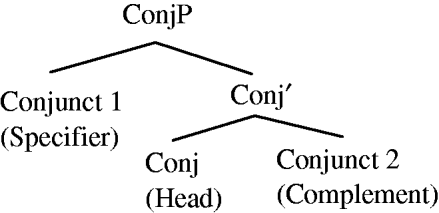
Restricting herself to conjoined pronouns, Johannessen (Reference Johannessen1998) also recognises the fact that the deviant conjunct gets default case. For her, this has to do with the structure of the Conjunction Phrase. On the basis of the observation that mixing canonical and non-canonical forms normally proceeds in that order (see (40) and (41) below, and Section 4.1 above), as well as on the basis of other assumptions which are not rehearsed here, Johannessen concludes that conjoined nouns form a Conjunction Phrase (ConjP) headed by the conjunction and constructed according to the generalised X-bar schema given in Figure 2 (i.e. there is a head, in addition to a complement, which is sister to the head and daughter to the X-bar node, as well as a specifier, which is daughter to the XP and sister to X-bar).
Johannessen's (Reference Johannessen1998; Reference Johannessen1996: 669) ConjP.
The conjunction, which is the head, gets the case properties dispensed by the verb.Footnote 15 Since conjunctions display no case, case is realised on one of the conjuncts. Crucially, agreement in this framework is always a relation between a head and its specifier.Footnote 16 Thus, the pronoun or noun which sits in the specifier position receives the expected canonical case, whereas the other pronoun (or noun) can host default case, as the model does not stipulate that any agreement relations will obtain between a head and its complement. It follows that if only one of the two conjuncts is aligned with the expected canonical marking, it must be the one that appears in the specifier position.
Johannessen (Reference Johannessen1998: 3, 54–55) believes that the relative order of heads and complements is fixed in any given language. With particular reference to English, she claims that the order of verb (head) and object (complement) corresponds to having a conjunction (head) and a deviant conjunct which follows it (complement). This is indeed true in sentences like (40) and (41).
(40) Can someone help my wife and I find housing in Texas?
(41) She and him will drive to the movies.
(both examples from Johannessen Reference Johannessen1998: 15–16)
This account predicts that the first conjunct (the specifier) will not be allowed to admit non-canonical morphology if the second conjunct (the complement) bears the expected canonical case. And yet, this is exactly what we find in examples (36) and (37) above, as well as in (42) and (43):
(42) No, quite the opposite. Him and I have remained close.
(43) Well, it does, in a way, because him and I took different paths fighting our case.
(both examples from COCA)
The fundamental motivation behind Johannessen's approach is primarily theory-internal, and her arguments can be turned upside down, again for theory-internal reasons. Zoerner (Reference Zoerner1995), for instance, props up the ConjP scaffolding too, but with exactly the opposite predictions – he expects that the conjunct in complement position will be given the canonical case, because for him the conjunction (head) acts like a case-assigning predicate which somehow channels the case for the relevant position; in addition, heads dispatch features to their complements, but not to their specifiers. A similar idea was entertained and rejected while discussing Payne & Huddleston's (Reference Payne, Huddleston, Huddleston and Pullum2002) proposed solution in Section 4.1 above.
4.4 Quinn (Reference Quinn2005)
Building on Johannessen's work, Quinn (Reference Quinn2005) appeals to violable weighted constraints in order to model pronoun case assignment in conjoined and non-conjoined phrases alike, including determiner pronouns. One such constraint is Relative Positional Coding 1, which states that, in a conjoined phrase, the first conjunct must be gracile and the second robust. The set of gracile pronoun forms comprises: me, he, she, we, they; the set of robust forms comprises: I, him, her, us, them. As this does not account for coordinations like me and they, Quinn (Reference Quinn2005) introduces an additional constraint, stipulating that sometimes the second conjunct has to be ‘more robust’ than the first, with they declared more robust than the other gracile pronouns. Yet another constraint allows invariant strong forms like him and me. The invariant strong forms are listed as: me, him, her, us, them.
However, none of these dictates seems to be in a position to straightforwardly capture attested and reported combinations like me and he in (36) and (37), or her and we functioning as subjects; if these were eventually captured, that would be achieved in a rather forceful manner, since such patterns are certainly less expected in this model. Examples like (42) and (43) above also slip through the net, unless some extra caveats are brought in (e.g. Quinn Reference Quinn2005: 192ff.). As pointed out by an anonymous JL referee, the above constraints do interact with others, such as Positional Case (see below) and Argument Case, both of which predict the occurrence of nominative forms in conjoined subjects. Nevertheless, it is the present author's belief that such a proliferation of optional rules somehow misses a deeper generalisation.
This brief survey of some relevant literature has revealed the need for an analysis that does a better job of demystifying the phenomenon under investigation. We will try to provide such an analysis in the next section, but we first set out to justify our decision not to make exclusive use of constituent structure.
4.5 Against an approach exclusively based on constituent structure
Since English is a configurational language, it might seem that we can rely on constituent-structure trees to formulate the generalisations. Such arboreal generalisations are laid out in the two bullet points below (to be visualised as in Figure 3 below), but, as we shall see, they soon turn out to be rather problematic.
• If the maximal projection of a pronoun is immediately dominated by IP, then the pronoun gets nominative case (as in Weall left or simply Weleft). If the (main/lexical) verb (incl. a copula), or a preposition, immediately c-commandsFootnote 17 the maximal projection of a pronoun, the pronoun then gets accusative case. This accounts for straightforward instances like She gave it to him and It's me.
• If, however, the pronoun is not the head of the maximal projection immediately dominated by IP, then the pronoun need not get nominative case and is free to receive default accusative case (in the colloquial variety). This accounts for Ustwo left and Me and himleft (assuming that coordination is exocentric). In the hyper-correct variety, if the verb or a preposition does not immediately c-command the maximal projection of a pronoun, the pronoun can then get default (nominative) case. In order for a pronoun to obligatorily get accusative case, its maximal projection has to be immediately c-commanded by the verb/preposition. This accounts for patterns like He drove my brother and I.
These insights appear in early work by Klima (Reference Klima1964), Emonds (Reference Emonds1976), and Hudson (Reference Hudson1995: 378), among others, but they need to be refined. In a theory like LFG, such relations as subject and object, as well as case assignment, are usually processed at functional structure, which is what we propose to do below. The motivation for rejecting a purely phrase-structural explanation is not whimsically theory-internal, however. It would be a challenge, possibly tackled by transformations or other suitable machinery, to extend our rigid phrase-structure account to languages with thriving morphological declensions and free word order, like Czech and Old Norse, which are hardly immune to non-canonicity (Siegel Reference Siegel1987: 69–70 highlights other, more formal, problems for configurational approaches to case assignment). Nor would such a tree-based model be able to naturally predict the behaviour of subject complements in English, since they inhabit the same surface c-structure position as objects, though attempts have been made within Minimalism to devise different underlying phrase-structural representations for the two types of constituent (as I am reminded by an anonymous JL referee; see Bowers Reference Bowers1993). The big debate on whether transformations are in general viable and motivated, or whether syntactic functions should be manipulated via phrase-structure trees, is ongoing. Unfortunately, we have no space for a more detailed discussion of what we believe to be a healthy scepticism on the part of non-transformationalists.
We will therefore primarily rely on LFG f-structure government and primitive grammatical functions such as subject, object and subject complement, but at the same time we will also make use of constituent-structure trees. We end up claiming that case in English is assigned to pronouns which are governed by a finite verbal pred at f-structure, bear certain grammatical functions, and appear in certain constituent-structure positions. In addition, the approach we will defend below is more flexible in delimiting what contexts individual pronominal forms are allowed to appear in, due to constraints that we attach to lexical entries.
5. A NEW PROPOSAL
We now proceed to reformulate our generalisations in the setting of LFG. After outlining the proposed f-structure solution, we will go on to explore how it can be implemented in different contexts where non-canonical case may gain a foothold, including conjoined and determiner pronouns, subject complements, as well as instances of topicalisation and left-dislocation. Special attention is paid to the inability of non-finite verbs, and perhaps prepositions in some varieties of English, to assign case. Focusing on conjoined environments, we address issues like the distributivity of case (see Section 5.9 below), and clusters with more than two conjuncts. In the later sections, we compare our model to existing ones that share similar intuitions, and bring this part of the paper to a close by listing the limitations of our account, as well as potential extra-syntactic constraints that remain to be worked out in future research. Finally, claims that English has no case at all will be assessed and discarded in Section 8.
5.1 Lexical-Functional Grammar (LFG)Footnote 18
Unlike tree-based transformational approaches to syntax, LFG makes available two types of syntactic representation. Constituent structure (c-structure) is similar to the surface phrase-structure trees of transformational grammar and provides information about linear order and constituency. Functional structure (f-structure) is separate from constituent structure and is entrusted with expressing tense, agreement, or grammatical relations such as subject and object in the form of attribute–value matrices enclosed in square brackets. An attribute like case, for example, might have the values Nom(inative) or Acc(usative). The value of a given attribute may be supplied by an embedded f-structure; for instance, the value of subj in Figure (3b) shows the f-structure of the pronoun she. F-structure is licensed by functional annotations on the nodes of the c-structure tree which specify the attributes and values of the f-structure. Such annotations can tell us that a given c-structure node, labelled ‘↓’, is the subject of the node above it, labelled ‘↑’, as expressed in the equation ‘(↑subj) = ↓’ that appears on the tree diagram (see Figure 3 above). These annotations spell out the links between c- and f-structure. The interface between the two modules will prove crucial for the present analysis, because we will enlist the help of such c-structure annotations to assign case which will then be processed at f-structure.
In our analysis, we will be appealing to f-structure government, which is discussed in the next section. Functional concepts such as subj and obj will also play a part, because the assignment of case will be tied to the grammatical role of the pronoun. A difference between LFG and transformational syntax is that grammatical functions are considered to be primitives in the former. Similarly to other formalisms (e.g. Government and Binding and Minimalism), LFG draws a distinction between structural (or functional) and lexical (or idiosyncratic) case (Allen Reference Allen1995: 125). Structural case is aligned with grammatical relations such as subj and obj. Lexical case, on the other hand, originates in the lexical entries of individual verbs and it, so to speak, overrides its structural counterpart. Below we demonstrate that Modern English has only got structural case left (in the sense of Butt Reference Butt2006: 145–146). Subject pronouns will therefore be fitted with nominative morphology and object pronouns with accusative morphology.
Finally, in a constraint-based theory like LFG, much emphasis is placed on the lexicon. We reflect this by regulating pronoun usage via distributional constraints associated with the lexical entries of individual pronominal forms. Having thus taken a glimpse at some of the relevant architecture of LFG, we are now equipped to present our proposal.
5.2 F-structure account: The basic principles
We can explain our data with the following overarching generalisations in the setting of LFG f-structure (to be supplemented below in order to take into account positional restrictions on case assignment):
• subj pronouns must receive nominative case if they are governed by the finite verb of the relevant clause.
• Similarly, an obj pronoun that is governed by a finite verb or a preposition will have to be assigned canonical accusative case.
• Ungoverned pronouns can get default accusative case in the colloquial variety or default nominative case in the hyper-correct variety.
A governed pronoun will appear as a governed grammatical function of the governing pred, not as a member of such a function or as a non-governed function. Looked at from the point of view of the case assigner, this means that the case assigner can only ‘have power’ over the head of the phrase to which it sends case, but its requirements cannot reach any further embedded potential receivers of case.Footnote 19
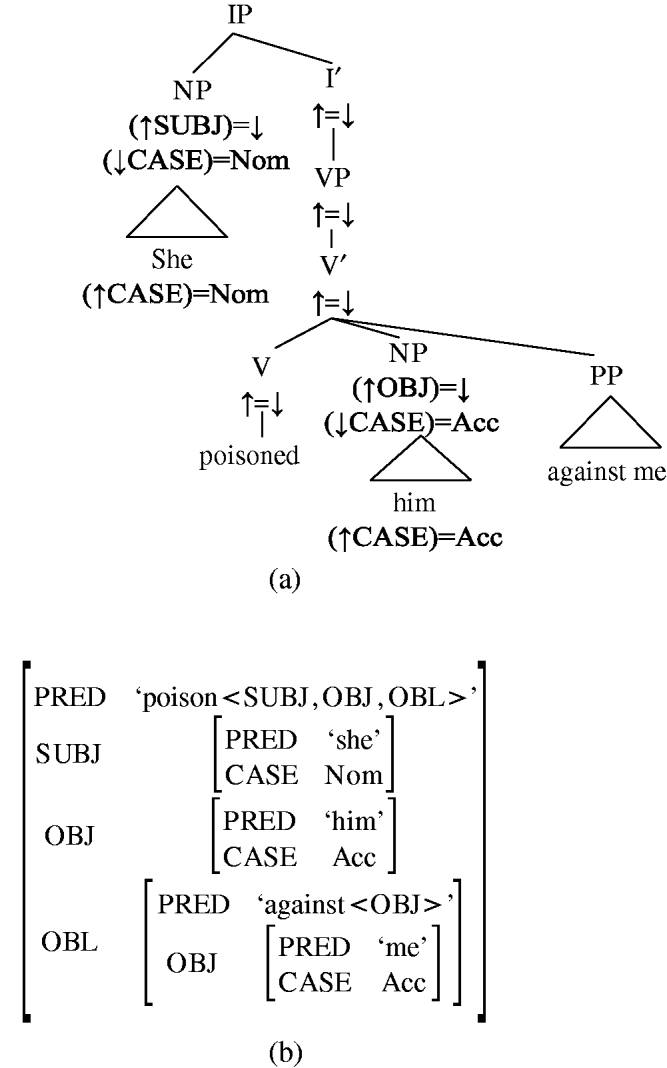
Partial c-structure (a) and partial f-structure (b) for She poisoned him against me (COCA).
In the f-structure in Figure 3 above, all the pronouns are governed by a case-assigning predicate (either the finite verb or the preposition). The predpoison governs the functions of subj, obj and obl. The respective values of those attributes are the f-structures for the pronouns she and him, as well as the f-structure of the PP against me. In the PP, the pred of the preposition governs its obj, whose value is supplied by the f-structure of the pronoun me. Since they are all governed, those pronouns must get the canonical case expected for their grammatical functions. This might be achieved by the traditional constraints given in (44).Footnote 20
(44) Constraints imposed by a case-assigning predicate
pred ‘poison<subj, obj, obl > ’
(↑subj case) = Nom, (↑obj case) = Acc
The first line in (44) tells us that the predicate poison takes a subject, an object and an oblique argument (a prepositional object). From the second line, we learn that the case of the subject has to be nominative and the case of the object has to be accusative. This is the traditional LFG treatment of arguments and the cases assigned to them by the predicate (Butt Reference Butt2006: 145ff.). We will only depart from these standardly held assumptions in one respect. Instead of having case assigned by the predicate, as shown in the second line of (44), we will have case associated with certain positions in the c-structure tree, with the nominative descending to subj constituents in the specifier of IP, and the accusative descending to obj sisters of V or P, as shown in the c-structure in Figure 3 above. The second line of (44) thus becomes redundant. Case will not be completely independent of predicates, however, because we continue to rely on function government by preds at f-structure, i.e. we still rely on the first line in (44), whereby the pred takes a subj, an obj and an obl, although it may not give case to them. In addition, case remains ultimately linked to the properties of predicates because we assume that non-finite verbs block case assignment (Section 5.4 and Figure 10 below illustrate how this is achieved formally).
For a pronoun to receive nominative case in any variety of Standard English, it will have to be a subj pronoun governed by a finite verb at f-structure, in addition to appearing in a specific c-structure position. For a pronoun to receive the accusative in any variety of Standard English, it will have to be an obj pronoun governed by a finite verb or a preposition at f-structure, in addition to appearing in a specific c-structure position. The empirical motivation for positional case assignment is presented in Section 5.7 below, but before we flesh out our proposal in full, we zoom in on some of the environments where default case may be tolerated because the relevant pronoun is not governed by a finite verbal pred or a preposition at f-structure.
5.3 Conjoined pronouns and determiner pronouns
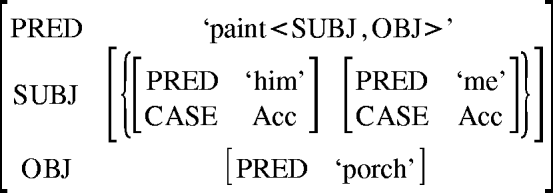
In Figure 4, the subject pronouns are further embedded as conjuncts within the coordinate structure. Lexical-Functional Grammar indicates this by enclosing them in curly brackets which signify that the conjuncts form a set. These brackets reflect the phrase structure in English – neither pronoun is the head of the phrase, and therefore is not governed by the finite verbal pred. Here, the verbal pred governs the coordinate structure as a whole, but not the individual conjuncts.Footnote 21 That is why they are allowed to default to the accusative.
Partial f-structure for How him and me painted the porch(COCA).
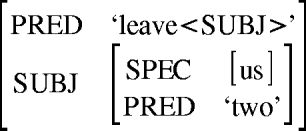
Another context where non-canonicity is possible is given in Figure 5. This time the first-person plural pronoun functions as a determiner in the subject phrase (see Section 3 above). Consequently, it appears as a sub-constituent (here, spec) of the subj f-structure and is therefore free to get default accusative case in the colloquial variety.
Partial f-structure for Us two left.
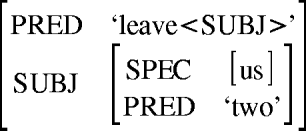
Analogous processes can be observed in the hyper-correct variety if the finite verb or a preposition does not govern a pronoun nested in the obj f-structure. In other words, if the pronoun appears in an f-structure which is a sub-constituent of the obj, the pronoun can get default nominative case in the hyper-correct variety. This explains sentences like (45).
(45) But to we nostalgic post-Imperial powers it was what the Scandinavian sexologists call an anticlimax.
(The Guardian, 27 March 1980; from Kjellmer Reference Kjellmer1986: 448; also quoted in Quinn Reference Quinn2005: 125; bold face mine)
5.4 Default case assignment in the absence of a finite predicate
Another context in which default case can step in is the absolute use of pronouns, where they stand on their own, as in (46).
(46) ‘Who's there?’ ‘Me’.
The reason for the default accusative in (46) is the absence of a (finite) verb to be governed by. This is also the explanation for elliptical constructions, like (47), which lack a finite predicate in the main clause (Quinn Reference Quinn2005: 178–180 advocates an alternative hypothesis).
(47) Me that's led such a quiet life!
(Wain, Hurry on Down; quoted in Erdmann Reference Erdmann1979: 69; bold face mine)
As we can establish from (48) and (49), either accusative or nominative forms are acceptable in elliptical constructions.
- (48)
(a) He was morose, she/her full of life.
(b) What, he/him a republican?
(both examples from Payne & Huddleston Reference Payne, Huddleston, Huddleston and Pullum2002: 460; bold face mine)
(49) She a beauty! I should as soon call her mother a wit.
(Jane Austen, Pride and Prejudice; quoted in Quinn Reference Quinn2005: 32; bold face mine)
This suggests that what we have here is indeed default case, which is different in the different varieties. The non-canonical, hyper-correct form in (50) can likewise be attributed to the non-existence of a verbal pred in the parenthetical if-clause.
(50) Who, if not he, could he have hired?
(Emonds Reference Emonds, Brame, Contreras and Newmeyer1986: 115; quoted in Johannessen Reference Johannessen1998: 125; bold face mine)
The same explanation can be extended to non-finite clauses, which we illustrate in (51)–(53).
(51) We were in Greville's office, I sitting in his swivel chair behind the vast expanse of desk, Annette sorting …
(Payne & Huddleston Reference Payne, Huddleston, Huddleston and Pullum2002: 460; bold face mine)
(52) He could think of a few himself, I expect, him being so much in the business already. (Payne & Huddleston Reference Payne, Huddleston, Huddleston and Pullum2002: 460; bold face mine)
(53) That's what you wanted, me going out to work every morning and bringing money in on Friday night.
(Sillitoe, A Tree on Fire; quoted in Erdmann Reference Erdmann1979: 71; bold face mine)
Although the predicate is there, it consists of a non-finite verb which cannot furnish its subject with case.Footnote 22 In essence, case ultimately seems to depend on the predicate. Non-finite predicates disable the positional case annotations in the c-structure, whereas finite ones activate those annotations (see Section 5.2 above and Figure 10 below).
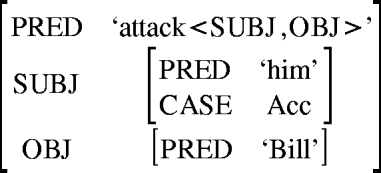
It should be noted that the accusative in (53) co-varies with the genitive (my), and not with the nominative, so the whole clause can be construed as a nominalised construction.Footnote 23 Accusative pronouns in such examples might indeed be thought of as modifiers of the nominalised gerundive form, rather than as independent subjects of the clause. However, such a scenario cannot cover (51) and (52), where a genitive pronoun is not an option. We therefore prefer to attribute the availability of default case in all such contexts to the inability of non-finite verbs to ensure case for their subjects. So-called Mad Magazine Sentences are a subtype of non-finite clause (Figure 6) (see Akmajian Reference Akmajian1984: 3–4; Siegel Reference Siegel1987: 62; Haegeman Reference Haegeman1994: 159). Since the pronoun in Figure 6 is not immediately governed by a finite verb, it can also default to the accusative.
F-structure for the Mad Magazine Sentence Him attack Bill?
Independent evidence from raising and control confirms that non-finite predicates cannot license case (see (54), (55) and Schwartz Reference Schwartz1985: 161–162).
(54) *Bill tried Tina/she to go. (Schwartz Reference Schwartz1985: 161–162)
(55) He seemed to go/I believed him to go. (invented)
In (55), case comes from the main-clause verbs seemed and believed, respectively.Footnote 24 In (54), the non-finite verb cannot even afford any form of subject, since both Tina and she are equally bad. Neither can they serve as the object of tried, since that role is already occupied by the clausal complement.
5.5 Prepositions and complementisers as case assigners
In Section 5.4 above, we saw that English non-finite predicates block case assignment. We now turn to the case-licensing properties of prepositions. Examples (56) and (57) are apparent exceptions to our generalisation from Section 5.2 above that objects which are not displaced and are immediately governed by a preposition should be accusative.
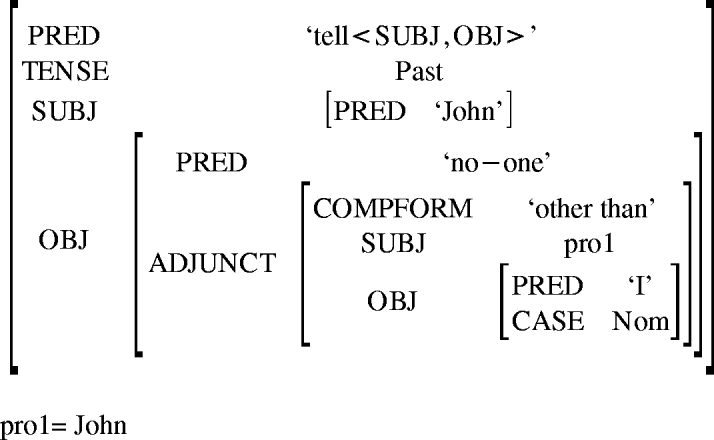
(56) John told no one other than I.
(57) For they to be understood correctly.
(both examples from Emonds Reference Emonds, Brame, Contreras and Newmeyer1986: 115; quoted in Johannessen Reference Johannessen1998: 125; bold face mine)
Because it can function as a complementiser (as in He is taller than I am), than in example (56) must have been (mis)interpreted as a complementiser instead of a preposition. Complementiser than is not a case-licensing preposition: in LFG, complementisers contribute the value of compform, without assigning case. Therefore, since there is no finite verb in the (elliptical) clause introduced by the complementiser, the pronoun can get default case (see Figure 7). Similarly, for in (57) can be either analysed as a preposition or as a complementiser. If it is a complementiser, then the case of the pronoun seems to be left to the verb to take care of.Footnote 25 Since the verb is non-finite, it will let the pronoun appear in whatever the default is. The same will hold for (58), which can be regarded as a telegraphic version of a girl like I am. But can also be a conjunction or a preposition. Although it would be a bit of a leap to say that it is anything other than a preposition in (59), the point is that it can be a conjunction elsewhere.Footnote 26
(58) a girl like I
(59) She will not sing for anybody else but he.
(both examples from Householder Reference Householder1987: 167, 174)
Re-analysis of a preposition as a complementiser.
There might be arguments against treating than as a complementiser in (56) above, since it can be stranded, as in I am the one he is taller than; this is a property that prepositions have but complementisers do not (Schütze Reference Schütze2001: 212). Then, the logical conclusion would be that prepositions in some varieties of English have lost their ability to allocate case (i.e. they block positional case assignment), similarly to non-finite verbs. In fact, we have come across a substantial number of examples like Come with I in the BNC, where with has legitimate credentials to be a preposition and nothing else. However, it remains for future work to determine if such sentences belong to Standard English in the first place, and if they should be included in the model, as English native speakers find them pretty bad (Steven Kaye, Mary Dalrymple, p.c.). For the time being, we will assume that the default case in (56)–(59) above can only be due to reanalysis.
5.6 Subject complements
The treatment of subject complements, which are neither subjects nor objects, is very interesting. Capturing their case-marking idiosyncrasies in terms of function, and not in terms of constituent structure, gives us a solution which would not be available if we were to rely on constituent structure alone. Strings like It is I are problematic for the tree-based account from Section 4.5 above, because they go against the generalisation that, if a verb immediately c-commands a pronoun, the pronoun must get accusative case. A proposal that appeals to function naturally makes the desired predictions.
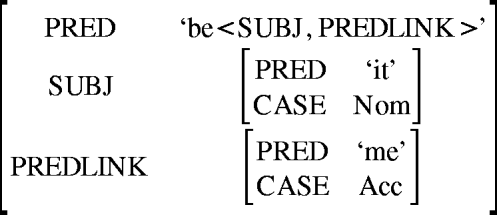
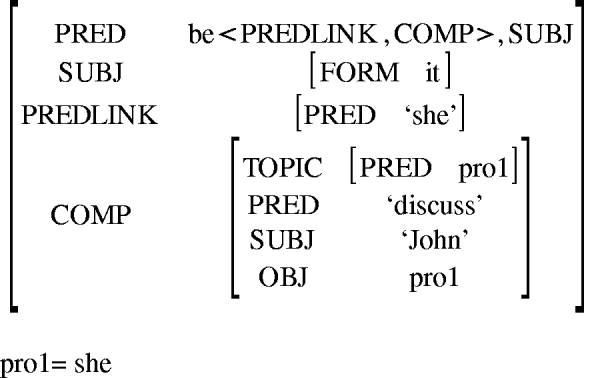
As mentioned in Section 5.2 above, the nominative is obligatory for non-displaced subj pronouns which are governed by a finite verb. Similarly, non-displaced pronouns heading obj f-structures and governed by a finite verb or a preposition have to get accusative case. A (sole) pronoun functioning as subject complement will be governed by the verb, but the f-structure for the subject complement will be associated neither with subj nor with obj, but with predlink (see Figure 8 and Butt et al. Reference Butt, King, Niño and Segond1999). A pronoun housed in the f-structure of a predlink, even when governed by a finite verbal pred, can receive either nominative or accusative morphology because a predlink is neither a subj nor an obj, and no case requirements have been specified for it.Footnote 27
F-structure for It’s me.
The explanation of the non-canonical example in (60) below follows from the fact that the nominative feminine pronoun appears in the predlink f-structure of the matrix clause; it therefore succumbs to the default nominative case in the hyper-correct variety, even though it is semantically also interpreted as an object within the embedded clause (cf. Quirk et al. Reference Quirk, Greenbaum, Leech and Svartvik1985: Section 6.5; Wales Reference Wales1996: 96). Crucially, our analysis assumes that there is no syntactic equality between the predlink of the main clause and the missing argument in the subordinate clause, as shown in Figure 9.
(60) It was she that John discussed in detail.
(Emonds Reference Emonds, Brame, Contreras and Newmeyer1986: 115; quoted in Johannessen Reference Johannessen1998: 125; bold face mine)
Partial f-structure for It was she that John discussed in detail.
5.7 Displacement and positional case assignment
Postposed pronominal subjects can be potentially challenging for our model. Grano (Reference Grano2006: 5) notes that when pronominal subjects are inverted, they must be accusative, as in (61) and (62).
(61) People are used to these stories of Alaska that are romantic and beautiful, and flowing wilderness, and here comes me with, y'know, an assault rifle and a jug of R&R. (Zwicky Reference Zwicky2004)
(62) Before her, in the arms of death, lay him on whom her hopes of happiness seemed to have formed so firm a basis.
(Percy Bysshe Shelley, Prose Works; from Visser Reference Visser1963: 248; quoted in Quinn Reference Quinn2005: 306)
This, however, is not always the case, because some speakers can insert nominative pronouns in such contexts (Catherine Mary MacRobert, p.c.). In other words, we seem to be dealing with another environment that fosters default case.
As Zwicky (Reference Zwicky2004) puts it, either me in (61) is not a subject, or the inverted construction is an exception to the rule that English subjects have nominative case.Footnote 28 The former scenario has more plausibility to it. Bresnan (Reference Bresnan1994) also argues that the locative phrase is the real subject in examples like (61) and (62). The third-person subject–verb agreement in (61) is a tell-tale sign. More evidence that such pronouns are not subjects is given by Bresnan (Reference Bresnan1994). Likewise, something has ‘gone wrong’ with the case of the fronted object in (63) and the topicalised subject in (64).
(63) She, who had been the bane of his life, he treated with the respect a good son might offer a kind mother.
(Charlotte Brontë, Villette; from Jespersern & Haislund Reference Jespersen and Haislund1949: 225; quoted in Quinn Reference Quinn2005: 305)
(64) Me, on the other hand, am not so patient.
(http://groups.google.com/group/alt.consumers.free-stuff/browse_frm/thread/22e5e49f6036de49/4930da530c426f97; quoted in Grano Reference Grano2006: 6; bold face mine)
(65) *Me probably won't want to go. (Grano Reference Grano2006: 6)
The reason for the assignment of non-canonical case in both (63) and (64) is that a constituent has been topicalised (by fronting) and does not appear in the phrase-structure position where it is expected to appear. The parenthetical PP on the other hand indicates that the subject in (64) is not in its usual subject position. Other constituents can be lodged between the subject and the verb, but if they are not parenthetical, as in (65), the subject remains in situ and non-canonical case is ruled out. This seems to be so because probably is much more integrated in the clause, and does not isolate the preceding pronoun as a displaced topic in the same way that a parenthetical expression like on the other hand does. In addition, Schütze (Reference Schütze2001: 210) treats the non-canonical pronoun in left-dislocated constructions like (66) below as a non-argument which ends up with default case because there is no obvious case assigner for it.
(66) Me, I like beans (Schütze Reference Schütze2001: 210)
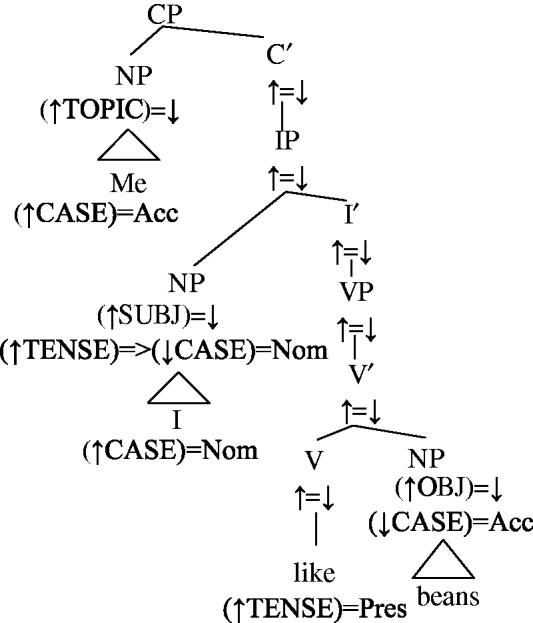
Unlike the topicalised examples with a gap in (63) and (64), both the relevant grammatical function and the dislocated topic position are filled in (66).Footnote 29I is the subject and me is a floating topic; they are co-referential but do not share the same case.Footnote 30 We are going to propose a unified treatment for both topicalisation and left-dislocation, ignoring some crucial differences between them which are irrelevant for the purposes of the present paper (see Greenberg Reference Greenberg1984: 283 and the references cited there, as well as Ross Reference Ross1967; Rodman Reference Rodman1974; Prince Reference Prince and Kamio1997: 133; Gregory & Michaelis Reference Gregory and Michaelis2001).
The evidence presented in this section supports the claim that case in English is assigned positionally, with nominative descending to subjects appearing in the specifier of IP, and accusative descending to objects appearing as sisters of V or P (as per Section 5.2 above, as well as Quinn's Reference Quinn2005 idea about Positional Case). Anything that does not surface in its canonical phrase-structure position will thus be free to get default case. This can be achieved through the interaction of LFG c-structure and f-structure, as envisaged in Section 5.1 above. Assigning case positionally does not amount to going back to a purely phrase-structural explanation, because we continue to rely on functional categories, with some extra help from the interface between c- and f-structure. This seems to be necessary for English.
Above we mentioned that f-structure is licensed by annotations attached to c-structure nodes, which are themselves the product of the valency requirements of the predicate. The specifier of IP will bear the annotation (↑subj) = ↓, which states that it acts as the subject of IP. Likewise, the NP complement of the V or P will be marked as (↑obj) = ↓, indicating that what is below this node acts as the object of the nodes higher up. Those will also be the places where case specifications are inserted, so there will be an association in English between occupying a particular slot and being required to have a certain case (see Figure 10). If a constituent appears elsewhere, it will resolve its grammatical function in an indeterminate way. Fronted elements can be subjects or objects, or have a number of other grammatical functions. Crucially, such displaced constituents will not be required to have a particular case.Footnote 31 What is more, the annotation (↑tense) = >(↓case) = Nom establishes a link between the positional assignment of case and the presence of a finite predicate, in line with the findings from Section 5.4 above.
Positional case assignment in a finite clause.
5.8 Displacement and wh-pronouns
The reasoning from the previous section can be straightforwardly applied to wh-words that function as relativisers and interrogative pronouns. Since they are usually displaced, we expect that wh-pronouns will in principle be able to get default case, except in pied piping. In this way, the form is always who in the colloquial variety, whereas whom can be encountered in all grammatical functions in the hyper-correct variety, as in (67).
(67) certain members of the press whom I suppose are friends and friendly to him (COCA)
(compare: I suppose them to befriends vs. I suppose they arefriends)
When a wh-object of a preposition is moved to the front of the clause and the preposition is stranded, the pronoun can be either nominative or accusative, as in (68) (see Quirk & Greenbaum Reference Quirk and Greenbaum1973: 379).Footnote 32 However, if the preposition is fronted with the pronoun, the only possible case is normally the canonical accusative, as shown in (69) (cf. Quirk & Greenbaum Reference Quirk and Greenbaum1973: 379).
(68) the person who/whom they were interested in
(69) the person in *who/whom they were interested (both invented)
In this sense, the present account has an advantage over that of Quirk et al. (Reference Quirk, Greenbaum, Leech and Svartvik1985) outlined in Section 4.2 above, because the latter fails to explain why the default case is disallowed with pied piping, in (69), or why it is possible to get whom instead of who in the hyper-correct variety, when one would not expect whom to break into the subject's territory. And yet, we did find some instances of who used with a pied-piped preposition in the BNC, one of which is displayed in (70).
(70) She was a founder member of the Bradford Gilbert and Sullivan Society, with who she had a long association. (BNC)
This means that whom has been lost altogether from the grammars of at least some speakers, and our account only concerns people whose grammars do not let them use who with pied-piped prepositions. Similarly, the default form who normally takes over in so-called echo-questions (e.g. You saw who?/You went with who?), as I was reminded by an anonymous JL referee. This, however, smacks of nominalisation, as interrogative wh-words are not usually expected to remain in situ and fail to trigger subject–auxiliary inversion (unless they are subjects themselves).
It is essential to ensure that our mechanism does not over-generate. Unacceptable sentences like (71) must be outlawed.
(71) *Whom saw Mary? (Lasnik & Sobin Reference Lasnik and Sobin2000: 358)
Positional case assignment accomplishes that naturally, because wh-subjects appear in situ, unless separated from the rest of the clause by other material such as an extra clause or a parenthetical expression. The fact that we do not witness subject–auxiliary inversion with subject wh-pronouns suggests that they are indeed not displaced; this sets them apart from fronted wh-pronouns or fronted adverbs like never, both of which trigger subject–auxiliary inversion (see Huddleston & Pullum Reference Huddleston and Pullum2005: 162–165). Yet again, there are surprising counter-examples like (72) and (73).
(72) no matter who spoke, or whom was addressed
(73) Ben Johnson, whom should have known, thought Shakespeare's writing too fluent, too facile …
(both examples from Lasnik & Sobin Reference Lasnik and Sobin2000: 363)
The speakers that produced them must have conflated the construction with a displaced wh-word and the one where the wh-word remains in situ.
5.9 Distributivity of case, lexical constraints on individual pronominal forms
Since the different varieties of English described above have different settings, the default can either be the (colloquial) accusative or the (hyper-correct) nominative. Conjoined phrases are one context in which pronouns can get default case because neither of the conjuncts is the head or main pred of the subj or obj f-structure. In conjoined constructions, case may at first sight appear to be an optionallydistributive feature.Footnote 33 The mother node gets the expected canonical case, which is sometimes passed down to both conjuncts and sometimes to neither; it is also possible for only one conjunct to receive the expected canonical case, with the other one left with the default. At first glance, the distributivity of case seems to offer a principled way of drawing boundaries between the different registers of English. Case is always a distributive feature in the standard, prescriptively correct, variety, and therefore must always spread to all conjuncts. It may be a non-distributive feature that never gets passed down in the colloquial system which has Me and him left, or in the hyper-correct variety with between he and I; in addition, case may be a feature involved in ‘single-conjunct government’ in the varieties with mixed nominative and accusative conjuncts (see Payne & Huddleston Reference Payne, Huddleston, Huddleston and Pullum2002: 462–463).
The trouble with this picture is that there is no way of telling when case will distribute and when it will not. A far more promising idea is to model assignment by saying that case in English is always non-distributive (following Schwartz Reference Schwartz1985, Parker, Riley & Meyer Reference Parker, Riley and Meyer1988, Schütze Reference Schütze2001, Sadock Reference Sadock, Orgun and Sells2005). This means that case requirements will only reach the c-structure mother node or the main f-structure pred of the relevant phrase, but will never be handed over to any further embedded constituents such as conjuncts or determiners. We will rely on this assumption and will then put additional constraints on the lexical entries of pronouns. A nominative (74) and an accusative (75) pronoun will have the following lexical entries in the colloquial register (see Butt Reference Butt2006).
(74) Partial lexical entry for a nominative pronoun in the colloquial register
he: (↑case) = Nom
(subj ε* (spec) ↑)
(75) Partial lexical entry for an accusative pronoun in the colloquial register
him: (↑case) = Acc
The representation in (74) includes a constraint associated with the lexical entry of the word form he. It states that he is nominative in case and is only allowed to function as subject, or as part of a subject (ε) (which is what we encounter in conjoined phrases, for example), or as the specifier of the subject. The entry in (75) designates him as the default which can step in where accusative case is assigned, as well as anywhere else where there are no case requirements, since it is not restricted to a particular function. Similarly to the term unmarked in the way it is understood in morphology, default case here means absence of additional specifications (for more on default case in English, see Schwartz Reference Schwartz1985: 165; Wales Reference Wales1996: 101; Johannessen Reference Johannessen1998: 121–122; Schütze Reference Schütze2001).
Schütze (Reference Schütze2001: 221ff.) talks about two algorithms of implementing default case. One way is to have word forms which are the ‘least featurally specified items of their respective paradigms’, and the other is a specific ‘feature-filling mechanism that applies before vocabulary insertion’. This mechanism would issue instructions of the type: ‘if you find a DP/NP with no case, assign it such and such case’. Our model obviously falls into the first category: there are default items, and default case is ‘a descriptive way of referring to that set of forms but has no independent status in the grammar’ (Schütze Reference Schütze2001: 221). The empirical advantage of this for English is that it is sometimes nominative pronouns (e.g. who), and sometimes accusative pronouns (e.g. him), that act as the default in the colloquial variety (see Schütze Reference Schütze2001, especially page 222).
In a coordinate construction in the colloquial variety, the subject in Spec IP and its corresponding f-structure will be required to be nominative, but this requirement will not spread to the individual conjuncts. Consequently, some of them might end up being morphologically accusative, while still counting as conjuncts within the subj (the mother NP node will still be annotated with the equation (↑subj ) = ↓). On this analysis, the case requirements coming from the c- and f-structure will travel to the conjoined phrase but will not affect individual conjuncts. Independently, due to lexical-entry constraints on the pronouns, nominative forms are barred outside of subjects.
However, if the pronoun is not embedded in a conjoined phrase (or another super-structure), the case requirements will reach it. A non-conjoined, non-dislocated accusative pronoun will therefore not be able to function as the subject of a finite verb, because there will then be a clash between the case assigned for the relevant function (at f-structure) and position (at c-structure), on the one hand, and the case information supplied by the pronoun on the other (see Figure 10 above).Footnote 34
In the colloquial variety, the nominative cannot penetrate an obj f-structure, because its lexical-entry specifications bind it to subj. If we remove this restriction, the nominative will be allowed anywhere where no case requirements are imposed. This is the situation in the hyper-correct variety.Footnote 35 The constraints for the hyper-correct variety will thus be a mirror image of the colloquial ones above, with the nominative unrestricted and the accusative confined to obj functions – (76) and (77).Footnote 36
(76) Partial lexical entry for a nominative pronoun in the hyper-correct register
he: (↑case) = Nom
(77) Partial lexical entry for an accusative pronoun in the hyper-correct register
him: (↑case) = Acc
(obj ε* (spec) ↑)
What we will need to do for the prescriptively correct variety is restrict the nominative to subj (and predlink) functions, and the accusative to obj functions. In other words, the entry for he would look like (74), possibly extending the restriction to predlink (for some speakers; see footnote 7 above, as well as Section 5.6), whereas the entry for him would be as in (77), thus ensuring that subjects are always nominative and objects always accusative. Our rules do not require that the same speaker should consistently operate with only one sub-system on different occasions or even in different utterances, but consistency is expected within the same clause (consult Wales Reference Wales1996: 108 for code-switching between the different registers).Footnote 37 Unlike Klima (Reference Klima1964), who derives the rules of one variety from the rules of the others, we build parallel (sub-)systems, each of which has its own grammatical constraints associated with certain pronominal forms.
As mentioned in Section 2 above, our posited register boundaries may turn out to be an idealisation, because it is often rather problematic to determine register independently of pronoun use. However, it would not be a good idea to conflate all three sub-systems by placing no lexical-entry restrictions on either nominative or accusative pronouns. This would have the undesirable consequence of allowing accusative subjects to appear in the same clause as nominative objects.Footnote 38 As we saw in example (15) above, repeated as (78) below, such co-occurrence results in ungrammaticality, thereby lending support to our register divisions. A summary of how the case forms of pronouns work in the three different registers we have identified is provided in Table 1.
(78) *Me and him know she and I
Summary of the functions of pronominal case forms in the different registers of Standard Present-Day English.
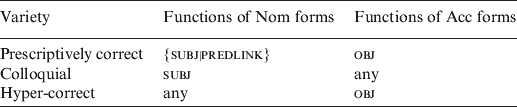
We expect that any of the conjuncts in a phrase with more than two will be free to choose either canonical or default case. There have been speculations in the literature that all non-final conjuncts must bear identical case, even when the case of the final conjunct is different (Zoerner Reference Zoerner1995: 352). If this were really so, our model would suffer a heavy blow. However, we can produce empirical evidence to justify our predictions:
(79) The next day he, her and I were in my flat and she asks ‘you coming with us too …
(http://www.thestudentroom.co.uk/showthread.php?t=1630595; accessed 2 June 2011)
(80) Joe insists that he and Gail need to go away – just he, her and the boat.
(http://coronationstreetupdates.blogspot.com/2010_01_01_archive.html; accessed 2 June 2011)
6. SYNTACTIC AND EXTRA-SYNTACTIC CONSTRAINTS
Our proposal does not address ordering tendencies. In fact, a search in the BNC shows that conjoined subjects can be both nominative, as in (81); both accusative, (82)–(83); nominative and accusative, (84); and accusative and nominative, (85). All combinations are possible, albeit with different frequencies. In addition, individual pronouns might have their own preferences as to the company they keep.
(81) I and she'd never said a word.
(82) Me and him don't talk very much.
(83) Him and me have never kept things from each other;
(84) … and take Maggie away from him and she and me and Francie could go back to Ireland and live quietly together and play music …Footnote 39
(85) But him and I have this fight, right? (all examples from BNC)
Attempts have been made to constrain the distribution of conjoined pronouns in terms of person and case (e.g. Parker et al. Reference Parker, Riley and Meyer1988, Quinn Reference Quinn2005, Grano Reference Grano2006). According to Grano (Reference Grano2006), if all conjuncts are in the nominative, second person pronouns should come before third person pronouns, which in turn should come before first person pronouns, but (81) does not abide by these rules. If we have a string of accusative forms, then second person tends to precede first, which in turn would tend to precede third, but problems arise with (82) and (83). Moreover, these constraints do not operate in cases of mismatch, when one conjunct is nominative and the other accusative. The data from the BNC do offer some support for previous generalisations that, if there is a case mismatch where first-person pronouns are involved, the accusative tends to be the first conjunct and the nominative the second one, whereas the situation is reversed with non-first-person pronouns (Quinn Reference Quinn2005, Grano Reference Grano2006). More importantly, however, our research also turned up counter-examples to these observations. Such generalisations are therefore only tendencies, rather than hard and fast rules. Even Grano (Reference Grano2006: 41) himself reports exceptions to his ‘X and I’ constraint, such as (86). The ranking of person is no less problematic, as both you and me and me and you are fairly common (Grano Reference Grano2006: 55). It would be biased to overlook non-conformist ‘aberrations’ like (87) and (88).
(86) I and others have been having this problem. (Grano Reference Grano2006: 41)
(87) she and me and Francie could go back to Ireland and live quietly together. (BNC)
(88) ears and mouth and nose, head and shoulders, knees and toes, me and he. (BNC)
I will therefore refrain from attempting to predict the ordering preferences of various pronouns or what combinations are more likely than others. What I have tried to do here is set out the syntactic constraints on when non-canonical case assignment is possible, leaving the ordering tendencies outside of the realm of syntax (see Parker et al. Reference Parker, Riley and Meyer1988: 221). In addition to tendencies of ‘closest- and furthest-conjunct government’, there are phonological, sociolinguistic and pragmatic effects, as well as prescriptive influences, and differences in the behaviour of individual pronominal forms, some of which have already featured in the discussion. They are not in the scope of the present work either. Discussion of such arguably ‘extra-syntactic’ matters or meaning nuances can be found in Quattlebaum (Reference Quattlebaum1994), Wales (Reference Wales1996: 104), Boyland (Reference Boyland, Bybee and Hopper2001), Angermeyer & Singler (Reference Angermeyer and Singler2003), Quinn (Reference Quinn2005), and Zwicky (Reference Zwicky2005a, b).
7. THE PRESENT APPROACH AND SIMILAR IDEAS IN THE LITERATURE
Analyses of case patterns in English abound in the specialist literature. I have already touched upon many of them and contrasted them with mine. Here I mention some like-minded authors, highlighting what the present model shares with theirs and also the respects in which it differs.
Quinn (Reference Quinn2005: 79) notes that some formal approaches to coordination assume that conjoined phrases are transparent to outside case influences (Pollard & Sag Reference Pollard and Sag1994; Zoerner Reference Zoerner1995; Johannessen Reference Johannessen1996, Reference Johannessen1998), while others treat conjoined phrases as fundamentally opaque and predict that the argument structure status and/or syntactic position of the coordination as a whole will have no bearing on the case of its members (Emonds Reference Emonds, Brame, Contreras and Newmeyer1986; Schütze Reference Schütze1997: 59; also Peterson Reference Peterson2004: 675ff., who talks about the non-distributivity of case). On this count, the present model of pronominal case assignment falls squarely into the second camp, but pronouns will still have to ‘know’ the function of the constituent in which they appear.
The opinions presented here are sympathetic to the ones espoused by Schwartz (Reference Schwartz1985), Parker et al. (Reference Parker, Riley and Meyer1988), and Sadock (Reference Sadock, Orgun and Sells2005), for whom the optionality of case in conjoined phrases is caused by the dominating NP which serves as a barrier to case assignment. However, all of the cited scholars only use phrase structure to express the generalisations, whereas our approach relies primarily on grammatical functions and lexical constraints (see Section 4.5 above). Similarly to the present author, Schwartz (Reference Schwartz1985) believes that we get variation because of the percolation of case to individual conjuncts, but her account suffers from the problems that beset Johannessen's (Reference Johannessen1998) (see Section 4.3 above).
Schütze (Reference Schütze2001: 217) proposes a very similar analysis to the one developed here, and also employs default case in his account. This is perhaps the work to which the present paper bears the greatest resemblance. What we call case distributivity, Schütze calls case spreading (or concord), which in addition includes case agreement within the NP in languages like Latin. It is an advantage of Schütze's approach over others discussed here that it covers default/non-canonical case in both conjoined and non-conjoined NPs. He comes up with a typology akin to the classification into distributive and non-distributive features, and also maintains that canonical case is only assigned to pronouns occupying head positions (he acknowledges the same distinction between we/us two and we all). According to Schütze (Reference Schütze2001: 226), the following options exist:
(i) do not spread the case of the head (English, Spanish, dialectal Norwegian);
(ii) spread it to all constituents within DP (Latin, German);
(iii) spread it only to the specifier of DP (Norwegian dialects).
Schütze envisages a situation in which either all or none of the conjuncts get canonical case, or a situation in which only the specifier gets it. What his trichotomy lacks, however, is the option of sanctioning either non-canonical/default or canonical morphology on any conjunct. Assuming that case can only spread to the specifier is discredited by the same inadequacies as those exposed in relation to Johannessen's (Reference Johannessen1998) work, which will not be repeated here (see Section 4.3 above). Schütze refuses to handle instances of conjoined nominative and accusative forms, dismissing them as unnatural (following Emonds Reference Emonds, Brame, Contreras and Newmeyer1986 and Sobin Reference Sobin1997). This is another point on which my analysis departs from Emonds' (Reference Emonds, Brame, Contreras and Newmeyer1986), Sobin's (Reference Sobin1997) and Schütze's (Reference Schütze2001) – they do not ‘take the possibility of an unambiguously nom pronoun as a member of a conjunction to be a bona fide option for any grammar of English’ (Schütze Reference Schütze2001: 214). According to these researchers, all conjoined phrases are exclusively comprised of accusative pronouns, irrespective of their grammatical role; nominative forms are deemed to be an artificial addition which does not need explaining. Nor does Schütze believe that who and whom should be recognised as case forms (Schütze Reference Schütze2001: 218). More recently, Parrott (Reference Parrott2007: Chapter 6) has recast analogous notions in the framework of Distributed Morphology: in general incredulous of the syntactic status of case in English (see below), again relying on ConjPs and only looking at a subset of the data presented here.
8. DO ENGLISH PRONOUNS HAVE CASE AFTER ALL?
Before we bring this discussion to a close, we need to consider the possibility that we have been on a wild goose chase all along. It has been suggested that English altogether lacks morphological case because other languages with inflections mark all subtypes of subject as nominative. Advocates of this view maintain that the remnants of case on English pronouns are not the sort of case that depends on grammatical relations and should therefore be generated with special, idiosyncratic rules, not by activating the mechanisms of case assignment. Hudson (Reference Hudson1995) goes as far as to suggest that English is a completely caseless language, like Chinese. This raises the question of the status of our rules formulated in the preceding sections: do they regulate case assignment or do they pertain to the distribution of arbitrary forms?
Hockett (Reference Hockett1947: 342–343), for instance, contends that me and I are in complementary distribution, at least in some dialects of English, ‘I initially, except in isolation, me directly after a verb or a preposition and in isolation’, inviting the conclusion that so-called subjective and objective forms actually belong to the same morpheme (see Emonds Reference Emonds, Brame, Contreras and Newmeyer1986; Hudson Reference Hudson1995; Howe Reference Howe1996: 99–100; Blevins Reference Blevins, Aarts and McMahon2006: 508, 514–516). Harris (Reference Harris1981: 18–19) likewise claims that English is headed for a situation in which the distinction between I and me will become a distinction between a ‘clitic’ form bound to the finite verb and a ‘non-clitic’ form appropriate elsewhere, as in French (see Quinn (Reference Quinn2005: 383, Chapter 3), who splits pronouns into strong and weak).Footnote 40 If English reaches this state of affairs, it will sound credible to argue that the earlier remnants of a crumbling case system are no longer the exponents of different case properties at all, but just clitic or non-clitic variants of a lexeme (or even two separate lexemes). Although they might be moving in that direction, English pronouns have not yet started functioning like their French ‘counterparts’. If I was a clitic, we would be surprised to spot it in conjoined phrases at all.
While I am sympathetic to the reasoning behind such scepticism, I am no less convinced that he and him should be treated as exponents of case. As Schütze admonishes,
failing to do so would leave it as a total coincidence (at least synchronically) that the ‘nominative’ environments in English are a subset of the nominative environments in bona fide case languages, rather than just any arbitrary set of surface positions that could be written into an idiosyncratic rule. (Schütze Reference Schütze2001: 216–217)
Moreover, we would hardly expect to discover an analogous division of labour between nominative and accusative in other languages with impoverished case systems which have also been argued to retain no ‘proper case’, such as Bulgarian or Irish, but in fact we do (Schütze Reference Schütze2001: 217–218; see McCloskey Reference McCloskey1986 for more on case and conjunction in Modern Irish, and Hristov Reference Hristov2012: 266–267 on Modern Bulgarian). Finally, languages with healthy declensions like Latin, Old Norse and Czech are no strangers to non-canonicity, recorded in circumstances similar to the ones relevant for English, Norwegian or other systems with moribund inflections (consult Gil Reference Gil, Hopper and Thompson1982 for Classical Hebrew and the Nilotic language Nandi; Lasersohn Reference Lasersohn1995: 33–34 for Latin; Johannessen Reference Johannessen1996: 674; 1998: 18 for Norwegian; Camacho Reference Camacho2003: 34 and Rini Reference Rini2003 for Spanish). I doubt that anyone would use non-canonical case assignment as an excuse for saying that Czech or Latin have no case. All of these considerations are in favour of confirming that our rules apply to case forms.
9. CONCLUSION
This paper has demonstrated that, despite the considerable progress made in the study of English pronominal case assignment, a fully satisfactory, comprehensive account has not been articulated so far. Our LFG-based account aims to fill the gap, assuming the following underlying principles:
• Canonical nominative case must be assigned if the relevant pronoun is the head (main pred) of a subj f-structure governed by a finite verb and occupies the Spec of IP at c-structure.
• Canonical accusative case must be assigned if the relevant pronoun is the main pred of an obj f-structure governed by a finite verb or a preposition. In addition, the pronoun will have to be sister of V or P and daughter of V′ or P′ at c-structure, where case is actually dispensed.
• In all other situations, non-canonical/default case may sneak in. Different defaults operate in different sub-systems of Standard English.
The only case that English has got left is structural and it is housed in specific phrase-structure positions. Although the present paper's reliance on positional case assignment is very much in the spirit of previous work, we enrich our model with the functional-structure dimension and the lexical constraints regulating the distribution of individual pronominal forms. This gives our proposal greater explanatory power and empirical adequacy.