V eni, CreatorSpiritus! From the triumphant chorus of Gustav Mahler's Eighth Symphony to the muse-choir adorning Gustav Klimt's Beethoven Frieze, the Vienna Moderns celebrated the inspirational powers of the feminine.Footnote 1 Muses, or the spiritual forces guiding acts of artistic and literary creation, have long been associated with the creative output of the Vienna Moderns, the groups and individuals responsible for the development of modernism in the arts and literature in Vienna from 1890 to 1910.Footnote 2 These inspiring women—commonly personified as femmes fatales, femmes fragiles, and femmes savantes—played a crucial role in bringing the art, architecture, and writing of Viennese Modernism to fruition.
Like the nine goddesses of art and poetry in Greek mythology, the Viennese muses derived their powers from gendered assumptions of how feminine beauty and womanly charms could release male artists from their own insecurities. As Jung-Wien writer Peter Altenberg once commented, “For us [men], a woman must be like a mountain-forest, something which raises us up and frees us from our inner slavery, something exceptional, like a fairy to the lost journeyman, mildly leading us to our highest heights.”Footnote 3 Cultural critic Karl Kraus likewise praised the muses' motivational capacities in the aphorism: “feminine sensuality is the primal spring where male spirituality draws renewal.”Footnote 4 The lives of Alma Mahler, muse to composer Gustav Mahler, expressionist painter Oskar Kokoschka, Bauhaus founder Walter Gropius, and poet Franz Werfel; Emilie Flöge, reform-clothing designer and Gustav Klimt's lifelong companion; and Lina Loos, the “Silver Lady” of the coffeehouse, have been cited as particularly demonstrative of the artist-muse paradigm, a model in which women's particularly feminine qualities animate and awaken male genius.Footnote 5
The concept of the female muse continues to influence and, in some ways, to obscure, the emerging corpus of literature on women and gender in the field inspired by Carl Schorske. Schorske's elegant arguments wove together political, artistic, cultural, and psychological currents to attribute modern culture, which he framed as the clash of “the culture of grace” and “the culture of law,” to the disillusioned sons of liberalism.Footnote 6 While scholars have critiqued and revised specific aspects of Schorske's findings, the cultural history of Vienna 1900 has yet to be scrutinized through a gendered lens.Footnote 7
Instead, the existing scholarship on women has branched in two directions, both of which leave the fundamental connections between the fin-de-siècle “woman question” and artistic modernism unexplored.Footnote 8 One branch prioritizes the political activism of women's groups with regard to municipal and imperial politics and the Austrian feminist movement.Footnote 9 Although such works highlight female contributions to mass-party politics, often through work in voluntary organizations, many accounts fall short of deconstructing the gender norms that justified such activism. The other branch privileges women's contributions as patronesses, hostesses, and muses to the artists of Viennese modernism.Footnote 10 Both sets of interpretations neglect the direct output of female artists and writers, as well as the ways in which artistic inspiration itself constituted a vehicle for women's creative expression.Footnote 11 Furthermore, with the history of Viennese Modernism immortalizing the crucial role of the “eternal feminine” while largely overlooking the work of female artists, the possibility of the male muse has been erased from the historical landscape of Vienna 1900. Was there not also a primordial spring of masculinity—to borrow Kraus's phrase—from which female artists took sustenance?
In the spirit of Joan Scott's conception of gender as a useful category of historical analysis, this study of three Viennese artist-couples—Gustav Klimt and Emilie Flöge, Adolf and Lina Loos, and Gustav and Alma Mahler—calls the traditional gendering of the muse paradigm into question. It is my argument that three of Vienna 1900's most acclaimed muses not only found similar inspiration in their male partners but also utilized the very canon of femininity that enshrined them as unreachable ideals to carve out a feminine space in the arts. The men of the Vienna Moderns often served as muses, as beings who inspired and enabled the genesis, creation, and completion of works of art, literature, or poetry. While artists and muses have conventionally been understood in gendered terms—male as artist and female as muse—the three couples' own writings and correspondences reveal the artistic careers of Emilie, Lina, and Alma to have been inspired, enabled, and even negatively motivated (admittedly, an odd reversal of the muse paradigm) by their male partners. The gendered practices of these three partnerships likewise bring the contrast between a “public” and a “private” modernism into high relief.
A word, however, is necessary on definitions of modernity and modernism. By “modernity,” I mean processes of urbanization, industrialization, and centralization of bureaucratic and educational institutions, whereas “modernism” refers to the late-nineteenth-century cultural movement toward new forms of expression in the arts and literature. The term “Vienna Moderns” references the social and intellectual networks of those individuals involved in the development of modernism in art, architecture, design, literature, music, and philosophy in the Austrian capital from roughly 1890–1910.Footnote 12 Broadly defined, Viennese Modernism emphasized creative freedom, originality, integrity, and artistic timeliness while encompassing a variety of aesthetic styles. The Viennese Secessionist motto—“To the Age Its Art/To Art Its Freedom”—emblazoned on its building's simple white facade, exemplified this philosophy of creative freedom and contemporaneousness.Footnote 13
In literature, modernism remains inseparable from the Jung-Wien circle of Hermann Bahr, Hugo von Hofmannsthal, Arthur Schnitzler, Peter Altenberg, and Karl Kraus. Modernism in the fine and applied arts is most commonly linked to the Secession (1897) and other institutional offshoots from the Association of Fine Artists: such as the Hagenbund (1900) or the “other” Secession led by Josef Urban, the Wiener Werkstätte (1903), the applied arts and crafts commercial workshops led by Josef Hoffmann and Koloman Moser, and the Kunstschau (1908), the group of Stilkünstler who broke from the rump Secession over a disagreement on the value of applied arts versus painting.Footnote 14 Architectural modernism centered on the debate between Adolf Loos, Josef Hoffmann, and Otto Wagner on the proper aesthetic vernacular of modern design, whereas modernism in music references the works of Mahler and the “Second Viennese School” of Alban Berg, Arnold Schönberg, and Anton Webern.Footnote 15 Six individuals—Gustav Klimt and Emilie Flöge; Adolf and Lina Loos; and Gustav and Alma Mahler—stand at the center of this article because their lives illustrate particularly well the personal and professional connections between these fields, as well as reversals of the typical muse paradigm.
Investigating how particular definitions of modernism intersected with sociocultural constructions of gender—and the boundaries of the public and private spheres—remains at the core of this essay. Although other gender historians have rightly argued that “modern” gender relations are characterized by the increased presence of women in the public sphere and the decline of strictly sexually defined divisions of labor, the situation was not so straightforward among the artists in question.Footnote 16 This article questions whether the public-sphere modernism of these six individuals extended to their private lives—to determine, for instance, if the “modernity” of their personal relationships and sexual practices (as measured by their society's standards of normalcy) was related, in any manner, to their cultural innovations.Footnote 17 The case studies will suggest that, even within the progressive circles of the Viennese avant-garde, artistic “modernism” did not necessarily align with so-called “modern” gender relations or favorable opinions on the women's movement.Footnote 18
Beginning with a survey of gender ideals among the Vienna Moderns, this essay explores the relationship between conceptions of modernism, musedom, and artistic genius in the case of three celebrated artistic couples to propose that the boundaries between muse and artist were more fluid than previously assumed. Examples from the lives of the case studies illustrate the interchangeability of these roles and, in particular, show that three of Vienna 1900's most celebrated female muses were actually practicing their own form of art in a manner that subtly undermined conventional gender norms.
Gendered Constructions of Muse and Artist within the Wiener Moderne
Like elsewhere in fin-de-siècle Europe, the Vienna Moderns based definitions of masculinity and femininity on Aristotelian ideals.Footnote 19 According to traditional reasoning, certain virtues such as action, creativity, and strength were inherently masculine and public, while qualities like artifice, beauty, and passivity corresponded to femininity and the private sphere. Together, male and female were to form a complementary whole. Considering the importance of “feminine” aesthetics to the self-stylization of Viennese gentlemen, however, such binary ideals did not correspond to reality.Footnote 20 The writings of aesthetes like Hugo von Hofmannsthal, for instance, convey traditionally feminine notions of beauty, grace, and sensuality as does the decorated language of the Viennese feuilletonists. This in part is a product of Vienna's baroque, counterreformation heritage—an enduring legacy of emotion, theatricality, elaborate ornamentation, and languid aestheticism. Such qualities are typically classified as feminine according to a binary definition of gender. Was the Viennese hothouse of sensual artifice overly feminized and contrary to the modernist search for truth?
Certain figures in Vienna 1900—such as Theodor Herzl, Adolf Loos, and Karl Kraus—uttered an emphatic yes to this question and turned their backs on the allegedly feminine aesthetic qualities that they believed characterized Viennese culture. Kraus's and Loos's critiques of linguistic and architectural ornament and their emphasis on integrity of form represented efforts to purify Vienna of its “decadent” and effeminate cultural wreckage. Similarly, the transformation of Theodor Herzl from polished, intellectual dandy to the populist “King of Zion” at the podium of the first Zionist Congress amounted to a sharpening of his masculine identity, renouncing notions of (feminine) aristocratic self-stylization.Footnote 21 As Michael Burri has recently suggested, a Parsifalesque ideal of knightly chivalry guided Herzl to a more aggressive version of manhood, far removed from the polished “Herr Doktor Herzl.” In fact, from struggling against feelings of physical weakness to longing for male camaraderie, issues of masculine confidence marked Herzl's entire path from assimilation to Zionism.Footnote 22 Thus, at least in certain visions of modernity, the modern man was reinventing himself by discarding certain “feminine” trappings.
Despite these examples, the distinctly feminine space of the salon—with its Rococo furnishings, dainty refreshments, and general air of artifice—remained a critical venue for the Vienna Moderns. Beginning with the Biedermeier salon of Fanny von Arnstein, Viennese society had developed a vibrant, feminine-sponsored salon culture over the course of its history. The salons of journalist Berta Zuckerkandl-Szeps, educational reformer Eugenie Schwarzwald, modern dancer Grete Wiesenthal, socialite Adele Bloch-Bauer, and “muse extraordinaire” Alma Schindler Mahler were spaces in which the Vienna Moderns met, mingled, and found physical and spiritual sustenance.Footnote 23
Particularly known for its intimacy, Zuckerkandl's salon convened Sunday afternoons in her genteel Oppolzergasse apartment. After exhausting Zuckerkandl's supply of cakes and finger sandwiches, some of the avant-garde trickled over to Mahler's Sunday evening salon in the nearby Elisabethstrasse. Adjacent to Mahler's salon stood the Schillerplatz Palais of Adele Bloch-Bauer, a prominent supporter of Austrian modernism and the Social Democratic Party, whose salon hosted guests such as Stefan Zweig and Karl Renner. The meeting place of Viennese intellectuals, Schwarzwald's salon was home to Stammgäste like Adolf Loos and Egon Friedell and was also, due to Schwarzwald's prohibitionist beliefs, dry. Armed with tea cakes and conversation, the salonnières relied on traditional feminine cultural institutions to forge new artistic and intellectual opportunities for the avant-garde.
Closely linked with the salon was the concept of the muse: the idea, originating in Greek mythology, of feminine divinity animating the creative output of poets, artists, and thinkers. Summarized by their hope to be “mildly led to [their] highest heights,” Peter Altenberg and his literary friends viewed femininity as a font of artistic inspiration. In fact, in his piece “How I Became a Writer,” Altenberg credited two young girls whom he met on an 1894 summer holiday in Gmunden, Lower Austria, with inspiring his first prose sketches.Footnote 24 Altenberg and his cohorts' preoccupation with feminine perfection—that is, their admiration of both real and imagined ideals—climaxed in the conception of the Kindfrau, an impressionable, fragile young woman whom men could mold to their desires. His tribute to the sublime influence of a certain Venetian shop girl encapsulated this ideal: “She is an aesthetic union of Otéro [the stage name of a popular Italian cabaret dancer], Grete Wiesenthal, and Duse. She is sixteen years old and very thin and tall, in other words—perfection personified.”Footnote 25
Nonetheless, as much as Altenberg admired such women—with Grete Wiesenthal, pioneer of Viennese modern dance, and Lina Loos, the “Silver Lady” of the Vienna Moderns, ranking high on his list—his admiration did not extend to their potential creativity. In fact, femininity was specifically described as noncreative.Footnote 26 As Lisa Fischer has rightly argued, Altenberg's idealization of women as martyred saviors who would save men from their own self-destruction represented no more than a veiled attempt to preempt female creativity.Footnote 27 Acutely aware of his own inadequacies—and the competition he faced from the ladies—Altenberg's definition of the artist was gendered in a manner that left little room for creative women.
Karl Kraus shared a similar conception of femininity's creative potential as his high-strung friend Altenberg. For Kraus, Altenberg, and their contemporaries, femininity embodied a “primal spring” of creative motivation and rejuvenation. Typical of his philosophies, however, Kraus's aphorisms on women were highly contradictory. In the following aphorism, for instance, the satirist at once praises muses as a multiplier of male energy while slandering the sterility of the female intellect: “The lust of the male draws sustenance from the sterile mind of woman. Female lust nourishes the male intellect, creates its work … Books and paintings are created by womankind, though not by those who write and paint themselves. A work is brought to life: here the woman conceives what the man bore.”Footnote 28 In crediting womankind with helping to achieve artistic and literary masterpieces, Kraus almost went so far as to elevate women to the status of artist. Not quite, however, as any claims women had to being artists were indirect at best. In the opinion of Kraus and other members of the Vienna Moderns, it was the weakness of the feminine vessel—and her mind's very sterility—that stimulated male artists' creative impulses.Footnote 29
The discussion surrounding prostitution mirrored, in many ways, societal contradictions in thinking about women.Footnote 30 Kraus, the self-proclaimed greatest admirer and detractor of women, perceived the hypocritical nature of efforts to police prostitution. Observing how prostitution plagued the city, the satirist looked to middle-class morals—that polite society expected purity from females but welcomed young gentlemen to experiment with such women—rather than blaming the prostitute or her client. Bourgeois marriage and the “woman market” represented, in Kraus's estimation, cloaked versions of more illicit forms of sexual traffic.Footnote 31
Kraus's critique of prostitution, however, did not prevent him from ridiculing bluestockings and feminists such as the cultural philosopher and sometimes gender theorist Rosa Mayreder (herself an accomplished still-life painter) or Auguste Fickert, who, along with Mayreder, cofounded the General Austrian Women's Association in 1893 around the issue of the female voting controversy in Lower Austria. Such women were, in Kraus's estimation, leading a misguided crusade to assume men's cultural and political duties.Footnote 32 In this respect, Kraus agreed with friends such as Altenberg, Loos, and Friedell that men and women possessed fundamentally different cultural tasks. While culture was man's creation, the woman's task was to be the material of men's desire to create—a sort of living work of art. Therefore, for Kraus the modern woman would not find emancipation by a forced entry into the public sphere but by celebrating her sexuality.
Perhaps dramatist and novelist Arthur Schnitzler best summarized Vienna's sexual hypocrisy in Reigen (1903), a series of dramatic tableaus showing how attitudes toward sexuality transcended class and social status. Speaking through the character of the respectable, bourgeois husband to his wife, the apparent ideal of feminine domesticity and purity, he writes: “For a man who has seen a bit of the world … marriage means something more mysterious than for you girls of good stock. You come to us [men] pure … and at least somewhat unknowing, and therefore, you have a much clearer picture of love's ways than we do.”Footnote 33 Though the husband expects feminine purity and devotion—and certainly not that his wife might also have sexual longings—the husband's ideas are disjoined from reality. He remains in the dark about his wife's affair, which the audience has witnessed in the previous scene. Despite differences of location, socioeconomic class, and refinement of language and manners, everything boils down to the sex act. Sexuality's leveling power is best illustrated at the curtain's close when the count has slept with the prostitute from the first scene, bringing the Reigen full circle.
In contrast to those celebrating femininity's creative potential for male artists, some intellectuals deplored the feminization of modern culture and the increased presence of women in the public sphere.Footnote 34 The celebrated misogyny of Otto Weininger's influential Sex and Character (Geschlecht und Charakter)—with its dictum of “das Weib ist nichts”—comes to mind.Footnote 35 Kraus had quipped that “an admirer of women agrees with enthusiasm to the arguments of your contempt of women” in his review of the work in question.Footnote 36 Yet, in contrast to Kraus's ambiguity towards the feminine, Weininger's theories left no doubt that women were incapable of genius. As Weininger concluded in the chapter “Talent and Genius” in Sex and Character: “Woman [das Weib] is excluded from that sort of genius, however, which remains one and the same despite deep differences between original geniuses, and which, according to the theories laid out here, can be manifested everywhere … so must women be classified as unable to achieve genius.”Footnote 37 However, Weininger's assessment of female “nothingness” as a tabula rasa for the male mind—“women are material that takes on any form…. Woman [das Weib] is nothing, and therefore, only for this reason, she can become everything, while man can only ever become, what he is”—found a more direct expression in Kraus's thinking.Footnote 38 Not only with Kraus, Sex and Character found a wide readership among the circles of the Vienna Moderns, and also, according to a recent study, as far away as the London Gentleman's Clubs.Footnote 39
Even feminists like Rosa Mayreder, while differing with Weininger's conclusion that women neither desired nor deserved emancipation, appreciated Weininger's theories that gender was exclusive of biological sex. Only two years later, after freeing herself of many of her commitments to the General Austrian Women's Association, did Mayreder's Zur Kritik der Weiblichkeit turn the table on Weininger and his protégés.Footnote 40 Shifting the focus of the “woman question” from femininity and “the New Eve” to “the New Adam” and changing codes of manhood, Mayreder argued that “the deepest origins of the change occurring in the position of the female sex will never be rightly understood so long as the change in the conditions of life of the male sex remain unconsidered…. One of the most important factors in the rise of the feminist movement is most likely to be found in the changes taking place within the male sex.”Footnote 41 She went on to conclude that “nothing is of greater importance to women than to battle against the abstractions into which they are constantly being converted by masculine thought … they must battle against woman as a fetish.”Footnote 42 Precisely the sort of idealization that Mayreder rallied against found its zenith in the Vienna Moderns' preoccupation with feminine perfection.
The writings of Egon Friedell also bring to light the detrimental effects of the idealization about which Mayreder had complained. The actor and cultural historian orchestrated theatrical, dance, and musical programs at the Cabaret Fledermaus, a café founded in 1907 that art critic Ludwig Hevesi described as “a place where immaculately dressed muses in the latest cosmopolitan fashions have an artistically reliable place to go, where no cultured person should feel bored, or at least only in the manner of his own choosing.”Footnote 43 A Wiener-Werkstätte collaborative Gesamtkunstwerk, with most elements from the famed Flaches Modell cutlery to the elegant bentwood Fledermaus furniture suite designed by Josef Hoffmann, the Fledermaus became the meeting place of the Vienna Moderns and their muses.Footnote 44
Friedell's observations on the exquisite creatures to be found in the Cabaret Fledermaus suggest a confident masculinity, wherein men used women like objects and then discarded them. “For thinkers and artists, women are nothing more than an accidental stimulant that he uses to raise his spiritual metabolism…. For him women are like alcohol, nicotine, black coffee. He only needs them for the moment … and when the necessary strength has been released, they cease to exist for him.”Footnote 45 Like Altenberg, Kraus, and others, Friedell maintained women's importance in the creative process while clearly demarcating their position outside of the real artist's studio. Though male artists could mix with muses in the gender-neutral space of the cabaret—or even in the feminine space of the salon—the artist's studio remained a male enclave.
The writings of Stefan Zweig also implied that femininity—entailing, as it were, its own set of womanly arts—coexisted uneasily with conceptions of being an artist. With their makeup palettes, brushes, and foundational clothing, fashionable women like those in the Cabaret Fledermaus were expected to embody the most demanding effects of artistic effort: that is, they had to balance painterly artifice with an effortless naturalism in their daily toilette and manner of dressing. A passage from Zweig's memoirs, The World of Yesterday, captures how such ladies projected an image of natural beauty and slimness through quite unnatural devices like the corset and torturous stiletto shoes. “How the ‘lady’ of former times in her careful and oppressive attire violat[ed] Nature in every single detail! The middle of her body laced into a wasp's shape by a whalebone-corset, blown out like a huge bell from the waist down, the neck closed in up to the chin, legs shrouded to the toes, the hair towering aloft with countless curls, locks, and braids under a majestically swaying monstrosity of a hat, the hands encased in gloves even on the hottest summer days … the ‘lady’ was an unhappy, pitifully helpless person.”Footnote 46 Creatures of artifice made immobile by their clothing, women were both painter and sitter, artist and critic, and jury and judge when it came to perfecting the art of feminine self-stylization.
The preceding discussion demonstrates the degree to which different members of the modernist camp remained ultimately unsure about the compatibility of femininity, art, and the public sphere. For some of the Vienna Moderns, feminine aesthetics were to be absolutely excluded from visions of modern society. To quote Adolf Loos's famous polemic against ornament, “Wherever I abuse the everyday-use-object by ornamenting it, I shorten its life span…. Only the whim and ambition of women can be responsible for the murder of this material….”Footnote 47 In spite of his personal support for the women's movement—he contributed articles on women's fashions to Dokumente der Frauen, the journal of Rosa Mayreder and Marie Lang's General Austrian Women's Association—Loos wanted to divorce modernity from the impermanent, feminine, and decorative aspects that clung to it.Footnote 48 But whether this was even possible in the Viennese context, with its inbred aestheticism and popular penchant for feminine self-presentation, appears uncertain. Nor can we be sure why Loos gave his support to the women's movement while holding women responsible for the desecration of material objects and architectural interiors. The variety of discourses circulating among the Vienna Moderns on notions of gendered spheres, artistic modernism, and creative genius suggest that much unease still existed about these concepts' compatibility.
The Womanly Arts, Female Artists, and Male Muses: Rethinking the Muse in Vienna 1900
Although historians have typically deployed gendered concepts, viewing men as artists and women as muses, this study shows how the men of the Vienna Moderns often played a reciprocal role of muse to their female counterparts. The three women to be examined here—Emilie Flöge, Lina Loos, and Alma Mahler—assumed the role of artist, despite the tensions among conceptions of “woman,” “artist,” and “creative genius” in Vienna 1900. All three women, in fact, used these very tensions to their advantage. First, unlike Friedell's idea of a disposable stimulus to be used to boost one artistic metabolism, Gustav Klimt served as a reciprocal source of inspiration to Emilie Flöge's career as a reform-clothing fashion designer. Next, in a reversal of the conventional muse paradigm, it was Adolf Loos's domineering manner of personal relations—and abstraction of Lina to an unreachable ideal—that provided the negative inspiration for Lina's literary career. Her works were highly critical of bourgeois marriage and society's double standard with regard to women's sexual and professional desires. Finally, reveling in the sort of feminine idealization that Mayreder deplored, Alma Mahler elevated musedom to a form of art and thrived on being a “Creator of Creators,” a self-consciously active and aggressive facilitator of artistic genius.
The womanly arts of grace, artifice, and self-stylization offered a convenient means of carving out a feminine space in the arts that extended well beyond the private enclave of the salon. Gender prescriptions and the division between the public and private spheres thus proved flexible for the cultivated women of the Vienna Moderns. Yet the evidence used here to explain these relationships reflects a largely male perspective, in that—with the exception of Alma's diaries—most sources generated by Emilie, Lina, and Alma have been destroyed. Like the feminine ideal that male artists praised, the muses' historical voice remains distant and aloof.
Gustav Klimt and Emilie Flöge
Emilie Louise Flöge has been characterized as the Coco Chanel of the Mariahilferstrasse (Vienna's main shopping street), as an important collaborator with the Wiener Werkstätte, and as Gustav Klimt's muse.Footnote 49 None of these labels, however, adequately conveys the extent of Flöge's involvement with the reform-clothing movement, the late-nineteenth-century crusade against the physical and psychological ills of the corset. Taking inspiration from art-nouveau centers abroad, Flöge created reform clothing, integrating traditional modes of ornamentation and decoration, such as frills, ruffles, and the famous geometrical patterns used on her fabrics, into much simplified dress forms.Footnote 50 Such garments allowed women greater freedom of movement—a sartorial innovation crucial to setting “women in motion” in the public sphere.Footnote 51 Her lifelong companion, Vienna Secession founder Gustav Klimt, shared her enthusiasm for freeing men and women from encumbering clothing. Not only painting his subjects in Flöge's creations—and often overwhelming their bodies with their dresses' decorative surfaces—Klimt produced clothing designs commissioned by Flöge's workshop. Embracing the sort of “feminine” aesthetics that Loos deplored, their version of Jugendstil modernism affirmed the compatibility of femininity and art.
Klimt and Flöge first met after the marriage of their siblings Helene Flöge and Ernst Klimt. Both Gustav and Emilie came from bourgeois families but were not wealthy. Klimt's father was a goldsmith, and the Flöge patriarch was a meerschaum pipe manufacturer. After Ernst's death, the three single Flöge sisters—the widow Helene, Pauline, and Emilie—opened a fashion salon at Mariahilferstrasse 1b in the Casa Piccola. This establishment, the Schwestern Flöge Modehaus, thrived thanks to Emilie's creative vision, social connections, and insider knowledge of the Viennese and Parisian fashion industries.Footnote 52,Footnote 53Although Klimt continued to communicate with Helene and his niece after his brother's death, Klimt's correspondence with Emilie remained much more frequent and informal, demonstrating the value he placed on Emilie's camaraderie.Footnote 54
At the time when the Flöge sisters launched their fashion house, Viennese ladies had three options for purchasing clothing: haute-couture boutiques, prêt-a-porter outlets, and hired seamstresses whose offerings were usually less stylish than couture clothing. While all of these alternatives were expensive, the high prices of Flöge's fashions bolstered her firm's success and exclusivity. The Flöge label was ten times more expensive, for example, than garments produced by seamstresses and four times the price of prêt-a-porter clothing. To put these prices in perspective, the average artisan in Vienna 1900 might have been able to buy four of Flöge's garments annually, provided no wages were squandered on food, rent, or other necessities.Footnote 55 Despite the exclusive prices of Flöge's creations, her reform-clothing designs, which were patterned to bring a similar level of modern functionalism and mobility to women's clothing as the recent advancements in men's clothing, exercised a trickle-down effect on the makers of cheaper garments. Even inexpensive department stores began selling housedresses and simple shift dresses like Flöge's that would have allowed middle- or working-class women more freedom of movement.
Flöge identified closely with the Secessionist credo of Ver Sacrum—a sacred spring of art that would reinvigorate Austrian society—and the Wiener Werkstätte Gesamtkunstwerk ideal.Footnote 56 Elevating the applied arts like fashion, jewelry making, and interior design to a level plane with painting, sculpture, and the other fine arts, the Wiener Werkstätte strove to unify every aspect of daily life into a single work of art. Professors Josef Hoffmann and Koloman Moser encouraged their students—many of them women at the School of Applied Arts—to redesign every aspect of modern life, particularly in the fields of ceramics, fashion, and textiles. Flöge worked closely with Hoffmann, Moser, and other Wiener Werkstätte artists such as costume designer Eduard Wimmer-Wisgrill, to produce reform-clothing dresses following Henry van der Velde's model. A series of lectures in Vienna by van der Velde—the important Belgian designer who led the fin-de-siécle artistic dress movement—strongly influenced the designs of Emilie and her Wiener Werkstätte colleagues.Footnote 57
Not only did she incorporate Wiener-Werkstätte textiles into her own creations—and furnish her boutique with Moser's elegant black-and-white furniture and retail displays of Hoffmann jewelry—Flöge also executed many of Hoffmann's and Wisgrill's designs in her sewing workshop. The sleek modern lines of such Werkstätte fashions, devoid of constricting corsets, hoops, or stays, conveyed an elegant simplicity of form reminiscent of the Biedermeier era. These reform-clothing creations were worn by salonnières including Sonia Knips, Adele Bloch-Bauer, Frederike Maria Beer, and Alma Mahler. According to most accounts, Flöge's frocks became popular among the avant-garde for their comfort, functionalism, and style.
Historians have not yet examined Klimt's role in Emilie's career as a fashion designer. Though art historians concur that Emilie represented Klimt's “eternal feminine” and inspired many of his important works—from The Kiss to the Beethoven Frieze—most do not acknowledge the possibility of the “eternal masculine.” This is the idea that Klimt, too, was a source of spiritual—and practical—inspiration and support to Flöge. Since so much attention has been devoted to the issue of Flöge's musedom, these arguments will not be reproduced here.Footnote 58 What is more interesting is the way that the painter played the role of muse to his female counterpart and how this suggests a flexibility of gender roles in practice among the circles of Vienna Moderns.
Klimt disdained bourgeois convention, gender norms not excepted. From clothing—he found suits oppressive and dressed in free-flowing, kimono-like smocks—to ideas on gender and sexuality, Klimt refused to be constrained by social mores and preferred a more bohemian lifestyle. Social expectations did not prevent his indecorous flirtations with well-bred young ladies—such as pursuing Alma Schindler during their 1899 travels through Italy—or employing lower-class call girls as models.Footnote 59 Nor was he bothered by the fourteen illegitimate children he left scattered around the city, despite their mothers who persistently reminded him of his progeny. Libertine though he was, Klimt still expected his mother and sister to attend to his physical comforts. Like a schoolboy, Klimt was fed, clothed, and housed by his mother for his entire life and never formally attached himself to any one woman.Footnote 60
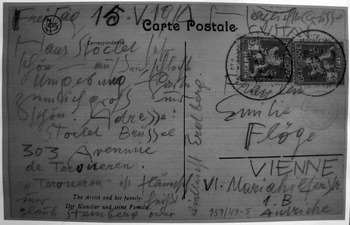
Regardless of his motivations for bachelorhood, Klimt dedicated much energy to facilitating Flöge's career in reform clothing. This support took on emotional, spiritual, and practical dimensions. The two shared a similar worldview—a sense of working against the philistine and bourgeois society—that motivated their work and endeared them to each other as lifelong companions. This attitude is evident in their everyday correspondence from 1913 to 1918. The manner in which Klimt discusses everyday life—professional matters such as clients, patrons, and openings; recent premieres and scandals in the opera; and even his narrative of gastronomic and social happenings—illustrates that the pair regarded the formalities of Viennese society and his professional obligations as a painter with skepticism.Footnote 61 Klimt, for instance, poked fun at the very Wiener Ansichtskarten—pictures of recognized Viennese landmarks, such as the Stephansdom, Schönbrunn Palace, and the Hofburg—that he used to write to Emilie. On these cards he entrusted Emilie with his candid remarks about his colleagues, such as Josef Hoffmann and Carl Moll, as well as patrons including the Primavesi, Waerndorfer, and Stoclet families (see Figure 1).Footnote 62
Postcard from Klimt to Flöge, May 1914. Source: Österreichische Nationalbibliothek, Vienna.

All the while, however, Klimt declared to “Midi,” his nickname for Emilie, how he eagerly awaited their next meeting or her homecoming when she was away on business. Furthermore, when they were both in Vienna, Gustav and Emilie not only shared French lessons and professional contacts, but they were also avid theater, opera, and concertgoers. Indeed, an entire folder of the Klimt-Flöge Nachlass contains theater invitations: invariably listing the time, place, location of seats, and names of any other parties who would be in attendance.Footnote 63 Another form of entertainment at the center of their relationship was humor. As Wolfgang Fischer has rightly argued, Klimt's irreverent sense of humor offered Flöge an outlet of stress relief: a source of rejuvenation crucial to her firm's success.Footnote 64
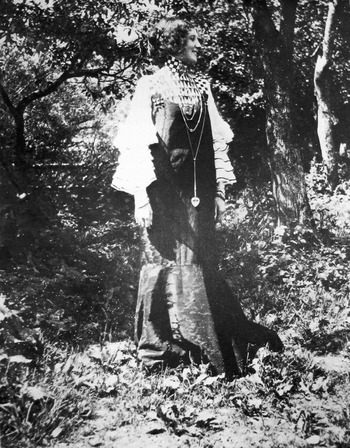
On a pragmatic level, too, Klimt provided invaluable assistance to Flöge's career. In addition to having various Wiener-Werkstätte pieces especially commissioned for Emilie, Klimt served as a liaison to the Wiener Werkstätte and passed along orders, designs, and patterns to his colleagues.Footnote 65 Not only did he offer alterations to Wisgrill and Hoffmann's clothing designs, Klimt also sketched clothing patterns for himself and Emilie to be produced by Flöge's workshop. Such garments included flowing smock-like housedresses that Emilie donned during their yearly Sommerfrische to the Salzkammergut, as well as painting smocks that he wore in the studio.Footnote 66 It was there in the Austrian Lake District that the symbolist painter pioneered modern fashion photography. His photos of Emilie modeling a variety of frocks, which were cut on the three basic patterns of the reform dress (the “tent” dress, the straight cut dress, and the extra long dress with narrow silhouette and widening below the knee), demonstrated his mastery of composition (see Figure 2). Their collaboration on fashion photography revealed much fluidity between the roles of artist and muse, student and mentor, and assistant and master. Here, as fashion was Emilie's domain, one might expect that she was directing and Klimt assisting. However, given that Gustav was behind the camera and Emilie was modeling, these roles appear to have been interchangeable. The photos were the product of joint artistic collaboration. Such flexibility suggests that meanings of “artist” and “muse” did not correspond to gendered prescriptions.
Flöge photographed by Klimt, Attersee ca. 1906. Source: DKD Vol 19 (1906/7).

Not only did their partnership deviate from conventional gender roles, there is also good evidence to suggest that their relationship actually constituted a reversal of male and female norms. For instance, although his correspondence with others was highly erratic, Klimt wrote Emilie daily when she was traveling and noted the frequency with which she answered his letters. He complained of the one-sided nature of their correspondence when Emilie was preoccupied with business in Paris. In May 1914 while en route to visiting the Palais Stoclet in Brussels, a major commission of the Wiener Werkstätte for which he painted a series of murals, Gustav wrote Emilie: “On bright meadows full of summer flowers. At the moment it seems there is no telephone connection to Vienna … [various details about train accommodations]. The mail is collected in the morning here, so at least this card will be in your hands by the evening. And now dear Midi again the most sincere things from your GUSTAV.”Footnote 67
If Klimt's eagerness in this note to contact Emilie is any indication, he had invested himself in Emilie despite the fact that they never married. Klimt's conception of musedom was, in fact, nothing like Friedell's idea of a stimulus to be used to boost one's artistic metabolism and then disposed of. The painter's dismay at Emilie's inaccessibility—a regular feature of these correspondences—suggests that he was closer to being used and discarded than she was. While Klimt may have also used Flöge as a source of motivation, he served as a reciprocal source of spiritual, emotional, and practical inspiration to her. His capacity to see Emilie as an artist discredits the notion that femininity and creative genius were necessarily irreconcilable concepts in Vienna 1900. Together, he and Flöge fashioned a version of modernism in which the two concepts were harmonious. In Klimt's and Flöge's artistic universe, female artists belonged in the atelier rather than in the salon.
Adolf and Lina Loos
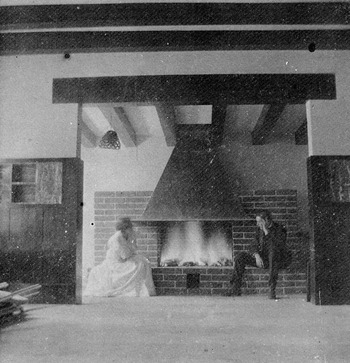
As a counterpoint to the Klimt and Flöge partnership, the brief marriage of Adolf and Lina Loos (see Figure 3) epitomized the dangers—and, in animating Lina's literary career, the benefits—of male idolization of females. Daughter of the proprietor of Café Piccola, a coffeehouse located on the ground floor of Flöge's fashion house, Karolina Obertimpfler had committed herself to acting at a young age. When not attending theater classes, Lina gained a following among the intellectuals frequenting her father's and other cafes. Peter Altenberg christened her the “Silberne Dame” of the Vienna Moderns in tribute to her ash-blond hair, girlish figure, and aura of impressionable femininity.Footnote 68
Adolf and Lina Loos, 1903. Source: Graphische Sammlung Albertina.

“Silver Lady” Lina became particularly popular with members of Altenberg's Stammtisch, which included Karl Kraus, Egon Friedell, and Adolf Loos. Loos was the architect and cultural critic who debated the proper vernacular of modern architecture and design with Otto Wagner and Josef Hoffmann in a series of public lectures and essays. In fact, it was Loos's famed cigarette case, which, free as it was of ornament or decoration, he often produced during his lectures as a model of modern functionalism that indirectly brought Lina and Adolf together. During their first encounter in the Café Löwenbräu, Lina is reported to have snatched—and then accidentally broken—the well-known case. When Lina asked how she might compensate for the loss of his precious case, Loos surprised her with a marriage proposal.Footnote 69 A half year later, on 21 July 1902, the two were wed by Loos's uncle at the Schlosskapelle Lichtenstein in Eisengrub/Lednice, not far from Loos's hometown of Brünn/Brno.
While this and other versions of their meeting have become legendary, Lina and Adolf's motivations for marriage remain clear.Footnote 70 For Lina, the prospect of marriage to a respectable, if outspoken, architect not only allowed her to placate her parents' displeasure over her acting career, but it also allowed her to gain permanent access to the artistic milieu in which Loos stood at the center.Footnote 71 While Lina's later writings reveal that she viewed the marriage as an interlude in her own process of self-realization, the union promised her social and artistic advantages at the outset.Footnote 72
Different concerns, however, motivated Loos to marry a girl twelve years his junior. Although it was quite normal, as Schnitzler's passage from Reigen illustrates, for Viennese gentlemen to marry younger women, Loos displayed an unmistakable preference for the Kindfrau—the fragile, childlike, and sexually innocent young creatures that Altenberg's aphorisms glorified—in his first and subsequent marriages.Footnote 73 The image of the Kindfrau—with a slight, almost androgynous figure and look of emotional detachment or boredom—appealed to artists like Loos and Altenberg because they could worship, idolize, and form such women to their desires without them becoming dangerous.Footnote 74 As Lisa Fischer has rightly argued, “women were to be modeled according to men's needs; this was a fundamental reason why Adolf Loos took an interest in, and loved, Lina.”Footnote 75 Lina therefore, was to be born anew as his creation; to come to share his worldview; and, above all, to accept an identity as the wife of a great architect, rather than as a great woman or actress in her own right.
Aside from the appeal of fashioning his very own Kindfrau, Loos, an aspiring but notoriously broke architect, was much interested in Lina's financial prospects. When he met Lina, Loos had exhausted his financial resources from his 1893–96 travels through the United States and his perennial overexpenditure on tailored clothing and other beautiful materials. Although renowned for his cultural criticisms in the Neue Freie Presse, Loos remained without a regular income during the marriage due to a lack of commissions, and money proved a continual source of marital stress.Footnote 76 Lina's parents, in fact, paid the rent for the young couple's comfortable Bösendorferstrasse apartment and provided most of its furnishings.Footnote 77 Although Loos was eager to assume the husbandly role of provider, Lina relied on her parents and friends in the General Austrian Women's Association for financial support during their marriage. Both Adolf and Lina's close friendship with Marie Lang—who, along with Rosa Mayreder and Auguste Fickert, headed the General Austrian Women's Association—would prove important to the Loos's future. The Marie Lang circle not only organized fund-raising lecture-opportunities for Adolf, but it also obtained for him numerous architectural commissions, including the Wiener Frauenklub, the interiors of Dr. Eugenie Schwarzwald's Female Lyceum and private residence, and other projects.Footnote 78
Although the idealized femme fragile could bolster masculinity, femininity could also become threatening. Like his friends Peter Altenberg and Karl Kraus, Adolf Loos held highly complex and contradictory views on women. Women, in the eyes of Loos, became dangerous when they crossed the boundary between salon and studio, infiltrating the artist's workshop with impure decorative aesthetics. According to Loos: “The modern producers of our culture have no ornamentation…. Only people who were born in the present but actually live in earlier times—women, the rural population, Orientals (including the Japanese)—as well as people with mutilated brains, such as necktie and wallpaper designers, are capable of producing new ornamentation of equal quality to the old.”Footnote 79
Loos contended that although women possessed a natural affinity to ornament and even a capacity for ornamental innovation, this trait was (ironically) neither “modern” nor “artistic.” That women resided in the past rather than in the present only underscored the incompatibility of femininity and modernism. The doilies, needlepoint, and folk art produced by women had no place in Man's Temple of Art—a situation which Loos satirized in his allegory “The Poor Little Rich Man.”Footnote 80 In contrast to the Wiener Werkstätte decorative interiors parodied in the “Rich Man” piece, Loos envisioned a modern aesthetic that disguised rather than celebrated difference or uniqueness. Loos's principles of modern cladding dictated an inconspicuous yet distinguished mask to be donned in the public sphere, which was honest in its presentation of materials.Footnote 81 The solemn dignity of his Haus am Michaelerplatz facade exemplified this aesthetic principle.Footnote 82 With her compelling variation on the canonical interpretation of the structure, Lisa Fischer has interpreted the Haus am Michaelerplatz as an architectural expression of the Kindfrau: unadorned, ornamentally undeveloped, and without aesthetic marking of gender.Footnote 83 As far as Loos was concerned, the salon—with its artifice, stylistic deception, and conspicuous display of difference—was women's proper domain. True art, in which craftspeople labored for an integral presentation of function and material, remained the realm of the masculine workshop.
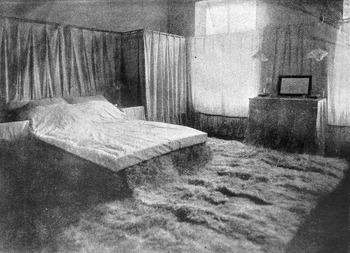
Linked to the idea of the feminine drive to ornamentation was Loos's notion that women themselves were significant primarily for their decorative value and should, like a fragile objet d'art, be kept separate and protected. Adolf's designs for their Bösendorferstrasse apartment—an architectural expression of gendered spheres—illustrate his efforts to mold the much-adored “Silver Muse” of the Vienna Moderns to his ideals of feminine purity. Lina's bedroom, washed in white from floor to ceiling, symbolized Loos's conception of private female virtue. Using a pale angora as a floor covering and airy white curtains to soften the walls, the bedroom design evoked an atmosphere of security, tranquility, and, above all, feminine purity (see Figure 4).Footnote 84
Lina Loos's Bedroom. Source: Kunst (1903) Courtesy MAK Library, Vienna.

The architect published photographs of the room in Kunst, Altenberg's art review to which Loos's own insert Das Andere: Ein Blatt zur Einführung abendländischer Kultur in Österreich was attached as a supplement.Footnote 85 Loos added the simple caption, “Adolf Loos: My Wife's Bedroom: White Linens, White Curtains, White Angora Fur” to the illustrations.Footnote 86 The brevity of Loos's description only reinforced his efforts to create an unornamented—and hence purer—feminine space. Shortly after publishing these photographs, Loos composed a private letter to Lina on the coming of their first anniversary. Though praising Lina as “the wisdom of the world”—precisely for her unknowingness—Loos expressed discomfort with Lina's continued dedication to theater. Loos reproached her to “study your little role [as his wife] rather than all of the others. If you want to stay with theater, there will be time later.”Footnote 87
Rather than reinforcing her fragility and separateness, however, Loos's attempts to domesticate Lina in the private sphere produced the opposite effect. Her frustration erupted in an affair with Heinz Lang, young son of their friend Marie Lang. Furthermore, Lina began writing poetry, plays, and essays exposing the very set of feminine ideals to which she felt confined.Footnote 88 Stylistically, she adopted a short “telegram style” of prose like that of her admirer Peter Altenberg.Footnote 89 Lina's marital experience and her exposure to the women's movement provided the emotional catalyst and content for her critiques of bourgeois gender norms and marriage.Footnote 90 In a reversal of the conventional muse paradigm, her experience offered a negative inspiration for her writing. In her highly autobiographical one-act play “Wie man wird, was man ist,” Lina criticized Loos's (fictionalized as “der Mann”) desire to form his young wife, Ali, like a piece of marble or an impressionable child.
DER MANN: But you would be disappointed, my good lady. Ali is nothing more than pure material. I will form her. I will make something grand out of her. Her bad qualities can remain dormant. A work of art should be made of her.Footnote 91
Revealing how Loos regarded her more as material than a personality, Lina endeavored to expose the hypocrisy of those, who like her husband, proclaimed themselves modern, while indulging in private gender relations that were anything but modern. In his prolific writings and lectures, Loos chastised Austria for its cultural backwardness; yet he could not tolerate that his wife might be more concerned with her own talents than with his.
While Loos should not be measured against today's standards of emancipation, still, his personal ideals measure up as relatively backwards even by turn-of-the-century standards. His ideas were curiously at odds with his progressive views on women's fashion (to be discussed below). According to Lisa Fischer, Loos's domineering manner of personal conduct was markedly less advanced than that of males found in most other Viennese households.Footnote 92 He specifically instructed Lina not to dream of becoming a great woman or actress but to be content as the wife of a great architect.Footnote 93 Loos's unwillingness to accommodate Lina's creative aspirations was all the more puzzling considering that he gave public lectures on ladies' fashion in conjunction with the General Austrian Women's Association, insisting that women's occupational and social advancement could not be achieved until women's clothing achieved the same level of functionalism as men's clothing. Lina's innate sense of independence, which led her to view the marriage as an interlude to a longer process of self-actualization, multiplied her frustrations. Stimulated by Loos's refusal to compromise, Lina pursued her literary ambitions and acting career (at New York City's German Theater, on various European tours, and in the Cabaret Fledermaus) with renewed fervor after their separation in 1905.
In his article “Ladies' Fashion” in a special March 1902 issue of Dokumente der Frauen devoted exclusively to women's fashion (with contributions by Alfred Roller and Hermann Bahr), Loos argued that the unequal development of men's and women's clothing over the past century owed to the fact that women's clothing still retained “premodern” ornamentation, colors, and long skirts encumbering bodily mobility. “No cultural period other than ours has witnessed such an enormous difference in the clothing of the free man and the free woman. In past epochs, the man also wore colorful and richly decorated clothing, whose seams reached to the ground. The grandiose advancement that has taken hold of our century has happily overcome ornament…. Ornament is something that must be overcome.”Footnote 94
In a typically polemic fashion, Loos likened the trends in ladies' clothing to “the cries of abused children, the shrieks of mistreated women, the monstrous screams of tortured prisoners, the shrieks of those dying on the funeral pyre.”Footnote 95 He asserted that because women are subject to men in love and in the social world, women's clothing was not inspired by shame or modesty, but to make them an enticing riddle to men. As “the awakening of love is the only weapon that woman presently wields in the battle of the sexes,” sexual allure, as expressed through clothing, remained the primary method through which women buttressed their social position.Footnote 96 Breaking out of this sartorial backwardness to dress in a more rational manner was necessary, Loos argued, not only out of cultural but also for sociopolitical grounds. Loos concluded his piece on ladies' fashion with a progressive optimism: “No longer through an appeal to sensuality, but rather, through woman's hard-achieved economic and intellectual independence will an equality with man be reached. Worth or un-worth of woman will not rise and fall with the change of sensuality. In this manner will velvets and silks, flowers and ribbons, feathers and colors, lose their influence.”Footnote 97
In spite of his behavior at home, Loos hoped that, with the disappearance of such impractical materials and embellishments, modern ladies' clothing would no longer signify women to be a sexual and erotic commodity, but to become closer to the more uniform standards in men's clothing. Yet Loos disliked the decorative reform dresses designed by Flöge and “Quadratl” Hoffmann almost as much as he found traditional women's clothing impractical. In contrast to Hoffmann and Flöge, Loos believed clothing should be left to tailors, lest clothing fall into the hands of pretentious artists and architects. Simply tailored garments—well-cut yet comfortable suits, blouses, skirts, jackets—embodied Loos's vision for women's clothing. That Lina increasingly sported the Wiener Werkstätte fashions that he so detested served as an added source of frustration.
Particularly in light of his marital experience, Adolf Loos's cultural criticisms present an interesting contrast to Klimt and Flöge's modern vision. Despite their mutual concern with reforming women's fashion, Loos's version of modernism denigrated feminine ornamentation, while Flöge and Klimt's decorative art dresses embraced it. Loos, Klimt, and Flöge's diverging views on fashion mirrored their broader conceptions of modernism. Like Loos, Flöge wanted to liberate women from a sexualized suit of armor. However, her vision of modern clothing, patterned on the art-nouveau reform dress, contrasted sharply with Loos's idea of simple, tailor-made suits.Footnote 98 Leaving aside his greater critique of the Wiener Werkstätte—the decorative swindlers he dubbed the “Wiener Weh”—Loos believed that the reform dresses produced by Flöge and the Wiener Werkstätte imposed a foreign form on women.Footnote 99 Draped with overwhelming geometric patterns, the female body was subordinated to the dress's decorative function. Modernist critic Berta Zuckerkandl also expressed qualms about the arts-and-crafts dress, though for different reasons than Loos. She argued that, by handing artists the responsibility for fashion, clothing might lose its value as a form of feminine self-expression.Footnote 100 Loos was admittedly less concerned with female self-expression, the major leitmotif of Zuckerkandl's criticism.
Despite his attempts to invest a similar degree of modern uniformity in women's clothing as men's, Loos championed a genteel vision of men's clothing defined in contrast to the feminine. Loos predicated his analysis of clothing on the inherent difference between men and women. While even reform-style women's clothing remained ephemeral and drew attention to the body, men's clothing was to be modeled on British Vornehmheit: that the proper English gentleman, though well-dressed and put-together, should not seek to draw attention to himself through clothing. Loos argued that the modern man should reject the “fetish of fashion” and endeavor to be inconspicuous. Clothing, therefore, should function as a mask that all men could don in the public sphere. He recommended: “To be correctly dressed! With that expression I feel as if I had removed the mystery with which our fashions have been surrounded until now. With words such as beautiful, elegant, chic, smart, or dashing we try to describe fashion. But that is not the main point at all. The point is to be dressed in such a manner as to attract as little attention to oneself as possible.”Footnote 101 A model of inconspicuous consumption and gentility, Loos sought to distance men's fashion from feminine excess.
Such a vision was quite at odds with Flöge and Klimt's vision of modern fashion. While Loos sought to reinforce the essential difference between male and female—and, by extension, the boundary between public and private—Klimt's and Flöge's vision of fashion prescribed a more androgynous norm. Klimt designed kimono-like smocks for himself, and Emilie downplayed the gender difference: lending credit to Zweig's ideas that modern fashion deemphasized the difference between male and female.Footnote 102 Moreover, whereas Loos's ideas on fashion promoted a modern uniformity, each of Flöge's reform dresses emphasized its unique decorative qualities. To Flöge, a uniform was completely antithetical to clothing's expressive function.
Loos's cultural criticism—as well as the manner in which his conventional views on gender relations animated Lina's literary and acting career—underscores the divergent conceptions of gender, artist, and the “modern” within the Vienna Moderns. Loos's modern vision contrasted sharply with Flöge and Klimt's, which embraced feminine decoration and female artists. Despite his progressive views on women's fashion, Loos posited distinct cultural roles for masculine and feminine. Men created culture while women were the divine creatures suffering for, and inspiring, it. That Lina found a sort of “negative inspiration” for her own creative endeavors in these ideals—seeking to critique the very canon of femininity to which she felt confined—became an unintended by-product of such attitudes.
Around the time she was gaining recognition as a writer—long after those knowing her as the “Silberne-Dame” were gone—Lina wrote an essay called “Thinking Over My Life.” She recounted how a teacher, who once had called her nothing but “eyes, hair, and dreamy silliness,” asked her at age fourteen what she wanted to become in life, to which she replied, “I would like best to live and die for a great idea!”Footnote 103 Years after her seperation from Loos, Lina confided this memory to Egon Friedell, inquiring how he interpreted such a remark. The answer, Friedell surmised, was simple: she had died a martyr's death in her former life (with Loos) and had been born again. Lina recalled that; “now I am old, and when I reconsider my life, how peculiarly fateful was this childish dictum! I was becoming an actress; [yet] I turned down big roles to the annoyance of the director determined to make a famous and celebrated actress out of me….”Footnote 104 Coming to fully appreciate the meaning of her fateful comment, Lina concluded; “Now, at my life's end, I finally understand the beginning of my life; in between lies an ever-unfulfilled remaining desire….”Footnote 105
Gustav and Alma Mahler
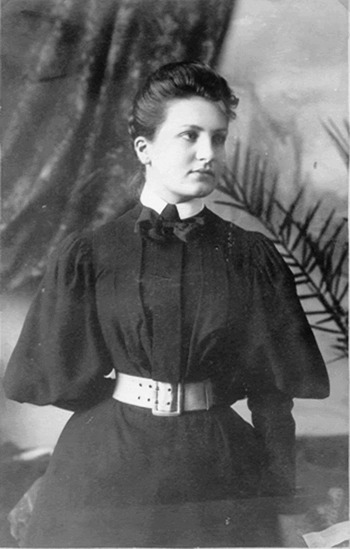
Alma Maria Schindler (see Figure 5) has been celebrated as the twentieth century's muse extraordinaire, animating the creative outputs of Gustav Klimt, Gustav Mahler, Oskar Kokoschka, Walter Gropius, and Franz Werfel.Footnote 106 The eldest daughter of Austrian landscape painter Emil Schindler, Alma was raised in the circles of the Vienna Moderns. Having died when Alma was thirteen, Schindler, whom Alma henceforth revered as a “great monument,” left a lasting impact on her life.Footnote 107 Alma expressed her grief not only in her compositions (particularly the song “In Meines Vaters Garten”), but she also virtually spent the rest of her life searching for partners whose genius rivaled her father's.Footnote 108
Alma Schindler, 1897. Source: Annenberg Rare Book and Manuscript Library, Philadelphia.

With much resentment did Alma receive her mother's decision to marry Schindler's protégé, the painter and art-dealer Carl Moll, and move the family to a Hoffmann villa on the Hohe Warte, a fashionable residential development at the edge of the city. Nonetheless, because of Moll's position as Secession cofounder, Alma enjoyed distinct intellectual and artistic privileges—including standing invitations to exhibitions, salons, opera, and concerts, as well as intimate acquaintances with the avant-garde—while pursuing an unusually advanced, though informal, education. In addition to her studies of history, literature, and philosophy, Alma Schindler aspired to be a composer. “Already in my early years a desire for heaven on earth grew within me; I found this through music,” Alma commented in her autobiography.Footnote 109 Her musical training consisted of piano and counterpoint lessons with organist Josef Labor and composition studies with Alexander Zemlinsky, the teacher and brother-in-law of Arnold Schönberg.Footnote 110
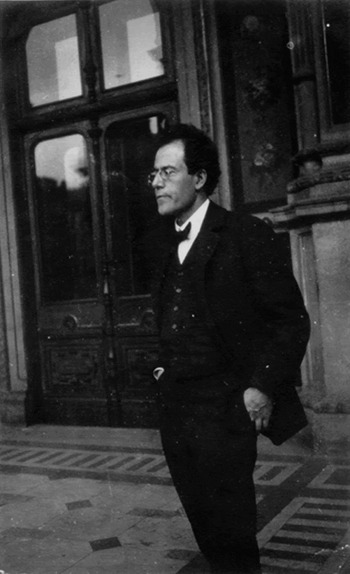
Alma's combination of beauty and intellect—in addition to her affairs with famous men—generated considerable popular interest in her. While a serious biography of Alma Mahler remains to be produced, many recent works cast Alma as a repressed artist forced to give up composition by her egocentric husband: the composer and Hofoperdirektor Gustav Mahler (see Figure 6), who became captivated with her during a dinner party at Berta Zuckerkandl's Döbling villa on 7 November 1901.Footnote 111 While correcting the previous neglect of Alma's musical output, such accounts misconstrue Alma's true creative calling: the animation of artistic output in others.
Gustav Mahler, Vienna Court Opera, 1907. Source: Annenberg Rare Book and Manuscript Library, Philadelphia.

Alma possessed an uncanny ability to recognize artistic genius in others: to enable and even force creative minds to bring their talents to fruition. She thrived on being what she termed the “Creator of Creators”: a sort of active and even aggressive facilitator of artistic genius. In weighing the merits of pursuing composition against supporting the artistic output of others, Alma decided that she could best achieve her dream of an artistic “heaven on earth” through the masterpieces she could indirectly create. As she recollected: “Whatever my productive gifts were, I could relive them [better] in other more important minds.”Footnote 112 Alma, nonetheless, embodied a different sort of muse than the childish waifs described by Altenberg or the independent businesswoman embodied by Emilie Flöge. In contrast to both, Alma—the “Creator of Creators”—played an active and often abrasive role in the creative process, exacting certain levels of artistic output from her partners. The meaning of this “Creator of Creators” concept is best summarized in Alma's own words: “When I was young, I saw myself as one of the first great female composers. But then I also began to realize the tremendous impression that I could make on men, what an important role I could play in their lives, becoming literally the Creator of Creators. Would you want me to recall the works in music, literature, painting, and architecture that would never have been done without me having been there?”Footnote 113 Alma echoed Karl Kraus's idea that women were the creators of books and paintings even if they did not hold the pens or brushes.
Taking a different path toward creative expression than both Lina and Emilie, Alma expressed her artistic aspirations through the traditional feminine roles of muse and salonnière and reveled in the sort of idealization described by Mayreder rather than shunning it. In this manner, the arguments of recent scholars that Alma “suffered the costs of self-abnegation and repressing one's abilities in the process of motivating others” are open to debate.Footnote 114 A space traditionally classified as feminine, Alma's salon was her atelier. Through a mixed media of emotional manipulation, intellectual guidance, and sex, Alma's male admirers provided a canvas for the “Bride of the Wind's masterpiece.” Hence, it is quite fitting that, in old age, Alma described her own life as a “masterpiece.” Her upper east side New York apartment, filled with Mahler manuscripts (including his unfinished Tenth Symphony, upon which he famously scribbled outpourings of devotion to her), Kokoschka sketches, and Werfel's books, was a shrine to her own career.
While existing scholarship has acknowledged Alma's inspiration of Mahler's works, it has ignored the manner in which she elevated her strong presence in the creative process to a form of artistic expression. Recent musicological work, for instance, has established Alma's role in inspiring many of Mahler's symphonies, Lieder, and other orchestral works. These pieces have created portraits of him, Alma, and their daughters; captured the heroism of the human spirit; and explored fundamental questions of life, death, and love.Footnote 115 During their courtship, Gustav wrote Alma about music's metaphysical potential, “You will find a new light on the relation of music to reality; for music, mysterious as it is, often illuminates our souls with a flash of lightening.”Footnote 116 Scholars, however, often overlook the revelations in Gustav's letters to Alma that he regarded these compositions not as his but as a mutual creative endeavor. As he wrote to Alma before their marriage: “From now on, is it not possible for you to regard my music as if it were your own?”Footnote 117 This was a mission that Alma was prepared to accept, but perhaps more actively than intentionally.
The teenager Alma wrote of composing grand operas in her diary, while the more mature Alma shifted to a different form of artistic expression: the manipulation of human feelings.Footnote 118 As she summarized her achievements in an interview later in life, “self-reflectively, egotistically, I collected people—if you insist on seeing it that way—and gave the world works of art.”Footnote 119 Blurring the boundary between muse and artist, such egotistical words from a muse do much to call the traditional gendering of the muse paradigm into question. Far from Altenberg's ideal of a “mountain fairy” leading artists to their highest heights or Friedell's concept of an accidental stimulant to be used and then disposed of, Alma was a selective muse only concerned with first-rate geniuses. After all, Alma had once declared to Gustav that all she loved in a man was his achievement—and if she ever met a man with a greater talent than Mahler's, she would “have to love him.”Footnote 120
Mahler's expectations for the marriage both opposed and, in certain ways, paralleled Loos's ideals. Gustav's famous letter of 20 December 1901, written to his fiancée from Berlin, presents a good picture of his intentions. Unlike Loos's intentions for Lina, Mahler did not wish to transform Alma into an aloof and unreachable ideal. He did, however, hope to guide Alma's intellectual growth. In his correspondence with Alma, the court-opera director provided his young fiancée with philosophical and literary reading lists.Footnote 121 Mahler did, however, expect her to prioritize their art, that is, the compositions for which the musically trained Alma served as muse, copyist, and sounding board, but which officially bore only his name.
Certain passages of Mahler's letter have been taken out of context to construe him as a domineering tyrant who demanded that his fiancée give up composition. Such an interpretation misconstrues the true situation: for a sterile-minded and obedient wife was the last thing that Mahler intended. As he clarified to Alma, “Don't believe that I take the philistine view of the relationship of a married couple which sees a woman as some sort of diversion along with being a housekeeper to her spouse. Surely you don't believe that I think or feel that way.”Footnote 122 Nevertheless, while Mahler may have distanced himself from more philistine expectations of marriage, he nonetheless drew the line in how far he was willing to share his art with Alma. “One thing is certain: if we are to be happy together, you will have to be ‘as I need you’—not as my colleague, but as my married wife!”Footnote 123 In spite of his supposedly progressive views on marriage, Mahler, similar to Adolf Loos, preferred that his wife's creative ambitions not compete with his.
Although the emotional torpor with which she received this letter should not be overlooked, Alma ultimately concluded that her talents were best invested in musedom rather than in composition. As she recalled in her Mahler memoirs, “I spent the night in tears … [but] recovered my confidence and finally wrote him a letter, promising what he wished.”Footnote 124 Speculating whether Alma could have realized her musical talents under different societal conditions remains beyond the scope of this article. The issue of Alma's composition is largely beside the point. What is clear, however, is that Alma distanced herself from her composition and focused on creating for herself a uniquely active role as muse. Manipulating her lovers to produce certain levels of artistic output in exchange for her hand (for instance, her promise to marry Kokoschka when he completed his masterpiece); enforcing her husbands' isolation to facilitate their concentration (as with Werfel's writing); and providing not only spiritual but also practical career advice (when, for example, she encouraged Mahler to resign as Viennese Hofoperndirektor in exchange for more promising opportunities in New York) were among some of Alma's more active forms of “inspiration.”
This is not, however, to dismiss the seriousness with which Alma had approached composition in her youth. In fact, Alma's diary reveals an extraordinary dedication to composition, for the young socialite often declined invitations to compose or study. Alma even derided her “frivolous side”—a desire for praise and attention in the social world—for distracting her from more important intellectual pursuits.Footnote 125 The encouragement of Alexander Zemlinsky, her composition teacher, that she possessed the ability to produce better quality work by concentrating on the form of her pieces only reinforces such themes.Footnote 126 Nonetheless, Alma abandoned composition to marry Mahler.
Further evidencing Alma's distance from her composition is Mahler's unearthing of her “poor, forgotten” songs shortly after he discovered Alma's affair with the architect Walter Gropius (beginning during their stay at a health resort). One evening at their summer residence at Toblach in South Tirol, Alma heard her “poor, forgotten Lieder” being played from the house as she was returning from a walk. Although Mahler was full of praise for her songs, Alma, who had long realized that her true talents were not found in composition, was “petrified and embarrassed” to hear her immature Lieder being overesteemed by someone as gifted as Mahler.Footnote 127 Whether Mahler genuinely detected any merit in her songs or was merely attempting to flatter her cannot be determined with any certainty. However, it was clearly at his insistence that the songs were revised and published. Alma, on the other hand, had come to terms with the limitations of her musical talents.
The complexity surrounding Alma's decision to accept Mahler's proposal and pursue a life as a facilitator of artistic genius is best illuminated not by her autobiography or Mahler memoirs—both of which offer a highly filtered life history—but by an unpublished work of fiction called “Zwischen zwei Kriegen.” In contrast to Alma's published biographies, “Zwischen zwei Kriegen” more candidly reveals her own inner struggles with the role of muse.Footnote 128 The details of Alma's various relationships are apparent in its plot. Viktor is a Moravian Jew (whose father, like Mahler's, was a dealer of brandy and books) whose talent and thirst for artistic perfection brings him to the Vienna Music Conservatory where he falls in love with a Christian girl, Eva. While wrestling with her own creative ambitions and ambivalence toward Jews, Eva chooses a life of supporting Viktor's genius and, with the fall of an independent Austrian state, follows him into exile to the United States (just as Alma lived in exile with Werfel in California).
“Zwischen zwei Kriegen” clearly expresses Alma's own creative struggles to an extent not acknowledged in her memoirs and concludes with an uplifting vision gratifying Eva's—or rather, Alma's— role in furthering the cycle of human creation.Footnote 129 As Alma concluded her autobiography, “My life was beautiful. God granted me to know our time's works of genius, before they left their creators' hands. And if I can, for a while, hold the stirrups of these knights of light, so is my existence justified and consecrated.”Footnote 130 In spite of the gender roles her society demanded, Alma reworked traditional codes of musedom—largely framed in terms of feminine passivity, innocence, and unknowingness—into a dynamic and self-aware role. Reinventing musedom in more active terms signified an artistic vocation that both supported and, in some ways, subverted accepted codes of gender.
Conclusion
Understandings of gender, creative genius, and specific meanings of modernism varied greatly among the Vienna Moderns. All three women examined here as case studies pursued careers as artists—as an avant-garde fashion designer, as an actress and writer, and as a professional muse—by navigating the tensions between these concepts to their advantage. While conventional accounts have correctly stressed the muses' importance to the Vienna Moderns' creative output, such accounts neglect how traditional feminine roles lent power to the salonnière and the interactive nature of the artist-muse relationship. Men, too, served to inspire the female artists of Vienna 1900. Only now is the art-historical canon recognizing contributions of female artists to Viennese Modernism.Footnote 131
Beyond the more peripheral issue of recognition of individual artists lies the fundamental question of how “modernism” vis-à-vis gender roles and women's “emancipation” is to be understood. The post-Schorske dialogue has tended to view Viennese Modernism and the Austrian women's movement in isolation. The Secessionist motto of Der Zeit ihre Kunst, Der Kunst ihre Freiheit has thus far appeared to possess little relevance to Mayreder's and Weininger's theories, while the elegant salon world of the Vienna Moderns seemed a far cry from the feminist crusade. Defining and stretching the limits of women's place in the arts, however, suggested that these projects were closer than previously assumed. Muses like Emilie Flöge, Lina Loos, and Alma Mahler promoted a unique sort of feminine emancipation in a way that minimized their aberration from traditional gender ideals. These resourceful women used the Vienna Moderns' ambivalent views on women—and the feminine arts that male artists both loved and feared—to pry open the masculine studio and exhibition hall. Mildly leading male artists to their highest heights, the celebrated muses of the Vienna Moderns should be celebrated as modern artists in their own right.
MeganBrandow-Faller is a PhD candidate in history at Georgetown University, Washington, DC 20057. My sincerest thanks to the staffs of the Austrian National Library Handschriften-, Autographen-, und Nachlass-Sammlung, the Wienbibliothek im Rathaus Handschriftensammlung, and the Austrian Museum für Angewandte Kunst Kunstblättersammlung for their readiness in procuring materials for me. In New York, I am indebted to Edeltrud Desmond for sharing the Austrian Cultural Forum Library's resources; in Philadelphia, to Nancy Shawcross at the University of Pennsylvania Rare Books and Manuscripts Library. For the continued support of the Graduate Studies Committee at Georgetown and of my advisor James Shedel, I am most grateful.