China's use of the death penalty has long attracted scholarly and public attention owing to the large number of executions carried out by the state and its wide range of capital offences. The accepted wisdom is that the Chinese people are overwhelmingly in favour of the death penalty; this alleged support is used as a major justification for why the Chinese legal system should retain and impose capital punishment. Both abolitionistsFootnote 1 and retentionistsFootnote 2 in China have asserted that there is strong public support for capital punishment in their theoretical writings, and policymakers cite public support as a fundamental reason for its continued use.Footnote 3 In practice, public opinion also directly influences judicial decisions. On several occasions, the leaders and judges of the Supreme People's Court of China (SPC) – the nation's highest judicial body, which is responsible for reviewing and approving all executions – have explicitly stated that the court would not have decided to execute a defendant if there was not overwhelming public support; moreover, public attitudes in specific cases can influence the entire judiciary, indirectly affecting decision making in other capital cases.Footnote 4 On this account, public opinion exerts systematic pressure on the judiciary to decide life-or-death issues differently.
Surprisingly, although a remarkable number of scholarly works and policy decisions have based their conclusions on public opinion, there has yet to be a study that reports a precise rate of public support for the death penalty. Rather, overwhelming support is taken to be self-evident and indisputable and few, if any, doubt the reliability of this presumption. Underlying this firm belief is the cliché that the Chinese have a punitive tradition and cultureFootnote 5 and that for “thousands of years, the idea of ‘a life for a life’ has been deeply ingrained among ordinary folk.”Footnote 6
This article provides the first precise estimation of public opinion on the death penalty in China and shows that conventional notions of the public's punitiveness are not well founded. The data on public opinion were taken from a national representative sample of 31,664 individuals, surveyed in 2014 as part of the China Family Panel Studies (CFPS) which was conducted by the Institute of Social Science Survey of Peking University. Designed to study a range of topics based around Chinese communities, families and individuals, the CFPS is generally accepted as the most reliable social survey to have been conducted in China so far.
Prior Surveys
Public opinion matters substantially to both policy discussion and judicial decisions; however, prior studies offer little evidence of Chinese people's support of the death penalty in a reliable manner. Some surveys have tried to measure public attitudes to the death penalty but their sampling and survey methodology raise serious concerns. In 1995, the Law Institute of the Chinese Academy of Social Sciences conducted a survey in 14 counties within three Chinese provinces (Yunnan, Shaanxi and Beijing), receiving answers from 4,983 respondents. The survey asked respondents whether the number of executions in China was “too many, not too many, appropriate, or too few.” Only 3 per cent responded that there were too many executions, suggesting that the vast majority supported the death penalty.Footnote 7 These respondents, drawn from only 14 counties, are certainly not nationally representative. More importantly, the survey's validity cannot be evaluated because the researchers did not disclose their survey method, so their results render few useful implications. Using university students as respondents, a different set of surveys found a support rate of about 60–80 per cent.Footnote 8 However, again, college students are by no means a good research sample as they are not representative of the population as a whole.
The most reliable study so far was conducted in 2007 by the Max Planck Institute and the Research Center for Contemporary China at Peking University. Surveying 4,472 respondents selected by stratified, multi-stage PPS (population proportional to size) sampling in three provinces and municipalities (Beijing, Hubei and Guangdong), the authors found that 58 per cent of respondents supported the death penalty, 14 per cent opposed it and 28 per cent were undecided.Footnote 9 The study further measured the level of support for the death penalty by providing case vignettes, surveyed respondents’ attitudes to life imprisonment as an alternative, and analysed the motivation behind public support of capital punishment (for example, retribution or deterrence).Footnote 10 In other words, it provides a thorough analysis using a scientific survey methodology; however, the drawback of the study is obvious. The surveyed provinces cover only a small portion (about 10 per cent) of the Chinese population. Moreover, Beijing and Guangdong are among the most developed provinces (or municipalities) and attract a vast number of migrant workers, making the demographics of these regions different from most other provinces in China.
Data and Findings
This article draws on data from the China Family Panel Studies (Zhongguo jiating zhuizong diaocha 中国家庭追踪调查), a nationally representative and annual longitudinal survey launched in 2010 by the Institute of Social Science Survey of Peking University.Footnote 11 Using multistage probability sampling, the CFPS completed interviews with all individuals living in 14,960 sampled households, totalling 33,600 adult observations. The study covered 25 provinces, the combined populations of which amount to about 95 per cent of the population of mainland China, with only Inner Mongolia, Xinjiang, Tibet, Hainan, Ningxia and Qinghai provinces excluded. Designed to study a range of topics connected to Chinese communities, families and individuals, the CFPS is generally accepted as the most reliable social survey to have been conducted in China. Research using CFPS data has appeared in leading science and social science journals.Footnote 12
The survey questions on attitudes to capital punishment are in the 2014 wave, embedded in Part N of the survey concerning religion, legislation and political attitudes. The findings reported in this article are based on the data provided by the 31,664 respondents who answered the questions in this part of the survey.
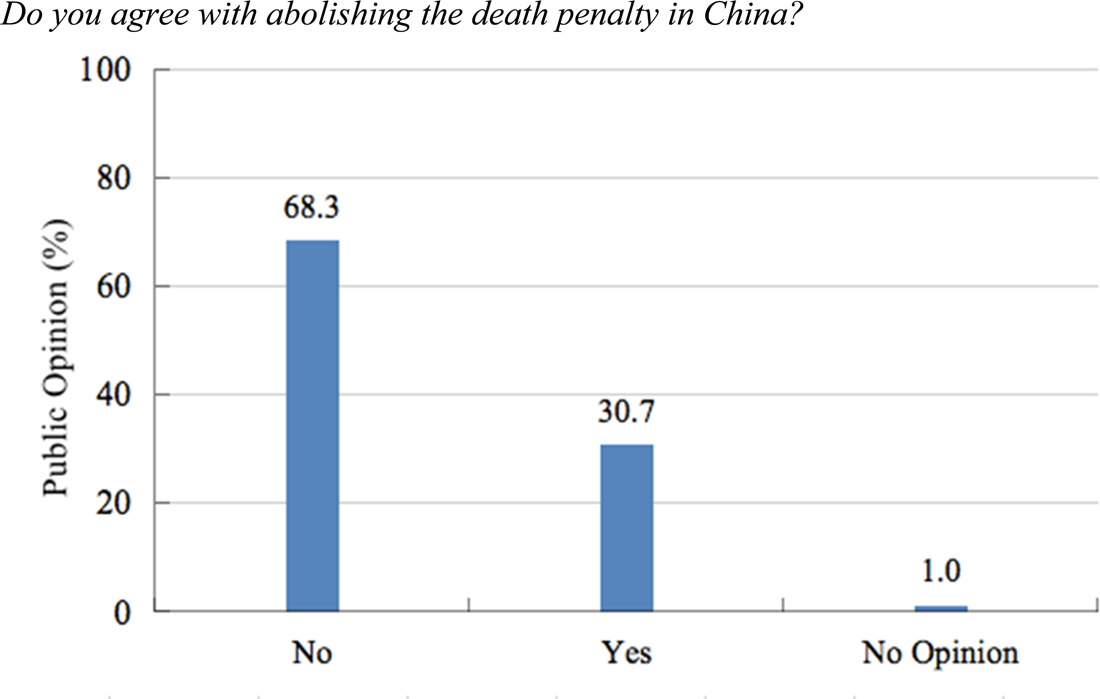
Respondents were asked the following central question regarding their views on the death penalty: “Do you agree with abolishing the death penalty in China?” (Nin shifou zantong zai Zhongguo feichu sixing? 您是否赞同在中国废除死刑?). They were given the choice of answering “Yes,” “No,” or “No opinion.” Among the 31,664 respondents, 68.3 per cent were in support of retaining the death penalty (choosing “No”), 30.7 per cent wished to abolish it, and 1.0 per cent had no clear opinion (see Figure 1 and Table 1). Among those who were against abolition of the death penalty, 87.8 per cent thought it should be retained to punish serious violent crimes such as murder and arson; 83.9 per cent believed it should be meted out for serious corruption offences such as embezzlement and bribery, and 77.3 per cent agreed that it should be retained to punish offences such as fundraising fraud.
Public Opinion on the Abolition of the Death Penalty in China

Alternatives to the Death Penalty and Motives for Support

Notes:
* The survey explained the meaning of “death penalty with reprieve” directly after the question. “Death sentence with reprieve” means giving a death-row inmate a two-year suspended sentence of the execution. The convicted person will be executed if, during the two years following the sentence, they are found to have intentionally committed further crimes; otherwise, the execution will be carried out.
Undoubtedly, 68.3 per cent suggests strong public support for the death penalty, as the majority of the Chinese are in favour of it; however, it is less than first assumed by most commentators. For example, a top judge from the SPC has implied that there is overwhelming public support for the death penalty.Footnote 13 Chen Xingliang 陈兴良, a leading criminal law scholar in China, has suggested that there is a “public consensus” on the application of the death penalty.Footnote 14 Zhu Suli 朱苏力 contends that support for capital punishment is one of the “basic sentiments” of the Chinese people, an opinion shared by many Chinese scholars and practitioners.Footnote 15 Yet, a 68.3 per cent support rate does not seem to constitute a public consensus or a basic sentiment. Notably, the 2007 survey by the Max Planck Institute reported an even lower support rate of 58 per cent.
A comparison across retentionist jurisdictions provides further context for the statistics: a 2018 Gallup poll in the United States shows that 56 per cent of respondents support the death penalty and 41 per cent oppose it. From 2006 to 2010, support rates in the United States were 67 per cent, 69 per cent, 64 per cent, 65 per cent and 64 per cent, respectively – close to the 2014 level of support for the death penalty in China.Footnote 16 In East Asia, the Japanese are overwhelmingly in favour of capital punishment. Government surveys in 2009 and 2013 show a support rate of about 86 per cent and that rate has remained high for the last decade.Footnote 17 In Taiwan, a 2006 survey using a representative sample found that 76 per cent of respondents were for the death penalty.Footnote 18 Recent government and media polling have reported higher support rates, spanning from 80 per cent to 88 per cent.Footnote 19 In South Korea, a country that has retained the death penalty but without carrying out any executions since 1998, the support rate was 70 per cent in 1994, 55 per cent in 2001, and 51 per cent in 2008.Footnote 20 The survey questions in different jurisdictions are essentially the same – they typically ask whether a respondent agrees with the abolition of the death penalty; any differences are slight. Taken together, the level of public support for the death penalty in mainland China is similar to that in the United States in the 2000s and in South Korea in the 1990s, and substantially lower than some of the neighbouring East Asian jurisdictions such as Japan and Taiwan.
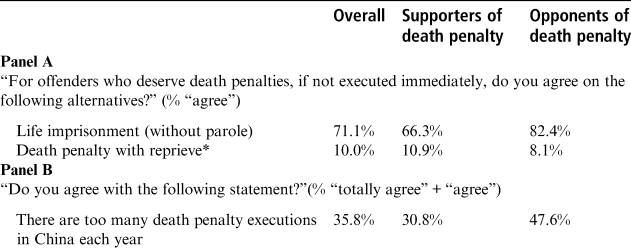
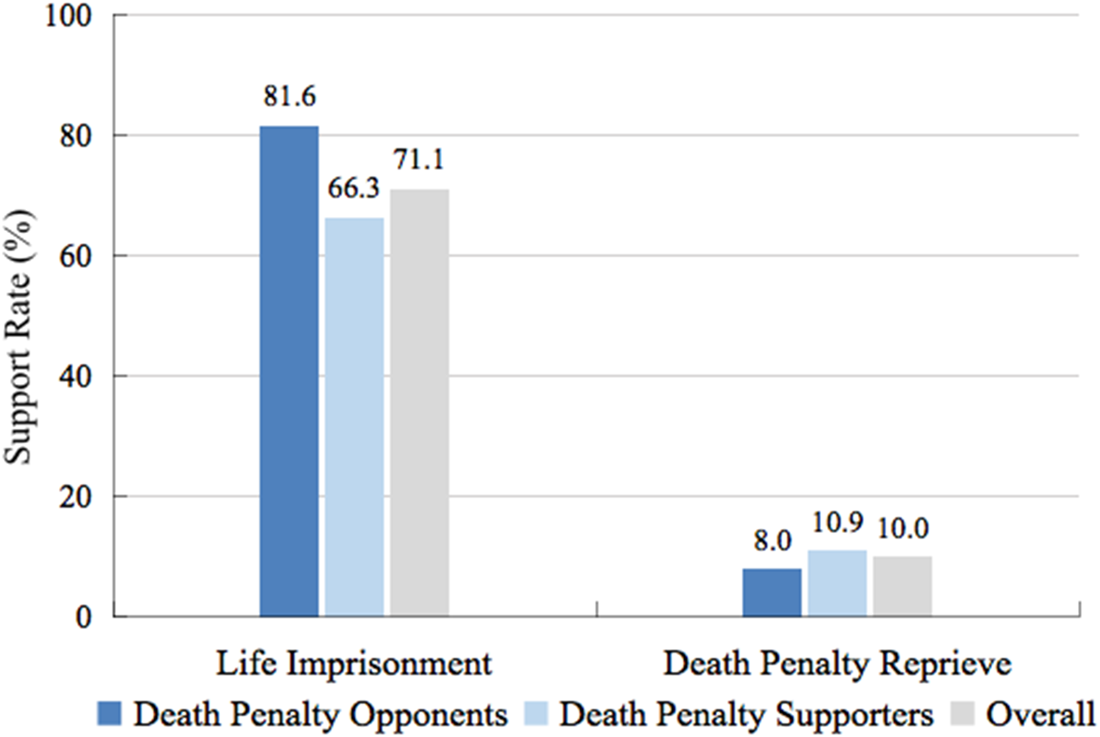
A more striking result comes from the questions about the alternatives to capital punishment. Most Chinese scholars believe that the notion of retribution – one of the traditional values passed down throughout history – is deeply rooted in public sentiment and will prevent the public from agreeing to abolish capital punishment.Footnote 21 The finding here, however, suggests that the Chinese people are much more lenient: the majority (71.1 per cent) are in favour of replacing the death penalty with life imprisonment without parole (see Table 1, panel A, and Figure 2). In fact, even among supporters of the death penalty, 66.3 per cent are in favour of life imprisonment as an alternative.
Public Attitudes on Alternatives to the Death Penalty
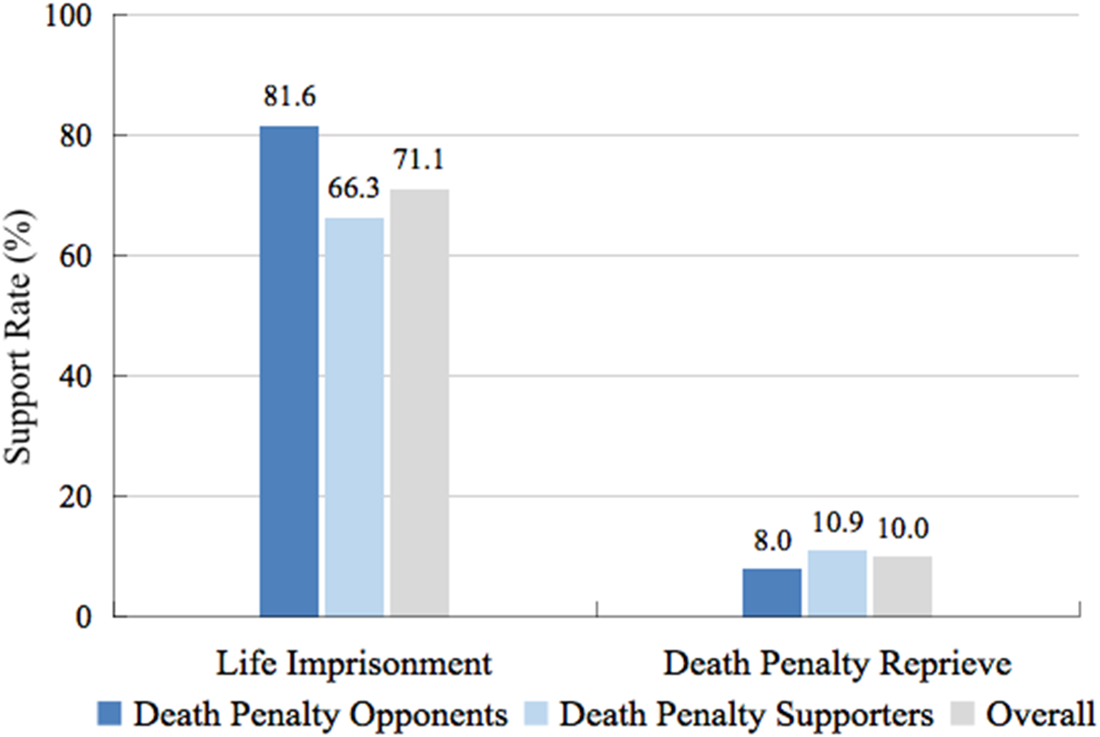
That said, the results on the alternatives to capital punishment need to be interpreted with great caution. A major concern is the subtlety of the wording of the survey question: “For offenders who deserve the death penalty, if not executed immediately, do you agree with the following alternatives?” This sentence is regrettably ambiguous and can be interpreted in two different ways. Those respondents who interpreted the question to mean “do you agree with using the following alternatives to replace the death penalty?” would have undoubtedly supported the replacement of the death penalty with life imprisonment; however, those who interpreted the question as meaning “given that we do not (or cannot) execute offenders, do you agree with the following alternative punishments?” would have chosen life imprisonment simply because it is the second-harshest punishment and capital punishment was no longer an option. In other words, the latter respondents might not necessarily support life imprisonment as an alternative. Given the ambiguity of the survey, we must be very cautious when drawing further implications.
Another finding concerns the motives for supporting or opposing the death penalty (Table 1, panel B). Tellingly, 35.8 per cent of respondents stated that they think “there are too many death penalty executions in China every year,” suggesting that many people think that China is applying the death penalty improperly. This proportion was 47.6 per cent among opponents of the death penalty and was 30.8 per cent even among supporters, indicating that many supporters of the death penalty question the excessive use of capital punishment in China.
Education and Support for the Death Penalty
Many factors can be associated with individual attitudes regarding the death penalty (an analysis of the correlation between punitiveness and different socio-economic factors in China can be found in the online supplementary material). The focus of this study is on education, which has particularly important theoretical implications. Mainstream legal scholars believe that when the public is better educated and more informed, they will be less supportive of this cruel and unusual punishment, so these scholars pin their abolition hopes on education to reduce public punitiveness.Footnote 22
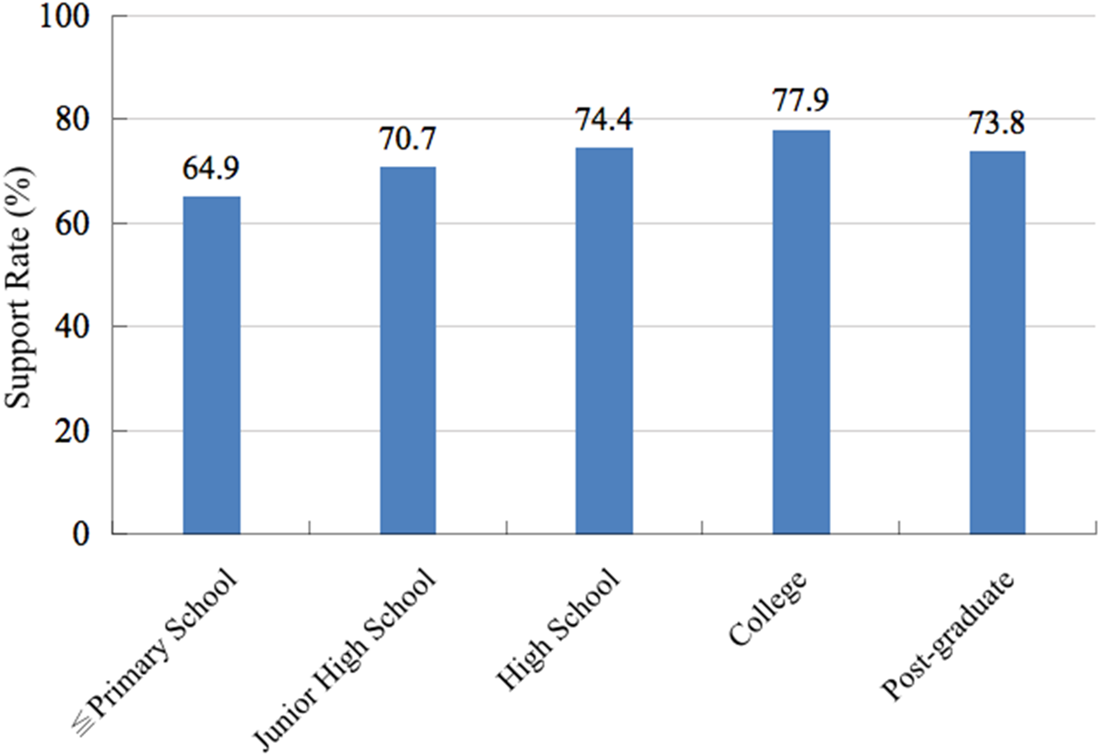
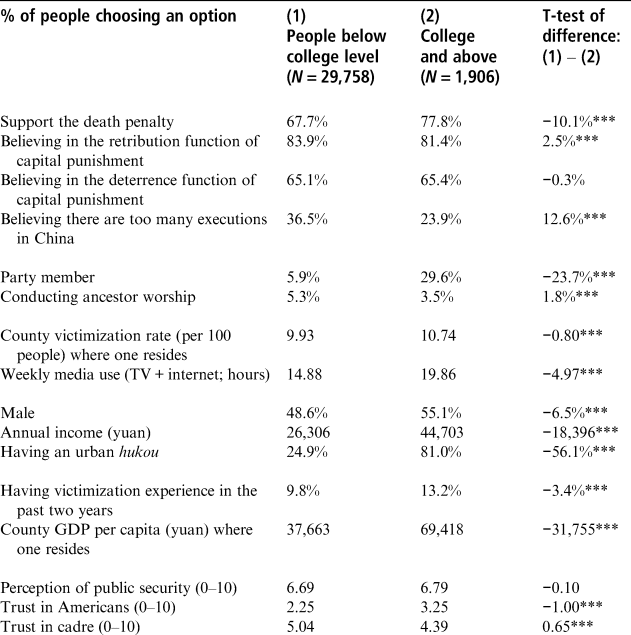
But this is an erroneous presumption. The data show a positive correlation between education and support for the death penalty in China. Among those with a college education or higher (6.0 per cent of the respondents), the support rate is 77.8 per cent; for those with a lower education level, it is 67.7 per cent (Table 2). In other words, people who attain a college-level education are about 10 per cent more likely to support the death penalty.Footnote 23 In fact, support rates increase in strict correspondence to level of education: 64.9 per cent for those with a primary education or below, 70.7 per cent for junior high school graduates, 74.4 per cent for high-school graduates, and 77.9 per cent for college graduates (Figure 3). This finding is especially striking in light of the fact that nearly all previous studies in criminology, to the best of my knowledge, find a negative correlation between education level and support for the death penalty. Admittedly, previous surveys have been conducted in countries other than China (for example, the United States,Footnote 24 England and WalesFootnote 25 and AustraliaFootnote 26). The finding here suggests a special phenomenon regarding Chinese elites and their punitiveness. But, why? Here, I analyse the theory and data in an attempt to answer this question.
Levels of Education and Support for the Death Penalty

Summary Statistics: Sorted by Education Level

Notes:
*p < 0.10, **p < 0.05, ***p < 0.01.
Two explanations that can be excluded: political ideology and fear of crime
Political ideology
Education is closely associated with values. One may suspect that the better-educated people in China are more conservative on the ideological spectrum, and thus more punitive and more supportive of the death penalty. But this possibility can be ruled out according to existing evidence. Previous studies have found that better-educated people in China are more likely to be in favour of democratic institutions and market reforms and less likely to support nationalistic and traditional social values.Footnote 27 In other words, people with a higher level of education are more liberal.
The CFPS data can also cross-validate this pattern. The CFPS does not directly ask questions about political ideology, but there are two proxies for a respondent's position on the ideological spectrum. It asks “Please rate your degree of trust in the following groups. (Let 0 be very untrustworthy, while 10 is very trustworthy.)” The targets to be rated include 1) Americans, and 2) cadres in China. People who receive higher levels of education have higher trust in Americans, indicating that they are more open to the West and have an affinity with people from a democratic regime (Table 2). At the same time, better-educated people show less trust in cadres in China, which suggests that they are more sceptical about China's authoritarian system.
The above evidence suggests that better-educated people are indeed more liberal; however, they are also more punitive. These two sets of findings seem to be contradictory, but together, they indicate that the stronger support for the death penalty among the educated is not driven by their support for conservative political values. Education must affect punitiveness through other channels.
Fear of crime and utilitarian response to crime
People who attain higher levels of education usually have a higher social status, and are more likely to become targets of crime. This is true according to the data. Table 2 sorts people into two groups according to education level. People with a higher level of education are more likely to live in areas with more crime (measured by county victimization rate) and better economic development (measured by county GDP per capita). They are also more likely to be exposed to media, to have urban hukou (chengshi hukou 城市户口), and to be victimized (i.e. they are more likely to have experienced crime within the past two years). Given these facts, one may naturally assume that the positive association between education and punitiveness is attributable to these environmental circumstances and forms part of people's utilitarian response to crime as they desire to fight crime with harsh punishments.
This explanation is also incorrect. The CFPS probes respondents’ perceptions of public security with the question: “How do you rate the public security of your current place of residence? Choose from 0 (very unsafe) to 10 (extremely safe).” There is no statistically discernible difference between differently educated people regarding this perception, although people with a higher level of education usually live in areas with a higher crime rate and are more likely to have experience of being a victim of crime.Footnote 28 People with a college education and above in fact have a higher rating on public security than the rest (6.79 versus 6.69), although the difference is statistically insignificant. This evidence casts doubt on the “utilitarian response to crime” explanation. If better-educated people do not think that their neighbourhood is unsafe, it is not reasonable to infer that they are more supportive of the death penalty because they have a stronger desire to reduce crime. Their motive for supporting the death penalty provides further evidence for this scepticism: better-educated people do not display a greater degree of agreement with the deterrence function of capital punishment in the survey (see Table 2).
Together, these findings show that people with a higher level of education are not supportive of the death penalty simply because they are more concerned about being victims of crime and look to harsh punishment to reduce future harm.
A more plausible explanation: less sympathy
People with higher levels of education are disproportionally from wealthier families and situated in social networks of like-minded people. Consequently, they are less likely to be the relatives, friends or colleagues of a criminal, and are less likely to be acquainted with any criminal offenders personally. As a result, the better-educated sympathize less with criminals, which in turn may induce more punitive attitudes. Previous studies of US conditions confirm this hypothesis.Footnote 29 I find some support for this hypothesis in the context of China as well.
The CFPS asks whether any family member (parent, spouse, child) is not living in the respondent's family, and why. The reasons given include the answer “in prison.” I use this answer to record whether a respondent has a close relative in prison. None of the 1,906 people who received college education or above had any imprisoned family members, while 29, or 0.1 per cent, of the 29,758 people who received less than a college-level education had a close relative in prison. The difference in family member imprisonment rate between the two groups of respondents is not statistically significant (p = 0.173), owing to the limited sample size; however, the comparison is still informative and suggests that people with a higher education are less likely to have family members who commit crime. It may also be inferred that the better-educated are less likely to know criminals, or have any close relationship with them.
Among the 29 respondents with close relatives in prison, the support rate for the death penalty was only 51.7 per cent, much lower than that of other respondents (68.3 per cent), and the difference in support rate between respondents with and without imprisoned family members was close to the 5 per cent level of significance (p = 0.055), even though the sample size was extremely small (29). This finding supports the notion that people who know or have a close relationship with a criminal are less likely to support the death penalty. It also suggests that they are less punitive because they have stronger sympathy for this underprivileged group.
Punitiveness in China: Traditional Culture? Penal Elitism?
It is a truism among Chinese legal circles that support for capital punishment is rooted in the particular cultural conditions of China – that is, widespread support for the death penalty is justified by a deeply rooted preference for punitive measures among the Chinese people, with its origins to be found in the history of China. This truism is espoused in both government and academia. For example, during a press conference at the SPC in 2018, a judge told reporters that China could not abolish the death penalty because doing so would anger the public, which overwhelmingly supports capital punishment, as “for thousands of years, the idea of ‘a life for a life’ has been deeply ingrained among ordinary folk.”Footnote 30
Chinese scholars are in broad consensus that China should gradually reduce the range of capital offences through legislation and should constrain the use of the death penalty in judicial practice.Footnote 31 However, mainstream scholars consider that abolition of the death penalty in the near future is unrealistic considering China's current social and political climate.Footnote 32 Prevailing public support for the death penalty, driven by traditional culture, is a major concern. For example, Chen Xingliang 陈兴良 writes that “In traditional Chinese legal culture, the idea that the killer should be killed is deeply seated, and it has become an important part of the social sentiment of the Chinese nation, which deters the abolition of the death penalty in China.”Footnote 33 Gao Mingxuan 高铭暄 finds that “For historical and practical reasons, the retributive concept is deeply rooted among the citizens.”Footnote 34 Similarly, Zhao Bingzhi 赵秉志 suggests that abolition of the death penalty would be constrained by the history, culture and traditions of Chinese society.Footnote 35 These mainstream criminal law scholars typically argue that the consequence of such widely held and deeply rooted punitive preferences is that China cannot and should not abolish the death penalty in the near future, although this group could be seen as liberal in the context of the death penalty debate because they consistently support a reduction in the use of capital punishment in the short term and its abolition in the long run.
Very few in legal academia oppose abolition as an ideal, but retentionists are very influential, particularly Zhu Suli 朱苏力.Footnote 36 Zhu's argument also cites public sentiment and traditional culture. In an interview, he famously criticized “some scholars in legal academia who completely disregard the sentiments of the public and simply use abolishing the death penalty to serve their own ends,” adding that “legal scholars always impose their beliefs on the public” and that “many arguments of legal academia for the abolition of the death penalty simply insult the public's intelligence.”Footnote 37 He presents eloquent reasoning that supports the idea that punitive policies are rooted in China's soil and should take into account the sentiments of ordinary people, traditional culture and substantive justice. Furthermore, he suggests that Chinese legal academia should wean itself off a systemic reliance on the Western rhetoric of human rights when it participates in local legislative and judicial practices.Footnote 38
I contend that the cultural explanation for public support of the death penalty in China is at best partially true. A reasoning that attributes public support solely to traditional culture is flawed and misleading. It is flawed because evidence shows that the Chinese public is less punitive than is commonly thought and is less punitive than the generalized public opinions in other East Asian jurisdictions with a shared common heritage of traditional values and culture. It is misleading because the use of the traditional culture argument in explanations for the need for the death penalty can only divert us from understanding the more sophisticated issues that underlie public punitiveness in China. For example, the simplistic cultural explanation cannot explain the positive association between education and support for the death penalty. In fact, if we restrict ourselves to ideas of culture to explain public punitiveness, we might never come to terms with this association and the related problems.
A close look at the past literature shows that scepticism towards cultural explanations for public punitiveness, although rare, are present. For example, Roger Hood and Carolyn Hoyle argue that the value of retributive justice – a life for a life – was often strongly held in European culture before the death penalty was abolished and, thus, China is not unique in having a tradition of vengeance.Footnote 39 Moreover, China has historically possessed all the ingredients needed to promote leniency and a milder system of justice.Footnote 40 The assertion that public punitiveness stems from a culture of long standing does not explain the rapid shifts in attitudes to the death penalty in many developed societies over the last few decades.
A theory that closely ties in with the reasoning in this article was raised by Børge Bakken.Footnote 41 He suggests that the defining characteristic of public support for the death penalty in China changed from being a concept of penal populism to one of penal elitism in as early as the 2000s.Footnote 42 By analysing and comparing the 1995 survey (conducted by the Chinese Academy of Social Sciences) and the 2007 survey (by the Max Planck Institute), Bakken finds that public support for the death penalty fell sharply between 1995 and 2007. Importantly, elites (the better educated and Party members) were more punitive than the general public in both surveys, suggesting the Chinese masses are not the conservative element that is holding back reform of the penal system. Rather, penal political elitism is preventing China from abolishing capital punishment; traditional culture is obviously not responsible for penal elitism.
The evidence in this article lends support to the theory of penal elitism. Using the first nationwide representative survey, I confirm that the elite class in China is indeed more punitive than the general public. But, important caveats are necessary before we fully embrace the penal elitism argument, especially the version articulated by Bakken.Footnote 43 As stated earlier, the 1995 and the 2007 surveys should be treated with caution owing to serious concerns about their reliability and validity. It is especially problematic to compare the results of the two surveys, as they used different survey questions and methodologies and were on different topics. Thus, it is not clear whether we can conclude that there has been a shift from penal populism to penal elitism in China. Most importantly, the 68.3 per cent rate of support for capital punishment found by my study suggests that support for it is still strong among the general public, although it is stronger among the elites.Footnote 44 The current situation can be better described as a co-existence of penal populism and penal elitism in China.
With reference to penal elitism, Bakken suggests that political elites and intellectuals promote support for the death penalty as a social value.Footnote 45 In other words, the elites are using the overwhelming public support for the death penalty as an excuse, rather than a reason, to further their own agenda, whether that be eliminating the political opposition or maintaining social stability. Bakken goes on to argue that it is not culture but political power that dominates the Chinese affinity for harsh punishments.Footnote 46 The evidence in this article, however, does not go so far. What it does show is that elites are more supportive of harsh punishment but, as suggested by the analyses in the preceding section, this attitude does not stem from any conservative political ideology (they are, indeed, more liberal in general) or from any fear of crime or from an impulse to curb crime. It is incorrect to infer that the elites intentionally misinterpret public attitudes to achieve their own goals.
That said, although the evidence presented in this article does not support a strong version of penal elitism in China, it does support the milder position that the elites are an obstacle, perhaps the most important one, to the abolition of the death penalty in China. At a minimum, combining the results of theoretical discussion and empirical evidence, it seems that the hypothesis of a link between culture and punitiveness in China has not been proven and, so far, lacks an empirical basis. On a practical level, vengefulness in culture should not be taken to be an immovable obstacle to the modernization of Chinese penal sentiment or to the abolition of the death penalty.
Conclusion
This article is the first attempt to study the nationwide public support for the death penalty in China with a representative sample. The empirical analyses reveal a set of novel findings on public support for the death penalty in China, and these findings matter substantially to both theory and policymaking. The retentionists in China oppose the abolition of the death penalty because they believe that public support for capital punishment is overwhelming and that its abolition would disregard the basic sentiments of the Chinese people.Footnote 47 On the other hand, abolitionists argue that public opinion is an elusive and unreliable point of reference for legislators and judges. Most importantly, the public needs to be educated about the realities of capital punishment and the human rights issues involved – when the population becomes better educated, its support of this cruel and unusual punishment will diminish.
Both the retentionists and the abolitionists, I believe, miss the point. The retentionists are wrong because public support for the death penalty is not as strong as they thought. Preliminary evidence also suggests that most Chinese people would agree to replacing the death penalty with life imprisonment without parole. As for the abolitionists, their belief that public support for the death penalty will wither away when the Chinese people become more educated is also wrong. The better-educated group is indeed more punitive and, as the educated population grows, public support for the death penalty may grow stronger, as was the case in Japan and Taiwan. To curb this trend, abolitionists must think carefully about how to reform education in order to reduce the punitiveness of the elite class.
The data used in this article are from the most reliable survey in China so far. But, given the importance of the death penalty issue, there should be further polling and analysis of statistical evidence to cross-examine the empirical results of this study. There is also a need to gain a better understanding of why – and what specific content of – formal education incurs a stronger sense of punitiveness. This article should be seen as the starting point for a more rigorous approach to the study of public attitudes to the death penalty in China.
Supplementary material
Supplementary material is available online at https://doi.org/10.1017/S0305741020000739
Acknowledgement
This research was financially supported by the Open Research Fund from Shenzhen Research Institute of Big Data, under Grant No. 2019ORF01009.
Conflicts of interest
None.
Biographical notes
John Zhuang LIU is assistant professor of law and economics at the School of Management and Economics, the Chinese University of Hong Kong, Shenzhen. He is also a research scientist at Shenzhen Research Institute of Big Data. His research focuses on empirical studies of judicial behaviour. He applies both traditional methods, such as statistical analysis and regression models, and AI technologies and big data algorithms, such as natural language processing and machine learning, to study massive judicial decision data in China. His work has appeared in a number of academic journals, including the Journal of Legal Studies, Journal of Empirical Legal Studies, International Review of Law and Economics, American Journal of Comparative Law, Peking University Law Journal (Chinese) and China Law Review (Chinese).