Introduction
Approximately 1.7 million individuals in the United States experience a traumatic brain injury (TBI) each year (Faul, Xu, Wald, & Coronado, Reference Faul, Xu, Wald and Coronado2010). The majority of these TBIs (70–90%) are “mild” in severity, as defined by a relatively brief alteration of consciousness or post-traumatic amnesia (Cassidy et al., Reference Cassidy, Carroll, Peloso, Borg, von Holst, Holm and Coronado2004). During the initial hours, days, and weeks after mild TBI, individuals commonly experience symptoms such as headache, memory problems, dizziness, sensitivity to noise or light, or irritability (Brenner et al., Reference Brenner, Terrio, Homaifar, Gutierrez, Staves, Harwood and Warden2010; Iverson & Lange, Reference Iverson and Lange2003). While postconcussive symptoms after mild TBI often dissipate within 3–6 months (Iverson & Lange, Reference Iverson and Lange2003), clinically significant symptoms may also persist chronically. Estimates of rates of persistent postconcussive symptoms following mild TBI range from 1 to 5% (Iverson, Reference Iverson2005; McCrea, Reference McCrea2008) to a much higher 27.3% (Sigurdardottir, Andelic, Roe, Jerstad, & Schanke, Reference Sigurdardottir, Andelic, Roe, Jerstad and Schanke2009) or 29% (Sterr, Herron, Hayward, & Montaldi, Reference Sterr, Herron, Hayward and Montaldi2006), depending largely upon the method used to determine clinical significance of the persisting symptoms.
DSM-IV-TR diagnosis of Postconcussional Disorder (a “research diagnosis”) requires head trauma with post-traumatic amnesia, loss of consciousness, or post-traumatic seizures; neuropsychological impairment; and at least three of the following symptoms: headaches, dizziness, fatigue, irritability, sleep problems, affect changes/anxiety/depression, personality changes, and apathy (American Psychiatric Association, 2000). Symptoms must be present for 3 months after the injury and interfere with social or occupational functioning. Using slightly different diagnostic criteria, ICD-10 diagnosis of Post-Concussion Syndrome requires a head injury with loss of consciousness and at least three of the following symptoms: headaches, dizziness, fatigue, irritability, insomnia, concentration problems, memory problems, and problems tolerating stress, emotional excitement, or alcohol (World Health Organization, 1992).
While both diagnoses require a head injury, many of these self-reported “postconcussive” symptoms are commonly found in uninjured populations, suggesting that some traditional symptoms of head injury can have very high base rates (Gouvier, Uddo-Crane, & Brown, Reference Gouvier, Uddo-Crane and Brown1988; Gunstad & Suhr, Reference Gunstad and Suhr2002; Lees-Haley, Fox, & Courtney, Reference Lees-Haley, Fox and Courtney2001; McCrea, Reference McCrea2008; Suhr & Gunstad, Reference Suhr and Gunstad2002; Wong, Regennitter, & Barrios, Reference Wong, Regennitter and Barrios1994). For example, Iverson and Lange (Reference Iverson and Lange2003) found high rates of mild fatigue (75.7%), irritability (71.8%), and poor concentration (61.2%) in a healthy population. In an additional study, Iverson (Reference Iverson2006) found that 85.9% and 89.1% of depressed, non–head-injured participants reported three or more postconcussive symptoms consistent with Postconcussional Disorder and Post-Concussion Syndrome, respectively.
As a result of the apparent lack of specificity of “postconcussive” symptoms, the validity and utility of DSM-IV Postconcussional Disorder and ICD-10 Post-Concussion Syndrome continue to be a subject of active debate (Gunstad & Suhr, Reference Gunstad and Suhr2002; Iverson & Lange, Reference Iverson and Lange2003; McCrea, Reference McCrea2008). With such high base rates of “postconcussive-type” symptoms in a non-head injured population, these diagnoses rest largely upon patients’ reports (or clinicians’ judgments) about the impairment caused by these symptoms after head injury, and researchers and clinicians are left wondering what these “postconcussive” symptoms really represent.
To resolve these issues, the construct of postconcussive symptoms must be examined more closely. One valuable method for accomplishing this goal is through factor analysis. By examining the interrelationships between different symptoms reported on a questionnaire, factor analysis can aid in the identification of the common components that contribute to their expression. For example, support for the existence of dissociable postconcussive symptom clusters (e.g., somatic, cognitive, and affective symptoms) would provide indirect evidence for shared causes and correlates of postconcussive symptoms within each symptom cluster. Improved understanding of the factor structure of postconcussive symptoms across populations is therefore essential to identifying meaningful targets for diagnosis and intervention.
Further comparison of the factor structure of postconcussive symptoms between groups of individuals with and without a history of mild TBI could also help answer questions about the similarities and differences between “postconcussive” and “postconcussive-type” symptoms. While differences in mean levels of postconcussive symptoms may be expected between mild TBI and non-TBI groups, differences in factor structure would suggest that postconcussive symptoms represent different phenomena in one group than in the other. For example, if brain injury were the primary cause of “somatic” postconcussive symptoms, then a somatic symptom cluster might be more evident among those with a history of mild TBI (due to stronger interrelationships between somatic symptoms) than among those without a history of mild TBI. Conversely, if the factor structure of postconcussive symptoms were very similar regardless of TBI history, this would provide evidence that the causes and correlates of these symptoms might also be quite similar between groups.
Previous Factor Analyses of Postconcussive Symptoms
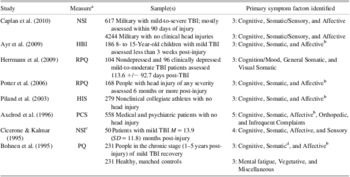
Several previous studies have conducted factor analyses of postconcussive symptoms. Despite a wide range of measures, post-injury assessment times (acute to chronic), postconcussive symptom measures, and patient populations, these studies have commonly found that symptoms cluster into separable cognitive, somatic, and affective factors (Axelrod et al., Reference Axelrod, Fox, Lees-Haley, Earnest, Dolezal-Wood and Goldman1996; Ayr, Yeates, Taylor, & Browne, Reference Ayr, Yeates, Taylor and Browne2009; Caplan et al., Reference Caplan, Ivins, Poole, Vanderploeg, Jaffee and Schwab2010; Cicerone & Kalmar, Reference Cicerone and Kalmar1995; Piland, Motl, Ferrara, & Peterson, Reference Piland, Motl, Ferrara and Peterson2003; Potter, Leigh, Wade, & Fleminger, Reference Potter, Leigh, Wade and Fleminger2006). A summary of these studies is provided in Table 1.
Selected factor analyses of postconcussive symptoms, 1995–2010

aNSI = Neurobehavioral Symptom Inventory, HBI = Health and Behavior Inventory, RPQ = Rivermead Postconcussion Symptoms Questionnaire, HIS = Head Injury Scale, PCS = Postconcussion Syndrome Questionnaire, PQ = Postal Questionnaire.
bSimilar symptom groups were referred to as an “Emotional” factor in Potter et al. (Reference Potter, Leigh, Wade and Fleminger2006) and Ayr et al. (Reference Ayr, Yeates, Taylor and Browne2009), a “Neuropsychological” factor in Piland et al. (Reference Piland, Motl, Ferrara and Peterson2003), a “Dysthymic” factor in Bohnen et al. (Reference Bohnen, Wijnen, Twijnstra, van Zutphen and Jolles1995), and a “Psychological” factor in Axelrod et al. (Reference Axelrod, Fox, Lees-Haley, Earnest, Dolezal-Wood and Goldman1996).
cThe Post Mild Traumatic Brain Injury Symptom Checklist described in this study was later renamed the Neurobehavioral Symptom Inventory.
dSimilar symptom group was referred to as “Vegetative/Bodily” in Bohnen et al. (Reference Bohnen, Wijnen, Twijnstra, van Zutphen and Jolles1995).
To examine the differences between “postconcussive” symptoms and “postconcussive-type” symptoms, a subset of these studies have also compared factor structures between individuals with head injury and healthy controls. For example, Bohnen, Wijnen, Twijnstra, van Zutphen, and Jolles (Reference Bohnen, Wijnen, Twijnstra, van Zutphen and Jolles1995) found that symptoms in the mild TBI group tended to cluster into cognitive, somatic (i.e., “vegetative/bodily”), and affective (i.e., “dysthymic”) factors, whereas symptoms among healthy controls clustered into three different, loosely defined factors. In contrast, a later study by Caplan et al. (Reference Caplan, Ivins, Poole, Vanderploeg, Jaffee and Schwab2010) identified the same three-factor model of postconcussive symptoms representing cognitive, affective, and somatic/sensory factors in both healthy and head-injured groups. Although the head-injured group reported higher mean levels of symptoms, this study provided support for a similar symptom clustering regardless of the presence or absence of head injury.
Summary
High base rates of “postconcussive-type” symptoms in non–head-injured populations raise questions about the validity of the postconcussive symptom construct. Previous factor analyses of postconcussive symptoms have consistently identified cognitive, somatic, and affective factors across several populations and instruments. However, qualitative comparisons of these symptoms between healthy and injured populations (Bohnen et al., Reference Bohnen, Wijnen, Twijnstra, van Zutphen and Jolles1995; Caplan et al., Reference Caplan, Ivins, Poole, Vanderploeg, Jaffee and Schwab2010) have yielded inconsistent results. As described previously, factor analysis can provide important clues about the meaning of postconcussive symptoms and the ways in which these symptoms may be impacted by mild TBI. This information bears directly on issues related to the validity of diagnoses such as Post-Concussion Syndrome and Postconcussional Disorder.
The present study was conducted to address these unresolved issues through a direct comparison of postconcussive symptoms in a large, non-referred sample of university students. We hypothesized that postconcussive symptoms would be well-represented by a three-factor model (including somatic, cognitive, and affective factors) among non-referred participants with and without a history of mild TBI or orthopedic injury.
Methods
Participants and Procedures
All study procedures were approved by institutional review boards at Michigan State University and the Uniformed Services University of the Health Sciences. Potential participants (N = 3330) were recruited at a large public university through a campus-wide research participation Web site. To obtain a broad, non-referred sample, all students registered in the university human subject pool were eligible to participate in this Web-based “study of injury” for course credit. All data were collected via a Web-based questionnaire administered through the central participant pool Web site operated by the university. Previous research suggests that, when conducted carefully, studies using Web-based designs are comparable to those conducted in a laboratory setting (Birnbaum, Reference Birnbaum2004). To minimize incentives for secondary gain that could otherwise affect the validity of data collected, potential participants were informed that all data were confidential and for research purposes only. Additionally, potential demand characteristics were minimized by collecting information in the following order on the questionnaire: demographics, postconcussive symptoms (without referring to concussion or TBI), frequency of alcohol and drug use, history of neurological, psychiatric, and developmental illness, and history of injuries.
Postconcussive symptoms within the last 2 months were assessed using the Postconcussion Syndrome Checklist (PCSC; Gouvier, Cubic, Jones, Brantley, & Cutlip, Reference Gouvier, Cubic, Jones, Brantley and Cutlip1992) a questionnaire soliciting the frequency, intensity, and duration of each of 10 symptoms (headache, dizziness, irritability, memory problems, concentration problems, fatigue, visual disturbances, sensitivity to noise, judgment problems, and anxiety) on a 1 to 5 scale. The PCSC has previously been shown to have good psychometric properties, with internal consistency of .92 and a split-half reliability of .95 (Sullivan & Garden, Reference Sullivan and Garden2011). For use in statistical analyses, PCSC Symptom Scores were computed as the sum of frequency, intensity, and duration for each of 10 PCSC symptoms. Each of four PCSC Subscale Scores were computed as the sum of relevant Symptom Scores (Cognitive = memory + concentration + judgment; Somatic = headache + dizziness + fatigue; Affective = irritability + anxiety; Sensory = noise + visual disturbances). PCSC Total Score was computed as the sum of all Symptom Scores.
For the purpose of this study, history of traumatic brain injury was determined by participant responses to multiple questions focusing on loss of consciousness (LOC) and post-traumatic amnesia (PTA). Participants who responded affirmatively to having “lost consciousness or forgotten information (even temporarily) as a result of a blow to the head” then answered several questions (written in lay terms) regarding mechanism of injury (including a qualitative description), time of injury, and the duration of the LOC and/or PTA. Glasgow Coma Scale (GCS) ratings and potential alterations of consciousness (AOC) without co-occurring LOC or PTA were not assessed due to lack of access to medical records and the potential ambiguity of self-report for these types of injuries.
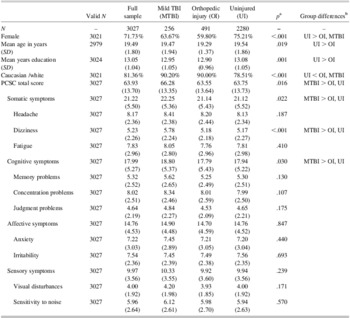
To best represent potential long-term sequelae of a mild TBI in a university population, only individuals who met the study's conservative criteria for mild TBI (e.g., must have had LOC or PTA) were included in the “mild TBI” group. Furthermore, several individuals were excluded to preserve the comparison of single, post-acute mild TBI to individuals without a history of head injury. Specifically, individuals were excluded for a history of psychotic or neurological illness other than TBI (n = 28), a history of moderate-to-severe TBI (n = 71), a history of multiple TBIs (n = 125), or a history of mild TBI within the last 3 months (n = 61). An additional 18 individuals were excluded for providing inconsistent or incomplete information regarding TBI severity. The “orthopedic injury” comparison group consisted of those individuals without a history of mild TBI who reported breaking a bone within the last 5 years (more remote orthopedic injury was not assessed). The “uninjured” group consisted of all remaining individuals who did not meet criteria for the mild TBI or orthopedic injury groups. Demographic characteristics and postconcussive symptoms for the final sample of 3027 participants (n = 2280 uninjured; n = 491 orthopedic injury; n = 256 mild TBI) are shown in Table 2.
Participant demographic characteristics and postconcussive symptoms

a Statistical significance of one-way ANOVA or chi-square, as appropriate.
b Statistically significant Scheffe or Chi-square post hoc differences between group, evaluated at p < .05.
Statistical Analyses
Confirmatory factor analyses (CFAs) were conducted with AMOS 18 using Maximum Likelihood (ML) estimation. The following fit indices were reported for each CFA model: Root Mean Square Error of Approximation (RMSEA), for which values of .05 or less are considered good fit and values of .08 or less are considered acceptable, and the Tucker-Lewis Index (TLI) and Comparative Fit Index (CFI), for which values of .95 or greater are considered good fit and values of .90 or greater are considered acceptable. Pearson χ2 was reported for comparisons of absolute fit between nested models. Change in CFI was also reported when evaluating invariance across nested multiple-groups models, with a CFI reduction of .01 or greater indicating a meaningful reduction in fit, as this index has been demonstrated to be more robust to differences in sample size between groups (Cheung & Rensvold, Reference Cheung and Rensvold2002). PCSC Symptom Scores were used as input for CFAs. SPSS 16.0 was used for all other analyses. PCSC Total, Subscale, and Symptom Scores were used as input for between-group mean comparisons. Missing values for postconcussive symptom variables (1.1% of total PCSC data points) were imputed using expectation maximization (EM).
Results
Participant Characteristics
Demographic characteristics
Demographic characteristics and postconcussive symptoms are presented in Table 2. Age (M = 19.49 years; SD = 1.80) and education (M = 13.05 years; SD = 1.04) reflected the university setting. The majority of participants were female, although this proportion was relatively lower among individuals with a history of mild TBI (63.67%) and orthopedic injury (59.80%) than those with no injury history (75.21%). Most participants were Caucasian, and the proportion of Caucasian participants was greater among those with a history of mild TBI (90.20%) and orthopedic injury (90.00%), relative to those with no injury history (78.51%).
Postconcussive symptoms
Internal consistency of the PCSC in the full sample was good (α = .90). PCSC Total Score was significantly higher in the mild TBI group than in the uninjured (d = 0.19) and orthopedic injury (d = 0.20) groups, and significant differences between mild TBI and non-TBI groups were also found for Somatic and Cognitive PCSC subscales and PCSC symptoms of dizziness. The main effect of group (uninjured vs. orthopedic injury vs. mild TBI) on PCSC total remained significant after controlling for differences in gender, age, education, and ethnicity, F(2,2969) = 4.73, p = .009.
Injury characteristics
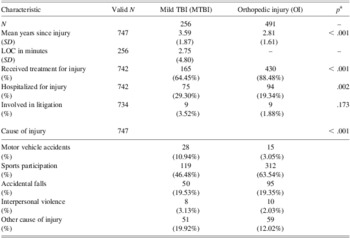
After excluding individuals with multiple TBIs, recent TBI, or moderate-to-severe TBI, as described previously, 8.46% of individuals in the final sample (n = 256) had sustained a mild TBI at some time during their lives, whereas 16.22% had sustained a broken bone within the last five years without lifetime history of TBI (n = 491). Injury characteristics for these groups are presented in Table 3. As shown, mean time since injury was significantly greater for the Mild TBI group (M = 3.59; SD = 1.87) than for the Orthopedic Injury Group (M = 2.81; SD = 1.61). This difference is consistent with the alternate methods of assessing these groups (i.e., lifetime vs. within the past 5 years only). Participation in sports was the primary cause of injuries reported, with accidental falls being second most common in both groups. The majority of individuals in both groups received treatment for their injury. Individuals in the orthopedic injury group were more likely to have received treatment overall, whereas individuals in the mild TBI group were more likely to have been hospitalized for their injury. Relatively few participants in this sample reported involvement in litigation related to their injury (3.52% in the mild TBI group and 1.88% in the Orthopedic Injury group).
Injury characteristics of participants with mild TBI or orthopedic injury

a Statistical significance of independent-samples t-test or chi-square, as appropriate.
Confirmatory Factor Analysis of Postconcussive Symptoms
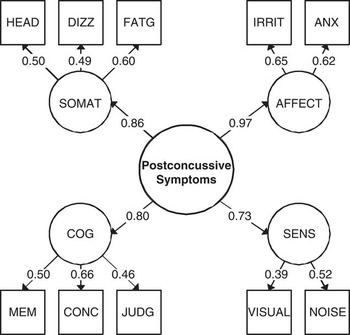
A series of confirmatory factor analyses (CFAs) were conducted to examine the factor structure of the PCSC in the full sample (e.g., all groups combined). The baseline model permitted each of the 10 individual PCSC symptoms (headache, dizziness, fatigue, visual disturbances, sensitivity to noise, irritability, anxiety, and problems with memory, concentration, and judgment) to load freely upon a single factor. As expected, the single-factor model demonstrated relatively weak overall fit, χ2(35) = 508.92, p < .001, CFI = .89, TLI = .86, RMSEA = .07. Next, guided by previous findings, a three-factor model was constructed by allowing individual symptoms to load freely upon a somatic/sensory factor (headache, dizziness, fatigue, visual disturbances, and sensitivity to noise), an affective factor (irritability and anxiety), and a cognitive factor (problems with memory, concentration, and judgment). These three symptom factors were permitted to load freely upon a higher-order factor representing overall postconcussive symptoms. The three-factor model demonstrated acceptable overall fit, χ2(32) = 363.45, p < .001, CFI = .92, TLI = .89, RMSEA = .06, and represented a significant improvement in fit from the single-factor model, Δχ2(3) = 145.47, p < .001. In a final modification to the model, a fourth factor was added by allowing sensory symptoms (visual disturbances and sensitivity to noise) to load freely upon a sensory factor separate from the somatic factor. This four-factor model (depicted in Fig. 1) demonstrated acceptable-to-good overall fit, χ2(31) = 295.49, p < .001, CFI = .94, TLI = .91, RMSEA = .05, and represented significant further improvement from the three-factor model, Δχ2(1) = 67.96, p < .001.
Confirmatory factor analytic model of postconcussive symptom clusters. Note: Standardized factor loadings shown. All factor loadings p < .001. SOMAT = Somatic; AFFECT = Affective; SENS = Sensory; COG = Cognitive; HEAD = headache; DIZZ = dizziness; FATG = fatigue; IRRIT = irritability; ANX = anxiety; VISUAL = visual disturbances; NOISE = sensitivity to noise; MEM = problems with memory; CONC = difficulty concentrating; JUDG = judgment problems.

Additional CFAs were then conducted to examine possible differences in the factor structure of postconcussive symptoms between participants in the mild TBI, orthopedic injury, and uninjured groups. First, the four-factor symptom model was examined in separate single-group CFAs. Overall, model fit was acceptable-to-good in the mild TBI group (χ2[31] = 59.56; p = .001; CFI = .92; TLI = .88; RMSEA = .06), the orthopedic injury group (χ2[31] = 59.96; p = .001; CFI = .92; TLI = .88; RMSEA = .06), and the uninjured group (χ2[31] = 220.70; p < .001; CFI = .94; TLI = .92; RMSEA = .05). Next, in a series of multiple-group CFAs, the four-factor symptom model was examined simultaneously among all three separate groups with a progressively restrictive set of model constraints. This involved obtaining estimates for an unconstrained (freely estimated) model, followed by subsequent models in which model parameters were constrained to be equivalent across all three groups. Parameter constraints were applied cumulatively, in the following order: first-order factor weights (e.g., loadings from somatic, affective, cognitive, and sensory factors onto their constituent symptoms), Δχ2(6) = 9.82, p = .13, ΔCFI = .001; second-order factor weights (e.g., loadings from the overall postconcussive symptom factor onto the somatic, affective, cognitive, and sensory factors), Δχ2(3) = 2.57, p = .46, ΔCFI < .001; second-order factor variances, Δχ2(1) = .28, p = .60, ΔCFI < .001; first-order factor residuals, Δχ2(4) = 7.99, p = .09, ΔCFI = .001; and measurement residuals (e.g., error terms of the individual symptom variables), Δχ2(10) = 14.36, p = .16, ΔCFI = .001. As shown, the degree to which the four-factor symptom model accurately represented the data was not significantly reduced, even when all factor weights, variances, and residuals were assumed to be identical across all three groups. These results suggest that the construct of postconcussive symptoms is remarkably similar between individuals with a history of mild TBI, individuals with a history of orthopedic injury, and uninjured individuals. The final, fully constrained multiple-group factor model demonstrated acceptable-to-good overall fit, χ2(141) = 415.47, p < .001, CFI = .94, TLI = .94, RMSEA = .03.
Discussion
In this large, non-referred sample of university students, self-reported postconcussive symptoms were compared between individuals with and without a prior history of mild TBI or orthopedic injury. Confirmatory factor analyses were performed to identify potential similarities and differences in the factor structure of these symptoms between mild TBI, orthopedic injury, and uninjured groups. In addition, we examined differences in mean levels of postconcussive symptoms between these groups.
Although several previous studies of postconcussive symptoms have included nonclinical samples (Axelrod et al., Reference Axelrod, Fox, Lees-Haley, Earnest, Dolezal-Wood and Goldman1996; Caplan et al., Reference Caplan, Ivins, Poole, Vanderploeg, Jaffee and Schwab2010; Piland et al., Reference Piland, Motl, Ferrara and Peterson2003), to our knowledge, this is the first study to also include non-referred groups of individuals with and without history of mild TBI and orthopedic injury. In this study, all three groups of interest were drawn from the same broad sample. By mitigating some of the selection biases that would be expected in referred clinical samples (e.g., increased symptom severity and poorer outcome; Dikmen & Levin, Reference Dikmen and Levin1993; Dikmen, Machamer, & Temkin, Reference Dikmen, Machamer and Temkin2001), this sampling methodology may more accurately represent the broader phenomenology of postconcussive symptoms among university students with a history of mild TBI, while also allowing for a more direct comparison with non-TBI groups.
Comparison of Mild TBI, Orthopedic Injury, and Uninjured Groups
Consistent with many previous studies of postconcussive symptoms in the long-term phase of recovery from injury (Alexander, Reference Alexander1995; Masson et al., Reference Masson, Maurette, Salmi, Dartigues, Vecsey, Destaillats and Erny1996), results from this study of university students demonstrated that history of mild TBI is associated with modestly greater overall symptom burden compared to orthopedic injury (d = .20) and uninjured groups (d = .19), particularly in terms of cognitive and somatic symptoms. These effect sizes correspond with a difference of 2–3 points on the PCSC Total Score, which has a 120-point range. Differences in gender, age, education, and ethnicity between groups could not account for the higher mean level of symptoms in the mild TBI group. Additionally, the absence of increased symptom burden in the orthopedic injury control group suggests that elevated symptoms within the mild TBI group were not due to the generic effects of injury. These findings provide some support for the notion that a history of mild TBI may subtly alter the expression of postconcussive symptoms, even in the long-term phase after injury.
However, examination of the factor structure of postconcussive symptoms provided an additional perspective. Confirmatory factor analyses provided evidence that postconcussive symptoms clustered into the same four factors (somatic, cognitive, affective, and sensory) in mild TBI, orthopedic injury, and uninjured groups. In fact, direct comparison of additional elements of symptom factor structure revealed no significant between-group differences of any kind. These results suggest that, irrespective of differences in the mean level of symptoms, the construct of postconcussive symptoms is remarkably similar between these three groups. Consistent with previous research (Iverson, Reference Iverson2005; McCrea, Reference McCrea2008), “postconcussive” symptoms in a university population appear to represent the same general phenomenon, whether or not someone has a prior history of mild TBI or orthopedic injury.
This finding has several important clinical and theoretical implications. The first implication relates to the way that postconcussive symptoms are conceptualized. In the absence of evidence that a group of symptoms is unique to those with a history of mild TBI, describing these symptoms as “postconcussive” may be inappropriate or misleading, at least in the post-acute phase of injury. An alternate label, such as “neurobehavioral,” may better represent the apparently non-specific nature of these symptoms. Similarly, describing high levels of symptoms as a “syndrome” suggests that key postconcussive symptoms co-occur in a manner that aids in the identification of the disorder. Our data provide strong evidence that this is not the case, at least among university students. The equivalence of factor structure demonstrated across mild TBI, orthopedic injury, and uninjured groups suggests that the symptoms experienced by those with mild TBI (despite being modestly higher overall) do not represent an identifiable syndrome.
Second, comparison of uninjured and mild TBI groups to an orthopedic injury group suggested that postconcussive symptoms were not impacted by generic effects of injury in this sample. Neither of these two types of injury appear to significantly influence the clustering of somatic, affective, cognitive, and sensory symptoms within this population.
Finally, the apparent discrepancy between level of symptoms (e.g., somewhat higher after mild TBI) and structure of symptoms (e.g., no different after mild TBI) may provide clues regarding the origin of these symptoms. One possibility is that mild TBI exerts its effects through a relatively “global” pathway that is shared by other, non-neurological causes of these symptoms. Alternately, it is possible that mild TBI does have more “local” symptom effects (or a combination of global and local effects), but that the magnitude of local effects is very small relative to other influences. Further study will be needed to identify the local and global effects of mild TBI and other factors which may affect expression of these symptoms.
Overall Structure of Postconcussive Symptoms
Confirmatory factor analyses across groups supported a four-factor model of postconcussive symptoms that includes somatic, cognitive, affective, and sensory symptom factors. These findings are largely consistent with the prior literature (Axelrod et al., Reference Axelrod, Fox, Lees-Haley, Earnest, Dolezal-Wood and Goldman1996; Ayr et al., Reference Ayr, Yeates, Taylor and Browne2009; Caplan et al., Reference Caplan, Ivins, Poole, Vanderploeg, Jaffee and Schwab2010; Cicerone & Kalmar, Reference Cicerone and Kalmar1995; Piland et al., Reference Piland, Motl, Ferrara and Peterson2003; Potter et al., Reference Potter, Leigh, Wade and Fleminger2006), suggesting that this general postconcussive factor structure is stable across a range of different populations, sampling methods, and instruments.
Notably, one relatively novel variation in factor structure was demonstrated in this study. The majority of prior studies have grouped somatic and sensory symptoms into a single factor (Axelrod et al., Reference Axelrod, Fox, Lees-Haley, Earnest, Dolezal-Wood and Goldman1996; Ayr et al., Reference Ayr, Yeates, Taylor and Browne2009; Caplan et al., Reference Caplan, Ivins, Poole, Vanderploeg, Jaffee and Schwab2010; Piland et al., Reference Piland, Motl, Ferrara and Peterson2003; Potter et al., Reference Potter, Leigh, Wade and Fleminger2006), a factor structure which also demonstrated acceptable fit in our sample. However, a four-factor model with separate somatic and sensory factors demonstrated the strongest fit in the current study. Future studies examining correlates of postconcussive symptoms will be useful in determining whether each of these symptom subtypes may provide unique, clinically useful information.
Aside from a better understanding of the postconcussive (or neurobehavioral) symptom construct, awareness of these robust symptom factors can assist clinicians and researchers in identifying meaningful units of analysis. Instead of only examining a patient's overall symptom score or the severity of individual symptoms, these results suggest that examination of composite somatic, cognitive, affective, (and possibly, sensory) symptom scores may provide the most “bang for the buck.” In this same vein, it is worth noting that factor analyses of the 9-item HIS (Piland et al., Reference Piland, Motl, Ferrara and Peterson2003), the 10-item PCSC (Gouvier et al., Reference Gouvier, Cubic, Jones, Brantley and Cutlip1992), the 16-item RPQ (Potter et al., Reference Potter, Leigh, Wade and Fleminger2006), the 22-item NSI (Caplan et al., Reference Caplan, Ivins, Poole, Vanderploeg, Jaffee and Schwab2010; Cicerone & Kalmar, Reference Cicerone and Kalmar1995), the 44-item PCS (Axelrod et al., Reference Axelrod, Fox, Lees-Haley, Earnest, Dolezal-Wood and Goldman1996), and the 50-item HBI (Ayr et al., Reference Ayr, Yeates, Taylor and Browne2009) have found generally consistent results in terms of factor structure. Therefore, our results suggest that even symptom inventories with comparatively fewer items like the PCSC are able to capture the core elements of the postconcussive symptom construct.
Limitations
The large sample size and non-clinical sampling procedures used in this study represent significant methodological strengths, including increased statistical power and the mitigation of some factors (such as demand characteristics and the perceived potential for secondary gain) that can affect symptom presentation in clinically recruited samples (Dikmen & Levin, Reference Dikmen and Levin1993; Gunstad & Suhr, Reference Gunstad and Suhr2002; Mittenberg, DiGiulio, Perrin, & Bass, Reference Mittenberg, DiGiulio, Perrin and Bass1992; Satz et al., Reference Satz, Alfano, Light, Morgenstern, Zaucha, Asarnow and Newton1999). However, our methods may also present some limitations. Although an ideal experimental design might include the report of trained personnel who observed each injury as it occurred, self-report of injury is the only form of information available in many clinical and research settings. Our carefully designed series of questions about injury history, written in lay language to determine the severity, mechanism, and circumstances of injury was designed to be comparable to other forms of self-report. Likewise, the subset of participants whose self-reports were inconsistent or inconclusive with regard to injury severity was excluded to maximize the validity of our conclusions. The strong internal consistency obtained for our measure of postconcussive symptoms (α = .90) provides further support for the reliability of our measurements.
Our university sample consisted primarily of Caucasian individuals between the ages of 18 and 21. Although this age group makes up a large proportion of all mild TBI cases (Bazarian et al., Reference Bazarian, McClung, Shah, Cheng, Flesher and Kraus2005; Cassidy et al., Reference Cassidy, Carroll, Peloso, Borg, von Holst, Holm and Coronado2004), this restricted range may reduce generalizability of findings to children, older adults, or individuals not enrolled in post-secondary education. Females were also overrepresented relative to the general population or those with a history of mild TBI, although this effect may be counterbalanced by higher reporting of postconcussive symptoms and a correspondingly greater numbers of females in many clinical settings (Thornhill et al., Reference Thornhill, Teasdale, Murray, McEwen, Roy and Penny2000). Sports injuries were also over-represented in this sample relative to the falls, motor-vehicle accidents, and other mechanisms that more commonly cause TBI in general civilian populations (Bazarian et al., Reference Bazarian, McClung, Shah, Cheng, Flesher and Kraus2005; Cassidy et al., Reference Cassidy, Carroll, Peloso, Borg, von Holst, Holm and Coronado2004). Since our study includes multiple mechanisms of injury in our mild TBI group, it is possible that mechanism-specific effects could be masked by our design. Additionally, we did not include participants with multiple TBIs or moderate-to-severe TBIs. As such, the findings of this research can be most directly applied to other individuals with similar demographic and injury characteristics.
As described above, prior research across a broad range of populations suggests that similarities in the structure of postconcussive symptoms across populations appear to be more prominent than the differences. However, it is possible that some results may not generalize to other groups with different causes of injury, number/severity of injuries, or patterns of psychological comorbidity. For example, using a sample of 345 US military veterans with mild TBI, Benge, Pastorek, and Thornton (Reference Benge, Pastorek and Thornton2009) found that post-traumatic stress can influence the factor structure of postconcussive symptoms. Although post-traumatic stress is less common among university students, these findings highlight the need for further study of variables that may impact the factor structure of postconcussive symptoms within key TBI populations.
Conclusion
After sustaining a head injury, reported symptoms such as headache, irritability, sensitivity to noise, and trouble concentrating have traditionally been attributed to the effects of the injury. When these symptoms persist into the post-acute phase of injury at clinically significant levels, they are commonly interpreted as evidence of a postconcussive syndrome. However, a substantial body of evidence suggests that these symptoms are not specific to individuals recovering from brain injury, and are in fact common in a wide variety of clinical and non-clinical populations (Gouvier et al., Reference Gouvier, Uddo-Crane and Brown1988; Gunstad & Suhr, Reference Gunstad and Suhr2002; Lees-Haley et al., Reference Lees-Haley, Fox and Courtney2001; McCrea, Reference McCrea2008; Suhr & Gunstad, Reference Suhr and Gunstad2002; Wong et al., Reference Wong, Regennitter and Barrios1994).
The current study builds upon this body of evidence by directly comparing the factor structure of postconcussive symptoms between those with and without a history of head injury or orthopedic injury. Those with a prior history of mild TBI reported modestly greater overall symptom burden. However, the way in which these symptoms clustered (i.e., the factor structure) was indistinguishable between mild TBI, orthopedic injury, and uninjured groups. These findings cast further doubts upon the validity of the “postconcussive syndrome” and raise intriguing questions about pathways by which mild TBI may affect symptom expression, as well as the relative influences of other factors. Additionally, similarities in postconcussive-type symptoms reported by uninjured individuals and those with orthopedic injury suggests that the generic effects of injury upon symptom report may be minimal in this population.
Similar to prior studies across several populations, symptoms in this large sample of university students clustered into somatic, cognitive, and affective factors, plus a sensory factor (most commonly grouped with somatic symptoms in previous studies). Future studies examining the potentially unique influences on each of these individual symptom clusters may provide more effective targets for intervention among those with a history of mild TBI.
Acknowledgments
Institutional support for this research was provided by the Uniformed Services University of the Health Sciences. The authors report no conflicts of interest.