Implications
Sulla is a short-lived perennial legume that in the past played a key role in cereal-based systems of Mediterranean region. Today there is a growing interest in sulla in traditional and in non-traditional areas due to its excellent agronomic traits, forage quality as well as its moderate level of condensed tannins. This study demonstrated that lambs-fed sulla forage, in comparison with lambs-fed ryegrass, had superior growth performance and yield without negative effects on physical, chemical and sensory properties of the meat. The results could contribute to enhance the role of the species within crop–livestock farming systems, improving their productivity and sustainability.
Introduction
Sulla (Hedysarum coronarium L.) is a short-lived perennial legume native to the Mediterranean basin where it is extensively grown as a 2-year forage crop for grazing and/or hay or silage production, and it plays a key role in cereal-based systems of semi-arid regions (Ruisi et al., Reference Ruisi, Siragusa, Di Giorgio, Graziano, Amato, Carimi and Giambalvo2010). Grazing on sulla forage has been shown to have a positive impact on the productivity of meat and dairy sheep (Burke et al., Reference Burke, Waghorn and Brookes2002; Bonanno et al., Reference Bonanno, Di Grigoli, Vargetto, Tornambè, Di Miceli and Giambalvo2007a; Molle et al., Reference Molle, Decandia, Giovanetti, Cabiddu, Fois and Sitzia2009) and goats (Bonanno et al., Reference Bonanno, Di Grigoli, Stringi, Di Miceli, Giambalvo, Tornambè, Vargetto and Alicata2007b).
The beneficial effects of sulla have been attributed to its high protein content, degradable-to-structural carbohydrate ratio (Burke et al., Reference Burke, Waghorn, McNabb and Brookes2004) and moderate content of condensed tannins (CT). In Mediterranean environments, the CT content of sulla shows large variability, from 8 to 50 g/kg of whole plant dry matter (DM), depending on the environment, growth stage and genotype (Amato et al., Reference Amato, Di Miceli, Giambalvo, Scarpello and Stringi2005). At high levels of CT in forage (>70 g/kg of DM), CT form strong complexes with dietary protein, depressing voluntary feed intake, nutrient utilization and productivity of ruminants. CT at moderate levels in forage (<60 g/kg of DM, as occurs for sulla) protects forage protein from degradation in the rumen, due to CT binding protein, and hence increased escape protein to the intestinal tract (Min et al., Reference Min, Barry, Attwood and McNabb2003; Waghorn and McNabb, Reference Waghorn and McNabb2003), thus improving protein utilization and animal performance.
Moreover, the intake of CT from tanniferous plants seems to provide a partial solution to the control of gastrointestinal nematode parasitism in ruminants (Hoste et al., Reference Hoste, Jackson, Athanasiadou, Thamsborg and Hoskin2006) which causes considerable productivity losses and reduced profits in grazing ruminant livestock. In this way, it has shown that the consumption of sulla forage containing CT, as well as other CT moderately rich legumes, reduces gastrointestinal nematode parasitism in sheep (Niezen et al., Reference Niezen, Waghorn, Charleston and Waghorn1995 and Reference Niezen, Charleston, Robertson, Shelton, Waghorn and Green2002).
With regard to lamb meat quality, the studies on the effects of feeding sulla forage and/or CT are limited and their results are not always concordant (Priolo and Vasta, Reference Priolo and Vasta2007).
This study evaluated the nutritional properties of CT-containing sulla forage, as well as its impact on lamb carcass and meat characteristics, and involved assessment of the growth performance, the level of nematode infection and the carcass and meat quality of lambs-fed fresh sulla forage relative to those fed CT-free annual ryegrass (Lolium multiflorum Lam. subsp. Wersterwoldicum) forage.
Material and methods
Experimental design
The research was carried out from April to May at the Pietranera Experimental Farm, located in a hilly semi-arid area of Sicily, Italy (37°30′N, 13°31′E; 178 m a.s.l.).
Thirty-two Comisana male lambs, born on the farm and averaging 100 ± 8 days of age and 19.0 ± 2.8 kg of BW, were used. From birth, the lambs had been reared at pasture with ewes, and had a naturally acquired gastrointestinal nematode infection.
During the experiment, the lambs were managed according to the guidelines for accommodation and care of experimental animals of the European Union Directive 86/609/EEC and the recommendation of the Commission of the European Communities 2007/526/EC.
At the start of the experiment, the lambs were blocked on age, BW and level of faecal nematode egg excretion, constituting eight balanced blocks. Then animals from each block were randomly assigned to one of four experimental treatments. Two groups were fed ad libitum with fresh forage of sulla (cv. Sparacia), whereas the other two groups were fed ad libitum with fresh forage of ryegrass (cv. Elunaria). The fresh forage of both species were daily supplied in an amount enough to maintain refusals always higher than 30% of offered forage. One sulla group and one ryegrass group were treated with anthelmintics (200 μg ivermectin and 5 mg oxfendazole per kg of BW) to remove gastrointestinal parasites. Thus, according to the treatments, there were the following experimental lamb groups (i) sulla non-treated with anthelmintic (NTR), (ii) sulla treated with anthelmintic (TR), (iii) ryegrass NTR and (iv) ryegrass TR.
For 49 days until slaughter, the lambs were housed in eight wheat straw-bedded pens, with two pens per treatment and each pen with four lambs. Every pen was equipped with a feeding-trough of 2 m (0.5 m/head), the length of which permitted to avoid the lambs competed for feeds.
The forage materials were harvested daily by hand between 0700 and 0900 h from newly established swards that had not been grazed previously. In addition, all lambs were daily offered 200 g/head of a commercial concentrate (DM 887 g/kg of fresh matter, CP 217 g/kg of DM, ether extract 42 g/kg of DM, ash 94 g/kg of DM, NDF 183 g/kg of DM, ADF 97 g/kg of DM, ADL 19 g/kg of DM).
Measurements and analysis
Offered and refused feeds of lambs from each pen were recorded daily. Average daily DM intake of each group of lambs housed in a pen was calculated as the difference between weekly amounts of offered and refused forages divided by the number of week days (7); then, this value was divided by metabolic body weight (BW0.75) of all lambs in each pen. For the calculation of BW0.75 on a day when lambs BW was not measured, a linear increase in BW between the two adjacent weighing days was assumed.
Samples of offered and refused forage were taken at weekly intervals during the 7-week trial period, frozen at −20°C, and freeze-dried for subsequent analysis. Before freezing, the forage samples were separated into botanical fractions (leaflets, petioles, stems and racemes for sulla; leaves, stems and inflorescences for ryegrass). Analyses for DM, ash, ether extract, CP (Association of Official Analytical Chemists (AOAC), 1995) and structural carbohydrates (NDF, ADF and ADL; Van Soest et al., Reference Van Soest, Robertson and Lewis1991) were carried out on the forages and concentrate. For CT determination, freeze-dried samples of sulla forage were ground through a 1.0 mm pore diameter sieve, mixed and extracted in duplicate in aqueous acetone (70%, vol/vol), and measured by spectrophotometric absorbance at 550 nm using the butanol-HCl-Fe3+ assay (Porter et al., Reference Porter, Hrstich and Chan1985), with delphinidin as the reference standard (Tava et al., Reference Tava, De Benedetto, Tedesco, Di Miceli and Piluzza2005).
Lamb BW was assessed at the beginning of the experiment (day 1) and at days 29 and 49 (the day before to slaughter). Grab samples were collected from the rectum of each lamb on days 1, 29 and 49, and were processed either immediately or stored at 4°C and processed within 2 days. Faecal egg count (FEC) was carried out using a modified McMaster technique (Stafford et al., Reference Stafford, West and Pomroy1994), with one egg representing 50 eggs/g of fresh faeces.
At 150 days of age, all lambs were fasted for 12 h, transported to the slaughtering facility, and weighed before slaughter. Immediately after slaughter, the gastrointestinal tracts (abomasum, small and large intestines) were removed, separated, tied, weighed and frozen at −20°C. The excised tracts were then thawed and washed to remove the lumen content for calculation of empty BW. A 10% aliquot of lumen content of each parasitized lamb was collected and washed through a sieve to separate nematode worms which were identified and counted by species according to Barth and Visser’s (Reference Barth and Visser1991) identification key.
After slaughter, the carcasses were maintained at ambient temperature (>10°C) for 6 h, then chilled to 4°C for 24 h and again weighed. The weights of the right hind leg (HL), and perirenal and pelvic fat were also recorded. Weights of tissue components (lean meat, bone and fat) of the right HL were determined by dissection.
The pH of the longissimus dorsi (LD) muscle was measured with a Hanna FC 200 penetrating probe. The colour of the LD section cut between the last thoracic and first lumbar vertebrae was measured after 1 h of blooming with a Minolta Chroma Meter CR 300 (Minolta Camera Co. Ltd, Osaka, Japan) using the illuminant C. Results were expressed as lightness L*, redness a* and yellowness b* in the CIELAB system. Chroma (colour intensity) was calculated as (a*2 + b*2)0.5; hue angle (0° = red) was calculated as arctangent (b*/a*).
Samples of LD muscle were then removed, vacuum-packed and frozen at −20°C for later analysis. LD meat was thawed at 4°C for 24 h, and weights of frozen and thawed meat were recorded for assessment of thawing loss. Cooking loss was measured by wrapping weighed LD samples in polyethylene bags, heating the samples in a water bath at 75°C for 40 min, then re-weighing to determine moisture loss. The Warner-Bratzler shear force was determined for four 12.7 mm cylinders of cooked meat excised from each sample, and measured with an Instron 5564. Water, fat and ash content (AOAC, 1995) were determined on LD meat. Protein was estimated by difference.
The cooked LD meat was assessed by a triangle difference test with 28 untrained panellists in two separate sessions, in accordance with Napolitano et al. (Reference Napolitano, Cifuni, Pacelli, Riviezzi and Girolami2002). Each panellist tasted meat from lambs on each of the sulla (S) and ryegrass (R) diets in both triangular possibilities (S-S-R and R-R-S), and was asked to identify the sample that was different from the other two samples.
Statistical analyses
For weekly data on forage, DM, and nutrients intake calculated on a metabolic BW basis, the pen was the experimental unit. These weekly data were analysed using the SAS 9.1.2 (Statistical Analysis Systems Institute, 2004) MIXED procedure, with repeated measures model, according to Littell et al. (Reference Littell, Henry and Ammerman1998), with forage species (FS; sulla and ryegrass), anthelmintic treatment (AT) and the interaction FS×AT as fixed effects, the pen within FS×AT as repeated subject and the week as repeated measure.
The individual lamb was considered the experimental unit for BW at days 1, 29 and 49 of the experiment, weight gain from days 1 to 49, carcass and meat parameters. These individual data were analysed using the SAS 9.1.2 (2004) GLM procedure with a model including the effects due to block (eight levels), FS, AT and FS×AT. The FEC at days 1, 29 and 49 of the experiment and the number of nematode worms in parasitized lambs were submitted to a one-way analysis of variance with FS as effect. Data from FEC were Log10 transformed before analysis.
Standard references tables (Amerine et al., Reference Amerine, Pangborn and Roessler1965) were used for calculating the significance of differences in the sensory triangle tests.
Results and discussion
Forage composition and intake
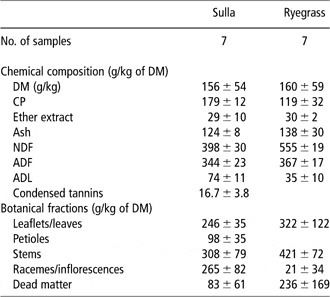
The average chemical composition and the incidence in botanical fractions of offered forages are reported in Table 1. As expected, the sulla forage was greater in CP and lower in fibre components than ryegrass. The CT concentration in offered sulla was 16.7 g/kg of DM and no CT were detected in ryegrass forage. The whole-plant CT content of sulla was comparable to that recorded in Sicily by Priolo et al. (Reference Priolo, Bella, Lanza, Galofaro, Biondi, Barbagallo, Ben Salem and Pennisi2005) (17.8 g/kg of DM), but lower than values found in Sardinia (from 24 to 36 g/kg of DM; Molle et al., Reference Molle, Decandia, Giovanetti, Cabiddu, Fois and Sitzia2009), and in New Zealand, which ranged from 35 (Niezen et al., Reference Niezen, Charleston, Robertson, Shelton, Waghorn and Green2002) to 72 g/kg of DM (Douglas et al., Reference Douglas, Stienezen, Waghorn, Foote and Purchas1999). The CT content in sulla is affected by several factors such as environment, genotype, physiological stage and their interaction (Amato et al., Reference Amato, Di Miceli, Giambalvo, Scarpello and Stringi2005).
Chemical composition and proportion of botanical fractions of offered forages (mean ± s.d.)

DM = dry matter.
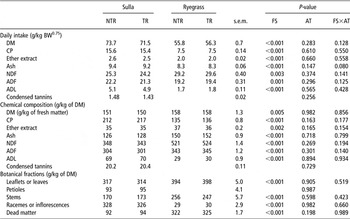
During the trial, the lambs consumed the entire amount of supplied concentrate (200 g/day per head as fed). Daily forage DM intake (Table 2) of lambs-fed sulla was about 15 g/kg BW0.75 greater than for lambs fed ryegrass (P < 0.001), regardless of the anthelmintic treatment. As a consequence, sulla-fed lambs consumed more than double the CP but less NDF than ryegrass-fed lambs. The CT intake of sulla-fed lambs averaged 1.46 g/kg BW0.75.
Forage DM and nutrients intake and chemical composition and proportion of botanical fractions of ingested forages

DM = dry matter; NTR = non-treated with anthelmintic; TR = treated with anthelmintic; FS = forage species; AT = anthelmintic treatment.
The greater DM intake of sulla forage in this study is in agreement with that reported for lambs (Niezen et al., Reference Niezen, Waghorn, Charleston and Waghorn1995) and grazing dairy ewes (Bonanno et al., Reference Bonanno, Di Grigoli, Vargetto, Tornambè, Di Miceli and Giambalvo2007a). The higher sulla intake found in this experiment could be related to the more favourable chemical composition observed in legume forage, which was higher in protein and non-structural carbohydrates (270 v. 158 g/kg of DM for sulla and ryegrass, respectively; data not shown in the tables) and lower in structural carbohydrates in comparison with ryegrass. Indeed, it is well established that the degree of synchrony between the rates of fermentation of carbohydrates and degradation of protein in the rumen influences diet selection and intake of ruminants (Kyriazakis and Oldham, Reference Kyriazakis and Oldham1997). Moreover, Burke et al. (Reference Burke, Waghorn, McNabb and Brookes2004) suggested that the greater DM intake of sulla forage is linked to the greater ratio of degradable-to-structural carbohydrates, resulting in a faster rate of breakdown in the rumen, and subsequent outflow to the intestine.
However, many authors have found that high CT concentrations in forage (60–100 g/kg of DM) can depress DM intake and nutrient utilization in ruminants, with detrimental effects on their productivity (Min et al., Reference Min, Barry, Attwood and McNabb2003; Waghorn and McNabb, Reference Waghorn and McNabb2003). It could be assumed that in this experiment the moderate CT concentration in sulla did not negatively affect DM intake, in accordance with Wang et al. (Reference Wang, Douglas, Waghorn, Barry, Foote and Purchas1996) and Molle et al. (Reference Molle, Decandia, Giovanetti, Cabiddu, Fois and Sitzia2009).
Comparing chemical and botanical composition of offered (Table 1) and ingested forages (Table 2), marked differences were observed, indicating that lambs fed each diet had the opportunity of selecting more proteic and less fibrous parts of plants. In fact, the proportion of leaflets and racemes was higher (P < 0.001) in the ingested (316 and 327 g/kg of DM, respectively) than in the offered sulla forage (246 and 265 g/kg of DM, respectively), whereas the contrary was observed for the stems (308 and 171 g/kg of DM for offered and ingested forage, respectively; P < 0.001). Similar selective behaviour was observed in lambs-fed ryegrass. Accordingly, lambs showed greater DM intake of leaves than stems, as also demonstrated with other grass species (Laredo and Minson, Reference Laredo and Minson1973; Poppi et al., Reference Poppi, Minson and Ternouth1981). In addition, the CT concentration was greater in ingested than in offered sulla (20.3 g/kg of DM v. 16.7 g/kg of DM), due to greater intake of plant components containing more CT (leaflets, 28.5 g/kg of DM; racemes, 25.5 g/kg of DM) than petioles (7.0 g/kg of DM) and stems (6.8 g/kg of DM). Feed intake and chemical and botanical selectivity were not affected by the anthelmintic treatment.
Growth and carcass composition
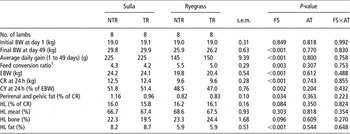
At the end of the experiment, lambs offered sulla showed greater BW (P < 0.001) than lambs-fed ryegrass (Table 3). The better growth performance of sulla-fed lambs can be easily related to the greater DM and protein intake of sulla forage in comparison with ryegrass. Average daily weight gain of lambs-fed sulla was higher by about 20 g than that observed by Bonanno et al. (Reference Bonanno, Todaro, Portolano, Alabiso, Giaccone, Alicata and Leto1997) for male Comisana lambs in the same growth phase and reared indoor in a similar environment.
Effects of consumed forage species on lambs growth, performance at slaughter and hind leg dissection

NTR = non-treated with anthelmintic; TR = treated with anthelmintic; EBW = empty body weight; CR = carcass weight; CY = carcass yield; HL=hind leg; FS = forage species; AT = anthelmintic treatment.
1Feed conversion ratio calculated taking into account the total DM intake (forage and concentrate).
The nutritional utilization of sulla forage was more efficient than that of ryegrass, evident from the lower feed conversion ratio (P < 0.05; Table 3). This could be due to the favourable chemical composition of sulla forage, such as the high protein and non-structural carbohydrate content, and low structural carbohydrate level. In addition, the content of CT, being moderate, is assumed not to have affected feed utilization efficiency. On the contrary, Molle et al. (Reference Molle, Decandia, Giovanetti, Cabiddu, Fois and Sitzia2009) observed impaired DM and protein digestibility in ewes-fed sulla in comparison with PEG-dosed ewes. Indeed, in that study, CT content in offered sulla forage (24–36 g/kg of DM) was markedly higher than that observed in this experiment (16.7 g/kg of DM).
Owing to the nutritional benefits of sulla forage, sulla-fed lambs at slaughter had heavier carcasses (P < 0.001) than ryegrass-fed lambs, with a greater dressing percentage (P < 0.01) and incidence of perirenal and pelvic fat (P < 0.05; Table 3). The increased fatness of sulla-fed lamb carcasses was also evident in the greater proportion of fat tissue in the HL (P < 0.001; Table 3), as would be expected from the higher BW at slaughter. The fatness levels found in carcasses for both diets is consistent with that observed for Comisana lambs at similar age (Bonanno et al., Reference Bonanno, Todaro, Portolano, Alabiso, Giaccone, Alicata and Leto1997).
Non-treated and treated lambs by anthelmintic showed similar BW changes over the period of the experiment and carcass characteristics at slaughter, regardless of the diet. Certainly, this result has to be linked to the low level of nematode infection observed in non-treated lambs. In fact, whereas lambs treated with anthelmintic drugs had always a FEC of zero, in non-treated lambs the initial FEC was quite low (183 eggs/g on average). FEC from non-treated lambs decreased slightly at day 29 of experiment (146 and 163 eggs/g for lambs-fed sulla and ryegrass, respectively), and had almost completely disappeared at the end of the experimental period (6 and 13 eggs/g for lambs-fed sulla and ryegrass, respectively). Nevertheless, adult nematode worms were isolated from the gastrointestinal tracts of non-treated lambs fed each FS. The mean number of adult worms was low and did not differ among lambs on the feeding treatments (108 v. 131 in lamb-fed sulla and ryegrass, respectively; P = 0.695). Most of the adult nematodes (>90% in both lambs groups) were Teladorsagia circumcinta, a species that resides in the abomasum. Many studies have shown how the exposure to CT could have different effects on this nematode species, depending on its developmental stage. In particular, CT is ineffective for the control of established Teladorsagia circumcinta adult worms (as reviewed by Hoste et al., Reference Hoste, Jackson, Athanasiadou, Thamsborg and Hoskin2006). As it is accepted that adequate protein and nutritional energy can positively affect the expression of immunity in sheep infected with gastrointestinal nematodes (Brown et al., Reference Brown, Poppi and Sykes1991; Coop and Kyriazakis, Reference Coop and Kyriazakis1999; Akkari et al., Reference Akkari, Darghouth and Ben Salem2008), it may be hypothesized that the almost total disappearance of faecal eggs and the low worm counts were attributable in this experiment to the housing conditions and nutritional status of the lambs fed with each forage.
Meat quality
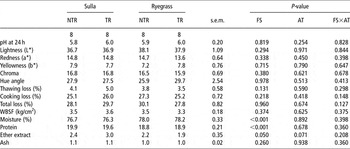
Diet did not modify the physical characteristics of LD meat (Table 4), but affected its chemical composition, which was greater in protein (P < 0.001) and ether extract (P < 0.05) content with the sulla-based diet. The higher ether extract of LD meat from sulla-fed lambs is consistent with the greater proportions of fat depots in carcass and HL (Table 3), and was expected considering that lambs-fed sulla were heavier, and therefore in a more advanced stage of development than lambs-fed ryegrass.
Effects of consumed forage species on physical characteristics and chemical composition of lambs Longissimus dorsi meat

NTR = non-treated with anthelmintic; TR = treated with anthelmintic; FS = forage species; AT = anthelmintic treatment; WBSF = Warner-Bratzler shear force.
L* = measure of darkness to lightness, larger number indicates a lighter colour. a* = measure of redness, larger number indicates a more intense red colour. b* = measure of yellowness, larger number indicates a more yellow colour. Chroma = (a*2+b*2)0.5, measure of total colour, larger number indicates a more vivid colour.
Hue angle = (arctg b*/a*), represents the change from the true red axis, larger number indicates a greater shift from red to yellow.
Meat colour parameters were not affected by FS. This result is in contrast to the observations of Priolo et al. (Reference Priolo, Bella, Lanza, Galofaro, Biondi, Barbagallo, Ben Salem and Pennisi2005), who reported a lighter meat colour in Comisana lambs (slaughtered at 148 days of age) fed-sulla forage containing 17.8 g/kg of DM of CT than meat from lambs given sulla supplemented with polyethylene glycol, to deactivate the CT. Similar results were found for Comisana lambs (slaughtered at 105 days of age) receiving CT from carob pulp (Ceratonia siliqua L.) (Priolo et al., Reference Priolo, Waghorn, Lanza, Biondi and Pennisi2000), and this was explained as a possible effect of CT in reducing microbial biosynthesis of vitamin B12, a precursor of haemoglobin (Priolo and Vasta, Reference Priolo and Vasta2007). In this study, the absence of an effect of CT on meat colour may be due to the lower CT intake of lambs-fed sulla relative to that in previously reported experiments, and also to a different reactivity of sulla CT than those in carob pulp.
The results of triangle tests (21 correct indications from panellists out of a total of 56 comparisons) indicated that the sensory testers were unable to distinguish significantly meat derived from the different FS. Therefore, the panellists’ responses with respect to the sensory properties of meat from animals on each diet suggest that there were no alterations to the meat flavour. In this regard, a greater content of skatole, a compound that confers an unpleasant flavour to meat, was found by Priolo et al. (Reference Priolo, Bella, Lanza, Galofaro, Biondi, Barbagallo, Ben Salem and Pennisi2005) for the fat of lambs-fed fresh sulla forage with or without polyethylene glycol compared with lambs fed a maize-based diet. However, the level of skatole in the fat of lambs-fed sulla should not be different from that of lambs-fed ryegrass, because skatole levels seem to be enhanced by feeding fresh green forage, and reduced by a CT intake greater than that in this experiment (Priolo and Vasta, Reference Priolo and Vasta2007).
Conclusions
The results of this study demonstrate that weigh gain improved in lambs-fed sulla forage in comparison with those fed ryegrass. Lambs-fed fresh sulla showed superior growth performance, and carcass weight and yield, as a consequence of greater DM and CP intake and better nutritional efficiency. These beneficial effects may be a function of the favourable ratios linking protein, structural and non-structural carbohydrates of sulla forage, and may depend on its moderate CT content which improves intestinal protein utilization by inhibiting protein degradation in the rumen.
This study also showed that the CT-containing sulla forage did not negatively influence the physical, chemical and sensory properties of the lamb meat.
The low initial level for FEC in lambs made it difficult to establish the effect of parasitic infection on lamb growth, regardless of the diet. In this regard, further investigations are required to establish whether grazing of small ruminants on sulla in Mediterranean environments could be a useful strategy for reducing nematode parasitism, given that the CT intake from sulla can be easily lower than the 35 g/days considered necessary for effective control of nematodes.
Acknowledgements
This research is part of the project Use of forages with anthelmintic properties for the organic livestock improvement, funded by the Consorzio Bioevoluzione Sicilia.