Introduction
Most of the dunes at the European Atlantic coast are covered with Ammophila arenaria (L.) Link (marram). This dominance is partly due to successful natural colonization and partly due to marram planting in order to stabilize dunes and to protect the coast against sea and wind erosion. Although A. arenaria is appreciated in Europe for its sand-stabilizing qualities, in other continents it poses a problem as an invasive plant that replaces native grasses (Beckstead and Parker, Reference Beckstead and Parker2003; Knevel et al., Reference Knevel, Lans, Menting, Hertling and van der Putten2004; Van der Putten et al., Reference Van der Putten, Yeates, Duyts, Reis and Karssen2005). For decades, ecologists have been intrigued by the contras between vigorously growing A. arenaria in the highly dynamic coastal foredunes and degenerating A. arenaria stands in inland stabilized dunes (Marshall, Reference Marshall1965; Van der Putten et al., Reference Van der Putten, van Dijk and Troelstra1988).
In the older dunes, the plants seem less vigorous and usually do not produce inflorescences (Wallén, Reference Wallén1980). Despite the important role it plays as ecosystem engineer in coastal dunes, there is very little known about the genetic variation of this clonal plant. The only study of the genetic variation in A. arenaria showed genetic differentiation between coastal populations in Europe (Rodríguez-Echeverría et al., Reference Rodríguez-Echeverría, Freitas and van der Putten2007).
A. arenaria is a wind-pollinated, amphimictic, tetraploid plant (Bennett and Leitch, Reference Bennett and Leitch1995). The plants' rhizomes enable fast spread across large areas. Parts of rhizomes can be transported by sea, washed ashore and start new populations (Wallén, Reference Wallén1980). Seed viability is high in general, but seedling establishment in the field is very low due to desiccation, sand burial or erosion (Huiskes, Reference Huiskes1979). Most seeds are produced by the tussocks near the coastline. Here, the plants grow vigorously and start flowering in Northern Europe in May and June, while seeds are dispersed in August and September. Further inland, the A. arenaria plants grow much more slowly and seed production is low or completely absent. The mainly clonal propagation of A. arenaria makes it difficult to distinguish between individuals. Tussocks of 80–160 cm in diameter have been described (Greig-Smith, Reference Greig-Smith1961), but it is not known to what extent a clone can spread. Clonal plants are expected to have a low genetic diversity within, but high diversity among, populations (McLellan et al., Reference McLellan, Prati, Kalltz, Schmid, de Kroon and van Groenendael1997). Uniola paniculata L., a coastal dune grass with similar growth characteristics to A. arenaria and also used for dune restoration, was studied with amplified fragment length polymorphism (AFLP) and large variation was found between populations from different states (Subudhi et al., Reference Subudhi, Parami, Harrison, Materne, Murphy and Nash2005). In Carex sylvatica Hudson, low numbers of genotypes were found within populations, but these genotypes were very distinct (Arens et al., Reference Arens, Bijlsma, van't Westende, van Os, Smulders and Vosman2005).
We expected to find genetic differentiation between coastal and inland populations due to selection pressure of the different habitats, and more genetic variation where new dunes are being formed, compared with older dunes. In the newly formed dunes, plants can become established via rhizomes from extending clones, via stolons with buds washed ashore and via seedlings, but the latter seems to have low chances of survival. In older dune areas, genotypes can be outcompeted by other plant species, resulting in lower genetic diversity. Since there are hardly any seeds produced and there is no opportunity for rhizomes to wash ashore, relatively little variation is expected. Somatic mutations would be expected to be the main source of genetic variation (Dulieu, Reference Dulieu2005).
We analysed the genetic diversity within three population pairs in Wales, UK. AFLP markers were used, which are widely applied to study genetic variation between closely related organisms due to the high reproducibility of the fingerprints (Vos et al., Reference Vos, Hogers, Bleeker, Reijans, van de Lee, Hornes, Frijters, Pot, Peleman, Kuiper and Zabeau1995) and cost efficiency as compared with, for example, the development of microsatellite markers (Mueller and Wolfenbarger, Reference Mueller and Wolfenbarger1999). AFLP allows not only quantification of the distinctness of populations but also identification of loci that are possibly under directional selection. If the selection pressure of mobile and stable dunes is strong enough, then the same divergent loci should be found in each of the three sites.
Material and methods
Locations
Three dune systems in Wales (UK) were selected for sampling. Morfa Dyffryn (N 52°80′ W 04°14′) is a Site of Special Scientific Interest (SSSI) with more than 60 ha A. arenaria mobile dunes. The site has been eroding since the 1940s. The local marram population has most likely been supplemented with material from the nearby dune area at Morfa Harlech to prevent further erosion. The heavy erosion means that the current coastal populations probably are former inland populations. Ynyslas (N 52°31′ W 04°03′) is also an SSSI and has around 18 ha of A. arenaria mobile dunes and the total area is increasing due to sand accumulation. Marram has been planted from 1971 to 1989 at blowouts, close to the coast. Although the origin of the material was not documented, it is most likely to have been local. Broomhill Burrows (N 51°65′ W 05°07′) is also an SSSI and has only 6 ha with A. arenaria mobile dunes. There is some erosion due to visitor pressure, but no marram has been planted.
Small-scale sampling within Ynyslas
Thirty-three samples were taken from Ynyslas in Wales, UK in December 2004. From a central point in the stable dunes, 400 m from the coast, samples were taken crosswise in four different directions over a maximum distance of 100 m, i.e. north, east, south and west. The distance from the central sample to the next four samples was 0.39, 0.78, 1.56, 3.12, 6.25, 12.5, 25 and 50 m, respectively. One green leaf was collected from each sampling point. The leaf was kept in a labelled plastic bag on ice during collecting of the samples. After returning to the laboratory on the day of collection, 50 mg of each leaf was flash-frozen in liquid nitrogen and stored at − 80°C until DNA extraction.
Large-scale sampling in Ynyslas, Morfa Dyffryn and Broomhill Burrows
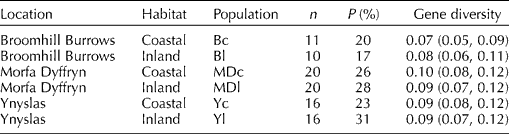
Ninety-three samples were taken from three dune areas in Wales in July 2005. Parallel to the coastline, a green leaf was collected every 100 m from the A. arenaria tussock closest to the sea. Parallel to the sampling points near the coast, additional samples were taken at 200 m further inland. Initially, we aimed for sampling two parallel transects of 16 samples each for all three areas. In Ynyslas, this was possible, but in Broomhill Burrows, the A. arenaria covered only a stretch of approximately 1 km length along the coastline and thus the two transects from that area included only 10/11 samples. Morfa Dyffryn was the largest area and there transects of 2 km were sampled (20 samples, collected every 100 m). In total, the samples collected per area varied between 21 and 40 (Table 1). Samples were treated as in the small-scale sampling.
Characteristics of the six coastal and inland populations of Ammophila arenaria based on 201 amplified fragment length polymorphism loci

n, number of samples; P, polymorphic loci. Gene diversity (expected heterozygosity) was calculated according to Nei (Reference Nei1987) with lower and upper confidence intervals in brackets.
DNA extraction and AFLP analyses
Plant material was ground twice for 1 min at 20 rpm with a tungsten ball in liquid nitrogen. Then, total DNA was extracted using a Qiagen DNeasy kit according to the manufacturer's instructions (Qiagen, Hilden, Germany). A sample of 10 μl crude extract was run on a 1% agarose gel stained with ethidium bromide to assess DNA quality and estimate DNA concentration. Approximately, 100 ng was used for the AFLP according to Vos et al. (Reference Vos, Hogers, Bleeker, Reijans, van de Lee, Hornes, Frijters, Pot, Peleman, Kuiper and Zabeau1995), modified for fluorescent capillary electrophoresis as described by Skøt et al. (Reference Skøt, Humphreys, Armstead, Heywood, Skøt, Sanderson, Thomas, Chorlton and Hamilton2005).
The two restriction enzymes used to cut genomic DNA were EcoRI and MseI. Two selective primer pairs (EcoR1-ACA/Mse1-CAC and EcoR1-AGA/Mse1-CTC) produced around 100 bands each when tested on a small subset of samples. Reproducibility was confirmed by running duplicate samples in two separate AFLP runs (error rate 1.2%). A third primer pair, EcoR1-ACG/Mse1-CAT, did not give reproducible results and was therefore not used any further. The selective EcoR1 primers were fluorescently labelled. The amplified DNA fragments were separated by capillary electrophoresis on an ABI Prism 3100 Genetic Analyzer (Applied Biosystems, Warrington, UK). The presence or absence of bands between 50 and 400 bp was scored with Genotyper v3.7 software (Applied Biosystems) and manually inspected. A binary matrix was constructed on the basis of the absence or presence of bands.
Data analysis
AFLP banding patterns were used in the analyses as haplotypes. The simple match
coefficient was used as recommended by Kosman and Leonard (Reference Kosman and Leonard2005) for polyploid organisms on the basis of dominant banding
profiles. Gene diversity was calculated according to Nei (Reference Nei1987), as  and averaged over all markers. An analysis of molecular variance (AMOVA)
based on pairwise Euclidian distances was calculated with aid of software ARLEQUIN v3.01
(Schneider et al., Reference Schneider, Roessli and Excoffier2000)
according to Weir (Reference Weir1996). This procedure was
chosen since it does not require estimates of allele frequencies.
If there are strong and divergent selection pressures in coastal and inland habitats, then one would expect to find the same differentiation loci in all three different sites. To identify loci under selection, outlying F ST values were used as proposed by Beaumont and Nichols (Reference Beaumont and Nichols1996), and Beaumont and Balding (Reference Beaumont and Balding2004). For the analysis of the coastal versus inland populations, the program FDIST2 was used (http://www.rubic.rdg.ac.uk/~mab/software.html).
The program STRUCTURE 2.0 (Pritchard et al., Reference Pritchard, Stephens and Donnelly2000) was used to estimate the population structure in the total sample of genotypes with a Bayesian approach. The data were entered as haplotypes and analysed assuming the absence of admixture. For K, the number of clusters, a range of one to four was tested. The dataset was run ten times for each possible K value (burnin = 10,000, MCMC = 10,000). To detect the most probable number of clusters, the ΔK statistic was used (Evanno et al., Reference Evanno, Regnaut and Goudet2005). The difference in frequency of occurrence of type 1 and 2 clusters in coastal and inland populations has been tested with a Fisher's exact test with 2 × 2 contingency tables.
As an estimate of population differentiation, Bayesian methods were used according to Holsinger and Lewis (Reference Holsinger and Lewis2003). The full model was compared with f = 0 and θ = 0. Because estimates for f derived from dominant data may be unreliable, the f free model was also run. Several runs were conducted with default sampling parameters (burnin = 50,000; sample = 250,000; thin = 50). The model with the lowest deviance information criterion was used to estimate θ, the Bayesian analogue of F ST.
To test the relation between geographical distance and genetic similarity (isolation by distance, IBD), Mantel tests (Mantel, Reference Mantel1967) were performed with 999 permutations using Spearman's rank correlation. For these statistical tests, GenAlEx 6.0 (Peakall and Smouse, Reference Peakall and Smouse2006) was used, after ranking the data.
Results
Small-scale genetic structure: Ynyslas
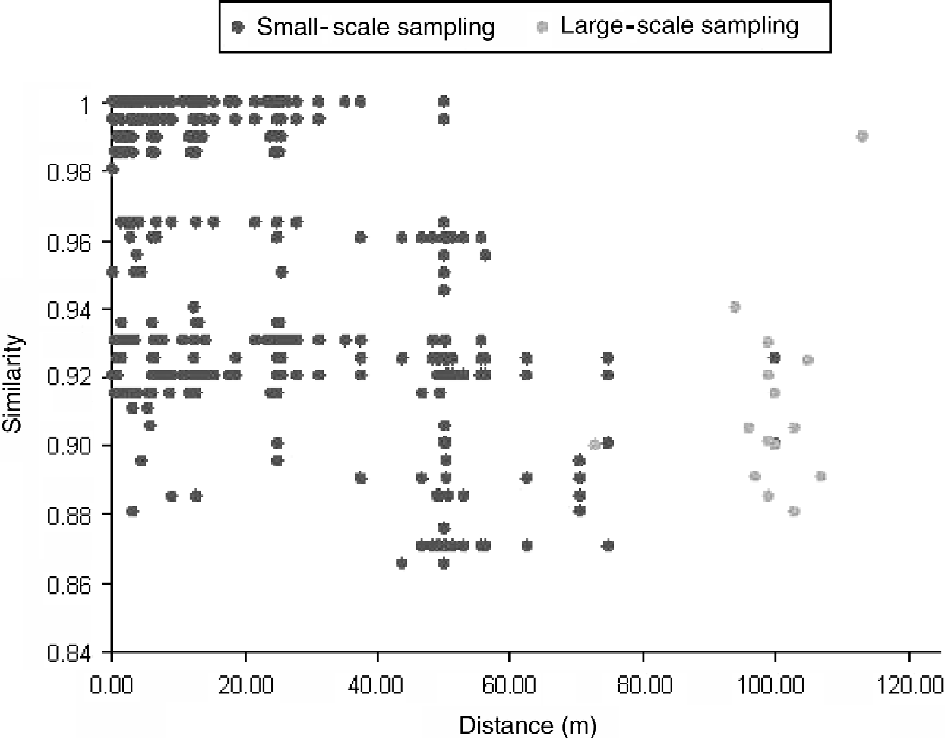
Of the 201 AFLP loci, belonging to 33 individuals sampled within a square of 100 m × 100 m, 22% of the bands were polymorphic. The samples showed a pattern of one large clone intermingled with a number of different and apparently small clones. In total, only 16 different fingerprints were retrieved from the 33 samples. From those 16 fingerprints, 14 were unique (one or more bands different), 1 fingerprint was shared by two samples at 25 m distance and 1 fingerprint appeared to represent one large clone: 17 identical fingerprints were found at distances ranging from 39 cm to 50 m. IBD analysis indicated a weak but significant negative correlation between genetic similarity and geographic distances (r = − 0.29; P = 0.027). As the number of samples at the larger distances (100 m) was low, one deviating sample at the extreme sampling points could have a large impact. However, including the genetic similarities of the large-scale sampling from the inland Ynyslas population for the 100 m distances (Fig. 1), confirmed the pattern of lower genetic similarity at distances of more than 50 m between plants.
Isolation by distance analysis based on pair wise simple matching coefficients and geographic distances among individuals of Ammophila arenaria.

Large-scale genetic structure: Ynyslas, Morfa Dyffryn and Broomhill Burrows
Both primer pairs yielded 43% polymorphic bands. Of the 201 AFLP loci, belonging to 93 individuals of six populations, between 17 and 31% were polymorphic (Table 1). Therefore, gene diversity levels were low, i.e. from 0.07 to 0.10. Both indicators of genetic diversity (percentage of polymorphic loci and Nei's gene diversity) did not differ consistently between coastal and inland populations. Despite the low diversity, only one pair of identical clones was found, in Broomhill Burrows at a distance of 723 m between clones.
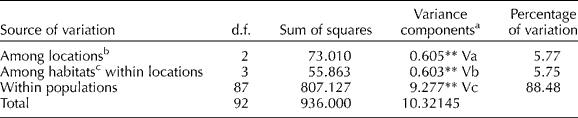
The AMOVA indicated that 6% of the total genetic variance was attributable to the difference between sampling sites, 6% was found between coastal and inland populations within sampling sites, while most of the variance was found within populations (Table 2). Within the three different sites, no significant IBD was found (P>0.10). However, over larger distances, including data from all three sites, a weak IBD was found (r = − 0.13; P = 0.001). The genetic similarity between populations remained high, with an average similarity coefficient of 0.89.
Analysis of molecular variance between coastal and inland populations of Ammophila arenaria as implemented by software ARLEQUIN v3.01
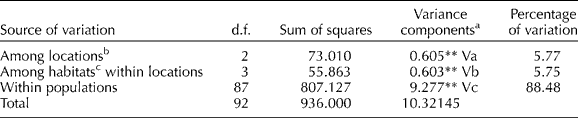
a This procedure is based on pairwise Euclidean square distances used for AMOVA computations of AFLP data. Significance of tests was based on 10,000 permutations. Significance of variance components is indicated as ** for P < 0.01. This was chosen since it did not require indirect estimates of allele frequencies.
b Locations are the three sampling sites: Broomhill Burrows, Morfa Dyffryn and Ynyslas.
c Habitat is defined as inland versus coastal, there are six populations, i.e. three coastal and three inland.
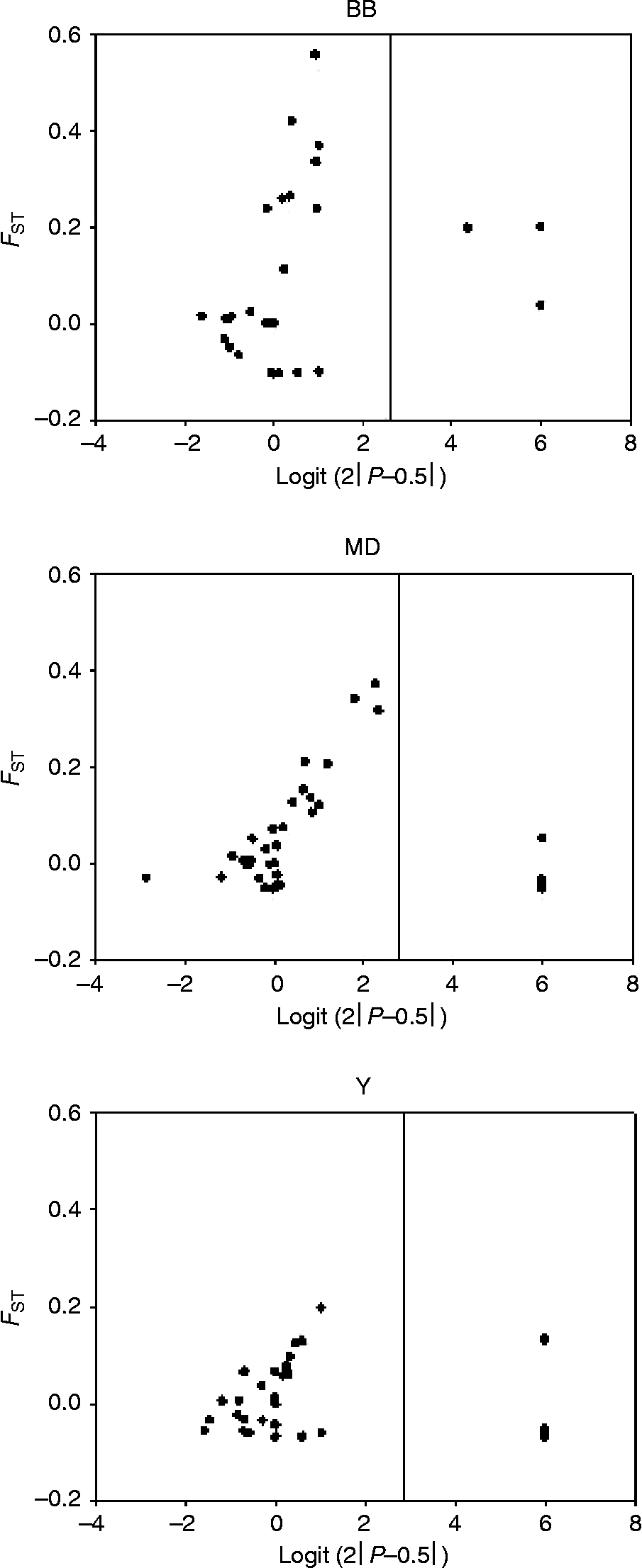
For each site, potential outlier markers were identified from coast versus inland genotypes with respect to their F ST value. This suggests that these loci or closely linked loci may be under selection. However, the outlier loci were unique for each site. The F ST values were relatively low, especially in Morfa Dyffryn (Fig. 2).
Plot of F ST against the logit of the probability of finding equally or more extreme F ST values. The vertical line indicates P < 0.05 after Bonferroni correction for multiple testings. BB, Broomhill Burrows; MD, Morfa Dyffryn; Y, Ynyslas.

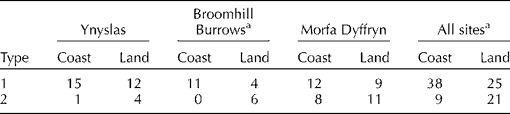
STRUCTURE detected two clusters in the samples from three dune systems in Wales. Cluster 1 contained 63 samples from all three locations, both coastal and inland samples. Cluster 2 also contained samples from all three locations, but these 30 samples were mostly from inland samples (Table 3). The difference in frequency of occurrence of type 1 and 2 clusters in coastal and inland populations is significant in Broomhill Burrows (P = 0.008; Fisher's exact test) and in all sites (P = 0.011). In the other two sites, the differences in frequency of occurrence were not significant (P>0.05), although the trends were similar. In the Bayesian analysis of population structure, comparing the two clusters assigned by STRUCTURE, the full model was best supported. Moderate differentiation between the two clusters was found with θB = 0.19 (95% confidence interval 0.13–0.26).
Assignment of land and coastal Ammophila arenaria genotypes to groups according to STRUCTURE v2.0
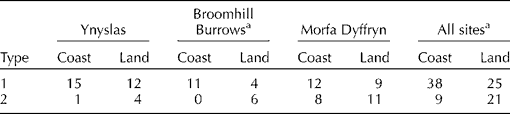
a A significant difference in frequency of occurrence of type 1 and 2 clusters in coastal and inland populations in Broomhill Burrows data and in all sites (P < 0.05; Fisher's exact test).
Discussion
Genetic variation in young and older dunes
Our hypothesis of more genetic variation in the younger dunes was not borne out by the gene diversity (expected heterozygosity) data, which did not differ between coastal and inland populations (Table 1). There are several possibilities that could explain this similarity in gene diversity in coastal and inland populations. One, maybe the vegetative material that is washed ashore does not contribute much to population genetic diversity. Two, seeds from coastal populations could be blown by wind further inland, where they have better chances of establishment. Three, the sampling strategy might not have been sensitive enough to detect any differences. In our case, the distance to the coast might not have been the best predictor for clone age, due to the dynamic nature of dunes. In future studies, it might be better to select plants from stable and mobile dunes instead of selecting samples on the basis of distance to the coast. This might also explain why the outlier markers, as detected with the FDIST analysis, were different for each location.
The two AFLP types of A. arenaria that were detected with the STRUCTURE analysis seemed to have a spatial structure. The association between cluster type and population (coastal or inland) has statistical support for all sites and Broomhill Burrows. The samples of the second-type cluster were found mainly inland; the processes that lead to this spatial arrangement cannot be deduced from this study. It could be the result of colonization history or related to selection pressures of the different habitats. For example, sand deposition is minimal in older dunes, as opposed to young dunes. Morfa Dyffryn differs from the two other sites in its heavy erosion. The heavy erosion means that the current coastal populations probably are former inland populations. This could explain why the second type is found at the coast in Morfa Dyffryn, but hardly at all at the coast of the other two sites.
Clone identification, clone size and distribution
The high proportion of monomorphic loci (57%) is consistent with the range found for other clonal species. In C. sylvatica populations, 66% of monomorphic bands were found (Arens et al., Reference Arens, Bijlsma, van't Westende, van Os, Smulders and Vosman2005). The coastal dune grass U. paniculata was studied with AFLP and monomorphism was on average 41% (Subudhi et al., Reference Subudhi, Parami, Harrison, Materne, Murphy and Nash2005). Despite the low number of polymorphic loci in our study, it was nevertheless sufficient to discriminate nearly all samples from three different sampling sites. Samples were assigned to the same clone when they had identical fingerprints. It is possible to encounter different genotypes that share the same alleles for the genotyped loci, if few loci are genotyped. In our samples, this probability appears low since among 93 samples only one duplicate was found. This indicates that the duplicates found in the 33 small-scale samples were due to sampling the same clones and not the consequence of analysing too few bands. On the other hand, somatic mutations and scoring errors could lead to overestimation of the numbers of clones, but this bias is likely to be of minor importance, since 99.7% of the clone pairs differed by five bands or more, with an average of 20 bands difference.
The small-scale sampling indicated the presence of one dominant clone, covering up to 50 m, although it was not determined whether all tussocks with identical fingerprint were physically connected. At distances of 100 m and more, it was very unusual to find a shared AFLP fingerprint, indicating that maximum clone size is somewhere between 50 and 100 m. This is much more than expected, since A. arenaria predominantly seems to produce vertical rhizomes rather than horizontal ones (Gemmell et al., Reference Gemmell, Greig-Smith and Gimingham1953; Pavlik, Reference Pavlik1983). Large clonal plants will have the advantage in exploring poor and heterogeneous environments (D'Hertefeldt and Jonsdottir, Reference D'Hertefeldt and Jonsdottir1999), but more sampling in other areas is necessary to confirm the observed pattern of one large clone intermingled with a number of different and apparently small clones.
This study provides the first evidence for two distinct clusters of A. arenaria within native populations. The observed pattern of the two types of A. arenaria, suggests that one type is colonizing the newly formed dunes, and that further landward a second type becomes more common. The occurrence of two types should be verified on a broader geographical scale, preferable in an area where the native A. arenaria population has not been disturbed by planting. Transplant experiments with the two types would indicate whether dispersal or selection pressure by the different habitats lead to the current spatial structure.
Acknowledgements
We thank the Countryside Council Wales for permission to sample in the dunes and especially Mike Bailey, Graham Williams and Matt Sutton for information on the history of A. arenaria in Wales. This work is part of the EcoTrain project, which is funded by the European Union (RTN2-2001-0464). IGER is an institute of the Biotechnology and Biological Sciences Research Council.