


The year 2017 was the most expensive year for disasters ever recorded worldwide, with US $337 billion in total economic losses from natural catastrophes and large man-made disasters.1 In the United States, the Federal Government alone provided US $89.3 billion in emergency supplemental funding to assist states, communities, businesses, and individuals in response to the recent hurricanes, wildfires, and other disasters.2
Current federal funding for public health emergencies has been described as a “crisis” in which “we have had a number of emergency situations where cuts and delays in federal public health emergency funding cost lives, caused enormous suffering, and resulted in exorbitant preventable medical costs.”1
There are few sources available that offer a comprehensive measurement of US federal funding for disaster-related funding, including health. Little is currently known regarding federal allocations for disaster science involving a span of key disaster-associated disciplines (eg, emergency management, engineering, medicine, public health, and social science).
The objective of this study is to characterize US federal funding for disaster-related research for these 5 key disciplines during 2011–2016.
METHODS
An online search was performed using the US Government website, http://www.USAspending.gov, to identify federal funding of awards, grants, contracts from 2008–2017 for disaster-related research for the 6 years between 2011 and 2016. This is the official US Government database collecting data on all federal contracts, grants, loans, insurance, and other financial assistance.
An advanced data search was performed of federal funding awards, subawards, grants, contracts, and other financial outlays provided by the Federal Government to states and local jurisdictions, regions, territories, and tribal reservations during 2011–2016.
Searches of the USAspending.gov database were performed to include the search term, disaster, AND one of the following 23 key words:
Research
Medicine
Public health
Social science Engineering
Emergency management
Hazards
Vulnerability
Resilience
Risk reduction
Preparedness
Response
Recovery
Management
(Social science subset of terms, as follows)
Behavioral
Cognitive
Psychology
Sociology
Communication
Economics
Culture
Law
Political
Criteria for study inclusion were identified as a (1) disaster-related research, (2) conference related to disaster research, (3) disaster assessment, or (4) unsure, as well as (5) funding allocation destined within the United States, including (6) only fixed and variable costs directly associated with a study. Items meeting inclusion criteria were then assigned to 1 of 5 disciplines: medicine, public health, social science, engineering, and emergency management. Assignments of criteria were performed by 1 individual and then validated by 2 additional reviewers using the same reference. Results were aggregated into 1 database where simple calculations of descriptive statistics were performed. Subawards were not included in this study because, by definition, subawards are a component of award funding and are therefore already included in the computation of expenditures.
The results of these 23 key word searches were aggregated into 1 single spreadsheet database. All duplicates were deleted. Simple calculations of descriptive statistics were performed using MS Excel™ software.
Assignments of criteria for data exclusion and professional discipline were performed by 1 individual. Disciplines were then validated by 2 additional expert reviewers using the same algorithm. A taxonomy of 35 widely-accepted target capabilities and functions necessary for managing emergencies (particularly involving population health) was developed to categorize each funding grant (Appendix A).Reference Barbera, Macintyre and Shaw3–Reference Walsh, Subbarao and Gebbie8 Using this taxonomy, 1 individual assigned each funding a capability and function, which was then validated by 2 additional reviewers. Items were considered to be related to a particular capability if the item description was primarily associated with 1 or more predesignated functions of that capability.
RESULTS
A total of 11 021 governmental transaction entries were identified during the key word search, of which 1876 entries were excluded because they involved negative or zero-dollar values.
This left 9145 government contract and assistance items for inclusion in the structured review. Of those, 8882 were excluded as not involving disaster research and 262 (3%) were included. Assistance grants comprised 175 (67%) of the items, and 87 (33%) were contracts. Only 11 search terms returned results and “research” yielded 76% of all search results.
For the 6 years, a total of US $69.3 million in disaster science research funding was identified, averaging US $11.5 million annually. Figure 1 indicates annual US Federal funding allocations for disaster research by professional discipline during 2011–2016. Total funding levels quadrupled during the first 3 years and then halved over the last 3 years studied. Funding levels for 2016 dropped to 29% below the overall mean of US $11 537 462 for that same period.
Total Annual US Governmental Funding for Disaster Research Related to 15 CDC Public Health Preparedness Capabilities 2008-2-17

Disaster Research According to Professional Discipline
Table 1 lists the number and percentage of Federal disaster-related items and allocations during 2011–2016 by professional discipline. Half of the 262 disaster-related research projects were related to engineering (134, 52%). This is 3 times those of grants and contracts for social sciences and emergency management and over 5 times those of public health and medicine. The engineering discipline also receives more than half of the total funds for the 6 years (see Table 1).
Number and Percent of Total Entry Items and Amounts of Funding Allocated for Disaster-Related Assistance Grants and Contracts Funded by the US Federal Government, 2011–2016 (in US Dollars)

Disaster Research Funding According to Institution
There were 91 organizations and academic institutions that received at least US $25 000 in Federal funding during the study period. The top 10 (11%) recipients received 52% of all disaster research funding allocated in the United States during 2011–2016 (Table 2).
Ten Institutions That Received the Highest Amounts of US Federal Assistance and Contracts for Disaster Research, 2011–2016

The Federal Government was both the sponsor and the recipient of the award for 38% of all funds. The highest funded US academic institutions for disaster research during 2011–2016 were Duke University, US $3 451 588 (5% of total funding); CUNY Research Foundation, US $3 116 378 (5%); University of Maryland, US $1 951 279 (3%); Columbia University, US $1 647 886 (2%); and the University of Florida, US $1 404 985 (2%).
Disaster Research Funding According to Target Capability
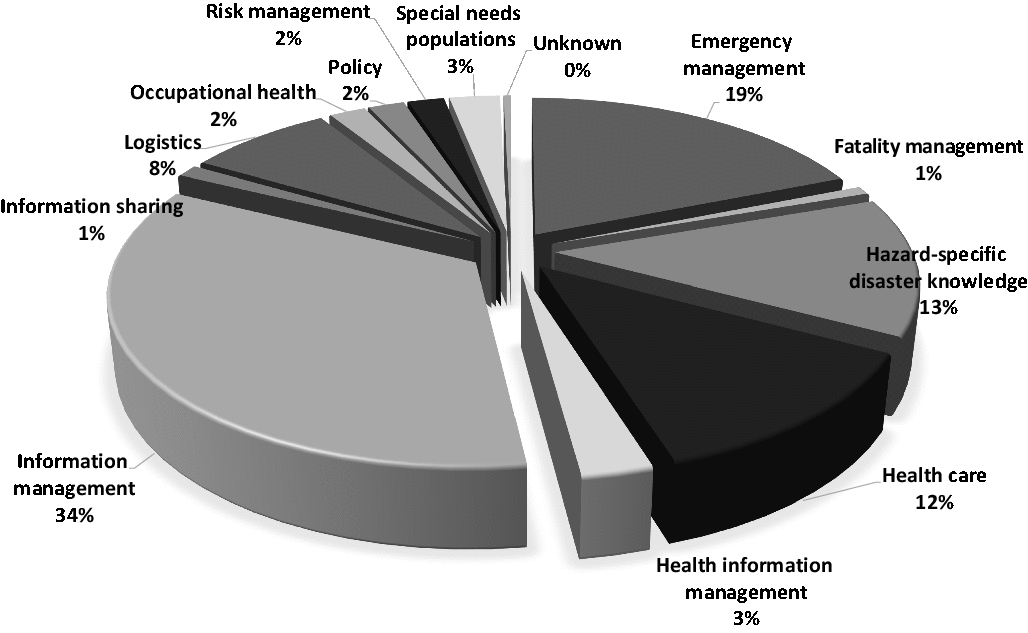
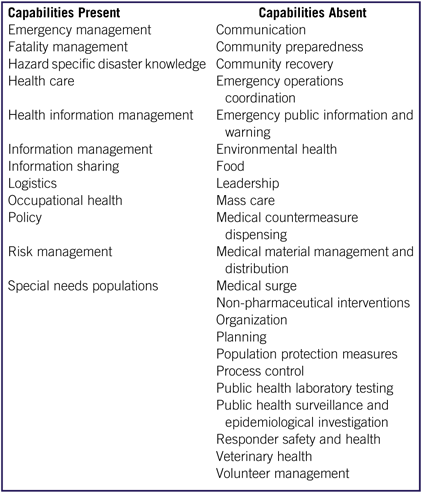
The target capability taxonomy of 35 disaster management capabilities (see Appendix A) was used to map the funding items to capabilities identified by the Federal Government as key components of disaster preparedness and response. The titles and descriptions of these 262 federally funded research projects were directly related to only 12 (34.3%) of the 35 pre-identified target capabilities as a primary subject of the project. Figure 2 depicts the relative frequency of these 12 target capabilities among disaster research projects funded during 2011–2016. It is notable that 38% of federally funded disaster research projects were related to managing and sharing information.
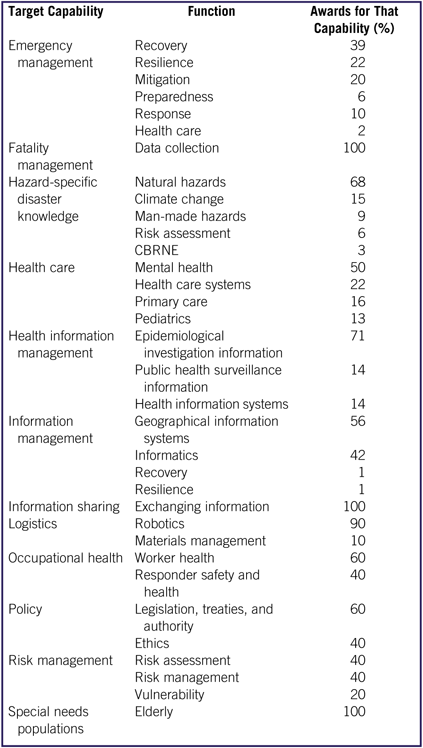
Table 3 lists target capabilities that received funding for disaster research during 2011–2016, as well as other widely-accepted capabilities that were not funded. Table 4 lists the composition of disaster research performed for each of the 12 funded target capabilities, in terms of function.
US Governmental Funding for Individual NPHPCs According to Year (2008-2017)
A Comparison of Disaster Management Capabilities Either Present or Absent From US Federally Funded Disaster Research, 2011–2016
Percentage of Research Awards for Functions Associated With Each of the 12 Disaster Management Target Capabilities, as Funded by the Federal Government During 2011–2016
CBRNE = chemical, biological, radiological, nuclear, explosives
Trends in Funding of Individual Capabilities During 2011–2016
Table 5 and Figure 3 also depict wide variations related to annual funding within individual capabilities. Six of the 12 capabilities received no funding for at least 2 of the 6 years studied. In comparison, research involving the capability of “information management” was consistently funded as compared with other capabilities (receiving over US $2 million of funding every year and > US $5 million for 2 peak years).
US Federal Assistance and Contracts for Disaster Research, According to Capability (2011–2016)

A Comparison of US Federal Expenditures for Preparedness-Related R&D as a Share of Total Funding for the PHEP Cooperative agreement, and US Federal Expenditures for R&D as a Share of GDP (2008-2017)

Funding for “emergency management” research appears to have increased 500% in the first year and then halved over the remaining 5 years. Funding for logistics spiked remarkably in 2014, largely due to a 1-year increase in studies involving robotics). Health care research was largely unfunded in 2011, then increased to over US $2 million in 2014, only to halve again by 2016.
DISCUSSION
Despite US Government policies that identify disasters as a significant threat to the public health and national security, this study identified very few Federal allocations for disaster-related research. During 2011 to 2016, we found a total of US $69.3 million in Federal allocations for disaster-related research, with an average annual allocation of US $11.5 million. The annual funding varied widely, from US $4.5 million in 2011 to US $17.4 million in 2013 and then dropped to US $8.2 million in 2016.
Five key academic disciplines also involved in disaster preparedness and response (medicine, public health, social science, engineering, emergency management) were included in the study to represent a broad range research effort. Over half of the total and annual funding was dedicated to the engineering discipline. The research funding for social sciences and emergency management shifted considerably over the 6-year period, whereas the lowest levels of annual funding was consistently noted for the disciplines of disaster medicine and public health.
Outside of biosecurity funding, there is little funding available in the areas of health and public health. What funding is available in these areas is limited to existing Federal research funding programs such as through the National Institute of Environmental Health Sciences, which funds environmental monitoring programs, especially after toxic events.Reference Miller, Yeskey and Garantziotis9 The Centers for Disease Control and Prevention (CDC) also provides some funding for disaster preparedness and response research, but focuses heavily on infectious diseases and public health preparedness.Reference Iskander, Rose and Ghiya10, 11 Perhaps the main reason for this lack of funding is that there are no specific Federal funding sources for non-infectious and non-environmental disaster health research. Engineering and social sciences are consistently funded by the National Science Foundation (NSF), National Aeronautics and Space Administration (NASA), National Oceanic and Atmospheric Administration (NOAA) and others; Biosecurity by the Biomedical Advanced Research and Development Authority (BARDA), Defense Threat Reduction Agency (DTRA), the Defense Advanced Research Projects Agency (DARPA) among others; whereas health and public health research are limited to small budgets within the CDC.
This distribution of funds was also clustered to just a few institutions. More than half of all disaster research funding went to just 10 institutions, and only 10 academic institutions received total funding greater than US $1 million during the study period. It is also important to note that 4 out of the top 5 highest funded institutions were agencies of the Federal Government, especially NASA and the US Department of Defense.
A greater concern is that we did not identify any research funding during the entire study period for 23 of the 35 national disaster management capabilities. This implies that there is not a coordinated research strategy to identify and answer key questions to improve preparedness and response for national disaster capabilities. For the capabilities that did receive funding, there was no indication of a strategy to the funding that was granted. For example, 38% of the total disaster research funding was for studies related to information management, and almost all of this went to 2 research topics – geographic information systems (56%) and informatics (42%). While information management is a key element of managing disasters, it is difficult to justify allocating over one-third of the limited research funding to this 1 capability and then narrowly focusing it to 2 technical areas. There were critical capabilities such as population protection, shelter in place, and evacuation that received no funding during the entire 6-year period. This appears to be a non-random circumstance that occurred in absence of a strategy or overarching framework for prioritization. Prior publications have recommended the development of a disaster-related research strategy for our nation.Reference Shultz and Galea12–14
In the context of the economic costs of disaster preparedness and response, and other research spending, the amount of funding available for disaster-related research is extremely low. According to the NOAA, during the decade of 2007–2016, there were 2015 deaths and US $431.1 billion in economic losses in the United States from weather and climate disasters alone.15
The Federal Government spends billions on disaster preparedness. For example, just for health care and public health preparedness, the government has 2 large funds – The CDC Public Health Emergency Preparedness (PHEP) cooperative agreement, which has provided more than US $11 billion to public health departments across the nation since 2002, and the Hospital Preparedness Program (HPP) of the Office of the Assistant Secretary for Preparedness and Response (ASPR) that has provided US $4.5 billion to fund hospital and health care system preparedness during the same time period.16, 17 This means that disaster research funding accounted for less than 1% of Federal preparedness spending in just these areas alone, and is a far smaller percentage compared with the hundreds of billions of dollars spent on emergency response and economic losses.
Compared with other federally funded research efforts, disaster-related research funding is also small. As a specific example, in 2016, we identified US $8.2 million in disaster research funding. During the same year, the Federal Government spent an estimated US $13.7 billion for health-security related programs,Reference Boddie, Kirk Sell and Watson18 the HPP and PHEP programs spent US $840 million, and the total research funding from the National Institutes of Health (NIH) was US $31.3 billion, including US $91 million for “adolescence sexual activity” and US $366 million for “complementary and alternative medicine” research alone.19
The US Government has created a coordinated research strategy for biological threats and epidemics, as well as some chemical, nuclear, and radiologic threats. BARDA was created by the Project BioShield Act of 2004 and established under the Pandemic and All-Hazards Preparedness Act of 2006 to fund the research, development, and stockpiling of vaccines and treatments for public health emergencies such as a chemical, biological, radiological, or nuclear attacks. BARDA’s budget for the past number of years has been US $415 million annually. As a result of this, funding emergency health and public health research has skewed dramatically to biosecurity. A 2012 study by Shelton et al. Reference Shelton, Connor and Uscher-Pines20 assessed all federal research funding for health security. The study found that between 2003 and 2010, 66% of all Federal health security research grants were directed toward biological threats and bioterrorism.Reference Shelton, Connor and Uscher-Pines20
There is evidence that the lack of funding has had a significant negative impact on the quality and content of disaster research. A recent study by Birnbaum et al. identified major flaws in published disaster science studies between 2009 and 2014, noting that, “all the articles identified lacked a uniformed terminology and structure, the science is fragmented and analysis is difficult” and that, “very little evidence has been generated about which interventions really work and which do not”.Reference Birnbaum, Adibhatla, Dudek and Ramsel-Miller21
There is also evidence that targeted disaster public health research funding works. A 2017 study reviewed research related to the 2008 research priorities identified by the Institute of Medicine (IOM) from 2009 to 2015.22 This is an area that the CDC’s Office of Public Health Preparedness and Response has specifically funded since the report was issued. They found 156 published studies that specifically address the 4 priority research areas: (1) training improvement, (2) communications improvement, (3) sustainable response systems, and (4) effective criteria and metrics. The majority of the published research was funded by CDC grants and university research centers. The study concluded that quality of the research improved over time, but that there remained research gaps in all areas.Reference Savoia, Lin and Bernard23
Limitations
USAspending.gov (http://www.usaspending.gov) is the searchable, official government database collecting data on federal contracts, grants, loans, insurance, and other financial assistance. Grants and other financial outlays include money that the Federal Government awards or lends for projects in states, local jurisdictions, regions, territories, and tribal reservations, as well as payments for eligible needs to help individuals and families. However, because of ongoing data quality problems identified by the Government Accounting Office (GAO) as recently as June 2014, it is possible that search results may be incomplete or have inaccuracies. According to 1 GAO report, data on contracts appeared to be more accurate than data on grants and other awards.Reference Gerli24 This is applicable to this study because 67% of the items included here are grants and 33% are contracts.
It may be possible (through a mixed approach of database searches, institutional interviews, Freedom of Information Act requests, and so on) to validate the USAspending.gov database for accuracy and validity. However, this is beyond the scope of this limited study. It is also assumed that such searches, interviews, and requests may diminish reproducibility and increase the potential for a higher degree of second order uncertainty.
It was therefore considered more appropriate under this set of circumstances to place all queries of disaster research (ie, among professional disciplines, target capabilities, and funding) using the same USAspending.gov database. It is assumed that these data derived from 1 source (albeit prone to systemic bias) are preferable to the alternative of data aggregated from multiple sources, according to multiple methodologies that may impart additional unknown biases.
There is also the potential for introduction of selection bias given that individual decisions were made for inclusion and exclusion, as well as for assigning capabilities and functions using descriptive information from each study. To reduce this potential, each of the decision points were validated (ie, inclusion criteria by 2 secondary reviewers and capabilities/functions assignments by 1 secondary reviewer). While the potential for significant degrees of uncertainty appears to be small, it does exist.
Finally, though the sample size was relatively large (n = 9145), the selection of this sample may also have been influenced by a relatively narrow selection of 23 key words. Presumably, if these key words were further expanded to include a more detailed elaboration of specific hazards (eg, Ebola or hurricane), there may expectedly be a larger number of entries returned. However, it is difficult to imagine a remarkably different outcome considering the routine use of these key word terms to describe these same widely-accepted disaster management interventions for said hazards.
CONCLUSION
Many aspects of US federal funding for disaster-related scientific research appear highly variable during 2011–2016. There are no clear reasons for apportionment. There appears to be an absence of prioritization. There does not appear to be a strategy for the alignment of disaster-related research within national disaster policies.
Despite the importance of disasters for our national security, economic security, and the health of the US population, there does not appear to be a strategy for the coordination of disaster research among or across these disciplines. There are few consistent disaster research funding sources. The limited funding available does not allow for the development of research expertise, a consistent researcher development path, or for the progression of the quality of the research.
Acknowledgments
The authors wish to acknowledge the work of the following persons for their contributions to this work in the form of data collection and management: Jessica Abbinett, Catherine Evans, Kelsey McDavid, and Maraia Tremarelli.
Supplementary material
To view supplementary material for this article, please visit https://doi.org/10.1017/dmp.2019.14.
Conflict of Interest Statement
The authors have no conflicts of interest to declare.



