Introduction
Many patients suffer from severe hoarseness and dysphagia caused by vocal fold paralysis due to an injury to the recurrent laryngeal nerve. Autologous fat injection laryngoplasty was first described in 1991 by Mikaelian as a type of augmentation surgeryReference Mikaelian, Lowry and Sataloff1 with the following advantages: (1) reduced invasiveness compared with thyroplasty with or without arytenoid adduction; (2) reduced inflammation; (3) less granulation tissue formation compared with Teflon injection; and (4) good physiological performance (with favourable viscoelastic properties for good vocal quality).Reference Glats, Kalkanis, Neumeister, Suchy, Lyons and Moulavi2
The purpose of the present study was to compare the vocal function of patients with unilateral vocal fold paralysis who underwent either autologous fat injection laryngoplasty or framework surgery following thyroplasty either with or without arytenoid adduction.
Subjects and methods
This study was approved by the Kurume University institutional review board. In our hospital, the type of procedure used to treat unilateral vocal fold paralysis is chosen based on the difference in glottal level on phonation, determined by careful observation of the glottis shape using a fibrescope.Reference Umeno, Chitose, Sato and Nakashima3 If a patient has a glottal level difference on phonation, an arytenoid adduction or an arytenoid adduction with type one thyroplasty (AAT) will be chosen, in order to overcome the glottal level difference and glottal incompetency. If a patient has no glottal level difference on phonation, fat injection laryngoplasty will be chosen, because this procedure yields stable voice function and good long term results.Reference Umeno, Shirouzu, Chitose and Nakashima4 However, if a patient has too many anaesthesic risks or has insufficient subcutaneous fat in the lower abdomen, a thyroplasty using Gore-Tex® (Japan Gore Tex Inc., Tokyo, Japan) will be chosen. In contrast, in terminally ill patients with conditions such as oesophageal cancer or lung cancer, transcutaneous intra-fold silicone room temperature valcanized ((RTV)-silastic) or collagen injection will be chosen, based on the patient's request.
From May 2000 to June 2008, a total of 64 patients with unilateral vocal fold paralysis underwent fat injection laryngoplasty via endolaryngeal microsurgery in Kurume University Hospital. Five of these 64 patients received additional fat injection laryngoplasty having previously undergone framework surgery (one patient underwent thyroplasty, three arytenoid adduction, and one thyroplasty plus arytenoid adduction), because they were unsatisfied with their post-operative vocal function. Of the 64 patients, 29 were men and 35 women. Their ages ranged from 25 to 78 years, with a mean of 57.0 years.
In addition, from October 1992 to June 2008 a total of 62 patients with unilateral vocal fold paralysis underwent framework surgery (31 patients underwent thyroplasty, 18 arytenoid adduction, and 13 thyroplasty plus arytenoid adduction) at Kurume University Hospital. Of these 62 patients, 40 were men and 22 women. Their ages ranged from 28 to 80 years, with a mean of 60.6 years.
Fat injection laryngoplasty was undertaken for patients developing unilateral vocal fold paralysis due to: thyroid cancer surgery (n = 35); lung or mediastinal surgery (11); idiopathic causes (five); cardiovascular surgery (four); oesophageal surgery (three); head injury (two); neck tumour (two); and Wallenberg syndrome (two).
Framework surgery was undertaken for patients developing unilateral vocal fold paralysis due to: lung or mediastinal surgery (n = 16); thyroid cancer surgery (15); idiopathic causes (13); cardiovascular surgery (eight); oesophageal surgery (five); neck tumour (three); and brain infarction (two).
All endolaryngeal microsurgery procedures employing fat injection laryngoplasty were conducted under general anaesthesia. Before injection, autologous fat was harvested from the subcutaneous tissue of the lower abdomen, using a liposuction technique. The fat was injected into the paralysed vocal fold through a 19G needle designed for endolaryngeal microsurgery. Fat was injected into the middle part of the membranous portion of the vocal fold within the thyroarytenoid muscle layer, and into the oblong pit of the arytenoid cartilage, with the intention of medialising the arytenoid cartilage.Reference Umeno, Shirouzu, Chitose and Nakashima4 The total quantity of injected fat for each patient ranged from 0.5 to 6.0 ml (mean, 2.7 ml). Thyroplasty and arytenoid adduction were performed under local anaesthesia. Thyroplasty employed a silicone block in 26 patients and Gore-Tex in 18 patients.
The vocal function of patients undergoing framework surgery was compared before and after the procedure using the paired t-test. Post-operative voice examination results were evaluated a median of 12 months after framework surgery and a median of three years after fat injection laryngoplasty. Patients' vocal function was compared according to the procedure undergone (i.e. framework surgery versus fat injection laryngoplasty), both pre-operatively and post-operatively, using the t-test.
The parameters assessed were: (1) maximum phonation time; (2) mean airflow rate during phonation over a comfortable duration; (3) pitch perturbation quotient; (4) amplitude perturbation quotient; and (5) normalised noise energy for 0–4 kHz. The first two parameters were designed to reflect the degree of glottic incompetence, while the last three reflected acoustic aspects of voice quality.
Results
Of the 64 patients undergoing fat injection laryngoplasty, re-injection was required in three cases. One was a case of fat extrusion through the injection hole. In the other two cases, we suspected that near-total fat re-absorption had occurred, allowing breathy hoarseness to re-appear. The remaining 61 patients did not require any additional fat re-injection. There were no cases of airway compromise severe enough to require operative intervention.
Of the 62 patients undergoing framework surgery, one suffered from dyspnoea 3 hours after arytenoid adduction because of bilateral vocal fold paralysis and unilateral arytenoid oedema. As a result, this patient required a tracheotomy one day after arytenoid adduction.
Vocal function
The pre- and post-operative results for all the assessed vocal parameters are shown in Table I. All parameters showed a statistically significant improvement, comparing pre- with post-operative results using the paired t-test.
Patients' pre- and post-operative vocal function: framework surgery vs fat injection laryngoplasty

Data represent means (standard deviations). *By paired t-test. FS = framework surgery; FIL = fat injection laryngoplasty; pre-op = pre-operative; post-op = post-operative; MPT = maximum phonation time; MFR = mean airflow rate during phonation; PPQ = pitch perturbation quotient; APQ = amplitude perturbation quotient; NNEa = normalised noise energy for 0–4 kHz
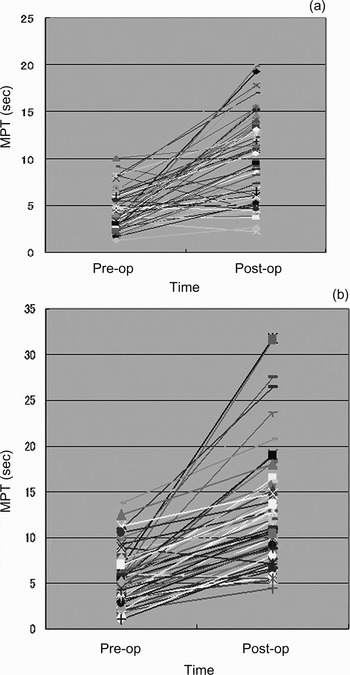
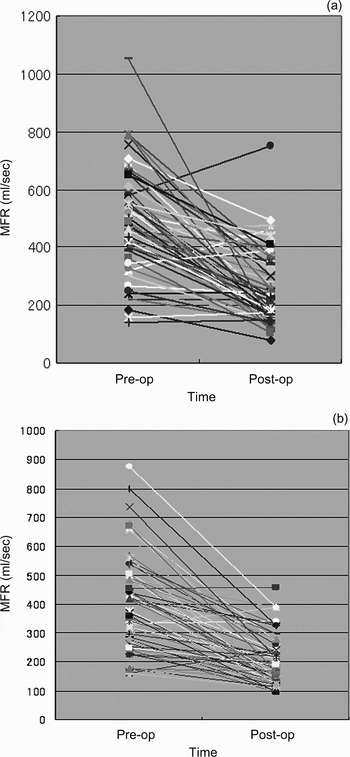
Figure 1 shows data for maximum phonation time before and after surgery. Results for pre- and post-operative mean airflow rate during phonation are shown in Figure 2. In the majority of the patients, these two parameters were outside the normal range before surgery. Following fat injection laryngoplasty and framework surgery, maximum phonation time increased significantly and mean airflow rate during phonation decreased significantly (p < 0.01). However, after fat injection laryngoplasty the improvement in maximum phonation time and mean airflow rate during phonation appeared more stable and less variable, compared with results after framework surgery.
Pre- and post-operative maximum phonation time for (a) framework surgery and (b) fat injection laryngoplasty. The maximum phonation time increased significantly after both procedures (p < 0.01). However, post-operative results for fat injection laryngoplasty appeared more stable, with less dispersion, compared with post-operative results for framework surgery.

Pre- and post-operative mean airflow rate during phonation, for (a) framework surgery and (b) fat injection laryngoplasty. The mean airflow rate decreased significantly after both procedures (p < 0.01). However, post-operative results for fat injection laryngoplasty seemed to be more stable, with less dispersion, compared with post-operative results for framework surgery.

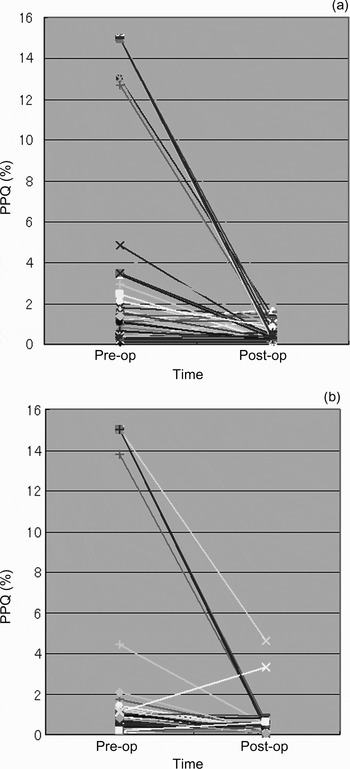
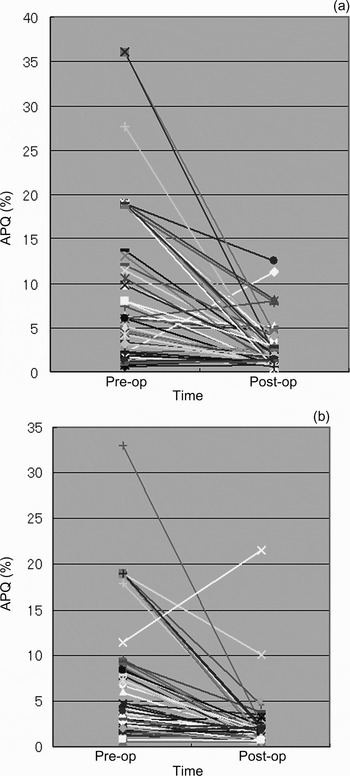
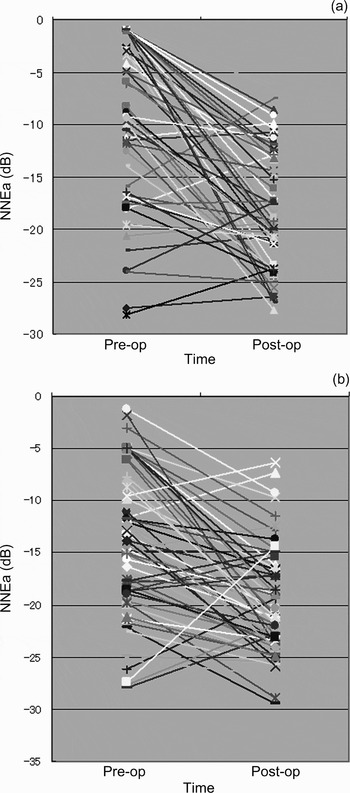
Results for pitch perturbation quotient before and after surgery are shown in Figure 3. The amplitude perturbation quotient results before and after surgery are shown in Figure 4. Results for normalised noise energy (0–4 kHz) before and after surgery are shown in Figure 5. In the majority of patients, all these parameters were outside the normal range before surgery. Following both fat injection laryngoplasty and framework surgery, all these parameters improved significantly. However, after fat injection laryngoplasty the improvement in all these parameters appeared more stable and less variable, compared with results after framework surgery.
Pre-and post-operative pitch perturbation quotient for (a) framework surgery and (b) fat injection laryngoplasty. The pitch perturbation quotient decreased significantly after both procedures (p < 0.01). However, post-operative results for fat injection laryngoplasty seemed to be more stable, with less dispersion, compared with post-operative results for framework surgery.

Pre- and post-operative amplitude perturbation quotient for (a) framework surgery and (b) fat injection laryngoplasty. The amplitude perturbation quotient decreased significantly after both procedures (p < 0.01). However, post-operative results for fat injection laryngoplasty seemed to be more stable, with less dispersion, compared with post-operative results for framework surgery.

Pre- and post-operative normalised noise energy for 0–4 kHz, for (a) framework surgery and (b) fat injection laryngoplasty. The normalised noise energy decreased significantly after both procedures (p < 0.01). However, post-operative results for fat injection laryngoplasty seemed to be more stable, with less dispersion, compared with post-operative results for framework surgery.

Results for comparison of the vocal function of patients undergoing each procedure (i.e. fat injection laryngoplasty versus framework surgery), both before and after surgery, using the t-test, are shown in Table II. Before surgery, all vocal function parameters for fat injection laryngoplasty patients were significantly better, compared with those of framework surgery patients. After surgery, all vocal function parameters for fat injection laryngoplasty patients improved significantly more, compared with framework surgery patients.
Patients' vocal function for each procedure: pre- vs post-operative

Data represent means (standard deviations). *By paired t-test. Pre-op = pre-operative; post-op = post-operative; FS = framework surgery; FIL = fat injection laryngoplasty; MPT = maximum phonation time; MFR = mean airflow rate during phonation; PPQ = pitch perturbation quotient; APQ = amplitude perturbation quotient; NNEa = normalised noise energy for 0–4 kHz
Discussion
Framework surgery
Framework surgery following thyroplasty with or without arytenoid adduction is a common surgical procedure for patients with unilateral vocal fold paralysis. However, framework surgery techniques have inherent complications, including prosthesis migration, inflammation, infection, haematoma formation and failure to achieve satisfactory vocal quality. In addition, airway compromise sometimes develops, necessitating removal of the implant, intubation or tracheotomy, and prolonged hospitalisation.Reference Glats, Kalkanis, Neumeister, Suchy, Lyons and Moulavi2 In our patients, no prosthesis migration occurred because the thyroid cartilage membrane was preserved at the vocal fold level under the silicone block or Gore-Tex.
In addition, no infection or haematoma formation was observed. Nevertheless, one of our cases did require a tracheotomy following arytenoid adduction, because of bilateral vocal fold paralysis. The reason for healthy side vocal fold paralysis was suggested to be the over-hanging of the non-paralysed side of thyroid ala in order to get a good view to see the muscular process of the arytenoid cartilage. The healthy side of the recurrent laryngeal nerve seemed to oppress by the non-paralyzed side of the thyroid ala according to over-hanging of the paralyzed side of thyroid ala using a hook. Thyroplasty is a surgical procedure which is generally safe and easy to perform, and which can be carried out under local anaesthesia. However, arytenoid adduction does carry a slight risk of post-operative dyspnoea.
Fat injection laryngoplasty
Fat injection laryngoplasty is a popular surgical technique for patients with unilateral vocal fold paralysis. It has been shown to be safe and easy to perform. Laccourreye et al. reported a series of 80 patients undergoing intracordal injection of autologous fat.Reference Laccourreye, Papon, Kania, Crevier-Buchman, Brasnu and Hans5 They demonstrated fat extrusion at the injection site in one patient, and dyspnoea in another patient which was managed by temporary tracheotomy. In our 64 cases, fat extrusion occurred at the injection site in one patient because the injection had too superficial. No patients developed dyspnoea requiring post-operative tracheostomy, probably because our usual practice was to squeeze the vocal fold outside from inside (i.e. from inside of the vocal fold toward the paraglottic space) using a small cotton ball immediately after the injection. This procedure may extrude any free fat from the tiny injection hole in the vocal fold. In addition, excessive swelling of the vocal fold was prevented and therefore the risk of dyspnoea was decreased.
Vocal function
Fat is theoretically the ideal implant material for injection laryngoplasty, because of its biocompatibility and the fact that its viscosity is similar to that of the contents of Reinke's space.Reference Chan and Titze6 Our study found that improvement in vocal function (for all parameters) seemed more stable and less variable after fat injection laryngoplasty than after framework surgery.
In many cases undergoing arytenoid adduction or arytenoid adduction with thyroplasty, the level difference (i.e. vertical displacement) of the paralysed vocal fold was noted pre-operatively.
All parameters of vocal function were significantly better in pre-operative fat injection laryngoplasty patients, compared with pre-operative framework surgery patients. In addition, post-operative improvement in all vocal function parameters was significantly greater in fat injection laryngoplasty patients, compared with framework surgery patients. Favourable functional results were obtained not only because of the injected fat's biocompatibility and viscosity but also because of the quantity used and the injection position. As we have previously reported, the morphological characteristics of liposuctioned fat are such that the cytoplasm and basal lamina of the fat cells form a thin pellicle around the fat droplets, which are thus invested with a meshwork of fine reticular fibres.Reference Sato, Umeno and Nakashima7 This characteristic is one of the reasons why autologous fat has viscous properties similar to those of the human lamina propria.Reference Sato, Umeno and Nakashima7
We have previously proposed fat injection into the middle part of the membranous portion of the vocal fold and into the oblong pit of the arytenoid cartilage, so as to medialise the arytenoid cartilage.Reference Umeno, Chitose, Sato and Nakashima3 If a patient has any glottal gap between the vocal processes on phonation before fat injection, then fat injection into the oblong pit of the arytenoid cartilage can effectively medialise the paralysed vocal fold.
However, the long term effectiveness of fat injection laryngoplasty has been debated, because the quantity of fat resorption is unpredictable. Graft survival depends on many factors. Methods of fat harvesting and injection differ between institutions, and damage to cell membranes can be an influencing factor. Graft survival is reduced when a purification process is used.Reference Mikus, Koufman and Kilpatrick8 The cell size and density of liposuctioned autologous fat tend to differ between individuals. We have previously reported that atrophy of each fat cell has a greater influence on the graft volume when the fat cells are large and sparse, rather than small and dense.Reference Sato, Umeno and Nakashima7 In addition, the proliferative ability of injected autologous fat may also be related in some degree to the graft volume.Reference Sato, Umeno and Nakashima7 After fat injection laryngoplasty, the injected fat will of course be absorbed to a greater or lesser degree, depending on various factors. Therefore, as large a quantity of fat as possible should be injected into the vocal fold, without causing airway compromise. There are numerous reports of studies yielding 40 to 60 per cent fat graft survival,Reference Sato, Umeno and Nakashima7–Reference Zaretsky, Shindo, deTar and Rice16 thus supporting our recommended practice of over-injection.
Framework surgery is a good method for patients who require local anaesthesia. However, the technique of thyroplasty is difficult, and it is also considered to be inaccurate to fix the flange in the optimum position with the optimum volume in the thyroid cartilage. During arytenoid adduction, it is also difficult to fix 3-0 nylon in the optimum position on the thyroid cartilage, to achieve the optimum strength.
Therefore, fat injection laryngoplasty is an appropriate procedure for improvement of vocal function, in patients with unilateral vocal fold paralysis in whom there is no pre-operative glottal level difference of the paralysed vocal fold.
Conclusions
Autologous fat injection was found to be a more effective and stable therapy for improving the vocal function of patients with vocal fold paralysis, compared with framework surgery.
Acknowledgements
This study was supported in part by a Grant-in-Aid for Scientific Research (#19591997) from the Ministry of Education, Culture, Sports Science and Technology, Japan.