Introduction
High rodent diversity has been recorded in South-East Asia (Marshall, Reference Marshall, Lekagul and McNeely1988; Corbet & Hill, Reference Corbet and Hill1992; Aplin et al., Reference Aplin, Brown, Jacob, Krebs and Singleton2003), which is a hot spot of biodiversity and emerging infectious diseases (Coker et al., Reference Coker, Hunter, Rudge, Liverani and Hanvoravongchai2011; Morand et al., Reference Morand, Jittapalapong, Supputamongkol, Abdullah and Huan2014a). In this region, rodents are widely found in various habitat types: some are synanthropic species that live close to humans in villages or cities; some are generalist species that are sparsely found in peri-domestic habitats, such as land used by humans or disturbed habitat; whereas others are specialists that dwell in specific habitats, such as forests (Blasdell et al., Reference Blasdell, Bordes, Chaisiri, Chaval, Claude, Cosson, Latinne, Michaux, Morand, Pagès and Tran2015; Morand et al., Reference Morand, Bordes, Blasdell, Pilosof, Cornu, Chaisiri, Chaval, Cosson, Claude, Feyfant, Herbreteau, Dupuy and Tran2015a).
Rodents also cause substantial transmission of pathogens of veterinary and medical importance (Meerburg et al., Reference Meerburg, Singleton and Kijlstra2009; Chaisiri et al., Reference Chaisiri, Siribat, Ribas and Morand2015; Morand et al., Reference Morand, Jittapalapong and Kosoy2015b) because of their microparasites (virus, bacteria and protozoa) or macroparasites (i.e. helminths), and they are agricultural pests that spoil stored food (Singleton et al., Reference Singleton, Hinds, Krebs and Spratt2003, Reference Singleton, Belmain, Brown, Aplin and Htwe2010). Based on these aspects of their biology and potential importance as pathogen carriers, numerous studies have used rodents as models to study host–parasite interactions, community ecology and network analysis, particularly in rodent–helminth associations (Dallas & Presley, Reference Dallas and Presley2014; Froeschke & Matthee, Reference Froeschke and Matthee2014; Pilosof et al., Reference Pilosof, Fortuna, Cosson, Galan, Ribas, Chaisiri, Segal, Krasnov, Morand and Bascompte2014, Reference Pilosof, Morand, Krasnov and Nunn2015; Bordes et al., Reference Bordes, Morand, Pilosof, Claude, Krasnov, Cosson, Chaval, Ribas, Chaisiri, Blasdell, Herbreteau, Dupuy and Tran2015).
Network analysis has become an alternative approach for researchers to study applied ecology in host–parasite interactions (Poulin, Reference Poulin2010; Pilosof et al., Reference Pilosof, Morand, Krasnov and Nunn2015). Based on this approach, the interaction between hosts and parasites in a particular community can be viewed as either a bipartite network, in which hosts and parasites are treated as two distinct types of nodes (hosts on one side and parasites on the other side), or a unipartite network, in which only hosts or parasites are assigned as nodes that connect each other with interaction links (e.g. based on parasite sharing) (Poulin, Reference Poulin2010). This kind of analysis can be applied to study several aspects of epidemiology, such as exploring the structure of interactions through network architectural parameters (i.e. nestedness, connectance and modularity) or elucidating parasite transmission by identifying key host species as a connected hub for parasite sharing in the population (Dormann et al., Reference Dormann, Fruend, Bluethgen and Gruber2009; Godfrey, Reference Godfrey2013; Morand et al., Reference Morand, McIntyre and Baylis2014b). Nestedness has been considered one of the most common patterns of community organization, both in free-living and parasite communities (Van der Mescht et al., Reference Van der Mescht, Krasnov, Matthee and Matthee2016). Nestedness refers to the degree of interactions by specialists (species which share fewer parasite species with other hosts) that are subsets of interactions by generalists (which share several parasite species with other hosts) in a particular community (Wright & Reeves, Reference Wright and Reeves1992; Dormann et al., Reference Dormann, Fruend, Bluethgen and Gruber2009; McQuaid & Britton, Reference McQuaid and Britton2013). Here, nestedness was computed and used as a parameter to investigate the structure of the rodent–helminth assemblage. We also present both bipartite and unipartite network analyses to visualize interactions between gastrointestinal helminths and their rodent hosts at the country level in Cambodia.
Although many studies have revealed substantial diversity of the helminth fauna from rodents in South-East Asia (Sinniah, Reference Sinniah1979; Roberts, Reference Roberts1991; Claveria et al., Reference Claveria, Causapin, Guzman, Toledo and Salibay2005; Paramasvaran et al., Reference Paramasvaran, Krishnasamy, Lee, John, Lokman, Naseem, Rehana and Santhana2005; Chaisiri et al., Reference Chaisiri, Chaeychomsri, Siruntawineti, Bordes, Herbreteau and Morand2010; Mohd Zain et al., Reference Mohd Zain, Behnke and Lewis2012; Palmeirim et al., Reference Palmeirim, Bordes, Chaisiri, Siribat, Ribas and Morand2014; Prasetyo, Reference Prasetyo2016) and new helminth species have been discovered continuously over the past decade (Chaisiri et al., Reference Chaisiri, Morand and Ribas2011; Ribas et al., Reference Ribas, Veciana, Chaisiri and Morand2012; Veciana et al., Reference Veciana, Bain, Morand, Chaisiri, Douangboupha, Miquel and Ribas2015), this information is still very limited for Cambodia. To our knowledge, only one publication reported on the helminth fauna of a small mammal, the Asian house shrew, Suncus murinus (Veciana et al., Reference Veciana, Chaisiri, Morand and Ribas2012). In rodents, only two articles have been published in Cambodia: one was a re-description of a known nematode species, Physaloptera ngoci, which parasitizes rodents in South-East Asia (Veciana et al., Reference Veciana, Chaisiri, Morand, Miquel and Ribas2013), and the other published the effects of host species and habitat on parasite species richness in rodents from South-East Asia (Palmeirim et al., Reference Palmeirim, Bordes, Chaisiri, Siribat, Ribas and Morand2014). However, those publications did not reveal a comprehensive list of the helminth fauna in Cambodian rodents.
Accordingly, the objectives of this study were: (1) to describe for the first time the infection and diversity of gastrointestinal helminths in wild Cambodian rodents; (2) to determine the effects of ecological and biological variables that potentially explain helminth infection; and (3) to explore the community structure of rodent–helminth associations and identify the main host species that could play a primary role in helminth transmission in the community, using network analysis.
Materials and methods
Rodent sampling
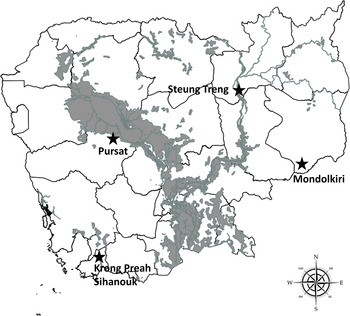
In ‘Community ecology of rodents and their pathogens in South-East Asia’ (CERoPath, www.ceropath.org) field surveys from 2008 to 2014, rodents were collected by live-trapping from four localities in Cambodia: Krong Preah Sihanouk (latitude (Lat.) 10.42N; longitude (Long.): 103.51E) in 2008, Mondolkiri (Lat. 12.14N; Long. 106.89E) in 2009, Pursat (Lat. 12.52N; Long. 103.97E) in 2012 and Steung Treng (Lat. 13.36N; Long. 105.95E) in 2014 (fig. 1). Within each location, 10–12 trapping days at a minimum of 100 traps/day (10 lines of 10 traps) were set within an area that covered approximately 10 km2. Each study site was sampled once from November–March (dry season) or June–July (wet season). At the level of the trapping line, Global Positioning System (GPS) coordinates were recorded in the WGS84 coordinate system by Garmin Montana 600 (Garmin International Inc., Olathe, Kansas, USA). In addition, animals were also collected with the help of local hunters, and their hunting experience increased the number of sampled rodents. Local hunters were well informed about the objectives of the present research study, and were asked to provide information on the location of animal capture, including habitat and type of land use, and GPS coordinates were subsequently recorded by the members of the field research team.
Distribution of the four sampling localities in Cambodia.

Four main types of habitat were recorded for rodents sampled from all locations, and were based on degree of human land use and urbanization, as follows: (1) forest, including primary, secondary, community forest or reforestation areas; (2) dry land, including cultivated areas in non-flooded foothills or plains (e.g. maize, dry rice, cassava, pineapple), and scrub, fallow, grasslands and orchards; (3) rain-fed land (floodplain), including rice fields, legume fields (soybean, mung bean and peanut) and irrigated areas; and (4) settlement or human-developed areas, such as cities, villages or isolated houses (Herbreteau et al., Reference Herbreteau, Jittapalapong, Rerkamnuaychoke, Chaval, Cosson and Morand2011).
Intestinal tract examination and helminth isolation
Rodents were euthanized at the local field stations on the day of trapping. Morphological characteristics and morphometry were assigned for species identification in distinct specimens following Marshall (Reference Marshall, Lekagul and McNeely1988) and Aplin et al. (Reference Aplin, Brown, Jacob, Krebs and Singleton2003), whereas molecular markers (both nuclear and mitochondrial) were used for problematic samples, as published by Pagès et al. (Reference Pagès, Chaval, Herbreteau, Waengsothorn, Cosson, Hugot, Morand and Michaux2010). Determination of rodent sex (male/female) and sexual maturity (juvenile/adult) followed the criteria described in Herbreteau et al. (Reference Herbreteau, Jittapalapong, Rerkamnuaychoke, Chaval, Cosson and Morand2011). Intestinal tracts were divided into three main parts: stomach, small intestine and large intestine, and each helminth part was examined under a stereomicroscope, and placed in a separate container. The parasites obtained were separated by group for each individual animal, based on morphological appearance, and were preserved in 70% ethanol for further taxonomic identification. Cestodes and trematodes were subjected to ethanol gradient dehydration, staining with acetic carmine dye and mounting on glass slides, whereas nematodes were cleared and mounted in lactophenol solution. Taxonomic assignment was conducted following helminth identification keys (Yamaguti, Reference Yamaguti and Yamaguti1958; Skrjabin et al., Reference Skrjabin, Shikhobalova and Orlov1970; Schmidt, Reference Schmidt1986; Anderson et al., Reference Anderson, Chabaud and Willmott2009) and some specific helminth species description publications (Ribas et al., Reference Ribas, Veciana, Chaisiri and Morand2012; Veciana et al., Reference Veciana, Chaisiri, Morand, Miquel and Ribas2013).
Statistical analysis
To estimate intestinal helminth diversity, we focused on parasite species richness, which is the number of helminth taxa found in a rodent host species within a study area (Bordes & Morand, Reference Bordes and Morand2008). Diversity estimators were computed using the ‘BiodiversityR’ package (Kindt & Coe, Reference Kindt and Coe2005) implemented in the R freeware version 3.0.1 (R Core Team, 2015) to compare helminth diversity among different categorical variables (i.e. habitat, locality, season and rodent species). Two indices, first-order Jackknife and Chao, were used as species richness estimators to help control biases that may occur from sampling effort or undersampling of rare species. These estimators produce precise and less biased species richness estimation, and appeared more suitable for analysing parasite data compared with other estimators (Walther & Morand, Reference Walther and Morand1998). A parasite species accumulation curve was also generated to evaluate rodent sample size adequacy. A non-parametric Kruskal–Wallis test (KW) with post-hoc multiple pairwise comparisons (Holm–Bonferroni method) and Mann–Whitney–Wilcox test (W) were used to evaluate the effects of habitat, location, season and host attribute (sex and maturity) on helminth species richness. ANOSIM, non-parametric analysis of similarity with 1000 permutations, was also computed using the ‘vegan’ package (Oksanen et al., Reference Oksanen, Blanchet, Kindt, Legendre, Minchin, O'Hara, Simpson, Solymos, Stevens and Wagner2013) in R freeware version 3.0.1, to check whether helminth species compositions were similar among studied locations.
To study host–parasite interactions, we conducted bipartite network analysis of the helminth assemblage in rodent hosts using the ‘vegan’ (Oksanen et al., Reference Oksanen, Blanchet, Kindt, Legendre, Minchin, O'Hara, Simpson, Solymos, Stevens and Wagner2013) and ‘bipartite’ packages (Dormann et al., Reference Dormann, Fruend, Bluethgen and Gruber2009) implemented in R freeware version 3.0.1. Only host species with sample sizes of ≥5 individuals were included in the analysis. Host–parasite interaction matrices based on presence/absence (bipartite network and nestedness matrices) that combined the four localities were visualized using ‘visweb’ and ‘plotweb’ functions. Nestedness temperature and nestedness metric based on overlap and decreasing fill (NODF) were computed using ‘nestedtemp’ and ‘nestednodf’ functions, respectively. Nestedness temperature (T) varies from 0 to 100°, where T = 0° is the maximum nestedness and gradually reduces to non-nestedness at T = 100° (Atmar & Patterson, Reference Atmar and Patterson1993). NODF also ranges from 0 to 100, but, in contrast to T, a value of 100 indicates perfect nestedness and 0 represents total non-nestedness (Almeida-Neto et al., Reference Almeida-Neto, Guimaraes, Guimaraes, Loyola and Ulrich2008).
The bipartite network was transformed to a unipartite network using the ‘tnet’ package (Opsahl, Reference Opsahl2009). The unipartite network showed relative interaction patterns among rodent hosts regarding the co-occurrence of helminth taxa shared within the host community. Eigenvector centrality, a mathematical vector of linear transformation that characterizes relative scores of nodes in a network based on the connections of vertices (corners or points where the two lines meet at particular nodes) in a network graph, was calculated using the ‘evcent’ function in the ‘igraph’ package (Csardi & Nepusz, Reference Csardi and Nepusz2006). This centrality measurement was used to estimate the role of each host (rodent) as a connector to other hosts with regard to helminth sharing. A higher centrality value of a node (rodent) is associated with greater connection to the other nodes (other hosts), which indicates high helminth transmission in the network (Morand et al., Reference Morand, McIntyre and Baylis2014b; Pilosof et al., Reference Pilosof, Morand, Krasnov and Nunn2015).
Generalized linear models (GLMs) using binomial logit distributions for helminth infection (positive/negative) were computed in the ‘lme4’ package (Bates et al., Reference Bates, Mächler, Bolker and Walker2015) in R to identify the variables that explain helminth infection in Cambodian rodents. Model selection was performed using the likelihood-based method, Akaike's information criterion with sample size adjustment (AICc) using the ‘gmulti’ package (Calcagno & De Mazancourt, Reference Calcagno and De Mazancourt2010). The quality of various models was quantified by several parameters, including AICc, delta AICc (∆AICc), Akaike's weight (Wr) and model-averaged importance of term (MaIT). ∆AICc is the difference between the AICc value of a given model and the model with the minimum AICc score. The minimum AICc score potentially indicates the best model. Wr is the probability that a particular model is the best for the given data (Burnham & Anderson, Reference Burnham and Anderson2002). MaIT is the proportion that a variable of interest appears, on average, after the number of best models is computed by the AICc process (i.e. averaged over 150 best models in our study). This is illustrated through histograms to identify the significance of particular variables. Variables with importance scores of >80% (default by ‘gmulti’ package) were included in the final model.
Trichostrongylidae found in the present study potentially represented several species in different hosts. Accordingly, to avoid biases in the dataset, we decided to exclude these worm taxa from statistical analyses, including diversity estimation, linear regression model and host–parasite network analysis.
Results
Prevalence of gastrointestinal helminths
In total, 569 rodents (14 species) were captured from the four locations in Cambodia and examined for intestinal helminth infection. Total prevalence of infection was 58.5% (333 parasitized rodents), with no substantial differences among three locations, Krong Preah Sihanouk (61.0%), Mondolkiri (62.6%) and Pursat (64.7%), but much lower prevalence in Steung Treng (16.0%). For rodent species with sample sizes ≥10, Rattus argentiventer showed the highest prevalence (90.0%) followed by Niviventer fulvescens (86.6%), Rattus tanezumi (81.1%), Rattus norvegicus (74.3%) and Bandicota savilei (65.8%).
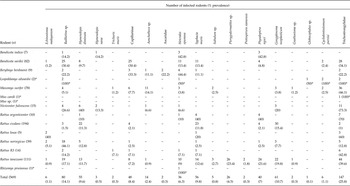
Nineteen helminth taxa were identified, including one trematode, three cestodes and 15 nematodes. Although the majority of taxa were identified to the species level, some could only be identified to family or genus level because of either the lack of clear morphological characteristics or their potential as new species to science. Trichostrongylid nematodes were the most dominant at 25.8% prevalence, followed by Raillietina sp., Gongylonema neoplasticum, Syphacia muris and Hymenolepis diminuta, with prevalences of 14.1, 10.7, 9.8 and 9.6%, respectively (table 1).
Prevalence of gastrointestinal helminth infection in Cambodian rodents.

* Rodent species had a small sample size (<5).
Gastrointestinal helminth infection and diversity
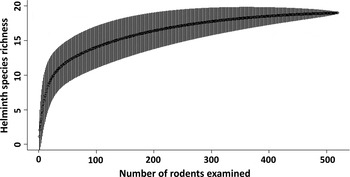
The helminth species accumulation curve increased sharply in the initial phase and then reached a plateau when more than 300 rodents were examined, which indicates that an adequate sample size was reached (fig. 2).
Species accumulation curve of intestinal helminths recovered from all 569 rodent hosts.

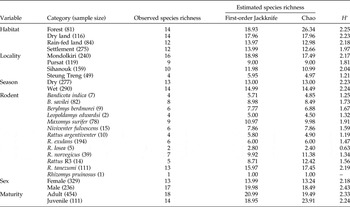
Observed helminth species richness and estimators of species richness are provided in table 2. Regarding habitat, rodents trapped from forest habitat had higher helminth diversity (first-order Jackknife = 18.93, Chao = 26.34 and H′ = 2.25) than rodents from other habitats. In terms of locality, the highest helminth diversity was found in rodents from Mondolkiri (16 observed species); rodents trapped from Sihanouk and Pursat harboured nearly equal helminth species richness (10 and 9 species, respectively); and rodents from Steung Treng were parasitized by the lowest number of helminth species (only 4 species). Regarding species composition, we found significant dissimilarity of helminth species composition among the four studied locations (ANOSIM: R = 0.6355, P = 0.001). Similar values in helminth species richness were noted in dry and wet seasons, with 13 and 14 observed species, respectively. Among rodent species, R. tanezumi harboured the greatest helminth species richness (13 species), followed by Maxomys surifer (9 species), B. savilei (8 species) and R. norvegicus (7 species). Helminth species richness was higher in male (17 species) than female rodents (13 species), and higher in adults (18 species) than juveniles (14 species).
Observed and estimated helminth species richness (first-order Jackknife and Chao), and diversity indices (Shannon index: H′) of Cambodian rodents based on different habitats, localities, seasons and host attributes (species, sex and maturity). Trichostrongylidae data were excluded from analysis.

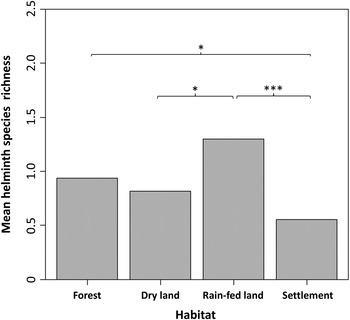
At the individual host level, there was a significant difference in helminth species richness among the categorized habitats (KW chi-square = 29.75, df = 3, P < 0.0001), with post-hoc multiple pairwise comparisons provided in fig. 3. Helminth species richness differed significantly among the four study localities (KW chi-square = 37.59, df = 3, P < 0.0001). No significant differences were observed between dry and wet seasons (W = 35290, P = 0.053), rodent sex (W = 35469, P = 0.33) and rodent maturity (W = 26550, P = 0.064).
Analysis of differences in mean of helminth species richness found at the individual host level among the four categorized habitats with multiple pairwise comparisons (Holm–Bonferroni method) following the Kruskal–Wallis test (*P < 0.05, **P < 0.01, ***P < 0.001).

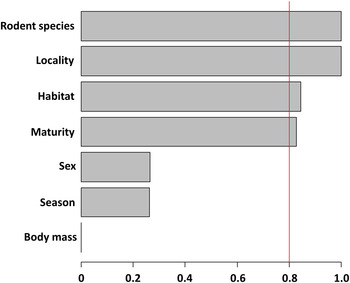
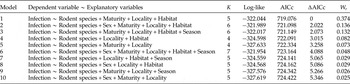
GLM analysis investigated effects of potential explanatory variables on individual helminth infection status in rodents (positive/negative). After fitting 150 models by AICc, the top ten models with relevant parameters were selected, and are shown in tables 3 and 4. The best model (Infection ~ Rodent species + Maturity + Locality + Habitat) was selected for further analysis of lowest AICc value (719.076), highest Akaike weight (0.374), the four explanatory variables that passed the 80% threshold of MaIT (fig. 4) and variables that showed low values of variance inflation factor, which indicated no severe multicollinearity effect among the variables.
Model-averaged importance terms of independent variables used to explain intestinal helminth infection in Cambodian rodents. The values on the x-axis indicate the proportion of particular variables that appeared in the model selection process after the 150 best models were computed by AICc. Variables with an importance score of >80% (red line) were included in the final model.

Generalized linear models (GLMs) testing the effects of various independent variables on helminth infection (GLM with binomial logit distribution) in Cambodian rodents. Model selection was done using Akaike's Information Criterion corrected for sample size (AICc). Only the top ten models are shown. The initial model for AICc selection was Infection ~ Rodent species + Sex + Maturity + Body mass + Locality + Habitat + Season. Abbreviations: K = the number of estimated variables, Log-like = maximized value of the logarithm of the likelihood function, ∆AICc = the difference between AICc value of a given model and the model with minimum AICc and W r = Akaike weights.

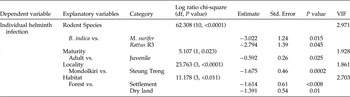
Generalized linear model showing variables that explain individual helminth infection (with binomial logit distribution) in Cambodian rodents. The best-fit models were selected with AICc, and an analysis of deviance table (type II tests) for the explanatory independent variables is provided. Only significant values are included. VIF = variance inflation factor.

Regarding helminth infection status of individual rodents, Bandicota indica had a lower infection rate than M. surifer and Rattus phylogenetic clade R3 (a sister species of R. tanezumi). Juveniles were significantly infected less than mature rodents. An effect of habitat was also observed: helminth infection was significantly higher in rodents from forest than in those from settlements or dry-land habitats. In terms of geographical location, rodents from Mondolkiri were infected at a much higher rate than rodents from Steung Treng Province. Statistical analysis details of how these explanatory variables influenced helminth infection are provided in table 4.
Host–parasite network analysis
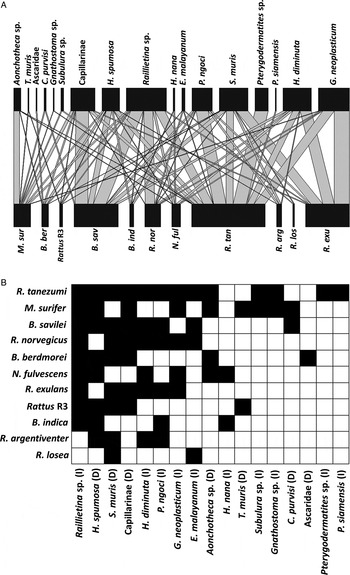
We performed bipartite network analysis on the rodent–helminth assemblage (fig. 5A). Nestedness temperature and NODF values were 23.4 and 58.9, respectively (excluding members of Trichostrongylidae; see nestedness structure in fig. 5B). Rattus tanezumi and M. surifer were placed at the top rows of the bipartite matrix because they harboured large helminth species communities. Alternatively, the trichostrongylid, Raillietina sp., and Heterakis spumosa helminths were placed on the left-most side of the matrix, and were widely found in several host species; the three helminth species on the right-hand side only infected one host species each: Ascaridae in Berylmys berdmorei, and Pterygodermatites sp. and Protospirura siamensis in R. tanezumi.
Bipartite network analysis illustrates rodent–helminth association in Cambodia. (A) Bipartite graph with strength of interaction lines that indicate number of observations. (B) Network matrix of rodent–helminth associations based on presence/absence data. Only host species with sample sizes ≥5 were included. Life-cycle type of each helminth taxon is indicated in parentheses; D = direct, I = indirect.

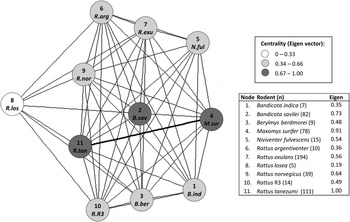
Unipartite network and eigenvector centrality values of rodent hosts with regard to helminth sharing are depicted in fig. 6. Similar to the bipartite network, R. tanezumi and M. surifer appeared to be the most central nodes (hosts) in the host–parasite network, with high centrality values (1.00 and 0.91, respectively).
Unipartite network graph and calculation of eigenvector centrality values, which illustrate the pattern of intestinal helminth sharing among Cambodian rodent hosts. Strength of interaction lines indicates level of helminth species sharing between two nodes. Only host species with sample sizes ≥5 were included.

Discussion
Within the four localities in Cambodia, 14 rodent species were trapped from several habitat types. Most of the rodents are considered habitat specialists, because they tend to prefer certain habitats, including R. norvegicus and Rattus exulans in human settlements (synanthropic species); Berylmys berdmorei, B. indica, B. savilei, Mus caroli, R. argentiventer and Rattus losea in agricultural lowland or sloped dry land, including fallow and tree plantations (peri-domestic habitat); and Leopoldamys edwardsi and M. surifer in forest. However, a couple of rodent species had less habitat preference (generalist tendencies), including N. fulvescens, which was found moving between dry land and forest, and R. tanezumi and Rattus phylogenetic clade R3 (the mitochondrial lineage of R. tanezumi), which were found in many habitat types, ranging from forest to human households (Blasdell et al., Reference Blasdell, Bordes, Chaisiri, Chaval, Claude, Cosson, Latinne, Michaux, Morand, Pagès and Tran2015; Palmeirim et al., Reference Palmeirim, Bordes, Chaisiri, Siribat, Ribas and Morand2014).
Investigation of the helminth fauna of wild rodents has been widely reported in several countries in South-East Asia: Indonesia, Lao People's Democratic Republic (PDR), Malaysia, Philippines, Thailand and Vietnam (Tubangui, Reference Tubangui1931; Singh & Chee-Hock, Reference Singh and Chee-Hock1971; Wiroreno, Reference Wiroreno1978; Krishnasamy et al., Reference Krishnasamy, Singh, Ambu and Ramachandran1980; Pham et al., Reference Pham, Tran and Hasegawa2001; Paramasvaran et al., Reference Paramasvaran, Krishnasamy, Lee, John, Lokman, Naseem, Rehana and Santhana2005; Chaisiri et al., Reference Chaisiri, Chaeychomsri, Siruntawineti, Ribas, Herbreteau and Morand2012; Mohd Zain et al., Reference Mohd Zain, Behnke and Lewis2012; Pakdeenarong et al., Reference Pakdeenarong, Siribat, Chaisiri, Douangboupha, Ribas, Chaval, Herbreteau and Morand2014; Prasetyo, Reference Prasetyo2016). However, there is very limited information available to date from Cambodia. Therefore, our present study provides important information on the intestinal helminth fauna of rodents in this country.
The present investigation showed a high level of helminth parasitism (overall, 58.5%) in rodents. Compared with previous studies conducted in neighbouring countries (Thailand and Lao PDR), the overall prevalence in Cambodia was about the same as that observed in Thailand (Chaisiri et al., Reference Chaisiri, Chaeychomsri, Siruntawineti, Ribas, Herbreteau and Morand2012) and slightly lower than that reported in a study in Lao PDR (Pakdeenarong et al., Reference Pakdeenarong, Siribat, Chaisiri, Douangboupha, Ribas, Chaval, Herbreteau and Morand2014), with prevalences of 57.7% and 65.8%, respectively.
Overall, a high number of helminth species (19 taxa) were found in Cambodian rodents. The majority of helminths recovered were nematodes (15 taxa) followed by cestodes (3 taxa), and only one trematode was found. Trichostrongylid nematodes were the most common parasites and had a broad host range, as they occurred in nearly all examined rodent species (with the exception of B. indica and Rhizomys pruinosus). The cestode Raillietina sp. and the caecal nematode H. spumosa were the other predominant parasites in ten rodent species.
Most of the identified members of Trichostrongylidae appeared to be potentially new genera and species. Based on morphological sorting, morphotypes were identified and appeared to differ among rodent species. According to this morphological assignment, we suggest the existence of one trichostrongylid morphotype per host genus. However, it is possible that some morphotypes may be composed of cryptic species. Further morphological and molecular investigations need to be performed to clarify this ambiguity.
We compared analysis results with and without Trichostrongylidae taxa in the dataset. The results were similar regardless of Trichostrongylidae inclusion (data not shown). However, inclusion of trichostrongylids removed the effect of ‘maturity’ in the GLM to explain helminth infection. Because Trichostrongylidae were found simultaneously in almost all rodent species (except B. indica), and in adults and juveniles, inclusion of Trichostrongylidae probably minimized the effect of maturity away during model selection.
In terms of zoonotic helminthiases, five species have been recorded as helminths of potential medical importance: Echinostoma malayanum, Raillietina sp., H. diminuta, H. nana and Cyclodontostomum purvisi (Chaisiri et al., Reference Chaisiri, Siribat, Ribas and Morand2015). However, because H. nana is a cryptic species, there is still controversy regarding whether human infection is caused by human-to-human transmission or rodent-to-human transmission, as previously thought (Macnish et al., Reference Macnish, Morgan-Ryan, Monis, Behnke and Thompson2002). Rodents can act as a reservoir of these zoonotic parasites in the environment, and humans can be infected by ingestion of food, vegetables or soil contaminated with infective-stage larvae.
Regarding helminth infection in individual rodents, host attributes (host species and maturity) and environmental factors (habitat and geographical location) played important roles as explanatory variables that influence helminth infection. Differences in host species reflect differences in host traits in several ways, such as dietary range, foraging habit, metabolic rate and immunogenicity, which probably have different effects on parasite infection. The role of host maturity can be explained by the assumption that the adult hosts live longer and roam further when searching for food, which increases their chances of being exposed to infective stages of parasites in the environment compared with those of young animals (Behnke et al., Reference Behnke, Lewis, Zain and Gilbert1999; Rossin et al., Reference Rossin, Malizia, Timi and Poulin2010).
Habitat appeared to be an important factor that influenced intestinal helminth infection and its diversity in Cambodian rodents (table 4 and fig. 3). Rodents in human settlements harboured significantly lower helminth species richness than those in other habitats, especially rodents in rain-fed land and forest. This finding confirms previous results reported in Thailand and Lao PDR (Chaisiri et al., Reference Chaisiri, Chaeychomsri, Siruntawineti, Ribas, Herbreteau and Morand2012; Pakdeenarong et al., Reference Pakdeenarong, Siribat, Chaisiri, Douangboupha, Ribas, Chaval, Herbreteau and Morand2014), which revealed that urbanization negatively affects helminth species richness in rodents. This result is also consistent with that of McKinney (Reference McKinney2008), who revealed that both vertebrate and invertebrate species richness tended to decrease in urbanized areas. Urbanization and other habitat disturbances may affect host–parasite interactions by reducing the stability of the host–parasite network, which may affect initial parasite transmission (Bordes et al., Reference Bordes, Morand, Pilosof, Claude, Krasnov, Cosson, Chaval, Ribas, Chaisiri, Blasdell, Herbreteau, Dupuy and Tran2015).
In addition, helminth infection differed among the four different geographical locations in Cambodia; for example, rodents from Steung Treng had a substantially lower prevalence of infection (16%) than the other locations (61–64.7%). Additionally, helminth species composition significantly differed among the four studied locations (ANOSIM: R = 0.6355, P = 0.001). This could be caused by biogeographical conditions (e.g. forest density, habitat fragmentation, temperature, rainfall and humidity) that change with location. We also note that the temporal effect (year of data collection) could play an additional role in influencing infection status, because the animals from each location were collected in different years.
To investigate the rodent–helminth assemblage, we employed host–parasite network analysis that combined the four studied localities. First, a nested structure of host–parasite associations was observed. The structure could be explained by some assumptions regarding the different abilities of hosts/parasites to interact with each other. For parasites, intrinsic factors, such as life-cycle complexity, could influence their potential to infect a new host and survive (De Bellocq et al., Reference De Bellocq, Sarà, Casanova, Feliu and Morand2003). Parasites with simple or direct life cycles may be better able to occupy a new host than parasites with more complicated (indirect) life cycles, in which one or two intermediate hosts are required (see helminth life-cycle types detailed in fig. 5B). In addition, in terms of host foraging habits and environmental conditions, habitat shifts that occur in hosts can lead to nestedness of parasite assemblages in a community (Timi & Poulin, Reference Timi and Poulin2003). This concept is consistent with another idea that explains how nestedness structure occurred; that is, interactions in a network tend to be nested when a new species enters into a community (in this case, R. tanezumi moving among habitats) (Bastolla et al., Reference Bastolla, Fortuna, Pascual-García, Ferrera, Luque and Bascompte2009; Joppa et al., Reference Joppa, Montoya, Solé, Sanderson and Pimm2010).
Additionally, the unipartite network revealed that R. tanezumi was the most central host in the network, based on helminth species sharing. The rodent R. tanezumi is a generalist species (low habitat preference) which occurs in all habitat types (Palmeirim et al., Reference Palmeirim, Bordes, Chaisiri, Siribat, Ribas and Morand2014; Blasdell et al., Reference Blasdell, Bordes, Chaisiri, Chaval, Claude, Cosson, Latinne, Michaux, Morand, Pagès and Tran2015; Morand et al., Reference Morand, Bordes, Blasdell, Pilosof, Cornu, Chaisiri, Chaval, Cosson, Claude, Feyfant, Herbreteau, Dupuy and Tran2015a). This species seems to adapt to the changing environment of South-East Asia, and can potentially be hypothesized to be a ‘bridge species’ that links rodent–parasite communities from forest to agricultural land and human settlement habitats. Based on our results, we suggest that R. tanezumi might play in important role in host–parasite interactions and parasite transmission of both intestinal helminths, as shown in the present study, and other pathogens to other rodent hosts or even humans.
Acknowledgements
The authors are grateful to Cambodian local officers for their technical assistance and facilitation of both the laboratory and the field work.
Financial support
Field and laboratory work in this study were funded by the French Agence nationale de la recherche (ANR) Biodiversity Grant ANR 07 BDIV 012 CERoPath project ‘Community Ecology of Rodents and their Pathogens in a changing environment’ (www.ceropath.org) and by the French ANR Programme Changements Environnmentaux Planetaires et Societes (CP & ES) Grant ANR 11 CPEL 002 BiodivHealthSEA (Local impacts and perceptions of global changes: biodiversity, health and zoonoses in South-East Asia; www.biodivhealthsea.org).
Conflict of interest
None.