Introduction
Major depression and smoking are both highly prevalent, serious global health problems (Murray & Lopez, Reference Murray and Lopez1997, Reference Murray and Lopez1999; Corrao et al. Reference Corrao, Guindon, Cokkinides and Sharma2000; Üstün et al. Reference Üstün, Ayuso-Mateos, Chatterji, Mathers and Murray2004) that are highly associated (Lasser et al. Reference Lasser, Boyd, Woolhandler, Himmelstein, McCormick and Bor2000; Fergusson et al. Reference Fergusson, Goodwin and Horwood2003; Hasin et al. Reference Hasin, Goodwin, Stinson and Grant2005). The mechanism for this association is unclear. A common etiology for smoking and depression, such as shared genetic or environmental factors, has been proposed (Kendler et al. Reference Kendler, Neale, Maclean, Heath, Eaves and Kessler1993; Breslau et al. Reference Breslau, Peterson, Schultz, Chilcoat and Andreski1998; Dierker et al. Reference Dierker, Avenevoli, Stolar and Merikangas2002), as have causal explanations where smoking leads to depression (Breslau et al. Reference Breslau, Peterson, Schultz, Chilcoat and Andreski1998; Wu & Anthony, Reference Wu and Anthony1999) or depression leads some individuals to self-medicate by smoking (Breslau et al. Reference Breslau, Peterson, Schultz, Chilcoat and Andreski1998; Lerman et al. Reference Lerman, Caporaso, Main, Audrain, Boyd, Bowman and Shields1998; Audrain-McGovern et al. Reference Audrain-McGovern, Lerman, Wileyto, Rodriguez and Shields2004).
If smokers use cigarettes to protect against symptoms of depression, then quitting smoking could increase the risk for later episodes of depression. This increased risk for major depressive episodes (MDEs) following smoking cessation has been observed in case reports (Bock et al. Reference Bock, Goldstein and Marcus1996; Stage et al. Reference Stage, Glassman and Covey1996) and clinical studies (Covey et al. Reference Covey, Glassman and Stetner1997; Glassman et al. Reference Glassman, Covey, Stetner and Rivelli2001). This risk may be heightened for smokers with a history of depression, as increases in depressed mood immediately following smoking cessation are common among these smokers (Covey et al. Reference Covey, Glassman and Stetner1990; Piasecki et al. Reference Piasecki, Niaura, Shadel, Abrams, Goldstein, Fiore and Baker2000; Burgess et al. Reference Burgess, Brown, Kahler, Niaura, Abrams, Goldstein and Miller2002; see Kahler et al. Reference Kahler, Brown, Ramsey, Niaura, Abrams, Goldstein, Mueller and Miller2002 for a nuanced qualification). Indeed, one study of smokers with a history of depression found that an elevated risk for MDEs persisted even after 3 months following smoking cessation (Glassman et al. Reference Glassman, Covey, Stetner and Rivelli2001). Other studies, however, have not reported a similar risk following smoking cessation (Tsoh et al. Reference Tsoh, Humfleet, Muñoz, Reus, Hartz and Hall2000; Kahler et al. Reference Kahler, Brown, Ramsey, Niaura, Abrams, Goldstein, Mueller and Miller2002), while yet others have found that smoking itself predicts later depression (Brown et al. Reference Brown, Lewinsohn, Seeley and Wagner1996; Klungsøyr et al. Reference Klungsøyr, Nygård, Sørensen and Sandanger2006; Munafò et al. Reference Munafò, Hitsman, Rende, Metcalfe and Niaura2008). Given the ambiguities in the literature cited above, further work is required to examine if there is increased risk of depression following smoking cessation.
The present study tests whether there is an increased incidence of MDEs following smoking cessation in an international sample of smokers using a self-help online smoking cessation program. We tested three hypotheses: (1) smokers who successfully quit will have a greater incidence of MDEs than those who do not; (2) smokers with a previous history of MDEs will have a higher incidence of new episodes than smokers without such history; and (3) smoking will interact with history of depression such that smokers with a depression history who successfully abstain have the highest incidence of MDEs. Each hypothesis was examined for MDE incidence concurrent with abstinence at 1 month and for MDE incidence subsequent to 1-month abstinence.
Method
Data are from a study of an Internet-based self-help smoking cessation trial presented in detail in a report of the active cohort maintenance group described below (Muñoz et al. in press). Briefly, participants were randomized to one of four Internet intervention conditions that successively added features to the previous condition: (1) a basic online smoking cessation guide (condition 1); (2) condition 1 plus email reminders to return to the guide during the intervention (condition 2); (3) condition 2 plus online mood management (condition 3); (4) condition 3 plus online ‘bulletin board’ groups (condition 4). Participants had access to the site for the duration of the study. Participants were then followed for 1 year, with assessments at 1, 3, 6 and 12 months after their initial quit date. A subset of participants without current baseline MDE in this group and a larger automated follow-up group (described below) were examined for this report.
Participants
Participants were recruited to our site (www.stopsmoking.ucsf.edu or www.dejardefumar.ucsf.edu) via the World Wide Web. Eligible participants reported being aged 18 years or older, smoking five or more cigarettes per day, using email at least once weekly and an intention to quit in the next month. Eligible participants who signed an online consent form, filled out baseline questionnaires, reported cigarettes smoked on three separate days and set a quit date within 1 month were randomized to study conditions (Muñoz et al. Reference Muñoz, Barrera, Delucchi, Penilla, Torres and Pérez-Stablein press).
Randomized participants not meeting symptom criteria for a current MDE at baseline (n=7574) were selected for the present analyses. Spanish speakers (n=5043) resided in over 55 countries, with Spain (n=1758), Mexico (n=889) and Argentina (n=849) representing 69% of these participants. English speakers (n=2531) resided in over 90 countries with the USA (n=1168), South Africa (n=198), India (n=196) and the UK (n=138) representing 67% of these participants. In this sample, 62.4% of participants identified as Hispanic or Latino (5.5% of English speakers, 93.1% of Spanish speakers), 73.0% white or of European descent, 12.2% Mestizo (mixed Spanish–indigenous background), 4.6% of Asian descent, 1.3% of African descent, 0.3% Native American or indigenous peoples and 8.1% other designations. Over half of both English and Spanish speakers had completed some college.
Design
Participants were from one of two groups from the smoking cessation trial: (1) an active cohort maintenance (email and phone) follow-up group (n=799) or (2) a larger automated email-only follow-up group (n=6775). Both groups received automated email prompts at 1, 3, 6 and 12 months after their initial quit date to complete online follow-up questionnaires. Cohort maintenance participants who did not respond to automated emails received phone calls and personal emails from research staff for that follow-up assessment. The two groups differed only with respect to follow-up procedures experienced, but not with respect to the actual smoking cessation intervention.
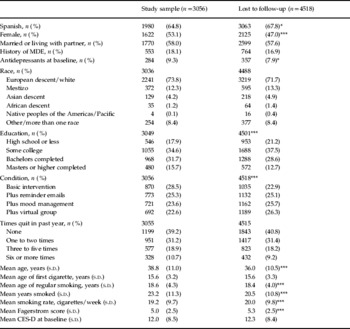
For this study, participants needed to have reported their smoking status at the 1-month follow-up and completed an MDE assessment on at least one of four follow-ups. This abstinence measure provided the earliest assessment of post-intervention abstinence status. Participants were considered positive for a new MDE if they met criteria at any follow-up assessment. A large number of participants (n=4518, see Table 1) did not provide these data and were considered lost to follow-up, as is common among Internet samples (Eysenbach, Reference Eysenbach2005). Of the participants providing abstinence data at 1 month (n=3170), 96.4% provided MDE data for at least one follow-up point.
Baseline characteristics of participants from an online smoking cessation trialFootnote a

MDE, Major depressive episode; s.d., standard deviation; CES-D, Center for Epidemiological Studies – Depression Scale.
Values are given as number of participants (percentage) or mean (s.d.).
a Baseline characteristics were compared by Pearson χ2 and t tests.
Lost to follow-up participants differed from the study sample
* p⩽0.05, *** p⩽0.001.
Measures
The MDE Screener (‘Mood Screener’, Muñoz, Reference Muñoz1998)
This 15-item scale was used to screen for current and lifetime history of MDE at baseline and MDE since either the quit date or the most recent assessment. This scale screens for the nine Diagnostic and Statistical Manual of Mental Disorders, 4th edition (DSM-IV) symptoms of a MDE and impairment due to those symptoms (APA, 2000). While this scale does not provide a formal diagnosis of major depressive disorder, it has been found to be valid and reliable, and agrees well with the Structured Clinical Interview for DSM-IV Axis I disorders, clinician version (SCID-CV) (κ=0.76, sensitivity=0.97, specificity=0.97, Vázquez et al. Reference Vázquez, Muñoz, Blanco and López2008) and the Primary Care Evaluation of Mental Disorders (PRIME-MD, Spitzer et al. Reference Spitzer, Williams, Kroenke, Linzer, deGruy, Hahn, Brody and Johnson1994) screener in English and Spanish speakers (κ=0.75, Muñoz et al. Reference Muñoz, McQuaid, González, Dimas and Rosales1999).
Center for Epidemiological Studies – Depression Scale (CES-D, Radloff, Reference Radloff1977)
This 20-item self-report scale yields a continuous depression score (0 to 60), with higher scores signifying greater depression. Elevated CES-D scores in individuals without current major depression have been shown to predict future episodes of depression (Lewinsohn et al. Reference Lewinsohn, Hoberman and Rosenbaum1988).
Smoking status
Abstinence at 1 month was assessed with 7-day and 30-day abstinence questions (Hughes et al. Reference Hughes, Keely, Niaura, Ossip-Klein, Richmond and Swan2003; Muñoz et al. 2009). Self-reported 7-day point prevalence is a standard measure in smoking cessation trials that corresponds well with bioverification measures (Velicer et al. Reference Velicer, Prochaska, Rossi and Snow1992; Hughes et al. Reference Hughes, Keely, Niaura, Ossip-Klein, Richmond and Swan2003). Participants endorsing abstinence on the 7-day measure were asked the 30-day question, while those reporting smoking were automatically coded as having smoked in the past 30 days.
Analysis
Bivariate analyses were used to examine MDE incidence as a function of abstinence and history of depression. Multiple logistic regression analyses were used to examine the prediction of MDE from smoking abstinence, history of depression and their interaction for tests of hypotheses 1, 2 and 3, respectively. Sex and baseline CES-D were included in the models for their known relationship to depression incidence (Lewinsohn et al. Reference Lewinsohn, Hoberman and Rosenbaum1988; Kessler et al. Reference Kessler, Zhao, Blazer and Swartz1997). Several candidate variables were considered for inclusion in the model, including treatment condition and the use of antidepressant medication at baseline for any possible influence on MDE incidence, as well as follow-up subsample for potential differences due to follow-up method. Other candidate variables included baseline variables significantly associated with loss to follow-up (see Table 1) or with 1-month abstinence that attained a p<0.10 in initial logistic regression analysis. These candidate variables were entered into the model simultaneously and then manually removed if they were not significant (p<0.05), for determining the final main effects model. The interaction of abstinence and depression history was evaluated for its impact on the final main effects model, as were interaction effects between each pair of variables in the main effects model. Interaction terms that potentially contributed (p<0.10) to the main effects model were further tested with other main and interaction effects in the model. Two parallel sets of analyses were conducted, one modeling MDE assessed concurrently with the 1-month assessment of abstinence and the second modeling MDE assessed subsequently, among those participants without MDE at the 1-month assessment. All analyses were conducted using both the 7-day and 30-day abstinence measure.
Results
Follow-up rates and abstinence
The follow-up rate was 40.3% (3056 of 7574). Table 1 summarizes participant characteristics and reveals several demographic, smoking and clinical differences between those lost to follow-up and those retained in the study sample. Importantly, however, participants lost to follow-up did not differ from retained participants with respect to either their history of depression or their baseline CES-D scores. The overall 7-day abstinence rate was 37.0%. Abstinent participants were more likely to be married or living with a partner (61.7% v. 55.8%, χ2=10.30, df=1, p=0.001), less likely to report a history of MDE (14.5% v. 20.2%, χ2=15.63, df=1, p<0.001), less likely to be taking antidepressant medication at baseline (7.5% v. 10.3%, χ2=6.64, df=1, p=0.010), had lower baseline CES-D scores [mean 11.3 (s.d.=8.3) v. 12.5 (s.d.=8.5), t=−3.574, df=3048, p<0.001] and were less likely to be in the basic intervention condition (condition 1) (22.9% v. 31.7%, χ2=29.82, df=3, p<0.001).
Incidence of MDEs
The rate of screening positive for new MDEs was 18.3% over the entire follow-up period, 10.1% by the 1-month follow-up and 10.6% after the 1-month follow-up. Initial inspection of incidence by 1-month abstinence status yielded an interesting observation. Individuals who reported abstinence had a lower incidence of MDE than those who were still smoking, for MDE screened both at 1 month [87 abstainers out of 1117 (7.8%) v. 215 smokers out of 1868 (11.5%), χ2=10.64, df=1, p=0.001] and 3, 6 or 12 months [78 abstainers of 792 (9.8%) v. 117 smokers of 1053 (11.1%) for smokers], although this latter difference was not significant (χ2=0.762, df=1, p=0.383). Individuals with a history of depression had a higher incidence of MDE than those without such history, for MDE screened both at 1 month [92 history out of 537 (17.1%) v. 210 no history out of 2446 (8.6%), χ2=35.35, df=1, p<0.001] and 3, 6 or 12 months [68 history out of 313 (21.7%) v. 127 no history out of 1530 (8.3%), χ2=35.35, df=1, p<0.001].
Prediction of MDEs
MDE and abstinence assessed concurrently at 1 month
The final logistic regression model (see Table 2) for MDE assessed concurrently with abstinence at 1 month was statistically significant (χ2=135.6, df=6, p<0.001). Spanish language, baseline CES-D, Fagerstrom Test for Nicotine Dependence scores (Heatherton et al. Reference Heatherton, Kozlowski, Frecker and Fagerstrom1991), history of depression and 7-day abstinence status were significantly related to MDE screened at 1 month. Contrary to our first hypothesis, continued smoking and not abstinence was related to MDE incidence [odds ratio (OR) 1.36, 95% confidence interval (CI) 1.04–1.78, p=0.02]. In support of our second hypothesis, a history of depression at baseline predicted MDE (OR 1.71, 95% CI 1.29–2.27, p<0.001). Higher baseline CES-D scores (OR 1.06, 95% CI 1.04–1.07, p<0.001) and Fagerstrom scores (Heatherton et al. Reference Heatherton, Kozlowski, Frecker and Fagerstrom1991) (OR 1.10, 95% CI 1.04–1.15, p<0.001) both predicted an increased incidence of 1-month MDE. The interaction of MDE history and abstinence did not significantly improve the model (χ2=0.54, df=1, p=0.46) and thus did not support our third hypothesis that the incidence of depression would be highest for abstaining smokers with a previous history of depression. No other potential interactions were found to be significant.
Final logistic regression for major depressive episodes assessed concurrently with abstinence at 1 month in an online sample of smokers attempting to quit

CI, Confidence interval; df, degrees of freedom; CES-D, Center for Epidemiological Studies – Depression Scale.
MDE assessed after 1-month abstinence
The previous analysis examined the association of abstinence and MDE assessed concurrently. At the 1-month follow-up point, 2683 participants had not screened positive for an MDE, 74.7% of whom provided subsequent MDE data used for a stricter analysis of the incidence of MDE after the assessment of abstinence. Baseline CES-D, age of regular smoking and history of depression, though not abstinence, were significant predictors in a main effects model of subsequent MDE (χ2=80.20, df=5, p<0.001). In the final logistic regression model (Table 3), sex emerged as a significant predictor, although in interaction with depression history (see below). Unlike the previous analysis, neither smoking nor abstinence predicted subsequent MDE (OR 1.05, 95% CI 0.77–1.45, p=0.74). As in the previous analysis, history of depression predicted subsequent MDE (OR 3.87, 95% CI 2.25–6.65, p<0.001), as did higher CES-D scores (OR 1.05, 95% CI 1.03–1.07, p<0.001). Age of regular smoking emerged as a significant predictor (OR 1.04, 95% CI 1.01–1.07, p=0.02) in this model. Examination of interaction effects again failed to find a significant interaction of abstinence and history (χ2=0.02, df=1, p=0.90), but detected a significant interaction (χ2=4.00, df=1, p=0.045) between sex and history of depression that qualified the emergent main effect of sex (Table 3). History of depression interacted with sex such that females had a greater incidence (78 out of 774, 10.1%) than males (49 out of 756, 6.5%) when both lacked a history of depression (OR 1.60, 95% CI 1.09–2.35, p=0.02) but not when both had a history [42 females out of 202 (20.8%) v. 26 males out of 85 (23.4%), OR 0.76, 95% CI 0.43–1.36, p=0.35]. For all analyses of concurrent and subsequent MDE, use of the 30-day abstinence measure yielded a similar pattern of results.
Final logistic regression for major depressive episodes assessed subsequent to abstinence at 1 month in an online sample of smokers attempting to quit

CI, Confidence interval; df, degrees of freedom; CES-D, Center for Epidemiological Studies – Depression Scale.
Discussion
Based on evidence from this international sample of smokers, quitting smoking through online self-help does not appear to increase the incidence of MDEs. In fact, contrary to our first hypothesis, smoking and not abstinence was related to the incidence of MDE screened via a self-report instrument, when both were assessed 1 month after an intended quit date. The incidence of MDE in the months following the assessment of abstinence, however, was not related to either smoking or abstinence. As expected from our second hypothesis, a history of depression was a significant predictor of MDE incidence in smokers, reflecting well-established findings with more structured diagnostic instruments used in naturalistic (Solomon et al. Reference Solomon, Keller, Leon, Mueller, Lavori, Shea, Coryell, Warshaw, Turvey, Maser and Endicott2000) and epidemiological studies (Kessler et al. Reference Kessler, Zhao, Blazer and Swartz1997) of clinical and general populations not restricted to smokers. Contrary to our third hypothesis, however, no interaction was found between a previous history of MDE and abstinence from smoking. Among smokers with a past history of depression, abstaining from smoking did not increase the risk for MDE relative to smokers without such history.
These findings reflect those from other studies. In smokers receiving traditional face-to-face smoking cessation interventions, Tsoh et al. (Reference Tsoh, Humfleet, Muñoz, Reus, Hartz and Hall2000) also failed to find an increased incidence of MDE following abstinence, but did observe a higher incidence of MDE among smokers with a history of depression. Among these smokers, both the Tsoh study and another study (Kahler et al. Reference Kahler, Brown, Ramsey, Niaura, Abrams, Goldstein, Mueller and Miller2002) also found that smoking abstinence did not increase this risk further. The similarity of these findings is encouraging, as these two studies, unlike the present study, employed clinic-based samples, face-to-face smoking cessation interventions and structured clinical assessment instruments to diagnose MDE over follow-up. In contrast, the Glassman study found that abstinence increased MDE risk among smokers with a history of depression (Glassman et al. Reference Glassman, Covey, Stetner and Rivelli2001).
The reasons for these conflicting results are unclear. It is unlikely that differences in the smoking cessation interventions or in MDE assessment methods account for these divergent results. Both the Glassman (Glassman et al. Reference Glassman, Covey, Stetner and Rivelli2001) and Tsoh (Tsoh et al. Reference Tsoh, Humfleet, Muñoz, Reus, Hartz and Hall2000) studies used a combination of behavioral and somatic interventions, while the Kahler (Kahler et al. Reference Kahler, Brown, Ramsey, Niaura, Abrams, Goldstein, Mueller and Miller2002) and present study used only behavioral interventions, albeit in very different formats. While the present study used only a self-report screening instrument to detect MDE, the other studies all used clinical interviews to diagnose MDEs. Nonetheless, despite the greater similarity in methods of the Glassman, Kahler and Tsoh studies, the results of the present study and not the Glassman study converge with the other two.
The most plausible explanation may be subtle differences in the sample selection procedures. Like the Kahler and Tsoh studies, the Glassman study examined a sample of clinic-based smokers, and despite eligibility criteria for heavier smokers in the Glassman study (20+ v. 10+ cigarettes per day), the Glassman, Kahler and Tsoh studies had comparable smoking rates at baseline (27.4, 27.3 and 23.3 cigarettes per day, respectively). The Glassman study, however, also required that participants had been smoking at a rate of 20 or more cigarettes per day for the preceding year but only followed smokers who ‘were actually attempting to stop smoking’ (Glassman et al. Reference Glassman, Covey, Stetner and Rivelli2001, see p. 130). Thus, their sample may have included more dependent smokers, who were more susceptible to the potential depressogenic effects of sudden abstinence and excluded those who had insufficient motivation to complete their quit attempt (Covey et al. Reference Covey, Glassman, Stetner, Rivelli and Stage2002). If the latter is true, then less motivated, excluded smokers would have clearly failed to quit and might also have developed MDE in the following year at high rates. This would have resulted in similarly high incidence in those who quit and those who did not quit.
The convergence of findings from the Kahler and Tsoh studies (Tsoh et al. Reference Tsoh, Humfleet, Muñoz, Reus, Hartz and Hall2000; Kahler et al. Reference Kahler, Brown, Ramsey, Niaura, Abrams, Goldstein, Mueller and Miller2002) and the present study lends support to the conclusion that smoking cessation does not increase MDE incidence for most smokers. These three studies differed in smoking cessation methods, in the populations studied, as well as the measures and methods used to evaluate the impact of abstinence on MDE. All three studies failed to find an increased incidence of MDE among smokers who abstained, even among those smokers with a past history of depression. Smoking cessation attempts, even among smokers with a past history of depression, should therefore be encouraged, as the long-term health consequences of smoking are substantial and the risk of depression following smoking cessation is not apparent. Given the findings of the Glassman study (Glassman et al. Reference Glassman, Covey, Stetner and Rivelli2001), however, further work may be required to determine if a unique subgroup of smokers exist that are particularly susceptible to MDEs following smoking cessation.
Reactions to cessation attempts have been shown to be quite variable and appear to be most evident during the actual process of quitting (Burgess et al. Reference Burgess, Brown, Kahler, Niaura, Abrams, Goldstein and Miller2002; Kahler et al. Reference Kahler, Brown, Ramsey, Niaura, Abrams, Goldstein, Mueller and Miller2002). Some smokers might have experienced an increase in depression during the quit attempt that was too small or short-lived to be detected 1 month after the smoker had quit. Our finding that abstainers had a lower incidence of MDE at 1 month relative to non-abstainers suggests that such transient increases in depression may not be limited to abstainers and is consistent with findings that some smokers may actually experience an improvement in affect following a successful quit attempt (Kahler et al. Reference Kahler, Brown, Ramsey, Niaura, Abrams, Goldstein, Mueller and Miller2002; Blalock et al. Reference Blalock, Robinson, Wetter, Schreindorf and Cincirpini2008). Unfortunately, the present study cannot evaluate the immediate response to smoking cessation, since data were not collected continuously during the quit attempt.
Other predictors of MDE during follow-up were observed in the current study, with some differences between MDE assessed concurrently with and subsequent to abstinence at 1 month. Not surprisingly, baseline symptoms of depression predicted MDE during follow-up during both periods. Smoking-related variables also predicted MDE, with baseline Fagerstrom scores and the age of regular smoking predicting MDE at 1 month and subsequent MDE respectively, although the reasons for these associations are unclear. Finally, sex emerged as a predictor of MDE in interaction with depression history among participants without MDE at 1-month follow-up, revealing that females had a greater incidence of first-time episodes of depression than males. This finding reflects well-established epidemiological observations regarding sex differences in depression incidence (Üstün et al. Reference Radloff2004).
Limitations
This study has several limitations that should be considered when interpreting these findings. First, all data were self-report collected via the Internet, which is still a relatively novel research method. Recent studies have found, however, that Internet-based administration of measures is comparable with traditional paper-based (Herrero & Meneses, Reference Herrero and Meneses2004) and telephone administration (Graham et al. Reference Graham, Papandonatos, Bock, Cobb, Baskin-Sommers, Niaura and Abrams2006). In addition, despite the fact that MDE was detected via a screening instrument and that abstinence was not bioverified, the similarity of the pattern of our findings to previous findings bolsters confidence in these results even with these limitations. Second, the frequency and temporal resolution of assessments did not permit an examination of the timing of cessation and episode onset or the immediate consequences on mood of a cessation attempt. Nonetheless, we are again reassured by the convergence of our results with those of previous studies with greater temporal resolution. Third, a large number of participants were lost to follow-up, which may have affected the results. However, retained participants and those lost to follow-up did not differ with respect to history of MDE or their baseline depression symptoms, the most potent predictors of incidence in this study. In addition, variables associated with loss to follow-up were evaluated and were not found to change the primary conclusions from the analyses.
Conclusions
No evidence was found that abstinence increases the risk of MDE in smokers with or without a previous history of depression in an international sample of smokers using a self-help Internet cessation program. The findings suggest that smoking does not appear to function as a self-medication to stave off MDEs for the majority of smokers. Given the high rate of MDE in this sample, it appears that smokers are at an elevated risk for MDE whether or not they manage to abstain from smoking, particularly if they have a history of depression. Clinicians should not hesitate to encourage smoking cessation efforts in their patients, but should still carefully monitor all smokers for the development of depressive episodes, especially those with a history of depression.
Acknowledgements
This work was performed at the University of California, San Francisco (UCSF) Department of Psychiatry at San Francisco General Hospital (SFGH).
This research was supported by training grant MH74500 from the National Institute of Mental Health, grant 13RT-0050 from the Tobacco-Related Disease Research Program (principal investigator R.F.M.), by grant no. TW05935 from the Tobacco Research Network Program, Fogarty International Center and by an infrastructure grant from the University of California Committee on Latino Research to the UCSF/SFGH Latino Mental Health Research Program. The authors thank the Center for Health and Community (Nancy Adler, Director) for providing office space and additional resources to target Latino smokers and Leslie Lenert, M.D. for having made major contributions to the creation of the initial website as part of our earlier Internet projects. Special thanks go to Google, Inc. for awarding us an AdWords grant, which provided us with the ability to recruit smokers worldwide using Google-sponsored links.
Finally, we thank the following research assistants, who helped prepare these data and made the follow-up phone calls 24 hours a day to reach smokers around the world: Yasmin Lozano, Erika Torres, Alejandra Calderon, Jasmine Alvarez, Elma Lorenzo, Yunuen Mora, María José Herrera, Jessica Z. Borja, Luis Flores, Sam Ruiz, Wendy Zepeda-Diaz, Karina Alcalá, Celia P. Casco, Ritika Dhami, Shelley K. Dhillon, Jennifer Liang and Alberto Jimenez.
Declaration of Interest
None.