

I. Introduction
An emerging consensus in the economic history literature has identified the period encompassing the French Revolutionary and Napoleonic Wars as one of the key turning points in the process of global market integration. Federico and Persson (Reference Federico, Persson, Hatton, O'Rourke and Taylor2007), Jacks (Reference Jacks2005, Reference Jacks2006), Rönnbäck (Reference Rönnbäck2009) and Studer (Reference Studer2009) all very clearly indict the so-called French Wars in disrupting the slow, but gradual process of intra- and intercontinental market integration that had unfolded over the seventeenth and eighteenth centuries. The effects of this commodity market disintegration are most clearly seen in the work of O'Rourke (Reference O'Rourke2006, Reference O'Rourke2007). The shared findings of his papers are that the relative price effects of the French Wars were larger than generally appreciated, global in scale, and brought large changes to consumer welfare in their wake. However, what is less clear from all of these studies is the effect of the French Wars on the operation of domestic commodity markets.
In particular, this article addresses the questions of how and why England suffered from such a decline in domestic market integration. Locating the sources of this decline is far from trivial. The attendant destruction of commercial and transport infrastructure which typically takes place in times of war was notably absent in the English case, due to the accidents of geography and history. In fact, apart from one half-hearted excursion by a mixed lot of French soldiers and convicts, which was apocryphally repulsed by unarmed Welsh women (Stuart Jones, Reference Stuart Jones1950), no battles actually took place on British soil. As a consequence, English commodity markets during the French Wars make for an analytically simpler – yet still complex – case study of the effects of foreign wars on domestic economies. Certainly, there exists a burgeoning literature on war and the macroeconomy (cf. Glick and Taylor Reference Glick and Taylor2010; O'Rourke Reference O'Rourke2006, Reference O'Rourke2007). However, this article takes a decidedly different approach by focusing on domestic – rather than international – developments in times of war.
At the same time, a sizeable literature has put forward favored explanations for market disintegration in this period. Thus, Tooke (Reference Tooke1838), Heckscher (Reference Heckscher1922), Crouzet (Reference Crouzet1958) and many others have all weighed in on this matter. Yet the specific mechanisms involved remain vague. A likely contender in this regard is the effect of the French Wars on the English coastal trade: the losses to the mercantile fleet due to French harassment were significant and certainly affected the functioning of this crucial link in domestic commerce. Another contender is the uneven spread of commercial banking from its centre in London: differing degrees of financial intermediation might imply differences in the provision of commercial credit in times of expansionary government policy or shocks emanating from the international economy. One of this article's contributions is in sorting out these far from mutually exclusive explanations in a coherent empirical framework. The means for assessing the effects of the French Wars are the prices of four basic agricultural commodities – wheat, barley, oats and beans – at weekly intervals for the 40 counties of England collected by Brunt and Cannon (Reference Brunt and Cannon2004, Reference Brunt and Cannon2005). Standard measures of the size of price dispersion across counties are used first to document the disintegration of the English market occasioned by the wars and then to probe the likely channels through which the wars affected commodity prices. The article offers four such categories: weather, trade, policy and wartime events. The main conclusions of the article are that all of the above most likely contributed to commodity price dispersion but that the primary means identified by which warfare influenced domestic commodity market integration was through international trade and wartime events.
The findings of the article also impinge on key issues relating to welfare and economic growth. First, market integration most immediately impacts upon the efficacy of markets. Here, the efficacy of markets – as opposed to their efficiency – relates to the level of real resources which must be dedicated to the distribution of goods from primary producers to final consumers. Considering the considerable number of transactions required to wrangle goods up and down the supply chain, any improvement in the efficacy of markets can have profound influences on economic welfare (Ejrnæs and Persson Reference Ejrnæs and Persson2010). In this respect, the French Wars have long been implicated in the decline – or at best, stagnation – of standards of living during the early Industrial Revolution period (cf. Ashton Reference Ashton1949; Lindert and Williamson Reference Lindert and Williamson1983; Nicholas and Steckel Reference Nicholas and Steckel1991). This article provides further evidence on the disruptive nature of the wars and suggests that the process of market disintegration differentially affected English regions, giving weight to the view that the French Wars were the primary culprit in depressing real wages during this period.
Furthermore, the results of this study inform the inquiry into the sources of economic growth in general and the Industrial Revolution in particular. The role of domestic commodity markets in shaping the course of economic history has long been recognized. In one of the first contributions to the literature, Hicks (Reference Hicks1969) proposed a market-led growth model, explicitly suggesting a role for domestic integration in helping to drive the growth process. Granger and Elliott (Reference Granger and Elliott1967) likewise viewed the decline of regional markets and the corresponding rise of a truly English market as one of the preconditions of the Industrial Revolution. In more recent work, Kelly (Reference Kelly1997) sought to give teeth to the theory of Smithian growth by demonstrating that in a model of geographic specialization with threshold effects in transportation, sustained domestic market integration could actually give rise to an abrupt acceleration in the growth rate of an economy. And while his article focuses on Sung dynasty China as a case study, he does note that the same processes could have been at work in eighteenth-century Britain with the rise of integrated canal and turnpike networks. Thus, to the extent to which the French Wars disrupted English markets, one might expect that changes in domestic integration vitally affected the pace of industrialization and growth.
The article proceeds as follows. After reviewing developments in the transport and diplomatic arenas in Sections 2 and 3, the article considers the views of previous researchers on the disintegration of English commodity markets in Section 4. Section 5 discusses the data in greater detail, while Section 6 documents the wars’ contribution to the process of market disintegration and then seeks to relate changes in the behavior of prices to the underlying processes of weather, trade, policy and wartime events. Finally, Section 7 concludes and offers some possible implications of the heightened price dispersion brought on by the French Wars for English economic history, specifically in the context of the role of commodity markets in conditioning English growth prospects for the nineteenth century.
2. Internal developments: the primacy of transport
For a number of years, Adam Smith's prognosis in 1776 that ‘the prices of bread and butchers’ meat are generally the same, or very roughly the same throughout the greater part of the United Kingdom’ (Reference Smith1976, p. 177) was taken at face value.Footnote 1 Lacking much of the data and certainly the necessary statistical techniques, the economic historian's view of English market integration in the eighteenth century was for a long time dominated by the early work of Gras (Reference Gras1915) and Rogers (Reference Rogers1887, Reference Rogers1902). The former was quick to point to institutional features in explaining the evolution of the English market. For Gras, the integration of grain markets relied on the interplay between municipal corn regulations and the various Corn Laws with the eighteenth century marking a somewhat dramatic turning point as the grip of local proscriptions – both legal and moral – was lessened. Although not very explicit on the matter, Rogers took a slightly different tack. Instead, he emphasized the role of well-developed transport linkages in driving the process of integration. At the very least, a cumulative picture can be drawn from these two, namely that the gradual integration of various regional markets into an approximate national market had certainly taken place by the mid eighteenth century.
In one of the earliest, truly quantitative works on the subject, Granger and Elliot (Reference Granger and Elliott1967) find that the emergence of a national market in wheat could be dated from the late seventeenth/ early eighteenth centuries. Admittedly, their data were sparse, but recent and more data-intensive work on the late eighteenth century (Shiue and Keller Reference Shiue and Keller2007) as well as the early nineteenth century (Jacks Reference Jacks2005, Reference Jacks2006) suggests that the domestic commodity market in England was among the most efficient in the world at this time. Central to this English precociousness was the development of internal transport linkages. This proceeded along many lines in eighteenth-century England, giving rise to the idea of a transport revolution. Generally, the literature identifies three separate fronts along which this revolution proceeded – canals and rivers, the coastal trade and turnpikes. In what follows, a brief summary of developments in each sector will be provided with the hope of identifying patterns which will be salient to the question of the domestic effects of the French Wars.
Of the three, it is canals which have probably captured the popular imagination most fully. Accordingly, a rich literature has developed in British economic history concerning the role of canal and river navigation from the earliest of times (cf. Hadfield Reference Hadfield1950–85; Willan Reference Willan1936). And as a consequence, the general outlines of canal and river development during the eighteenth century are readily discerned. Drawing from its rich natural endowment of rivers, England was able to make impressive gains in navigable waterways from the mid seventeenth century when a spate of Acts was passed by Parliament. Duckham (Reference Duckham, Aldcroft and Freeman1983) offers a succinct summary for our period: from 1660 to 1750, 40 rivers were subject to Improvement Acts, while Parliament passed 29 Acts for inland navigation in the 1760s, 23 such Acts in the 1770s, culminating with the Canal Mania of 1790–4 and its 80 associated inland navigation Acts. Partly due to the maturation of canal networks, the general atmosphere of austerity, and the fact that so many investors had their fingers burned in the speculative boom surrounding the Canal Mania, the French Wars saw very few developments in canal or river navigation.
The coastal trade of England and Wales was for long the linchpin in the system of domestic commerce. In 1700, London alone accounted for 69 percent of all inland trade, with the majority of this figure being provided by coastal shipping, especially in coal and grains (Dyos and Aldcroft Reference Dyos and Aldcroft1969). Taking a look at the available figures on shipping capacity, Aldcroft and Freeman (Reference Aldcroft, Freeman, Aldcroft and Freeman1983) report that the tonnage of ships engaged in the coastal trade increased from 154,640 in 1760 to 332,962 by 1790. In contrast to the experience with inland navigation, the French Wars period seems to be associated with a tremendous increase in coastal tonnage, in that it reached 833,416 by 1824. This view is also corroborated by the figures for the average-per-annum coastwise shipment of grain, which rose from 166,716 tons in the period 1780/86 to 446,318 tons in 1819/27. At the same time, the authors note that ‘the activity of enemy vessels and privateers seriously harassed the shipping of the East and South coast ports’ (p. 147; cf. Tooke Reference Tooke1838, p. 115) during the French Wars. Thus, it remains an open question whether additions to the size of the coastal fleet were able to counteract the wartime disruptions.
Finally, turning to the rise of turnpikes, we can refer to Arthur Young who noted in 1768 that ‘all the sensible people attributed the dearness of their county to the turnpike roads; and reason speaks the truth of their opinions. . .make but a turnpike road though their county and all the cheapness vanishes at once’ (Reference Young1768, p. 260). Certainly then, the perception of turnpikes as enhancing market integration – albeit at the cost of diminishing local purchasing power – was widely held. Much of this probably stemmed from the rapidity with which the turnpike trust emerged as a dominant means of overland carriage. A strong surge in the early 1700s which established – or more precisely, affirmed – London as the hub of domestic traffic was followed by a boom period dating from 1750 which, over the next 20 years, witnessed the formation of over 500 trusts operating more than 15,000 miles (Albert Reference Albert, Aldcroft and Freeman1983). The year 1770 marked a fairly dramatic break in trend as only 4,000 additional miles of road were added in the next 50 years, most of these consisting of feeders to the existing major arteries. This pattern of establishment, boom and maturation in the physical turnpike network also seems to be matched in its internal dynamics. In a recent series of articles, Bogart traces the impact of turnpike trust formation on parish-level transportation investment (Reference Bogart2005a) and the consequent reduction in freight charges as well as passenger travel times (Reference Bogart2005b). On all accounts, it appears that the big gains in investment, freights and travel times were made prior to 1770 with slow, but steady improvements through the French Wars.
To sum up, the early integration of English commodity markets was almost certainly dependent upon developments in the transport sector. And the changes witnessed in canals and rivers, the coastal trade and turnpikes necessarily altered the landscape of English commerce. However, for our purposes, it is important to bear in mind that the two overland transport sectors were transformed well before the outbreak of the French Wars. Additionally, the effects of the French Wars almost certainly swamped any further developments in the transport sector. A hint of this might be seen in the figures provided by Mathias (Reference Mathias1983), who reports that the total investment in canals between 1750 and 1815 was some £20 m while the total debt issue attributable to the French Wars was some £500 m and total direct military costs were in excess of £1,000 m. The marginal effects might have been very different, but surely the magnitudes involved are telling. This state of affairs will allow for some latitude in the estimation to follow, in that no explicit controls for developments in canals, rivers and turnpikes – beyond county fixed effects – will be thought necessary. And in the case of the coastal trade, the areas affected are conveniently defined by the geography of England. Before proceeding to the empirics, however, a consideration of the main diplomatic developments of the period is in order.
3. External developments: the primacy of war
The state of Anglo-French relations throughout the eighteenth century was contentious at best. In the century before 1793, the two parties openly engaged in warfare for 45 years. What is more, the theatre of conflict was remarkably wide, extending from the traditional epicentre provided by the Rhineland and Low Countries to more exotic and far-flung locales such as Cochin, Montevideo and Pittsburgh. But for all this, the period was marked by a noticeable – if somewhat slight – uptake in the level of international trade, both in absolute terms and relative to GDP (O'Rourke and Williamson Reference O'Rourke and Williamson2002, Reference O'Rourke and Williamson2004).
These developments, in part, explain why the French Wars can be considered the nadir of Anglo-French commercial relations. The French declaration of war against the English in February 1793 witnessed not only the introduction of a revolutionary anti-British rhetoric, but also a precipitous decline in Anglo-French trade volumes. Mokyr and Savin (Reference Mokyr and Savin1976) estimate the annual average of Anglo-French bilateral trade in 1793/99 to be one-tenth of the value in 1788/92. Although precise figures are harder to come by for the later wartime period of 1800/15, it seems pretty certain that further declines in commercial activity between the two belligerents occurred (Cuenca Esteban Reference Cuenca Esteban2001). This decline in trade volumes was, of course, generated by enormous increases in trade costs. Tooke (Reference Tooke1838) long ago made this point explicit. Comparing costs between the Baltic and London in 1809/12 and 1837, he found that freight and insurance for one quarter of wheat was 600 d. in the former period and 54 d. in the latter. Likewise, Danson (Reference Danson1894) reports that marine insurance premiums in 1816 were less than one-third their level in 1810. One of the most obvious sources for these large premiums was the loss of mercantile shipping as even the British with their readily apparent naval superiority lost 11,000 ships – or equivalently, 2–3 percent of its shipping stock annually – to privateering over the course of the French Wars (Mokyr and Savin Reference Mokyr and Savin1976).
Coupled with the heightened risks of seizure and sinking, there was also a tremendous increase in protective and prohibitive trade measures. This pattern was firmly established at the very outbreak of the war as the Jacobin-dominated French National Convention repudiated the unpopular Vergennes – or Eden – Treaty of 1786 and raised formidable tariff barriers. This was followed by a proclamation in October of 1793 which allowed for the seizure of all British goods in the realm (Haight Reference Haight1941). The French declaration of war and imposition of trade barriers was answered on the other side of the Channel with the first in an almost continuous series of naval blockades of the French coast.
These acts of commercial aggression were, of course, not limited to the two main belligerents. On the one hand, French and, especially, British treatment of self-declared neutral bottoms and crews precipitated major diplomatic crises such as the formation of the League of Armed Neutrality in 1800, which saw the Baltic powers – Denmark, Prussia, Russia and Sweden – effectively close the Sound at a time of extreme dearth in the UK, and major commercial crises such as the US Non-Importation Act of 1806/12, the US Embargo Act of 1807/9 and the US Non-Intercourse Act of 1809/10. The former crisis was only resolved with the destruction of the Danish fleet and consequent shelling of Copenhagen in 1801 (Ruppenthal Reference Ruppenthal1943). And while the latter probably did more harm to the United States than to either of the belligerents (cf. Frankel Reference Frankel1982; Heaton Reference Heaton1941; and O'Rourke Reference O'Rourke2006), it was a decisive factor in the American decision to wage the ill-timed – by British standards – War of 1812.
On the other hand, the most prominent development of the French Wars was the steady annexation of continental Europe into a greater French polity. In this way, direct political control was established in the Low Countries by 1795; in central Italy, Hanover and the left bank of the Rhine by 1801; in the Piedmont/Liguria by 1804; and in Dalmatia by 1805. Indirect control through the establishment of puppet or vassal governments was in effect by 1804 in the Kingdom of Italy; by 1806 in the Confederation of the Rhine and the Kingdom of Naples; and by 1808 in the Grand Duchy of Warsaw and Spain. Thus, after the successive defeats of Austria in 1805, Prussia in 1806 and Russia in 1807, Napoleon was in the position to fully extend the range of his Berlin Decree of 1806, which banned the import of British goods and prohibited the landing of British (including colonial) bottoms in French ports. This, of course, marked the beginning of the Continental System.
Economic historians have long debated Napoleon's exact intentions in declaring his reverse blockade of the United Kingdom. Rose's claim that his ‘economic ideas were those of the crudest section of the old Mercantilist School’ (Reference Rose1902, p. 74) seems to capture much of the spirit of early thought on the subject, implying that the goal was simply to bleed Britain of its bullion. Likewise, Cunningham (Reference Cunningham1910) documents the precipitous decline in the reserves of the Bank of England from the beginning of the Continental System to the time of Waterloo. In one of the most authoritative studies on the topic, Heckscher (Reference Heckscher1922) suggested that the Continental System was intended to not only strangle British exports and generate a balance-of-payments crisis, but also provide a valuable source of revenue as the war ground on. More recently, Neal has argued that the Continental System was designed to ‘disrupt the traditional British techniques for financing wars on the European continent’ (Reference Neal1990, p. 201).
Of course, these interpretations are not mutually exclusive. Indeed, all are consistent with one of the most controversial incidents during the French Wars, the exportation in 1810 of continental grains following a seriously deficient harvest in Britain. The amounts imported from the continent were far from trivial, with 225,710 quarters of grain coming from France and 1,080,731 quarters coming from allies or vassal states of France (Marshall Reference Marshall1833). Various commentators (Galpin Reference Galpin1925; Olson Reference Olson1963; and Young Reference Young1812) have calculated these imports to represent about 15 percent of total British consumption give or take a few percentage points. Furthermore, one cannot claim ignorance or indifference on Napoleon's part as he himself noted in 1808 that ‘the corn question is for sovereigns the most important and delicate of all’ (quoted in Olson Reference Olson1963, p. 61). Most likely, the decision to grant the licenses simply recognized the immense arbitrage profits available for the taking by the revenue-starved French government: an export license for wheat cost 830 francs per ton (Heckscher Reference Heckscher1922) at a time when wheat sold on average for some 250 francs per ton in the Pas-de-Calais (Labrousse et al. Reference Labrousse, Romano and Dreyfus1970). At the same time, the decision may have also been motivated by a desire to raise French prices and, thus, quell agrarian unrest, particularly in the volatile western regions (Melvin Reference Melvin1970).
What all of the preceding hopefully illustrates is that we cannot be as sanguine as William Pitt, who declared in 1800 that ‘it is clear from a deduction of facts that war of itself has no evident and necessary connection with the dearness of provisions’ (quoted in Rose Reference Rose1902, p. 66). In the following, a brief synopsis of the thoughts of economic historians on the topic will be given in an effort to direct the empirical analysis of wartime commodity prices.
4. Previous explanations for the behavior of commodity prices
Fortunately, there are a few leads provided by the economic history of Georgian England. In one of the earliest contributions to the literature, Tooke (Reference Tooke1838) suggested that of the myriad of publications professing to have explained the behavior of English commodity prices during the French Wars none had availed themselves to consider the effects of weather on agriculture during the period. His volumes seem to be a catalog of catastrophes, underlining his main point that ‘a greater proportion of unfavorable seasons [took place] in the interval between 1792 and 1819, than in an equal interval anterior or subsequent to that period’ (p. 85). However, Tooke himself was careful to stress the additional – and potentially interactive – effects of the war on currency and trade flows. Some researchers, although acknowledging wartime disruptions, have continued to maintain the primacy of the climate in explaining the heightened dispersion of prices during the period (cf. Chambers and Mingay Reference Chambers and Mingay1966; Lamb Reference Lamb1977; Libby, Reference Libby1977; Mathias Reference Mathias1983; O'Brien Reference O'Brien1989). At the same time, the connection between weather and prices has been questioned on two fronts. First, and more generally, some researchers have cast doubt on the possibility of isolating the effects of weather on prices, citing the large number of variables involved in price formation (Brunner Reference Brunner2002; Pfister Reference Pfister1975; de Vries Reference Vries, Rotberg and Rabb1981). Second, and more pointedly, at least one economic historian has claimed that Tooke overestimated the effects of weather, suggesting that ‘it is even possible that he may have assumed bad harvests in certain years from the fact that corn prices were high’ (Schumpeter Reference Schumpeter1938, p. 26).
In light of the discussion in Section 3, a second obvious explanation for the behavior of commodity prices is the various trade restrictions imposed by the English, French and other parties. And nowhere were these restrictions more acutely felt than in the trade in foodstuffs. Moving from the position of a net-exporter to a net-importer of grains sometime in the 1760s, both English and foreign commentators considered ‘food. . .as the weakest link in Britain's chain of defense’ (Olson Reference Olson1963, p. 6). Heckscher was even more explicit in noting that ‘the question of the dependence of Great Britain on imports from the European mainland has generally been regarded as identical with the question of its provision with food. . .[and]. . .the importance of Great Britain's imports of foodstuffs. . .can practically be regarded as identical with her imports of wheat’ (Reference Heckscher1922, p. 336). This over-reliance on foreign sources of grain was made manifest in the years 1795, 1800 and 1812 when adverse trade conditions combined with inclement weather to produce widespread bread riots, threats to the person of the King pressing for peace, and the highest grain prices ever recorded in England (Fay Reference Fay1921; Stern Reference Stern1964; Thompson Reference Thompson1971; author's calculations). Certain authors (Danson Reference Danson1894; Galpin Reference Galpin1925; Sears Reference Sears1919) have emphasized the degree to which shortages of foreign supply and a certain fetish of self-sufficiency gave rise to feverish speculation and, hence, commodity price volatility.Footnote 2 On the other hand, even as astute an observer as Arthur Young felt ‘that imports could have only a psychological effect, being too small to lower the home price of wheat’ (Stern Reference Stern1964, p. 180). A final element to be considered with respect to trade issues is the Continental System itself. More specifically, if it truly was successful in inducing balance-of-payments difficulties for England, it would undoubtedly have had a profound influence on the course of the exchange rate and, in turn, domestic prices of imported goods such as grains.Footnote 3
Another of the predominant themes in the economic history of the French Wars is the effects of government military expenditures and borrowing. The levels of expenditures and borrowing were certainly unprecedented, with net annual additions to the war debt averaging between 5.75 and 6.75 percent of national income (Williamson Reference Williamson1985). The result of this borrowing was that the face value of accumulated debt in 1820 stood in excess of £850 m (Clapham Reference Clapham1920) with a corresponding market value of £700 m, or roughly two-times GNP (Clark Reference Clark2001). While most of the literature has focused on the possible effects of crowding-out and its implications for British industrialization (cf. Heim and Mirowski Reference Heim and Mirowski1987; Temin and Voth Reference Temin and Voth2005; Williamson Reference Williamson1984; and Wright, Reference Wright1999), there are a few avenues which have remained unexplored.
First, research into commodity markets has long emphasized the interaction of arbitrage across space and across time, with the interest rate helping to determine the level of storage and, thus, the range of commodity prices between periods of production (Samuelson Reference Samuelson1957). The basic idea is that storage behavior is governed by the costs of withholding goods from the market until a future date. Apart from the physical deterioration of goods over time and the actual costs of storing commodities, the other key variable will be the prevailing rate of interest which represents the opportunity cost of not selling in the present, assuming that the proceeds of such a sale can and will be invested in alternative assets. A number of economic historians have successfully exploited the behavior of commodity prices to estimate prevailing interest rates (cf. Brunt and Cannon Reference Brunt and Cannon2004; McCloskey and Nash Reference McCloskey and Nash1984; van Zanden Reference Zanden2004). Potentially, this procedure can be reversed, namely by using data on interest rates to help explain the behavior of commodity prices. The implication is that if the French Wars led to higher interest rates and the Samuelson model approximately holds, then the range of intra-annual commodity prices and, thus, commodity price dispersion must have increased.
Second, the suspension of convertibility in 1797 has often been seen as an attempt to monetize the debt with disastrous consequences for the dispersion of prices (Acworth Reference Acworth1925; Crouzet Reference Crouzet1958; Silberling Reference Silberling1919).Footnote 4 Monetized government expenditures are likely to register on prices on two levels – a general inflationary effect and commodity-specific effects tied to civil or military requisitions of foodstuffs and other raw materials, both of which are likely to vary geographically depending on the composition of output and the degree of financial intermediation at the local level. Both Schumpeter (Reference Schumpeter1938) and Silberling (Reference Silberling1923, Reference Silberling1924a, Reference Silberling1924b) explicitly note the positive correlation between the level of expenditure and general – as well as commodity-specific – price movements, respectively emphasizing the roles of the proportion of borrowing-to-expenditure and advances by the Bank of England. This also suggests another means by which warfare cum monetary expansion provides a link between changes in nominal exchange rates and domestic commodity prices of internationally traded goods.
Finally, more than a few researchers have suggested a role for wartime events in determining the movement of specie prices or equivalently in this era, the nominal exchange rate (cf. Crouzet Reference Crouzet1990; Mokyr and Savin Reference Mokyr and Savin1976; Neal Reference Neal1990; Silberling Reference Silberling1919). While some historical studies have been conducted on the effects of wartime news on exchange rates, particularly during the US Civil War (Guinnane et al. Reference Guinnane, Rosen and Willard1996; McCandless Reference McCandless1996; Weidenmier Reference Weidenmier2002), no equivalent work has appeared on the effects of ‘news from the front’ on commodity prices. The intuition, in this case, is that the arrival – or accumulation – of news which reflects unfavorably on the prospects of victory may initiate new rounds of speculation in commodity markets and potentially raise the dispersion of prices. Thus, the potential explanations for the behavior of commodity prices that will be considered below fall into four broad categories: weather, trade, policy and wartime events. In the following section, a brief motivation for and discussion of the dependent and independent variables used will be provided.
5. Data
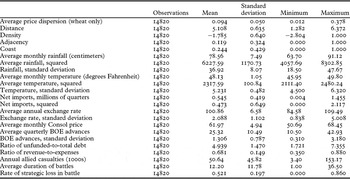
In order to explain the behavior of commodity prices, the first task is to define appropriate measures which capture changes in the dispersion of prices. The commodity price data employed are those underlying the recent work of Brunt and Cannon (Reference Brunt and Cannon2004) and described in detail in Brunt and Cannon (Reference Brunt and Cannon2005). The Corn Laws of 1672 stipulated that every market town in England and Wales submit weekly returns on the total revenues and quantities sold of corn and related commodities. Using the London Gazette as their primary source, Brunt and Cannon have reconstructed the weekly Corn Returns and, hence, prices for barley, beans, oats and wheat for the 52 counties of England and Wales plus London in the period from 1771 to 1820. In what follows, only the data for the 40 English counties will be used as continuous series are not available for the Welsh counties and London – the goal being to maintain as strict comparability over time as possible.
Taking a cue from the international macro literature (Engel and Rogers Reference Engel and Rogers1996), the basic building block for the analysis will simply be the logged relative price in two counties, ln (Pit/Pjt). Whereas Engel and Rogers difference this ratio between time t and t−2 and calculate its standard deviation, we will take a more intuitive approach. Recently, Broda and Weinstein (Reference Broda and Weinstein2008) have pointed out that this standard deviation term captures ‘Approximate Relative PPP’ in that it only measures changes in the percentage deviation of prices in two locations. This property is generated by the fact that Engel and Rogers used city-specific CPIs which are only available in index form and not comparable in levels. Broda and Weinstein further suggest that in the case where exact price levels are available a more intuitive measure of price dispersion is simply ln |(Pit/Pjt)|, the absolute value of log of the price of good i in location j relative to location k, itself averaged over an appropriate period of time. In what follows, we utilize this average price dispersion measure as our dependent variable.
With the relative price data in hand, the average of the price ratio for two counties was calculated for the four commodities, for every calendar year between 1771 and 1815 (t = 45), and for all available unique pair-wise combinations of counties (n = 40*39/2 = 780). Apart from its intuitive appeal as a measure of commodity price dispersion, this measure should also serve as a good proxy for the level of trade costs separating locations. Thus, as market disintegration occurs, prices should diverge in the two counties, and one would expect successively higher values of this variable.
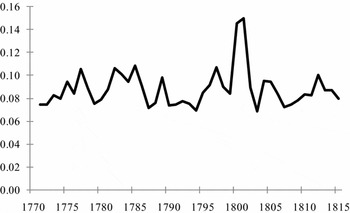
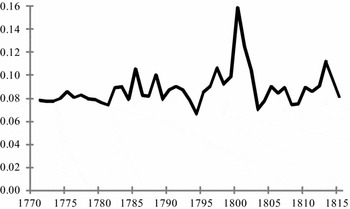
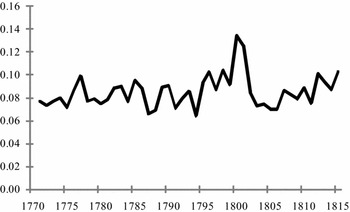
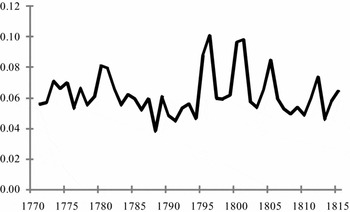
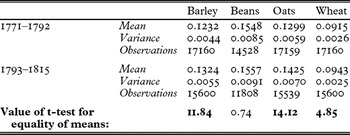
Figures 1 through 4 chart the evolution of the preferred measure of commodity price dispersion for barley, beans, oats and wheat, averaging across all unique county-pairs in the period from 1771 to 1815. The results are quite suggestive in that all the series exhibit a marked upward swing dating from 1793, the beginning of hostilities. The wheat series, in particular, are interesting for the fact that the French Wars came against the backdrop of a downward trend in price dispersion throughout the 1770s and 1780s and for the fact that its successive peaks in 1795, 1800, 1805 and 1812 coincide precisely with the dates identified in the historical literature as the years of greatest dearth in England. If any further doubt remains that the French Wars contributed to the relative disintegration of the English market, Table 1 addresses this issue head-on. There, a simple t-test of the equality of the means in the two periods, 1771–92 and 1793–1815, confirms that the French Wars were associated with heightened price dispersion across all commodities, save beans.Footnote 5 On an unconditional basis, the average increase in price dispersion potentially attributable to the French Wars stands in the order of 5 percent. Of course, what remains to be determined is the exact propagation mechanisms. First, control variables employed in the empirics are introduced. Then, the four likely suspects – namely, weather, trade, policy and wartime events – and their associated measures will be considered in turn.
Average price dispersion for barley, 1771–1815

Average price dispersion for beans, 1771–1815

Average price dispersion for oats, 1771–1815

Average price dispersion for wheat, 1771–1815

Average price dispersion and the French Wars

5.1. Control variables
The control variables employed below are measures of the great-circle distance separating counties, their average population densities, as well as a limited set of their geographical features, namely their adjacency to one another and whether or not they are situated on the coast. The distance variable is calculated as the logged Euclidian distance between county seats and like the other geographic controls is time-invariant. County area and population figures are taken from Mitchell (Reference Mitchell1988), and the density figure is calculated as the logged average of the ratio of population-to-area in counties i and j and varies across county-pairs and time.
5.2. Weather
The weather variables considered here are the annual means and standard deviations of monthly rainfall and temperature taken from the Climatic Research Unit (1992) and Manley (Reference Manley1974). These variables have previously been determined to generate the best fit in semi-parametric estimations of the harvest–weather relationship by Khatri et al. (Reference Khatri, Solomou and Wu1998). The intuition is that the state of the harvest will be a strong determinant of the prevailing dispersion of crop prices. As both deficient or excessive rainfall and temperature will have adverse effects on harvests and hence prices, a squared mean term will also be included. Of course, these variables and their interpretation must be treated with some caution as all of the series have been generated for one localized area, south-east England, and are, thus, county-pair invariant. While agronomists and historians have long insisted on the importance of micro-climates in agriculture, it is likely that the series can at least capture inter-annual variations in English weather, citing their usual pattern of high correlation over relatively short distances (Bryson and Padoch Reference Bryson, Padoch, Rotberg and Rabb1981).
5.3. Trade
English trade figures for wheat, barley, oats and beans are taken from Marshall (Reference Marshall1833). The import figures reported there are comparable to those of Mitchell and Deane (Reference Mitchell and Deane1962) and Schumpeter (Reference Schumpeter1960). This source is also attractive in that it allows for the calculation of net imports – that is, imports less exports – for all commodities except beans.Footnote 6 Another trade-related variable to be considered is the exchange rate for the GBP. Lacking a truly appropriate reference currency, the decision was made to use the GBP-USD exchange rate in light of both the relative isolation of the United States from the events of the French Wars and its burgeoning importance in the English overseas grain trade. Annual means and standard deviations were computed from the monthly US series given in Schneider et al. (Reference Schneider, Schwarzer and Zellfelder1991). Both the trade and exchange rate data variables are county-pair invariant.
5.4. Policy
In assessing the effects of changes in interest rates induced by government expenditures, monthly price data on 3 percent Consols underlying Neal (Reference Neal1990) are used to construct annual means and standard deviations. The choice of the price of Consols is straightforward: these were the primary vehicle for financing the war effort; and since they were zero-coupon bonds, their price should accurately capture changes in the market rate of interest. The second class of variables are those relating to monetary and fiscal disbursements. The particular variables of interest are the means and standard deviations of Silberling's quarterly series on Bank of England total advances (Reference Silberling1923) and the values of Schumpeter's annual series on the level and composition of the English national debt (Reference Schumpeter1938), specifically the ratios of unfunded-to-total debt and revenue-to-expenses. In both cases, the variables under this category are county-pair invariant.
5.5. Wartime events
Here, it is proposed that there are at least three variables which might have altered market perceptions of the progress of the war and fed into the behavior of prices via speculation in commodity markets. These are the levels of British and allied casualties in battle; the average duration of battles; and the average rate of strategic loss in battle of the British and their allies. All of these were calculated annually using Smith (Reference Smith1998). In order to ease the data entry requirements, only incidents with 1000+ casualties on either side were coded. In total, over 350 incidents attained this threshold. Once again, the variables under this category are county-pair invariant.


6. Empirics
6.1. Initial exercises
The basic specification in this section is of the following form:

where Dispersion is defined, as before, as the average of logged relative prices in two counties in a given calendar year and is assumed to follow an autoregressive process. The estimates are corrected for potential heteroskedasticity and any remaining auto-correlation, suggesting that OLS will be consistent. Additionally, standard errors are clustered on years to account for the fact that many of our independent variables are county-pair invariant and, thus, their standard errors may be downwardly biased if left uncorrected. The Dist term is the Euclidean distance separating the county seats of i and j; the expectation is that dispersion should be increasing in this variable. Density is the logged average population density of counties i and j. In this case, it might be reasonable to expect either positive or negative effects. If we take a cue from the literature on the gravity model of trade, it is generally found that trade flows between nations are increasing in the density of populations as this proxies for the thickness of markets. In this light, Dispersion would be negatively correlated with Density, that is, trade flows work to ameliorate commodity price dispersion. At the same time, Density could capture diseconomies of scale in marketing or congestion costs in transportation, resulting in a positive correlation with Dispersion. Finally, the specification above includes a number of indicator variables: Adjacency for whether counties i and j lay next to each other to capture potential changes in administrative boundaries or transportation modes associated with crossing county borders; Coast for whether counties i and j both lay on the coast to capture the possibility of coastal shipping linking the two; and fixed effects for each county.
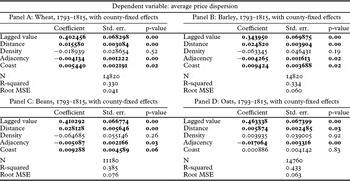
Benchmark estimates for wheat in the period from 1793 to 1815 can be found in Panel A of Table 4. The coefficients conform to the priors given above: commodity price dispersion is strongly persistent from year to year, increasing in distance, and decreasing in adjacency. To give some sense of the magnitudes involved, a one standard deviation increase in logged distance (=0.635) is predicted to increase the price dispersion measure by 0.198 standard deviations (=0.028). Equivalently, adjacency is predicted to lower dispersion by 0.082 standard deviations and coastal counties are predicted to have dispersion which is 0.108 standard deviations higher. This last result on the Coast variable may seem paradoxical as we would generally associate maritime transport with lower trade costs and, hence, commodity price dispersion. However, as can be seen in the Appendix, this result is contingent upon the state of warfare. Finally, this specification captures an appreciable amount of the variation of the dependent variable, in that the R2 is a healthy 0.330.Footnote 7
Initial estimates across commodities

NB: Fixed effects suppressed; OLS estimation with heteroskedasticity and auto-correlation consistent standard errors clustered on years.
Panels B, C, and D of Table 4 consider the other commodities available from the London Gazette, namely barley, beans and oats. In general, the results are encouraging. In all four commodity classes, commodity price dispersion is positively serially correlated, increasing in distance, and smaller in the presence of a shared county border. In the case of oats, however, there are no identifiable effects for coastal locations. This apparently reflects the fact that this commodity with its low unit-value was not traded as extensively as wheat, with the consequence that most flows of oats were highly localized (Gras Reference Gras1915; Rogers Reference Rogers1902). In what follows, the focus will be concentrated on the results for wheat. This choice reflects a desire to keep the exposition cleaner and the notion that the market for wheat best approximates general conditions in the national market for commodities. Additionally, the interested reader can also consult the Appendix, which reports the results of exercises which pool across various periods and regions.
6.2. Final estimates
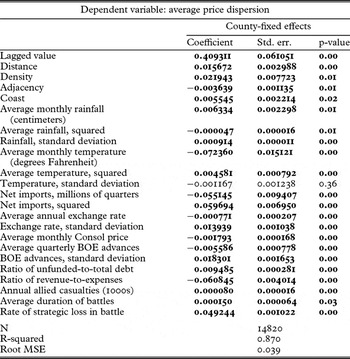
Table 5 reports the OLS estimates with the full set of independent variables and county-fixed effects. Generally, the results look reasonable. All the control variables – save the Density variable – retain roughly the same coefficients as in Panel A of Table 4. The percentage of the variation in average price dispersion explained by the independent variables is also high, with an R-squared value of 0.870. In terms of the two weather variables, rainfall and temperature, there is evidence of a non-linear relationship, as the average and squared-average terms are both significant. Both suggest that increases in average monthly rainfalls and temperatures – when evaluated at their means – were associated with better harvests, and, thus, lower price dispersion.Footnote 8 Additionally, the standard deviation of rainfall is found to be positively associated with commodity price dispersion.
Final estimates

NB: Fixed effects suppressed; OLS estimation with heteroskedasticity and auto-correlation consistent standard errors clustered on years.
Turning to the results on the trade variables, here, we find commodity price dispersion to be decreasing in net imports, but with a rather strong and positive coefficient on the squared term.Footnote 9 In theory, net imports could be positively or negatively associated with commodity price dispersion: positively if unsettled market conditions – that is, higher price dispersion – induced a flow of imports into England; and negatively as the flow of imports could stabilize price dispersion by augmenting domestic commodity stocks.Footnote 10 Additionally, the table shows that commodity price dispersion was decreasing in the level of the GBP exchange rate. This can be thought of in two ways, either as the greater purchasing power of the GBP or the lack of balance-of-payment difficulties facilitating international transactions for grain. In any case, the most important evidence comes from the standard deviation of the exchange rate. The expectation is that commodity price dispersion would be increasing in exchange rate volatility, a result confirmed in the data.
On the fiscal and monetary policy variables, we find that the average Consol price is negatively associated with commodity price dispersion. This makes intuitive sense as the Consol is a zero-coupon bond, and its price should be negatively correlated with the market interest rate. Thus, Table 5 provides evidence that commodity price dispersion is positively related to the level of the nominal interest rate. The results also suggest that dispersion is decreasing in the level of Bank of England (BOE) advances and increasing in this variable's standard deviation. Interpreting the second result is straightforward as the volatility of money stocks is often taken as a proxy for uncertainty over future rates of inflation (Devereux and Yetman Reference Devereaux and Yetman2005). Interpreting the first result seems more problematic, especially if we expect BOE advances to reflect the general rate of inflation. In this case, it is important to remember that we are already conditioning on two other variables – the ratios of unfunded-to-total debt and of revenue-to-expenses which are likely to capture any monetization of debt on the part of the British government and which perform as expected with commodity price dispersion increasing in the former and decreasing in the latter. It is argued that in this case the level of BOE advances captures the ease of obtaining commercial credit and, thus, the facilitation of both domestic and international trade flows (Acworth Reference Acworth1925). The last independent variables to consider are those relating to wartime events. All three variables – the annual allied causalities, the average duration of battles and the rate of strategic loss in battle – contribute significantly to the explanatory power of the regression in column A and enter into the estimates with the expected signs.
6.3. Assessment of wartime forces
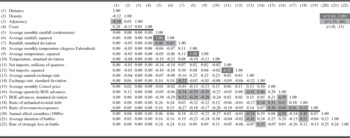
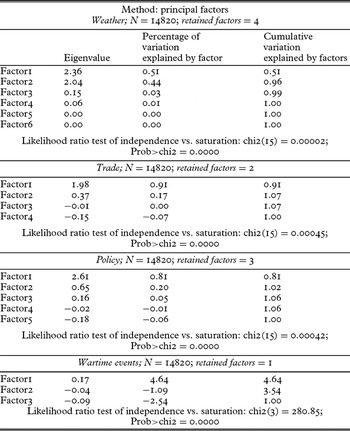
The final exercise in this section will be to provide a rough assessment of the relative magnitude of the wartime forces in effect under the general headings of weather, trade, policy and wartime events. However, we are immediately confronted with the fact that the set of independent variables is not only large but also may suffer from relatively high degrees of correlation within groups, as seen in Table 3. An obvious way forward is to employ factor analysis to reduce the dimensionality of our independent variables. Factor analysis has a long-standing tradition in the psychometrics literature dating from at least the work of Spearman (Reference Spearman1904) and is becoming increasingly commonplace in finance and macroeconomics. The intuition is much like that of OLS regression: in a multidimensional space, factor analysis seeks to identify successive hyper-planes (or factors) which capture increasing amounts of the shared variation in the underlying variables. Once the most relevant factors are identified, it then becomes possible to extract a single index thought to be representative of the variation in the underlying data.
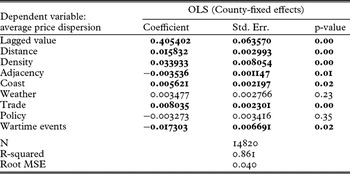
Table 6 reports the results of factor analysis on our four categories of independent variables: weather, trade, policy and wartime events. The shared outcome is that a very high degree of the variation within these headings can be accounted for by a relatively small number of factors in each case. Log-likelihood ratio tests also confirm the significance of the factors under each heading. With these results in hand, it is then possible to collapse the independent variables under each heading into a single factor score (or composite variable). These four factor scores simply replace the long list of variables in the estimating equation for Table 5. Table 7 largely reproduces the results found there with respect to the control variables, albeit at a cost of a slightly smaller R-squared and slightly larger root mean-squared-error. Unfortunately, the relatively high correlation between the weather and trade indices on the one hand and the government policy and wartime events indices on the other seems to confound precise estimation for the weather and policy indices.
Factor analysis

Final estimates with principal factors as regressors

NB: Fixed effects suppressed; OLS estimation with heteroskedasticity and auto-correlation consistent standard errors clustered on years.
Regardless of the indices’ statistical significance, we can rank the indices in terms of their quantitative significance. In the case of a one standard deviation increase in the weather index (=0.998), commodity price dispersion is predicted to change by 0.069 standard deviations. Likewise, trade, government policy and wartime events are predicted to change commodity price dispersion by 0.157, 0.062 and 0.132 standard deviations, respectively. Given these figures along with those on statistical significance, the results suggest that the prime movers of commodity price dispersion in the time of the French Wars were international trade and wartime events.
7. Conclusion
The purpose of this article has been to determine the means by which warfare influences the process of domestic commodity market disintegration. It was argued that England during the French Wars was an appropriate choice, given the prominent role of commodity markets in English economic history, the rich set of data available, and the accidents of geography and history which made for a clean analytic case study – that is, the English experience allows one to abstract away from the physical destruction generally associated with wars. Following the lead of earlier economic historians, four categories were suggested as likely sources of changes in the degree of commodity market integration, namely weather, trade, policy and wartime events. The means of assessing the various explanatory variables were empirical exercises relating commodity price dispersion to likely proxies for the four categories. Overall, it is suggested that the primary vehicle for warfare to influence domestic commodity market integration was through international trade linkages and the arrival of news regarding wartime events.
Apart from highlighting this empirical finding, we might do well to consider the broader implications of this study. For one, it might inform the terms of an emerging debate on the relation between well-functioning markets and economic growth. A recent literature has emerged concerning the relative performance of markets and the determinants of economic growth in the time of the Industrial Revolution, echoing in part the market-led growth model proposed by Hicks (Reference Hicks1969). The most prominent of these studies is the work of Shiue and Keller (Reference Shiue and Keller2007), which finds a statistical dead-heat between Western Europe and China in terms of commodity market integration prior to 1780, but a real English lead among all the contenders. Their conclusion seems to be a negative one, in the sense that the simultaneous occurrence of sustained economic growth and an upswing in commodity market integration in Western Europe, circa 1830, suggests to them that the latter is not a necessary condition for the former. In this view, there seems to be little room for markets in explaining the nature or timing of the European ascent to economic primacy in the nineteenth century. However, if the smooth functioning of markets matters at all, then the fallout of the French Wars on the English domestic economy could have profound implications for our understanding of the nature and timing of economic growth.
What will be suggested in closing is a defense of well-functioning markets in conditioning future growth prospects. Of course, this notion is not a new one to readers of economic history. North and a series of co-authors have long argued that the particular constellation of English institutions – inclusive of its markets – was the key to its burgeoning economic success in the eighteenth century (North and Thomas Reference North and Thomas1973; North and Weingast Reference North and Weingast1989). Likewise, Acemoglu et al. (Reference Acemoglu, Johnson and Robinson2005) have recently reminded us that the interactive effects between markets, institutions and growth can take a very long time to unfold. At the same time, relatively little has been made of the role of domestic – as opposed to international – markets in determining English output growth. Given the predominance of domestic trade at the time and the disruptions of domestic markets attendant upon the French Wars, the degree to which the domestic market got prices right could have been crucial to England's growth prospects at the time. In a sense, this work follows up on the sentiments of Adam Smith who felt that the causes of English prosperity seem to be the ‘equal and impartial administration of justice’ along with ‘the liberty of exporting. . .to almost any foreign country and what perhaps is of still greater importance, the unbounded liberty of transporting [goods] from any part of our own country to any other. . .’ (Reference Smith1976, p. 610). Of course, more fully explicating the causal links between growth, institutions and markets – both domestic and international – in the English case remains a task for future work.
Acknowledgements
Liam Brunt and Edmund Cannon generously allowed for the provision of the commodity price data and are warmly thanked. The author also wishes to thank Greg Clark, Larry Neal and Solomos Solomou for the provision of other data; Doug Allen, Clyde Reed, the editor and three anonymous referees for comments; and Dan Bogart for helpful discussions and for providing much of the impetus for the article. The standard disclaimer applies. Finally, the author gratefully acknowledges the Social Sciences and Humanities Research Council of Canada for research support.
Appendix
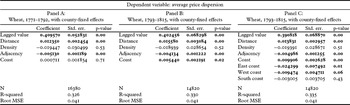
Having considered the cross-commodity properties of the control estimation, here we will take a look at the temporal stability of the estimates to ensure that these are not simply generated by wartime conditions. Panel A of Table A1 reports the results for the non-wartime period from 1771 to 1792, while Panel B repeats the results for the period from 1793 to 1815 for ease of comparison. Naturally, the English saw their fair share of warfare during the period from 1771 to 1792, including – but not limited to – the American Revolutionary, Anglo-Mysore and Anglo-Maratha Wars. The argument here is that these conflicts were on the whole peripheral – as their names would imply – and minimally disrupted the traditional financial and trade flows of the English. All the coefficients are estimated to be of the same sign and, generally, of the same magnitude before as opposed to during the French Wars.
Initial estimates across periods

NB: Fixed effects suppressed; OLS estimation with heteroskedasticity and auto-correlation consistent standard errors clustered on years.
However, there is one exception. The coefficient on Coast is strongly insignificant before the wars, suggesting that coastal counties were no better off on average in times of peace. However, the coefficient on Coast is positive and strongly significant during the wars. This can be explained by two observations. First, although we condition on distance, this is a linear measure, while most coastal routes would have been decidedly non-linear – here, a good example might be Lancashire and Lincolnshire which have a measured distance of 117 kilometers, but which would be separated by some 1,500 kilometers of coast. In other words, the Coast variable may be too coarse to capture any advantages enjoyed by a very small subset of coastal counties, explaining its insignificance in the pre-war years. At the same time, the harassment of coastal shipping during the French Wars is likely to have driven freight and insurance costs up enough for this subset to register in the data, explaining its significance in the war years.
This result can be seen a little more clearly if we control for geographical variation in the Coast variable by constructing separate indicators for the east, west and south coasts of England. The results from including these indicators variables in the regressions are presented in Panel C of Table A1. For the wartime estimation, we still pick up the positive Coast effect, but it is clearly limited to the southern coast of England – precisely the area which contemporaries and historians have identified as being the most susceptible to French raiding parties (Aldcroft and Freeman Reference Aldcroft, Freeman, Aldcroft and Freeman1983; Mokyr and Savin Reference Mokyr and Savin1976). On the other hand, the littoral counties of the North Sea in particular were largely protected, as their conditional mean is predicted to be 0.014 (or over 15 percent) lower than that of the full sample (0.094).
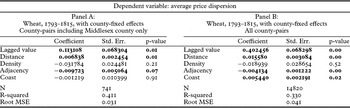
Finally, there is the potential that the estimation strategy is not fully controlling for cross-sectional correlation in the error terms. The intuition here is that by using price data for all county-pairs the standard errors on the regression coefficients may be biased downward as the relative prices in certain county-pairs may not be independent of those in a second county-pair. For example, we include price information on the county-pairs of Lancashire–Lincolnshire, Lancashire–Yorkshire and Lincolnshire–Yorkshire when it may be econometrically sufficient to consider only the first two pairs, as the third pair might provide no more independent information. A potential corrective is to estimate equation (1) above but only on a subset of county-pairs. What is needed in this case is an appropriate reference point. This is not a difficult task, as Defoe writing in the 1720s noted that ‘this whole Kingdom, as well the people, as the land, and even the sea, in every part of it, are employed to furnish something. . .to supply the city of London with provisions’ (1991, p. 12) and that, above all, London corn was ‘provided in all counties of England’ (ibid., p. 397). Accordingly, in Panel A of Table A2, the estimation results are reported for only those county-pairs which include Middlesex. Middlesex was chosen as the numéraire as price data for London are only available for the period from 1771 to 1793. However, given that the correlation between the two series for that period is 0.94, the substitution of Middlesex seems justified. In general, these match the general patterns and magnitudes of Panel B, the full-sample results. The only deviation is the insignificance on the Coast variable in Panel A. However, in this specification, this is not strictly speaking the same variable as in Panel B, in that Middlesex is not a coastal county – that is, Coast is no longer bilaterally defined, but rather enters as a one when the other county in the pair is on the coast. In sum, the results suggest that cross-sectional correlation is not unduly biasing the baseline estimates.
Initial estimates across regions

NB: Fixed effects suppressed; OLS estimation with heteroskedasticity and auto-correlation consistent standard errors clustered on years.