Introduction
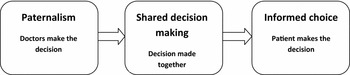
Making decisions about treatment is an integral part of modern healthcare. Treatment decisions take place along a continuum (Figure 1), from paternalism at one extreme, through shared decision making (SDM), to informed decision making by the patient at the other extreme.Reference Charles, Gafni and Whelan1–Reference Dudley3 Paternalism has a one-way flow of information from doctor or other healthcare professional to patient, the former determining the information which is given to the patient regarding the risks and benefits of the proposed treatments, as well as which treatment is the best option, in their opinion, for the patient. At the other end of the continuum is informed decision making. Here, information given to the patient by the healthcare professional is essentially the same as in the paternalistic model – from professional to patient. The clinician is still the prime source of the relevant information on the risks and benefits of the different treatment options; the difference is that the patient makes an informed choice based on this information. In informed decision making, beyond communicating this information, the clinician has no further part to play in helping the patient to make a decision.Reference Charles, Gafni and Whelan1 Shared decision making occupies the middle ground between these two extremes of clinical practice. There are many definitions of shared decision making, but the definition that is generally accepted is that provided by Charles et al.Reference Charles, Gafni and Whelan4: ‘Shared decision making is the involvement of both patient and doctor, a sharing of information by both parties taking steps to build a consensus about preferred treatment and reaching an agreement about which treatment to implement’. It is the sharing of information on options and values which is fundamental to achieving full participation in the process.
The continuum of treatment decisions

As well as presenting patients with comprehensible information on the risks and benefits of available treatment options, a key component of shared decision making is the clarification of values, often termed values elicitation.Reference Edwards and Elwyn5 Values elicitation involves establishing what is important to the patient and how this might shape their decisions. It is sometimes difficult for a patient to clearly articulate which factors are important in helping them to make a decision. A discussion between the patient and the clinician will help to clarify their values and to support the patient's engagement in the decision-making process: a process which can sometimes be supported by the use of decision aids, which are discussed later in this review.
This review will look at what shared decision making is and how it can be incorporated into a clinical encounter within geriatric medicine. The benefits and challenges of implementation into care of the elderly are discussed with a detailed case study to illustrate the effectiveness of such engagement.
Why is shared decision making important for geriatric medicine?
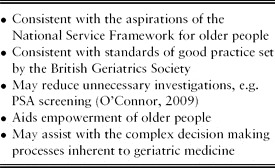
There are many reasons why shared decision making is high on the agenda for the health service generally and geriatric medicine in particular (Table 1), adding weight to the argument that it ought to become part of routine practice: the norm not the exception.
Why SDM is important for geriatric medicine

Firstly, there is a policy imperative across the NHS to involve people in decisions about their care, the term ‘No decision about me without me’ being a central theme in government policy.6 Guidance on how this involvement will occur in practice is required. The tenets of shared decision making are also reflected in the standards of ‘person-centred care’ set by the National Service Framework (NSF) for Older People.7 The NSF states that: ‘Older people should be involved in making their own decisions, where this is possible and is what they wish, about the options available to them’.
Secondly, there are ethical imperatives to provide evidence-based information to patients regarding the risks and benefits of treatments, which help promote shared decision making.Reference Weinstein, Clay and Morgan8 Coulter also raises the fact that with better informed and more involved patients there is a gradual move towards the ethical imperative of the autonomous patient.Reference Coulter9 Medication prescribing is highlighted by the NSF as a key area where information about risks and benefits should be shared and the patient given the opportunity to ask questions about their medication. The NSF also suggests that, where patients consent, providing appropriate information for carers is also essential to allow them to support the person that they care for in making decisions.
Finally, shared decision making is also relevant to the practical standards of care set by the British Geriatrics Society. Involvement of older people in management choices is the first item highlighted in a list of principles of good medical and social care for older people.10 The British Geriatrics Society document clarifies that older people should expect: ‘Clear and sensitively expressed explanations of their medical condition/illness unless their ill health prevents this, and of the treatment options available, in writing if required’.10 In line with the NSF, the British Geriatrics Society standards also acknowledge that sharing information with carers may be appropriate in helping older people to receive the best care.
There is also observational evidence that points to other reasons for this surge in shared decision making. Wennberg and GittlesohnReference Wennberg and Gittlesohn11 believe that it has been led, in part, by an identification of unexplained variations in practice. Those authors, prompted by variations in rates of hysterectomies, looked at 193 small areas in six states in New England, USA, and compared surgical rates across similar geographical areas. They found that some communities were receiving more treatment than others, although there was little difference in the population to warrant this variation and they argued that this was more to do with differences in styles of medical practice. The procedures where rates varied the most were the ones where there was no clear best option in terms of the medical evidence available. In light of this discovery of variation in practice, Wennberg and GittlesohnReference Wennberg and Gittlesohn11 advocated promotion of more informed medical consumers. Such informed patients would understand the risks and benefits of the different treatment options and make their own preferences known to their clinicians.Reference Anderson, Fuller and Dudley12 There is evidence of similar variation in clinical practice within geriatrics where there is also often no ‘best option’ apparent. An example is in the prescribing of anticoagulation for atrial fibrillation (AF) – even where predicted risk and benefit figures can be estimated using epidemiological data, the complexity of decision making in the context of co-morbidity leads to significant variation in clinical practice.Reference Anderson, Fuller and Dudley12
According to a recent article by Mulley,Reference Mulley13 unwarranted variation (such as that identified in New England and for AF patients) can be reduced if more time is invested in supporting clinicians and patients in their decision-making process, including the implementation of measures of quality and outcomes. This proposal, highlighting the role of an informed patient, had been outlined earlier by Barry et al.,Reference Barry, Fowler, Mulley, Henderson and Wennberg14 who examined men who were suffering from benign prostatic hyperplasia. Barry et al. also suggested that decisions should be based on patient values and preferences, as well as on possible outcomes of different treatment options. Understanding that patients wanted to be given a great deal of information about their condition, in agreement with Mulley, and Wennberg and Gittlesohn, Barry suggested that enhanced patient participation might reduce unwarranted variation in practice and improve medical decisions.Reference Barry, Fowler, Mulley, Henderson and Wennberg14 The authors did have one reservation, in that they thought that patients who were bothered by mild symptoms might demand costly and unwarranted treatment, but this concern was shown to be unfounded in their study.
A further study of decision making by Hingorani and VallanceReference Hingorani and Vallance15 demonstrated how presenting patients with individualized cardiovascular risks and a display of the health benefits of intervention, allowed the patient and clinician to participate in a decision about the most effective package of risk reduction. All three of these studies have shown how presenting patients with information on the clinical evidence and the likely effects of alternative options allows patients to be better informed about treatment options and to make better-informed decisions. In fact, many decisions have to be made in the face of some uncertainty and ambiguity regarding the outcomes of treatment, and sharing this responsibility appropriately involves the patient in the decision.Reference Mulley16
Older people and decision making
It is wrong to assume either that all older people prefer to be told which is the best option for them or that all older people wish to be involved in decisions about their care. There is a range of preferences in terms of the extent of involvement that older people are comfortable with, just as there are with any other clinical group. CoulterReference Coulter17 argues that the offer of choice is important to many patients, with older people being especially likely to value choice. A European study of 406 elderly patients highlighted that older people view being involved as being demonstrated by having a caring relationship with their healthcare provider, embracing a person-centred approach and receiving the appropriate information (several of the key components of shared decision making), rather than necessarily having an active role in the actual decision making.Reference Bastiaens, Van Royen, Pavlic, Raposo and Baker18 If we are to involve any patient in decisions about their care it needs to be to the extent that they wish. Often after a discussion with the patient about the extent they wish to be involved, and an explanation of the risks and benefits of treatment options, they are more likely to want to participate in the decision making process, even if they initially were reticent to do so. Clearly, the nature of geriatric medicine may mean that discussions with older people about their preference for involvement is challenging; frailty, visual and hearing difficulties, and cognitive impairment present potential barriers to communication to facilitate shared-decision making.
Five key elements of an SDM consultation
The strength of shared decision making being advocated in this review is its interactive approach, both parties sharing their information, acknowledging that, whereas clinicians possess clinical expertise, patients are experts regarding their own medical condition,19 sharing their personal details and values. This sharing enables an evaluation of the options and a jointly agreed, shared, decision.Reference Edwards and Elwyn5, Reference Edwards and Elwyn20
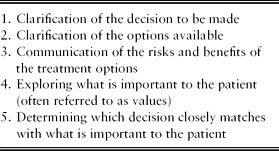
Within a shared decision making consultation there are several key elements (Table 2).
Five key elements of shared decision making

1. Clarification of the decision to be made
More often than not patients do not even realize that there is a decision to be made and that they can be part of that process. Patients need to be informed about what the decision is; why there is a choice; by when it has to be made; and how they can be involved.
2. Clarification of the options available
A patient needs to be clear that there may be many options available for their particular clinical condition, but only one or two may be appropriate for them given their past medical history and co-morbidities. It is the clinicians’ expertise that is called upon to narrow the options down and only present the patient with the ones that are suitable for them to consider.
3. Communication of the risks and benefits of the treatment options
Once the appropriate options have been identified the risks and benefits of each treatment option need to be effectively communicated to the patients. The patient needs to understand the positive effects and the possible negative effects of any treatment they choose. This involves having access to up-to-date evidence-based information on the clinical risks and benefits. It also requires skills in presenting this information in a way that it is understood by this particular patient group, bearing in mind possible communication difficulties.
4. Exploring what is important to the patient (often referred to as values)
When a patient is faced with a choice of treatments they need to make this decision informed by their values, i.e. what is important to them. They might prefer the option with the shortest stay in hospital; the least invasive treatment; the longest lasting effect; or the one with the quickest response. An important step in a decision-making consultation is to elicit a patient's values and then discuss how each of the proposed choices may impact on them. For example, an elderly person may highly value being in hospital for the shortest stay possible. They may then choose to opt for a treatment which they can receive as an out-patient, even though it may not be as successful as another option which may require an in-patient stay of several days. A patient and clinician are only able to make these choices if the patient's values and their relationship with the treatment choices are explicitly discussed.
5. Determining which decision closely matches with what is important to the patient
A discussion about which option the patient is leaning towards can be initiated once the patient is fully aware of the choices available, the risks and benefits of those choices and the clinician is aware of what is important to the patient. It may be that the patient needs more time or more information to consider the options or that the clinician feels that a decision is not required immediately so a further appointment could be made to finalize the decision. It is helpful if a decision is to be deferred, that a record is kept of which option the patient is initially favouring and why, and what they need in order to make their decision.
Benefits for older people
If the key principles of shared decision making are incorporated into a clinical encounter, elderly patients will understand that there are options available. Elderly patients will be able to discuss these options in relation to what is important to them and, often in collaboration with their clinician and their family members, be able to make a choice which is appropriate for them. The potential benefits for older people are clearly illustrated in the case study below. The case study identifies the clinical condition, the choices and how they are communicated to patients and how a decision was made.
Out-patient scenario – AF and anticoagulation
A 77-year-old male patient is referred by his GP with an irregular pulse and feeling mildly breathless on exertion. There is no history of palpitations, chest pain or syncope. The patient has a past medical history of hypertension and osteoarthritis, and takes 2.5 mg of ramipril and 75 mg aspirin daily. There is no history of diabetes, stroke or vascular disease. He is a retired taxi driver, an ex-smoker, non-drinker, lives alone, manages well at home and is able to walk about 500 m to the corner shop. Your clinical assessment shows that he is in AF, with no evidence of heart failure but probable mild obstructive airways disease. You believe that he would benefit from anticoagulation to reduce his risk of stroke. However, the patient is anxious about warfarin, his brother having died of a gastrointestinal bleed.
1. Clarification of the decision to be made
The key decision is whether anticoagulation would be of benefit to this patient given his new diagnosis of AF. Investigation and treatment of suspected mild chronic obstructive pulmonary disease (COPD) would be concurrent.
2. Clarification of the options available
The two options available for treatment are:
(a) continue with current medication;
(b) replace aspirin with warfarin (or alternative anticoagulant).
3. Communication of the risks and benefits of the treatment options
This patient's risk of stroke can be estimated using a clinical prediction score such as CHADS2 or CHA2DS2-VASC.21 The patient's score using either algorithm places him in the ‘high risk’ category for stroke and, on the basis of such guidelines alone, anticoagulation would be appropriate. Bleeding risk can also be estimated using a clinical prediction score such as the HAS-BLED (as recommended by the European Society of Cardiology). In this case his HAS-BLED score of 2 does not suggest that he is at ‘high risk’ of bleeding.
Communication with patients about estimated risks is complex, but an attempt should be made to discuss this patient's chance of having a stroke in the future along with his chance of bleeding due to anticoagulation. In this case, using clinical frequency estimates alone, the chance of stroke is higher than that of bleeding. However, it is very difficult to quantify the potential magnitude of ‘harm’ inherent to either event. Communication of risks and benefits should also include the practicalities of administering anticoagulation including the need for international normalized ratio (INR) monitoring and caution with commencing new medications if prescribed warfarin.
4. Exploring what is important to the patient
As well as estimating risk and benefit as detailed above, perhaps more important is establishing the patient's values with regard to stroke, gastrointestinal (GI) bleeding and the practicalities of taking anticoagulation. It is important to clarify the patient's knowledge and awareness of stroke and the potential associated disability and mortality. Sensitive questioning as to the circumstances surrounding his brother's death may allow exploration of his anxiety in relation to bleeding. Understanding the extent of the patient's anxiety, and whether this can be alleviated, is likely to be key to determining which decision about anticoagulation most closely matches the patient's values. Further questions about his lifestyle may reveal whether the practicalities of anticoagulation monitoring are appropriate for him.
5. Determining which decision closely matches with what is important to the patient
Coming to a decision about anticoagulation will depend on the evolving process of communication with the patient. The discussion of the risks of stroke compared with bleeding may have led the patient to value the reduced risk of stroke more highly than his original concern about bleeding. Conversely, however, his anxiety with regard to anticoagulation may persist and be given greater credence than his perceived risk of stroke. The final decision may require on-going discussion of risks, benefits and values. A decision aid may be helpful in determining which decision most closely matches the patient's values.
How to support SDM
If there is to be widespread implementation of shared decision making in clinical areas such as treatment of AF, support needs to be in place to enable this to be effective and to reduce the burden of any implementation. There are a variety of support mechanisms available, which are highlighted below.
Decision aids
There is an important distinction between information provision and patient decision aids. Information leaflets give a broad perspective, including details of the risks and benefits, on the particular condition or treatment option being considered. Decision aids are evidence-based interventions designed to help prepare patients to participate in decision making. The decision aid provides information on specific choices, and facilitates their deliberation, by providing patients with information about the options and outcomes that are relevant to their health status. These decision aids help patients clarify and communicate the personal values they associate with the different features of the options provided.Reference O’Connor, Bennett, Stacey, Barry, Col and Eden22, Reference Elwyn, O’Connor, Stacey, Volk, Edwards and Coulter23 A set of international standards have been established for the quality of patient decision aids produced.Reference Elwyn, O’Connor, Stacey, Volk, Edwards and Coulter23 According to the Cochrane review, which evaluated the efficacy of decision aids in clinical practice,Reference O’Connor, Bennett, Stacey, Barry, Col and Eden22 effective decision aids have three essential components: first, they provide evidence-based information on the risks and benefits of treatments or interventions; secondly, they help patients to recognize the importance and the sensitive nature of their decisions; finally, by providing structured steps for the discussion, they help patients to clarify and communicate their values. One of the primary objectives of this communication between patient and doctor is to facilitate dialogue and for patients to make choices between possible treatment plans. In an ideal world, the patient would come to the consultation with sufficient knowledge about the available options, and clarity about their own personal values, along with the ability and desire to engage in decision making; in turn, the doctor would support the patient in this process. However, as this is seldom the case in reality,Reference Barnato, Llewellyn-Thomas, Peters, Siminoff, Collins and Barry24 such communication needs to be supported and decision aids are an effective method of achieving this. Randomized controlled trials of their use in diseases relevant to geriatric medicine are summarized in Table 3.
Randomized controlled trials of decision aids relevant to geriatric medicine

Skills development for clinical staff
To enable staff to be able to share decisions with elderly patients there needs to be a programme of skills development. Clinicians may need to develop new skills to enable them to elicit patients’ values and to communicate risk in ways which are acceptable and appropriate to elderly patients.
Encourage patients to ask questions
The onus is not only on the clinician to initiate a conversation about treatment choices, but also on the patients themselves. Awareness needs to be raised among patient groups that asking questions about options available is not only encouraged but advised.
Challenges
The challenges inherent to shared decision making may be even more apparent when applied to geriatric medicine. Whilst there may be a persisting belief that older people do not want to, or are not capable of, taking part in shared decisions making, evidence demonstrates that, for the majority of older people, this is not the case. Perhaps the greater challenge for geriatricians is implementing shared decision making in the context of complex, multi-faceted decisions for a population of patients who often have multiple co-morbidities. Although the evidence base for treatment options may help clinicians to weigh risks and benefits in general, the exclusion of older people from clinical trials often limits application of evidence to this population. The communication barriers associated with age-related conditions such as hearing, visual and cognitive impairment present a significant challenge for even those geriatricians committed to involving their patients in decision making. Moreover, the extent of involvement of family in supporting the decision making process of older people adds another degree of complexity. Clearly, implementation of shared decision making in practice necessitates the investment of both time and communication support that may not always be readily available to the geriatrician in the clinical environment.
Conclusions
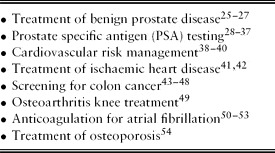
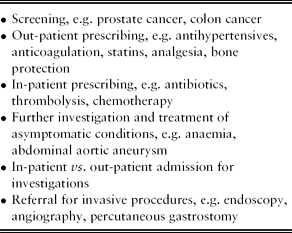
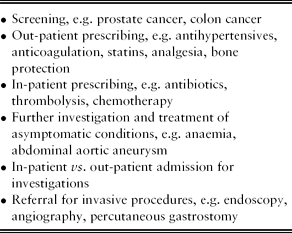
Elements of shared decision making already happen on a daily basis within geriatric medicine. However, there are multiple opportunities for greater use of this model of patient engagement for the benefit of older people, ranging from out-patient prescribing and screening to complex invasive procedures and in-patient care (Table 4). In order to adopt the five key elements of shared decision making, geriatricians may have to make some conscious changes to the structure of their clinical interactions, including the type of questions they pose, and the way that they communicate risk and benefit. The use of decision aids may require a period of familiarization and will depend on both availability and practicality given local service constraints. The challenges of integrating shared decision making into geriatric medicine have been presented, and geriatricians are likely to need support in terms of training, time and resources in order to optimize benefits. The evidence that many older people do want to be involved in decisions about their care places a responsibility on clinicians within geriatric medicine to make on-going efforts to overcome barriers inherent to shared decision making for the benefit of patients.
Key areas of geriatric medicine where SDM may be appropriate
Conflicts of interest
There are no conflicts of interest from either author.