Introduction
The relationship between cognitive functioning and autism spectrum disorders (ASD) has been the subject of previous research (Harris etal. Reference Harris, Handleman, Gordon, Kristoff and Fuentes1991; Sigman & Ruskin, Reference Sigman and Ruskin1999; Mayes & Calhoun, Reference Mayes and Calhoun2003). An early study by Freeman etal. (Reference Freeman, Ritvo, Needleman and Yokota1985) reported that the majority of children with autism have stable cognitive test scores over time. In this prospective study, 62 children with autism, first seen between 2 and 6 years of age, had cognitive assessments completed at yearly intervals for 5 years. Freeman etal. (Reference Freeman, Ritvo, Needleman and Yokota1985) reported that Intelligence Quotient (IQ) scores were relatively stable over time, with a change in IQ group occurring for only 12.9% of the sample. This is supported by Yang etal. (Reference Yang, Jong, Hsu and Cheng2003) who found mean Non-Verbal IQ/Developmental Quotient (DQ) to be stable, with no significant effect of time from initial assessment (circa 3 years of age) to review (circa 6 years of age) for a group of children with ASD.
However, recent research has indicated that IQ may not be stable over time for children with autism and that age and IQ may affect the stability of test scores. Mayes & Calhoun (Reference Mayes and Calhoun1999), in a cross-sectional study, found a significant correlation between age and Full-Scale IQ (FSIQ) in their sample of 164 children (ages 3 to 15 years) with autism. The mean FSIQ score was observed to change from 53 for children 3 years of age to 91 for children aged 8 years and older. However, after 8 years of age, both verbal and performance IQ were relatively stable. A number of studies have explored the extent of increases in IQ among children with autism. Sigman & Ruskin (Reference Sigman and Ruskin1999) followed up children initially seen between the ages of 3 and 5 into middle childhood and found that half of the children with autism showed increases in FSIQ, with the mean increase for this group equalling 22.38 points. Dietz etal. (Reference Dietz, Swinkels, Buitelaar, van Daalen and van Engeland2007) found that IQ scores increased by 15 points or more for approximately one-third of a group of children tested at 2 years and then again at 4 years of age. This echoed earlier research by Mayes & Calhoun (Reference Mayes and Calhoun2003), which reported that a similar percentage (33%) of preschool children with autism who had serial IQ testing at least 1 year apart showed a significant increase (15 points or more) in FSIQ over time. Thus, across these studies a proportion of the sample of the children with autism showed remarkable intellectual growth.
Research has also considered patterns evident in specific elements of IQ, as well as exploring some of the factors, that may influence these changes. The prospective study by Freeman etal. (Reference Freeman, Ritvo, Needleman and Yokota1985) showed a gradual increase in FSIQ from ages 4 to 7 years for children with autism who had verbal and performance IQs above 70 (High Functioning group). By comparison, FSIQ was stable for the children in their low functioning group (verbal and performance IQ below 70). Thus, less improvement was reported in children with a dual diagnosis of autism and intellectual disability. However, this is not a consistent finding within the literature. For example, Dietz etal. (Reference Dietz, Swinkels, Buitelaar, van Daalen and van Engeland2007) found that IQ improved across both the High and Low Functioning groups over time. Furthermore, Harris & Handleman (Reference Harris and Handleman2000) found children from their Low and High Functioning groups showed significant gains in IQ from a mean age of 4 years to 11 years, with the higher functioning group showing the greater increase.
The present study
The present study is conducted within the context of a tertiary referral service for children and young people with complex developmental disorders. The previous research in this area has highlighted a number of issues that may have implications for understanding the needs and abilities of children with autism and as such have potential implications for practice in this area. Therefore, the aim of the study was to investigate the stability of IQ/DQ over time in a clinical sample of children, with a diagnosis of ASD presenting to a tertiary clinical service. Within the context of this broad aim, a number of specific research questions are posed:
• Is there evidence of significant changes in FSIQ/DQ scores over time in a clinical sample of preschool children with ASD?
• Is there evidence of significant changes in FSIQ/DQ scores over time in children with ASD presenting with High Functioning (IQ/DQ ⩾ 70) and Low Functioning (IQ/DQ < 70) IQ/DQ at Time 1?
• Is there evidence of significant change in FSIQ/DQ over time when children's age at initial time of testing is controlled for?
Method
Participants
The sample comprised 50 children with a diagnosis of ASD: 76% were male (n = 38) and 24% were female (n = 12). The group had an average age of 4 years 3 months at Time 1 (ranging from 2 years 6 months to 6 years 4 months) and 7 years 8 months at Time 2 (ranging from 4 years 10 months to 13 years 2 months). At Time 1, FSIQ/DQ scores ranged from 30 to 96 with a mean IQ/DQ of 66. At Time 1, children were divided into two groups, High Functioning (IQ/DQ scores ⩾ 70, n = 22) and Low Functioning (IQ/DQ scores <70, n = 28) based on FSIQ/DQ at initial assessment.
Instruments
The diagnostic instrument for social and communication disorders (DISCO)
The DISCO is a semi-structured interview with a person's parents or caregiver developed by Wing (Reference Wing2003). It is designed to collect and code information in a systematic manner from birth onwards of persons with social and communication disorders. The DISCO provides algorithms for childhood autism (Kanner & Eisenberg, Reference Kanner and Eisenberg1957), autistic spectrum disorder (ASD; Wing & Gould, Reference Wing and Gould1979), Asperger's syndrome (Gillberg etal. Reference Gillberg, Gillberg, Rastam and Wentz2001) and atypical autism. The DISCO can compute algorithms on the basis of ICD-10/DSM-IV criteria.
The autism diagnostic observation schedule (ADOS)
The ADOS is a semi-structured assessment of communication, social interaction and play designed for use with individuals who have been referred because of a possible diagnosis of autism or other pervasive developmental disorders (Lord etal. Reference Lord, Rutter, Di Lavore and Risi1999). The ADOS has four modules designed for individuals with different chronological age and expressive language ability. Each module provides a range of tasks in which behaviour relevant to the diagnosis of pervasive developmental disorders can be observed. Behaviours are then rated. The diagnosis is formulated on the basis of algorithms of the social and the communication domains for each module.
Intellectual functioning
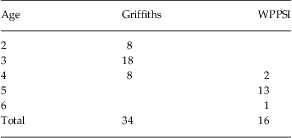
To assess intellectual functioning, a number of standardized developmental/cognitive tests were administered. The children were given the most appropriate test for their chronological age level in which they could receive a basal score (see Table 1). Tests used at Time 1 were 16 Wechsler Preschool and Primary Scales of Intelligence (WPPSI; Wechsler, Reference Wechsler1990; Wechsler, Reference Wechsler2003) and 34 Griffiths Mental Development Scales (Griffiths, 1984, Reference Griffiths1996; see Table 1). The WPPSI test administered was the current version in use at the time the child was evaluated. The WPPSI Third Edition-UK (WPPSI-III-UK) is a revision of the WPPSI – Revised-UK (WPPSI-R-UK). Both tests provide a composite score that represents a child's general intelligence quotient (i.e. FSIQ). The Griffiths Mental Development Scale (Griffiths) was completed by children whose chronological age was below the 2 years 6 months level, or who were functioning at this level. This standardized assessment yields a DQ rather than an FSIQ score. This is achieved by dividing the mental age by the chronological age and multiplying by 100 to get an average DQ score (Griffiths, Reference Griffiths1996). Therefore, an algorithm (Ivens & Martin, Reference Ivens and Martin2002) to convert the DQ into a comparable IQ score was used.
Number of children per IQ/DQ test by age at Time I (n = 50)
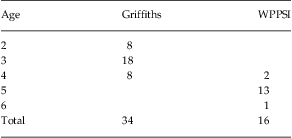
IQ, Intelligence Quotient; DQ, Developmental Quotient; WPPSI, Wechsler Preschool and Primary Scale of Intelligence.
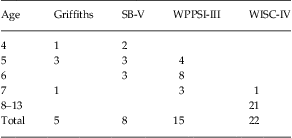
At Time 2, as a result of the ranges of ages and abilities, four standardized cognitive/developmental tests were administered to cover the ability range of the children in the study (see Table 2). The test administered was based on the child's ability to complete formal testing and obtain a FSIQ/DQ score. There were 22 Wechsler Intelligence Scales for Children, Fourth Edition (Wechsler, Reference Wechsler2004; WISC-IV-UK) and 15 WPPSI-III-UK administered. Eight Stanford–Binet Intelligence Scale Fifth Edition (Roid, Reference Roid2003; SB-5) were administered as these children were unable to obtain an FSIQ on the Wechsler Intelligence Tests. Five children were functioning at the 0–2-year level; therefore, the Griffiths Developmental Scale was administered (see Table 3).
Number of children per IQ/DQ test by age at Time 2 (n = 50)
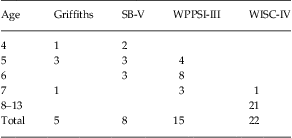
IQ, Intelligence Quotient; DQ, Developmental Quotient; WPPSI, Wechsler Preschool and Primary Scale of Intelligence; WISC, Wechsler Intelligence Scales for Children; SB-V, Stanford–Binet Intelligence Scale Fifth Edition.
DQ and IQ tests used during testing at Time 1 and Time 2

DQ, Developmental Quotient; IQ, Intelligence Quotient; WPPSI, Wechsler Preschool and Primary Scale of Intelligence; WISC, Wechsler Intelligence Scales for Children; SB-V, Stanford–Binet Intelligence Scale Fifth Edition.
*The number of subtests administered depends on the developmental age/level of the child.
F-scale is administered to children who are chronologically aged 2 years and over and who are able to complete this subscale.
Procedure
All the children in the study were initially seen for the assessment of complex developmental difficulties in an outpatient clinic at a tertiary referral service for children and young people. They were seen by a multidisciplinary team including a Consultant Child Psychiatrist, a Clinical Psychologist, a Speech and Language Therapist, an Occupational Therapist and a Social Worker. All children received an ICD-10 diagnosis of Autism or ASD by Consultant Psychiatrists experienced in diagnosing children with ASD. Of the 50 children, 24 (48%) met the ICD-10 criteria for a diagnosis of autism/ASD on the basis of clinical assessment alone. The other 26 (52%) children met the criteria for an ICD-10 diagnosis by the use of the DISCO and ADOS (standardized instruments for autism/ASD diagnosis, which were introduced into the clinic at this time), in addition to clinical assessment. On review, an ICD-10 diagnosis of ASD was confirmed for all children included in this paper using the DISCO. At Time 2, the DISCO was administered by a Research Registrar in Child and Adolescent Psychiatry who had completed 1 week's training on the DISCO and was licensed to use the test.
As part of a multidisciplinary research project, children who received a diagnosis of Autism or ASD over a 3-year period 2003–2006 (n = 65) were seen for review assessments. Of these participants, 15 had not completed a cognitive assessment at Time 1. Five children did not cooperate on formal cognitive testing to obtain a basal FSIQ/DQ score. Ten individuals were not offered a cognitive assessment, as it was not always part of routine practice at that time to offer a cognitive assessment as part of the ASD diagnostic assessment in the clinic. Repeat cognitive assessments were carried out on the remaining 50 children who were seen, on average, 3 years and 5 months (S.D. = 1 year 6 months) after initial assessment. All parents gave their informed consent for their child to participate in the study and they received a written report with the results of tests administered. Cognitive functioning was reviewed by trained psychologists using psychometric tests. At Time 2, 68% (34) of the children were in an ASD-specific education placement, of which 60% (30) were in a service using an eclectic teaching approach and 8% (4) were in an ABA service. Twenty six per cent (13) of the children attended a regular mainstream school, 85% (11) of whom had a Special Needs Assistant to support them with behaviour arising from their diagnosis of ASD. The remaining 6% (3) of the group were attending an intellectual disability specific service.
Results
Relationship between IQ/DQ scores at Time 1 and Time 2
The relationship between FSIQ/DQ at Time 1 and Time 2 was explored using Pearson's correlation analysis. In the total group (n = 50), there was a significant and strong positive relationship between FSIQ/DQ at Time 1 and Time 2 (r = 0.791, p < 0.01). Results indicated that the use of a particular cognitive measure was not associated with the increase in IQ/DQ scores. There was a significant and strong positive relationship between the 16 WPPSI FSIQs, at Time 1 and FSIQ at Time 2 (r = 0.835, p < 0.01). There was also a significant and strong positive relationship between the 34 Griffiths DQ-adjusted IQ scores at Time 1 and FSIQ/DQ at Time 2 (r = 0.830, p < 0.01). A one-way analysis of covariance (ANCOVA) was used to test for significant differences in IQ scores between those children who completed the Griffith Scale and those who completed the WPPSI scale. The ANCOVA controlled for age, as the Griffiths was used where children were not able to complete the WPPSI. Results indicated that the use of a particular cognitive measure was not associated with differences in IQ/DQ scores at Time 1, F(1, 47) = 3.233, p = 0.079). The term FSIQ will be used from here on as the DQ has been converted to a comparable FSIQ.
Change in FSIQ scores for High and Low Functioning groups
To explore changes in FSIQ over time, and to identify any differences between participants identified as scoring in the Low Functioning range (IQ < 70, n = 28) or High Functioning range (IQ ⩾ 70, n = 22), a two-way analysis of variance (ANOVA) was performed. The overall change in IQ was identified though the main effect for time, and the influence of level of IQ at Time 1 was factored into the interaction (see Table 4 for means and S.D.).
FSIQ mean scores (S.D.) for Low Functioning Group, High Functioning Group and Total Group at Time 1 and Time 2

IQ, Intelligence Quotient; FSIQ, Full Scale IQ.
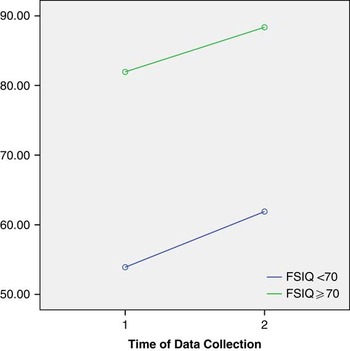
There was no significant interaction between Level of Functioning and Time, F(1, 48) = 0.197, p = 0.659 (see Fig. 1). However, there was a significant main effect for time, F(1, 48) = 16.157, p < 0.001, with the mean scores suggesting an overall increase in FSIQ from Time 1 to Time 2. The main effect of Level of Functioning was also significant, F(1, 48) = 73.829, p < 0.001, with examination of the mean scores suggesting, as would be expected that, independent of time of testing, FSIQ was higher among the High Functioning group.
Full scale IQ for Low and High Functioning groups at Time 1 and 2. IQ, Intelligence Quotient.

To explore this finding further, a number of additional analyses were performed. The first analysis explored the influence of age at time of testing. A significant positive correlation (r = 0.408, p = 0.001) was found between age at Time 1 and FSIQ at Time 1. In order to control for this relationship in the analysis, a two-way ANCOVA was performed, including the variables from the earlier analysis and adding age at Time 1 as a covariate. This analysis found no significant change in FSIQ over time in contrast to the finding reported above F(1.47) = 0.658, p = 0.022, suggesting that when age of first presentation was controlled for, there was no evidence of a significant change in FSIQ over time.
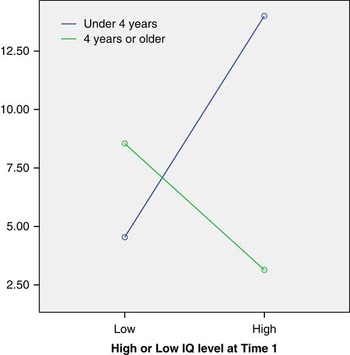
To examine the implications of this further, a statistical analysis of change in FSIQ was examined using the factors of level of IQ at Time 1 (High Functioning, Low Functioning) and age at Time 1 (under 4 years, 4 years and older), with the dependent variable of a computed score of change represented as Time 2 FSIQ minus Time 1 FSIQ (assuming FSIQ will increase). A two-way non-repeated ANOVA was performed, which identified a significant disordinal interaction between age and IQ level at Time 1 (see Fig. 2). Given the nature of the interaction, main effects could not be interpreted. A Test of Simple Effects was used to examine the nature of the interaction; however, this failed to find any significant differences between age groups for those with Low functioning, between age groups for those with High Functioning, between IQ groups for children under 4 years at T1 and between IQ groups for children 4 years and older. This lack of significance may reflect the significance value of the interaction (p = 0.036).
Change in IQ over time by Age Category and Level of Functioning (High v. Low). IQ, Intelligence Quotient.

Individual FSIQ change between Time 1 and Time 2
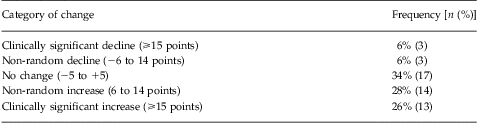
Following this, and recognizing the need to consider the clinical significance of changes in FSIQ, the FSIQ change score was examined to identify the nature of any change across the sample. Clinically significant change was categorized as a change of 15 points or more, as this difference equals one standard deviation from the mean of 100, which is used in conventional cognitive tests. Non-random change was categorized as a change between 6 and 14 points, and no change as +5 points to −5 points. Table 5 reports the frequency of each of these categories. In this group, the FSIQ scores increased by 15 points in 26% of children (n = 13). The increase occurred for both children in the High Functioning group (IQ ⩾ 70, 5 of the 13 children), and also in the Low Functioning group (IQ < 70, 8 of the 13 children). The three children (6%) whose FSIQ decreased by 15 points were in the Low Functioning group at initial assessment.
Frequency analysis of FSIQ change score
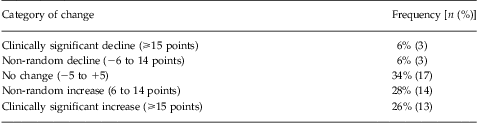
FSIQ, Full Scale IQ.
Discussion
Results of cognitive tests are often used as a prognostic indicator of long-term outcome for children with ASD. Indeed, IQ scores in children with ASD are considered to be as stable as IQ scores in children with other forms of developmental disability (National Research Council, 2001). This study reported data on follow-up cognitive assessments of 50 preschool children diagnosed with ASD. Cognitive scores measured when children were, on average, aged 4 years 3 months, and then again, on average, 7 years 8 months old, were strongly correlated in this study. This is in line with findings of other studies, which looked at the stability of cognitive testing in preschool children over time (Yang etal. Reference Yang, Jong, Hsu and Cheng2003; Mayes & Calhoun, Reference Mayes and Calhoun1999). This study also suggests that early cognitive testing of children with ASD is meaningful and that measuring cognitive functioning as part of the diagnostic process at an early age is useful.
The findings in the present study are also consistent with recent research, which indicates that IQ is not always stable over time for preschool children with ASD and that age and initial level of IQ may affect the stability of test scores (Harris etal. Reference Harris, Handleman, Gordon, Kristoff and Fuentes1991; Mayes & Calhoun, Reference Mayes and Calhoun2003; Sigman & McGovern, Reference Sigman and McGovern2005). Our findings show a significant increase in mean FSIQ over time for the total group and for the High IQ and Low IQ groups from Time 1 to Time 2. The study also found the IQ scores of 32% of the children diagnosed, with ASD changed significantly by 15 points or more between the two measurement times in this study. Interestingly, when age at Time 1 is controlled for, there is no evidence of significant change in FSIQ over time. Further studies are needed to determine whether the mean IQ increase for children with autism reflects a trend for the majority of children with ASD to improve in IQ during the preschool years or reflects the significant gains of a proportion of the sample of children. Future research on the cognitive functioning of preschool children with ASD over time is needed to explore this finding further.
This study also aimed to explore differential change in IQ and the findings show there was an increase in the mean FSIQ for both the High and Low Functioning groups over time. Looking at the IQ profiles, the findings do not concur with Freeman etal.'s (Reference Freeman, Ritvo, Needleman and Yokota1985) finding that FSIQ was stable over time for children in the low functioning group. However, it is in line with Sigman & Ruskin's (Reference Sigman and Ruskin1999), Harris etal's. (Reference Harris, Handleman, Gordon, Kristoff and Fuentes1991) and Dietz etal's. (Reference Dietz, Swinkels, Buitelaar, van Daalen and van Engeland2007) findings of an increase in IQ among preschool children across the whole range of intellectual functioning. Although the sample of children with low IQ in the present study is small (n = 28), the study adds to the existing body of knowledge, indicating an increase in IQ for this cohort of preschool children from Time 1 to Time 2. Further research is required looking at the cognitive functioning of children with ASD with low IQ over time before definite conclusions can be drawn as in the literature; to date, the sample sizes are small and the findings are mixed.
Methodological issues
Before considering the implications of the findings, a number of methodological issues must be considered. One of the methodological problems in carrying out longitudinal research on cognitive functioning in young children with autism is that the same cognitive measure is often not used over time and this may have influenced the findings of the current study. The increase in FSIQ scores could be an artefact of using different tests at Time 1 and Time 2, particularly using developmental tests (34 Griffiths) at Time 1. However, we endeavoured to address this by using an algorithm (Ivens & Martin, 2002) to convert the DQ into a comparable IQ score and doing correlational analysis on the different tests used at Time 1 and Time 2. Although it would have been desirable to use the same IQ tests at Time 1 and Time 2, this study was conducted in a naturalistic setting. The phenomenon of using different developmental/cognitive tests cannot be avoided when working with young children with ASD in a real-world setting. A number of children seen for testing at Time 1 would not have had the mental age of 2 years required to complete verbal IQ tests on the Stanford–Binet or WPPSI; in fact, many children would have had no words at the time of initial assessment. The phenomenon of reporting DQ at Time 1 and IQ at Time 2 is also a feature of other longitudinal studies of preschool children with ASD referred to in this paper and in the literature, with the exception of the Harris etal. (Reference Harris, Handleman, Gordon, Kristoff and Fuentes1991), Harris and Handleman (Reference Harris and Handleman2000) studies, which used the Stanford–Binet IV at Time 1 and Time 2. The Harris & Handleman (Reference Harris and Handleman2000) study had 27 participants whose mean age at Time 1 was 4 years 1 month and whose mean age at Time 2 was 11 years 8 months. All children in their study obtained an FSIQ score on the Stanford–Binet IV at Time 1 and Time 2.
Furthermore, as the participants in this study are all children presenting to a tertiary service, there is a level of individual variation in the group. Most notable is the age profile: the mean age at Time 1 was 4 years 3 months with a range of 2 to 6 years, whereas the mean age at Time 2 was 7 years 8 months with a range of 4 to 13 years. The overlapping age ranges may have influenced the findings and may have reduced the variation one might expect to see over time. This would be more problematic in a cross-sectional study and the potential influence of this variation is more likely to be limited by the longitudinal nature of the present study. Interestingly, when age at Time 1 was used as a covariate, there was no significant increase in FSIQ over time.
A further limitation of our study is that the sample is not representative of children in the ASD population in general, again as a result of the clinical setting. At Time 1, the FSIQ for the groups ranged from 30 to 96, and five children were not able to cooperate with formal cognitive testing, thus one cannot generalize the results to the whole ASD population. In addition, the sample sizes are relatively small, as it can be difficult to complete standardized tests on children with ASD and low IQ, and also the children may not obtain the basal IQ of 40 required to complete formal tests such as the Stanford–Binet, WPPSI-III, WISC-IV and are therefore not included in published studies.
Finally, the study did not control for intervention received between Time 1 and Time 2, which may have influenced change over time. As the children were seen as part of a clinical service, the level of intervention they received would have varied depending on the type and availability of services in different geographical areas. At Time 2, 68% of the children were in an ASD-specific education placement. Of these children, 60% were in a service using an eclectic teaching approach, and 8% were in an ABA service. There were 26% of the children in a regular mainstream school, 85% of whom had a Special Needs Assistant to support them because of behaviours arising from their diagnosis of ASD at Time 2. The remaining 6% of the total group were attending an intellectual disability-specific service. All children in the study received some form of intervention following diagnosis. However, we did not control for the type and multiplicity of interventions that each child received to allow us to draw meaningful conclusions about the effects of interventions. Further research studies are needed controlling for the effects of interventions on IQ over time.
Implications
It is recommended that children who are diagnosed with ASD and assessed on developmental and cognitive tests at preschool age are seen for review cognitive assessment at school age. This will yield information about their developmental trajectories and facilitate planning for appropriate educational provision. Teachers of children with ASD have identified the assessment of the level of intellectual functioning as highly relevant to their teaching in configuring their class, the curriculum to be followed and teaching procedures utilized (Kinsella, Reference Kinsella2000). Murray (Reference Murray2000) found that many parents of children with ASD report never having had their children's needs reviewed since the child was first diagnosed. Change in IQ scores and cognitive patterns have implications for the child's educational placement, learning style, and teacher and parent expectations. The results of our study would suggest that children who had an assessment of their intellectual functioning as preschool children should have a review cognitive assessment in the early school years as part of routine clinical practice when working with children with ASD.
Conclusion
The present study has provided some important insights into the issue of IQ as it presents in children with ASD. The findings add to the existing body of literature, confirming a number of previously identified patterns about stability and change in IQ in this group. However, more systematic prospective studies are needed to further elucidate the pattern of changes in IQ over time for children with low IQ and young children before more definitive conclusions can be reached about continuity and change in IQ in young children with ASD.
Acknowledgements
The authors thank the children and parents who participated in the study. They also thank the staff of St Frances Clinic, Temple Street, CUH; members of the Research Team: Dr M. Kashif, Registrar in Child Psychiatry, P. Ackermann, Speech and Language Therapy Manager, A. S. O'Connell, Speech and Language Therapist and a particular thanks to the Early Assessment Team, S. Keogh, Senior Speech and Language Therapist, C. Donoghue, Senior Occupational Therapist, S. Crowley, Senior Social Worker and to all the professionals and services that contributed.