Introduction
The use of seclusion in the management of violence was advocated as an alternative to mechanical restraint in the 1840s, but the practice has persisted despite the lack of an evidence base for its value (Gournay et al. Reference Gournay, Benson and Rogers2008). No high quality study of the value of using seclusion and restraint with the mentally ill has been found (United Kingdom Central Council for Nursing, Midwifery & Health Visiting, 2001) and no recommendations can be made about the effectiveness, benefits or harmfulness of the procedures (Sailas & Fenton, Reference Sailas and Fenton2000). Manual restraint is recommended only as a method of last resort for the management of violence and challenging behaviours (Department of Health, 2008) and its use needs to be minimised for ethical reasons (Sailas & Fenton, Reference Sailas and Fenton2000). In the context of secure services for women where high numbers of patients have a history of abuse, the minimisation of risk management strategies that have the potential to re-traumatise patients is a priority (Bonner et al. Reference Bonner, Lowe, Rawcliffe and Wellman2002). Other drivers are the sometimes catastrophic and fatal consequences of attempts to restrain (Paterson et al. Reference Paterson, Bradley, Stark, Saddler, Leadbetter and Allen2003).
There have, accordingly, been a number of initiatives to reduce the use of the strategies to manage violence. Intrusive reactive strategies (manual restraint, rapid tranquillisation and seclusion) are frequently used procedures in the management of challenging behaviour. Such reactive strategies are viewed as necessary because even the most successful treatment interventions, rarely eliminate challenging behaviour. The use of seclusion however, remains controversial. While some researchers have argued that the use of seclusion can be of therapeutic value (Cotton, Reference Cotton1995), prevent injury and reduce agitation (Fisher, 1994) others describe it as a form of social control over people already experiencing exclusion from the community, that is frequently harmful or traumatic to patients (Frueh et al. Reference Freuh, Knapp, Cusack, Gmbaugh, Sauvageot, Cousins, Yim, Robins, Monnier and Hiers2005). Contemporary behaviour approaches to assisting people with challenging behaviours stress the need for both proactive and reactive support strategies (Allen et al. 2010). There is general agreement that effort should be made to find appropriate support interventions that allow reduction in the use of seclusion in psychiatric facilities. Interventions that have proven to be of value in this regard were summarised by Gaskin et al. (Reference Gaskin, Elsom and Happell2007). They include:
-
∙ Introduction of a recovery approach (Smith et al. Reference Smith, Davis, Bixler, Lin, Altenor, Altenor, Hardenstine and Kopchick2005)
-
∙ Post-event analysis (Fisher, Reference Fisher2003)
-
∙ Post-seclusion debriefings
-
∙ Management setting new expectations for staff to reduce the use of seclusion
-
∙ Providing staff with resources (e.g. education) to enable seclusion rates to be reduced (Greene et al. Reference Greene, Ablon and Martin2006)
-
∙ Introduction of an seclusion audit tool (Taxis, Reference Taxis2002)
-
∙ Use of an interdisciplinary committee to oversee the development of the programme to reduce seclusion
-
∙ Improved patient treatment plans to include a behavioural perspective
-
∙ The development of high therapy, low conflict wards (Bowers et al. Reference Bowers, Brennan and Fisher2006)
-
∙ Treating patients as active participants in seclusion and restraint interventions (Schreiner et al. Reference Schreiner, Crafton and Sevin2004)
-
∙ Allowing patients to choose interventions to be used in managing their aggression (Sullivan et al. Reference Sullivan, Bezmen, Barron, Rivera, Curley-Casey and Marine2005)
-
∙ A variety of sensory interventions patients can request if agitated (e.g. Champagne & Stromberg, Reference Champagne and Stromberg2004; Fowler, Reference Fowler2006).
In all of the above studies, rates of seclusion decreased although the absence of an experimental design meant that causation could not be implied.
Most recently, a project undertaken in an Australian forensic hospital found that the use of ‘six core strategies’ was successful in reducing the frequency and duration of seclusion events but not in terms of staff support for its use (Maguire et al. Reference Maguire, Young and Martin2012). The strategies (Huckshorn, Reference Huckshorn2004) were: leadership guiding and supporting organisational change; continuous work force development; genuine consumer involvement; use of seclusion reduction assessment and planning tools; the use of data to support practice; and debriefing techniques. In Britain, the development and evaluation of the Safeward Model for reducing conflict and containment (including seclusion and restraint) resulted in a 14.6% decrease in conflict and a 23.6% decrease in containment when compared with control groups (L. Bowers, pers. comm. 2013). However, fidelity to the experimental interventions was only 38% and changes were not reflected in length of stay or in questionnaire assessments of indices such as ward atmosphere.
Reducing seclusion in forensic psychiatric services is a complex undertaking with a number of specific challenges (Maguire et al. Reference Maguire, Young and Martin2012). In secure psychiatric settings for women, the need to control violence to achieve therapeutic and rehabilitative goals (Gadon et al. Reference Gadon, Johnstone and Cooke2006) is compounded by factors associated with disturbed and violent behaviour. These include a high proportion of patients transferred from prison (Daffern et al. Reference Daffern, Howells and Ogloff2007) with a primary diagnosis of personality disorder (Braham et al. Reference Braham, Jones and Hollin2008) and a lifetime substance abuse or dependence disorder (McKinnon & Cross, Reference McKinnon and Cross2008). Further, while clinicians are significantly better than chance at predicting violence in patients overall, they are no better than chance at predicting violence in female patients (Lidz et al. Reference Lidz, Mulvey and Gardner1993). This is of particular significance given previous research showing that medium secure females are more likely to inflict violence as opposed to threat (Gudjonsson et al. Reference Gudjonsson, Robe-Hesketh and Wilson2000), that female patients are more likely to be secluded than male patients, and that staff are more likely to state that they have 'no explanation' for restraint incidents involving female patients (Leggett & Silvester, Reference Leggett and Silvester2003).
To date, attempts within secure services to reduce seclusion and restraint have (with notable exceptions; L. Bowers, pers. comm. 2013) compared two time periods and attempted to relate reductions in seclusion to specific interventions. These have included improving staff awareness and knowledge of seclusion through policy procedure and training, better monitoring and the involvement of a wide range of professions (Halder, Reference Halder2013). However, this analysis compounds change attempts with time in hospital (usually associated with a decrease in risk behaviours) and fails to match patients within the time periods studied.
The aims of the current study are to assess the effectiveness of interventions designed to minimise the use of seclusion in response to risk behaviours by comparing matched patients before and after change.
Method
Initiatives to reduce seclusion
Pre-change initiatives to minimise the use of seclusion included: staff training; the use of a recovery approach to patient care; post-incident use of Behaviour Chain Analysis (Linehan, Reference Linehan1993); the use of structured risk assessment tools and scenario-planning to inform risk management and intervention (Douglas et al. Reference Douglas, Hart, Webster and Belfrage2013) and the use of a risk stage system (Long et al. Reference Long, Anagnostakis, Banyard, Silaule and Dolley2014). All pre-change staff training was completed prior to the treatment of the post-change group. These initiatives were underpinned by the RAID (Reinforce Appropriate Implode Disruptive; Davies, Reference Davies2004) milieu therapeutic approach to the management of extreme behaviour. However, over a four month period in 2012, a number of additional initiatives were introduced whose purpose, as a primary or secondary benefit, was to reduce the incidence of seclusion. These included:
-
1. Training in Relational Security (Allen, Reference Allen2010) and its introduction into ward clinical team meetings attended by patient representatives. Training involved a one hour staff induction programme complemented by a ward team training session. These focused on the incorporation into weekly community meetings of an assessment of the ward compliance with areas of the Relational Security Wheel and a resulting action plan.
-
2. Including patient views in developing individualised plans for the prevention and management of aggression and violence.
-
3. On-ward training in de-escalation techniques. These focused on weekly one hour training sessions using ward case examples of how to manage disturbed behaviour by non-invasive relational strategies.
-
4. Timetabled, staff guided, behaviour chain analysis (BCA; Linehan, Reference Linehan1993) sessions following the occurrence of risk behaviours (Daffern & Howells, Reference Daffern and Howells2007). Prior to change, patients were responsible for completing and arranging help with BCAs.
-
5. Sensory integration techniques including the therapeutic use of weight, to help manage high levels of arousal (Champagne & Stromberg, Reference Champagne and Stromberg2004).
-
6. Timetabling leisure activity sessions at weekends given the relationship between increased activity and lower levels of disturbance (Sigafoos & Kerr, Reference Sigafoos and Kerr1994) and the increased likelihood of acts of self-harm at weekends (Nijman et al. Reference Nijman, Joost and Campo2002). Prior to this, weekends were relatively unstructured with no organised leisure or therapeutic sessions.
These have similarities with those interventions identified in large scale trials of expert-panel chosen initiatives to reduce seclusion (L. Bowers, pers. comm. 2013) and also reflect elements of the six core strategies successfully used in North America to reduce seclusion (Huckshorn, Reference Huckshorn2004).
Participants and setting
Participants were patients admitted to the medium secure unit for women of an independent charitable trust. The medium secure unit for women has two mental health wards and one ward for patients with learning disability, with a total of 40 beds. The majority of patients had an ICD-10 primary diagnosis of either emotionally unstable personality disorder or schizophrenia. All patients were detained under the Mental Health Act 1983 (for England and Wales) and had a forensic history and challenging behaviour.
Design
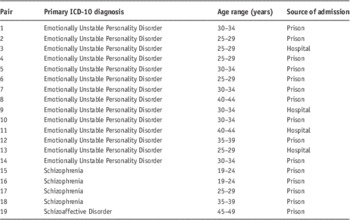
Study interventions to reduce the use of seclusion were introduced over a four month period. The first 19 patients admitted to medium secure care after this period were matched with 19 patients most recently admitted to medium secure care prior to changes. Nineteen patient pairs were matched on the basis of age, diagnosis and source of admission (hospital v. prison; see Table 1). Patient pairs were compared during their first year of admission in terms of episodes of seclusion, risk behaviours, nurse rated ward behaviour patterns and engagement in treatment sessions. All pre-change patients’ (n=19) first year of stay had been completed before the initiation of change. Staff patient ratios remained constant throughout the study period with no changes in senior personnel or key policies.
Matched pairs (N=19) of women in secure care

Following data gathering, patients and staff were asked to state which of the initiative introduced had been most effective in decreasing the use of seclusion.
Measures (pre–post)
-
1. Incidents of seclusions (frequency and time spent). These were recorded electronically by nursing staff.
-
2. Risk behaviours grouped according to Overt Aggression Scale categories of verbal aggression and aggression against self and others and objects (OAS; Yudofsky et al. Reference Yudofsky, Silver, Wynn Jackson, Endicott and Williams1986). Risk behaviours may or may not lead to restraint and seclusion. They are collated and categorised by assistant psychologists from electronic notes records.
-
3. Inpatient/Institutional Behaviour Rating Scale (IIBS; M. Dolan & R. Fulham, unpub. scale, 2001). This involves a patient's hospital care co-ordinator rating behaviour observed in the previous month on a 0 (not present) to 3 (very frequent) scale. The IIBS was routinely scored as the basis for a nursing report for each Section 117 meeting, at approximately six month intervals. Items selected for the current study were: self-harm; suicide ideation; appropriate behaviour; verbal aggression; physical aggression; property care, participation in ward/hospital programmes; compliance with drug treatment; responsibility for own behaviour; insight into disorder; insight into risk; relationship with primary nurse; and relationship with staff.
-
4. Attendance at care planned treatment sessions.
-
5. Seclusion Questionnaire (SQ; C. Long & R. West, unpub. scale, 2012). Staff and patients rated which of the following was the most effective in reducing the use of seclusion: training in de-escalation; timetabled BCA sessions; patient consultation about risk management plans; sensory integration treatment; increased activity sessions at weekends; and Relational Security items: increased levels of engagement with patients by staff (team) and initiatives to reduce bullying, harassment and discrimination (other patients). Respondents nominated the single intervention they viewed as the most effective in reducing the use of seclusion.
Statistical analysis
Data was analysed using SPSS software (version 18.0; SPSS Inc. 2009). Descriptive statistics were used to characterise the samples. Between group differences were assessed using paired t-tests. Categorical data were cross tabulated and compared using the Fisher’s Exact Test statistic. Non-parametric tests were used where Kolmogorov-Smirnoff tests showed data to be significantly non-normally distributed. A Bonferroni correction was applied to avoid Type 1 error.
Results
Participants
Thirty eight patients (19 matched pairs) were included in the study. Their mean age was 31 years and 1 month (range 19–49 years; SD=8 years, 9 months). The majority were of Caucasian origin (n=31; 82%), single (n=29; 76%) and had a forensic history (n=31; 82%). Twenty eight patients (74%) had a primary diagnosis of personality disorder while ten patients (26%) had a primary diagnosis of schizophrenia or schizoaffective disorder. Of nine patients (24%) with a secondary diagnosis of mild learning disability, all had a primary diagnosis of personality disorder. The mean age of patients at first admission to secure psychiatric services was 20 years, 3 months. Thirty patients were admitted from prison. All had a history of deliberate self-harm while 24 (63%) engaged in poly self-injurious (three or more) behaviours.
Seclusions
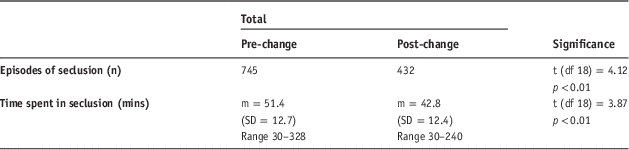
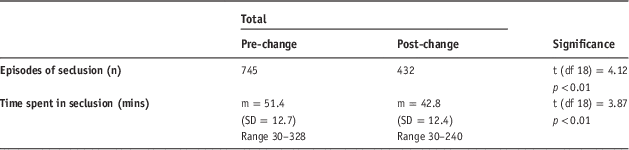
Table 2 shows that there were significantly fewer total seclusions for matched patients admitted after changes designed to reduce these. They also spent less total time in seclusion.
Seclusions for matched pairs (N=19) during their first 12 months in medium security
For ten pairs, physical aggression leading to seclusion was, for the majority of incidents (>70%), a response to staff interventions to prevent self-harm. For seven pairs, seclusion was a response to physical aggression against others. For two pairs, seclusion was a response to staff intervention to address aggression against objects or verbal aggression.
Three patients in the pre-change group and two patients in the post-change group were not secluded in their first year of medium secure care. Pre-change (n=16) patients averaged 46.6 incidents of seclusion with five patients responsible for 402 incidents (mean 80.4; 54% of all incidents). This compares with post-change patients (n=17) who averaged 25.4 incidents of seclusion, with five patients responsible for 201 incidents (46%).
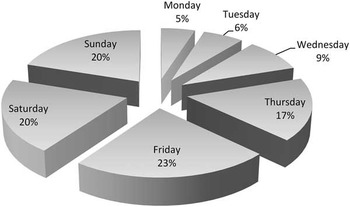
For both time periods, the majority of seclusions (58%) occurred in the evening between 5 and 8pm, and the highest incidence (63%) occurred at the weekends (Friday 23%, Saturday 20%, Sunday 20%; Fig. 1). Most incidents occurred in the autumn and winter months preceding Christmas (61%; October, November, December).
Incidents of seclusion across an average week.

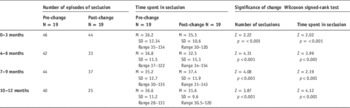
For post-change patients, the use of seclusion showed a decline over the four quarters of the first year following admission (see Table 3). Although this was not as clearly reflected in average total time spent in seclusion, the post-change group had significantly fewer seclusion episodes in each three month period of the year and spent significantly less time in seclusion.
Episodes of seclusion over a one year period in both pre-change and post-change groups

M, mean; SD, standard deviation
Risk behaviours
There was a significant decline in risk behaviours following the implementation of new initiatives (pre-change group M=69 (SD=12.5) v. post-change group M=60 (SD=8.2); t(18)=2.78, p<0.05). This was reflected in significant differences in terms of OAS categories of physical aggression against others (pre-change M=22 (SD=3) v. post-change M=12 (SD=2.2); t(18)=3.95, p<0.01) and physical aggression against self (pre-change M=19 (SD=4.2) v. post-change M=13 (SD=2); t(18)=2.34, p<0.05).
Institutional behaviour
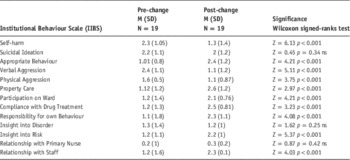
Significant improvements for post-change patients were evident on IIBS items of: self-harm; appropriate behaviour; verbal and physical aggression; property care; participation on ward; compliance with drug treatment; responsibility for own behaviour; insight into risk; and relationship with staff (see Table 4).
IIBS changes in patient behaviour pre- and post-change to reduce seclusions

ns= not significant
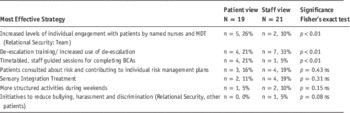
Patient and staff ratings of the most effective strategy in reducing seclusion
Patients and staff differed in terms of their rating of the most effective strategy in reducing the use of seclusion: significantly more patients (26%) rated the Relational Security team initiative item of increased individual engagement while significantly more staff (33%) felt the use of de-escalation techniques were most effective (see Table 5).
Reducing the use of seclusion: patient/staff choice of the most effective post-change strategy

BCA, behaviour chain analysis; ns, not significant
Patients were more likely to rate timetabled BCA sessions as more effective than staff, but did not show a statistically significant difference from staff in terms of their views of sensory integration treatment and patient contribution to their own risk management plans. A minority of staff (10%) and patients viewed the introduction of more structured weekend activities as the most effective strategy in reducing seclusion.
Therapeutic engagement and time spent in medium security
Post-change patients had a higher rate of session attendance (pre-change mean number of sessions per week =5.7 (SD 4.5) v. post-change M=8.6 (SD=2.4); t(18)=2.80, p<0.05) and were more likely to attend ten or more sessions per week (pre-change n=6 (32%) v. post-change n=13 (68%); χ 2(1)=14.29, p<0.01). The pre-change group also spent longer in medium security (pre-change M=21.3 months (SD=3.2) v. post-change M=17.5 months (SD=10.0); t(18), p<0.05).
Discussion
Although patients’ psychiatric symptoms have been found to be antecedents in 28% of violent incidents (Bowers et al. Reference Bowers, Stewart, Papadopoulos, Dack, Rass, Khanom and Jeffery2011), forensic hospital nurses are faced with managing behaviours that are not always related to the mental states of their patients (Daffern et al. Reference Daffern, Howells and Ogloff2007). The introduction of a series of initiatives to improve clinical practice in general, and to reduce the use of seclusion in particular, was associated with a reduction in the frequency and duration of seclusion episodes in the 12 months following admission to a medium secure women’s psychiatric service. This may be reflective of changes that led to a more effective structure (routines and rules) that is a key component of low conflict, high therapy psychiatric wards (Bowers, Reference Bowers2002). The finding that the majority (54%) of all seclusions in pre- and post-change groups related to a small minority of patients accords with previous observations. Obtained results are also encouraging given the preponderance of women admitted from prison (Maguire et al. Reference Maguire, Young and Martin2012). These findings confirm those in mixed gender samples in forensic mental health settings that seclusion can be successfully reduced without an increase in patient violence or coercive alternative strategies (Maguire et al. Reference Maguire, Young and Martin2012; L. Bowers, pers. comm. 2013). In addition, a reduction in risk behaviours and the use of seclusion in the post-change group was reflected in an increase in session attendance and a shorter stay in medium security (Long et al. Reference Long, Dolley and Hollin2011).
The study sample along with other women in secure settings in general have high rates of self-harming behaviour in association with a diagnosis of emotionally unstable personality disorder (Coid et al. Reference Coid, Kahtan, Gault and Jarman2000a, Reference Coid, Kahtan, Gault and Jarmanb; Linehan, 1993). Perhaps not surprisingly, current findings show that episodes of seclusion are the result of aggression against staff attempting to prevent self-harm. It is therefore encouraging that staff rated (IIBS) changes in patient behaviour following change showed a decrease in self-harm. This reflects findings in previous work (Bowers et al. Reference Bowers, Brennan and Fisher2006). Other IIBS rated changes showed significant reductions in verbal and physical aggression, and increases in appropriate behaviour. Staff IIBS ratings of improved compliance with drug treatment post-change may have contributed to an improved mental state and better engagement. Such bi-directional relationships are a feature of work conflict and containment in psychiatric settings (Bowers et al. Reference Bowers, Hackney, Nijman, Grange, Allan, Simpson, Hall and Eyres2007).
A lack of consensus between staff, and a lack of agreement between staff and patients, on the most effective strategy in reducing seclusion episodes reflects previous division of opinion in this area (L. Bowers, pers. comm. 2013). That 34% of staff and 21% of patients rated training in de-escalation techniques as the most effective way to reduce episodes of seclusion reflect previous reviews of seclusions showing that staff training in interaction skills can contribute to significant reductions in rates (van der Merwe et al. Reference van der Merwe, Bowers, Jones, Muir-Cochrane and Tziggili2009). This consensus between staff and patients was reflected in agreement about the importance of a linked initiative of actively consulting patients about their risk and incorporating patients views into risk management plans (Schreiner et al. Reference Schreiner, Crafton and Sevin2004; Sullivan et al. Reference Sullivan, Bezmen, Barron, Rivera, Curley-Casey and Marine2005). This, in turn, was reflected in staff IIBS ratings of greater insight into risk of post-change patients and the patients (21%) view of the importance of timetabled and staff guided use of behaviour chain analysis following a risk episode.
A quarter (26%) of patients surveyed (in contrast to staff) rated the Relational Security emphasis on individual engagement with staff and the MDT as the most effective of the new strategies in reducing seclusion. This was reflected in staff (IIBS) ratings of improved staff relationships in the post-change phase of the study. This is a positive finding since the maintenance of the same staff:patient ratio during the study period suggests there was a change in working practice, as perceived by patients, to prioritise patient contact in line with Relational Security initiatives (Allen, Reference Allen2010).
While objectively gathered data showed a relationship between new initiatives and increased session or patient engagement, or staff IIBS views of increased participation on the ward, this was not reflected in either staff ratings of the importance of an increased number of structured weekend activities. This is even more surprising given that the finding that most incidents of seclusion occur at weekends and during evenings. Findings in this regard run counter to research indicating that restraint episodes are less likely at weekends and at night (Smith et al. Reference Smith, Davis, Bixler, Lin, Altenor, Altenor, Hardenstine and Kopchick2005) and staff views that boredom and lack of meaningful activity are linked to aggression (Bowers et al. Reference Bowers, Stewart, Papadopoulos, Dack, Rass, Khanom and Jeffery2011). This may have implications for further development of appropriate therapeutic and leisure activities available to patients at weekends.
Study limitations include a small sample with a majority having a diagnosis of personality disorder. A matching design reliant on retrospective data also introduces a possible source of bias. Factors such as treatment readiness and engagement, which impact disturbed behaviour (Kozar, Reference Kozar2010; Long et al. Reference Long, Dolley and Hollin2011) could not be controlled for, and it is possible that a proportion of patients had experience of study interventions in previous settings. Further, the study did not control for the use of psychotropic medication and was reliant on retrospective data. The latter introduces a possible source of bias and makes it difficult to understand complex interactions between people. Asking respondents to nominate only the most important of the new interventions to reduce seclusion obscures the possibility that other strategies were viewed as very important. In addition, it was not possible to assess the fidelity with which staff implemented new measures. A problem of low fidelity to agreed initiatives with adherence rates of 38% is a feature of large scale research studies in this area (L. Bowers, pers. comm. 2013).
There is an emerging consensus among studies, which supports the use of complex multifaceted interventions to reduce the use of seclusion in inpatient psychiatric settings. However, given the considerable obstacles to evaluation of these using randomised controlled trials, future research might more usefully focus on rigorously designed case studies (Gaskin et al. Reference Gaskin, Elsom and Happell2007). The goal of eliminating the use of seclusion in a climate where its use is justified on the utilitarian grounds of protecting other patients, is unlikely to be realised in the near future (Maguire et al. Reference Maguire, Young and Martin2012).
Financial support
This research received no specific grant from any funding agency, commercial or not-for-profit sectors.
Conflict of interest
None