China's rural health care system was an integral component of the collective farming system. As collective farming was dismantled with the introduction of economic reforms, the comprehensive rural health care system simultaneously collapsed. While there have been numerous collective health care experiments since the beginning of the reforms, most residents of rural China lack access to health care. By 1993, only 6.4 per cent of China's rural population had health insurance, and coverage eroded even further over the next decade.Footnote 1 As a result, rural residents who became sick either spent family savings on health care or forwent medical services altogether.Footnote 2
In both industrialized and less developed countries, health shocks and poor health care are strongly correlated with increases in poverty.Footnote 3 China seems to be no different, as incomes have been shown to decline when health shocks occur.Footnote 4 For example, in 1998, according to the Ministry of Health, 22 per cent of poor households attributed their poverty to illness or injury. Furthermore, when Gustafsson and Li examined the relationship between health care expenses and poverty, they found that high health care expenses were associated with a 2.5 per cent increase in the number of households below the poverty line in 1995.Footnote 5 The lack of insurance against catastrophic illness may help to explain why China's progress in some aspects of human development has not been commensurate with its rapid economic growth.Footnote 6 For example, life expectancy has hardly risen in the last 25 years, and reductions in child mortality have seemingly underperformed those of other high growth economies.Footnote 7
The government unveiled the New Co-operative Medical System (NCMS) in October 2002 as a means of addressing inequities in the availability of health care in China. The NCMS is a voluntary risk-pooling insurance programme that targets major illnesses by offering partial reimbursement for catastrophic health care costs. The programme is administered at the county level, but the central, regional and sub-regional governments contribute on average 70 per cent of the total funding. County governments are given significant flexibility in many aspects of the design and management of their NCMS programmes, and hence they vary widely by locale. Although the system is being introduced gradually, the Ministry of Health anticipates making NCMS programmes available to nearly 700 million rural residents in all rural counties by the end of 2008.Footnote 8
Given the significant heterogeneity in programme design, it is likely that the system serves residents in some counties well while performing inadequately in other counties. The main objective of this article is to study which aspects of NCMS programmes are more successful in serving residents and which aspects lead programmes to be less successful. Specifically, we use primary survey data to evaluate how financing, coverage levels and eligibility/exclusions influence the following measures of programme success: whether participation rates grow over time, whether survey respondents consider the reimbursement process to be “cumbersome,” whether households carry additional insurance, and whether participating households have actually received reimbursement. Each of these outcomes will affect the survey respondents' willingness to enrol (or to re-enrol) in the NCMS programme, and thus the long-term prospects of the programme.Footnote 9 We find that covering emigrants and lowering minimum spending levels before expenditures are eligible for reimbursement indicate successful programmes, whereas restrictions on participation such as limiting treatment to certain hospitals and requiring referrals prior to treatment are indicative of less successful programmes. We also evaluate the potential of the NCMS to alleviate rural poverty caused by illness, finding that reimbursement rates are so low (even under the most optimistic scenarios) that many of the rural poor are still unlikely to be able to afford inpatient medical care.
This investigation is not meant to serve as a rigorous impact evaluation of the NCMS because programme counties have not been chosen randomly and the substantial heterogeneity of the NCMS designs make such an evaluation tenuous at best. Nevertheless, our results help to highlight aspects of NCMS design that deserve additional emphasis or, conversely, rethinking.
The article begins by discussing the objectives and governance of the NCMS. It next describes the survey data used in the analysis, and the variation in programme design and implementation in the 26 counties included in the sample. Correlations between the five measures of programme success defined above and various aspects of programme design are then examined. It also provides an analysis of why some aspects of programme design seem more successful than others. The article concludes with recommendations for changing NCMS programmes so that the new insurance programme may better serve the needs of people in rural China.
Health and Health Care Reforms in Rural China
Prior to the economic reforms of the 1980s, rural health insurance was an integral part of the collective farming system in China. Under the Rural Co-operative Medical System (RCMS), individual commune members contributed a portion of their earnings to a commune-based medical fund. Depending on total premiums collected, benefits typically included free visits at village health clinics, free or discounted medicines at village health clinics, and co-payments for referred hospitalization.Footnote 10 The RCMS thus served as a risk-pooling measure for China's farmers. Although the Ministries of Health, Agriculture and Finance continued to promote the RCMS after the dissolution of communal farming, the loss of collective welfare funds forced many communities to switch to fee-for-service systems, and the coverage rate dropped from 90 per cent to below 5 per cent between 1980 and 1985.Footnote 11 Nevertheless, viable RCMS programmes persisted in at least ten counties in eastern China.Footnote 12 Their longevity was linked to reliable financing from sideline industries, administrative and ideological support from county and township governments, enthusiasm among participants, and good management.
Buoyed by these examples, in 1994 the State Council initiated a project to re-establish the RCMS on a pilot basis in 14 counties in seven provinces.Footnote 13 Building on the lessons from the surviving RCMS programmes, the government stipulated that financing would be the joint responsibility of the central government, villages and programme participants; that counties and townships would help to design and administer programmes; and that participation would be voluntary.Footnote 14 Despite modest success in the pilot counties as well as counties that experimented with their own CMS-type programmes, by 2003, 96 per cent of rural households lacked medical insurance, 38 per cent of the sick did not seek medical attention, and medical debt forced many households to reduce food consumption.Footnote 15
To address urban-rural gaps in the provision of health care, the State Council unveiled the NCMS in October 2002.Footnote 16 This system has several important features that derive from programmes developed in the 14 pilot counties. First, the NCMS is voluntary, so farmers who do not want to participate are not compelled to do so. Despite this feature, enrolment rates have increased every year since the programme was implemented. Second, households have a direct role in financing the NCMS: they pay a fee for each member that participates in the programme, although, as discussed below, this requirement is often dropped for poor households. Third, central and local governments underwrite the programme to increase the total funding available. Finally, many aspects of the design, implementation and management of the NCMS are determined locally as a means of addressing local economic circumstances and health needs. As demonstrated below, these differences manifest themselves in participation fees, eligibility, reimbursement rates and participation rates, as well as general satisfaction with the NCMS programme.
Following the broad pattern of economic and social reform in China, the NCMS has been unveiled on an incremental, county-by-county basis since early 2003. It should be noted that the pilot counties for expansion of the programme were not randomly chosen, but rather were selected on the basis of local interest, managerial capacity, level of economic development and the quality of local health care facilities.Footnote 17 Their higher incomes and greater institutional capacities may therefore have given them a greater likelihood of success with the NCMS programme than other counties would have had. The number of counties with NCMS programmes increased rapidly from 333 at the end of 2004 to 2,319 by March 2007.Footnote 18 By accelerating implementation, the Ministry of Health expects the NCMS to be available in all rural areas by December 2008 rather than the initial target of December 2010. This accelerated rollout implies that the government considers the NCMS to be broadly successful.
As noted above, financing for the NCMS programme is the joint responsibility of the central government, provincial and sub-provincial local governments, and individual participants. The central government has stipulated a minimum participation fee of 10 yuan per person, and although most counties have set the fee at the 10 yuan minimum it can be as high as 40 yuan in some areas. Individual participation fees are matched by at least 20 yuan by regional and/or sub-regional governments in poor counties, although the State Council-level task force charged with implementing the NCMS has stipulated a 40 yuan match in many wealthy counties in coastal provinces. Finally, fees from participants in poorer western and central provinces are subject to an additional 20 yuan match from the central government.Footnote 19 The total funding available for each participant thus averages 43 yuan in western China, 45 yuan in central China, 62 yuan in eastern China and 52 yuan nationwide. By the end of 2006, the total budget for NCMS programmes totalled 31.9 billion yuan, approximately 9.9 billion yuan of which was derived from participation fees. Regional and sub-regional governments contributed approximately 16 billion yuan, the central government approximately 5.5 billion yuan and other sources approximately 551 million yuan.Footnote 20
The basic eligibility condition for participation in the NCMS programme is rural hukou 户口 status, and programme administrators are not allowed to refuse anyone based on health or socioeconomic condition.Footnote 21 Given the voluntary nature of NCMS participation, the prospect for adverse selection is high. To address this concern, the central government has conditioned its participation in financing the programme to participating counties enrolling at least 80 per cent of the rural population. Local governments have responded by taking such measures as requiring all members of households to enrol together, aggressively advertising the programme and visiting households to explain why they should join.Footnote 22 These measures, among others, have led to extremely high participation rates.Footnote 23 Some counties require individuals who have migrated out to enrol in the programme with other household members even though they may not be able to use the NCMS benefit in the places to which they move. In fact, migrants have better self-reported health status and lower incidence of acute illness, chronic disease and disability, even controlling for age and education, suggesting that they may be less likely to use the programme anyway.Footnote 24 Our preliminary fieldwork showed that other proactive recruitment efforts include local cadres encouraging farmers to join the programme through intense advertising campaigns, door-to-door appeals and similar tactics.
When the NCMS was instituted, health departments at the central, provincial and county levels were charged with establishing agencies for its administration.Footnote 25 At the central level, an inter-departmental task force with State Council-level authority undertakes evaluations, co-ordinates information-sharing among provincial authorities and offers general leadership on the programme. Health bureaus at the provincial level are responsible for offering leadership and technical assistance to administrative authorities from participating counties; they also monitor implementation and co-ordinate data collection for the central authorities. Finally, the administrative agency operating at the county level is charged with programme design (subject to restrictions established by the central government, outlined above), implementation and administration. Notably, the county-level committees include ordinary citizens in addition to officials from local governments and local health bureaus, thus providing additional input into programme design and transparency in administration. The extensive decentralization of the NCMS has encouraged wide experimentation on the part of county bureaus.Footnote 26
Because the total pooled fund is only sufficient to cover between 20 and 30 per cent of per capita medical spending in most areas (according to a 2004 report by the World Health Organization), county administrators must find ways to reimburse medical costs without exhausting the available funding.Footnote 27 However, with little direction from the state, individual counties have been left to experiment with their own systems of partial reimbursements.Footnote 28 That is, each county decides reimbursement rates, whether to restrict the types of ailments and treatments covered, how to set deductibles and ceilings on reimbursement, and whether or not to limit eligibility to certain clinics and hospitals.Footnote 29 In practice, reimbursement rates also vary according to the total cost of treatment, and many NCMS programmes stipulate that a spending threshold must be met before a hospital visit becomes eligible for reimbursement. Ceilings on the total eligible for reimbursement are also common. In addition, reimbursement rates often vary according to the administrative level of the clinic or hospital in which patients receive treatment. While all NCMS programmes cover inpatient medical care associated with catastrophic illnesses such as cancer, stroke and heart disease, only some cover outpatient care, even for follow-up treatment of these same illnesses.Footnote 30 Some counties cover medical care stemming from accidents or inpatient child delivery while others do not. Finally, some NCMS programmes stipulate that reimbursements are only available through local hospitals, severely limiting the utility of the programme for emigrants, particularly given that increasing numbers of migrants plan to settle in urban areas permanently.Footnote 31 These various attempts to limit payouts appear to have been successful, as one study found that just 6 per cent of total hospital expenses were reimbursed in surveyed counties in 2004.Footnote 32
Nevertheless, reimbursement procedures are generally straightforward. Our fieldwork shows that participants in most counties obtain reimbursement immediately if they are treated in an approved clinic or hospital in their county of residence.Footnote 33 In such cases, the clinics and hospitals generally reduce the patient's bill by the amount of NCMS coverage, later settling the balance with the county-level NCMS administrative office. In other counties, patients pay the entire medical bill themselves and submit receipts to the NCMS administrative office for partial reimbursement.
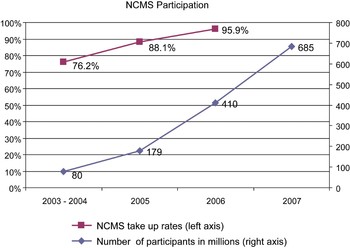
By the end of 2007, approximately 685 million rural residents (about 79 per cent of the total rural population) were enrolled in NCMS programmes. Participation grew 67 per cent between 2006 and 2007 and more than 700 per cent between 2004 and 2007 (Figure 1). However, not all the participation growth is due to programme expansion; average participation rates within programme counties have also risen, having increased from 76.2 per cent in 2004 to 95.9 per cent in 2006. Among poor households, participation growth is somewhat weaker, with participation rates increasing from 71 per cent in 2005 to only 82 per cent in 2006. The number of NCMS participants who have actually benefited from the programme has also seen a dramatic increase, doubling between 2005 and 2006. According to Ministry of Health statistics, hospitalization rates are 52.7 per cent higher in counties with NCMS programmes than in those without, while the average out-of-pocket expenditure for programme participants is 11.2 per cent and 19.3 per cent lower for county hospitals and township clinics, respectively.Footnote 34 Indeed, a Ministry of Health survey reveals very high satisfaction with the NCMS programme: among NCMS participants, about 90 per cent were willing to participate the following year, while 51 per cent of those not currently enrolled also expressed interest in becoming insured through the programme.Footnote 35 These outcomes, coupled with the accelerated rollout of the NCMS programme, suggest that the Chinese government considers it to be broadly successful.
NCMS Participation over Time

Data
The data for this study are derived from a joint household and county-level survey undertaken by the authors in October 2006.Footnote 36 The household sample consists of 50 households in each of 30 counties (1,500 households in total) in Anhui and Jiangsu provinces. Of those counties, 26 had NCMS programmes in place. The household survey included modules on demographics, health, health insurance, income sources, assets and expenditures. The county-level survey was directed at departments overseeing the NCMS in each county, asking detailed questions about the quality and quantity of health facilities as well as about the NCMS programme.
In Anhui, 16 of the province's 105 county-level divisions had operated NCMS programmes for at least one year prior to the date of our survey; all these counties are included in our sample, so the county-level data reflect a census of NCMS programmes in Anhui. All rural county-level districts in Jiangsu implemented NCMS programmes at least a year before the survey date, so the county sample in Jiangsu is drawn from a random sample stratified by county income. In both Anhui and Jiangsu, households are drawn from the National Bureau of Statistics sampling frame.
An important limitation of our study is that we do not have a random sample of NCMS programme counties across China. Therefore, our results are only statistically representative of counties with programmes in Anhui and Jiangsu. Nevertheless, the issues that we raise reflect broadly on the experience on NCMS programmes across China given the very loose guidelines provided by the central government. We thus limit ourselves to making qualitative generalizations based on these data.
Variation in NCMS Programmes
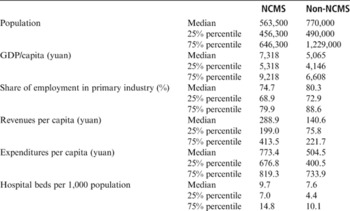
In Anhui, there is considerable evidence to suggest that the 16 counties that adopted the NCMS programme early face very different constraints on public spending from the 89 counties that had not yet adopted the programme (Table 1).Footnote 37 NCMS counties have lower populations (563,500 compared to 770,000 in the median county), perhaps easing the administrative burden of instituting the programme. They are also considerably wealthier, as average GDP/capita is 7,318 yuan in programme counties versus 5,065 yuan in all other counties. Residents of programme counties are less likely to be employed in agriculture (74.7 per cent versus 80.3 per cent in the median county), which may explain differences in GDP. A wealth disparity is also reflected in public finance: programme counties both provide more revenue to government coffers and receive more government spending per capita. Finally, as reflected in the fact that the median programme county has 16 per cent more hospital beds per 1,000 population than counties without an NCMS programme, counties that were selected to pilot the NCMS programme have greater capacity to cope with an increase in demand associated with health insurance. These observations combine to suggest that pilot counties in Anhui were chosen precisely because they were more likely to succeed. As a result, any causal inferences about the effect of NCMS programmes based on data from pilot counties would be subject to selection bias.
Characteristics of NCMS Counties and Non-NCMS Counties in Anhui

Source: China National Bureau of Statistics, China National Statistics Yearbook.
The participation fee chosen by counties largely reflects the broad differences in wealth levels between the two sample provinces. Only one county in Anhui set the participation fee above the 10 yuan minimum established by the central government (Table 2), and that county is quite wealthy, with a mean per capita income of more than twice the provincial average. By contrast, only two counties in Jiangsu adopted a 10 yuan participation fee, and two very wealthy county-level districts established participation fees of 30 yuan and 40 yuan, respectively. With additional wealth comes heterogeneity in participation fees and therefore programme financing. Of the ten sampled counties in Jiangsu, no more than two have the same participation fee.
Participation Fees in Sampled Counties, by Province

Notes: All but one county in Anhui province had a fee of 10 yuan.
Source:
Authors' survey data.
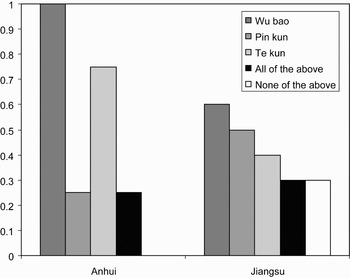
Most counties appear to actively promote the participation of the poor in NCMS programmes by allowing lower participation fees (Figure 2). For example, all the sampled counties in Anhui reduce participation fees for “five guarantee” (wubao 五保) households, as do six of the counties in Jiangsu. Eligibility for reduced fees for destitute (tekun 特困) households is higher in Anhui than in Jiangsu, and fewer officially designated poor (pinkun 贫困) households are eligible for reduced NCMS fees in Anhui than Jiangsu. In both provinces, some counties reduce fees for all three types of poor households, although three of the ten sampled counties in Jiangsu do not offer any fee reductions. In addition, six counties reduce participation fees for the disabled.
Share of Counties that Reduce Fees for Specific Types of Household, by Province

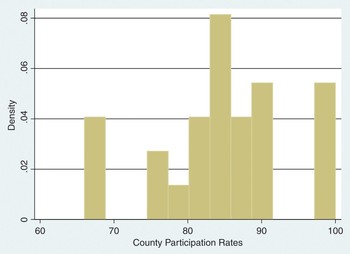
The share of the rural population enrolled in NCMS programmes is relatively high (Figure 3).Footnote 38 No sampled county's enrolment rate falls below 65 per cent.Footnote 39 Despite the stated intention of NCMS programmes to address health care needs among rural households only, some counties have opened the programmes to urban hukou holders as well, as shown by the fact that the number of participants exceeds the number of rural residents in one county in Anhui and three in Jiangsu.Footnote 40 Interestingly, the participation rates in the two provinces are not systematically different, with an average of 84 per cent in Anhui and 85 per cent in Jiangsu. Various subgroups of the population appear to be well integrated in the insurance scheme in both provinces as well: the participation rate among both wu bao and te kun households is 100 per cent in both provinces, and the median participation rate among pin kun households is only marginally lower.
NCMS Participation Rates in Sampled Counties

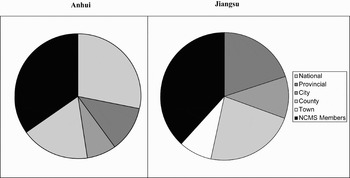
Reflecting differences in participation fees, financing strategies for NCMS programmes are generally quite different in the two provinces (Figure 4). While participation fees paid by households comprise a similar share of total programme financing, the central government provides about 27 per cent of the budget in Anhui but contributes nothing to the budget in Jiangsu, even in relatively poor counties. The Jiangsu provincial government and various local governments thus pay a higher share of the programme costs. For example, township governments contribute 8.3 per cent of the budget in Jiangsu, on average, while township governments in Anhui do not contribute to programme financing at all. Even so, these averages mask significant heterogeneity within each province. For example, the share of programme costs covered by the different levels of local government varies widely in Jiangsu; in fact, the provincial government contributes half the programme budget in the poorest counties, whereas four of the ten sampled counties receive almost no support from the provincial government. City officials compensate for the lack of financial support from the central and provincial governments in one wealthy county by paying over two-thirds of the NCMS budget themselves; in other rich areas in Jiangsu, county and town governments together pay a similar share. In Anhui, there is considerable variation in the share of financing provided by city governments.
Average NCMS Financing Schemes, by Province

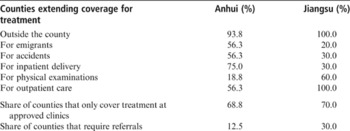
Table 3 describes variation in NCMS programme design in each of the counties participating in NCMS. Nearly 70 per cent of the sampled counties only authorize reimbursement for medical care obtained in officially designated clinics and hospitals, probably as a means of controlling costs. However, only two counties in Anhui and three in Jiangsu require that participants obtain referrals prior to treatment. Virtually all the sampled counties allow treatment at approved prefectural-level hospitals, although only 56 per cent in Anhui and 20 per cent in Jiangsu allow emigrants to participate,Footnote 41 probably because health care costs may be higher in destination communities. Over half the sampled counties in Anhui and 30 per cent of those in Jiangsu cover health expenses incurred as a result of accidents and inpatient child delivery, although fewer counties in Anhui than in Jiangsu extend coverage to physical examinations. Outpatient treatment is eligible for reimbursement in all ten of the sampled counties in Jiangsu but in only nine of those in Anhui.
Variation in NCMS Coverage in Sampled Counties, by Province

Source: Authors' survey data.
Reimbursement regimes for health expenditures vary tremendously, even in neighbouring counties. For example, the authors visited two counties with NCMS programmes during preliminary field work in 2005. While both had deductibles of 200 yuan and ceilings of 20,000 yuan, the reimbursement schedules were very different. In the first county, reimbursements increased progressively with total treatment expenditure. Thus, individuals whose medical treatment cost 999 yuan were reimbursed at a flat rate of 20 per cent, while those whose medical treatment cost 1,000 yuan were reimbursed at a flat rate of 25 per cent. Such a system creates undesirable incentives for patients and doctors, a problem that was acknowledged by NCMS officials in the county. In the second county, by contrast, the reimbursement rates decreased as total costs rose, suggesting that catastrophic medical care is still unlikely to be affordable for many households because out-of-pocket expenditure rises with health care costs.
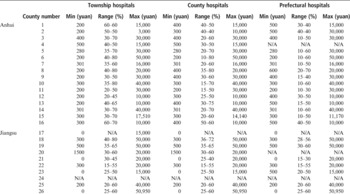
Table 4 depicts the minimum expenditure per health episode that is eligible for reimbursement, the range of reimbursement rates (which, as described above, vary according to the total expenditure) and the maximum level of spending eligible for reimbursement (that is, the level beyond which additional spending is out-of-pocket) in the 26 sampled counties. In many cases, the minimum, range and maximum vary by the type of hospital in which treatment is sought. Moreover, there is considerable variation in all these measures, both between and within provinces. For example, the floor established for deductible inpatient health expenses in town clinics varies from 200 yuan to 500 yuan in Anhui and from nothing to 1,500 yuan in Jiangsu. Similarly, reimbursement rates at township hospitals range from 15 to 80 per cent depending on the county and the total expenditure. The maximum expenditure eligible for reimbursement ranges from 3,000 yuan to 50,950 yuan. Deductibles are lower for treatment at lower-level clinics and hospitals in six of the ten sampled counties in Anhui, and reimbursement rates are higher at lower levels of administration in 18 of the 26 sampled counties. These results suggest that programme administrators have built incentives to pursue least-cost treatment and to support the local economy through the NCMS system. Despite the high level of variation, the median NCMS programme in Jiangsu has a lower minimum and a higher maximum, suggesting that NCMS programmes in Jiangsu are less resource-constrained than those in Anhui.
Reimbursement Schemes in Sampled Counties, by Province

Notes: “Min” is the minimum level of spending before expenditures become eligible for reimbursement at each level of hospital. “Range” is the range of reimbursement rates available. “Max” is the maximum level of spending eligible for reimbursement. “N/A” indicates that these data were not made available by county officials.
Source:
Authors' survey data.
Despite the relatively low minimum reimbursement rates reported in Table 4, survey evidence indicates that actual reimbursement rates for inpatient services often fall below these figures. For example, they were lower than the minimum advertised rates at township hospitals in 19 of the 23 sampled counties for which data are available. This finding suggests either that NCMS programmes do not cover the inpatient services that the local population needs or that the stated benefits of the programme greatly exceed the actual benefits.
In summary, our data demonstrate significant variation in NCMS programme design and implementation across counties in both Anhui and Jiangsu. These differences in participation fees, financing structures, coverage and eligibility, reimbursement rates, and other components of the programme may influence individuals' satisfaction and thus the long-term sustainability of the NCMS programme.Footnote 42 The next section uses descriptive regressions to determine which aspects of programme design are associated with more successful outcomes.
Measuring the Success of NCMS Programmes
Perhaps the most straightforward measure of the success of NCMS programmes is the enrolment rate. As noted in Figure 3, enrolment rates in the sampled counties are extremely high, suggesting that households are indeed satisfied. However, high participation rates may be attributable to the novelty of the programme, to strong tactics being used to encourage participation, or both. We therefore consider several other measures of programme success, each with its own advantages and drawbacks.
First, preliminary evidence shows that households are compelled to enrol at the time that the system is introduced, but that this pressure may abate over time.Footnote 43 Thus, increasing participation rates subsequent to the initial enrolment drive may be indicative of households waiting to enrol until after their friends and neighbours have benefited. That is, households that enrolled after the initial sign-up period may have done so precisely because the programme was demonstrably successful. Second, households were asked whether or not the reimbursement process is cumbersome, which may reflect their willingness to re-enrol in the future.Footnote 44 This outcome will be speculative for households that have never applied for reimbursement, but their perception may nevertheless influence the long-term success of the NCMS programme. Third, the survey asked whether household members carry other insurance, which may be interpreted in several ways. On the one hand, households that have other insurance may feel that the NCMS coverage is inadequate and not successful in meeting their insurance needs.Footnote 45 On the other hand, carrying additional insurance may imply that households have seen the benefits of insurance and therefore have chosen to purchase additional coverage. In this case, other insurance would be positively correlated with the success of the NCMS programme. The explanatory factors associated with additional insurance may provide clues as to the nature of this relationship.
To measure the conditional correlations between programme success and programme design, we use probit regressions and report marginal effects, with p-values based on cluster-robust standard errors.Footnote 46 We draw on the literature to choose aspects of programme design that reflect key elements, specifically, the share of total funding contributed by the county, the minimum level of spending required before expenditures are eligible for reimbursement, whether emigrants are covered by the NCMS plan, whether outpatient services are eligible, whether reimbursement is only offered at approved hospitals, and whether referrals are required for treatment.
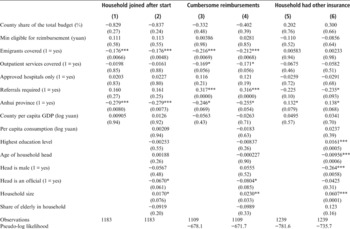
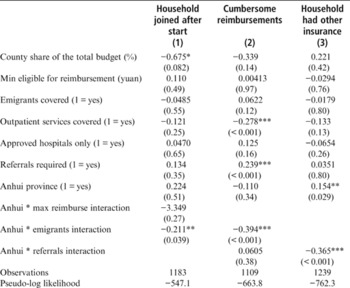
Controlling for county GDP, we find a strong negative correlation between eligibility for emigrants and delayed enrolment, suggesting that coverage of out-migrants is attractive for households in Anhui and Jiangsu (Table 5). Larger households were more likely to delay enrolment; given that all household members are typically required to enrol before any individual participant becomes eligible for reimbursement, this may reflect a wait-and-see approach among households for whom the total cost of participating is higher. Households in which the head is a government official were less likely to delay enrolment, consistent with a scenario in which there is pressure to participate, particularly among community leaders. Similarly, households that included government officials were less likely to report reimbursement procedures being cumbersome. Households located in counties in which emigrants are covered by the NCMS programme were also less likely to consider the reimbursement procedures to be cumbersome, as were households living in counties with programmes that cover outpatient services. By contrast, requiring referrals prior to seeking treatment is positively correlated with the perception that reimbursement procedures are cumbersome. We also find that the decision to purchase other insurance is strongly correlated with household demographics, as younger and more educated household members are more likely to have other insurance. As such individuals are more likely to have off-farm employment, additional insurance may be associated with such opportunities.Footnote 47 Similarly, larger households and female-headed households are each more likely to report at least one household member as having other insurance, perhaps because such households are more likely to include out-migrants. The almost total lack of correlation between programme characteristics and households' decisions to carry other insurance suggests that other insurance programmes do substitute for NCMS insurance among households that consider the NCMS coverage to be inadequate.
Conditional Correlations between NCMS Success and Programme Design (with controls for county and household characteristics)

Notes: Robust p values with county-level clustering in parentheses. ***p < 0.01, **p < 0.05, *p < 0.1. Estimation method is probit. Maximum share of expenses covered is measured for county level hospitals. The county deductible is defined as in the text.
Source: Authors' survey data.
Although households in Anhui are less likely to consider the reimbursement procedure to be onerous, they are also less likely to have delayed enrolment and more likely to carry additional insurance. To investigate these relationships further, the aspects of programme design that are statistically correlated with each measure of programme success are interacted with the Anhui province dummy in Table 6.Footnote 48 The negative correlation between coverage of emigrants and both delayed enrolment and cumbersome reimbursement requirements is only statistically significant in Anhui, suggesting that Anhui residents are particularly concerned about coverage for emigrants. Given that labour migration is a significant source of income in Anhui, this result is not unexpected. Programmes that require referrals are considered to be cumbersome in both provinces. Finally, Anhui residents are more likely to hold additional insurance, regardless of programme characteristics. Interestingly, however, residents of Anhui counties that require referrals are less likely to have additional insurance; as noted above, one possible explanation is that people who have successfully used the NCMS programmes develop a taste for insurance and purchase additional coverage.
Conditional Correlations between NCMS Success and Programme Design (with Interaction Terms)

Notes: Robust p values in parentheses. ***p < 0.01, **p < 0.05, *p < 0.1. Estimation method is probit. Standard errors are clustered at the county level. Maximum share of expenses covered is measured for county level hospitals. The county deductible is defined as in the text.
Source: Authors' survey data.
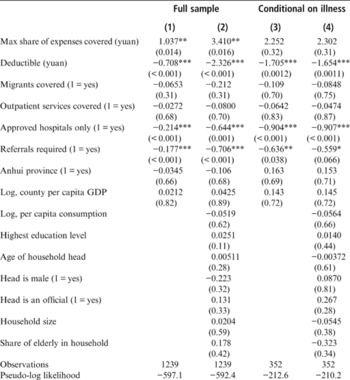
Another appealing measure of programme success is whether participating households have actually received reimbursement, under the assumption that households that benefit from the programme are more likely to re-enrol.Footnote 49 The share of total financing contributed by the county is positively correlated with reimbursement (Table 7), perhaps reflecting the fact that funding from the national government is often subject to delays and bureaucratic red tape, unlike funding disbursed locally.Footnote 50 By contrast, the minimum level of spending before expenditures become eligible for reimbursement, eligibility being limited to approved hospitals and treatment being dependent on a referral are all negatively correlated with receiving reimbursement. Of course, if the incidence of illness varies by county, then these correlations may reflect vulnerability to illness as well as programme characteristics. In columns 3 and 4, we thus restrict the sample to households that reported seeking inpatient care or that have otherwise reported a decline in health status during the year preceding the survey. Within this subsample, the minimum level of spending, restrictions on hospital choice and required referrals all reduce the likelihood of having received reimbursement.
Correlation between Receipt of NCMS Reimbursement and Programme Design (with controls for county and household characteristics)

Notes: Robust p values with county-level clustering in parentheses. ***p < 0.01, **p < 0.05, *p < 0.1. Models are estimated using probit regressions and marginal effects are reported. In columns 3 and 4, illness is defined as either a household member seeking inpatient care or reporting that their health status declined since 2005. Maximum share of expenses covered is measured for county level hospitals. The county deductible is defined as in the text.
Source: Authors' survey data.
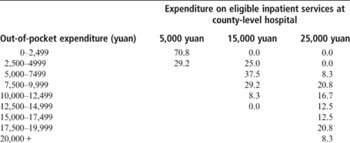
Finally, Table 8 reports the out-of-pocket expenses incurred for catastrophic illnesses treated at county hospitals under the assumption that the illness is eligible for reimbursement at the maximum rate. Columns 1, 2 and 3 assume total expenditures of 5,000 yuan, 15,000 yuan and 25,000 yuan, respectively. We chose these amounts based on the average inpatient expenditures in 2005, which were just under 5,000 yuan.Footnote 51 One may thus think of 5,000 yuan as an average expenditure and 25,000 yuan as a catastrophic expenditure. Although reimbursement rates are as high as 80 per cent in some counties, the upper bound on total expenditures eligible for reimbursement often reduces the reimbursement rates, and thus out-of-pocket expenditures are sometimes quite high. For example, an individual needing 15,000 yuan of treatment would pay less than 5,000 yuan out-of-pocket in only 25 per cent of sample counties. This problem is even more acute at higher levels of spending. For example, in over half of the sampled counties (14 of 26), an individual receiving 25,000 yuan of eligible inpatient services would pay more than half the costs out-of-pocket. If poor households are faced with such costs even after accounting for insurance, they are still unlikely to seek medical treatment, calling into question the utility of the NCMS programme for some households.Footnote 52
Out-of-Pocket Expenditure for Eligible Treatment at County-Level Hospitals in Sampled Counties

Notes: Figures are expressed as percentages, and should be interpreted as the percentage of counties in which a household would pay out-of-pocket expenditures in the range listed in each row. For example, in 70.8% of counties, a household incurring 5,000 yuan in expenditures would pay between 0 and 2,499 yuan out-of-pocket.
Source: Authors' survey data.
To summarize, coverage of emigrants and lower minimum spending levels before expenditures are eligible are good indicators of successful programmes. By contrast, restrictions on participation such as requiring referrals prior to treatment, limiting households to approved hospitals and low caps on reimbursements appear to limit the utility of the NCMS.
Conclusion
The introduction of the NCMS in October 2002 put rural health care back on the national agenda after a 25-year absence. As with other significant reforms in China, implementation of the NCMS has been both gradual and experimental. Although it is expected to operate in all rural Chinese counties by the end of 2008, county governments have been given significant autonomy in the design of their own NCMS programmes, often with little guidance provided by the central government or provincial authorities.
As a result, fundamental characteristics of the NCMS programme, such as participation rates, the minimum spending levels eligible for reimbursement and reimbursement rates, all vary dramatically from one county to the next. The contributions provided by the central government and various local governments also vary widely by county, with local governments contributing the lion's share of operating costs in some counties and virtually nothing in others. Even in the best-funded counties, however, the pooled fund is sufficient to cover only 30 per cent of anticipated medical expenditures.Footnote 53 The budget constraint affects decisions that each individual county makes about reimbursement rates and procedures, whether or not coverage should be restricted to inpatient care or catastrophic illness, and whether referral is first necessary prior to covered treatment.
While we find that in general participation in the NCMS is high, the heterogeneity in programme design influences satisfaction with it in each county, and thus its prospects for success. We consider four distinct measures of success: whether households joined after having had an opportunity to see the NCMS programme in operation, whether they consider the reimbursement procedures to be cumbersome, whether they carry insurance other than NCMS coverage, and whether participating households had received reimbursement at the time of the survey. We find that households respond favourably to making emigrants eligible for coverage. They also respond favourably to lowering the spending threshold for reimbursement eligibility. They are less likely to have received reimbursement in counties that require referrals, in part because they find reimbursement procedures in such counties to be cumbersome. They are also less likely to have received reimbursement in counties that limit treatment to approved hospitals, suggesting that such restrictions may be onerous.
As our analysis is from the household perspective, one might argue that none of our findings is that surprising, as all of them raise the value of the NCMS to the household while making it more costly to run. Nevertheless, there are two potential policy implications that could help improve overall health at a relatively low cost. First, China's government should begin to provide subsidized health care to migrants in urban areas. Shanghai has piloted a programme attempting to provide insurance to migrants, although take-up has been low.Footnote 54 A system for providing migrants with insurance or subsidized care in urban areas could potentially ease the financial burden on counties trying to provide care for migrants. Second, lowering the minimum threshold for reimbursement would not be terribly costly; for example, if the minimum was lowered from 500 yuan to 300 yuan at a 40 per cent reimbursement rate, the cost would be 80 yuan per additional reimbursement. For counties with budget surpluses, lowering the threshold represents a simple means of raising programme satisfaction. Removing the need for referrals or removing limits on the types of health facilities that could be used would seem more costly from the government perspective, as both could potentially lead to more frequent reimbursements of larger amounts.
Even within counties that are highly successful at present, however, the NCMS is likely to face significant long-term challenges. In particular, the incidence of catastrophic illness is relatively low, affecting no more than 4 per cent of rural households annually.Footnote 55 Given that the NCMS emphasizes such illnesses over outpatient health care, preventative care, inpatient delivery and accidents, the majority of households will see limited direct benefit from participation. If these healthy households dis-enrol from the NCMS, programmes in cash-strapped counties will face even tighter budget constraints. Second, programmes that do not cover preventative care may promote risky behaviour among participants who delay treatment for health problems until they are severe enough to become eligible for reimbursement. In addition to the negative health consequences of such behaviour, reliance on catastrophic care instead of preventative medicine is financially costly. Finally, reimbursement rates are generally low, even in the case of catastrophic illnesses. For example, the co-pay exceeds half of a bill totalling 15,000 yuan for eligible inpatient care at county-level hospitals in over one-third of the sampled counties. Such reimbursement rates may simply not be enough to encourage the poor to seek treatment for serious ailments. If the NCMS is to be successful in decreasing the impact of health shocks on poor households in rural China, a deeper financial commitment to the NCMS is necessary.