Introduction
Migration had a profound impact on Great Britain's ethnic composition in the second half of the twentieth century. The arrival of migrants from former colonies or dependencies (since World War II in particular) changed the sociolinguistic landscape of Great Britain and there was extensive language and dialect contact in nearly all major cities. Migrants from the Indian subcontinent were particularly influential: in the most recent (2011) census, 2,984,670 residents of England and Wales (5.3% of the total population) identified as Indian, Pakistani, or Bangladeshi (ONS 2012, table KS201EW). The British Asian community is not only the country's largest nonwhite ethnic minority group but also one that is characterized by considerable internal heterogeneity, both in terms of heritage country and along dimensions such as religious affiliation, regional-linguistic origins, identity, or sense of belonging (see Brown Reference Brown2006; Kalra Reference Kalra, Lal, Reeves and Rai2006; Reynolds & Verma Reference Reynolds, Verma and Britain2007).
Diasporic communities can be defined as ‘a minority ethnic group of migrant origin which maintains sentimental or material links with its land of origin, either because of social exclusion, internal cohesion or geo-political factors. It is never assimilated into the whole society but in time, develops a diasporic consciousness that carries out a collective sharing of space with others' (Esman Reference Esman, Hutchinson and Smith1996:316). Language usage in these communities emerges as a sociolinguistic hotspot, with criteria such as identity, interaction, and (degree of) social integration looming large in studies of the British Asian diaspora (Schreier Reference Schreier, Hernández-Campoy and Conde-Sylvestre2012). A number of studies have explored the social dimension of English within South Asian communities in London (Evans, Mistry, & Moreiras Reference Evans, Mistry and Moreiras2007; Hirson & Sohail Reference Hirson and Sohail2007; McCarthy, Evans, & Mahon Reference McCarthy, Evans and Mahon2011; Sharma Reference Sharma2011; Sharma & Sankaran Reference Sharma and Sankaran2011) and other British cities, including Bradford (Heselwood & McChrystal Reference Heselwood and McChrystal2000), Sheffield (Kirkham Reference Kirkham2011), and Glasgow (Lambert, Alam, & Stuart-Smith Reference Lambert, Alam and Stuart-Smith2007; Alam & Stuart-Smith Reference Alam and Stuart-Smith2011; Stuart-Smith, Timmins, & Alam Reference Stuart-Smith, Timmins, Alam, Gregersen, Parrott and Quist2011). Moreover, speakers of South Asian origin have been included in investigations of adolescent (and adult) heteroglossic speech practices (Rampton Reference Rampton1995, Reference Rampton2011; Harris Reference Harris2006) and in broader explorations of the impact of ethnic minority groups on current changes in British English (Khan Reference Khan2006; Torgersen, Kerswill, & Fox Reference Torgersen, Kerswill, Fox and Hinskens2006; Fox Reference Fox2015; Kerswill, Torgersen, & Fox Reference Kerswill, Torgersen and Fox2008; Cheshire, Kerswill, Fox, & Torgersen Reference Cheshire, Kerswill, Fox and Torgersen2011).
The question we address here is whether and to what extent the development of a diasporic consciousness and a sense of belonging (homeland vs. host country; Safran Reference Safran1991) are reflected in the community's speech patterns, that is, whether there is adoption of local features or maintenance of ancestral ones, both in the country of origin and in Great Britain. Safran (Reference Safran1991) shows that diaspora communities often have a strong feeling of belonging to the homeland and lists a set of characteristics, namely: residence in a peripheral region with regard to a common center (their origins), the idea of a common (often idealized) homeland, a feeling of exclusion from the host society, the desire to maintain the original culture in the homeland, and a sense of relatedness and allegiance to other groups from the same homeland. Language usage in diaspora communities is thus a relevant act of identity with high indexical function. While establishing connections to the homeland (e.g. among the Greeks in Germany; cf. Landau Reference Landau, Hutchinson and Smith1996), the search for an ancestral language in order to establish shared collective memories and social connections can also pose a challenge to group identity (cf. Lehmann's Reference Lehmann1998 discussion of Afro-Caribbean communities).
Our study contributes to the growing body of research on dialect variation and change in the diaspora by looking into a community that has received no attention to date: the East African Asians in Leicester. The so-called twice migrants, a term used by Bhachru (Reference Bhachru1986) to refer to East African Sikhs in Britain, refers to people of South Asian origin who have migrated to the UK from countries other than those in South Asia.
Our community differs from other South Asian groups in the UK in that its diasporic journey involved two stages: migration from the Indian subcontinent to East Africa (beginning in the late nineteenth century), and subsequent migration from East Africa to Great Britain (around 1970). Secondary diaspora situations allow us to study how such an unusual migration pattern influences the English variety or varieties spoken by immigrant groups and whether these differ from those found in direct (‘once’) migrant communities (as witnessed, for example, in the development of multiethnolects across Europe; Nortier & Dorleijn Reference Nortier, Dorleijn, Bakker and Matras2013).
The chief aim is thus to investigate the relationship between the speakers' unusual migration histories and their speech patterns. With the exception of Fiji Indians in New Zealand (Hundt Reference Hundt2014), such second-time migrations have not, to the best of our knowledge, been the focus of previous work on English in South Asian overseas communities. In order to gain a better understanding of the sociolinguistics of twice migration, we examine variation in the production of three vowels—foot, strut, and nurse (Wells Reference Wells1982)—by a group of first- and second-generation migrants from the East African Asian community in Leicester. We present and discuss the results of an acoustic analysis that seeks to establish (i) whether the patterns displayed by the first generation (Gen1) show any parallels to three potential input varieties, namely, Indian English, East African English, and East Midlands English; (ii) whether and how the production of vowels changes between Gen1 and the second, locally born generation (Gen2); and (iii) what role identity formation and a shifting sense of belonging (East African homelands or British Midlands) play in the process. As for terminology, Indian English (IndE) is used here in a broader sense to denote the second-language varieties of English spoken on the Indian subcontinent (Wells Reference Wells1982:624; McArthur Reference McArthur2003:312), the original homeland of the East African Asians. East African English (EAfE) denotes English spoken as a second language in Kenya, Uganda, and Tanzania (Schmied Reference Schmied and Mesthrie2008:150), their first host community; and East Midlands English (EMidE) refers to the native variety of English spoken in Leicester (Wells Reference Wells1982:349–51; Hughes, Trudgill, & Watt Reference Hughes, Trudgill and Watt2005:68–71), their current host community.
In the following sections, we provide a discussion of previous work on English in the British Asian diaspora and give a short overview of the migration history of the East African Asian community in Leicester. We then describe the linguistic variables and methods used, present the findings, and contextualize them in the larger framework of language variation and change under diasporic migrant conditions, with focus on the sociolinguistically unusual situation of twice migration.
Feature retention and reallocation in British Asian Englishes
Research on English in British Asian communities has predominantly dealt with the retention and transmission of L1-derived features or, more generally, contact-induced innovations. First-generation migrants have not been a major focus in recent studies, but when Gen1 speakers were included, L1-influenced traits were typically commented on. Evans et al. (Reference Evans, Mistry and Moreiras2007), for instance, found that vowel spaces of the English spoken by first-generation Gujarati migrants in London resembled that of their native language. Likewise, McCarthy et al. (Reference McCarthy, Evans and Mahon2011) showed that Gen1 informants from the London Bangladeshi community frequently used variants of /l/, /r/, and of British English monophthongs similar to those of Sylheti, and Sharma & Sankaran (Reference Sharma and Sankaran2011) reported the use of retracted /t/, a prototypical and rather salient IndE feature, by Indian-born speakers from the Punjabi community now residing in Southall, London.
Regarding locally born speakers, a common view in the dialect acquisition literature is that immigrant children do not acquire the foreign accent of their parents as such (see Chambers Reference Chambers2002). Evans and colleagues (Reference Evans, Mistry and Moreiras2007) and McCarthy and colleagues (Reference McCarthy, Evans and Mahon2011) found that their second-generation subjects had not acquired the L1-influenced traits of the first generation but had a strong tendency to use phonetic variants that approximated those of Standard Southern British English (SSBE), one of the local target varieties. The maintenance of L1-derived features (e.g. retracted /t/, clear variants of coda /l/, and monophthongal face and goat) is, however, attested in all other studies of British-born speakers. Furthermore, L1-derived traits often undergo reallocation, a process common in new dialect formation ‘where two or more variants in the dialect mix survive the leveling process but are refunctionalized, evolving new social or linguistic functions in the new dialect’ (Britain & Trudgill Reference Britain and Trudgill1999:245). L1-derived features were found to correlate with factors such as gender (Heselwood & McChrystal Reference Heselwood and McChrystal2000), friendship groups, and wider social networks (Fox Reference Fox2015), or to index ethnic orientation, local (ethnic) identity, and community of practice membership (Khan Reference Khan2006; Hirson & Sohail Reference Hirson and Sohail2007; Lambert et al. Reference Lambert, Alam and Stuart-Smith2007; Alam & Stuart-Smith Reference Alam and Stuart-Smith2011; Stuart-Smith et al. Reference Stuart-Smith, Timmins, Alam, Gregersen, Parrott and Quist2011). They also exhibit a complex combination of age- and gender-related variation that reflects the sociohistorical conditions in which different age groups had grown up (Sharma Reference Sharma2011; Sharma & Sankaran Reference Sharma and Sankaran2011).
Investigations of heteroglossic speech practices showed that adolescents from South Asian and other ethnic backgrounds employ a mix of Punjabi, Indian English, Caribbean Creole, and Cockney elements to signal inter-ethnic solidarity and working-class alignment (Rampton Reference Rampton1995) or a new type of hybrid ethnic identity (Harris Reference Harris2006), a practice carried over into adulthood by at least some speakers (Rampton Reference Rampton2011). Lastly, some innovations generated within South Asian and other ethnic-minority communities have been adopted by speakers of local British English, particularly by adolescents (Khan Reference Khan2006; Torgersen et al. Reference Torgersen, Kerswill, Fox and Hinskens2006; Fox Reference Fox2015; Kerswill et al. Reference Kerswill, Torgersen and Fox2008; Cheshire et al. Reference Cheshire, Kerswill, Fox and Torgersen2011). This indicates that the varieties of English spoken by British Asians and other ethnic minority groups may undergo refunctionalization as an identity-carrier and are an important source of innovation and change in present-day British English (cf. recent research on the origins and spread of multiethnolects across Europe; Nortier & Dorleijn Reference Nortier, Dorleijn, Bakker and Matras2013).
Sociohistorical background
The South Asian diaspora in East Africa
Large-scale migration from the Indian subcontinent to East Africa began with the ‘scramble for Africa’ at the end of the nineteenth century (Twaddle Reference Twaddle, Clarke, Peach and Vertovec1990; Gregory Reference Gregory1993; Oonk Reference Oonk, Lal, Reeves and Rai2006). When the region corresponding to present-day Kenya, Uganda, and Tanzania was partitioned between Britain and Germany in the 1890s, the expansion of the European powers created new economic opportunities that prompted extensive migration from South Asia. Between 1896 and 1903, almost 32,000 indentured laborers, mainly Sikhs from the Punjab, were imported by the British for the construction of the Uganda Railway, of whom about one fifth remained in East Africa (Gregory Reference Gregory1993:160–62). This group was soon joined by large numbers of free migrants from the northwestern part of the Indian subcontinent (Kutch, Kathiawar, inland Gujarat, Sindh and, to a lesser extent, Maharashtra) and, to a minor extent, from Goa (Gregory Reference Gregory1993:14, 37; Oonk Reference Oonk, Lal, Reeves and Rai2006:255). Many of them turned to commerce, opening up small retail shops, while others took up work as artisans or were employed in the colonial administration and as clerks in private companies. Their sociolinguistic backgrounds are diverse: the majority of the early migrants spoke no or little English at best. This changed in later years; English was widespread within certain immigrant groups and there was also continuous input from the Indian subcontinent through South Asian teachers (similarly, many went to India for further education).
By the early 1960s, the South Asian population in East Africa numbered about 364,500: 175,000 in Kenya, 77,500 in Uganda, 92,000 in Tanganyika, and 20,000 in Zanzibar (Oonk Reference Oonk, Lal, Reeves and Rai2006:256). Its linguistic make-up included a range of Indo-Aryan languages (mainly Gujarati and Kutchi, but also Punjabi, Sindhi, Marathi, and Konkani), as well as second-language varieties of English and Kiswahili. Although East African Asians never exceeded 2% of the total population (Oonk Reference Oonk, Lal, Reeves and Rai2006:254), they had come to predominate at the lower and middle levels of the colonial administration and in many sectors of the economy (discussion in Gregory Reference Gregory1993). After the East African territories gained independence in the early 1960s, the new governments adopted an economic policy of Africanization. This included restricting work permits and trading licenses for noncitizens and, in Tanzania, the nationalization of the main industries, banks, and insurance companies (Gregory Reference Gregory1993; Brown Reference Brown2006; Oonk Reference Oonk, Lal, Reeves and Rai2006). As a consequence, the late 1960s and early 1970s saw a large-scale exodus of South Asians from East Africa, the departure of about half of the Kenyan Asian population and 40% of Tanzanian Asians. In Uganda, General Idi Amin expelled all noncitizen South Asians in August 1972, giving them ninety days to leave and allowing them to take only £50 per head of family plus personal belongings. Within three months, the overwhelming majority of South Asians was forced to leave Uganda, losing assets amounting to an estimated £100–150 million (cf. Marett Reference Marett1989 for a detailed and very gripping account).
Relatively few East African Asians returned to the Indian subcontinent. A sizeable number went to Canada and the US, while smaller groups migrated to Malawi, Australia, New Zealand, and various cities in continental Europe (Brown Reference Brown2006; Oonk Reference Oonk, Lal, Reeves and Rai2006). Because of the former colonial connections between East Africa and Britain, however, the great majority resettled in the UK.
East African Asians in Leicester
The major British destinations for East African Asian migrants were London and Leicester. The Leicester Council for Community Relations estimated that by 1978, around 19,500 East African Asians had settled in Leicester, making up roughly half of the city's South Asian population: 10,500 from Uganda, 7,000 from Kenya, and 2,000 from Tanzania (Phillips Reference Phillips, Jackson and Smith1981:104). The migration patterns of the East African Asians differed from those of South Asians who arrived earlier in the UK (Phillips Reference Phillips, Jackson and Smith1981; Brown Reference Brown2006; Reynolds & Verma Reference Reynolds, Verma and Britain2007). While the latter were often unskilled male workers from rural areas who had reached the UK via chain migration (Kerswill Reference Kerswill and Hickey2010), the East African Asians arrived as family units via cluster migration. They tended to come from urban areas and had formerly pursued a variety of occupations (often requiring high skills and training). Moreover, many had formal qualifications and spoke English in their everyday lives (Robinson Reference Robinson1993:234–35). Although the twice migrants experienced a drop in social status upon arrival in Britain, their resources and skills allowed them to improve their socioeconomic situation within a few years, leading Robinson (Reference Robinson1993:241–42) to argue that ‘[f]ew other minority groups in Britain have achieved so much in such a short period of time’ (cf. also Marett Reference Marett1993).
The linguistic variables
The vowels analyzed in the present study are SSBE /ʊ/, /ʌ/, and /ɜː/, or foot, strut, and nurse in Wells' system of lexical set keywords (Wells Reference Wells1982:131–33, 137), and we begin with a description of their phonemic status and phonetic realization in IndE, EMidE, and EAfE. Qualitative descriptions of IndE generally list foot as the phoneme /ʊ/, sometimes specifying that, phonetically, it is realized as a rounded or weakly rounded [ʊ] (CIEFL 1972; Wells Reference Wells1982; Bansal Reference Bansal and Ramsaran1990; Nihalani, Tongue, Hosali, & Crowther Reference Nihalani, Tongue, Hosali and Crowther2004; Gargesh Reference Gargesh and Mesthrie2008). The evidence from these sources and other acoustic studies (Wiltshire Reference Wiltshire2005; Wiltshire & Harnsberger Reference Wiltshire and Harnsberger2006; Maxwell & Fletcher Reference Maxwell and Fletcher2009), however, suggests that foot may also show qualitative and/or quantitative overlap with goose, often depending on the speaker's regional-linguistic origins. With regard to the other two variables, the lack of a phonemic distinction between strut,nurse, and/or schwa figures prominently in the IndE literature (CIEFL 1972; Wells Reference Wells1982; Bansal Reference Bansal and Ramsaran1990; Nihalani et al. Reference Nihalani, Tongue, Hosali and Crowther2004). The phonetic qualities most widely attested for these vowels are [ə, ʌ] for strut and [ə(ːr), ʌ(ːr), ɜ(ːr)] for nurse, with two additional variants, [ɐ] for strut and [ɐː(r)] for nurse, reported by Maxwell & Fletcher (Reference Maxwell and Fletcher2009). Variability due to the regional-linguistic background of speakers (Gargesh Reference Gargesh and Mesthrie2008:235) is confirmed by acoustic studies: whereas L1 Hindi and Punjabi informants show a substantial overlap between nurse and either strut or schwa (Maxwell & Fletcher Reference Maxwell and Fletcher2009), Gujarati and L1 Tibeto-Burman subjects display a greater qualitative distinction between the two vowels (Wiltshire Reference Wiltshire2005; Wiltshire & Harnsberger Reference Wiltshire and Harnsberger2006).
EAfE is characterized by a loss of length distinctions and a tendency to avoid central vowels, which has led to a reduced vowel system (Schmied Reference Schmied and Mesthrie2008:159–60). Qualitative descriptions of the variety indicate that foot has collapsed with goose as [u] (Hancock & Angogo Reference Hancock, Angogo, Bailey and Görlach1982; Trudgill & Hannah Reference Trudgill and Hannah1994; Schmied Reference Schmied and Mesthrie2008). The absence of a qualitative contrast between foot and goose was also reported in an acoustic study of Black Kenyan English (Hoffmann Reference Hoffmann2011). strut and nurse have merged with trap, start,bath, and lett er under /a/ (Hancock & Angogo Reference Hancock, Angogo, Bailey and Görlach1982; Trudgill & Hannah Reference Trudgill and Hannah1994; Schmied Reference Schmied and Mesthrie2008). The occurrence of /a/ for strut and nurse is regarded as a highly diagnostic feature of EAfE, since West African English tends to have a back vowel /ɔ/ for this pair (Simo Bobda Reference Simo Bobda2001, Wolf Reference Wolf and Kirkpatrick2010). Whereas low front [a] is the only phonetic realization reported for strut, some variation seems to exist for nurse. For this vowel, besides the main quality [a] an open mid variant [ε] is found, which appears to be particularly common in Tanzanian English (Simo Bobda Reference Simo Bobda2001; Wolf Reference Wolf and Kirkpatrick2010). In Hoffmann's (Reference Hoffmann2011) acoustic study, strut and nurse clustered with trap, bath, start, and the onset of price in the low central area of the vowel space, and the author observes that the merged vowel has a somewhat centralized quality.
EMidE traditionally has no phonemic contrast between foot and strut. Like dialects of the North of England, it was not affected by the foot-strut split, a seventeenth-century sound change which led to the development of an additional phoneme /ʌ/ in the South (MacMahon Reference MacMahon and Romaine1999), and thus preserved the older five-term short vowel system with /ʊ/ for both foot and strut (Wells Reference Wells1982; Trudgill Reference Trudgill1999; Hughes et al. Reference Hughes, Trudgill and Watt2005). According to Wells (Reference Wells1982:356), the unsplit vowel found in northern England is generally realized as [ʊ] or [ɤ]. Speakers of more educated northern English dialects, however, often display a six-term system in which strut does contrast with foot but has a quality—often around [ə] or [ɤ]—that is phonetically intermediate between /ʊ/ and SSBE /ʌ/ (Wells Reference Wells1982; Hughes et al. Reference Hughes, Trudgill and Watt2005). Variation between the five- and six-term systems is common in the southern Midlands, for example, Northamptonshire, as ‘the isogloss for the foot-strut Split runs from the Severn estuary in the west to the Wash in the east’ (Wells Reference Wells1982:351), yet /ʌ/ does not seem to have advanced to Leicester. Evans & Iverson (Reference Evans and Iverson2007) conducted a longitudinal study of accent change among young adults from Ashby de la Zouch, a small town in Leicestershire and close to the city of Leicester. They found that, as a consequence of moving away from the area for university education (not, as one of the reviewers reminds us, due to acquisition in the East Midlands themselves), their subjects fronted and lowered the vowels in cud, bud (strut) and could (foot) over time, becoming more similar to the SSBE variants they had come into contact with (Evans & Iverson Reference Evans and Iverson2007:3819; cf. discussion of hybrid Leicestershire-SSBE below). Regarding the third variable, Wells (Reference Wells1982:360–61) observes that northern nurse is very similar to SSBE [ʌ:]. Raised and/or fronted variants have been reported for the Midlands (Wells Reference Wells1982; Docherty & Foulkes Reference Docherty, Foulkes, Foulkes and Docherty1999), and close realizations also occurred among Evans & Iverson's (Reference Evans and Iverson2007) Ashby speakers, although the overall tendency in this group was towards SSBE-like variants (Evans 2011, p.c.).
To sum up, there are important differences in regard to both phonemic status and phonetic realization of foot, strut, and nurse across the varieties that interacted in the case of the twice migrants (IndE, EAfE, and EMidE). Whereas the absence of a qualitative contrast between strut and nurse is widely reported for IndE and EAfE, EMidE displays different qualities for the two vowels. Central variants of strut and nurse predominate in IndE, while front realizations are characteristic of EAfE. In contrast, foot and strut are separate phonemes in IndE and EAfE but not in broad EMidE.
Method
Data collection and participants
The data used in the present study were collected via sociolinguistic interviews in the city of Leicester in 2007 and 2009 (Rathore-Nigsch Reference Rathore-Nigsch2015). Twenty-three first- and second-generation speakers were selected for analysis. The first-generation group was comprised of four female and five male subjects aged between forty-two and eighty (median = fifty eight), who had been born and raised in Kenya or Uganda and arrived in the UK, moving directly to Leicester, during adulthood or later. Their first-language backgrounds included Gujarati (six), Punjabi (two) and Kutchi (one) and all Gen1 participants had acquired English as a second language prior to arrival in the UK, for instance, through English-medium education in East Africa. The second-generation group included seven female and seven male speakers, aged from seventeen to forty one (median = twenty six). With the exception of two informants who had arrived in England at the age of two and four respectively, all had been born and raised in Leicester. In contrast to the first generation, Gen2 subjects exclusively came from a Gujarati background; the great majority had completed university-level education or were (in two cases) doing their A-levels.Footnote 1 As we saw above, the community was economically successful and enhanced their social status quickly. This is evidenced by the fact that first- and second-generation participants alike mostly had middle-class occupations, with some holding positions at managerial level.
Individual interviews lasted from twenty minutes to two hours, with an average length of an hour. They consisted of a relatively open-ended conversation in which ethnographic information about the speakers' biographical background, language proficiency, use and attitudes, as well as cultural and ethnic affiliations, was elicited. A minimum of twenty-five tokens per speaker was extracted for strut and nurse (averages: strut 54, nurse 37); for foot, however, which is a less frequent vowel, the minimum of tokens was five (three speakers), yet more than ten tokens were extracted for the majority of speakers (ironically, the shortest interview yielded fifteen tokens; Rathore-Nigsch Reference Rathore-Nigsch2015).
Acoustic analysis
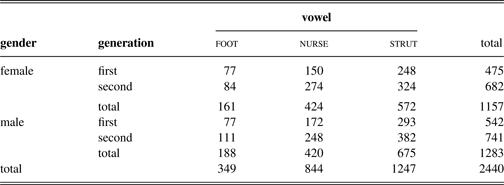
The interviews were recorded with a Sony MZ-RH1 Portable MD recorder and a Sony ECM-R100 Electret Condenser Microphone in 2007 and with a H2 Zoom Recorder in 2009. Roughly half an hour of conversation was analyzed for most speakers, starting after the first ten minutes of the interview (which is standard practice in variationist sociolinguistics). Token extraction was limited to monosyllabic items (content words: put, bus) and, in bi- or multisyllabic words, syllables with primary stress (study, dirty). Tokens were selected on a word-by-word basis because there was the possibility that stress placement varied across generations. Due to the low frequency of the foot vowel, the number of tokens per lexical item was not restricted (but in the statistical analysis lexical imbalances were controlled for by the inclusion of lexical item as a random factor; see the following section). Furthermore, based on the assumption that the final dataset of 2,440 tokens would be large enough to permit comparability across different vowel classes (cf. Table 1), prenasal tokens and very short vowels were analyzed separately, because both can have effects on possible mergers (liquids were not included), but we found no effects (see n. 4 below).
Number of foot, nurse, and strut tokens by gender and generation.

Tokens were identified and manually labeled using Praat (Boersma & Weenink Reference Boersma and Weenink2010). The frequencies of the first and second formants (F1 and F2, representing vowel height and the front-back dimension, respectively) were extracted automatically with a script written by Volker Dellwo (2011), which estimated formant values via Linear Predictive Coding (LPC) analysis (Thomas Reference Thomas2011:41–42). The script computed, for each vowel token, the mean F1 and F2 frequency for the middle 50% of the vowel duration, the measures used for subsequent analysis.
In order to allow for a direct comparison between female and male speakers, the formant values in Hz were then normalized with Lobanov's (Reference Lobanov1971) z-score procedure. Lobanov's (Reference Lobanov1971) method was adopted as the normalization procedure best suited to sociophonetic purposes (Adank, Smits, & van Hout Reference Adank, Smits and van Hout2004; Fabricius, Watt, & Johnson Reference Fabricius, Watt; and Johnson2009; Flynn Reference Flynn2011). This involves computing the mean and standard deviation for a particular formant Fn across all vowels of a speaker (Thomas & Kendall Reference Thomas and Kendall2011). The raw Fn frequencies produced by that speaker are then normalized by subtracting the mean and dividing the difference by the standard deviation (full discussion in Rathore-Nigsch Reference Rathore-Nigsch2015). Because additional vowels were necessary for the Lobanov (Reference Lobanov1971) method to work effectively, the formant values of 1,705 fleece, trap, and start tokens were extracted with the procedure described above. The enlarged dataset was then normalized in R (version 2.14.1, R Development Core Team 2011), using the norm.lobanov function from the vowels package (Kendall & Thomas Reference Kendall and Thomas2010).
Statistical analysis
The differences in the production of foot, strut, and nurse across generations and speaker sex were tested in a series of linear mixed-effects regression analyses. Mixed-effects models are a relatively recent development in statistics (Baayen Reference Baayen2008; K. Johnson Reference Johnson2008; D. Johnson Reference Johnson2009). Unlike ordinary regression analysis, this type of statistical technique does not require independence of observations. Its assumptions therefore provide a better match to datasets consisting of natural language samples in which tokens tend to be grouped by speaker and lexical item (see D. Johnson Reference Johnson2009 for a full discussion). The distinction between two types of predictors, fixed effects and random effects, enables mixed-effects models to evaluate the influence of independent variables such as gender, social class, or phonological environment (the fixed effects), while simultaneously taking into account variation across individual speakers and lexical items (the random effects).
The statistical analysis was carried out in R, using the lmer function from the lme4 package (Bates, Maechler, & Bolker Reference Bates, Martin and Bolker2011). Two linear mixed-effects models were fitted to the data, which estimated the influence of three fixed effects—vowel, generation, and speaker sex—and their interactions on Lobanov-normalized F1 and Lobanov-normalized F2, respectively. Speaker and lexical item were included in each model to control for imbalances in the dataset as well as inter-speaker and inter-word variability. If an interaction was found to be significant, the dataset was divided into subsamples and parallel follow-up analyses were carried out on each subset to investigate the origin of the interaction (Baayen Reference Baayen2008:166; Gries Reference Gries2009:269–70). Following D. Johnson (Reference Johnson2009), the overall significance of fixed effects and their interactions was evaluated via likelihood ratio chi-squared tests. These involved refitting the model without the predictor in question and then testing the difference between the deviances of the more complex and the new, simpler model against a chi-squared distribution. P-values for individual factor levels were obtained via Markov chain Monte Carlo (MCMC) sampling (see Baayen Reference Baayen2008:247–48), using the pvals.fnc (p-values) function from the languageR package (Baayen Reference Baayen2011). Lastly, in the follow-up analyses involving multiple comparisons, p-values were adjusted with the Bonferroni correction in order to reduce the risk of committing Type I errors (Baayen Reference Baayen2008:105–6, Gries Reference Gries2009:241–43).
Results
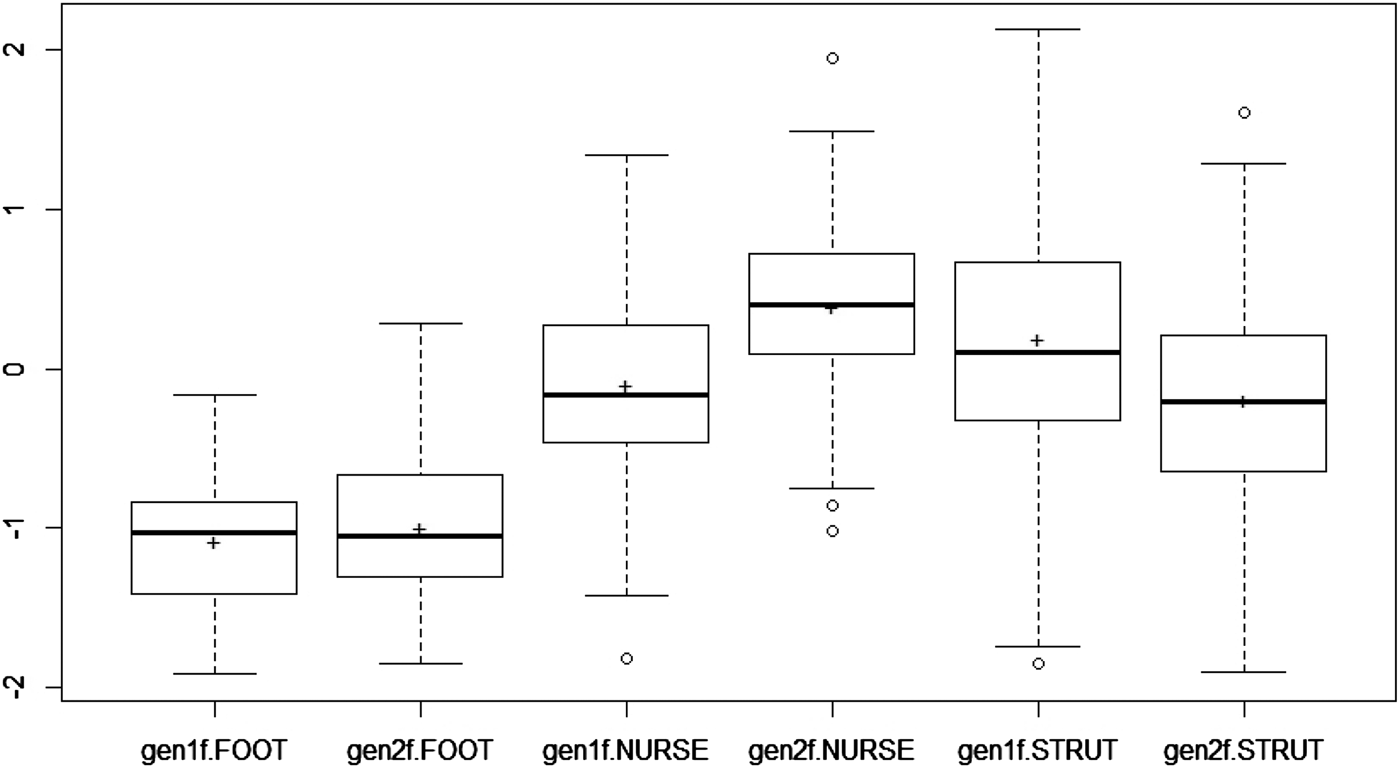
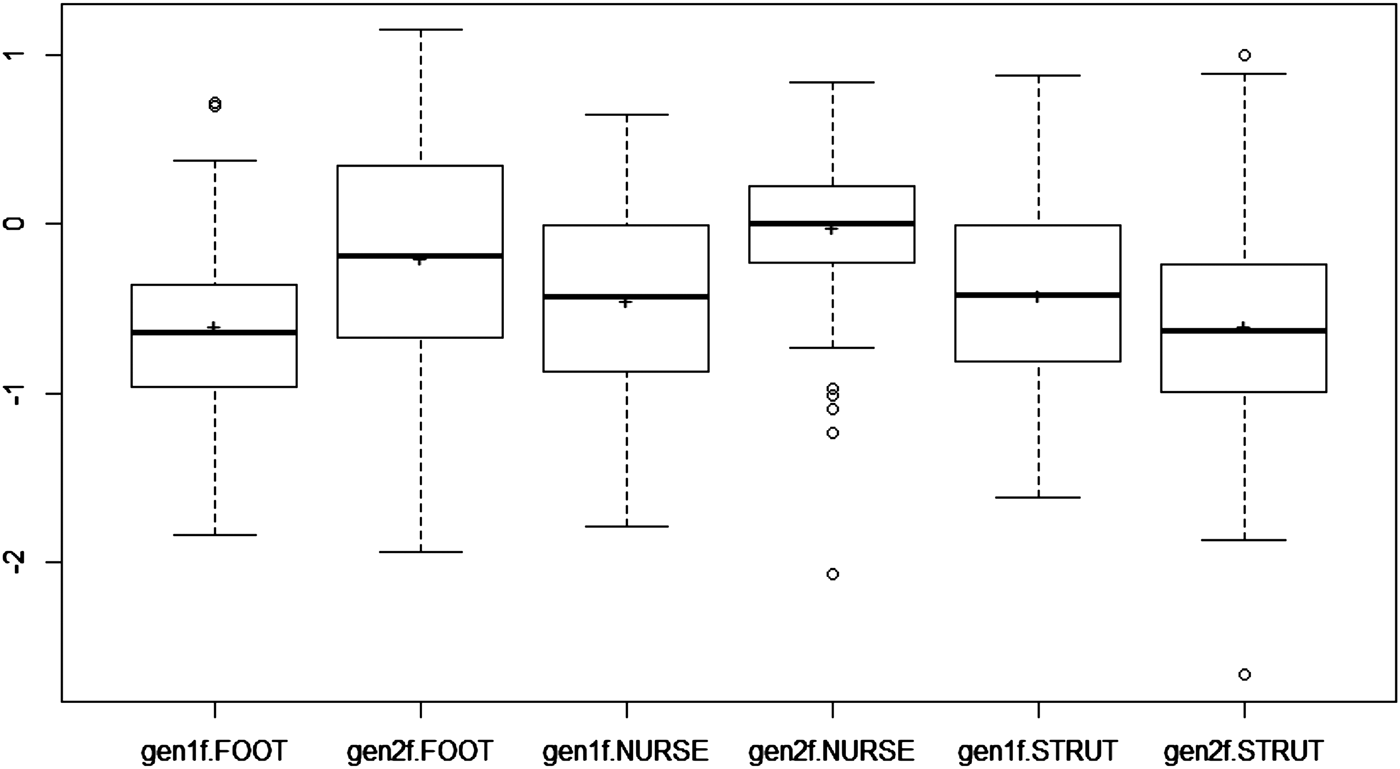
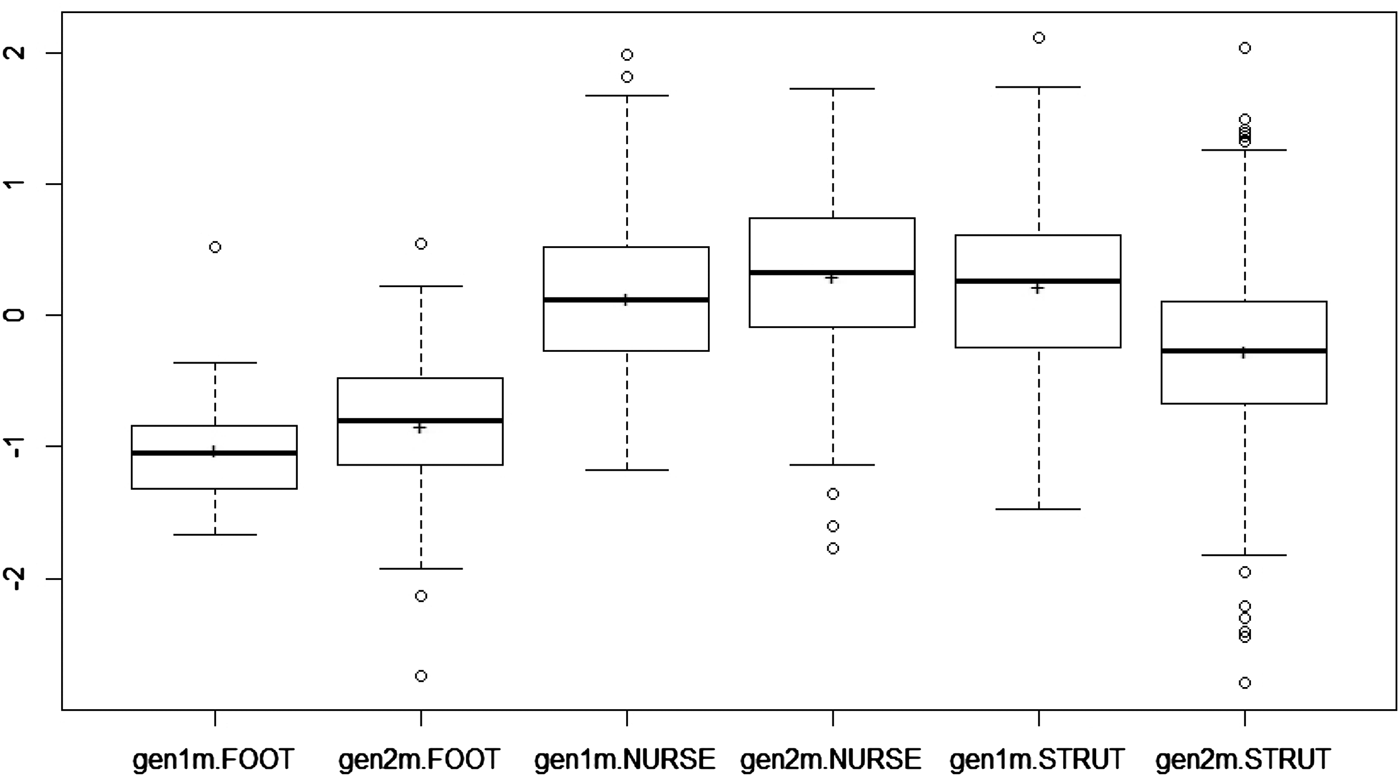
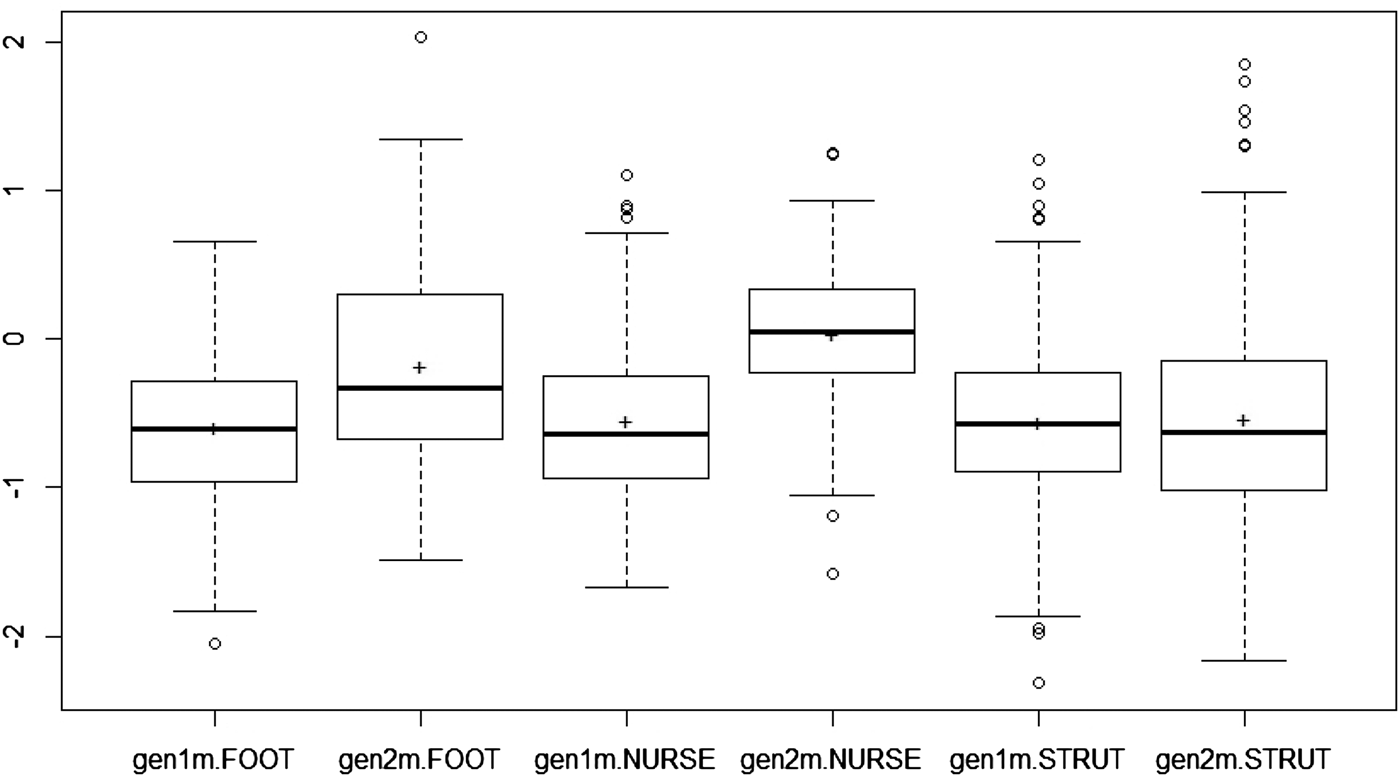
As mentioned earlier, the dataset used for the analysis included 2,440 tokens of foot, strut, and nurse. The boxplots in Figures 1 to 4 illustrate the distribution of the Lobanov-normalized F1 and F2 values of the three vowels for each speaker group (hereafter: Gen1f = first-generation females, Gen2f = second-generation females, Gen1 m = first-generation males, Gen2 m = second-generation males). The four graphs indicate that the distribution of formant values within the subsamples roughly follows a normal distribution, which is one of the main prerequisites of (mixed-effects) linear regression analysis (Gries 2008:231).
Boxplot of the F1 values of foot, strut, and nurse for first- and second-generation female speakers (Lobanov-normalized).
Boxplot of the F2 values of foot, strut, and nurse for first- and second-generation female speakers (Lobanov-normalized).
Boxplot of the F1 values of foot, strut, and nurse for first- and second-generation male speakers (Lobanov-normalized).
Boxplot of the F2 values of foot, strut, and nurse for first- and second-generation male speakers (Lobanov-normalized).
We notice substantial variability in the data. The interquartile ranges (the boxes), which encompass the central 50% of formant frequencies, are rather large (spanning, on average, around 100 Hz for F1 and 300 Hz for F2 in the nonnormalized data) and thus point to considerable in-group heterogeneity (Gries Reference Gries2009:114). At the same time, the differences concerning means and medians as well as the relatively small amount of overlap between the interquartile ranges indicate cross-generational differences in the phonetic quality of foot, strut, and nurse. For instance, the F1 values of strut differ markedly across generations for both male and female speakers (Figures 1 and 3), as do the F2 values of foot and nurse (Figures 2 and 4). F1 and F2 frequencies of strut and nurse tend to be very similar for the first generation but not for the second generation (Figures 1 to 4).
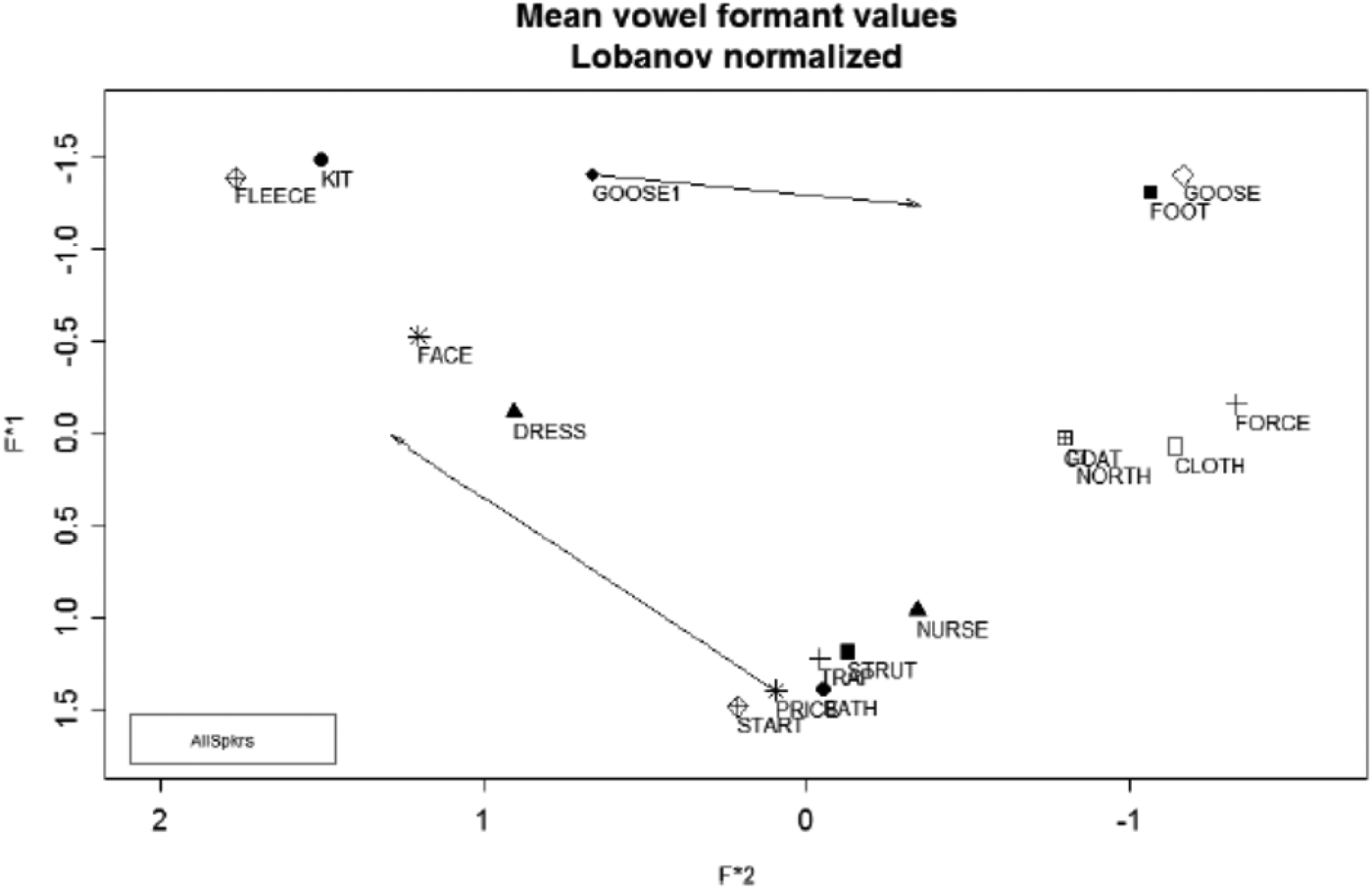
A comparison of the F1-F2 plots in Figures 5 and 6, which show the normalized mean values of foot, strut, and nurse (as well as their positions vis-à-vis fleece, start, and trap) for first- and second-generation speakers, respectively, confirms these differences. The patterns are remarkably similar across speaker sex. For Gen1, foot is much closer than strut and nurse, which are located next to each other in the central region of the vowel space (Figure 5). For Gen2, in contrast, the three vowels display a triangular configuration: foot is highest, nurse is lowest, and strut is intermediate in terms of height (and somewhat more back; see Figure 6). The plots strongly suggest that, while the phonetic quality of foot is different from that of strut and nurse for both generations, strut and nurse are separate phonemes for the second generation but qualitatively much less clearly distinct for the first. Lastly, the graphs also indicate that the quality of each vowel changes across generations: whereas Gen2 strut is closer than Gen1 strut across speaker sexes, Gen2 foot and Gen2 nurse are more front than their Gen1 counterparts. Furthermore, for female speakers, Gen2 nurse is noticeably more open than the corresponding Gen1 vowel.
Mean F1 and F2 values of foot, strut, and nurse for first-generation female and male speakers (Lobanov-normalized). fleece, trap, and start are shown as reference points.
Mean F1 and F2 values of foot, strut, and nurse for second-generation female and male speakers (Lobanov-normalized). fleece, trap, and start are shown as reference points.
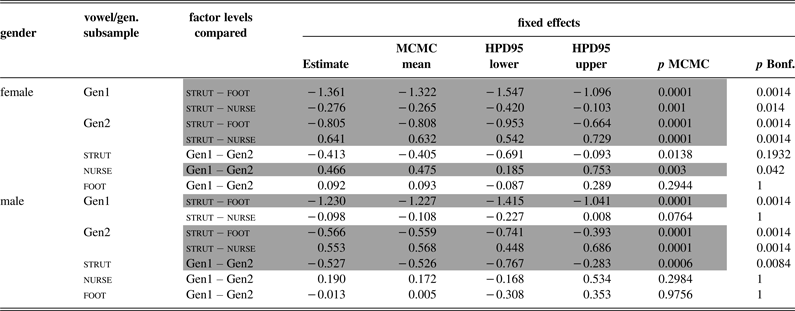
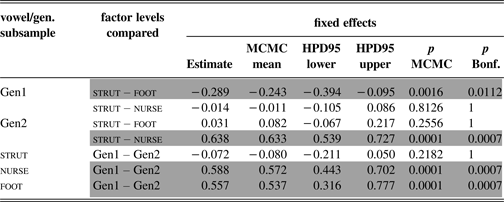
The main mixed-effects regression analyses revealed the presence of a significant three-way interaction between vowel, generation, and speaker sex for Lobanov-normalized F1 (Chisq = 7.467, df = 2, p = 0.024) and of a highly significant two-way interaction between vowel and generation for Lobanov-normalized F2 (Chisq = 231.022, df = 2, p < 0.001). A series of follow-up mixed-effects regression analyses was therefore carried out for both formants. Space limitations do not permit a full description here (see Rathore-Nigsch Reference Rathore-Nigsch2015 for further details), but a summary of the fixed-effect estimates is shown in Table 2 (for Lobanov-normalized F1) and Table 3 (for Lobanov-normalized F2).Footnote 2 In these tables, each row reports, for a particular subsample, the estimate of the difference in formant frequencies between two factor levels. For example, the first row in Table 2 indicates that for first-generation females, foot (the second factor level listed) has considerably lower F1 values (−1.361) than strut (the first factor level listed). It is, in other words, much higher than strut, a difference that is evaluated as highly significant (p MCMC = 0.0001) and remains very significant after a Type I error correction (Bonferroni-adjusted p = 0.0014).
Summary of the fixed-effect estimates from the follow-up analyses for Lobanov-normalized F1, investigating the effect of vowel and generation for each gender separately (significant differences are highlighted in grey).
Summary of the fixed-effect estimates from the follow-up analyses for Lobanov-normalized F2, examining the effect of vowel and generation (significant differences are highlighted in grey).
Tables 2 and 3 confirm that all four speaker groups have a qualitatively distinct foot-strut pair: foot is significantly higher than strut across generations and speaker sex (Bonferroni-adjusted p = 0.0014). For first-generation speakers, the vowels are also significantly distinct on the front-back dimension (Bonferroni-adjusted p = 0.0112). The strut-nurse pair displays greater variation across groups. For the second generation, the vowels are clearly different phonemes in that nurse is significantly more front (Bonferroni-adjusted p = 0.0014) and lower than strut (Bonferroni-adjusted p = 0.0007). For first-generation male participants, neither the F1 nor the F2 difference is significant (Bonferroni-adjusted p = 1). First-generation females do not exhibit a significant difference on the front-back dimension either (Bonferroni-adjusted p = 1) but they differ from male speakers in that their nurse vowel is significantly higher than strut (Bonferroni-adjusted p = 0.014). This suggests that, while the male group lacks a qualitative contrast between strut and nurse, the case of the female group is less clear-cut.Footnote 3 What seems more relevant is that, for both first-generation female and male speakers, the difference between the phonetic qualities of strut and nurse is very small, particularly when compared to foot, fleece, start, and trap (Figure 5).
Regarding the quality changes of individual vowels across generations, the regression analyses confirm that Gen2 strut is significantly higher than Gen1 strut for male speakers, with Bonferroni-adjusted p = 0.0084 (but the difference does not reach statistical significance for the female groups; Bonferroni-adjusted p = 0.1932). Furthermore, both the foot and nurse vowels were significantly more front for the second generation than the first generation (Bonferroni-adjusted p = 0.0007 in both cases) and, for the female groups, Gen2 nurse is also significantly lower than Gen1 nurse (Bonferroni-adjusted p = 0.042).
Discussion
Parallels to IndE, EAfE, and EMidE
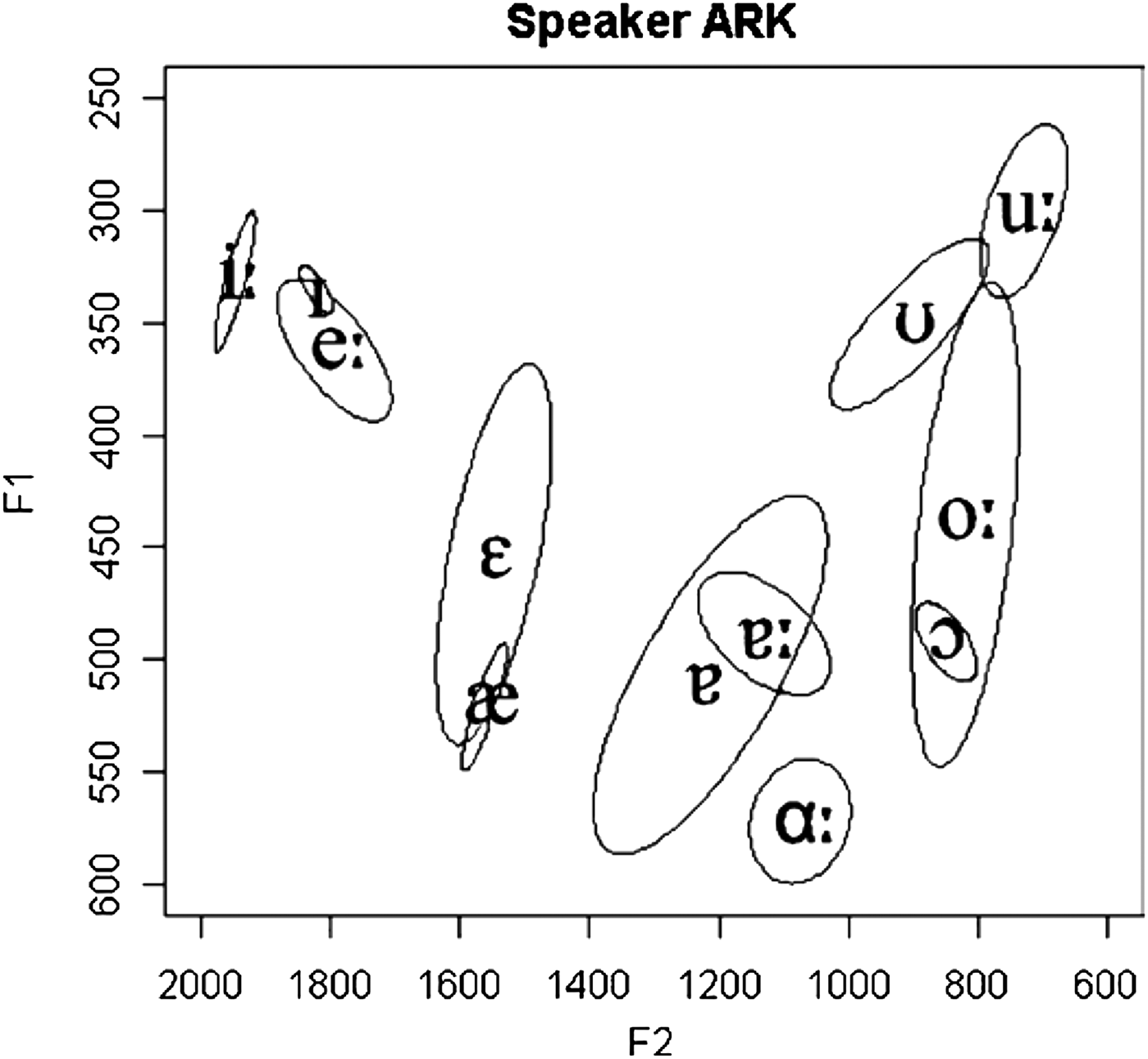
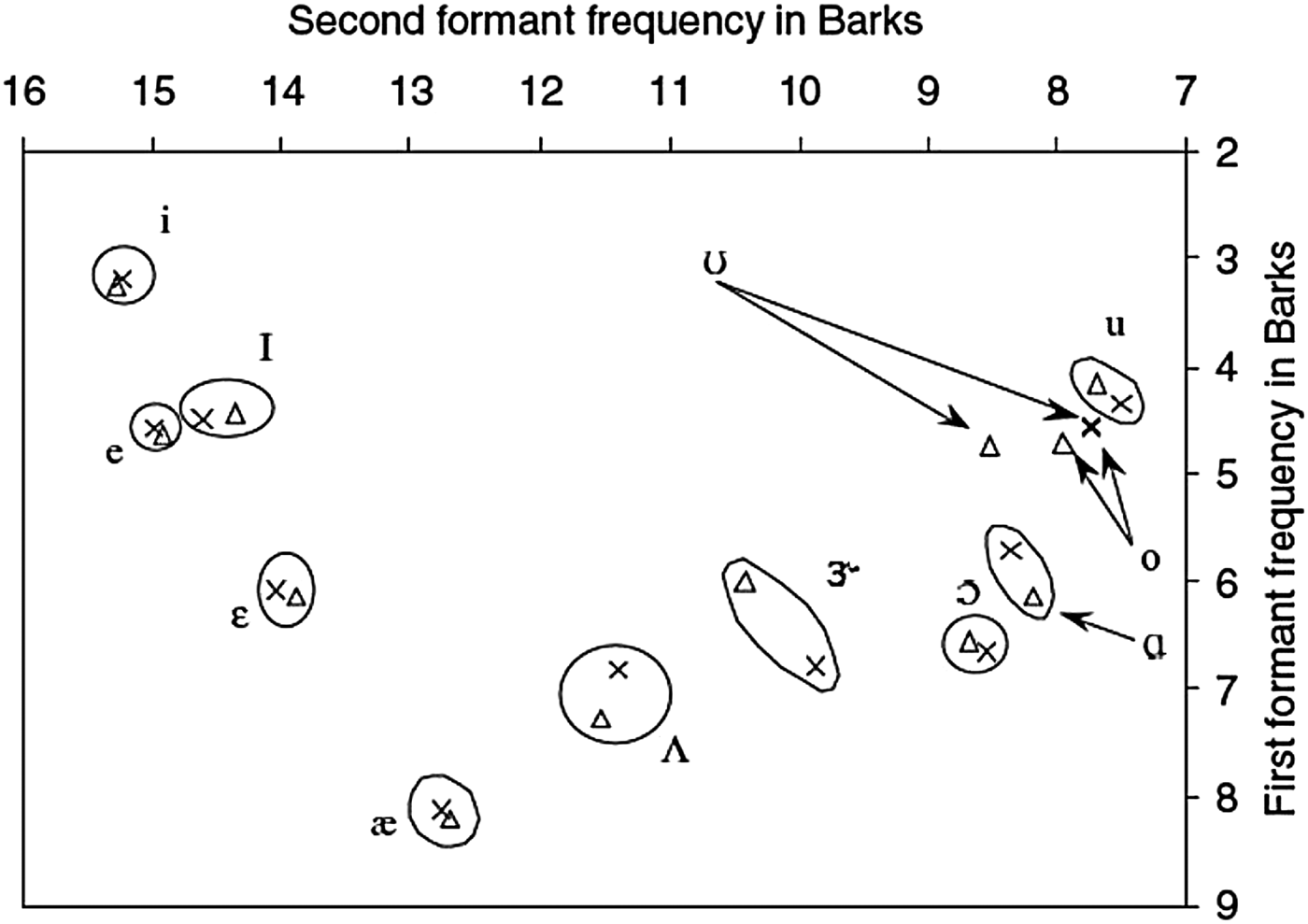
The first research question was whether the foot, strut, and nurse realizations of first generation speakers align with IndE, EAfE, or EMidE or whether they are a mixture of the varieties. Our analysis provides strong evidence of affinity with the first input variety, IndE: as discussed earlier, IndE has a phonemic contrast between foot and strut but is commonly claimed to have no qualitative distinction between strut and nurse, which predominantly have central qualities. Since acoustic studies point to variability in the phonemic status and phonetic realization of the three vowels across speakers from different regional-linguistic backgrounds, two plots from previous investigations of IndE are used for reference here (with the caveat that different scales or normalization methods are likely to have an impact on measurement; but see below). Figure 7 shows the un-normalized monophthongal vowel space of a male speaker of IndE from a Hindi L1 background (Speaker ARK, from Maxwell & Fletcher Reference Maxwell and Fletcher2009:60). Given the predominance of Gujarati L1 speakers in the present study, Figure 8 reproduces the Bark-transformed group means of four female speakers of Gujarati English (from Wiltshire & Harnsberger Reference Wiltshire and Harnsberger2006:98; note that the plot also shows the group means of four female speakers of Tamil English, who are not, however, relevant to our study).
F1-F2 ellipse plot of the monophthongal vowels produced by a Hindi L1 speaker of Indian English (in Hertz; from Maxwell & Fletcher Reference Maxwell and Fletcher2009:60). The ellipses represent 90% of the tokens that were measured and the IPA symbols the centroids of the respective vowels.
Mean F1 and F2 values of Gujarati English and Tamil English monophthongs, represented by Xs and triangles, respectively (in Bark units; from Wiltshire & Harnsberger Reference Wiltshire and Harnsberger2006:98).
Like the first generation in our study, the Hindi L1 speaker in Figure 7 produces separate foot and strut vowels but has no clear qualitative distinction between strut and nurse. The three vowels are realized as [ʊ], [ɐ], and [ɐː], respectively. A comparison with Figure 5, with fleece and start as reference points, reveals that the positions of foot, strut, and nurse are similar to those of the three Gen1 vowels. In contrast, Figure 8 suggests that the Gujarati English informants analyzed by Wiltshire & Harnsberger (Reference Wiltshire and Harnsberger2006) have a greater distinction between strut and nurse than our speakers, which also appears to be the case for first-generation Gujarati migrants in London (cf. the plot in Evans et al. Reference Evans, Mistry and Moreiras2007:1743).
The difference may at least partly be due to methodological decisions (use of a word-list in Wiltshire & Harnsberger Reference Wiltshire and Harnsberger2006 and Evans et al. Reference Evans, Mistry and Moreiras2007, spontaneous speech data in our study). As is known, vowel tokens in citation-form speech show a better separation in terms of quality (Thomas Reference Thomas2011:138–39).Footnote 4 Nevertheless, the phonetic qualities of strut and nurse produced by the Gujarati subjects of Wiltshire & Harnsberger (Reference Wiltshire and Harnsberger2006) and Evans et al. (Reference Evans, Mistry and Moreiras2007) are remarkably similar to those of Gen1 strut and nurse reported here: although the latter are somewhat higher, the two vowels are located in the central region of the vowel space for all groups.
Like IndE, EAfE has a phonemic distinction between foot and strut but lacks a contrast between strut and nurse. Despite this apparent similarity, the Gen1 vowels diverge from their EAfE counterparts in important ways. As noted EAfE foot has merged with goose (/u:/). A comparison of Figure 5 and Figure 9, which shows the Lobanov-normalized group means of nine male speakers of Black Kenyan English (from Hoffmann Reference Hoffmann2011:162), suggests that foot is more peripheral for the Kenyan group than for the first generation. The differences are even more striking for the strut-nurse pair. There is no evidence among Gen1 participants of characteristically EAfE front qualities such as [a] and [ε] and, although the informants of Hoffmann's (Reference Hoffmann2011) study used more centralized variants, Figure 9 indicates that they are much lower than the Gen1 vowels. Moreover, Gen1 strut and nurse are clearly distinct from trap and start, whereas in EAfE the four vowels have merged. This is also evident from Figure 9, with the exception that for Hoffmann's (Reference Hoffmann2011) subjects, nurse is slightly more back than the other vowels.
Mean F1 and F2 values of Black Kenyan English vowels (Lobanov-normalized; from Hoffmann Reference Hoffmann2011:162).
Regarding the third input variety, the first-generation speakers have distinct qualities for foot and strut and show no trace of adopting one of the most diagnostic features of broad EMidE, that is, the unsplit foot-strut vowel. The Gen1 vowel configuration also differs from the intermediate system with a fudged strut vowel that is characteristic of more educated forms of EMidE. Such a system is illustrated in Figure 10, which reproduces the monophthongal vowels of a subset of speakers of Evans & Iverson's (Reference Evans and Iverson2007) Ashby study.Footnote 5 The graph shows the Lobanov-normalized mean values of those participants (eight female and three male speakers) whose accents were rated as more southern-like at the end of the study and who can therefore be considered representative of a more educated variety of EMidE (Evans & Iverson Reference Evans and Iverson2007:3816–18; Evans 2011/2013, p.c.). In the following, this variety is referred to as hybrid Leicestershire-SSBE (hybrid Leics-SSBE).
Mean F1 and F2 values for female and male speakers of hybrid Leicestershire-SSBE (Lobanov-normalized; from Evans & Iverson Reference Evans and Iverson2007; the raw data was kindly provided by Evans, p.c. 2011/2013).
Figure 10 shows that hybrid Leics-SSBE speakers produce a centralized, fudged strut vowel that differs qualitatively from foot. Evans & Iverson's (Reference Evans and Iverson2007) Ashby subjects and our first-generation participants thus resemble each other in having a foot-strut contrast but the groups differ in that strut is higher and foot lower for the former. Moreover, Figure 10 illustrates a major difference between the Gen1 vowels and EMidE: unlike the first generation, hybrid Leics-SSBE speakers have separate phonemes for strut and nurse. Their nurse vowel is much more front than their strut vowel, and it is also much more front than Gen1 nurse.
To summarize, Gen1 East African Asians in Leicester have retained IndE patterns. Their production of the three vowels differs considerably from EMidE patterns, which is noteworthy, given that they have now lived in Britain for more than forty years (this is also reported in other settings involving South Asian immigrants in Great Britain; cf. Sharma & Sankaran Reference Sharma and Sankaran2011; Stuart-Smith et al. Reference Stuart-Smith, Timmins, Alam, Gregersen, Parrott and Quist2011).
Generational change
The second question was whether and how the production of foot, strut, and nurse changes across generations. The analysis in the Results section demonstrated that, like their parents' generation, Gen2 speakers exhibit a qualitative contrast between foot and strut (Figure 6). This indicates that they have not adopted the unsplit foot-strut vowel characteristic of broad EMidE either (note that, as one of the reviewers pointed out, though Gen2 speakers have a split that is not typical of broad EMidE, their strut vowel is central and thus not really typical of the vowel found in southern English accents). At the same time, the analysis also revealed considerable cross-generational differences. Gen2 foot was found to be considerably fronter than Gen1 foot (Figure 5), and an examination of Figure 10 indicates that the phonetic realization of the Gen2 vowel is closer to the quality of hybrid Leics-SSBE foot. Fronting of hood (foot) among second-generation speakers was also reported for Gujarati migrants in London (Evans et al. Reference Evans, Mistry and Moreiras2007).
The most striking differences emerged for strut and nurse. The Gen2 participants have acquired a qualitative contrast in the form of a strut-nurse split most likely through exposure to the local dialect, EMidE. As a comparison of Figures 6 and 10 shows, Gen2 participants indeed resemble the Ashby informants of Evans & Iverson's (Reference Evans and Iverson2007) study in producing distinct qualities for strut and nurse. Moreover, their nurse vowel is located roughly in the same region of the vowel space as hybrid Leics-SSBE nurse, and their strut vowel has about the same height as hybrid Leics-SSBE strut. Second-generation speakers have thus not adopted the patterns characteristic of their parents' generation, accommodating to an educated variety of EMidE instead.
Identity and a shifting sense of belonging
The third question was how the linguistic patterns shown by our participants are related to identity formation and East African Asians' sense of sociocultural belonging. During the interviews, several first-generation informants reported that they had gone back to East Africa to visit their previous homes, and narratives about East Africa were extremely positive. Most of the speakers had fond memories of their childhood and youth in Uganda and Kenya. Many claimed that the South Asian community in East Africa was very close-knit, with Hindus, Muslims, and Sikhs interacting freely and peacefully, even attending each other's festivals, marriages, and funerals. Some (perhaps idealistically) stated that this sense of bonding had translated into a distinct sense of identity among East African Asians in Leicester. In the words of one participant,
I think our heart is still in Africa. I mean I would be true in saying that I would not classify myself as Indian well because I've got Indian heritage but I am more of an African than an Indian because that's where you're born and you were brought up and your affinity is there.
Many felt that South Asians from East Africa were culturally different than direct migrants from the subcontinent. There were also anecdotes about East African Asians using Kiswahili with each other to bring back memories of the ‘good old times’ (or if they wanted to communicate with their spouse without being understood by their children). Personal narratives and reminiscences from the sociolinguistic interviews thus indicate that the double diaspora situation experienced by East African Asians in Leicester had a profound impact on the first generation's self-perception, with most informants showing strong affiliation with East Africa and a clear sense of cultural and linguistic distinctiveness vis-à-vis direct migrants from South Asia (see Rathore-Nigsch Reference Rathore-Nigsch, Hundt and Sharma2014, Reference Rathore-Nigsch2015 for a full discussion).
This raises the question why they do not align sociolinguistically with EAfE in the first place, maintaining IndE patterns instead (for foot, strut, and nurse at least). We believe that the community's migration history is essential to explain why there was no accommodation to EAfE. Both research on the history of East African Asians and the interviews conducted for the present study indicate that South Asians tended to live in ethnically segregated areas and at all times displayed a strong orientation towards their own communities. Intermarriages were rare and contacts with the African population tended to be limited, often in the form of dealings with customers or interaction with African employees. As knowledge of English was not widespread in the African population at the time (Schmied Reference Schmied and Mesthrie2008:153), interaction with Africans mostly took place in Kiswahili. Furthermore, during the colonial period there was continuous input of English from the Indian subcontinent through incoming migrants. South Asians who grew up in East Africa generally acquired English in school contexts and, crucially, the transmission of the language principally took place via teachers imported from South Asia. It was also quite common for migrants to return to their original homeland for further education. These factors diminished contact with, and influence from, EAfE, and strongly favored the maintenance of IndE. It is quite remarkable that the community developed a strong sense of being at home without accommodating to the local East African varieties.
The distinct sense of identity felt by the first generation largely faded away in the subsequent generation. Even though some second-generation participants had been to East Africa to experience where their parents had grown up, the great majority stated that they had no strong emotional connections with East Africa. In most cases, their sense of identity seemed to revolve principally around the British and Asian components of their heritage. As one speaker said, “England is my home”, only to emphasize that “so I am British but I just have this great Indian heritage as well”. The sense of belonging seems to have shifted. Though weaker than those of the first generation, second-generation informants’ ties to India were generally stronger than those to East Africa, and many had been to the subcontinent more than once to visit relatives or travel. Most had positive attitudes to Leicester and reported that they liked living in the city very much. In terms of identity, they almost invariably described themselves as ‘British Asian’, stating that they considered both cultures as their heritage. Their affiliation with a more general British Asian identity is in line with Marett's (Reference Marett1993) investigation of the situation of Ugandan Asians in Leicester twenty years after the expulsion. Marett reports that ‘[s]ignificantly there is now a strong sense among the Ugandan Asians of “belonging to Leicester”’ (Marett Reference Marett1993:256).
As discussed earlier, retention (perhaps reallocation) of L1-influenced traits among locally born members of diasporic communities is well attested in British Asian English. The question here is thus why Gen2 speakers diverge from this widely reported pattern, showing adoption of educated EMidE variants of foot, strut, and nurse. We believe that socioeconomic status may partly account for this. As we saw above, the East African Asian community in Britain is characterized by considerable upward social mobility. The university-level education and middle-class occupations of most Gen2 informants clearly distinguish them from the working-class communities that have been the focus of research on other British Asians (e.g. Heselwood & McChrystal Reference Heselwood and McChrystal2000; Khan Reference Khan2006; Fox Reference Fox2015; Cheshire et al. Reference Cheshire, Kerswill, Fox and Torgersen2011). It is noteworthy, in this regard at least, that our results are in line with the findings reported in Evans et al. (Reference Evans, Mistry and Moreiras2007), where second-generation subjects also showed accommodation to the local (prestige) variety of English. Their London Gujarati informants resemble our Gen2 participants not only in terms of regional-linguistic background but also in terms of socioeconomic status; according to Evans and colleagues (Reference Evans, Mistry and Moreiras2007:1744), their subjects' social mobility accounts for their tendency to approximate the SSBE vowel system.
Since retention of L1-derived features is also attested among second-generation South Asian speakers from lower middle-class backgrounds (Sharma & Sankaran Reference Sharma and Sankaran2011), socioeconomic status cannot be the sole explanation for the Gen2 speakers' adoption of educated EMidE patterns. The evidence from the sociolinguistic interviews reported above indicates that the accommodation we find for this group correlates with their sense of identity and belonging to the city, which leads us to argue that this was a key factor in the linguistic behavior of second-generation East African Asians in Leicester as well.
Conclusion
This study explored patterns of dialect variation and change among East African Asians in Leicester. The acoustic analysis of cross-generational variation in the production of the foot, strut, and nurse vowels showed that the first generation's use of these variables retained Indian English features, whereas the second generation accommodated to (educated) East Midlands English. The twice migrant community therefore by and large maintained their ancestral (Indian English) varieties. Factors such as knowledge of English and economic skills gave them an advantage in East Africa (particularly in the later immigration waves), and there is no evidence of accommodation to local EAfrE varieties. We have argued that this has a sociolinguistic explanation. Many members of the East African Asian community relied on English for everyday purposes and interacted with the British expatriate community, while their contacts with the African populations were limited. While we have little evidence of interaction between different varieties of IndE transplanted to East Africa (we cannot exclude dialect contact and mixing of features in the South Asian community), we feel confident in claiming that there was no (or if, very little) accommodation to BrE or EAfrE.
The situation changed after the community's forced ‘twice migration’ in the early 1970s. Upon moving to Leicester, Gen1 came to represent a ‘minority ethnic group of migrant origin which maintains sentimental… links with its land of origin’ (Esman Reference Esman, Hutchinson and Smith1996:316). Whereas the first generation maintained ancestral IndE features—yet paradoxically showed a sociocultural allegiance to Uganda and Kenya, where they had grown up yet not acquired local speech patterns—the first local born Gen2 group oriented themselves towards India while assimilating to local life, considering Leicester as their home (as exemplified in the quote above). They accommodated quickly and now align themselves with the local variety of BrE, a process of accommodation to local varieties reported in other studies on the British Asian diaspora as well (Evans et al. Reference Evans, Mistry and Moreiras2007 and McCarthy et al. Reference McCarthy, Evans and Mahon2011 report a strong tendency among Gen2 subjects to approximate Standard Southern British English). Further support comes from Rathore-Nigsch (Reference Rathore-Nigsch, Hundt and Sharma2014, Reference Rathore-Nigsch2015), whose quantitative analysis of postvocalic /r/ showed that Gen1 affiliated with IndE: rhoticity levels were variable (ranging from zero in one informant to 52% in others, with an average of 19.3% (106/550)), resembling what is reported in Sahgal & Agnihotri (Reference Sahgal and Agnihotri1988) and Wiltshire & Harnsberger (Reference Wiltshire and Harnsberger2006). She also found near-categorical use of taps and trills (96.2%, 102/106) rather than approximants, as in IndE. Gen2, however, was almost categorically nonrhotic and had only some vestigial cases of /r/ (0.7%, 5/700). Here, too, there was maintenance of an ancestral feature in Gen1 and rapid accommodation to local East Midland varieties in Gen2.
To conclude, our study provides evidence that there was both maintenance and loss of IndE patterns. IndE vowel realizations were maintained for about one generation and then quickly lost (the Gen2 adoption of educated EMidE features is not indicative of divergence trends as elsewhere, and there is no sign of ethnolectalization). Within a generation, the East African Asians in Leicester lost ancestral dialect features that the ancestral community had maintained for generations after migrating and relocating to another continent.