The Centers for Disease Control and Prevention (CDC) National Healthcare Safety Network (NHSN) introduced definitions for ventilator-associated events (VAEs) in 2013, replacing ventilator-associated pneumonia (VAP) surveillance definitions in adults. 1 VAE definitions were developed to broaden the range of adverse events detected by surveillance and to utilize objective criteria for surveillance (eg, increased ventilator settings) rather than subjective criteria (eg, radiographic interpretation). The broadest definition—ventilator-associated conditions (VAC)—is defined as worsening oxygenation while on mechanical ventilation after a period of improvement or stability, based on changes in daily minimum positive end-expiratory pressure (PEEP) or daily minimum fraction of inspired oxygen (FiO2). The VAE definition set includes subcriteria to identify the subset of VACs that might be infection-related ventilator-associated complications (IVAC) and possible ventilator-associated pneumonia (PVAP). IVAC criteria require an abnormal temperature or white blood cell (WBC) count as well as the initiation of new antimicrobials for at least 4 days within 2 days of the increase in PEEP or FiO2. PVAP requires detection of potentially pathogenic organisms via culture or other respiratory diagnostic tests.
We recently proposed an adaptation of the adult VAC surveillance definition to make it more applicable to neonates and pediatric patients.Reference Cocoros, Kleinman and Priebe 2 We defined pediatric VAC as an increase in daily minimum mean airway pressure (MAP) by ≥4 cm H2O or an increase in daily minimum FiO2 by ≥0.25 for 2 or more days following at least 2 days of stable or decreasing daily minimum MAP or FiO2. We found that patients diagnosed with pediatric VAC were at higher hazards for in-hospital mortality, prolonged hospitalization, and prolonged mechanical ventilation than matched patients without pediatric VAC.
We sought to determine whether the adult IVAC and PVAP criteria could be applied—or perhaps adapted—to neonatal and pediatric patients with VAC. We examined the prevalence of IVAC, assessed the utility of temperature and WBC criteria, and explored potential adaptations for neonatal and pediatric patients. We then evaluated whether patients with “pediatric VAC with antimicrobial use” (pediatric AVAC) and “pediatric PVAP” have worse outcomes than matched controls, and we assessed the overlap among cases identified using the pediatric AVAC and pediatric PVAP criteria versus those identified by the original NHSN pediatric VAP definition. 3
METHODS
Study Population
We included 6 US hospitals caring for neonates and/or pediatric patients: Beth Israel Deaconess Medical Center in Boston, Boston Children’s Hospital, Children’s Hospital of Philadelphia, Rush University Medical Center in Chicago, Primary Children’s Hospital in Salt Lake City, and Rainbow Babies and Children’s Hospital in Cleveland. Each hospital identified consecutive children aged ≤18 years who had been admitted to a pediatric intensive care unit (PICU), a cardiac intensive care unit (CICU), or a neonatal intensive care unit (NICU) and were ventilated for ≥1 day. The 6 hospitals accounted for 5 PICUs, 3 CICUs, and 5 NICUs. The study period varied by hospital, depending upon the availability of electronic data for ventilator parameters. February 5, 2008, was the earliest start date, and for all hospitals, the study period ended on June 30, 2013.
Pediatric VAC Events
Ventilation episodes were identified using NHSN criteria. 3 The dataset allowed for patients with multiple ventilation episodes during an intensive care unit (ICU) admission, multiple ICU admissions during a hospitalization, and multiple hospitalizations during the period of observation. We identified all pediatric VAC events in the study population using the proposed pediatric definition of an increase in minimum daily FiO2 of ≥0.25 or an increase in MAP of ≥4 cm H2O for at least 2 days after 2 or more days of stable or decreasing daily minimum FiO2 or MAP on the ventilator.Reference Cocoros, Kleinman and Priebe 2
For each episode of pediatric VAC, we identified up to 4 study patients without a pediatric VAC, without replacement (ie, once a patient without a VAC was matched to a patient with VAC, that patient was not available to be matched again). Patients were matched on the following factors: hospital, ICU type, age ±50% (note that if the pediatric VAC case was <8 days old, study patients were matched within 2 days of age), gestational age in weeks (for NICU patients only, study patients were matched within ±1 week of age), presence of congenital heart disease (based on International Classification of Disease, Ninth Revision, Clinical Modification [ICD-9-CM] diagnosis and procedure codes, excluding patent ductus arteriosus), and the number of ventilation days prior to VAC event plus 1 day (ie, control patients were required to be ventilated for at least as long as the matched case patient’s time until VAC onset plus 1 day; the extra day accounted for the VAC definition, which requires ≥2 days of higher ventilator settings).Reference Cocoros, Kleinman and Priebe 2
Identifying Potential Infection and Pneumonia Among Pediatric VAC Cases
We examined the frequency of pediatric VAC patients with abnormal temperatures and/or WBC counts using the adult IVAC thresholds: temperature <36°C or >38°C or WBC count ≤4,000 or ≥12,000 cells/mL on or after day 3 of ventilation, within 2 days before or after pediatric VAC onset. In addition, we explored alternative thresholds for temperature (<36°C or ≥38.5°C) and WBC count (≤4,000 or ≥15,000 cells/mL; ≤4,000 or ≥20,000 cells/mL). We then applied the IVAC criteria for new antimicrobial to the pediatric VAC cases alone, pediatric VAC cases with adult WBC count and temperature criteria (ie, the full adult IVAC definition), and pediatric VAC cases with our proposed alternative thresholds for abnormal WBC counts and temperatures. Finally, we applied the laboratory criteria component of the adult PVAP definition: a positive culture from a respiratory specimen, purulent respiratory secretions plus a positive culture from a respiratory specimen or pleural fluid culture, lung histopathology, or a diagnostic test for specific organisms. 1
We reviewed the interim and final results with a Pediatric VAC Advisory Board and with the CDC Neonatal and Pediatric VAE Working Group. The Advisory Board included representatives from the CDC, the Institute for Healthcare Improvement, the Pediatric Cardiac Intensive Care Society, the Society of Critical Care Medicine, and the Vermont Oxford Network. Members of the CDC Neonatal and Pediatric VAE Working Group represent national organizations and societies and provide the CDC with guidance regarding the implementation of VAE surveillance definitions for neonatal and pediatric populations.
Statistical Analyses
We calculated the number and proportion of pediatric VAC cases that met criteria for abnormal temperature or WBC count, new antimicrobial use, a positive diagnostic test for respiratory infection, and combinations of these criteria. We examined the frequency of new antimicrobial use and respiratory diagnostic testing among pediatric VAC cases by ICU type. Cox proportional hazard models with shared frailties for each matched set were used to estimate hazard ratios and 95% confidence intervals (CI) for hospital mortality and time to hospital discharge, ICU discharge, and extubation associated with each candidate definition. For the discharge and ventilation duration outcomes, we excluded all members of a matched set if 1 or more patients in the set died in the hospital.
To examine the overlap between pediatric VAE definitions and the original NHSN VAP definition, the 5 participating hospitals that reported pediatric VAP to NHSN during the study period were included. We compared pediatric VAEs with NHSN-defined VAP events by matching on hospital, individual study identifier, and timing of VAC and VAP onset (ie, within 1 week of each other). We calculated the proportion of pediatric VAE definitions that met the original NHSN VAP definition.
Analyses were performed using SAS version 9.3 (SAS Institute, Cary, NC). This study was approved by the Institutional Review Board of Harvard Pilgrim Health Care and by the review boards at each of the participating hospitals.
RESULTS
Candidate Criteria for Pediatric Infection–Related VAC and Pediatric PVAP
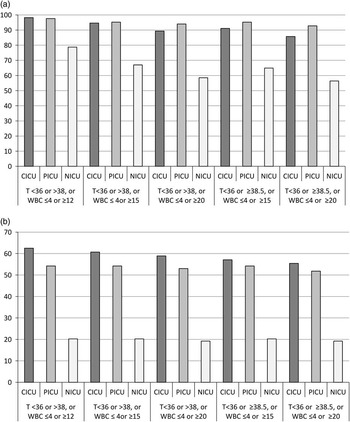
Our dataset comprised 9,025 patients with 10,377 hospital admissions and 12,167 mechanical ventilation episodes. Using the new pediatric VAC definition,Reference Cocoros, Kleinman and Priebe 2 we identified 233 events among 221 children (Table 1). In the PICU and CICU, 97.6% and 98.2% of pediatric VAC events, respectively, met adult IVAC criteria for abnormal temperature or WBC count (not considering new antimicrobial use) compared with 78.7% in the NICU. Stipulating stricter thresholds for abnormal temperatures or WBC counts had little effect on the proportion of pediatric VACs that met the criteria, particularly in the CICU and PICU (Figure 1A). The addition of new antimicrobial use to the abnormal temperature and WBC count criteria (ie, the full adult IVAC definition) substantially lowered the proportion of potentially infection-related pediatric VAC cases to 62.5% in the CICU, 54.2% in the PICU, and 20.2% in the NICU (Figure 1B). When we considered the new antimicrobial use criterion alone, results were nearly identical (62.5% in the CICU, 54.2% in the PICU, and 23.4% in the NICU). Very few pediatric VAC cases met potential pediatric PVAP criteria, defined as new antimicrobial use and a positive diagnostic test for respiratory infection (8.9% in the CICU, 13.3% in the PICU, and 4.3% in the NICU). Of the 20 pediatric PVAP cases, 17 met criterion 1 of the adult PVAP definition, 7 of those also met criterion 2, and 3 met criterion 3 (see Figure 3 for criterion definitions).
(A) Percentage of pediatric ventilator-associated condition (VAC) events meeting criteria related to infection, by intensive care unit (ICU) type. (B) Percentage of pediatric VAC events meeting criteria related to infection, including new antimicrobial use at the time of VAC onset, by ICU type; new antimicrobial use as defined for adult iVAC definition (CDC 2016). 1 T, temperature (°C); WBC, white blood cell count (thousands of cells/mL); CICU, cardiac ICU; PICU, pediatric ICU; NICU, neonatal ICU; iVAC, infection-related ventilator-associated complication.

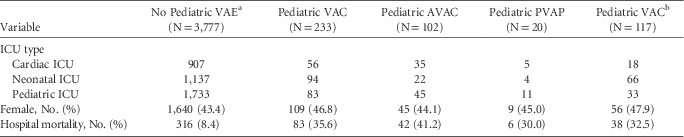
Characteristics and Outcomes of Pediatric Patients With and Without Pediatric Ventilator-Associated Events (VAE) in 6 Hospitals

NOTE. VAC, ventilator-associated condition; pediatric AVAC, pediatric VAC with antimicrobial use; pediatric PVAP, possible ventilator-associated pneumonia, defined as those pediatric VAC cases with antimicrobial use (AVAC) and a positive diagnostic test for respiratory infection; new antimicrobial use, respiratory diagnostic tests: see CDC 2016 for details 1 ; ICU, intensive care unit.
a From the original cohort. Pediatric VAE counts are on the episode-level (13 patients had >1 VAE). ICU type was based on location at the initiation of ventilation.
b No new antimicrobial use (Abx) and no positive respiratory diagnostic test (lab).
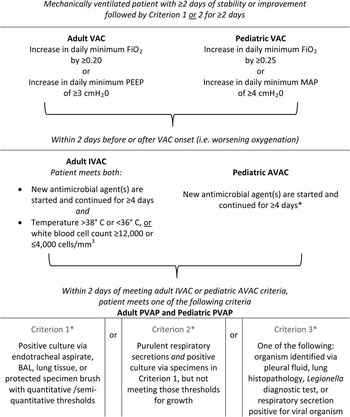
Because our findings suggested that temperature and WBC criteria were present in almost all pediatric VAC patients, our advisory board reasoned that there is little cause to burden hospitals with collecting these data elements. We therefore propose focusing on pediatric VAC with antimicrobial use, or “pediatric AVAC,” rather than IVAC. A positive diagnostic test for respiratory infection among pediatric AVAC cases would meet criteria for “pediatric PVAP.” Table 1 reports the number of patients with each of these VAE definitions. Figure 3 shows the similarities and differences between the adult and pediatric VAE surveillance definitions.
Outcomes Associated With Pediatric AVAC and Pediatric PVAP
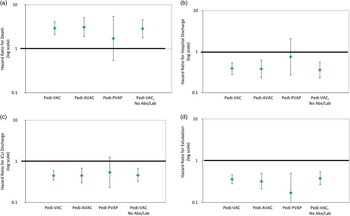
Neonatal and pediatric patients with VAC had higher mortality rates than patients without VAC (35.6% vs 8.4%; Table 1). Crude mortality was 41.2% among pediatric AVAC cases and 30.0% among pediatric PVAP cases. When patients with pediatric VAC, pediatric AVAC, pediatric PVAP, pediatric VAC without pediatric AVAC or pediatric PVAP criteria were compared with matched patients without pediatric VAC, hazards for hospital mortality, hospital discharge, ICU discharge, and extubation were consistent for all comparisons, suggesting that pediatric VACs with and without antibiotics were associated with similar, poor outcomes (Figure 2A–D). Point estimates were similar between ICU types (data not shown), but small numbers resulted in wide, overlapping confidence intervals.
Comparison to NHSN VAP
The 5 hospitals with applicable data identified 85 ventilation episodes that met the NHSN criteria for pediatric VAP during the study period. When matched against pediatric VAC events in these hospitals (n=218), 13 of 218 (5.9%) were identified as VAC and VAP, and 72 of 85 (84.7%) were not identified as VAC. Among patients with pediatric AVAC (ie, pediatric VAC and new antimicrobial use), 8 of 100 (8.0%) were also identified as having VAP, and 3 of 19 (15.8%) patients with pediatric PVAP (ie, pediatric VAC and both new antimicrobial use and a positive respiratory diagnostic test) were identified as having VAP.
DISCUSSION
We explored whether the framework used for surveillance of VAEs in adults—a framework that includes IVAC and PVAP—can be applied to neonatal and pediatric patient populations. Nearly all pediatric VAC cases were associated with abnormal temperature or WBC measurements in CICU and PICU settings, regardless of the thresholds used. This finding suggests that the temperature and WBC criteria are not useful for identifying the subset of pediatric patients that clinicians treat with antibiotics. Similar findings have been reported for adults.Reference Klompas, Magill and Robicsek 4 In NICUs, we observed lower proportions of pediatric VAC patients that met criteria for abnormal temperature or WBC count, which is likely due in part to thermoregulation interventions for premature neonates at risk for temperature instability, rather than improved ability to discriminate infectious causes of pediatric VAC. Given the potential burden of data collection for these elements and their limited utility, we do not recommend use of temperature or WBC count criteria for surveillance of infection-related VAC in children.
New antimicrobial use varied substantially by ICU type. NICUs prescribed antibiotics least frequently, with 23.4% of patients receiving a new antimicrobial in the context of worsening oxygenation on a ventilator. In contrast, 62.5% of CICU and 54.2% of PICU patients that met pediatric VAC criteria received new antimicrobials. Although we cannot assess the appropriateness of antimicrobial use for patients with pediatric VAC, the ability to describe variations in pediatric AVAC rates in different hospitals may provide useful feedback that can be used for internal quality improvement efforts. A relatively small proportion of pediatric AVAC patients had positive diagnostic tests for potentially pathogenic organisms (~9% met the pediatric PVAP definition), similar to findings in the adult population, in which relatively few VAC cases meet criteria for PVAP.Reference Klein Klouwenberg, van Mourik and Ong 5 – Reference Stevens, Silva and Gillis 8
We also investigated whether pediatric VAE subcategories (ie, pediatric VAC, pediatric AVAC, pediatric PVAP, and pediatric VAC without antimicrobial use or positive cultures) were associated with worse outcomes by comparing cases to matched controls without VAE. Overall, we found that the hazard for hospital mortality was high regardless of the definition used and that duration of hospitalization, ICU length of stay, and duration of ventilation were longer compared with matched controls, thus emphasizing the severity of pediatric VAC, pediatric AVAC, and pediatric PVAP. Our findings are consistent with other researchers who have recently assessed outcomes among cohorts of pediatric patients with the adult definitions of VAC, IVAC, and/or PVAP and found longer hospital and ICU length of stay and ventilation duration compared with those not meeting those definitions, as well as increased hospital mortality.Reference Cirulis, Hamele and Stockmann 9 , Reference Phongjitsiri, Coss-Bu and Kennedy 10
We found poor overlap between proposed pediatric VAE definitions and the current NHSN pediatric VAP surveillance definition, which is similar to findings in adults for whom low concordance between VAE definitions and the former adult VAP definition have been reported.Reference Klein Klouwenberg, van Mourik and Ong 5 The fact that >90% of pediatric AVAC patients did not meet NHSN’s current VAP surveillance criteria underscores the fact that traditional VAP surveillance only captures a tiny fraction of antibiotic use among ventilated patients with respiratory deterioration. Pediatric AVAC surveillance therefore has the potential to better monitor and compare the burden of antibiotic prescribing in pediatric patients with respiratory deterioration.
As previously noted, the data used for this study did not allow us to examine whether antimicrobials and/or diagnostic testing for respiratory infection were used appropriately within each institution and ICU type. Risk adjustment may be warranted to support meaningful comparisons of antimicrobial use in different institutions. Another important limitation is related to interpretation of results for different ICU types. As shown in Table 1, the numbers became small, especially when certain additional criteria were applied (eg, positive respiratory diagnostic testing), and we encourage caution when interpreting ICU type–specific results.
In conclusion, a substantial proportion of children with pediatric VAC receive prolonged courses of antibiotics, while only a minority met the adult PVAP definition. The proposed pediatric AVAC and pediatric PVAP measures provide an opportunity for understanding clinical practice and support efforts to optimize the use of antimicrobials in US hospitals, potentially as process indicators for quality of care related to antimicrobial use in ICUs.Reference Bouadma, Sonneville and Garrouste-Orgeas 7 Determining whether these metrics can be useful in pediatric national benchmarking and quality improvement programs will require further work to establish the generalizability of our findings to a broader set of hospitals, calculation of risk adjustment to account for differences in populations, and prospective evaluation to determine the responsiveness of pediatric AVAC and pediatric PVAP definitions to quality improvement initiatives.
Outcomes among patients with a pediatric ventilator-associated conditions (VAC) with and without select criteria, pediatric VAC with antimicrobial use (pediatric AVAC), and pediatric ventilator-associated pneumonia (pediatric PVAP) compared with matched patients without pediatric VAE. (A) Hospital mortality, (B) hospital length of stay (LOS), (C) ICU LOS, and (D) extubation; No Abx/Lab, no new antimicrobial use and no positive respiratory diagnostic test (CDC 2016) 1 ; VAE, ventilator-associated event; Pedi, pediatric. LOS and duration of ventilation analyses are among survivors only. Hazard ratios below 1.0 indicate longer duration of hospitalization (2B), ICU length of stay (2C), and duration of ventilation (2D).

National surveillance definitions for ventilator-associated events (VAE) in adults and proposed pediatric VAE surveillance definitions. VAC, ventilator-associated condition; FiO2, fraction of inspired oxygen; PEEP, positive end-expiratory pressure; MAP, mean airway pressure; IVAC, infection-related ventilator-associated complication; PVAP, possible ventilator-associated pneumonia; BAL, bronchoalveolar lavage; pediatric AVAC, pediatric VAC with antimicrobial use. Surveillance “day 1” is the day of intubation and initiation of mechanical ventilation; the earliest day VAE criteria can be fulfilled is day 4, and the earliest event date for VAE is day 3 of mechanical ventilation. *See the full CDC NHSN protocol for details related to each criterion (CDC, 2016 1 ).

ACKNOWLEDGMENTS
We are grateful to our colleagues who contributed to this study, including Irina Miroshnik, Anand Karadkhele, Felicia Scaggs-Huang, Janusz Pasierbski, Gail Potter-Bynoe, Anne McDonald, Sheila Levins, Meagan Dubosky, Valerie Kalinowski, Jean Silvestri and Sarah Klieger. We also wish to thank our Pediatric VAC Advisory Members, Susan Hocevar, Shelley Magill, Jeffrey Burns, Jeffrey Horbar and Roger Resar, for their guidance and input regarding the development of a neonatal and pediatric VAC definition.
Financial support: This research was funded by the Agency for Healthcare Research and Quality (AHRQ) R18 (grant no. 1R18HS021636) to Dr. Lee.
Potential conflicts of interest: Dr. Sandora has received payment for development of educational materials and other meeting expenses from the Society of Healthcare Epidemiology of America. Dr. Sammons has received grant funding from Merck. Dr. Priebe has received grants from the NIH and the Cystic Fibrosis Foundation. Dr. Logan has National Institutes of Health (NIH) funding through National Institute of Allergy and Infectious Diseases (NIAID; grant no. K08AI112506). Dr. Klompas received grant support from this study and support from the CDC for studies on VAE surveillance and prevention. All other authors have no conflicts of interest relevant to this article to disclose.